

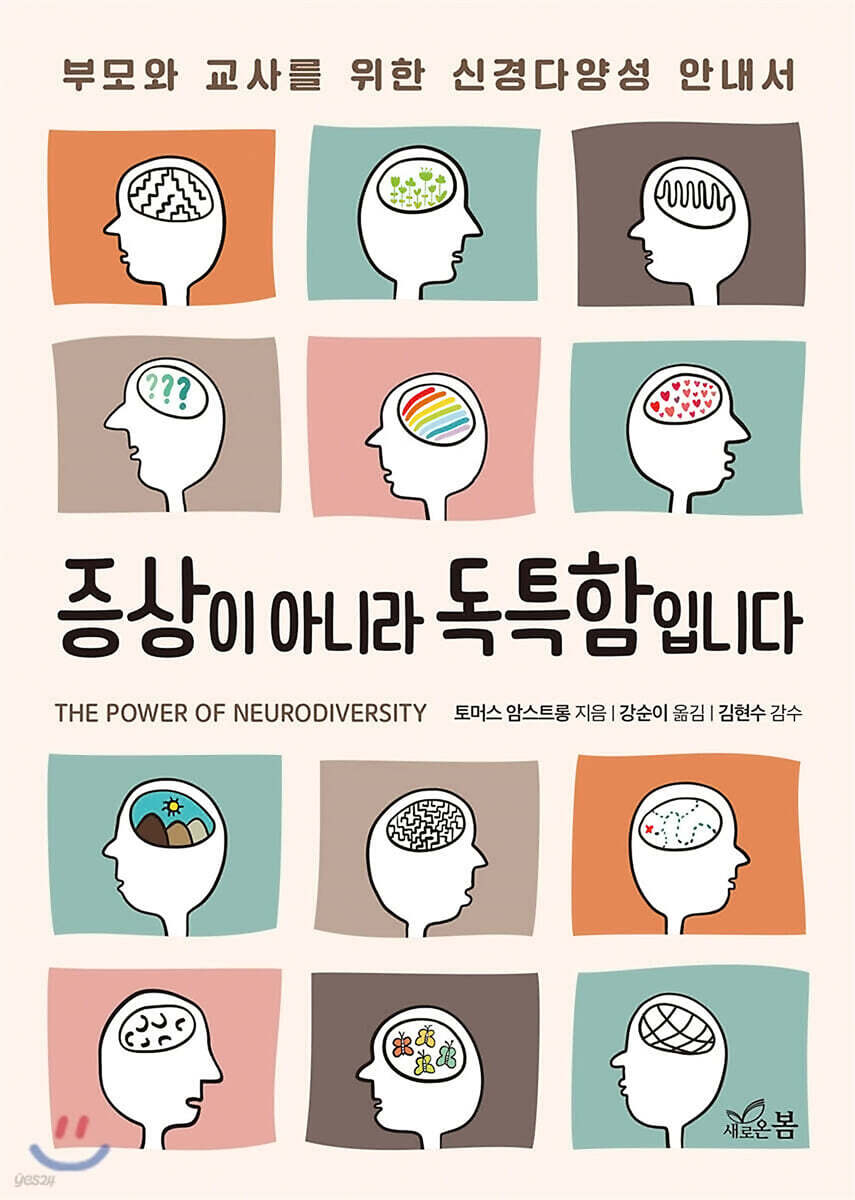
It's not a symptom, it's a uniqueness.
 |
Description
Book Introduction
Introduction to the 8 Diversity Principles
Harvard Business Review highlights 'neurodiversity' and its use.
A Guide for Parents and Teachers Working with Children with Dyslexia, ADHD, Autism, Depression, and More
The first book introducing 'neurodiversity' has been published.
The book is titled, “It’s Not a Symptom, It’s Uniqueness,” and its subtitle is “A Guide to Neurodiversity for Parents and Teachers.”
Neurodiversity is the concept that each human brain has natural variations in important mental functions such as sociality, learning, attention, and mood.
It contains the idea that each person's neurodevelopment is different and should be accepted and respected like other human differences.
It broadens awareness of human diversity, such as biodiversity and cultural diversity.
It was popularized in the late 1990s by Judy Singer, who has an autistic child, and journalist Harvey Bloom, who wrote about it in 'The Atlantic'.
'Neurodiversity' gained attention in 2017 when the Harvard Business Review covered it.
The Harvard Business Review specifically highlighted the strengths and talents of neurodiversity and how they can be leveraged in creative careers.
Among people with neurological conditions such as autism spectrum disorder and dyslexia, there are many talented individuals with exceptional talents in pattern recognition, memory, and mathematics, and many cutting-edge companies such as Microsoft, SAP, and Hewlett-Packard are utilizing neurodiverse talent.
Interestingly, Silicon Valley has a higher rate of people with high-functioning autism spectrum disorder than California as a whole.
The author presents eight principles of neurodiversity.
These eight principles of neurodiversity are the core messages that run through the entire book, guiding us on understanding and creating an environment (suitable place) for neurodiverse people.
Harvard Business Review highlights 'neurodiversity' and its use.
A Guide for Parents and Teachers Working with Children with Dyslexia, ADHD, Autism, Depression, and More
The first book introducing 'neurodiversity' has been published.
The book is titled, “It’s Not a Symptom, It’s Uniqueness,” and its subtitle is “A Guide to Neurodiversity for Parents and Teachers.”
Neurodiversity is the concept that each human brain has natural variations in important mental functions such as sociality, learning, attention, and mood.
It contains the idea that each person's neurodevelopment is different and should be accepted and respected like other human differences.
It broadens awareness of human diversity, such as biodiversity and cultural diversity.
It was popularized in the late 1990s by Judy Singer, who has an autistic child, and journalist Harvey Bloom, who wrote about it in 'The Atlantic'.
'Neurodiversity' gained attention in 2017 when the Harvard Business Review covered it.
The Harvard Business Review specifically highlighted the strengths and talents of neurodiversity and how they can be leveraged in creative careers.
Among people with neurological conditions such as autism spectrum disorder and dyslexia, there are many talented individuals with exceptional talents in pattern recognition, memory, and mathematics, and many cutting-edge companies such as Microsoft, SAP, and Hewlett-Packard are utilizing neurodiverse talent.
Interestingly, Silicon Valley has a higher rate of people with high-functioning autism spectrum disorder than California as a whole.
The author presents eight principles of neurodiversity.
These eight principles of neurodiversity are the core messages that run through the entire book, guiding us on understanding and creating an environment (suitable place) for neurodiverse people.
- You can preview some of the book's contents.
Preview
index
Recommendation
Recommendation and review
Entering
Chapter 1: Neurodiversity: A New Era of Understanding Has Arrived
Our Culture Stained by Disease | The True Meaning of Neurodiversity | The 8 Principles of Neurodiversity | The Power of Neurodiversity
Chapter 2: The Joy of an Active Brain
The Origins of ADHD | ADHD: An Evolutionary Leap for Humanity? | Creating 'Good Chemistry' in the ADHD Brain | The Gift of ADHD in Another Time, Another Place | ADHD and the Creative Connection | Building a Neighborhood for Children with ADHD: Keep It Stimulating! | Building a Neighborhood for Adults: Tap into Your Dynamic Brain | What About Medication?
Chapter 3: The Positivity of Living Autistically
Connecting Online | Autism: History and Causes | Working Within a System | Welcome to the World of Where's Waldo? | Discover and Develop Special Interests
Chapter 4: Different Types of Learners
A Look Inside the Brains of People with Dyslexia | The Talents of Dyslexics | People with Dyslexia: Pioneers of a New Era | Entrepreneurs Who Break the Rules | Rewiring the Brain for Writing | Making the Most of Your Dyslexic Brain
Chapter 5: The Gift of Mood
The Anatomy of a Mood Disorder | It's in the Eyes of the Beholder | Productive and Unproductive Depression | Saturn in Old Age | The Downsides of Happiness | Mood Disorders and Building a Neighborhood
Chapter 6: The Benefits of Anxiety
The Biology of Anxiety | The Value of Anxiety | The Evolutionary Advantages of Anxiety Disorders | Obsessive-Compulsive Disorder and Cultural Rituals | Anxiety and the Construction of a Niche
Chapter 7: The Rainbow of Intelligence
The Downsides and Upsides of Williams Syndrome | The Invention of Intellectual Disability | The Question Isn't How Smart You Are, It's What You Are Smart About | The High Emotionality of Down Syndrome | Intellectual Disability in Different Times and Cultures | Finding a Place for Everyone
Chapter 8: Thinking Differently
Schizophrenia: Not a Romantic Illness | The Paradox of Schizophrenia | Schizophrenia and the Origins of Humanity | Thought Disorder or Creative Act? | The Assault on Rationality | Shamans, Holy Fools, and the Intoxicated | Finding a Necessity in Schizophrenia
Chapter 9 Neurodiversity in the Classroom
A World of Deficiency, Damage, and Dysfunction | The Many Children Left Behind | The Magic of Inclusion | What Would a Neurodiverse Classroom Look Like?
Chapter 10: The Future of Neurodiversity
Our "Throwaway Culture" | Fighting "Disabilityism" | Are There Truly Normal People? | Three Ways to Support Mutations | Making Neurodiversity Inclusive
Helpful Resources
annotation
Recommendation and review
Entering
Chapter 1: Neurodiversity: A New Era of Understanding Has Arrived
Our Culture Stained by Disease | The True Meaning of Neurodiversity | The 8 Principles of Neurodiversity | The Power of Neurodiversity
Chapter 2: The Joy of an Active Brain
The Origins of ADHD | ADHD: An Evolutionary Leap for Humanity? | Creating 'Good Chemistry' in the ADHD Brain | The Gift of ADHD in Another Time, Another Place | ADHD and the Creative Connection | Building a Neighborhood for Children with ADHD: Keep It Stimulating! | Building a Neighborhood for Adults: Tap into Your Dynamic Brain | What About Medication?
Chapter 3: The Positivity of Living Autistically
Connecting Online | Autism: History and Causes | Working Within a System | Welcome to the World of Where's Waldo? | Discover and Develop Special Interests
Chapter 4: Different Types of Learners
A Look Inside the Brains of People with Dyslexia | The Talents of Dyslexics | People with Dyslexia: Pioneers of a New Era | Entrepreneurs Who Break the Rules | Rewiring the Brain for Writing | Making the Most of Your Dyslexic Brain
Chapter 5: The Gift of Mood
The Anatomy of a Mood Disorder | It's in the Eyes of the Beholder | Productive and Unproductive Depression | Saturn in Old Age | The Downsides of Happiness | Mood Disorders and Building a Neighborhood
Chapter 6: The Benefits of Anxiety
The Biology of Anxiety | The Value of Anxiety | The Evolutionary Advantages of Anxiety Disorders | Obsessive-Compulsive Disorder and Cultural Rituals | Anxiety and the Construction of a Niche
Chapter 7: The Rainbow of Intelligence
The Downsides and Upsides of Williams Syndrome | The Invention of Intellectual Disability | The Question Isn't How Smart You Are, It's What You Are Smart About | The High Emotionality of Down Syndrome | Intellectual Disability in Different Times and Cultures | Finding a Place for Everyone
Chapter 8: Thinking Differently
Schizophrenia: Not a Romantic Illness | The Paradox of Schizophrenia | Schizophrenia and the Origins of Humanity | Thought Disorder or Creative Act? | The Assault on Rationality | Shamans, Holy Fools, and the Intoxicated | Finding a Necessity in Schizophrenia
Chapter 9 Neurodiversity in the Classroom
A World of Deficiency, Damage, and Dysfunction | The Many Children Left Behind | The Magic of Inclusion | What Would a Neurodiverse Classroom Look Like?
Chapter 10: The Future of Neurodiversity
Our "Throwaway Culture" | Fighting "Disabilityism" | Are There Truly Normal People? | Three Ways to Support Mutations | Making Neurodiversity Inclusive
Helpful Resources
annotation
Publisher's Review
The first book introducing 'neurodiversity' has been published.
The book is titled, "It's Not a Symptom, It's Uniqueness," and its subtitle is "A Guide to Neurodiversity for Parents and Teachers."
Neurodiversity is the concept that each human brain has natural variations in important mental functions such as sociality, learning, attention, and mood.
It contains the idea that each person's neurodevelopment is different and should be accepted and respected like other human differences.
It broadens awareness of human diversity, such as biodiversity and cultural diversity.
It was popularized in the late 1990s by Judy Singer, who has an autistic child, and journalist Harvey Bloom, who wrote about it in 'The Atlantic'.
'Neurodiversity' gained attention in 2017 when the Harvard Business Review covered it.
The Harvard Business Review specifically highlighted the strengths and talents of neurodiversity and how they can be leveraged in creative careers.
Among people with neurological conditions such as autism spectrum disorder and dyslexia, there are many talented individuals with exceptional talents in pattern recognition, memory, and mathematics, and many cutting-edge companies such as Microsoft, SAP, and Hewlett-Packard are utilizing neurodiverse talent.
Interestingly, Silicon Valley has a higher rate of people with high-functioning autism spectrum disorder than California as a whole.
The author presents eight principles of neurodiversity.
These eight principles of neurodiversity are the core messages that run through the entire book, guiding us on understanding and creating an environment (suitable place) for neurodiverse people.
The 8 Principles of Neurodiversity
Principle 1: The human brain operates like an ecosystem, not a machine.
Principle 2: Humans and the human brain exist on a continuum of competencies.
Principle 3: Human capabilities are determined by the values of the culture to which they belong.
Principle 4: Whether something is considered a disability or a talent depends largely on where and when you were born.
Principle 5: Success in life is based on adapting your brain to the demands of your surroundings.
Principle 6: Success in life also depends on adapting your environment to the needs of your unique brain (building your niche).
Principle 7: Niche building includes occupational and lifestyle choices, assistive technologies, human resources, and other strategies that enhance the quality of life of individuals with neurodiverse disabilities, tailored to their specific needs.
Principle 8: Building a positive niche directly modifies the brain, which ultimately increases adaptability to the environment.
Author Thomas Armstrong explains neurodiversity by synthesizing various scientific studies, including brain science, multiple intelligences, anthropology, evolutionary biology, and psychology. He covers seven disorders: ADHD, autism, dyslexia, mood disorders, anxiety disorders, intellectual disabilities, and schizophrenia, with one chapter each. The chapter on ADHD systematically explains the origins of ADHD, the different ADHD talents across time and culture, ADHD and creativity (as in Einstein), the characteristics and positive strengths of these individuals, good role models and career prospects that bring out their characteristics and strengths, and how to create a personalized environment.
This book is a "neurodiversity guide for parents and teachers," not just for those affected, but also for children diagnosed with or experiencing mental difficulties. It addresses the creation of a personalized environment, assistive technology, and helpful human resources, as well as treatment.
In particular, the chapter titled “Neurodiversity in the Classroom” provides specific examples of how to integrate and support children with neurodiversity in education.
We hope that this book will expand awareness of 'diversity' in our society and play a positive role, especially in the upbringing and education of children with mental difficulties.
It is just as important to focus on and develop your child's strengths as it is to eliminate their negative flaws. If your child is happy, both their parents and teachers will be happy.
I also hope that this will help open up opportunities to broadly embrace their strengths.
Recommendation and review
“It’s not a symptom, it’s a trait.
“It’s not a sign, it’s a servant.”
Creating new hope by breaking away from the paradigm of excessive discrimination and disability.
Something else is more beautiful
Having lived for a long time in a suffocating culture of uniformity, we find it more difficult to acknowledge and embrace differences, but the essence of evolution and development is to continue to change and evolve.
Therefore, our effort to be with others and to see others enriched is in accordance with our nature.
To reject anything else is to fail to accept the laws of nature.
In that sense, diversity is a beautiful element that makes us progress.
Therefore, diversity must be respected.
Beyond Diagnosis, To Neurodiversity, To New Talents and Values!
This book, which focuses on seven diseases, contains my own perspectives, as if I had been breathing alongside Thomas Armstrong.
The author, Thomas Armstrong, started out as a special education teacher, became a professor, a writer, founded an organization, and became a trainer and workshop leader, meeting countless children and parents.
And like me, I'm sure you've experienced, felt sad and struggled with the experience of so-called diagnosed children being left as disabled, not as 'differently abled', but as people without talent or ability.
So a new concept would have been needed.
Their uniqueness, creativity, and rarity, in a way, have special value as they reveal another aspect of our spiritual world.
I think this book embodies the earnest hope that more people should know about this.
Efforts to embrace neurodiversity as a new social force have already begun.
The concept of neurodiversity, first introduced a decade ago by Judy Singer, the mother of a child with Asperger's syndrome, and then by journalist Harvey Bloom, has been increasingly expanded by individuals with Asperger's syndrome, their families, and professionals exploring neurodiversity theory.
This book proposes that we move beyond understanding normality and abnormality as a disconnected dimension, explained in terms of disease and disability, and instead understand them as neurodiversity and understand normality and abnormality as a continuum.
It became widely known to the world in 2017 when an article titled “Neurodiversity as a Competitive Edge” was published in the Harvard Business Review.
It was news that they started hiring people with autism or ADHD as employees not just for welfare reasons, but because their talents are needed socially.
The news reported that companies like Microsoft and Hewlett-Packard are recruiting neurodiverse groups through special "hangouts" rather than traditional interviews or hiring processes, and that some of these groups are showing exceptional performance.
It is said that the process also included the efforts of a company called Specialisterne, which helps friends from neurodiverse groups find employment.
Now we are just getting started.
Developing talents well and creating concrete hopes
The latter half of the book is organized into classroom stories.
This group of friends desperately needs schools, teachers, and classrooms that will recognize their talents and discover that they are not symptoms but traits, not signs but servants, and that these traits and servants will be nurtured.
By understanding the concept of neurodiversity, starting with multiple intelligences, we can realize our aspiration to transform this group of friends into talented individuals who can brighten the world.
That's why we'll end with a classroom story.
Thomas Armstrong has written another book about the neurodiverse classroom.
To help parents and inspire teachers, I guess.
Please stop nagging and find out.
So, I ask the readers of this book:
From a neurodiversity perspective, please understand that although children may have some challenges, they also have talents shining through.
And please don't hurt that precious talent by scolding it! Be the adults, parents, and teachers who recognize that talent.
And please take good care of the diagnosis behind it and make up for any shortcomings.
Or, just let the flaws be offset by the strengths.
Let me emphasize this again.
Please understand the strengths of the seven disorders in this book from a neurodiversity perspective and guide them well into that talent and career.
But please don't expect too much, and let him enjoy his talent and live happily.
I think Thomas Armstrong probably felt the same way.
Kim Hyun-soo, Department of Psychiatry, Myongji Hospital, School for Wounded Children, and Cooperative Principal of Growth School
The book is titled, "It's Not a Symptom, It's Uniqueness," and its subtitle is "A Guide to Neurodiversity for Parents and Teachers."
Neurodiversity is the concept that each human brain has natural variations in important mental functions such as sociality, learning, attention, and mood.
It contains the idea that each person's neurodevelopment is different and should be accepted and respected like other human differences.
It broadens awareness of human diversity, such as biodiversity and cultural diversity.
It was popularized in the late 1990s by Judy Singer, who has an autistic child, and journalist Harvey Bloom, who wrote about it in 'The Atlantic'.
'Neurodiversity' gained attention in 2017 when the Harvard Business Review covered it.
The Harvard Business Review specifically highlighted the strengths and talents of neurodiversity and how they can be leveraged in creative careers.
Among people with neurological conditions such as autism spectrum disorder and dyslexia, there are many talented individuals with exceptional talents in pattern recognition, memory, and mathematics, and many cutting-edge companies such as Microsoft, SAP, and Hewlett-Packard are utilizing neurodiverse talent.
Interestingly, Silicon Valley has a higher rate of people with high-functioning autism spectrum disorder than California as a whole.
The author presents eight principles of neurodiversity.
These eight principles of neurodiversity are the core messages that run through the entire book, guiding us on understanding and creating an environment (suitable place) for neurodiverse people.
The 8 Principles of Neurodiversity
Principle 1: The human brain operates like an ecosystem, not a machine.
Principle 2: Humans and the human brain exist on a continuum of competencies.
Principle 3: Human capabilities are determined by the values of the culture to which they belong.
Principle 4: Whether something is considered a disability or a talent depends largely on where and when you were born.
Principle 5: Success in life is based on adapting your brain to the demands of your surroundings.
Principle 6: Success in life also depends on adapting your environment to the needs of your unique brain (building your niche).
Principle 7: Niche building includes occupational and lifestyle choices, assistive technologies, human resources, and other strategies that enhance the quality of life of individuals with neurodiverse disabilities, tailored to their specific needs.
Principle 8: Building a positive niche directly modifies the brain, which ultimately increases adaptability to the environment.
Author Thomas Armstrong explains neurodiversity by synthesizing various scientific studies, including brain science, multiple intelligences, anthropology, evolutionary biology, and psychology. He covers seven disorders: ADHD, autism, dyslexia, mood disorders, anxiety disorders, intellectual disabilities, and schizophrenia, with one chapter each. The chapter on ADHD systematically explains the origins of ADHD, the different ADHD talents across time and culture, ADHD and creativity (as in Einstein), the characteristics and positive strengths of these individuals, good role models and career prospects that bring out their characteristics and strengths, and how to create a personalized environment.
This book is a "neurodiversity guide for parents and teachers," not just for those affected, but also for children diagnosed with or experiencing mental difficulties. It addresses the creation of a personalized environment, assistive technology, and helpful human resources, as well as treatment.
In particular, the chapter titled “Neurodiversity in the Classroom” provides specific examples of how to integrate and support children with neurodiversity in education.
We hope that this book will expand awareness of 'diversity' in our society and play a positive role, especially in the upbringing and education of children with mental difficulties.
It is just as important to focus on and develop your child's strengths as it is to eliminate their negative flaws. If your child is happy, both their parents and teachers will be happy.
I also hope that this will help open up opportunities to broadly embrace their strengths.
Recommendation and review
“It’s not a symptom, it’s a trait.
“It’s not a sign, it’s a servant.”
Creating new hope by breaking away from the paradigm of excessive discrimination and disability.
Something else is more beautiful
Having lived for a long time in a suffocating culture of uniformity, we find it more difficult to acknowledge and embrace differences, but the essence of evolution and development is to continue to change and evolve.
Therefore, our effort to be with others and to see others enriched is in accordance with our nature.
To reject anything else is to fail to accept the laws of nature.
In that sense, diversity is a beautiful element that makes us progress.
Therefore, diversity must be respected.
Beyond Diagnosis, To Neurodiversity, To New Talents and Values!
This book, which focuses on seven diseases, contains my own perspectives, as if I had been breathing alongside Thomas Armstrong.
The author, Thomas Armstrong, started out as a special education teacher, became a professor, a writer, founded an organization, and became a trainer and workshop leader, meeting countless children and parents.
And like me, I'm sure you've experienced, felt sad and struggled with the experience of so-called diagnosed children being left as disabled, not as 'differently abled', but as people without talent or ability.
So a new concept would have been needed.
Their uniqueness, creativity, and rarity, in a way, have special value as they reveal another aspect of our spiritual world.
I think this book embodies the earnest hope that more people should know about this.
Efforts to embrace neurodiversity as a new social force have already begun.
The concept of neurodiversity, first introduced a decade ago by Judy Singer, the mother of a child with Asperger's syndrome, and then by journalist Harvey Bloom, has been increasingly expanded by individuals with Asperger's syndrome, their families, and professionals exploring neurodiversity theory.
This book proposes that we move beyond understanding normality and abnormality as a disconnected dimension, explained in terms of disease and disability, and instead understand them as neurodiversity and understand normality and abnormality as a continuum.
It became widely known to the world in 2017 when an article titled “Neurodiversity as a Competitive Edge” was published in the Harvard Business Review.
It was news that they started hiring people with autism or ADHD as employees not just for welfare reasons, but because their talents are needed socially.
The news reported that companies like Microsoft and Hewlett-Packard are recruiting neurodiverse groups through special "hangouts" rather than traditional interviews or hiring processes, and that some of these groups are showing exceptional performance.
It is said that the process also included the efforts of a company called Specialisterne, which helps friends from neurodiverse groups find employment.
Now we are just getting started.
Developing talents well and creating concrete hopes
The latter half of the book is organized into classroom stories.
This group of friends desperately needs schools, teachers, and classrooms that will recognize their talents and discover that they are not symptoms but traits, not signs but servants, and that these traits and servants will be nurtured.
By understanding the concept of neurodiversity, starting with multiple intelligences, we can realize our aspiration to transform this group of friends into talented individuals who can brighten the world.
That's why we'll end with a classroom story.
Thomas Armstrong has written another book about the neurodiverse classroom.
To help parents and inspire teachers, I guess.
Please stop nagging and find out.
So, I ask the readers of this book:
From a neurodiversity perspective, please understand that although children may have some challenges, they also have talents shining through.
And please don't hurt that precious talent by scolding it! Be the adults, parents, and teachers who recognize that talent.
And please take good care of the diagnosis behind it and make up for any shortcomings.
Or, just let the flaws be offset by the strengths.
Let me emphasize this again.
Please understand the strengths of the seven disorders in this book from a neurodiversity perspective and guide them well into that talent and career.
But please don't expect too much, and let him enjoy his talent and live happily.
I think Thomas Armstrong probably felt the same way.
Kim Hyun-soo, Department of Psychiatry, Myongji Hospital, School for Wounded Children, and Cooperative Principal of Growth School
GOODS SPECIFICS
- Date of publication: November 7, 2019
- Page count, weight, size: 352 pages | 476g | 150*210*17mm
- ISBN13: 9791195699667
- ISBN10: 1195699662
You may also like
카테고리
korean


korean

![GQ KOREA Mark (Monthly): December [2025]](http://librairie.coreenne.fr/cdn/shop/files/8ef265dbbfbf186523ed75ba7319009d.jpg?v=1765340328&width=3840)


