

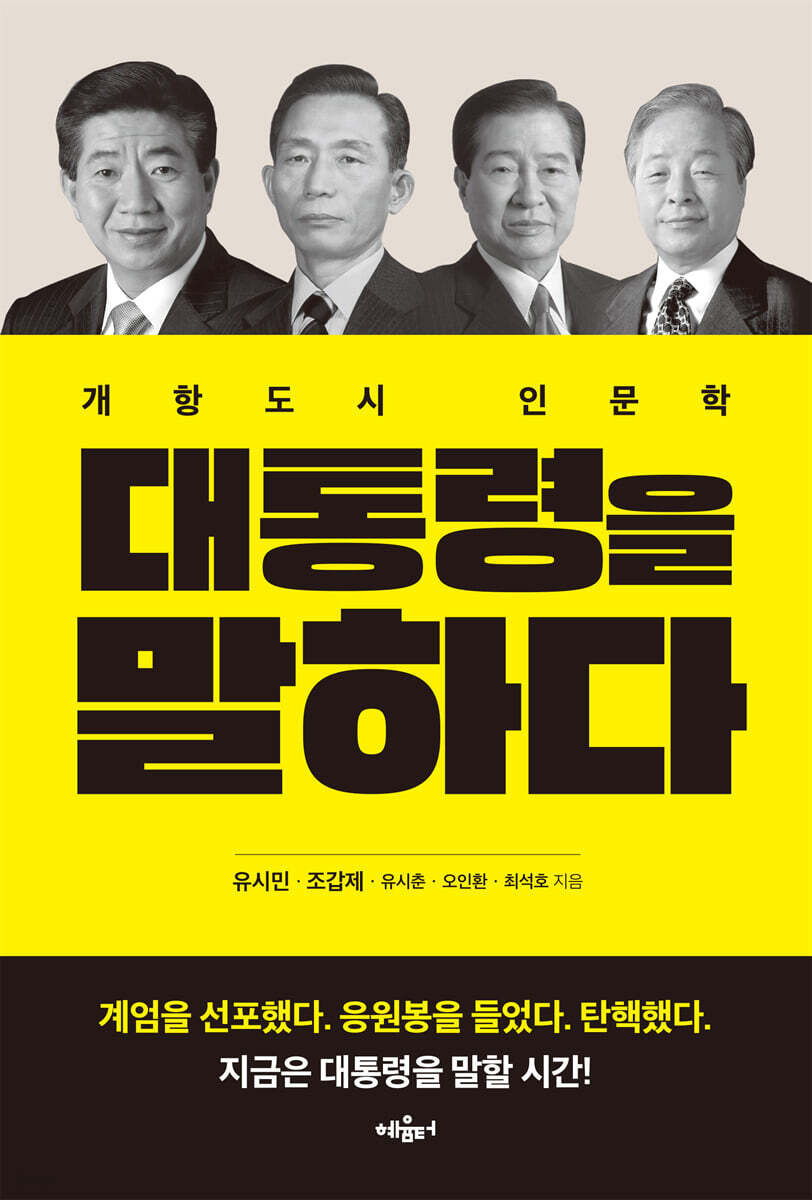
Speaking of the President
 |
Description
Book Introduction
Martial law was declared.
I held the cheering stick.
Impeached.
Now is the time to speak to the President!
On December 3, 2024, President Yoon Seok-yeol declared martial law.
On December 14, the National Assembly voted to impeach President Yoon Seok-yeol, suspending him from his duties as president.
The Constitutional Court began its impeachment trial and unanimously voted to remove President Yoon Seok-yeol from office on April 4, 2025.
And the people elected Lee Jae-myung as president on June 3, 2025.
Going through the breathless political process, I think again about the president.
What kind of person should a president be? I asked authors of presidential autobiographies and biographies and compiled their answers into a book.
I held the cheering stick.
Impeached.
Now is the time to speak to the President!
On December 3, 2024, President Yoon Seok-yeol declared martial law.
On December 14, the National Assembly voted to impeach President Yoon Seok-yeol, suspending him from his duties as president.
The Constitutional Court began its impeachment trial and unanimously voted to remove President Yoon Seok-yeol from office on April 4, 2025.
And the people elected Lee Jae-myung as president on June 3, 2025.
Going through the breathless political process, I think again about the president.
What kind of person should a president be? I asked authors of presidential autobiographies and biographies and compiled their answers into a book.
- You can preview some of the book's contents.
Preview
index
Introduction: Speaking of the President
Martial law / Humanities in open cities / Lecturer of "Speaking of the President" / Writer Yoo Si-min / Reporter Jo Gap-je / Chairman Yoo Si-chun / Minister Oh In-hwan / Director Choi Seok-ho / President of the Republic of Korea
Chapter 1: Speaking of President Roh Moo-hyun
Intro - Director Choi Seok-ho
Welcome Address - Former Incheon Mayor Park Nam-chun
Lecture - Author Yoo Si-min on President Roh Moo-hyun
The Roh Moo-hyun Era without Roh Moo-hyun / Prosecution and Media Reform / Korea-US FTA / Polarization / New Administrative Capital / Grand Coalition / Peaceful Unification / Presidential Election Prediction / Soft Power
Closing - Director Choi Seok-ho
Chapter 2: Speaking of President Park Chung-hee
Intro - Director Choi Seok-ho
Lecture - Reporter Jo Gap-je on President Park Chung-hee
Worst conditions, minimum sacrifice, shortest period, greatest achievement / Resumption of diplomatic relations between Korea and Japan / January 21 Incident / Heavy chemical industry construction / October Yushin / Oil shock / October 26 assassination / Yoon Seok-yeol's impeachment and early election / Asia's leading political leaders / Thus Spoke Zarathustra
Closing - Director Choi Seok-ho
Chapter 3: Speaking of President Kim Dae-jung
Intro - Director Choi Seok-ho
Lecture - Chairman Yoo Si-chun Talks About President Kim Dae-jung
June Struggle, the first year of democracy / Positive human / Democratic market economy / Establishment of the National Human Rights Commission and the Ministry of Gender Equality / Sunshine Policy / Welfare state / Cultural president / Basic livelihood security / Family law revision / Feminist / Information society / Overcoming economic crisis / Internationalist
Lecture Thoughts - Hong In-seong, Former Mayor of Incheon Jung-gu
Closing - Director Choi Seok-ho
Chapter 4: Speaking of President Kim Young-sam
Intro - Director Choi Seok-ho
Welcome Remarks - Incheon Dong-gu District Mayor Kim Chan-jin
Lecture - Minister Oh In-hwan speaks about President Kim Young-sam
Longest-serving Minister of Public Information / Compressed growth of democratization / Kim Young-sam, a great politician / Theory of the 40s / Three-party merger / Military reform / Real-name financial transaction system / Information age / Globalization / Reevaluation of Kim Young-sam
Closing - Director Choi Seok-ho
Chapter 5: Speaking of the President of the Republic of Korea
Intro - Director Choi Seok-ho
Lecture - Director Choi Seok-ho Speaks on the President of the Republic of Korea
Things Koreans Like / People Koreans Like / Presidents Koreans Like / President Roh Moo-hyun and the Grand Coalition Proposal / President Park Chung-hee and the October Yushin / President Kim Dae-jung and the Mokpo War / Kim Young-sam, President of the New Democratic Party / Evaluation of Presidential Achievements / Presidents Koreans Want /
Closing - Director Choi Seok-ho
Martial law / Humanities in open cities / Lecturer of "Speaking of the President" / Writer Yoo Si-min / Reporter Jo Gap-je / Chairman Yoo Si-chun / Minister Oh In-hwan / Director Choi Seok-ho / President of the Republic of Korea
Chapter 1: Speaking of President Roh Moo-hyun
Intro - Director Choi Seok-ho
Welcome Address - Former Incheon Mayor Park Nam-chun
Lecture - Author Yoo Si-min on President Roh Moo-hyun
The Roh Moo-hyun Era without Roh Moo-hyun / Prosecution and Media Reform / Korea-US FTA / Polarization / New Administrative Capital / Grand Coalition / Peaceful Unification / Presidential Election Prediction / Soft Power
Closing - Director Choi Seok-ho
Chapter 2: Speaking of President Park Chung-hee
Intro - Director Choi Seok-ho
Lecture - Reporter Jo Gap-je on President Park Chung-hee
Worst conditions, minimum sacrifice, shortest period, greatest achievement / Resumption of diplomatic relations between Korea and Japan / January 21 Incident / Heavy chemical industry construction / October Yushin / Oil shock / October 26 assassination / Yoon Seok-yeol's impeachment and early election / Asia's leading political leaders / Thus Spoke Zarathustra
Closing - Director Choi Seok-ho
Chapter 3: Speaking of President Kim Dae-jung
Intro - Director Choi Seok-ho
Lecture - Chairman Yoo Si-chun Talks About President Kim Dae-jung
June Struggle, the first year of democracy / Positive human / Democratic market economy / Establishment of the National Human Rights Commission and the Ministry of Gender Equality / Sunshine Policy / Welfare state / Cultural president / Basic livelihood security / Family law revision / Feminist / Information society / Overcoming economic crisis / Internationalist
Lecture Thoughts - Hong In-seong, Former Mayor of Incheon Jung-gu
Closing - Director Choi Seok-ho
Chapter 4: Speaking of President Kim Young-sam
Intro - Director Choi Seok-ho
Welcome Remarks - Incheon Dong-gu District Mayor Kim Chan-jin
Lecture - Minister Oh In-hwan speaks about President Kim Young-sam
Longest-serving Minister of Public Information / Compressed growth of democratization / Kim Young-sam, a great politician / Theory of the 40s / Three-party merger / Military reform / Real-name financial transaction system / Information age / Globalization / Reevaluation of Kim Young-sam
Closing - Director Choi Seok-ho
Chapter 5: Speaking of the President of the Republic of Korea
Intro - Director Choi Seok-ho
Lecture - Director Choi Seok-ho Speaks on the President of the Republic of Korea
Things Koreans Like / People Koreans Like / Presidents Koreans Like / President Roh Moo-hyun and the Grand Coalition Proposal / President Park Chung-hee and the October Yushin / President Kim Dae-jung and the Mokpo War / Kim Young-sam, President of the New Democratic Party / Evaluation of Presidential Achievements / Presidents Koreans Want /
Closing - Director Choi Seok-ho
Detailed image
Into the book
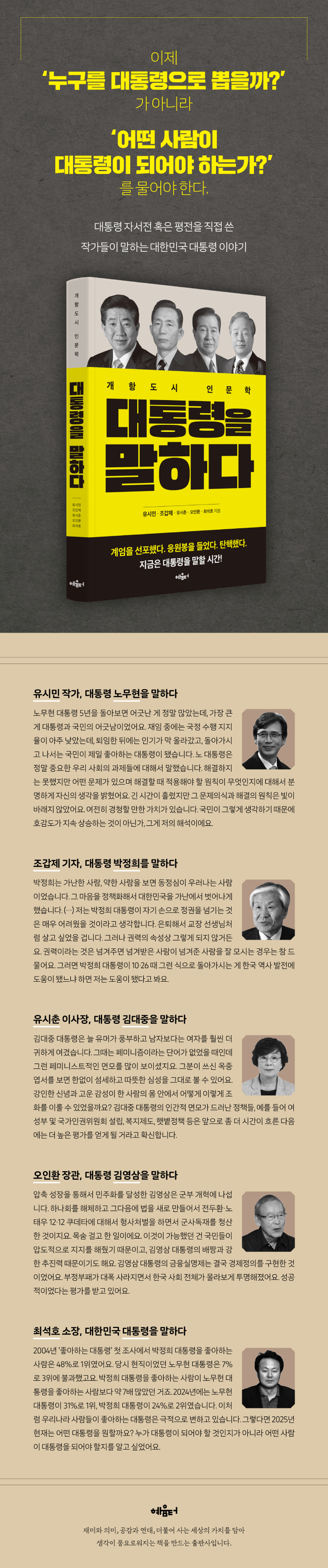
Looking back on the five years of President Roh Moo-hyun's presidency, there were many things that went wrong, but the biggest one was the disconnect between the president and the people.
How did this discrepancy manifest itself? While in office, his approval ratings for his performance were extremely low. After leaving office, his popularity skyrocketed, and upon his death, he became the nation's most beloved president.
When President Roh Moo-hyun was in Bongha Village, he came out to greet tourists who were flocking there and said this.
“When I was working, I said I couldn’t do it, I couldn’t do it, I didn’t like it, I didn’t like it, but now that I’ve quit and come out to play, I say I like it.” It was a joke, but a sincere comment, expressing your thoughts on the misalignment between the people and the president.
Yes, that's right.
The people and the president are greatly at odds.
I believe that only when all of that falls into place will President Roh Moo-hyun find his proper place as a historical figure.
--- From “Chapter 1: Speaking of President Roh Moo-hyun”
I believe that, despite many twists and turns, Korean society has managed to heal the discord between the president and the people that arose during the Roh Moo-hyun presidency.
We can't view all of history this way, but at least President Roh Moo-hyun needs to be interpreted this way to understand the phenomenon of his continued rise in popularity among the public. That's why I'm telling you this.
This is a separate issue from the grief we felt over the President's passing.
President Roh spoke about some really important issues facing our society.
Although I didn't solve it, I was able to clearly state my thoughts on what the problem was and what principles should be applied when solving it.
Although a lot of time has passed, the awareness of the problem and the principles for solving it have not faded.
It's still worth listening to.
My interpretation is that the popularity continues to rise because the public thinks that way.
--- From “Chapter 1: Speaking of President Roh Moo-hyun”
I really liked the book.
Let me tell you an anecdote. After the Uri Party won 151 seats in the April 15, 2004 general election, they invited the elected officials to the Blue House guest house for dinner.
At the end, they gave us each a paper shopping bag.
I was hoping that everyone would have a Nonghyup gift certificate, but I couldn't open it there, so I just took it and left.
The President read a lot of books while suspended from office due to impeachment, and among them was Jeremy Rifkin's The End of Work.
I thought it contained a very important agenda, so as a member of the 17th National Assembly, I asked him to read this book and think about the problems in our labor market.
Many members of the National Assembly came out and said this jokingly.
"You don't even have a Nonghyup gift certificate!" You didn't even buy seolleongtang (Korean traditional soup) during your candidacy. Would you give us a Nonghyup gift certificate? That's how much you loved books.
If you hadn't left like that, I think there's a good chance you'd be doing something related to books.
If you had a YouTube channel, wouldn't you have 5 million subscribers?
--- From “Chapter 1: Speaking of President Roh Moo-hyun”
When talking about President Park Chung-hee, many people say, “The Yushin regime is a dictatorship. This is absolutely unacceptable.”
Politically speaking, you might be able to argue that, but then, if the Yushin regime hadn't existed, would the construction of the heavy chemical industry have been successful? I don't think it would have been successful.
That's the level of sacrifice, the minimum sacrifice.
Isn't what we gained in exchange for minimal sacrifice the greatest achievement? What else do we have now, apart from our automobile industry, our semiconductors, our steel, our petrochemicals, and our precision machinery?
--- From “Chapter 2: Speaking of President Park Chung-hee”
“I ask questions based on what if.
“If the October 26 assassination had not occurred, I wonder whether President Park Chung-hee would have peacefully handed over power or whether he would have held on to power until the end.” That’s a very good question.
I think it would have been very difficult for President Park Chung-hee to hand over power on his own.
When I retired, I wanted to live like a principal.
But, due to the nature of power, that is not the case.
When it comes to power, it's rare for the person who receives it to serve the person who gave it to them well.
So, did President Park Chung-hee's death on October 26th help the development of Korean history? I think it did.
--- From “Chapter 2: Speaking of President Park Chung-hee”
He was always humorous and valued women much more than men.
At that time, the word "feminism" didn't exist, but you showed a lot of feminist aspects.
After he passed away, a media outlet asked me to write a manuscript, so I wrote the title, “A Rarely Bisexual Person.”
--- From "Chapter 3: Speaking of President Kim Dae-jung"
If you look at the postcards he wrote from prison, you can see his infinitely delicate, kind, warm, and gentle nature.
At that time, the prison allowed us to write sealed letters once a month.
I found out later that I had written 80 pages of manuscript paper as a letter from prison.
When I look at the very small letters, it looks like I'm looking at an embroidery hoop.
How can such strong convictions, such subtle nuances, such kindness, such warmth, all be so harmoniously combined within one person? This is what I find myself thinking.
--- From "Chapter 3: Speaking of President Kim Dae-jung"
We experienced the IMF economic crisis in November 1997.
During the IMF crisis, the non-performing loans of large corporations that caused a chain of bankruptcies amounted to 112 trillion won, equivalent to 28% of GDP.
Public funds were invested here.
Ultimately, the economic crisis was overcome in 2001, three years earlier than the IMF's prediction of 2004.
It's a great achievement.
In some ways, it can be said that they implemented an economic policy that was more rapid and efficient than the Sunshine Policy.
--- From "Chapter 3: Speaking of President Kim Dae-jung"
Kim Young-sam, who achieved democratization through compressed growth, embarked on military reform.
The military dictatorship was liquidated by disbanding the Hanahoe and then creating a new law to criminally punish the December 12 coup of Chun Doo-hwan and Roh Tae-woo.
It was something I risked my life for.
This was possible because the people gave overwhelming support, and also because of President Kim Young-sam's courage and strong driving force.
--- From “Chapter 4: Speaking of President Kim Young-sam”
The real-name financial transaction system ultimately achieved economic justice.
With corruption largely eliminated, Korean society as a whole has become incredibly transparent.
It is being evaluated as a success.
Even the Blue House economic chief didn't know that President Kim Young-sam was going to implement a real-name financial transaction system.
He even left an episode where he was caught by the prosecution for hiding money because he didn't even tell his son, and he ended up being indicted.
His son, Kim Hyun-chul, buried 5 billion won of the remaining money from the presidential election expenses in the budget of the Agency for National Security Planning, but failed to change it to his real name, and it was caught five years later during the Hanbo incident.
--- From “Chapter 4: Speaking of President Kim Young-sam”
We also surveyed 'favorite presidents'.
In the first survey in 2004, 48% of people liked President Park Chung-hee, ranking first.
At the time, incumbent President Roh Moo-hyun was in third place with 7%.
There were about seven times more people who liked President Park Chung-hee than those who liked President Roh Moo-hyun.
A second survey was conducted in 2014, ten years later.
On April 16th of that year, the Sewol ferry sank.
The ranking of Koreans' favorite presidents also changes dramatically.
Those who like President Roh Moo-hyun rise to first place with 32%, beating out those who like President Park Chung-hee with 28%.
In 2019, following 2014, the percentage of people who like President Roh Moo-hyun remained unchanged at 32%.
Those who like President Park Chung-hee fall again to 23%.
How did this discrepancy manifest itself? While in office, his approval ratings for his performance were extremely low. After leaving office, his popularity skyrocketed, and upon his death, he became the nation's most beloved president.
When President Roh Moo-hyun was in Bongha Village, he came out to greet tourists who were flocking there and said this.
“When I was working, I said I couldn’t do it, I couldn’t do it, I didn’t like it, I didn’t like it, but now that I’ve quit and come out to play, I say I like it.” It was a joke, but a sincere comment, expressing your thoughts on the misalignment between the people and the president.
Yes, that's right.
The people and the president are greatly at odds.
I believe that only when all of that falls into place will President Roh Moo-hyun find his proper place as a historical figure.
--- From “Chapter 1: Speaking of President Roh Moo-hyun”
I believe that, despite many twists and turns, Korean society has managed to heal the discord between the president and the people that arose during the Roh Moo-hyun presidency.
We can't view all of history this way, but at least President Roh Moo-hyun needs to be interpreted this way to understand the phenomenon of his continued rise in popularity among the public. That's why I'm telling you this.
This is a separate issue from the grief we felt over the President's passing.
President Roh spoke about some really important issues facing our society.
Although I didn't solve it, I was able to clearly state my thoughts on what the problem was and what principles should be applied when solving it.
Although a lot of time has passed, the awareness of the problem and the principles for solving it have not faded.
It's still worth listening to.
My interpretation is that the popularity continues to rise because the public thinks that way.
--- From “Chapter 1: Speaking of President Roh Moo-hyun”
I really liked the book.
Let me tell you an anecdote. After the Uri Party won 151 seats in the April 15, 2004 general election, they invited the elected officials to the Blue House guest house for dinner.
At the end, they gave us each a paper shopping bag.
I was hoping that everyone would have a Nonghyup gift certificate, but I couldn't open it there, so I just took it and left.
The President read a lot of books while suspended from office due to impeachment, and among them was Jeremy Rifkin's The End of Work.
I thought it contained a very important agenda, so as a member of the 17th National Assembly, I asked him to read this book and think about the problems in our labor market.
Many members of the National Assembly came out and said this jokingly.
"You don't even have a Nonghyup gift certificate!" You didn't even buy seolleongtang (Korean traditional soup) during your candidacy. Would you give us a Nonghyup gift certificate? That's how much you loved books.
If you hadn't left like that, I think there's a good chance you'd be doing something related to books.
If you had a YouTube channel, wouldn't you have 5 million subscribers?
--- From “Chapter 1: Speaking of President Roh Moo-hyun”
When talking about President Park Chung-hee, many people say, “The Yushin regime is a dictatorship. This is absolutely unacceptable.”
Politically speaking, you might be able to argue that, but then, if the Yushin regime hadn't existed, would the construction of the heavy chemical industry have been successful? I don't think it would have been successful.
That's the level of sacrifice, the minimum sacrifice.
Isn't what we gained in exchange for minimal sacrifice the greatest achievement? What else do we have now, apart from our automobile industry, our semiconductors, our steel, our petrochemicals, and our precision machinery?
--- From “Chapter 2: Speaking of President Park Chung-hee”
“I ask questions based on what if.
“If the October 26 assassination had not occurred, I wonder whether President Park Chung-hee would have peacefully handed over power or whether he would have held on to power until the end.” That’s a very good question.
I think it would have been very difficult for President Park Chung-hee to hand over power on his own.
When I retired, I wanted to live like a principal.
But, due to the nature of power, that is not the case.
When it comes to power, it's rare for the person who receives it to serve the person who gave it to them well.
So, did President Park Chung-hee's death on October 26th help the development of Korean history? I think it did.
--- From “Chapter 2: Speaking of President Park Chung-hee”
He was always humorous and valued women much more than men.
At that time, the word "feminism" didn't exist, but you showed a lot of feminist aspects.
After he passed away, a media outlet asked me to write a manuscript, so I wrote the title, “A Rarely Bisexual Person.”
--- From "Chapter 3: Speaking of President Kim Dae-jung"
If you look at the postcards he wrote from prison, you can see his infinitely delicate, kind, warm, and gentle nature.
At that time, the prison allowed us to write sealed letters once a month.
I found out later that I had written 80 pages of manuscript paper as a letter from prison.
When I look at the very small letters, it looks like I'm looking at an embroidery hoop.
How can such strong convictions, such subtle nuances, such kindness, such warmth, all be so harmoniously combined within one person? This is what I find myself thinking.
--- From "Chapter 3: Speaking of President Kim Dae-jung"
We experienced the IMF economic crisis in November 1997.
During the IMF crisis, the non-performing loans of large corporations that caused a chain of bankruptcies amounted to 112 trillion won, equivalent to 28% of GDP.
Public funds were invested here.
Ultimately, the economic crisis was overcome in 2001, three years earlier than the IMF's prediction of 2004.
It's a great achievement.
In some ways, it can be said that they implemented an economic policy that was more rapid and efficient than the Sunshine Policy.
--- From "Chapter 3: Speaking of President Kim Dae-jung"
Kim Young-sam, who achieved democratization through compressed growth, embarked on military reform.
The military dictatorship was liquidated by disbanding the Hanahoe and then creating a new law to criminally punish the December 12 coup of Chun Doo-hwan and Roh Tae-woo.
It was something I risked my life for.
This was possible because the people gave overwhelming support, and also because of President Kim Young-sam's courage and strong driving force.
--- From “Chapter 4: Speaking of President Kim Young-sam”
The real-name financial transaction system ultimately achieved economic justice.
With corruption largely eliminated, Korean society as a whole has become incredibly transparent.
It is being evaluated as a success.
Even the Blue House economic chief didn't know that President Kim Young-sam was going to implement a real-name financial transaction system.
He even left an episode where he was caught by the prosecution for hiding money because he didn't even tell his son, and he ended up being indicted.
His son, Kim Hyun-chul, buried 5 billion won of the remaining money from the presidential election expenses in the budget of the Agency for National Security Planning, but failed to change it to his real name, and it was caught five years later during the Hanbo incident.
--- From “Chapter 4: Speaking of President Kim Young-sam”
We also surveyed 'favorite presidents'.
In the first survey in 2004, 48% of people liked President Park Chung-hee, ranking first.
At the time, incumbent President Roh Moo-hyun was in third place with 7%.
There were about seven times more people who liked President Park Chung-hee than those who liked President Roh Moo-hyun.
A second survey was conducted in 2014, ten years later.
On April 16th of that year, the Sewol ferry sank.
The ranking of Koreans' favorite presidents also changes dramatically.
Those who like President Roh Moo-hyun rise to first place with 32%, beating out those who like President Park Chung-hee with 28%.
In 2019, following 2014, the percentage of people who like President Roh Moo-hyun remained unchanged at 32%.
Those who like President Park Chung-hee fall again to 23%.
--- From “Chapter 5: Speaking of the President of the Republic of Korea”
Publisher's Review
Martial law was declared.
I held the cheering stick.
Impeached.
Now is the time to talk about the President!
As clearly stated in Article 1, Paragraphs 1 and 2 of the Constitution of the Republic of Korea, the Republic of Korea is a democratic republic.
The sovereignty of the Republic of Korea resides in the people, and all state authority emanates from the people.
Nevertheless, former President Yoon Seok-yeol abused his power and declared illegal martial law on December 3, 2024.
Citizens filled Yeouido, lawmakers climbed over the fence and gathered at the National Assembly, and the military resisted the illegal order by lukewarmly carrying out operations.
Through the last martial law, we clearly learned what a threat a president who does not protect democracy and the Constitution poses to the people.
A book has been published that reflects on the achievements of past presidents of the Republic of Korea through the lens of 'Port City Humanities' and reconsiders the kind of person the President of the Republic of Korea should be.
‘Port City Humanities’ is Incheon’s representative humanities special lecture program.
In 2022, a complex cultural space called "Gaekhang City" was created in Gaekhang-ro, Jung-gu, Incheon, featuring a book village, an art village, and a coffee village. "Gaekhang City Humanities" is held here twice a year, once in spring and once in fall.
Season 7 brought to mind the recent impeachment crisis, regime change, and fundamental questions about democracy, focusing on the most political and human keyword, 'president.'
At a time when the 'president' and 'democracy' were running in different directions, Director Choi Seok-ho planned the 'Speaking of the President' humanities program in the port city, thinking that something had to be done.
It is truly a joyous and fortunate thing that the stories of the President of the Republic of Korea told by the speakers have been published in the book “Speaking of the President” so that they can be shared with many others who were not present at the event.
Now, the question is not 'Who should we elect as president?'
We must ask, 'What kind of person should be president?'
The president himself wrote an autobiography or biography
The story of the President of the Republic of Korea as told by the writers
'Speaking of the President' struck a balance by selecting two presidents, one progressive and one conservative.
Excluding living presidents, the standard was set based on presidents who received some degree of historical evaluation.
We decided to elect a president who enjoys the support of the people, excluding presidents who are controversial or whose terms are too short.
This is because we can learn lessons from the achievements of past presidents to guide the administration of today's president.
In this way, the four presidents were ultimately selected: Roh Moo-hyun, Park Chung-hee, Kim Dae-jung, and Kim Young-sam.
Next, the criteria for selecting instructors were based on those who knew the president well.
Anyone who served as a close associate of the president during his term or wrote an autobiography or biography of the president can be said to know the president well.
In this way, Yoo Si-min, Jo Gap-je, Yoo Si-chun, and Oh In-hwan were selected as instructors.
We selected Director Choi Seok-ho, the planner of the Port City Humanities "Speaking of the President" program and a lecturer who conducted a survey on the president's performance during each lecture, as the final lecturer, and examined the results of the survey together.
This book makes us look back on the merits and demerits of presidents: President Roh Moo-hyun, who dedicated himself to a just victory rather than one of expediency and foul play, but had his share of disagreements with the people; President Park Chung-hee, who contributed to industrialization and economic growth, but also had the fault of sacrificing dictatorship and workers; President Kim Dae-jung, who was a feminist and overcame the IMF economic crisis, but also had his share of excesses during the economic crisis; and President Kim Young-sam, who contributed to democratization and reform, but also had the fault of national bankruptcy.
President Roh Moo-hyun had the slogan, “The people are the president,” and said, “Social development and progress progress only as each and every citizen moves forward.”
The people are the ones who elect the president and delegate power to him.
What lessons can we learn from the president's coup? This book will prompt us, as citizens, to reflect on what kind of person should become president and raise citizens' awareness of democracy.
I held the cheering stick.
Impeached.
Now is the time to talk about the President!
As clearly stated in Article 1, Paragraphs 1 and 2 of the Constitution of the Republic of Korea, the Republic of Korea is a democratic republic.
The sovereignty of the Republic of Korea resides in the people, and all state authority emanates from the people.
Nevertheless, former President Yoon Seok-yeol abused his power and declared illegal martial law on December 3, 2024.
Citizens filled Yeouido, lawmakers climbed over the fence and gathered at the National Assembly, and the military resisted the illegal order by lukewarmly carrying out operations.
Through the last martial law, we clearly learned what a threat a president who does not protect democracy and the Constitution poses to the people.
A book has been published that reflects on the achievements of past presidents of the Republic of Korea through the lens of 'Port City Humanities' and reconsiders the kind of person the President of the Republic of Korea should be.
‘Port City Humanities’ is Incheon’s representative humanities special lecture program.
In 2022, a complex cultural space called "Gaekhang City" was created in Gaekhang-ro, Jung-gu, Incheon, featuring a book village, an art village, and a coffee village. "Gaekhang City Humanities" is held here twice a year, once in spring and once in fall.
Season 7 brought to mind the recent impeachment crisis, regime change, and fundamental questions about democracy, focusing on the most political and human keyword, 'president.'
At a time when the 'president' and 'democracy' were running in different directions, Director Choi Seok-ho planned the 'Speaking of the President' humanities program in the port city, thinking that something had to be done.
It is truly a joyous and fortunate thing that the stories of the President of the Republic of Korea told by the speakers have been published in the book “Speaking of the President” so that they can be shared with many others who were not present at the event.
Now, the question is not 'Who should we elect as president?'
We must ask, 'What kind of person should be president?'
The president himself wrote an autobiography or biography
The story of the President of the Republic of Korea as told by the writers
'Speaking of the President' struck a balance by selecting two presidents, one progressive and one conservative.
Excluding living presidents, the standard was set based on presidents who received some degree of historical evaluation.
We decided to elect a president who enjoys the support of the people, excluding presidents who are controversial or whose terms are too short.
This is because we can learn lessons from the achievements of past presidents to guide the administration of today's president.
In this way, the four presidents were ultimately selected: Roh Moo-hyun, Park Chung-hee, Kim Dae-jung, and Kim Young-sam.
Next, the criteria for selecting instructors were based on those who knew the president well.
Anyone who served as a close associate of the president during his term or wrote an autobiography or biography of the president can be said to know the president well.
In this way, Yoo Si-min, Jo Gap-je, Yoo Si-chun, and Oh In-hwan were selected as instructors.
We selected Director Choi Seok-ho, the planner of the Port City Humanities "Speaking of the President" program and a lecturer who conducted a survey on the president's performance during each lecture, as the final lecturer, and examined the results of the survey together.
This book makes us look back on the merits and demerits of presidents: President Roh Moo-hyun, who dedicated himself to a just victory rather than one of expediency and foul play, but had his share of disagreements with the people; President Park Chung-hee, who contributed to industrialization and economic growth, but also had the fault of sacrificing dictatorship and workers; President Kim Dae-jung, who was a feminist and overcame the IMF economic crisis, but also had his share of excesses during the economic crisis; and President Kim Young-sam, who contributed to democratization and reform, but also had the fault of national bankruptcy.
President Roh Moo-hyun had the slogan, “The people are the president,” and said, “Social development and progress progress only as each and every citizen moves forward.”
The people are the ones who elect the president and delegate power to him.
What lessons can we learn from the president's coup? This book will prompt us, as citizens, to reflect on what kind of person should become president and raise citizens' awareness of democracy.
GOODS SPECIFICS
- Date of issue: July 25, 2025
- Page count, weight, size: 232 pages | 352g | 152*225*16mm
- ISBN13: 9791198994233
You may also like
카테고리
korean


korean

![GQ KOREA Mark (Monthly): December [2025]](http://librairie.coreenne.fr/cdn/shop/files/8ef265dbbfbf186523ed75ba7319009d.jpg?v=1765340328&width=3840)


