

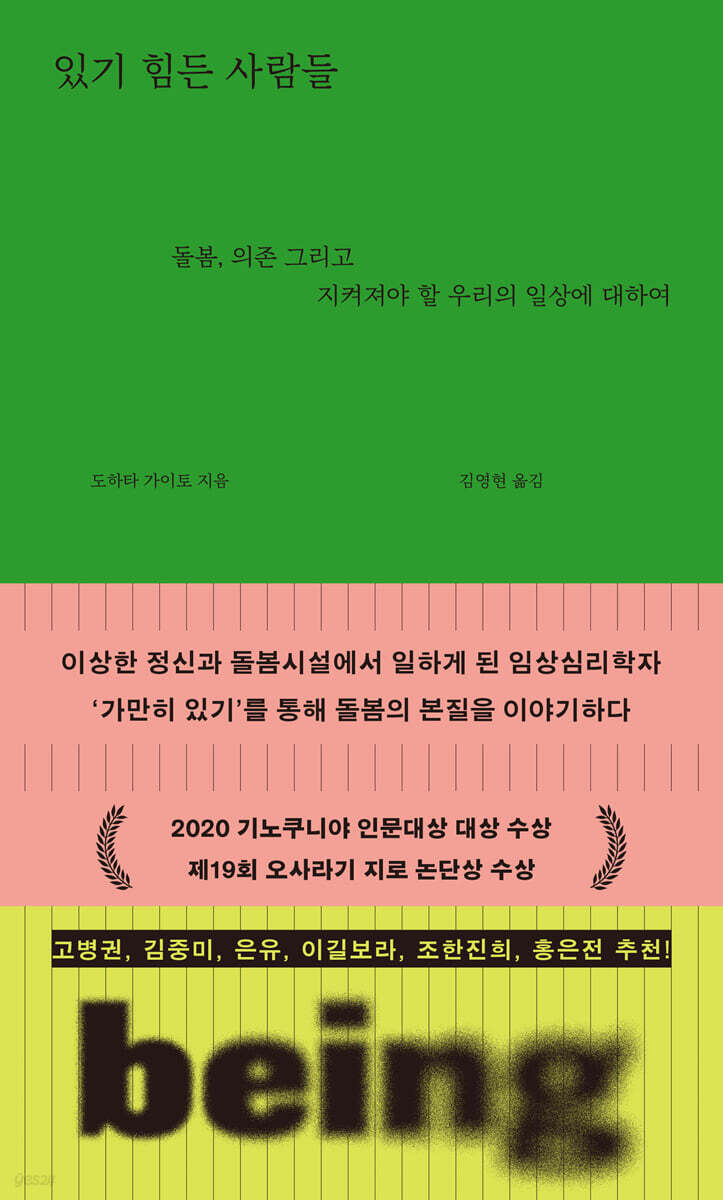
People who are difficult to be with
 |
Description
Book Introduction
If we cannot 'be', we cannot do anything in life.
However, what hinders the 'being' that is the foundation of our lives is capitalism and ourselves who have been brainwashed by capitalism.
The modern classic on "care", "People Who Are Difficult to Be," which swept the "Osaragi Jiro Prize for Editorial Writing," which is awarded annually to a single book in the fields of politics, economics, and society, and the "Kinokuniya Humanities Award," in which readers select the best humanities book of the year, has been published.
This book contains almost all discourses on 'care', including care that makes 'being' possible, the principles of care and dependence, the reciprocity of care, care that exists as a neutral state that is neither active nor passive, concerns surrounding care work that is considered a chore, care theory that presents a new perspective on work and human relationships, as well as separation and death, and the properties of neoliberalism that shakes 'being'.
This book, written by a clinical psychologist and drawing on his four years of experience working with schizophrenic patients at a psychiatric care facility in Okinawa, crosses over philosophy, sociology, anthropology, and depth psychology. It is an academic work, but also an essay filled with humor, emotion, and insight.
However, what hinders the 'being' that is the foundation of our lives is capitalism and ourselves who have been brainwashed by capitalism.
The modern classic on "care", "People Who Are Difficult to Be," which swept the "Osaragi Jiro Prize for Editorial Writing," which is awarded annually to a single book in the fields of politics, economics, and society, and the "Kinokuniya Humanities Award," in which readers select the best humanities book of the year, has been published.
This book contains almost all discourses on 'care', including care that makes 'being' possible, the principles of care and dependence, the reciprocity of care, care that exists as a neutral state that is neither active nor passive, concerns surrounding care work that is considered a chore, care theory that presents a new perspective on work and human relationships, as well as separation and death, and the properties of neoliberalism that shakes 'being'.
This book, written by a clinical psychologist and drawing on his four years of experience working with schizophrenic patients at a psychiatric care facility in Okinawa, crosses over philosophy, sociology, anthropology, and depth psychology. It is an academic work, but also an essay filled with humor, emotion, and insight.
- You can preview some of the book's contents.
Preview
index
To Korean readers / A difficult country to be in
Prologue / Is this okay?
Chapter 1: Care and Treatment / The Clinical Psychologist in Wonderland
Chapter 2 'There is' and 'There is' / Just sitting down
Chapter 3: Mind and Body / Touching the 'Ma-Mom'
Chapter 4: Experts and Non-Experts / Invisible Labor
Reflections on Time
Chapter 5: Circles and Lines / People Who Can't Feel Boredom
Chapter 6: The Polar Bear and the Whale / A Man Weak in Love
Chapter 7: Therapist and Patient / We Laugh Among Ourselves on Fridays
Chapter 8: People and Structure / Two Partings
Notes on Care and Treatment
Chapter 9: Shelters and Detention Centers / Just Being There Is Hard
Author's Note
main
References
Prologue / Is this okay?
Chapter 1: Care and Treatment / The Clinical Psychologist in Wonderland
Chapter 2 'There is' and 'There is' / Just sitting down
Chapter 3: Mind and Body / Touching the 'Ma-Mom'
Chapter 4: Experts and Non-Experts / Invisible Labor
Reflections on Time
Chapter 5: Circles and Lines / People Who Can't Feel Boredom
Chapter 6: The Polar Bear and the Whale / A Man Weak in Love
Chapter 7: Therapist and Patient / We Laugh Among Ourselves on Fridays
Chapter 8: People and Structure / Two Partings
Notes on Care and Treatment
Chapter 9: Shelters and Detention Centers / Just Being There Is Hard
Author's Note
main
References
Detailed image

Into the book
We can be our 'true selves' when we rely on someone completely, when we depend on them.
If that is not possible, a 'false self' is created.
So when ‘being’ becomes painful, we start ‘doing’.
In other words, in order for us to 'be' somewhere, we must become familiar with that place and be able to entrust our bodies to the people there with confidence.
(…) I just want to say one thing.
The dependence mentioned above is something we usually do unconsciously.
In fact, we live our lives entrusting ourselves to someone.
They just don't realize that dependence.
--- p.68
If a child expresses gratitude for everything his mother does, it means something bad is happening.
Because the child is not properly dependent.
Dependent labor is when the recipient is made to feel completely dependent by providing the obvious as if it were a given.
So, it can be said that dependent labor is a job that only brings losses.
All mothers in the world are truly amazing.
Because the better they do their job, the less grateful anyone is.
The less grateful you are, the better your mother is doing.
This situation must undoubtedly be related to the low social value of dependent labor.
Because no one realizes that dependent labor is like that.
--- p.130
If caring for someone is like caring for yourself, then conversely, being cared for by someone is like caring for that person.
The person with limited mobility encouraged the person who gave up their seat by sitting down, and the student who asked a question helped the teacher understand it more deeply.
This is how you see the world turned upside down in such a strange way.
--- p.227
Few people would say outright that 'being' is worthless.
You must have heard it said many times that the reason we use the word 'human being' is because 'being' is at the root of our being.
In reality, no matter how good a person is at his job, he must first be able to stay at work.
That's how important 'being' is.
It's a given, and everyone agrees that it is.
But there is definitely something uncomfortable about the words 'just, being, being'.
Something is bothering me.
The question “Is that okay?” lingers.
If that is not possible, a 'false self' is created.
So when ‘being’ becomes painful, we start ‘doing’.
In other words, in order for us to 'be' somewhere, we must become familiar with that place and be able to entrust our bodies to the people there with confidence.
(…) I just want to say one thing.
The dependence mentioned above is something we usually do unconsciously.
In fact, we live our lives entrusting ourselves to someone.
They just don't realize that dependence.
--- p.68
If a child expresses gratitude for everything his mother does, it means something bad is happening.
Because the child is not properly dependent.
Dependent labor is when the recipient is made to feel completely dependent by providing the obvious as if it were a given.
So, it can be said that dependent labor is a job that only brings losses.
All mothers in the world are truly amazing.
Because the better they do their job, the less grateful anyone is.
The less grateful you are, the better your mother is doing.
This situation must undoubtedly be related to the low social value of dependent labor.
Because no one realizes that dependent labor is like that.
--- p.130
If caring for someone is like caring for yourself, then conversely, being cared for by someone is like caring for that person.
The person with limited mobility encouraged the person who gave up their seat by sitting down, and the student who asked a question helped the teacher understand it more deeply.
This is how you see the world turned upside down in such a strange way.
--- p.227
Few people would say outright that 'being' is worthless.
You must have heard it said many times that the reason we use the word 'human being' is because 'being' is at the root of our being.
In reality, no matter how good a person is at his job, he must first be able to stay at work.
That's how important 'being' is.
It's a given, and everyone agrees that it is.
But there is definitely something uncomfortable about the words 'just, being, being'.
Something is bothering me.
The question “Is that okay?” lingers.
--- p.340
Publisher's Review
Why has our society become so difficult to exist in?
A new classic on care, lauded by readers, the press, and experts.
★ Highly recommended by Go Byeong-gwon, Kim Jung-mi, Eun-yu, Gil-bo-ra, Jo Han-jin-hee, and Hong Eun-jeon
★ 2020 Kinokuniya Humanities Award Grand Prize Winner
★ Winner of the 19th Osaragi Jiro Prize
The first task of a clinical psychologist employed at a psychiatric care facility: "Staying still."
“Is this okay? Shouldn’t we be treating the patient?”
The clash between caregiving, which helps us "be," and capitalism, which forces us to "do."
If we cannot 'be', we cannot do anything in life.
However, what hinders the 'being' that is the foundation of our lives is capitalism and ourselves who have been brainwashed by capitalism.
The modern classic on "care", "People Who Are Difficult to Be," which swept the "Osaragi Jiro Prize for Editorial Writing," which is awarded annually to a single book in the fields of politics, economics, and society, and the "Kinokuniya Humanities Award," in which readers select the best humanities book of the year, has been published.
This book contains almost all discourses on 'care', including care that makes 'being' possible, the principles of care and dependence, the reciprocity of care, care that exists as a neutral state that is neither active nor passive, concerns surrounding care work that is considered a chore, care theory that presents a new perspective on work and human relationships, as well as separation and death, and the properties of neoliberalism that shakes 'being'.
This book, written by a clinical psychologist and drawing on his four years of experience working with schizophrenic patients at a psychiatric care facility in Okinawa, crosses over philosophy, sociology, anthropology, and depth psychology. It is an academic work, but also an essay filled with humor, emotion, and insight.
This book is a revised edition of 『Living Every Day Dependably』 (Dada Bookstore, 2019) with a complete revision and a Korean-language author's preface.
A young clinical psychologist arrives at a 'strange care facility'
Exploring the 'being' that sustains our lives
A clinical psychologist with a doctorate from Kyoto University takes a job at a psychiatric care facility in Okinawa.
The author is flustered when, as his first task at a facility where people with schizophrenia reside, he is told to “just sit there” while the people are just sitting there blankly.
The author, who was eager to quickly 'cure' patients after completing his long studies, is unable to demonstrate his expertise and instead sits blankly with patients with schizophrenia, playing cards, playing badminton, and driving around, and feels anxious and questioning about his daily life.
And I start to think about 'being', something I've never thought about in my life.
Why is it so hard to just sit still and do nothing? How is it possible, and how does it become impossible, to "be," a state we've never been conscious of, like air? Am I okay with just "being," doing nothing?
However, as the author witnesses the process in which people with schizophrenia gradually find comfort and escape anxiety through simply 'being' and 'playing' with others, he gradually realizes that 'being' is the act that is the basis of survival, and that 'care', which is often overlooked compared to treatment, is an important element that makes such being possible.
The author, who had previously focused solely on treatment, began research on care.
This book contains a philosophy of care that is based on four years of experience working with people with schizophrenia, grounded in various academic disciplines such as philosophy, sociology, anthropology, and depth psychology.
By interacting with people with schizophrenia, each with a different story and symptoms, who have failed to 'exist' in society and come to care facilities, the author discovers the properties of care from each clinical experience.
We can only be ourselves when we depend on others.
The essence of care explored through practice and theory
What is the essence of care that underpins our ‘being’?
The author says that we must be able to 'be' in a certain place in order to 'do' something.
No matter how good a student is at studying, he or she must first be able to 'be' at school in order to study.
The same goes for work, gatherings, family, and relationships between two people.
And the author emphasizes that in order to 'be' somewhere, we must be able to 'depend' on the people there.
It is only when we are completely 'dependent' on someone that we can 'exist'.
A child can be at ease at home only when he or she is completely dependent on his or her mother, and an employee can be at ease at work only when he or she can rely on his or her colleagues.
Lovers and friends can only be together comfortably when they trust and rely on each other.
We can be our 'true selves' when we rely on someone completely, when we depend on them.
If that is not possible, a 'false self' is created.
So when ‘being’ becomes painful, we start ‘doing’.
_From the text
The author also describes the curious phenomenon of care not flowing in one direction but in the opposite direction, or in both directions, between the caregiver and the care recipient.
Giving up your seat on the subway or tutoring a friend may seem like acts of caring, but they are not.
Giving up your seat to someone makes you feel better, and teaching a friend a lesson deepens your own understanding.
Going further, we see a world turned upside down, where the person who gave up their seat to the person who gave it to them cheers up the person who gave it to them by sitting down, and the student who learned their lesson helps their friend gain a deeper understanding.
The author brings in Jungian psychology's theory of the 'wounded therapist', in which the therapist and the patient heal and are healed by each other, and explains the essence of care, which is to care by caring and to be cared for by being cared for.
Even in the facilities the author experienced, people with mental illness did not simply receive care.
The person with mental illness cared for another person, and sometimes the staff.
By caring for others in this way, the person himself also received care.
The author moves beyond the typical perspective that divides care into subject and object.
In places where care actually takes place, the world unfolds not in the active and passive voices of 'giving care / receiving care', but in the middle voice of 'where care is done'.
What is good care?
Drawing a "landscape of care" as it is, erasing vague illusions.
Although 『People Who Are Difficult to Be』 is advertised as an academic book, it also reads like an essay or a novel.
The author vividly portrays the staff of psychiatric care facilities and the people with mental illness.
The anecdotes featuring diverse characters such as the manager who is more adept at taking care of patients than anyone else, a nurse who seems more interested in baseball than caring for patients, a young man who has a hole in his head that needs to be plugged with a rock, and a man who folds and unfolds napkins all day on orders from the moon are full of laughter, emotion, and tears, making them just as interesting as a drama.
From these anecdotes, the author uncovers topics such as care and dependence, the interdependence of care, the risks of care, care and community, and care and capitalism, and approaches them theoretically.
Then, the boundaries between academic books, essays, and novels melt away, revealing a vivid 'landscape of care.'
The author confesses that he could not fully express his experience of care in the rigid language of a thesis.
Rather, he says he wrote an academic book that was not academic in nature because he believed that showing the 'landscape of care' as it is, with its difficulties and pains, laughter and joys, would be the most effective way to convey the essence and value of care.
The author's "Landscape of Care," written in vibrant prose, instantly draws readers in, revealing every nook and cranny of the reality of care we were unaware of.
The COVID-19 pandemic has fueled a surge of discussion about care in Korean society, but in the real world, incidents of violence and abuse are reported in the media almost daily.
Now, Korean society must take a step forward and consider what "good care" means, what happens between people in "care," and what the "joy of care" is as well as the "pain of care."
As recommended by Jo Han-jin, CEO of ‘Other Bodies,’ this book shows “a high level of care that goes beyond the fiction of care packaged with good intentions and the vagueness of good care.”
How is a 'difficult society' created?
A Philosophy of Care Against Neoliberalism
Why did the author, on his first day at a care facility, resist the initial instruction to simply "be"? Why, even while playing cards, volleyball, and driving with people with schizophrenia, did he constantly suffer from anxiety: "Can I just stay like this without treatment?" The author argues that the root of this anxiety lies in capitalism.
The author constantly contrasts treatment and care.
Treatment is an act by which a doctor brings healing to a patient, but it is also another word for doing, progress, independence, growth, production, and efficiency.
Conversely, care is another word for being, stability, dependence, routine, management, and staying.
Capitalist society values treatment over care.
We applaud only those who are independent and growing, and we treat dependence as a negative concept.
Such neoliberal standards denigrate the social value of care work and even reduce care facilities that exist for the “difficult to afford” to mere money-making tools.
The author emphasizes that our very existence is threatened by such capitalism's prioritization of treatment, growth, and efficiency.
When we lose our sense of 'being,' we lose our refuge when life gets tough, and we fall more easily into the swamp of instability.
Moreover, when an individual's 'being' is endangered, the 'being' of society as a whole is also at risk.
In the preface to the Korean edition, the author expresses concern that Japan has become a “difficult country to be in” due to its neoliberal reforms in the 2000s, and that Korea, too, appears to be a “difficult country to be in” with excessive competition and unstable politics, harboring “existential anxiety.”
Polarization, division across various levels, class conflict and the spread of hatred, a culture of ostentation and a high suicide rate... What kind of discussion should we begin to make "being" possible in this "difficult society" that has long been a challenge? The key lies in "dependence" and "care."
Having swept several major awards and received rave reviews from readers, the press, and experts, this book has been hailed as a new classic on care, and has become a must-read when discussing care in Japan, where the value of care has been re-examined since the early 2000s.
For countless people enduring a 'difficult society' and a 'difficult daily life,' the very existence of this book will be a source of care.
A new classic on care, lauded by readers, the press, and experts.
★ Highly recommended by Go Byeong-gwon, Kim Jung-mi, Eun-yu, Gil-bo-ra, Jo Han-jin-hee, and Hong Eun-jeon
★ 2020 Kinokuniya Humanities Award Grand Prize Winner
★ Winner of the 19th Osaragi Jiro Prize
The first task of a clinical psychologist employed at a psychiatric care facility: "Staying still."
“Is this okay? Shouldn’t we be treating the patient?”
The clash between caregiving, which helps us "be," and capitalism, which forces us to "do."
If we cannot 'be', we cannot do anything in life.
However, what hinders the 'being' that is the foundation of our lives is capitalism and ourselves who have been brainwashed by capitalism.
The modern classic on "care", "People Who Are Difficult to Be," which swept the "Osaragi Jiro Prize for Editorial Writing," which is awarded annually to a single book in the fields of politics, economics, and society, and the "Kinokuniya Humanities Award," in which readers select the best humanities book of the year, has been published.
This book contains almost all discourses on 'care', including care that makes 'being' possible, the principles of care and dependence, the reciprocity of care, care that exists as a neutral state that is neither active nor passive, concerns surrounding care work that is considered a chore, care theory that presents a new perspective on work and human relationships, as well as separation and death, and the properties of neoliberalism that shakes 'being'.
This book, written by a clinical psychologist and drawing on his four years of experience working with schizophrenic patients at a psychiatric care facility in Okinawa, crosses over philosophy, sociology, anthropology, and depth psychology. It is an academic work, but also an essay filled with humor, emotion, and insight.
This book is a revised edition of 『Living Every Day Dependably』 (Dada Bookstore, 2019) with a complete revision and a Korean-language author's preface.
A young clinical psychologist arrives at a 'strange care facility'
Exploring the 'being' that sustains our lives
A clinical psychologist with a doctorate from Kyoto University takes a job at a psychiatric care facility in Okinawa.
The author is flustered when, as his first task at a facility where people with schizophrenia reside, he is told to “just sit there” while the people are just sitting there blankly.
The author, who was eager to quickly 'cure' patients after completing his long studies, is unable to demonstrate his expertise and instead sits blankly with patients with schizophrenia, playing cards, playing badminton, and driving around, and feels anxious and questioning about his daily life.
And I start to think about 'being', something I've never thought about in my life.
Why is it so hard to just sit still and do nothing? How is it possible, and how does it become impossible, to "be," a state we've never been conscious of, like air? Am I okay with just "being," doing nothing?
However, as the author witnesses the process in which people with schizophrenia gradually find comfort and escape anxiety through simply 'being' and 'playing' with others, he gradually realizes that 'being' is the act that is the basis of survival, and that 'care', which is often overlooked compared to treatment, is an important element that makes such being possible.
The author, who had previously focused solely on treatment, began research on care.
This book contains a philosophy of care that is based on four years of experience working with people with schizophrenia, grounded in various academic disciplines such as philosophy, sociology, anthropology, and depth psychology.
By interacting with people with schizophrenia, each with a different story and symptoms, who have failed to 'exist' in society and come to care facilities, the author discovers the properties of care from each clinical experience.
We can only be ourselves when we depend on others.
The essence of care explored through practice and theory
What is the essence of care that underpins our ‘being’?
The author says that we must be able to 'be' in a certain place in order to 'do' something.
No matter how good a student is at studying, he or she must first be able to 'be' at school in order to study.
The same goes for work, gatherings, family, and relationships between two people.
And the author emphasizes that in order to 'be' somewhere, we must be able to 'depend' on the people there.
It is only when we are completely 'dependent' on someone that we can 'exist'.
A child can be at ease at home only when he or she is completely dependent on his or her mother, and an employee can be at ease at work only when he or she can rely on his or her colleagues.
Lovers and friends can only be together comfortably when they trust and rely on each other.
We can be our 'true selves' when we rely on someone completely, when we depend on them.
If that is not possible, a 'false self' is created.
So when ‘being’ becomes painful, we start ‘doing’.
_From the text
The author also describes the curious phenomenon of care not flowing in one direction but in the opposite direction, or in both directions, between the caregiver and the care recipient.
Giving up your seat on the subway or tutoring a friend may seem like acts of caring, but they are not.
Giving up your seat to someone makes you feel better, and teaching a friend a lesson deepens your own understanding.
Going further, we see a world turned upside down, where the person who gave up their seat to the person who gave it to them cheers up the person who gave it to them by sitting down, and the student who learned their lesson helps their friend gain a deeper understanding.
The author brings in Jungian psychology's theory of the 'wounded therapist', in which the therapist and the patient heal and are healed by each other, and explains the essence of care, which is to care by caring and to be cared for by being cared for.
Even in the facilities the author experienced, people with mental illness did not simply receive care.
The person with mental illness cared for another person, and sometimes the staff.
By caring for others in this way, the person himself also received care.
The author moves beyond the typical perspective that divides care into subject and object.
In places where care actually takes place, the world unfolds not in the active and passive voices of 'giving care / receiving care', but in the middle voice of 'where care is done'.
What is good care?
Drawing a "landscape of care" as it is, erasing vague illusions.
Although 『People Who Are Difficult to Be』 is advertised as an academic book, it also reads like an essay or a novel.
The author vividly portrays the staff of psychiatric care facilities and the people with mental illness.
The anecdotes featuring diverse characters such as the manager who is more adept at taking care of patients than anyone else, a nurse who seems more interested in baseball than caring for patients, a young man who has a hole in his head that needs to be plugged with a rock, and a man who folds and unfolds napkins all day on orders from the moon are full of laughter, emotion, and tears, making them just as interesting as a drama.
From these anecdotes, the author uncovers topics such as care and dependence, the interdependence of care, the risks of care, care and community, and care and capitalism, and approaches them theoretically.
Then, the boundaries between academic books, essays, and novels melt away, revealing a vivid 'landscape of care.'
The author confesses that he could not fully express his experience of care in the rigid language of a thesis.
Rather, he says he wrote an academic book that was not academic in nature because he believed that showing the 'landscape of care' as it is, with its difficulties and pains, laughter and joys, would be the most effective way to convey the essence and value of care.
The author's "Landscape of Care," written in vibrant prose, instantly draws readers in, revealing every nook and cranny of the reality of care we were unaware of.
The COVID-19 pandemic has fueled a surge of discussion about care in Korean society, but in the real world, incidents of violence and abuse are reported in the media almost daily.
Now, Korean society must take a step forward and consider what "good care" means, what happens between people in "care," and what the "joy of care" is as well as the "pain of care."
As recommended by Jo Han-jin, CEO of ‘Other Bodies,’ this book shows “a high level of care that goes beyond the fiction of care packaged with good intentions and the vagueness of good care.”
How is a 'difficult society' created?
A Philosophy of Care Against Neoliberalism
Why did the author, on his first day at a care facility, resist the initial instruction to simply "be"? Why, even while playing cards, volleyball, and driving with people with schizophrenia, did he constantly suffer from anxiety: "Can I just stay like this without treatment?" The author argues that the root of this anxiety lies in capitalism.
The author constantly contrasts treatment and care.
Treatment is an act by which a doctor brings healing to a patient, but it is also another word for doing, progress, independence, growth, production, and efficiency.
Conversely, care is another word for being, stability, dependence, routine, management, and staying.
Capitalist society values treatment over care.
We applaud only those who are independent and growing, and we treat dependence as a negative concept.
Such neoliberal standards denigrate the social value of care work and even reduce care facilities that exist for the “difficult to afford” to mere money-making tools.
The author emphasizes that our very existence is threatened by such capitalism's prioritization of treatment, growth, and efficiency.
When we lose our sense of 'being,' we lose our refuge when life gets tough, and we fall more easily into the swamp of instability.
Moreover, when an individual's 'being' is endangered, the 'being' of society as a whole is also at risk.
In the preface to the Korean edition, the author expresses concern that Japan has become a “difficult country to be in” due to its neoliberal reforms in the 2000s, and that Korea, too, appears to be a “difficult country to be in” with excessive competition and unstable politics, harboring “existential anxiety.”
Polarization, division across various levels, class conflict and the spread of hatred, a culture of ostentation and a high suicide rate... What kind of discussion should we begin to make "being" possible in this "difficult society" that has long been a challenge? The key lies in "dependence" and "care."
Having swept several major awards and received rave reviews from readers, the press, and experts, this book has been hailed as a new classic on care, and has become a must-read when discussing care in Japan, where the value of care has been re-examined since the early 2000s.
For countless people enduring a 'difficult society' and a 'difficult daily life,' the very existence of this book will be a source of care.
GOODS SPECIFICS
- Date of issue: July 21, 2025
- Page count, weight, size: 376 pages | 472g | 135*224*25mm
- ISBN13: 9791191716429
- ISBN10: 1191716422
You may also like
카테고리
korean


korean

![GQ KOREA Mark (Monthly): December [2025]](http://librairie.coreenne.fr/cdn/shop/files/8ef265dbbfbf186523ed75ba7319009d.jpg?v=1765340328&width=3840)


