

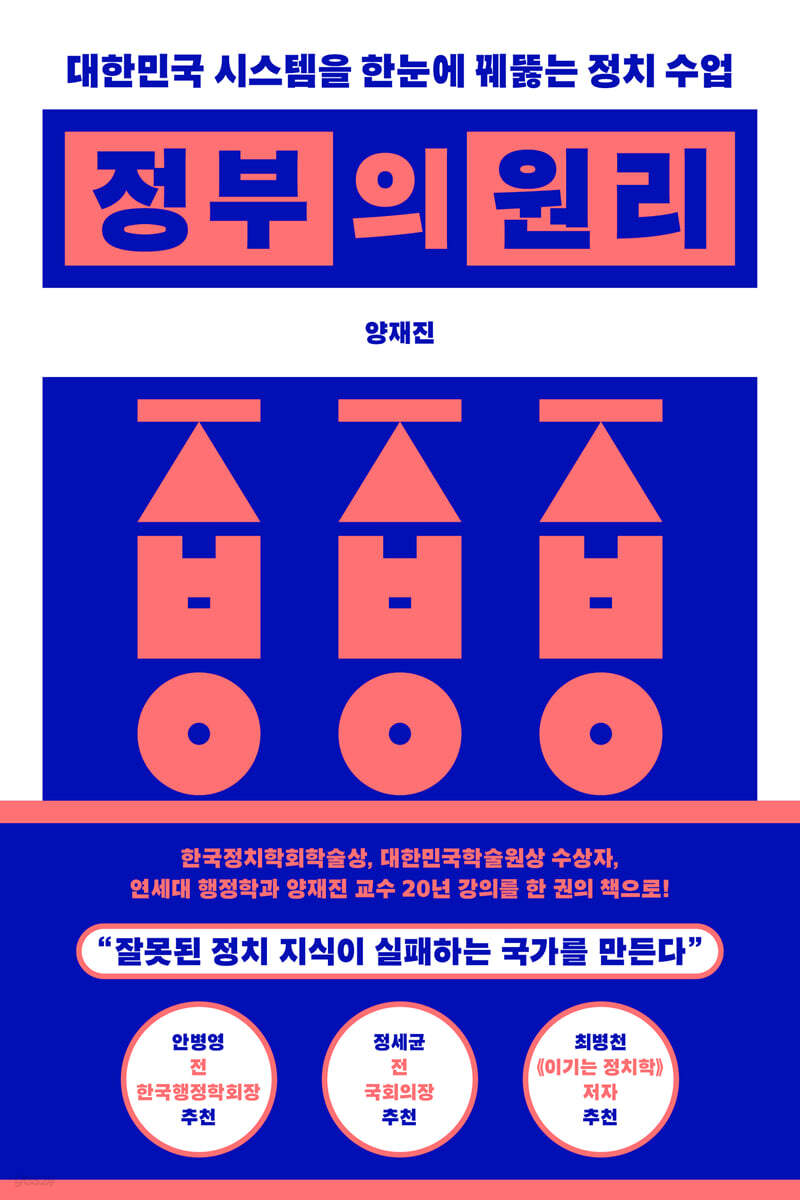
Principles of government
 |
Description
Book Introduction
★★★★★ Highly recommended by former President of the Korean Public Administration Association, Byung-Young Ahn!
★★★★★ Strongly recommended by former National Assembly Speaker Chung Sye-kyun!
★★★★★ Highly recommended by Choi Byeong-cheon, author of "Winning Politics"!
Winner of the Korean Political Science Association Academic Award and the National Academy of Sciences of the Republic of Korea Award
Professor Yang Jae-jin of Yonsei University's Department of Public Administration has compiled 20 years of lectures into a single book!
What is the true meaning of liberal democracy? Is direct democracy truly the best? Will the introduction of a four-year presidential term and a parliamentary cabinet system solve all of our political problems? "The Principles of Government" isn't simply an introductory book explaining "what is government?"
This critical political textbook thoroughly analyzes the principles and structure of Korean politics, from the workings of the National Assembly, political parties, federal/confederational, and national bureaucracy to constitutional amendments and electoral reform, and suggests directions for "possible reform."
Flexible explanations that bridge theory and practice, meticulous structure, a deep understanding of historical cases, and a comparative political perspective combine to create a three-dimensional and integrated understanding of Korean politics.
Beyond simple critique of the status quo, it stimulates the "institutional imagination" needed for the next leap forward in Korean politics, serving as both an intellectual guide and a practical guidebook for the redesign of Korean democracy.
★★★★★ Strongly recommended by former National Assembly Speaker Chung Sye-kyun!
★★★★★ Highly recommended by Choi Byeong-cheon, author of "Winning Politics"!
Winner of the Korean Political Science Association Academic Award and the National Academy of Sciences of the Republic of Korea Award
Professor Yang Jae-jin of Yonsei University's Department of Public Administration has compiled 20 years of lectures into a single book!
What is the true meaning of liberal democracy? Is direct democracy truly the best? Will the introduction of a four-year presidential term and a parliamentary cabinet system solve all of our political problems? "The Principles of Government" isn't simply an introductory book explaining "what is government?"
This critical political textbook thoroughly analyzes the principles and structure of Korean politics, from the workings of the National Assembly, political parties, federal/confederational, and national bureaucracy to constitutional amendments and electoral reform, and suggests directions for "possible reform."
Flexible explanations that bridge theory and practice, meticulous structure, a deep understanding of historical cases, and a comparative political perspective combine to create a three-dimensional and integrated understanding of Korean politics.
Beyond simple critique of the status quo, it stimulates the "institutional imagination" needed for the next leap forward in Korean politics, serving as both an intellectual guide and a practical guidebook for the redesign of Korean democracy.
- You can preview some of the book's contents.
Preview
index
Entering
Chapter 1: What is Politics, Government, and Democracy?
What is politics?
What is government?
Democracy, representative democracy, liberal democracy?
-Representative democracy
-Liberal democracy
Concluding Chapter 1
Chapter 2: The Roots and Principles of the Democratic Republic
Athenian democracy
Roman Republic
The American Republic: The Birth of Modern Liberal Democracy
Concluding Chapter 2
Chapter 3: Is There a Superior Form of Government?
presidential government
-Principles of the presidential system
-Presidential system in reality
parliamentary government
-Principles of the parliamentary cabinet system
-Parliamentary cabinet system in reality
Bicameral executive government
-The principle of the composition of the bicameral executive system
-The dual executive system in reality
South Korea's form of government: presidential system based on parliamentary cabinet system
Concluding Chapter 3
Chapter 4 Political Parties and Enterprises in the Political Market
History and types of political parties
Functions of political parties
Party leader election and nomination method
Socioeconomic rifts and the party system
The development and reality of political parties in Korea
Concluding Chapter 4
Chapter 5: Will Politics Change if the Electoral System Changes?
History of the right to vote
A major shift from a plurality representation system that elects individuals to a proportional representation system for political parties
Understanding and Characteristics of Each Type of Parliamentary Electoral System
- Majority representation system
-Proportional representation system with party lists
-Mixed electoral system
Understanding and Characteristics of Each Type of Presidential Election System
-Direct election
-Indirect election
-United States, direct elections through proxies
Concluding Chapter 5
Chapter 6: The Many Faces of Congress
The modern meaning of parliament as a representative of civil society
Powers and functions of the National Assembly
The legislative dynamics of a bicameral system
The National Assembly of the Republic of Korea is once again in a majority-party system, at the threshold of a consensus system.
Concluding Chapter 6
Chapter 7: State Bureaucracy and Political Control
The formation of a modern state bureaucracy
The need for regime change and political control over the bureaucracy
Political control strategies for bureaucracy
-What is the difference between bureaucrats and politicians?
-Political control strategy
South Korea's regression toward state bureaucracy and coercive control
Concluding Chapter 7
Chapter 8: State Forms and Central-Local Government Relations: Federal, Confederated, and Unitary
federal system
Federation
Single-shot system
Local autonomy in the Republic of Korea
Concluding Chapter 8
Chapter 9: Constitutionalism, a Core Element of Liberal Democracy
Solidarity of freedom and democracy through the Constitution
-The necessity and main contents of a liberal democratic constitution
-The flower of judicial review, the review of unconstitutionality
The Constitutional Court, the guardian of liberal democracy
The judicialization of politics, the politicization of the judiciary
Concluding Chapter 9
Chapter 10: Building a Free and Democratic Nation Again
The Failure of the Imperial Five-Year Single-Term President? The Falsehood of a Rosy Alternative
Preventing reckless driving and promoting cooperation through electoral system reform
-National Assembly elections, proportional representation system
-Presidential election, runoff voting system
Other things to consider
Concluding Chapter 10
main
Chapter 1: What is Politics, Government, and Democracy?
What is politics?
What is government?
Democracy, representative democracy, liberal democracy?
-Representative democracy
-Liberal democracy
Concluding Chapter 1
Chapter 2: The Roots and Principles of the Democratic Republic
Athenian democracy
Roman Republic
The American Republic: The Birth of Modern Liberal Democracy
Concluding Chapter 2
Chapter 3: Is There a Superior Form of Government?
presidential government
-Principles of the presidential system
-Presidential system in reality
parliamentary government
-Principles of the parliamentary cabinet system
-Parliamentary cabinet system in reality
Bicameral executive government
-The principle of the composition of the bicameral executive system
-The dual executive system in reality
South Korea's form of government: presidential system based on parliamentary cabinet system
Concluding Chapter 3
Chapter 4 Political Parties and Enterprises in the Political Market
History and types of political parties
Functions of political parties
Party leader election and nomination method
Socioeconomic rifts and the party system
The development and reality of political parties in Korea
Concluding Chapter 4
Chapter 5: Will Politics Change if the Electoral System Changes?
History of the right to vote
A major shift from a plurality representation system that elects individuals to a proportional representation system for political parties
Understanding and Characteristics of Each Type of Parliamentary Electoral System
- Majority representation system
-Proportional representation system with party lists
-Mixed electoral system
Understanding and Characteristics of Each Type of Presidential Election System
-Direct election
-Indirect election
-United States, direct elections through proxies
Concluding Chapter 5
Chapter 6: The Many Faces of Congress
The modern meaning of parliament as a representative of civil society
Powers and functions of the National Assembly
The legislative dynamics of a bicameral system
The National Assembly of the Republic of Korea is once again in a majority-party system, at the threshold of a consensus system.
Concluding Chapter 6
Chapter 7: State Bureaucracy and Political Control
The formation of a modern state bureaucracy
The need for regime change and political control over the bureaucracy
Political control strategies for bureaucracy
-What is the difference between bureaucrats and politicians?
-Political control strategy
South Korea's regression toward state bureaucracy and coercive control
Concluding Chapter 7
Chapter 8: State Forms and Central-Local Government Relations: Federal, Confederated, and Unitary
federal system
Federation
Single-shot system
Local autonomy in the Republic of Korea
Concluding Chapter 8
Chapter 9: Constitutionalism, a Core Element of Liberal Democracy
Solidarity of freedom and democracy through the Constitution
-The necessity and main contents of a liberal democratic constitution
-The flower of judicial review, the review of unconstitutionality
The Constitutional Court, the guardian of liberal democracy
The judicialization of politics, the politicization of the judiciary
Concluding Chapter 9
Chapter 10: Building a Free and Democratic Nation Again
The Failure of the Imperial Five-Year Single-Term President? The Falsehood of a Rosy Alternative
Preventing reckless driving and promoting cooperation through electoral system reform
-National Assembly elections, proportional representation system
-Presidential election, runoff voting system
Other things to consider
Concluding Chapter 10
main
Detailed image

Into the book
In this way, under a presidential system, conflict between the executive and legislative branches is always latent, and it suddenly surfaces the moment the opposition party wins a general election.
The bigger problem is that the presidential system lacks any democratic principles that can resolve these conflicts.
(...) Therefore, in a presidential system, properly resolving the problem of dual legitimacy is an important task not only for efficient state administration but also for the maturation of democracy.
The issue of conflict between the executive branch and the legislature is likely to be resolved under the leadership of the president if his public approval rating is high and his political leadership is outstanding.
But fundamentally, it is resolved when the election results in the executive and legislature being controlled by the same party.
In other words, it is time for a ruling party to be created, not a ruling party with a minority government.
In addition, if the president has a firm position as the leader of the ruling party and can exercise party power in the National Assembly, the potential for conflict between the executive and legislative branches is significantly reduced.
--- From "Is There a Superior Form of Government?"
In liberal democratic countries with a long history of party politics, party leaders are generally elected to reflect the opinions of party leaders, lawmakers, and party members.
The recent adoption by Korean political parties of reflecting public opinion poll results in the election of party leaders is highly unusual.
It is even more difficult to find cases where an outsider is appointed as the temporary party leader, like the emergency response committee chairman.
In cases like Europe where party leaders are elected through members of parliament or a recommendation committee, prior legislative experience and political career are greatly considered.
On the other hand, when the party leader is elected through a general vote of party members or even through an opinion poll, popularity becomes a major scoring point.
Since the incumbent member of the National Assembly does not need to be the party leader, the emergence of new leadership can bring about easy and rapid change.
However, it comes with the disadvantages of a political party losing stability and predictability and drifting towards populism.
--- From "Political Parties, Enterprises in the Political Market"
However, bureaucrats have the structural ability to deceive the ruling political forces that seek policy change.
First, they have superior information, professional skills, and experience in the relevant policy field than politicians.
They persuade those in power by citing theories and experiences, saying, 'This won't work because of this, that won't work because of that.'
It is difficult for an amateur politician to beat a professional.
And compared to presidents or ministers whose terms are limited, bureaucrats have the resource of guaranteed retirement.
Bureaucrats can delay policy changes until the regime changes.
This is why the president is struggling with lame duck status at the end of his term and why welfare instability is particularly severe.
In summary, the greater the difference in preferences between politicians and bureaucrats and the greater the gap in information power, the greater the possibility of deception by bureaucrats.
Conversely, the need for the ruling party to control it increases.
When there is a change of government between the ruling and opposition parties for the first time in a long time, or when there is a significant ideological difference between the left and right administrations, or when a political force pursuing large-scale reform comes to power, political control over the bureaucracy becomes a critical task.
--- From “State Bureaucracy and Political Control”
A runoff voting system should be introduced in the presidential election.
The runoff system increases the legitimacy of the president's rule by securing majority support.
At the same time, ahead of the election, we will encourage solidarity and alliances between independent political parties, rather than forced Chunhyang-style mergers or unifications.
Based on the support secured in the first round of voting, each party forms an alliance ahead of the second round of voting.
Even small parties that came in third or lower in the first round of voting negotiate with presidential candidates who have a solid stake in the runoff.
The parties that participated in the runoff election form a coalition cabinet after the election and share the fruits of victory.
Although it is a presidential system, it is not a winner-take-all system.
The bigger problem is that the presidential system lacks any democratic principles that can resolve these conflicts.
(...) Therefore, in a presidential system, properly resolving the problem of dual legitimacy is an important task not only for efficient state administration but also for the maturation of democracy.
The issue of conflict between the executive branch and the legislature is likely to be resolved under the leadership of the president if his public approval rating is high and his political leadership is outstanding.
But fundamentally, it is resolved when the election results in the executive and legislature being controlled by the same party.
In other words, it is time for a ruling party to be created, not a ruling party with a minority government.
In addition, if the president has a firm position as the leader of the ruling party and can exercise party power in the National Assembly, the potential for conflict between the executive and legislative branches is significantly reduced.
--- From "Is There a Superior Form of Government?"
In liberal democratic countries with a long history of party politics, party leaders are generally elected to reflect the opinions of party leaders, lawmakers, and party members.
The recent adoption by Korean political parties of reflecting public opinion poll results in the election of party leaders is highly unusual.
It is even more difficult to find cases where an outsider is appointed as the temporary party leader, like the emergency response committee chairman.
In cases like Europe where party leaders are elected through members of parliament or a recommendation committee, prior legislative experience and political career are greatly considered.
On the other hand, when the party leader is elected through a general vote of party members or even through an opinion poll, popularity becomes a major scoring point.
Since the incumbent member of the National Assembly does not need to be the party leader, the emergence of new leadership can bring about easy and rapid change.
However, it comes with the disadvantages of a political party losing stability and predictability and drifting towards populism.
--- From "Political Parties, Enterprises in the Political Market"
However, bureaucrats have the structural ability to deceive the ruling political forces that seek policy change.
First, they have superior information, professional skills, and experience in the relevant policy field than politicians.
They persuade those in power by citing theories and experiences, saying, 'This won't work because of this, that won't work because of that.'
It is difficult for an amateur politician to beat a professional.
And compared to presidents or ministers whose terms are limited, bureaucrats have the resource of guaranteed retirement.
Bureaucrats can delay policy changes until the regime changes.
This is why the president is struggling with lame duck status at the end of his term and why welfare instability is particularly severe.
In summary, the greater the difference in preferences between politicians and bureaucrats and the greater the gap in information power, the greater the possibility of deception by bureaucrats.
Conversely, the need for the ruling party to control it increases.
When there is a change of government between the ruling and opposition parties for the first time in a long time, or when there is a significant ideological difference between the left and right administrations, or when a political force pursuing large-scale reform comes to power, political control over the bureaucracy becomes a critical task.
--- From “State Bureaucracy and Political Control”
A runoff voting system should be introduced in the presidential election.
The runoff system increases the legitimacy of the president's rule by securing majority support.
At the same time, ahead of the election, we will encourage solidarity and alliances between independent political parties, rather than forced Chunhyang-style mergers or unifications.
Based on the support secured in the first round of voting, each party forms an alliance ahead of the second round of voting.
Even small parties that came in third or lower in the first round of voting negotiate with presidential candidates who have a solid stake in the runoff.
The parties that participated in the runoff election form a coalition cabinet after the election and share the fruits of victory.
Although it is a presidential system, it is not a winner-take-all system.
--- From "Building a Free and Democratic Country Again"
Publisher's Review
Complete your political literacy!
Faulty political knowledge creates a failing nation.
Understanding and redesigning South Korea's democracy from the ground up
Where is democracy in Korea? The spread of liberal democracy seemed irreversible after the collapse of Eastern Europe in the 1990s, but now, a democratic retreat is occurring around the world.
Korea is no exception.
Especially now, when events like the martial law controversy surrounding the Yoon Seok-yeol administration have brought home the crisis of Korean democracy, this book is a crucial attempt and intellectual challenge to fundamentally examine the institutional framework of Korean politics.
How well do we truly understand the liberal democratic system?
In reality, many people who participate in real-world politics, such as ordinary citizens, members of the National Assembly, government officials, aides, and journalists, remain stuck in misunderstandings and preconceptions about liberal democracy and representative democracy, and in conceptual confusion between republic and direct democracy.
Wrong political knowledge inevitably leads to wrong direction.
Direct democracy is the best, but some argue that our country, with its large population and land area, uses an indirect democracy based on a representative system. Others argue that the excessive power of the judiciary, which is not elected, is problematic and should be placed under democratic control.
There are still hopes that the problems of Korean politics will be solved by adopting a parliamentary cabinet system or a four-year presidential term.
"The Principles of Government" offers a correct understanding of institutions and a comparative political perspective, moving beyond the "wishful thinking" and confusion of concepts about our politics and government.
Beyond simply listing systems and dictionary-like explanations, it organically links concepts → systems → the operation of real politics, clearly revealing the gap between institutional design and real politics.
For example, it enables a three-dimensional and integrated understanding of Korean politics by examining how the concept of "liberal democracy" should be reflected in actual institutional design, what political outcomes that system produces, and how it has malfunctioned or been distorted within Korean politics.
“A masterpiece that elevates the level of research and discourse in this field!”
The author, who has taught 'Comparative Government' for 20 years
Rich historical examples and comparative analysis with foreign governments
South Korea holds liberal democracy as the core of its national identity, citing Article 1 of its Constitution, which states, "The Republic of Korea is a democratic republic."
However, even within the same liberal democratic countries, the way politics works and the way it is conducted are different.
This is because the political culture and national character are different, and above all, the political system is different.
Some places have a presidential system, some have a parliamentary system, and some have a bicameral executive system.
There are countries with two-party systems like ours, and there are also countries with multi-party systems where several large political parties are active in the parliament.
Some countries, like ours, have only one parliament, but many others have a House of Representatives and a Senate.
Are there any superior forms of government, party structures, and institutions? Why did Korea historically choose these systems, and what impact do each of these systems have on politics and what collective outcomes do they produce?
Professor Yang Jae-jin, the author, draws on the research and insights he has accumulated over 20 years of teaching "Comparative Government" to examine past cases and the workings of governments in other countries to gain a deeper understanding of Korean politics.
Starting from ancient Athenian democracy, it traces the roots of the Roman Republic and American constitutionalism, and reveals the historical origins of the Korean democratic republic system.
By systematically comparing the government forms, party structures, electoral systems, and judicial systems of various countries, including the United States, France, Germany, Sweden, and Japan, it reveals more clearly the state of politics, government, and democracy in Korea.
Furthermore, rather than leaving these traditions and cases as mere examples, they demonstrate how politics changes depending on the combination of each system, and serve as practical reference models for designing problems and directions for improvement in our political system.
Starting with the question, "Why is the political system a problem?", this book explores intriguingly how democracy is realized and undermined by the system, exploring cases from theory and reality, past and present, and Korea and the world.
“Why doesn’t our politics change?”
Institutional imagination for the next leap forward for Korean democracy!
Going beyond criticism of the status quo to suggest a direction for "possible reform."
The saying, "Economy is advanced, politics is backward," has now become a cliché, but the reality still holds true.
Although exports, IT infrastructure, and education levels are world-class, politics remains mired in a swamp of polarized confrontation, verbal warfare, and repeated irresponsible regime changes.
"Principles of Government" is a book that goes beyond this reality and makes us imagine the "next stage of Korean democracy."
Why is South Korea's presidential system repeatedly criticized as an "imperial presidency"? What are the ways to achieve responsible governance while maintaining the presidential system? How must the majority party structure in the National Assembly be transformed to facilitate cooperation? The author examines key political issues, including the cabinet-like elements inherent in South Korea's constitutional structure, the structural causes of the imperial presidency, and the politicization of the Constitutional Court and the judiciary. Beyond a simple critique of the current situation, the author proposes how to create a better political system, offering a detailed overview of institutional possibilities and directions for reform.
Critical examination of the introduction of a parliamentary cabinet system or a four-year presidential term, expansion of proportional representation in the National Assembly to break away from the two-party system, introduction of a presidential runoff election system to eliminate the winner-takes-all system, measures to strengthen the spirit of the Constitution and prevent the politicization of the judiciary, the possibility and limits of political control over the bureaucracy, restrictions on the National Assembly's impeachment power, and a realistic examination of the introduction of a bicameral system are all practical reform directions suggested by this book.
This book dissects the core infrastructure of democracy—government, political parties, parliament, elections, federations, and the constitution—and, to prevent discussions surrounding institutional reform from devolving into political squabbles or empty idealism, presents a path to "possible reform" based on empirical cases and institutional operating principles.
This book, "Principles of Government," ultimately presupposes the following belief:
Political systems change people and change political culture.
And the political system we have now can 'evolve' to enable a better democracy.
Will politicians who engage in reckless driving actually create and install their own control mechanisms? It won't be easy.
Right now, we urgently need effective alternatives for the intellectual community and the virtue and action of sovereign citizens.
This book is essential not only for those majoring in political science or public administration, but also for citizens seeking a clear understanding of the complex political system, policymakers, civil servants, lawyers, and political party practitioners contemplating practical political reform.
It answers the question, "Why is political system reform necessary now?" with constitutional depth and political breadth, serving as both an intellectual guide and a practical guide for redesigning Korean democracy.
Faulty political knowledge creates a failing nation.
Understanding and redesigning South Korea's democracy from the ground up
Where is democracy in Korea? The spread of liberal democracy seemed irreversible after the collapse of Eastern Europe in the 1990s, but now, a democratic retreat is occurring around the world.
Korea is no exception.
Especially now, when events like the martial law controversy surrounding the Yoon Seok-yeol administration have brought home the crisis of Korean democracy, this book is a crucial attempt and intellectual challenge to fundamentally examine the institutional framework of Korean politics.
How well do we truly understand the liberal democratic system?
In reality, many people who participate in real-world politics, such as ordinary citizens, members of the National Assembly, government officials, aides, and journalists, remain stuck in misunderstandings and preconceptions about liberal democracy and representative democracy, and in conceptual confusion between republic and direct democracy.
Wrong political knowledge inevitably leads to wrong direction.
Direct democracy is the best, but some argue that our country, with its large population and land area, uses an indirect democracy based on a representative system. Others argue that the excessive power of the judiciary, which is not elected, is problematic and should be placed under democratic control.
There are still hopes that the problems of Korean politics will be solved by adopting a parliamentary cabinet system or a four-year presidential term.
"The Principles of Government" offers a correct understanding of institutions and a comparative political perspective, moving beyond the "wishful thinking" and confusion of concepts about our politics and government.
Beyond simply listing systems and dictionary-like explanations, it organically links concepts → systems → the operation of real politics, clearly revealing the gap between institutional design and real politics.
For example, it enables a three-dimensional and integrated understanding of Korean politics by examining how the concept of "liberal democracy" should be reflected in actual institutional design, what political outcomes that system produces, and how it has malfunctioned or been distorted within Korean politics.
“A masterpiece that elevates the level of research and discourse in this field!”
The author, who has taught 'Comparative Government' for 20 years
Rich historical examples and comparative analysis with foreign governments
South Korea holds liberal democracy as the core of its national identity, citing Article 1 of its Constitution, which states, "The Republic of Korea is a democratic republic."
However, even within the same liberal democratic countries, the way politics works and the way it is conducted are different.
This is because the political culture and national character are different, and above all, the political system is different.
Some places have a presidential system, some have a parliamentary system, and some have a bicameral executive system.
There are countries with two-party systems like ours, and there are also countries with multi-party systems where several large political parties are active in the parliament.
Some countries, like ours, have only one parliament, but many others have a House of Representatives and a Senate.
Are there any superior forms of government, party structures, and institutions? Why did Korea historically choose these systems, and what impact do each of these systems have on politics and what collective outcomes do they produce?
Professor Yang Jae-jin, the author, draws on the research and insights he has accumulated over 20 years of teaching "Comparative Government" to examine past cases and the workings of governments in other countries to gain a deeper understanding of Korean politics.
Starting from ancient Athenian democracy, it traces the roots of the Roman Republic and American constitutionalism, and reveals the historical origins of the Korean democratic republic system.
By systematically comparing the government forms, party structures, electoral systems, and judicial systems of various countries, including the United States, France, Germany, Sweden, and Japan, it reveals more clearly the state of politics, government, and democracy in Korea.
Furthermore, rather than leaving these traditions and cases as mere examples, they demonstrate how politics changes depending on the combination of each system, and serve as practical reference models for designing problems and directions for improvement in our political system.
Starting with the question, "Why is the political system a problem?", this book explores intriguingly how democracy is realized and undermined by the system, exploring cases from theory and reality, past and present, and Korea and the world.
“Why doesn’t our politics change?”
Institutional imagination for the next leap forward for Korean democracy!
Going beyond criticism of the status quo to suggest a direction for "possible reform."
The saying, "Economy is advanced, politics is backward," has now become a cliché, but the reality still holds true.
Although exports, IT infrastructure, and education levels are world-class, politics remains mired in a swamp of polarized confrontation, verbal warfare, and repeated irresponsible regime changes.
"Principles of Government" is a book that goes beyond this reality and makes us imagine the "next stage of Korean democracy."
Why is South Korea's presidential system repeatedly criticized as an "imperial presidency"? What are the ways to achieve responsible governance while maintaining the presidential system? How must the majority party structure in the National Assembly be transformed to facilitate cooperation? The author examines key political issues, including the cabinet-like elements inherent in South Korea's constitutional structure, the structural causes of the imperial presidency, and the politicization of the Constitutional Court and the judiciary. Beyond a simple critique of the current situation, the author proposes how to create a better political system, offering a detailed overview of institutional possibilities and directions for reform.
Critical examination of the introduction of a parliamentary cabinet system or a four-year presidential term, expansion of proportional representation in the National Assembly to break away from the two-party system, introduction of a presidential runoff election system to eliminate the winner-takes-all system, measures to strengthen the spirit of the Constitution and prevent the politicization of the judiciary, the possibility and limits of political control over the bureaucracy, restrictions on the National Assembly's impeachment power, and a realistic examination of the introduction of a bicameral system are all practical reform directions suggested by this book.
This book dissects the core infrastructure of democracy—government, political parties, parliament, elections, federations, and the constitution—and, to prevent discussions surrounding institutional reform from devolving into political squabbles or empty idealism, presents a path to "possible reform" based on empirical cases and institutional operating principles.
This book, "Principles of Government," ultimately presupposes the following belief:
Political systems change people and change political culture.
And the political system we have now can 'evolve' to enable a better democracy.
Will politicians who engage in reckless driving actually create and install their own control mechanisms? It won't be easy.
Right now, we urgently need effective alternatives for the intellectual community and the virtue and action of sovereign citizens.
This book is essential not only for those majoring in political science or public administration, but also for citizens seeking a clear understanding of the complex political system, policymakers, civil servants, lawyers, and political party practitioners contemplating practical political reform.
It answers the question, "Why is political system reform necessary now?" with constitutional depth and political breadth, serving as both an intellectual guide and a practical guide for redesigning Korean democracy.
GOODS SPECIFICS
- Date of issue: July 18, 2025
- Page count, weight, size: 368 pages | 526g | 144*216*26mm
- ISBN13: 9791194285144
- ISBN10: 1194285147
You may also like
카테고리
korean


korean

![GQ KOREA Mark (Monthly): December [2025]](http://librairie.coreenne.fr/cdn/shop/files/8ef265dbbfbf186523ed75ba7319009d.jpg?v=1765340328&width=3840)


