

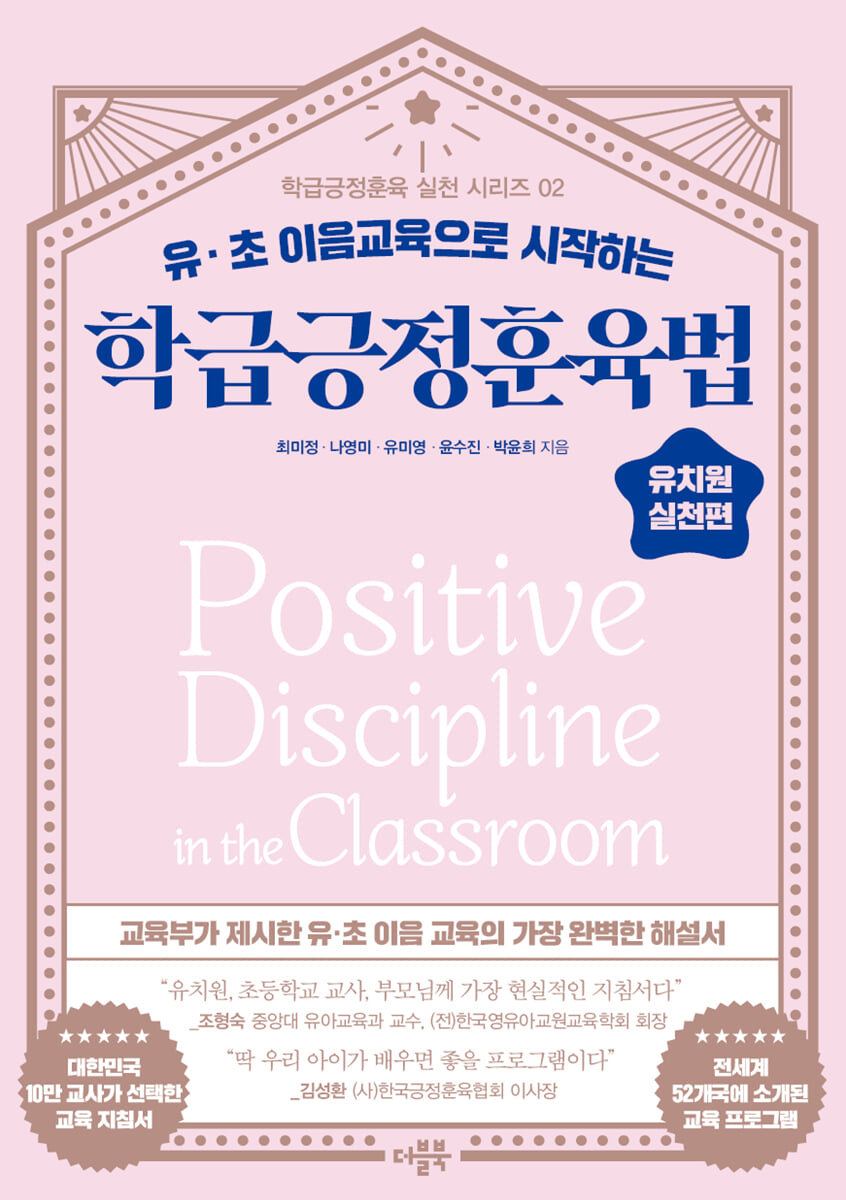
Positive Discipline in the Classroom: Kindergarten Practice
 |
Description
Book Introduction
The integrated elementary and middle school semester system will be fully expanded starting in 2026!
★The Ministry of Education's most complete guide to early childhood education★
Ahead of the full implementation of the 2026 joint kindergarten and elementary school semester, kindergarten and elementary school education experts working in the field gathered.
We met to discuss the innovation of early childhood education in Korea and to explore educational methods for children in transition who can adapt to times of change. We planned and wrote the book, “Classroom Positive Discipline: Kindergarten Practice.”
This period, when the educational environment changes from kindergarten to elementary school, is a very important time for our children as it marks the beginning of a life transition.
During this time, children learn the wisdom and courage to adapt to new environments and overcome crises as they go through life.
At a time when the roles of teachers and parents are more important than ever, we have compiled successful educational examples based on 'positive classroom discipline' actually practiced in the classroom by teachers working on the front lines of education, and have created the most efficient and reasonable educational guide.
A variety of activities that provide emotional support to children, the professional perspectives of educators, and systematic programs for children's growth and development will be of great practical help in teaching our children social skills and fostering cooperative relationships between teachers and parents.
Early childhood education is no longer optional but mandatory.
I hope that the contents of this book will serve as a guide to beneficial education for the happiness and future of our children.
★The Ministry of Education's most complete guide to early childhood education★
Ahead of the full implementation of the 2026 joint kindergarten and elementary school semester, kindergarten and elementary school education experts working in the field gathered.
We met to discuss the innovation of early childhood education in Korea and to explore educational methods for children in transition who can adapt to times of change. We planned and wrote the book, “Classroom Positive Discipline: Kindergarten Practice.”
This period, when the educational environment changes from kindergarten to elementary school, is a very important time for our children as it marks the beginning of a life transition.
During this time, children learn the wisdom and courage to adapt to new environments and overcome crises as they go through life.
At a time when the roles of teachers and parents are more important than ever, we have compiled successful educational examples based on 'positive classroom discipline' actually practiced in the classroom by teachers working on the front lines of education, and have created the most efficient and reasonable educational guide.
A variety of activities that provide emotional support to children, the professional perspectives of educators, and systematic programs for children's growth and development will be of great practical help in teaching our children social skills and fostering cooperative relationships between teachers and parents.
Early childhood education is no longer optional but mandatory.
I hope that the contents of this book will serve as a guide to beneficial education for the happiness and future of our children.
- You can preview some of the book's contents.
Preview
index
Recommendation
Connecting early childhood and elementary school education based on the "Classroom Positive Discipline" method is not optional, but essential. Cho Hyung-sook (Professor, Department of Early Childhood Education, Chung-Ang University/Former President, Korean Society for Early Childhood Education)
Introducing the best customized education program for your precious child. Kim Seonghwan (Yangpyeong Elementary School Teacher/Chairman of the Korea Positive Discipline Association)
Opening Remarks: Classroom Positive Discipline and Early Childhood Education Are Connected
Part 1: Classroom Positive Discipline, Early Childhood Education, and Child Development
Chapter 1: Early Childhood and Elementary Education: A Perspective from a 7-Year-Old Kindergarten Teacher
Chapter 2: Early Childhood and Elementary Education as Seen by a First Grade Teacher
Chapter 3: Classroom Positive Discipline from a Child Development Perspective
(1) Early childhood, where children take the initiative
(2) Childhood, where a sense of belonging is formed based on diligence
Part 2: Connecting Classroom Positive Discipline with Early Childhood and Elementary Education
Chapter 1 - Classroom Positive Discipline-Based Connected Kindergarten and Elementary School Education
(1) A special greeting for a child who is difficult to approach
(2) Creating consent and guidelines
(3) Practice daily routine
(4) Have practice time
(5) Define meaningful roles
(6) How to control anger
(7) Wounded child
(8) 3 Steps to Apologizing
(9) Recognizing each other's differences
(10) Class meeting
Chapter 2 - Intensive Semester-Long Continuing Education Using Positive Classroom Discipline
(1) Five Important School Readiness Skills
(2) First skill, emotional literacy
(3) Second skill, delayed gratification
(4) Third technology, cooperation
(5) Fourth skill, communication skills
(6) Fifth Skill: Courage and Growth Mindset
Chapter 3: Slow Learners and Early Childhood Education Through the Lens of Positive Discipline
(1) Learn about slow learners
(2) Slow learners, connection education, and positive classroom discipline
(3) PDC that adapts to the pace of slow learners encountered in school settings
(4) Teachers who grow together with PDC
Chapter 4 - Classroom Positive Discipline-Based Kindergarten and Elementary School Connection Education Practiced by First Graders
(1) We are all connected
(2) The flower of positive discipline: a grade-level gathering! Even first-year students can participate.
(3) Learn Korean vowels and go to your younger sibling's class to teach them.
(4) Invite your 5 year old siblings to play together in the first grade classroom.
(5) Learning about mistakes and recovering from them together with the 5-year-old class and the first graders.
(6) Children in the 3rd, 4th, and 5th grade classes and first graders gather together to learn self-regulation.
(7) Let's raise social awareness through Hangeul Day events.
Part 3: Proposals for Parent-Teacher Connection Education
Chapter 1 - A New Approach to First-Year Curriculum Presentations
(1) A three-party meeting where teachers, students, and parents face each other
(2) Conduct a three-party meeting
Chapter 2 - Observation Class for 7th Grade Graduating Class
(1) Transforming parents’ anxiety into trust and anticipation
(2) I want to be friends with confidence!
Chapter 3 - Positive Discipline Counseling for Parents
(1) Mother's tears
(2) Parent counseling from the perspective of positive classroom discipline
Chapter 4 - Growing Together with Positive Discipline for Slow Learners
(1) How to practice PD at home: Help like this
(2) Experiencing the power of PD
Closing remarks: Teacher, what skills do you have?
supplement
main
References
About the author
Connecting early childhood and elementary school education based on the "Classroom Positive Discipline" method is not optional, but essential. Cho Hyung-sook (Professor, Department of Early Childhood Education, Chung-Ang University/Former President, Korean Society for Early Childhood Education)
Introducing the best customized education program for your precious child. Kim Seonghwan (Yangpyeong Elementary School Teacher/Chairman of the Korea Positive Discipline Association)
Opening Remarks: Classroom Positive Discipline and Early Childhood Education Are Connected
Part 1: Classroom Positive Discipline, Early Childhood Education, and Child Development
Chapter 1: Early Childhood and Elementary Education: A Perspective from a 7-Year-Old Kindergarten Teacher
Chapter 2: Early Childhood and Elementary Education as Seen by a First Grade Teacher
Chapter 3: Classroom Positive Discipline from a Child Development Perspective
(1) Early childhood, where children take the initiative
(2) Childhood, where a sense of belonging is formed based on diligence
Part 2: Connecting Classroom Positive Discipline with Early Childhood and Elementary Education
Chapter 1 - Classroom Positive Discipline-Based Connected Kindergarten and Elementary School Education
(1) A special greeting for a child who is difficult to approach
(2) Creating consent and guidelines
(3) Practice daily routine
(4) Have practice time
(5) Define meaningful roles
(6) How to control anger
(7) Wounded child
(8) 3 Steps to Apologizing
(9) Recognizing each other's differences
(10) Class meeting
Chapter 2 - Intensive Semester-Long Continuing Education Using Positive Classroom Discipline
(1) Five Important School Readiness Skills
(2) First skill, emotional literacy
(3) Second skill, delayed gratification
(4) Third technology, cooperation
(5) Fourth skill, communication skills
(6) Fifth Skill: Courage and Growth Mindset
Chapter 3: Slow Learners and Early Childhood Education Through the Lens of Positive Discipline
(1) Learn about slow learners
(2) Slow learners, connection education, and positive classroom discipline
(3) PDC that adapts to the pace of slow learners encountered in school settings
(4) Teachers who grow together with PDC
Chapter 4 - Classroom Positive Discipline-Based Kindergarten and Elementary School Connection Education Practiced by First Graders
(1) We are all connected
(2) The flower of positive discipline: a grade-level gathering! Even first-year students can participate.
(3) Learn Korean vowels and go to your younger sibling's class to teach them.
(4) Invite your 5 year old siblings to play together in the first grade classroom.
(5) Learning about mistakes and recovering from them together with the 5-year-old class and the first graders.
(6) Children in the 3rd, 4th, and 5th grade classes and first graders gather together to learn self-regulation.
(7) Let's raise social awareness through Hangeul Day events.
Part 3: Proposals for Parent-Teacher Connection Education
Chapter 1 - A New Approach to First-Year Curriculum Presentations
(1) A three-party meeting where teachers, students, and parents face each other
(2) Conduct a three-party meeting
Chapter 2 - Observation Class for 7th Grade Graduating Class
(1) Transforming parents’ anxiety into trust and anticipation
(2) I want to be friends with confidence!
Chapter 3 - Positive Discipline Counseling for Parents
(1) Mother's tears
(2) Parent counseling from the perspective of positive classroom discipline
Chapter 4 - Growing Together with Positive Discipline for Slow Learners
(1) How to practice PD at home: Help like this
(2) Experiencing the power of PD
Closing remarks: Teacher, what skills do you have?
supplement
main
References
About the author
Detailed image
.jpg)
Into the book
New Zealand views early childhood education as a journey.
Rather than setting a goal and focusing only on the goal, focus on the process of connecting kindergarten and elementary school education.
The most notable characteristic is that the role of the director is considered important.
The director must form a strong bond with the children, develop a child-centered curriculum, and continually review the progress of the connection.
--- p.24
It is said that if a tree is transplanted from its original location to another, it takes at least four years for the tree to fully adapt.
Moreover, it would be difficult and arduous for a person to adapt to a new environment.
Entering elementary school, an environment completely different from kindergarten, is a turning point in children's lives where they face great fear in a new world.
--- p.29
There are children like Ga-eul who do not know their own emotions well and do not know how to deal with them.
If there are teachers who are concerned about this type of child, I recommend the PDC's activities of recognizing emotions and positive time-out space activities.
--- p.76
Communicating with the child's needs rather than the teacher's, recognizing that mistakes are a source of growth, and the joy of seeing self-regulation and mistakes as learning opportunities.
This is the important message that PDC wants to convey.
--- p.150
Minsik, a slow learner, was taking ADHD medication. He said the medication left him feeling weak and unappetizing, making it difficult to eat.
After unfolding the emotion cards and looking at the emotions Minsik felt over the past week, the emotion card he chose was 'happiness'.
--- p.152
Yoon Seong-jang, who gave teachers a sense of accomplishment and pride, and made them realize once again that they were growing together.
It was around the time when spring was transitioning into summer that I met Seongrang.
The teacher began to worry when he saw the student answering the teacher's questions with a silent smile without even expressing his own opinion first.
What kind of support does Seongrang need to help her ask questions first and express herself more confidently?
--- p.167
The most significant features of the 2022 revised curriculum are the increased number of Korean language classes, the significant changes to the integrated curriculum topics, and the inclusion of safety subjects in the integrated curriculum.
Additionally, to strengthen children's physical activity, the number of hours of indoor and outdoor play and physical activity within the "Fun Time" curriculum for first and second graders will be increased from 80 hours to 144 hours.
--- p.171
PDC's technologies are closely linked to future competency education in early childhood education.
This is mentioned in several parts of this book. PDC offers a variety of activities to help children grow into responsible, respectful, and capable mature citizens.
This activity details 11 essential skills for PDC classes, 8 skills for class meetings, and 52 tools for disciplining children.
These techniques are designed to help children develop life skills and qualities.
Rather than setting a goal and focusing only on the goal, focus on the process of connecting kindergarten and elementary school education.
The most notable characteristic is that the role of the director is considered important.
The director must form a strong bond with the children, develop a child-centered curriculum, and continually review the progress of the connection.
--- p.24
It is said that if a tree is transplanted from its original location to another, it takes at least four years for the tree to fully adapt.
Moreover, it would be difficult and arduous for a person to adapt to a new environment.
Entering elementary school, an environment completely different from kindergarten, is a turning point in children's lives where they face great fear in a new world.
--- p.29
There are children like Ga-eul who do not know their own emotions well and do not know how to deal with them.
If there are teachers who are concerned about this type of child, I recommend the PDC's activities of recognizing emotions and positive time-out space activities.
--- p.76
Communicating with the child's needs rather than the teacher's, recognizing that mistakes are a source of growth, and the joy of seeing self-regulation and mistakes as learning opportunities.
This is the important message that PDC wants to convey.
--- p.150
Minsik, a slow learner, was taking ADHD medication. He said the medication left him feeling weak and unappetizing, making it difficult to eat.
After unfolding the emotion cards and looking at the emotions Minsik felt over the past week, the emotion card he chose was 'happiness'.
--- p.152
Yoon Seong-jang, who gave teachers a sense of accomplishment and pride, and made them realize once again that they were growing together.
It was around the time when spring was transitioning into summer that I met Seongrang.
The teacher began to worry when he saw the student answering the teacher's questions with a silent smile without even expressing his own opinion first.
What kind of support does Seongrang need to help her ask questions first and express herself more confidently?
--- p.167
The most significant features of the 2022 revised curriculum are the increased number of Korean language classes, the significant changes to the integrated curriculum topics, and the inclusion of safety subjects in the integrated curriculum.
Additionally, to strengthen children's physical activity, the number of hours of indoor and outdoor play and physical activity within the "Fun Time" curriculum for first and second graders will be increased from 80 hours to 144 hours.
--- p.171
PDC's technologies are closely linked to future competency education in early childhood education.
This is mentioned in several parts of this book. PDC offers a variety of activities to help children grow into responsible, respectful, and capable mature citizens.
This activity details 11 essential skills for PDC classes, 8 skills for class meetings, and 52 tools for disciplining children.
These techniques are designed to help children develop life skills and qualities.
--- p.249
Publisher's Review
“How do you provide early childhood education?”
Contains clear answers to questions
The kindergarten-elementary school linkage education is literally the connection between kindergarten and elementary school curricula.
The purpose of this education is to help 5 and 8 year olds have happy companionship.
This book will be the ultimate guide to transforming anxiety and fear into anticipation and excitement ahead of the government's full implementation of early childhood education.
Teachers with extensive field experience in kindergartens and elementary schools have gathered together to share tips and success stories for interconnected education, presenting clear solutions for connecting kindergartens and elementary schools.
It also provides detailed explanations of fun classroom management methods, life guidance, discipline, social-emotional education, and play programs based on positive discipline.
This book, which presents a new paradigm for connected education, will be a friendly guide that provides courage and encouragement to children, parents, and teachers.
Experts in PDC (Positive Discipline in the Classroom) and early childhood education
Completed systematic teaching method
'Positive Discipline in the Classroom', based on Adlerian psychology, is the most effective educational approach recognized by teachers and education experts.
This book contains the educational philosophy of the kindergarten and elementary school education curriculum based on ‘positive classroom discipline.’
Especially in today's society where many families have only a few children, it is more important than ever for children to develop the virtues necessary to live competently as members of the community.
This is a time when our children must learn consideration and compromise as members of a community while maintaining their self-esteem as individuals. Through examples of early childhood education through PDC, teachers can learn in detail everything they need to know about this period, from educational philosophy and classroom management to disciplinary methods, life guidance, and social-emotional education.
For successful kindergarten-elementary school connection as suggested by the Ministry of Education
What are the four competencies?
To help us gain a more accurate understanding of early childhood education, we will examine the examples of countries around the world (New Zealand, the UK, Finland) that have been practicing early childhood education ahead of us, and suggest the direction of public education in Korea.
Additionally, based on this, it provides an in-depth explanation of the ‘4 competencies’ presented by the Ministry of Education.
This book introduces classroom positive discipline activities to help children develop four competencies that they need to develop: physical motor skills, lifelong learning skills, self-regulation skills, and social-emotional skills, based on the four principles of early childhood education: continuity, connectivity, diversity, and cooperation.
Growing through Positive Discipline in the Classroom (PDC)
For children, parents, and teachers
Adler, who is the psychological basis of PDC, said, “The task of a kindergarten teacher is to foster the child’s sociality.
“Education from the perspective of nurturing socially competent individuals should not remain an empty slogan,” he said.
What is the difference between learning and acquiring?
Learning is the process of teaching and learning, and acquisition is the process of putting what you have learned into your body.
Early childhood is a time for acquisition, not learning.
As the Korean proverb says, “Habits learned at age three last until age eighty,” children’s social and emotional skills are not innate, but must be developed through practice and acquisition.
We need to find skills that we haven't learned yet and teach and practice them.
These exercises will be a valuable experience.
Successful experiences during the first transition in life will serve as a stepping stone for the next transition.
This will help children build a strong inner self and internalize it to move forward into the bigger world.
This book was written with the sincere desire to support children who are going through their first transition in life and to help them succeed.
This is to help children grow into well-rounded individuals with sound character, social skills, and the four competencies suggested by the Ministry of Education.
I hope that this will be a time when both parents and teachers will be happy through the child's changes.
Contains clear answers to questions
The kindergarten-elementary school linkage education is literally the connection between kindergarten and elementary school curricula.
The purpose of this education is to help 5 and 8 year olds have happy companionship.
This book will be the ultimate guide to transforming anxiety and fear into anticipation and excitement ahead of the government's full implementation of early childhood education.
Teachers with extensive field experience in kindergartens and elementary schools have gathered together to share tips and success stories for interconnected education, presenting clear solutions for connecting kindergartens and elementary schools.
It also provides detailed explanations of fun classroom management methods, life guidance, discipline, social-emotional education, and play programs based on positive discipline.
This book, which presents a new paradigm for connected education, will be a friendly guide that provides courage and encouragement to children, parents, and teachers.
Experts in PDC (Positive Discipline in the Classroom) and early childhood education
Completed systematic teaching method
'Positive Discipline in the Classroom', based on Adlerian psychology, is the most effective educational approach recognized by teachers and education experts.
This book contains the educational philosophy of the kindergarten and elementary school education curriculum based on ‘positive classroom discipline.’
Especially in today's society where many families have only a few children, it is more important than ever for children to develop the virtues necessary to live competently as members of the community.
This is a time when our children must learn consideration and compromise as members of a community while maintaining their self-esteem as individuals. Through examples of early childhood education through PDC, teachers can learn in detail everything they need to know about this period, from educational philosophy and classroom management to disciplinary methods, life guidance, and social-emotional education.
For successful kindergarten-elementary school connection as suggested by the Ministry of Education
What are the four competencies?
To help us gain a more accurate understanding of early childhood education, we will examine the examples of countries around the world (New Zealand, the UK, Finland) that have been practicing early childhood education ahead of us, and suggest the direction of public education in Korea.
Additionally, based on this, it provides an in-depth explanation of the ‘4 competencies’ presented by the Ministry of Education.
This book introduces classroom positive discipline activities to help children develop four competencies that they need to develop: physical motor skills, lifelong learning skills, self-regulation skills, and social-emotional skills, based on the four principles of early childhood education: continuity, connectivity, diversity, and cooperation.
Growing through Positive Discipline in the Classroom (PDC)
For children, parents, and teachers
Adler, who is the psychological basis of PDC, said, “The task of a kindergarten teacher is to foster the child’s sociality.
“Education from the perspective of nurturing socially competent individuals should not remain an empty slogan,” he said.
What is the difference between learning and acquiring?
Learning is the process of teaching and learning, and acquisition is the process of putting what you have learned into your body.
Early childhood is a time for acquisition, not learning.
As the Korean proverb says, “Habits learned at age three last until age eighty,” children’s social and emotional skills are not innate, but must be developed through practice and acquisition.
We need to find skills that we haven't learned yet and teach and practice them.
These exercises will be a valuable experience.
Successful experiences during the first transition in life will serve as a stepping stone for the next transition.
This will help children build a strong inner self and internalize it to move forward into the bigger world.
This book was written with the sincere desire to support children who are going through their first transition in life and to help them succeed.
This is to help children grow into well-rounded individuals with sound character, social skills, and the four competencies suggested by the Ministry of Education.
I hope that this will be a time when both parents and teachers will be happy through the child's changes.
GOODS SPECIFICS
- Date of issue: February 21, 2025
- Page count, weight, size: 272 pages | 148*210*20mm
- ISBN13: 9791193153550
- ISBN10: 1193153557
You may also like
카테고리
korean


korean

![GQ KOREA Mark (Monthly): December [2025]](http://librairie.coreenne.fr/cdn/shop/files/8ef265dbbfbf186523ed75ba7319009d.jpg?v=1765340328&width=3840)


