

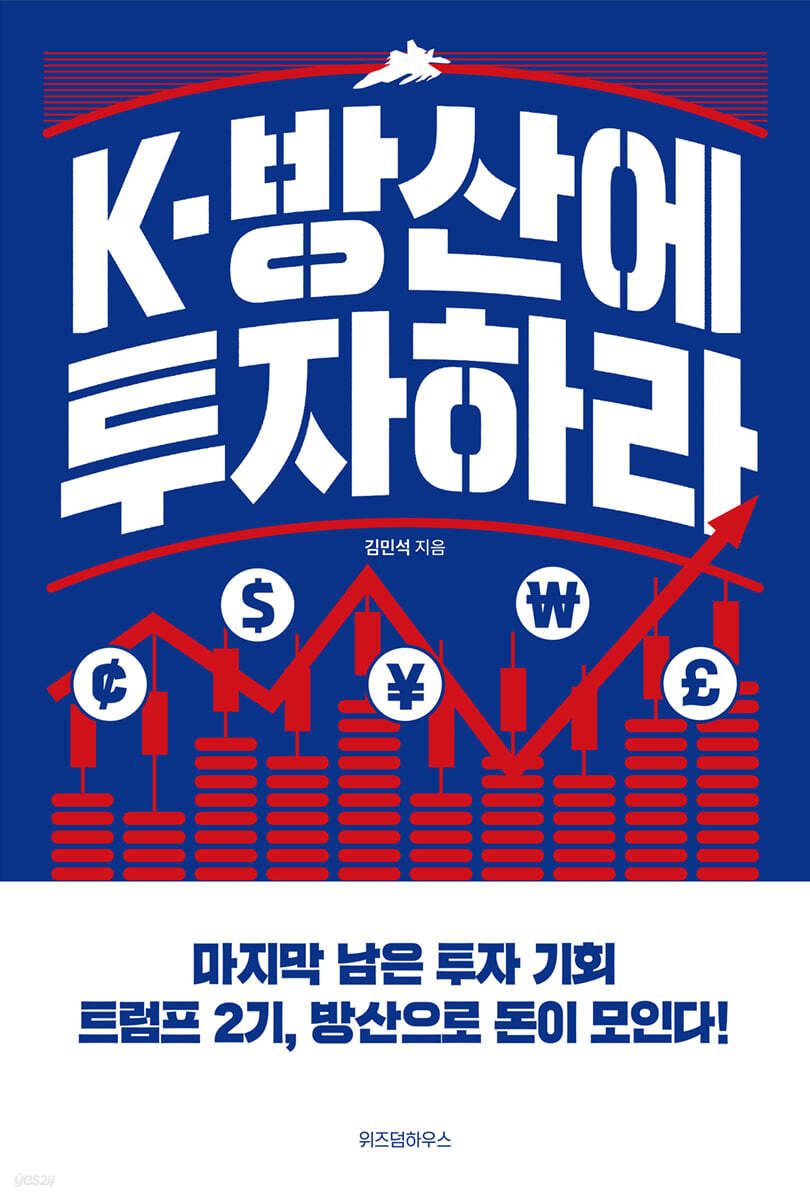
Invest in K-defense
 |
Description
Book Introduction
Pay attention to K-defense, the biggest beneficiary of the Trump 2.0 era!
From technology to product, market, and industry maps
A New Investment Strategy Discovered Through Exploring the Past and Future of K-Defense
Anyone who has invested at all, even those who have not, will have heard that “K-defense industries are doing well overseas.”
Since the large-scale arms export contract with Poland in 2022, 'K-defense industry' has become a phenomenon.
However, few people actually know what K-Defense's representative products are, what characteristics they have, and which companies are making them.
If you're an investor, you know that understanding an industry properly before investing can also help you predict its future.
This book introduces the core weapons exported by our country's defense industry and analyzes the current status of the companies that manufacture these weapons, helping readers predict the present and future of the K-defense industry.
From technology to product, market, and industry maps
A New Investment Strategy Discovered Through Exploring the Past and Future of K-Defense
Anyone who has invested at all, even those who have not, will have heard that “K-defense industries are doing well overseas.”
Since the large-scale arms export contract with Poland in 2022, 'K-defense industry' has become a phenomenon.
However, few people actually know what K-Defense's representative products are, what characteristics they have, and which companies are making them.
If you're an investor, you know that understanding an industry properly before investing can also help you predict its future.
This book introduces the core weapons exported by our country's defense industry and analyzes the current status of the companies that manufacture these weapons, helping readers predict the present and future of the K-defense industry.
- You can preview some of the book's contents.
Preview
index
Recommendation
Entering_Advance of K-Defense
Chapter 1: A Solid Cash Cow: Land Weapon Systems
Weapon 1.
Tanks: The "Prince of Ground Warfare," a Massive Export Success
Weapon 2.
Self-propelled howitzer: A bestseller exported to 10 countries
Weapon 3.
Armored vehicles: a true masterpiece recognized as the world's best performer.
Chapter 2: Aircraft Weapon Systems: A Massive Gathering of Wealth
Weapon 4.
Fighter: Breaking Through the Harsh Market with Cost-Effectiveness
Weapon 5.
Drones and Unmanned Aerial Vehicles: Overcoming Failures and Evolving into Next-Generation Core Businesses
Chapter 3: The Most Certain Food of the Future: Naval Weapon Systems
Weapon 6.
Diesel submarine: an assassin capable of launching surprise missile attacks.
Weapon 7.
Multi-purpose combat ship: Providing a total solution through complete domestic production.
Weapon 8.
Maritime Unmanned Systems: The "Ghost Fleet" Leading the Future of Naval Warfare
Chapter 4: Missiles: The Dark Horse of Exports
Weapon 9.
Surface-to-Surface Missiles: Another Dark Horse Aiming to Dominate the Global Market
Weapon 10.
Surface-to-air missiles: A hidden export bonanza in the sandstorm.
Chapter 5: Key Companies Responsible for K-Defense
1.
Three Survival Strategies for K-Defense Companies
2.
Aviation: KAI for manned aircraft and Korean Air for unmanned aircraft
3.
Mobile Weapon Systems: Hanwha Aerospace and Hyundai Rotem Battle for Dominance
4.
Sensors and Missiles: Competitors and Partners: Hanwha Systems and LIG Nex1
Go out and prepare for the future war
References
Appendix_ Representative weapons of K-Defense and the companies that make them
Entering_Advance of K-Defense
Chapter 1: A Solid Cash Cow: Land Weapon Systems
Weapon 1.
Tanks: The "Prince of Ground Warfare," a Massive Export Success
Weapon 2.
Self-propelled howitzer: A bestseller exported to 10 countries
Weapon 3.
Armored vehicles: a true masterpiece recognized as the world's best performer.
Chapter 2: Aircraft Weapon Systems: A Massive Gathering of Wealth
Weapon 4.
Fighter: Breaking Through the Harsh Market with Cost-Effectiveness
Weapon 5.
Drones and Unmanned Aerial Vehicles: Overcoming Failures and Evolving into Next-Generation Core Businesses
Chapter 3: The Most Certain Food of the Future: Naval Weapon Systems
Weapon 6.
Diesel submarine: an assassin capable of launching surprise missile attacks.
Weapon 7.
Multi-purpose combat ship: Providing a total solution through complete domestic production.
Weapon 8.
Maritime Unmanned Systems: The "Ghost Fleet" Leading the Future of Naval Warfare
Chapter 4: Missiles: The Dark Horse of Exports
Weapon 9.
Surface-to-Surface Missiles: Another Dark Horse Aiming to Dominate the Global Market
Weapon 10.
Surface-to-air missiles: A hidden export bonanza in the sandstorm.
Chapter 5: Key Companies Responsible for K-Defense
1.
Three Survival Strategies for K-Defense Companies
2.
Aviation: KAI for manned aircraft and Korean Air for unmanned aircraft
3.
Mobile Weapon Systems: Hanwha Aerospace and Hyundai Rotem Battle for Dominance
4.
Sensors and Missiles: Competitors and Partners: Hanwha Systems and LIG Nex1
Go out and prepare for the future war
References
Appendix_ Representative weapons of K-Defense and the companies that make them
Detailed image

Into the book
Since the defense industry's specialty is weapon production, knowing who makes what weapons, how they are made, and what their future development prospects and demand will be is crucial to determining the capabilities and future of the defense industry producing those weapons.
In other words, knowledge of our military's core weapons and the core weapons exported by our defense industry is the best means of predicting the present and future of the K-defense industry.
This is not much different from the fact that in order to invest in the entertainment industry, you need to know which entertainment company is debuting which singer in which genre, and what kind of performance and achievements those singers are achieving.
--- p.33
The book begins with macro questions such as, "Why and how has our defense industry become stronger?" and "How long will the current high growth rate last?"
In addition, we will cover the specific items we will be selling this year, next year, and by 2027, when we will leap forward as one of the top four defense powers, their competitiveness, and what we are currently preparing for the future defense industry.
Next, we compare and analyze representative rival companies in the South Korean defense industry, examining their competitiveness and capabilities as well as the types of competition they face.
The defense industry is fundamentally a sales business targeting the government, and it will be interesting to read this book while keeping in mind that competition in the domestic market for the Korean defense industry directly determines the performance of overseas exports and the fate of companies.
Finally, in the latter part, we examine the long-term prospects of our defense industry, predicting future warfare and the rapidly changing environment of the modern battlefield.
Through this book, readers will learn how business is conducted and exports are conducted in the highly specialized defense industry, unlike other general industries, how the competitiveness of K-defense products has increased, and what future prospects are possible.
I sincerely hope that this book will enhance readers' understanding of South Korea's defense industry and help them examine and predict the rise and fall of defense companies, their performance, and their future.
--- p.35
It wasn't just that it was superior in terms of price.
What's great about the K9 is that it has maintained a nearly constant price regardless of inflation despite being produced for 20 years, thanks to its incredible cost control capabilities.
As shown in the table below, the production costs for the first and eleventh mass productions were 3.7 billion won and 3.9 billion won, respectively. Considering the inflation over the past 20 years, it can be seen that the cost was managed almost miraculously.
This remarkable cost control capability is simply astonishing, especially considering that the selling prices of the American and German self-propelled guns, which are the K9's comparable targets, have nearly doubled over the same period.
In terms of performance, the K9 is a world-class product that satisfies all the performance requirements of a self-propelled artillery in modern warfare.
--- p.90
Currently, KAI is planning the KF-21SA, an export version of the KF-21.
In particular, we are pursuing a plan to develop a future air combat system in which the KF-21SA fighter jet, unmanned aircraft, and 6G low-orbit communication satellites are developed simultaneously, and in which the KF-21SA conducts joint operations with unmanned aircraft through low-orbit communication satellites, in cooperation with Middle Eastern partners.
Recently, Middle Eastern countries have been investing heavily in the development of science, technology, and industries that will not only enhance fighter performance but also replace the energy industry. The KF-21EX, an upgraded version of the KF-21, is a complex concept that goes beyond simple fighter development and encompasses unmanned aerial vehicles (UAVs) and satellites. Therefore, KAI intends to simultaneously transfer aircraft, drone, and space technologies to Middle Eastern countries and pursue joint development.
This joint development package is unprecedented in the global defense industry, and is expected to bear significant fruit if politicians in Middle Eastern countries are determined to achieve it.
Central and South America, Asia, and Eastern Europe are also strong export markets for the KF-21.
However, these markets have less investment capacity than the Middle East and require high-performance fighter jets at a reasonable price.
Therefore, whether the KF-21 can continue to maintain its current level of 'cost-effectiveness' and gain an advantage over its competitors is expected to be the biggest determining factor in future exports.
--- pp.176-177
Meanwhile, a milestone that will forever be remembered in the history of the Korean defense industry was achieved in December 2011: the successful export of three domestically produced DSME1400 submarines to Indonesia under the name Nagapasa for a total of 1.3 trillion won.
This success made South Korea the world's fifth submarine exporter.
Furthermore, this was a symbolic event that proved that the technological prowess of the Korean shipbuilding industry was truly superior, as it was achieved through victory in the export competition with TKMS of Germany, which had previously transferred technology to Korea.
But in fact, this success is not only due to technological prowess, but also to various timing and conditions that worked as luck for Korea.
--- p.216
The K239 Cheonmu, developed from 2009 to 2013 at a cost of 130 billion won, is a multiple rocket launcher that can carry various types of guided and unguided rockets and surface-to-surface missiles. As of 2024, it boasts the world's highest level of firepower among weapons of its class.
In the future, a budget of approximately 3.3 trillion won will be invested to deploy more than 200 multiple rocket launchers and rocket bombs for the Korean military.
Let's take a look at some of the characteristics of the Cheonmu as a multiple rocket launcher.
Compared to other equipment of the same class, Cheonmu has powerful firepower while maintaining low operating costs, and its various performances for avoiding enemy attacks in battle have also been greatly improved compared to existing equipment.
This is thanks to the Cheonmu's innate blend of features from the M270MLRS, a US-developed tracked rocket launcher, and the Hi-MASS wheeled rocket launcher. The MLRS and Hi-MASS are currently in service with some of the ROK Army's rocket launchers and are rivals to the Cheonmu in the global export market. Comparing these two rocket launchers with the Cheonmu further highlights the Cheonmu's unique characteristics.
--- pp.302-303
In other words, in the Korean defense industry, if it cannot meet domestic military demand and supply to the military, exports are impossible.
This is due to two problems.
One reason is that most of the system development of Korean weapons is led by ADD, not companies.
In other words, when ADD develops, the company receives technology from ADD and produces it.
However, ADD is an organization that develops weapons that can only satisfy the needs of the Korean military, and therefore K-defense industry naturally becomes a government-led industry.
Another problem is that Korea's export destinations only want to buy weapons that are actually used by the Korean military.
Since the ROK military possesses conventional forces on a world-class scale, the fact that a weapon is “operated by the ROK military” serves as a kind of guarantee of its performance.
Moreover, the greater the number of weapons purchased by the Korean military, the greater the overall economies of scale achieved, which in turn allows overseas customers purchasing such weapons to benefit from lower parts and maintenance costs.
For this reason, K-defense companies are desperately trying to secure the demands of the Korean military.
--- pp.360-361
In any industry, the rise and fall of a company depends on how well it predicts the future.
It is no exaggeration to say that predicting which products will be popular in the future and what their production volume and market share will be and preparing for them is, in fact, the core and everything of corporate management.
From that perspective, predicting the future of the defense industry becomes even more difficult.
This is because the market characteristics of the defense industry are a mixture of advantages over the civilian market and difficulties that cannot be compared to the civilian market.
If we consider the defense industry as simply a supply chain—that is, an industry that supplies products and services to the government—it typically takes five years to decide what product or solution to create, another five years to develop and produce it, and about 30 years to maintain it.
In other words, it is a business that must be viewed from a very long-term perspective, to a degree that cannot be compared to a single item from a general company.
In other words, knowledge of our military's core weapons and the core weapons exported by our defense industry is the best means of predicting the present and future of the K-defense industry.
This is not much different from the fact that in order to invest in the entertainment industry, you need to know which entertainment company is debuting which singer in which genre, and what kind of performance and achievements those singers are achieving.
--- p.33
The book begins with macro questions such as, "Why and how has our defense industry become stronger?" and "How long will the current high growth rate last?"
In addition, we will cover the specific items we will be selling this year, next year, and by 2027, when we will leap forward as one of the top four defense powers, their competitiveness, and what we are currently preparing for the future defense industry.
Next, we compare and analyze representative rival companies in the South Korean defense industry, examining their competitiveness and capabilities as well as the types of competition they face.
The defense industry is fundamentally a sales business targeting the government, and it will be interesting to read this book while keeping in mind that competition in the domestic market for the Korean defense industry directly determines the performance of overseas exports and the fate of companies.
Finally, in the latter part, we examine the long-term prospects of our defense industry, predicting future warfare and the rapidly changing environment of the modern battlefield.
Through this book, readers will learn how business is conducted and exports are conducted in the highly specialized defense industry, unlike other general industries, how the competitiveness of K-defense products has increased, and what future prospects are possible.
I sincerely hope that this book will enhance readers' understanding of South Korea's defense industry and help them examine and predict the rise and fall of defense companies, their performance, and their future.
--- p.35
It wasn't just that it was superior in terms of price.
What's great about the K9 is that it has maintained a nearly constant price regardless of inflation despite being produced for 20 years, thanks to its incredible cost control capabilities.
As shown in the table below, the production costs for the first and eleventh mass productions were 3.7 billion won and 3.9 billion won, respectively. Considering the inflation over the past 20 years, it can be seen that the cost was managed almost miraculously.
This remarkable cost control capability is simply astonishing, especially considering that the selling prices of the American and German self-propelled guns, which are the K9's comparable targets, have nearly doubled over the same period.
In terms of performance, the K9 is a world-class product that satisfies all the performance requirements of a self-propelled artillery in modern warfare.
--- p.90
Currently, KAI is planning the KF-21SA, an export version of the KF-21.
In particular, we are pursuing a plan to develop a future air combat system in which the KF-21SA fighter jet, unmanned aircraft, and 6G low-orbit communication satellites are developed simultaneously, and in which the KF-21SA conducts joint operations with unmanned aircraft through low-orbit communication satellites, in cooperation with Middle Eastern partners.
Recently, Middle Eastern countries have been investing heavily in the development of science, technology, and industries that will not only enhance fighter performance but also replace the energy industry. The KF-21EX, an upgraded version of the KF-21, is a complex concept that goes beyond simple fighter development and encompasses unmanned aerial vehicles (UAVs) and satellites. Therefore, KAI intends to simultaneously transfer aircraft, drone, and space technologies to Middle Eastern countries and pursue joint development.
This joint development package is unprecedented in the global defense industry, and is expected to bear significant fruit if politicians in Middle Eastern countries are determined to achieve it.
Central and South America, Asia, and Eastern Europe are also strong export markets for the KF-21.
However, these markets have less investment capacity than the Middle East and require high-performance fighter jets at a reasonable price.
Therefore, whether the KF-21 can continue to maintain its current level of 'cost-effectiveness' and gain an advantage over its competitors is expected to be the biggest determining factor in future exports.
--- pp.176-177
Meanwhile, a milestone that will forever be remembered in the history of the Korean defense industry was achieved in December 2011: the successful export of three domestically produced DSME1400 submarines to Indonesia under the name Nagapasa for a total of 1.3 trillion won.
This success made South Korea the world's fifth submarine exporter.
Furthermore, this was a symbolic event that proved that the technological prowess of the Korean shipbuilding industry was truly superior, as it was achieved through victory in the export competition with TKMS of Germany, which had previously transferred technology to Korea.
But in fact, this success is not only due to technological prowess, but also to various timing and conditions that worked as luck for Korea.
--- p.216
The K239 Cheonmu, developed from 2009 to 2013 at a cost of 130 billion won, is a multiple rocket launcher that can carry various types of guided and unguided rockets and surface-to-surface missiles. As of 2024, it boasts the world's highest level of firepower among weapons of its class.
In the future, a budget of approximately 3.3 trillion won will be invested to deploy more than 200 multiple rocket launchers and rocket bombs for the Korean military.
Let's take a look at some of the characteristics of the Cheonmu as a multiple rocket launcher.
Compared to other equipment of the same class, Cheonmu has powerful firepower while maintaining low operating costs, and its various performances for avoiding enemy attacks in battle have also been greatly improved compared to existing equipment.
This is thanks to the Cheonmu's innate blend of features from the M270MLRS, a US-developed tracked rocket launcher, and the Hi-MASS wheeled rocket launcher. The MLRS and Hi-MASS are currently in service with some of the ROK Army's rocket launchers and are rivals to the Cheonmu in the global export market. Comparing these two rocket launchers with the Cheonmu further highlights the Cheonmu's unique characteristics.
--- pp.302-303
In other words, in the Korean defense industry, if it cannot meet domestic military demand and supply to the military, exports are impossible.
This is due to two problems.
One reason is that most of the system development of Korean weapons is led by ADD, not companies.
In other words, when ADD develops, the company receives technology from ADD and produces it.
However, ADD is an organization that develops weapons that can only satisfy the needs of the Korean military, and therefore K-defense industry naturally becomes a government-led industry.
Another problem is that Korea's export destinations only want to buy weapons that are actually used by the Korean military.
Since the ROK military possesses conventional forces on a world-class scale, the fact that a weapon is “operated by the ROK military” serves as a kind of guarantee of its performance.
Moreover, the greater the number of weapons purchased by the Korean military, the greater the overall economies of scale achieved, which in turn allows overseas customers purchasing such weapons to benefit from lower parts and maintenance costs.
For this reason, K-defense companies are desperately trying to secure the demands of the Korean military.
--- pp.360-361
In any industry, the rise and fall of a company depends on how well it predicts the future.
It is no exaggeration to say that predicting which products will be popular in the future and what their production volume and market share will be and preparing for them is, in fact, the core and everything of corporate management.
From that perspective, predicting the future of the defense industry becomes even more difficult.
This is because the market characteristics of the defense industry are a mixture of advantages over the civilian market and difficulties that cannot be compared to the civilian market.
If we consider the defense industry as simply a supply chain—that is, an industry that supplies products and services to the government—it typically takes five years to decide what product or solution to create, another five years to develop and produce it, and about 30 years to maintain it.
In other words, it is a business that must be viewed from a very long-term perspective, to a degree that cannot be compared to a single item from a general company.
--- pp.424-425
Publisher's Review
Ranked No. 1 in global defense market growth (average growth rate of Korean defense companies in 2023: 39%)
Investment destinations following BBC (batteries, bio, semiconductors)
Pay attention to K-Defense, the hidden gem that only we knew about and that the world first noticed!
"South Korea is already a major player in the global defense industry." - CNN
"South Korea: The World's Quietest Arms Exporter" - Forbes
South Korea is shifting its defense industry focus from domestic demand to exports. - Reuters
According to foreign media outlets such as CNBC on November 28, 2023, Goldman Sachs highlighted South Korea's defense industry stocks, stating, "Given the strong position of the South Korean defense industry in the global military market, South Korean defense stocks are a good investment to avoid geopolitical risks." Leading global media outlets, including CNN, Forbes, and Reuters, also turned their attention to the South Korean defense industry.
Why are they interested in our defense industry?
The international defense industry market is currently experiencing growth due to events such as the Russo-Ukrainian War and the Israel-Palestine War.
Korea's defense industry is growing rapidly, following this trend.
In particular, while the average growth rate of the world's top 100 defense companies in 2023 was 4.2%, the average growth rate of Korean defense companies reached 39%, showing significant growth.
The battery, bio, and semiconductor industries, represented by BBC, have been leading the Korean investment market so far.
However, these three are gradually losing their competitiveness in the investment market due to the current US restraint, China's pursuit, and high exchange rates, and K-defense is emerging as a new investment destination.
Analysis of major export companies, including K2, Cheongung, and FA-50
Anyone can easily understand the Korean defense industry!
Since the launch of Trump's second term, interest in the K-defense industry has grown as the defense industry has emerged as the biggest beneficiary. However, few experts can provide easy and accurate information about this field.
The defense industry is related to the important issue of national defense, so there are many confidential matters, and due to the nature of weapons, it is not easy for the general public to access them.
Author Kim Min-seok, who has covered the military for over 20 years, presents "Invest in K-Defense Industry" for the first time in Korea, looking at K-Defense industry as the most reliable investment destination and future growth engine for our country, at a level that is accessible to the general public.
It covers everything from essential knowledge of technology (weapons) before investing, to market conditions that change with the global political situation and shifts in the war paradigm, to key companies responsible for the defense industry.
The only book with the most accurate analysis and outlook on K-defense!
This book consists of five chapters.
The book's opening section, "Introduction," explains why K-defense has garnered significant attention in the global market since the 2020s.
K-defense industry is receiving significant attention due to the changing paradigm of war caused by the Russo-Ukrainian War and the Israel-Palestine War, as well as changes in the global situation such as the US-China conflict and the Middle East conflict.
By examining this series of trends, we analyze the opportunities facing K-Defense Industries.
Chapters 1 through 4 introduce ten K-defense products that are competitive enough to be marketed globally.
It is divided into land, air, and sea weapon systems, and provides specific information on the characteristics of each product, related companies, which countries are being discussed for export, and the scale of exports.
Chapter 5: Key Companies Responsible for K-Defense Industry introduces eight companies that can be considered the pillars of K-Defense industry.
It comprehensively presents each company's strengths and characteristics, products under research, and global market strategies.
'Going Out_Preparing for the Future War' forecasts the next 10 years for K-defense.
By reading about 200 photos and analyzing the weapons and companies representing K-defense, you will be able to build the basic knowledge for investing in K-defense.
Reading this book will make you realize how ignorant we have been about K-defense.
Through this book, readers will be able to seize opportunities in the new wealth market based on a precise understanding of the K-defense industry.
Investment destinations following BBC (batteries, bio, semiconductors)
Pay attention to K-Defense, the hidden gem that only we knew about and that the world first noticed!
"South Korea is already a major player in the global defense industry." - CNN
"South Korea: The World's Quietest Arms Exporter" - Forbes
South Korea is shifting its defense industry focus from domestic demand to exports. - Reuters
According to foreign media outlets such as CNBC on November 28, 2023, Goldman Sachs highlighted South Korea's defense industry stocks, stating, "Given the strong position of the South Korean defense industry in the global military market, South Korean defense stocks are a good investment to avoid geopolitical risks." Leading global media outlets, including CNN, Forbes, and Reuters, also turned their attention to the South Korean defense industry.
Why are they interested in our defense industry?
The international defense industry market is currently experiencing growth due to events such as the Russo-Ukrainian War and the Israel-Palestine War.
Korea's defense industry is growing rapidly, following this trend.
In particular, while the average growth rate of the world's top 100 defense companies in 2023 was 4.2%, the average growth rate of Korean defense companies reached 39%, showing significant growth.
The battery, bio, and semiconductor industries, represented by BBC, have been leading the Korean investment market so far.
However, these three are gradually losing their competitiveness in the investment market due to the current US restraint, China's pursuit, and high exchange rates, and K-defense is emerging as a new investment destination.
Analysis of major export companies, including K2, Cheongung, and FA-50
Anyone can easily understand the Korean defense industry!
Since the launch of Trump's second term, interest in the K-defense industry has grown as the defense industry has emerged as the biggest beneficiary. However, few experts can provide easy and accurate information about this field.
The defense industry is related to the important issue of national defense, so there are many confidential matters, and due to the nature of weapons, it is not easy for the general public to access them.
Author Kim Min-seok, who has covered the military for over 20 years, presents "Invest in K-Defense Industry" for the first time in Korea, looking at K-Defense industry as the most reliable investment destination and future growth engine for our country, at a level that is accessible to the general public.
It covers everything from essential knowledge of technology (weapons) before investing, to market conditions that change with the global political situation and shifts in the war paradigm, to key companies responsible for the defense industry.
The only book with the most accurate analysis and outlook on K-defense!
This book consists of five chapters.
The book's opening section, "Introduction," explains why K-defense has garnered significant attention in the global market since the 2020s.
K-defense industry is receiving significant attention due to the changing paradigm of war caused by the Russo-Ukrainian War and the Israel-Palestine War, as well as changes in the global situation such as the US-China conflict and the Middle East conflict.
By examining this series of trends, we analyze the opportunities facing K-Defense Industries.
Chapters 1 through 4 introduce ten K-defense products that are competitive enough to be marketed globally.
It is divided into land, air, and sea weapon systems, and provides specific information on the characteristics of each product, related companies, which countries are being discussed for export, and the scale of exports.
Chapter 5: Key Companies Responsible for K-Defense Industry introduces eight companies that can be considered the pillars of K-Defense industry.
It comprehensively presents each company's strengths and characteristics, products under research, and global market strategies.
'Going Out_Preparing for the Future War' forecasts the next 10 years for K-defense.
By reading about 200 photos and analyzing the weapons and companies representing K-defense, you will be able to build the basic knowledge for investing in K-defense.
Reading this book will make you realize how ignorant we have been about K-defense.
Through this book, readers will be able to seize opportunities in the new wealth market based on a precise understanding of the K-defense industry.
GOODS SPECIFICS
- Date of issue: February 5, 2025
- Page count, weight, size: 468 pages | 824g | 152*225*28mm
- ISBN13: 9791171713134
- ISBN10: 1171713134
You may also like
카테고리
korean


korean

![GQ KOREA Mark (Monthly): December [2025]](http://librairie.coreenne.fr/cdn/shop/files/8ef265dbbfbf186523ed75ba7319009d.jpg?v=1765340328&width=3840)


