

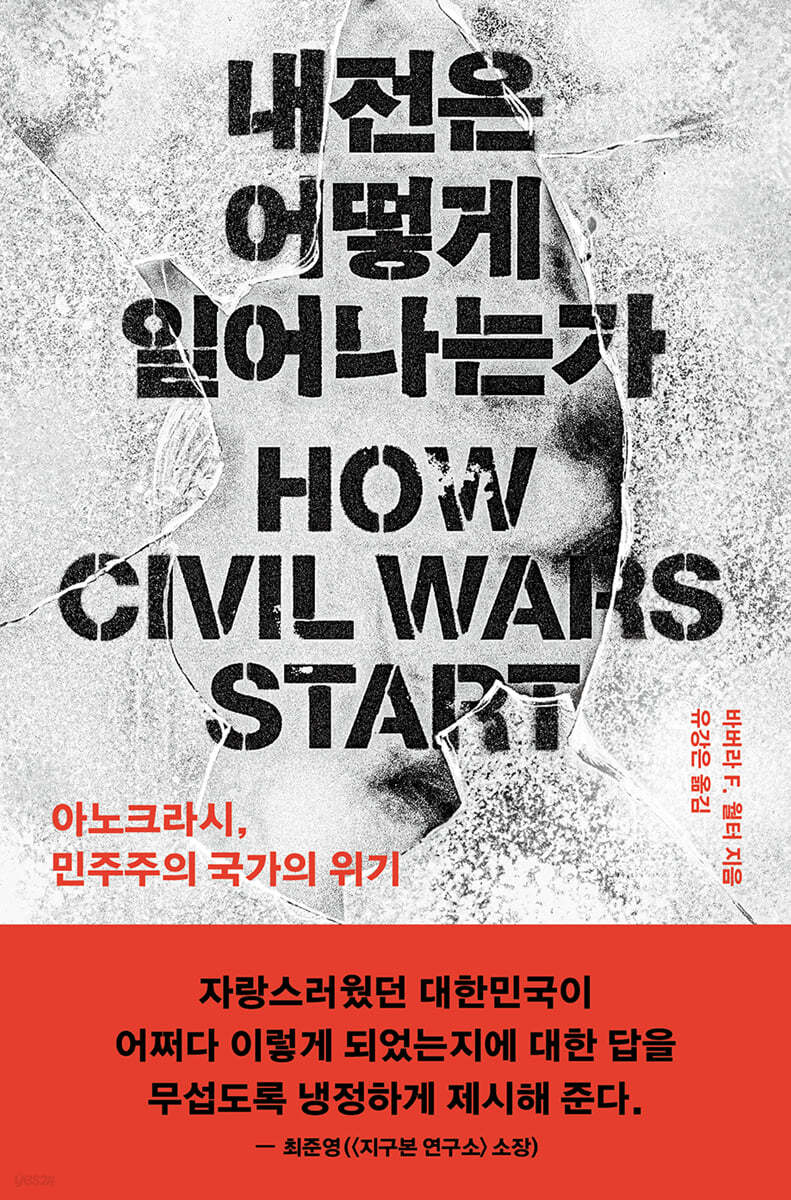
How Civil Wars Occur
 |
Description
Book Introduction
- A word from MD
-
Civil war is not far awayOn the surface, democracy appears to be functioning smoothly in Europe, the United States, and in Asia, South Korea and Japan.
But in reality, that is not the case.
A polarized society increases the likelihood of civil war breaking out.
In fact, Barbara F.
Walter points out that the number of civil wars has increased recently and their nature has changed.
A book needed to prevent division.
February 11, 2025. Social and Political PD Son Min-gyu
We used to believe that democracy was inherently stable and resilient in times of crisis, but we were wrong.
Now things are completely different.
More and more countries, including the United States, are falling into an intermediate state, anocracy, which is neither autocracy nor democracy.
South Korea, which has witnessed the decline of democracy before its eyes, appears to have joined this group.
Author Barbara F.
Walter illuminates the political turmoil and social divisions around the world, analyzing the factors that are deepening factionalism and extremism.
This suggests that even countries that have long maintained strong democracies are no longer safe.
In fact, the number of civil wars that have erupted around the world over the past two decades has nearly doubled.
However, it is different from the United States in the 1860s, Russia in the 1920s, or Spain in the 1930s.
Intermittent violence and terrorist acts occur, with the conflict being fueled by social media.
This book redefines civil war today and provides the knowledge we need to confront the dangers we face today.
Now things are completely different.
More and more countries, including the United States, are falling into an intermediate state, anocracy, which is neither autocracy nor democracy.
South Korea, which has witnessed the decline of democracy before its eyes, appears to have joined this group.
Author Barbara F.
Walter illuminates the political turmoil and social divisions around the world, analyzing the factors that are deepening factionalism and extremism.
This suggests that even countries that have long maintained strong democracies are no longer safe.
In fact, the number of civil wars that have erupted around the world over the past two decades has nearly doubled.
However, it is different from the United States in the 1860s, Russia in the 1920s, or Spain in the 1930s.
Intermittent violence and terrorist acts occur, with the conflict being fueled by social media.
This book redefines civil war today and provides the knowledge we need to confront the dangers we face today.
- You can preview some of the book's contents.
Preview
index
preface
1 The threat of anocracy
2. Intensifying factional fighting
3 The grim consequences of losing status
4 When Hope Fadeth
5 catalysts
6 How close are we?
7 What will war look like?
8 Preventing civil war
Acknowledgements
main
Translator's Note
Search
1 The threat of anocracy
2. Intensifying factional fighting
3 The grim consequences of losing status
4 When Hope Fadeth
5 catalysts
6 How close are we?
7 What will war look like?
8 Preventing civil war
Acknowledgements
main
Translator's Note
Search
Detailed image

Into the book
Perhaps we have believed for too long that peace will always reign.
Our institutions are unshakable, and our nation is exceptional.
But we also learned that we must not take the democracy we enjoy for granted, that we must recognize the power we possess as citizens.
--- p.17
When democracies turn into dictatorships, it's not because their leaders are weak and untested, like those who try to model their government after dictators, but because elected leaders—often very popular—are willing to ignore the safeguards that protect democracy.
These safeguards include constraints on the presidency, checks and balances on the legislature, judiciary, and executive, a free press that demands accountability, and fair and open political competition.
Aspiring dictators like Orbán, Erdogan, Vladimir Putin, or Brazilian President Jair Bolsonaro capitalize on citizens' fears about jobs, immigration, and safety to gain support, putting their political goals ahead of the demands of a healthy democracy.
--- p.42~43
The most powerful determinant of violence is the trajectory of a group's political standing.
Once power was seized, people were especially likely to fight when they saw it slip away.
Political scientists refer to this phenomenon as “downgrading.”
There are many variations on this topic, but it is a reliable way to predict who will initiate violence in a country likely to experience civil war.
--- p.93
Since 2010, the world has witnessed more countries descending the democratic ladder than ascending it.
This decline is evident not only in newly democratized countries, but also in wealthy liberal nations that once boasted of their long-held, inviolable democracy.
Some elected leaders are attacking freedom of expression and amending the constitution to centralize power in their own hands.
Other leaders try to weaken representative elections.
Every leader tries to convince his citizens of the need for dictatorial measures.
--- p.140
This is not the first time in modern history that a populist with anti-democratic tendencies has come to power.
The same is true for democratic countries that experience regression.
But there are differences in the method.
In the past, dictatorships arose when military generals staged coups.
But now the voters themselves are creating dictatorships.
A major reason this happens is that social media allows candidates to fuel or exploit citizens' skepticism about democracy as a form of government.
Disinformation campaigns can be used to attack institutions, undermining people's trust in representative government, a free press, and an independent judiciary, and eroding support for tolerance and pluralism.
Additionally, using disinformation to incite fear could contribute to the election of far-right candidates who emphasize law and order.
Finally, disinformation could be used to claim election fraud and convince at least some voters that the results were overturned, leading citizens to question the election results.
--- p.151
Trump, too, has squandered the grievances of white, male, Christian, rural Americans, casting them as victims whose rightful inheritance has been stolen.
He often talked about what he was being deprived of.
These included religious rights, gun ownership, and employment opportunities.
Trump's campaign slogan promised a return to the glory days.
--- p.190
If a second civil war were to break out in the United States, the combatants would not be gathering in the fields or wearing uniforms.
There may be no commander at all.
They will hang out in the shadows, communicating on bulletin boards and encrypted networks.
(……) They will plan their resistance online, devising strategies to undermine government at all levels and take over parts of the United States.
They will create chaos and fear.
And then they will force Americans to choose sides.
--- p.211~212
What increases the likelihood of civil war is factionalism.
Factionalization is complete when citizens form groups based on ethnicity, religion, or geography, and political parties become predatory, excluding competitors and implementing policies that primarily benefit themselves and their supporters.
And nothing fuels and accelerates factionalism like social media.
Our institutions are unshakable, and our nation is exceptional.
But we also learned that we must not take the democracy we enjoy for granted, that we must recognize the power we possess as citizens.
--- p.17
When democracies turn into dictatorships, it's not because their leaders are weak and untested, like those who try to model their government after dictators, but because elected leaders—often very popular—are willing to ignore the safeguards that protect democracy.
These safeguards include constraints on the presidency, checks and balances on the legislature, judiciary, and executive, a free press that demands accountability, and fair and open political competition.
Aspiring dictators like Orbán, Erdogan, Vladimir Putin, or Brazilian President Jair Bolsonaro capitalize on citizens' fears about jobs, immigration, and safety to gain support, putting their political goals ahead of the demands of a healthy democracy.
--- p.42~43
The most powerful determinant of violence is the trajectory of a group's political standing.
Once power was seized, people were especially likely to fight when they saw it slip away.
Political scientists refer to this phenomenon as “downgrading.”
There are many variations on this topic, but it is a reliable way to predict who will initiate violence in a country likely to experience civil war.
--- p.93
Since 2010, the world has witnessed more countries descending the democratic ladder than ascending it.
This decline is evident not only in newly democratized countries, but also in wealthy liberal nations that once boasted of their long-held, inviolable democracy.
Some elected leaders are attacking freedom of expression and amending the constitution to centralize power in their own hands.
Other leaders try to weaken representative elections.
Every leader tries to convince his citizens of the need for dictatorial measures.
--- p.140
This is not the first time in modern history that a populist with anti-democratic tendencies has come to power.
The same is true for democratic countries that experience regression.
But there are differences in the method.
In the past, dictatorships arose when military generals staged coups.
But now the voters themselves are creating dictatorships.
A major reason this happens is that social media allows candidates to fuel or exploit citizens' skepticism about democracy as a form of government.
Disinformation campaigns can be used to attack institutions, undermining people's trust in representative government, a free press, and an independent judiciary, and eroding support for tolerance and pluralism.
Additionally, using disinformation to incite fear could contribute to the election of far-right candidates who emphasize law and order.
Finally, disinformation could be used to claim election fraud and convince at least some voters that the results were overturned, leading citizens to question the election results.
--- p.151
Trump, too, has squandered the grievances of white, male, Christian, rural Americans, casting them as victims whose rightful inheritance has been stolen.
He often talked about what he was being deprived of.
These included religious rights, gun ownership, and employment opportunities.
Trump's campaign slogan promised a return to the glory days.
--- p.190
If a second civil war were to break out in the United States, the combatants would not be gathering in the fields or wearing uniforms.
There may be no commander at all.
They will hang out in the shadows, communicating on bulletin boards and encrypted networks.
(……) They will plan their resistance online, devising strategies to undermine government at all levels and take over parts of the United States.
They will create chaos and fear.
And then they will force Americans to choose sides.
--- p.211~212
What increases the likelihood of civil war is factionalism.
Factionalization is complete when citizens form groups based on ethnicity, religion, or geography, and political parties become predatory, excluding competitors and implementing policies that primarily benefit themselves and their supporters.
And nothing fuels and accelerates factionalism like social media.
--- p.264
Publisher's Review
★ New York Times Bestseller
★ The Sunday Times, The Financial Times,
Books of the Year selected by The Times, Esquire, and others
★ Director Choi Jun-young of Dr. Choi Jun-young's Globe Research Institute,
Recommended by Professor Ahn Byeong-jin of Kyung Hee University's Institute for Future Civilizations
The boundary between dictatorship and democracy,
Modern democratic countries in a state of anocracy
We used to believe that democracy was inherently stable and resilient in times of crisis, but we were wrong.
Now things are completely different.
More and more countries, including the United States, are falling into an intermediate state, anocracy, which is neither autocracy nor democracy.
In December 2024, South Korea, witnessing the decline of democracy before its eyes, appears to have joined this group.
Author Barbara F.
Walter is a political scientist who has specialized in civil war, political violence, and terrorism for decades.
Drawing on the latest research, statistics, and case studies from various countries, he illuminates political turmoil and social divisions around the world and analyzes the factors that fuel factionalism and extremism.
This suggests that even countries that have long maintained strong democracies are no longer safe.
In fact, the number of civil wars that have erupted around the world over the past two decades has nearly doubled.
However, it is different from the American Civil War in the 1860s, the Russian Civil War in the 1920s, or the Spanish Civil War in the 1930s.
Intermittent violence and terrorist acts occur, with the conflict being fueled by social media.
This book redefines modern civil war, providing the knowledge and information we need to confront the dangers we face today.
Where does the civil war begin,
Who initiates it and what triggers it?
On January 6, 2021, the U.S. Capitol was stormed.
It was the work of a far-right group that fervently supports Donald Trump, who refuses to accept the election results and continues to raise suspicions of election fraud.
This incident, which shocked the people, is evaluated as a symbolic event that revealed the current state of American democracy.
Walter clearly explains the process of political decline and the main causes of the anocracy in the United States, emphasizing that it is no longer the "longest-lived democracy."
At the same time, we pay attention to the tectonic shifts that have occurred in political, economic, and social aspects.
The demographic makeup has changed, and inequality and polarization are becoming increasingly severe.
All systems have weakened, and some privileged groups are running wild.
Moreover, social media has become a suitable tool for pursuing personal or factional interests, thus exacerbating the situation.
Similar developments are unfolding in other democratic countries.
In particular, Walter points out that, beginning in the mid-20th century, more and more civil wars have been fought between ethnic or religious groups rather than between political groups.
This also means that it is ultimately a fight for dominance over the other.
Civil wars are not simply accidental outbreaks of violence, but the result of complex factors, including the weakening of democracy and social instability.
The first priority in preventing the situation from worsening is to clearly understand where civil wars start, who starts them, and what triggers them.
We are in this crisis situation
How to overcome it?
Both transitions from dictatorship to democracy and from democracy to dictatorship entail instability.
Because in the process, power vacuums and imbalances naturally follow.
Walter says that we must be most wary of the “factionalism” and “extremism” that arise at this time.
Thus, it insightfully describes why the conflict between Shiites and Sunnis in Iraq reached such a serious level, what factors worsened the division of Yugoslavia after Tito's iron-fisted rule, and how religious conflict in Northern Ireland turned violent.
The anonymous characters in this book reveal that they never dreamed that a civil war would break out in their country.
But if you look closely, you can easily spot the signs.
Walter expresses concern that “the democratization fever that characterized the 20th and early 21st centuries is over,” but also reminds us of the power of democracy by suggesting a way forward.
We have time and means to reduce the likelihood of civil war breaking out.
This book will guide you to discover that path.
★ The Sunday Times, The Financial Times,
Books of the Year selected by The Times, Esquire, and others
★ Director Choi Jun-young of Dr. Choi Jun-young's Globe Research Institute,
Recommended by Professor Ahn Byeong-jin of Kyung Hee University's Institute for Future Civilizations
The boundary between dictatorship and democracy,
Modern democratic countries in a state of anocracy
We used to believe that democracy was inherently stable and resilient in times of crisis, but we were wrong.
Now things are completely different.
More and more countries, including the United States, are falling into an intermediate state, anocracy, which is neither autocracy nor democracy.
In December 2024, South Korea, witnessing the decline of democracy before its eyes, appears to have joined this group.
Author Barbara F.
Walter is a political scientist who has specialized in civil war, political violence, and terrorism for decades.
Drawing on the latest research, statistics, and case studies from various countries, he illuminates political turmoil and social divisions around the world and analyzes the factors that fuel factionalism and extremism.
This suggests that even countries that have long maintained strong democracies are no longer safe.
In fact, the number of civil wars that have erupted around the world over the past two decades has nearly doubled.
However, it is different from the American Civil War in the 1860s, the Russian Civil War in the 1920s, or the Spanish Civil War in the 1930s.
Intermittent violence and terrorist acts occur, with the conflict being fueled by social media.
This book redefines modern civil war, providing the knowledge and information we need to confront the dangers we face today.
Where does the civil war begin,
Who initiates it and what triggers it?
On January 6, 2021, the U.S. Capitol was stormed.
It was the work of a far-right group that fervently supports Donald Trump, who refuses to accept the election results and continues to raise suspicions of election fraud.
This incident, which shocked the people, is evaluated as a symbolic event that revealed the current state of American democracy.
Walter clearly explains the process of political decline and the main causes of the anocracy in the United States, emphasizing that it is no longer the "longest-lived democracy."
At the same time, we pay attention to the tectonic shifts that have occurred in political, economic, and social aspects.
The demographic makeup has changed, and inequality and polarization are becoming increasingly severe.
All systems have weakened, and some privileged groups are running wild.
Moreover, social media has become a suitable tool for pursuing personal or factional interests, thus exacerbating the situation.
Similar developments are unfolding in other democratic countries.
In particular, Walter points out that, beginning in the mid-20th century, more and more civil wars have been fought between ethnic or religious groups rather than between political groups.
This also means that it is ultimately a fight for dominance over the other.
Civil wars are not simply accidental outbreaks of violence, but the result of complex factors, including the weakening of democracy and social instability.
The first priority in preventing the situation from worsening is to clearly understand where civil wars start, who starts them, and what triggers them.
We are in this crisis situation
How to overcome it?
Both transitions from dictatorship to democracy and from democracy to dictatorship entail instability.
Because in the process, power vacuums and imbalances naturally follow.
Walter says that we must be most wary of the “factionalism” and “extremism” that arise at this time.
Thus, it insightfully describes why the conflict between Shiites and Sunnis in Iraq reached such a serious level, what factors worsened the division of Yugoslavia after Tito's iron-fisted rule, and how religious conflict in Northern Ireland turned violent.
The anonymous characters in this book reveal that they never dreamed that a civil war would break out in their country.
But if you look closely, you can easily spot the signs.
Walter expresses concern that “the democratization fever that characterized the 20th and early 21st centuries is over,” but also reminds us of the power of democracy by suggesting a way forward.
We have time and means to reduce the likelihood of civil war breaking out.
This book will guide you to discover that path.
GOODS SPECIFICS
- Date of issue: January 20, 2025
- Page count, weight, size: 336 pages | 484g | 143*217*23mm
- ISBN13: 9788932924892
- ISBN10: 8932924899
You may also like
카테고리
korean


korean

![GQ KOREA Mark (Monthly): December [2025]](http://librairie.coreenne.fr/cdn/shop/files/8ef265dbbfbf186523ed75ba7319009d.jpg?v=1765340328&width=3840)


