

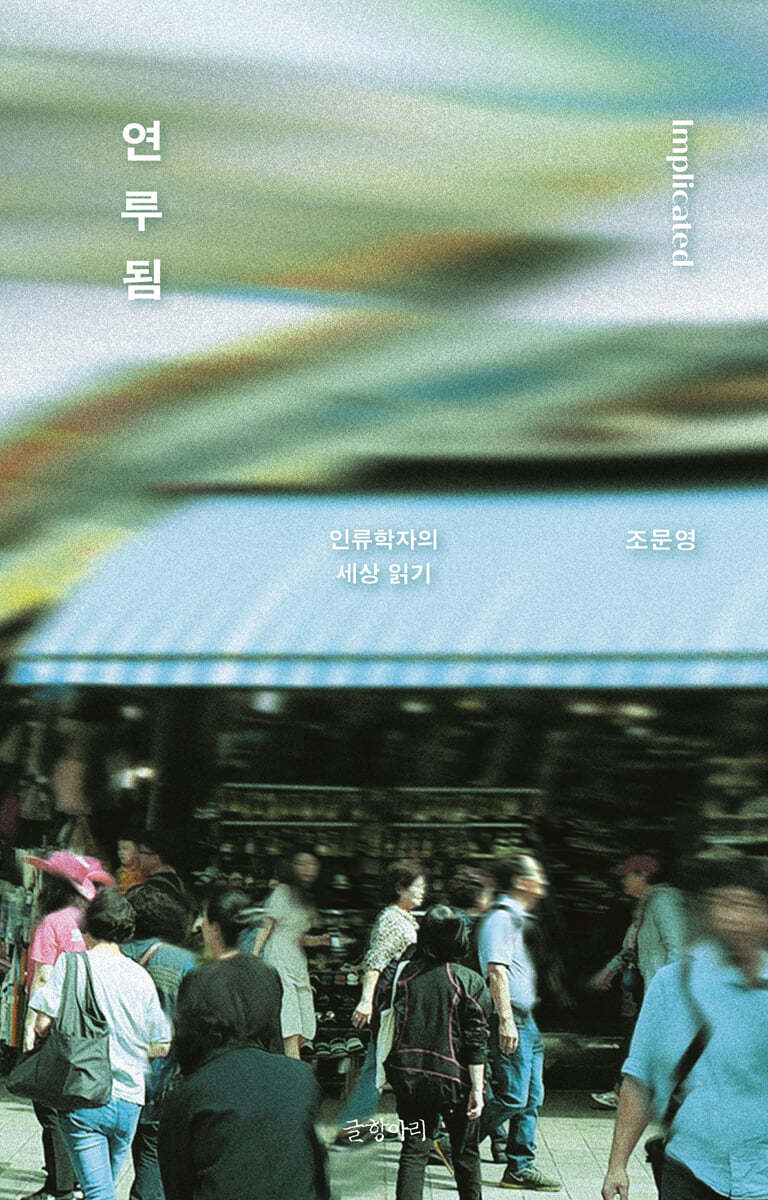
Implicated
 |
Description
Book Introduction
Author of the 64th Korea Publishing Culture Award
The Poverty Process, a new work by Jo Moon-young
Some worlds coexist with us, whether we like it or not.
Even if you leave the place where that uncomfortable feeling was, they constantly reappear in different forms.
The world that emerges becomes not an other that can be ignored, but a condition and phenomenon of collective life.
It's a field for anthropologists.
To be on the scene, he doggedly pursues what it is and how it exists, and along the way, he sometimes encounters and interrogates himself.
‘Involvement’ is embodied in him as a means of relating to a specific world that he has come into contact with.
Rather than wandering around the complexities of life and observing it, be immersed in it.
Rather than stand by and watch the world's contradictions and suffering, admit complicity and become involved, seeking a new direction.
The anthropologist's experience of 'being there' (Clifford Geertz) becomes a unique experience and part of life through involvement, and makes it possible to 'come back here and write.'
Anthropologist Jo Moon-young, who has studied physical and existential poverty in Korea and China, discovers the entanglement of social suffering in everyday life and, through a sense of involvement drawn from that very entanglement, attempts to achieve “a more solid understanding” and “a more responsible critique.”
"Implicated: Reading the World as an Anthropologist" is a book that compiles his writings published in various media over a period of ten years, from 2013 to 2023, from this perspective.
The Poverty Process, a new work by Jo Moon-young
Some worlds coexist with us, whether we like it or not.
Even if you leave the place where that uncomfortable feeling was, they constantly reappear in different forms.
The world that emerges becomes not an other that can be ignored, but a condition and phenomenon of collective life.
It's a field for anthropologists.
To be on the scene, he doggedly pursues what it is and how it exists, and along the way, he sometimes encounters and interrogates himself.
‘Involvement’ is embodied in him as a means of relating to a specific world that he has come into contact with.
Rather than wandering around the complexities of life and observing it, be immersed in it.
Rather than stand by and watch the world's contradictions and suffering, admit complicity and become involved, seeking a new direction.
The anthropologist's experience of 'being there' (Clifford Geertz) becomes a unique experience and part of life through involvement, and makes it possible to 'come back here and write.'
Anthropologist Jo Moon-young, who has studied physical and existential poverty in Korea and China, discovers the entanglement of social suffering in everyday life and, through a sense of involvement drawn from that very entanglement, attempts to achieve “a more solid understanding” and “a more responsible critique.”
"Implicated: Reading the World as an Anthropologist" is a book that compiles his writings published in various media over a period of ten years, from 2013 to 2023, from this perspective.
- You can preview some of the book's contents.
Preview
index
Beyond the West Gate Investigative Hometown
Part 1: Sensing: People Who Break Through the Plane ┃The World is Multiple ┃Do We Want 'Purung'? ┃When Curiosity Wanes ┃The Embarrassing Public Forum ┃Hearts in the Zone of Preference
Part 2: Facing the Face
The Seesaw of Threat and Bizarreness┃The Young Generation's Anti-China Rally┃The Strange Familiarity of the Coronavirus┃The Chinese People I Met
Observe Part 3
In a world that has lost its sense of purpose, North Korea, the "frontier," and the ghosts of colonialism. The stigma of being a "surplus woman."
Part 4: Getting involved
Between the rich and the poor, between parasites and their hosts┃Confronting the 'parasite'┃Preparing to live without stopping┃I want a home┃The disaster site that became a landmark┃Family enduring vulnerability together┃The ordinary life of Dongja-dong┃The 'owner revolution' and the true face of the development republic┃Your right to live┃The society of rights and the corpses outside of society┃The Korean civil movement, a fortunately unglamorous history
Part 5: Life - Working
Long live capitalism. ┃Newness beyond entrepreneurship? ┃A survival virus more virulent than COVID-19. ┃Ask the young workers how they are doing. ┃Beijing in 1997, Hong Kong in 2019. ┃The color of connection after COVID-19. ┃How labor dialogue transcends borders. ┃Non-regular workers and basic income. ┃The fate of coexistence. ┃Just give me the fish.
Part 6: Doing Politics
The Age of "Master's Play"┃The Politics of Perspective┃Beijing Banners, Seoul Plazas┃Shades Are Not to Be Seen, But to Be Eliminated
Part 7 Care
Your leaves also fall┃Sorrow that cannot find a place┃Not the elderly, but the elderly┃Caring for the elderly and caring for the earth┃Minari is wonderful
Part 8: Seating
"Why else would I wish for a military base?"┃Imagining an Equal Alternative┃Travel Journal of Itoshima, the 'Land of Hope'
Study Part 9
The world they embraced┃Taking a breath to fight better┃Demand the right to learn, more boldly┃Dreams on the lawn┃Am I you?┃Living in a 'hot' society┃Thanks to Y┃A Chinese exchange student who taught me┃Finishing the Chinese class
Read Part 10
When 'Poverty Safari' Becomes 'Poverty Camp'┃Those Complicit in Social Abandonment┃Can Homeless Women Become Books┃The Global War of East Asian 'Awls'┃The Paradox of Excellence┃Let's Smell Mushrooms
What's next?
Part 11: Living on Earth
A Step Forward for Vulnerable Lives | Basic Income to Save the Planet | Is a Common Future Possible?
Original source
Part 1: Sensing: People Who Break Through the Plane ┃The World is Multiple ┃Do We Want 'Purung'? ┃When Curiosity Wanes ┃The Embarrassing Public Forum ┃Hearts in the Zone of Preference
Part 2: Facing the Face
The Seesaw of Threat and Bizarreness┃The Young Generation's Anti-China Rally┃The Strange Familiarity of the Coronavirus┃The Chinese People I Met
Observe Part 3
In a world that has lost its sense of purpose, North Korea, the "frontier," and the ghosts of colonialism. The stigma of being a "surplus woman."
Part 4: Getting involved
Between the rich and the poor, between parasites and their hosts┃Confronting the 'parasite'┃Preparing to live without stopping┃I want a home┃The disaster site that became a landmark┃Family enduring vulnerability together┃The ordinary life of Dongja-dong┃The 'owner revolution' and the true face of the development republic┃Your right to live┃The society of rights and the corpses outside of society┃The Korean civil movement, a fortunately unglamorous history
Part 5: Life - Working
Long live capitalism. ┃Newness beyond entrepreneurship? ┃A survival virus more virulent than COVID-19. ┃Ask the young workers how they are doing. ┃Beijing in 1997, Hong Kong in 2019. ┃The color of connection after COVID-19. ┃How labor dialogue transcends borders. ┃Non-regular workers and basic income. ┃The fate of coexistence. ┃Just give me the fish.
Part 6: Doing Politics
The Age of "Master's Play"┃The Politics of Perspective┃Beijing Banners, Seoul Plazas┃Shades Are Not to Be Seen, But to Be Eliminated
Part 7 Care
Your leaves also fall┃Sorrow that cannot find a place┃Not the elderly, but the elderly┃Caring for the elderly and caring for the earth┃Minari is wonderful
Part 8: Seating
"Why else would I wish for a military base?"┃Imagining an Equal Alternative┃Travel Journal of Itoshima, the 'Land of Hope'
Study Part 9
The world they embraced┃Taking a breath to fight better┃Demand the right to learn, more boldly┃Dreams on the lawn┃Am I you?┃Living in a 'hot' society┃Thanks to Y┃A Chinese exchange student who taught me┃Finishing the Chinese class
Read Part 10
When 'Poverty Safari' Becomes 'Poverty Camp'┃Those Complicit in Social Abandonment┃Can Homeless Women Become Books┃The Global War of East Asian 'Awls'┃The Paradox of Excellence┃Let's Smell Mushrooms
What's next?
Part 11: Living on Earth
A Step Forward for Vulnerable Lives | Basic Income to Save the Planet | Is a Common Future Possible?
Original source
Detailed image
Into the book
People who welcome me but also feel uncomfortable, the looks that question my beliefs, the institutions and media that trivialize the social pain that stirs my emotions.
Perhaps he wanted to do his best in his studies, which he had started late after much consideration.
I couldn't suddenly say goodbye to the world of 'fathers' as I had to leave my father.
I wanted to understand, even if only a little, how he/she sees himself/herself and the world, what makes him/her dream or frustrated.
As I wandered around the investigative hometown of the typist, I sometimes saw the commonality between the abyss of differences, and I felt ashamed of the dogmatism I had previously uttered.
…criticism is not just my responsibility as a researcher.
It also interprets and criticizes the world.
--- From the "Preface"
The ordinary Chinese people I met while conducting field research helped me avoid the dangerous temptation to immediately equate China with the "Chinese state" and the "Chinese government."
It reminds me that the life I desire is not one mired in a power struggle between nations, each claiming exclusive sovereignty, but one in which humans give space to one another and other living beings, promising coexistence.
Whether in China or Korea, it reminds us of how narrow the standards of a "good life" have become while enduring in a space where the violence of modernity has accumulated, and how many ordinary people, despite their vulnerability, still reach out to others.
Above all, they remind us of the self-evident principle that hasty warnings and condemnations should not overwhelm interest and criticism.
--- From "Chinese People I Met"
In fact, finding a lord is not an outdated practice of pre-modern indigenous societies.
There are groups all over the world that serve powerful father leaders.
The search for a lord continues not only in authoritarian countries but also in democratic countries that emphasize the autonomy of citizens.
The more their followers are accused of populism, the more united they become, and instead of blurring the lines between achievement and failure, they reinforce the distinction between good and evil.
… However, in current Korean society (except for some fanatics), it seems that there are not many people who hope for and believe in the eternity of their lord.
Instead, finding a lord is becoming closer to playing a lord.
Politicians, of course, but also scholars, doctors, religious figures, celebrities, influencers, successful investors, casual lecturers, drama characters, and the cosmology known as MBTI.
The list of lords to follow and rely on continues to grow and change.
Anyone or anything can be my lord if it can comfort me and soothe my anxiety and resentment.
An era in which one can easily change one's lord is, in other words, an era in which trust in the lord has disappeared.
It's an era where everyone wants to believe, but no one can.
--- From "The Age of 'Master's Play'"
“I first got on a boat when I was fourteen, and in the span of just under thirty years, I started on an eel trap boat, then a yakidama tongtong boat, a cod boat, an ocean trolley, a general cargo ship, a refrigerated carrier, a chemical tanker, a waste carrier, and many other boats.” Looking at his subsequent trajectory, which included heart disease, tuberculosis, and homelessness, I honestly still don’t know what in his life could be categorized as a ‘disaster’ or a ‘crisis.’
Conversely, Valentine and Hasun's call for decolonizing the future invites us to look back at the history of "normalcy" that those who can perceive certain phenomena as crises have enjoyed in the first place.
Perhaps I had easy access to capital and resources throughout my life, allowing me to perceive these crises as more acute, even though I was less vulnerable to infection or climate change than the residents of the attic?
Perhaps he wanted to do his best in his studies, which he had started late after much consideration.
I couldn't suddenly say goodbye to the world of 'fathers' as I had to leave my father.
I wanted to understand, even if only a little, how he/she sees himself/herself and the world, what makes him/her dream or frustrated.
As I wandered around the investigative hometown of the typist, I sometimes saw the commonality between the abyss of differences, and I felt ashamed of the dogmatism I had previously uttered.
…criticism is not just my responsibility as a researcher.
It also interprets and criticizes the world.
--- From the "Preface"
The ordinary Chinese people I met while conducting field research helped me avoid the dangerous temptation to immediately equate China with the "Chinese state" and the "Chinese government."
It reminds me that the life I desire is not one mired in a power struggle between nations, each claiming exclusive sovereignty, but one in which humans give space to one another and other living beings, promising coexistence.
Whether in China or Korea, it reminds us of how narrow the standards of a "good life" have become while enduring in a space where the violence of modernity has accumulated, and how many ordinary people, despite their vulnerability, still reach out to others.
Above all, they remind us of the self-evident principle that hasty warnings and condemnations should not overwhelm interest and criticism.
--- From "Chinese People I Met"
In fact, finding a lord is not an outdated practice of pre-modern indigenous societies.
There are groups all over the world that serve powerful father leaders.
The search for a lord continues not only in authoritarian countries but also in democratic countries that emphasize the autonomy of citizens.
The more their followers are accused of populism, the more united they become, and instead of blurring the lines between achievement and failure, they reinforce the distinction between good and evil.
… However, in current Korean society (except for some fanatics), it seems that there are not many people who hope for and believe in the eternity of their lord.
Instead, finding a lord is becoming closer to playing a lord.
Politicians, of course, but also scholars, doctors, religious figures, celebrities, influencers, successful investors, casual lecturers, drama characters, and the cosmology known as MBTI.
The list of lords to follow and rely on continues to grow and change.
Anyone or anything can be my lord if it can comfort me and soothe my anxiety and resentment.
An era in which one can easily change one's lord is, in other words, an era in which trust in the lord has disappeared.
It's an era where everyone wants to believe, but no one can.
--- From "The Age of 'Master's Play'"
“I first got on a boat when I was fourteen, and in the span of just under thirty years, I started on an eel trap boat, then a yakidama tongtong boat, a cod boat, an ocean trolley, a general cargo ship, a refrigerated carrier, a chemical tanker, a waste carrier, and many other boats.” Looking at his subsequent trajectory, which included heart disease, tuberculosis, and homelessness, I honestly still don’t know what in his life could be categorized as a ‘disaster’ or a ‘crisis.’
Conversely, Valentine and Hasun's call for decolonizing the future invites us to look back at the history of "normalcy" that those who can perceive certain phenomena as crises have enjoyed in the first place.
Perhaps I had easy access to capital and resources throughout my life, allowing me to perceive these crises as more acute, even though I was less vulnerable to infection or climate change than the residents of the attic?
--- From "Is a Common Future Possible"
Publisher's Review
The suffering of the world
Connected to my life
Conspirators-Resisters
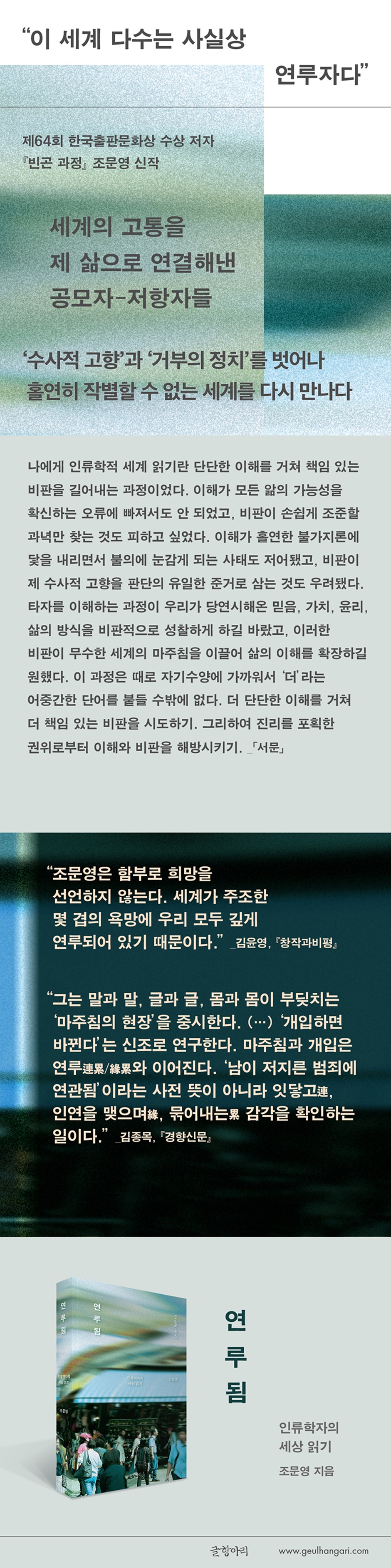
"The majority of the world is effectively complicit."
For me, reading the anthropological world was a process of developing a solid understanding and then developing responsible criticism.
I wanted to avoid the error of assuming that understanding is the possibility of all knowledge, nor did I want to avoid finding easy targets for criticism.
There was also concern that understanding would suddenly become anchored in agnosticism, turning a blind eye to injustice, and that criticism would use its own investigative hometown as the sole criterion for judgment.
I hope that the process of understanding others will lead us to critically reflect on the beliefs, values, ethics, and lifestyles we have taken for granted, and that this critique will lead us to encounter countless worlds, thereby expanding our understanding of life.
This process is sometimes so close to self-cultivation that we cannot help but cling to the ambiguous word 'more'.
To attempt more responsible criticism through a more solid understanding.
Thus, to liberate understanding and criticism from the authority that has captured the truth.
_"introduction"
“Jo Moon-young does not declare hope carelessly.
We are all trapped in a few layers of desires cast by the world.
“Because we are deeply involved.”
Kim Yun-young, Creation and Criticism
“He is a person who collides with words, writing with writing, and body with body.
We value the ‘site of encounter’.
(…)
We conduct research with the motto, 'If you intervene, things will change.'
Encounters and interventions lead to involvement and connection.
'Involved in a crime committed by another'
It is not a dictionary meaning, but it is connected, connected, and connected.
“It is a matter of confirming the sense of tying together.”
_Kim Jong-mok, Kyunghyang Shinmun
A strange tension, intense interest
―The moment you encounter the world
The 'I' in this book is an anthropologist, educator-learner, family member, fellow citizen, and earthling.
From students breaking through social distancing during the pandemic and stepping out of the screen, to residents of shantytowns who call the most severe forms of disasters “what a big deal,” to coal-fired power plant workers speaking as “frontline stakeholders” at climate justice marches, the scenes he encounters are unfamiliar and bizarre rather than familiar and ordinary.
“Tension, intense interest, hope and anxiety, impatience…”, encounters that arouse curiosity and anticipate possibilities, and the thoughts that arise from them are the material of this book.
'I' shines at the point where the world and worlds, including myself, meet.
In his eyes, even the ordinary daily life of an ordinary person is somehow reflected as a figure that catches his eye and from which he cannot take his eyes off.
He stares at a landscape that one might just pass by as if it were a scene where something important was happening.
It's time for anthropologists to meet the world.
Every time I start field research, the excitement and fear that used to overwhelm me suddenly come back to me.
In extremely ordinary places like a lab, a building hallway, or the streets of Sinchon.
My senses became sharper as the familiar suddenly became unfamiliar.
…a strange tension overturned familiar scenes, stirred conventions, and provided new stimulation. (22-23)
In the sixty-four essays written amidst this tension, the world that the author primarily portrays is the world of the so-called "vulnerable" beings who have been "marginalized" and "invisible," such as the poor, workers, youth, the elderly, women, the disabled, indigenous people, immigrants, the countryside, and non-humans.
However, as we follow his gaze and read “the world they embraced,” one by one, we come to realize that the question of what adjective to use before “world” is not so simple.
The questions that started out to get to know you deeper and deeper bring out 'me'.
A world that can only be accessed when we approach it to the point where the lessons of fragmentary and narrow experiences, the a priori frames, and the vague and dichotomous relationship between structure and individual no longer work—the author tries to understand it, to try to understand it.
Just as in my previous work, "The Poverty Process: The Assemblies of Poverty and the Anthropology of Vulnerable Lives," poverty was both ubiquitous and nowhere, the worlds of this book are neither typical nor easily defined.
Thus, the richness of relationships embedded in the daily lives of the poor, the discussions among young people outside of the “youth debate that has become a dead end,” the diverse lives of Chinese people that are not synonymous with the “Chinese nation,” and the perspectives of feminists that are not lumped together as “feminists” come into view.
The world of multiples is constantly being re-recognized, expanded, and interconnected.
Beyond the ‘investigative hometown’ and the ‘politics of rejection’
Suddenly reunited with a world that cannot be said goodbye
Before such an encounter became possible, there was a world he had left behind.
In the “Preface,” the author briefly reflects on his relationship with his father, with whom he “rarely stayed in the same hometown.”
“As the tacit knowledge of the world of ‘We are strangers’ began to go against my common sense more and more often, I gradually began to prepare to leave home.
“I go further in search of a sympathetic and comforting investigative homeland where I don’t have to try hard to persuade.” (10) ‘Father,’ who symbolizes a world where coexistence is difficult, appears before him again after encountering anthropology.
But when I started studying anthropology and started to study the other, 'father' started appearing here and there.
People who welcome me but also feel uncomfortable, the looks that question my beliefs, the institutions and media that trivialize the social pain that stirs my emotions.
Perhaps he wanted to do his best in his studies, which he had started late after much consideration.
I couldn't suddenly say goodbye to the world of 'fathers' as I had to leave my father.
I wanted to understand, even if only a little, how he/she sees himself/herself and the world, what makes him/her dream or frustrated.
As I wandered around the investigative hometown of the typist, I sometimes saw the commonality between the abysses of differences, and I felt ashamed of the dogmatism I had previously uttered. (10)
The world is told by Wang Dezhi, a Chinese man who has been involved in the labor movement for nearly 20 years.
“If you think we are doing something wrong, I hope you understand the situation before criticizing.” (161) This was a response to the criticism that the Chinese labor movement is not sufficiently addressing the issues of women and sexual minorities.
The tension evoked by Wang Dezhi's words resonates with the author's awareness of the incompleteness of his own world in the "Preface."
“The criticism that came after the density of understanding was increased had to change.
Criticism is not just my job as a researcher.
“It also interprets and criticizes the world.” (10) Taking this reciprocity for granted, the book opens with a question asking about the reader’s ‘investigative hometown.’
Where is your "rhetorical home"? With whom do you feel comfortable speaking? According to philosopher Vincent Decombes, a person's rhetorical home stops "where the interlocutors no longer understand the reasons they give for their actions and deeds, the complaints they express, or the praise they express."
It is rare for someone to have the same investigative hometown and territorial hometown.
If you miss your hometown and it feels far away, isn't it because your hometown disappears as soon as you set foot on it? (9)
The author says that this investigative homeland is where we live in “a world where each person has their own lock.”
There, “the battle between worlds, each with its own slang and rules, is a daily occurrence.”
The choice of those who are fed up with the discrimination and hate speech being spewed both online and offline today seems to be not the stale harmony of politicians or the outdated solidarity of activists, but rather literal 'rejection.'
The 'safe space' that the students I met around me envisioned was not a village like Pungleung where people of all ages and genders were entangled in a mess, but rather a sterile zone where any potential threats had been eliminated from the beginning.
Korea is not the only exception.
Recently, anthropologists have been witnessing the 'politics of refusal' around the world.
Weary of repeated oppression, control, violence, and stigma, indigenous people, the homeless, and women choose disconnection over connection, finding a sense of belonging within a "we" that practices refusal together. (31)
The binding force of the mind that penetrates the class preference zone… The desire to be with the other person for a long time requires a sense of comfort.
It is enough to keep a safe distance from an alien opponent or to briefly summon them as an object of curiosity. (44)
How much can we understand beyond the "sterile zone" built by sharpening our senses to threats and obsessively blocking out the heterogeneous? What kind of criticism is possible based on such an understanding? In an "investigative homeland" that is unchallenged and inviolable, there is always the risk of mechanically tying the unique world of each young person to the "'Ewha man/Ewha woman', "female school student/male school student", and "2030" frames, and there is always the possibility of limiting our own capabilities by saying "China did China," failing to consider "the existence of people [resistance] 'fighting' in a country with a population of 1.4 billion."
A world where cultural tastes, political preferences, life aspirations, and perspectives on others are algorithmically divided, data-bound, and commercialized ignores the uniqueness of relationships and leaves us profoundly emotionally drained.
Criticism, which has taken the place of criticism, is only interested in suppressing opponents with sharp language, forcing ordinary citizens to seek refuge in their own investigative hometowns to escape conflict and hatred.
A society where these individuals build fortresses in their respective hometowns and identify strangers and intruders based on "safety" keeps us in a state of constant tension. (15)
Anthropology says, “Serious learning about other worlds comes before hasty criticism.”
Then, beyond the struggles of the world that were the pretext for discord and the “grounds for permanent expulsion,” “something common through each person’s diversity” might emerge.
When you leave your hometown and step into the void of understanding, a world unfolds endlessly, unreadable to the untrained eye.
The author takes a step towards it and makes a pledge.
“I will not try hard to find my hometown, and I will not return to it easily.”
responsible criticism,
Uncomfortable coexistence
This book, consisting of 64 chapters in 11 parts, mainly deals with topics that the author has been interested in as an anthropologist.
Part 1, “Sensing,” is about the emergence of certain worlds; Part 2, “Encountering,” is about the conflicts and conflicts of the world; Part 3, “Observing,” is about the world as a field of anthropology; Part 4, “Getting Involved,” is about poverty, a long-standing research topic of the author; Part 5, “Living-Laboring,” is about thoughts and practices drawn from the field of making a living; Part 6, “Doing Politics,” is about the landscape of politics unfolding in everyday life; Part 7, “Caring,” is about reflections on aging and care; Part 8, “Taking a Place,” is about the possibility of a region that is not subsumed by the discourse of decline and extinction; Part 9, “Studying,” is about the world of learning encountered as a learner and educator; Part 10, “Reading,” is about reading as a critic and participant; and Part 11, “Earth-Living,” talks about the planetary crisis and the search for coexistence.
In a letter to a potential reader of this book just before its publication, the author wrote:
'Yeonru連累' is a single perspective that crosses writings written in different times, environments, on different topics and in different formats.
It is also a proposal to find a way between understanding and criticizing others.
When criticism becomes sharp condemnation and understanding becomes blind embrace, involvement illuminates the entanglements of the world, confronting us with the tension between understanding and criticism.
Some readers may find the word's association with crime uncomfortable.
It is enough to remember that we are bound (累) and at the same time connected (連) beings.
I want to find new possibilities in acknowledging that most of us are not lofty fighters, but rather people struggling in a turbulent world.
Instead of asking what the world is and hastily judging its value, how is it possible to consistently contemplate how we connect with countless worlds and where their suffering should be directed? Anthropology, with its long and persistent attachment to "unfamiliar" worlds, may offer a practical reference point for this question.
It is the density of understanding obtained by tracing the reason why an action had to be done within the radius of the actor before hastily judging and criticizing the action, the orientation of life that does not turn its back on imperfect worlds, “the work of exploring categories, units, events, and places centered on production and entanglement” (Cho Moon-young, “Dialogue between Actor-Network-Theory and Critical Anthropology,” 『Comparative Cultural Studies』 Vol. 27 No. 1, 2021, pp.
Could it be the sense of involvement we acquire from (422-423)? "What is present? And so what lies before our starting point as we try to follow the connection? It is a bundle of enormous inequality, the weight of history, and sticky emotions and relationships" (same text, p.
427), the author discovers through anthropology “the possibility of living without remaining in a comfortable apocalypse.”
We live in a world where words like collapse, apocalypse, and catastrophe are frequently encountered.
But who is this "we" who truly feels the sense of crisis that our shared world is collapsing? Are you, am I, part of this "community"? (375)
In a time when confrontation and hostility extend beyond defense mechanisms born of anxiety to become deeply rooted in our very existence, it will not be easy to forge new relationships with fellow citizens and nonhuman life forms without being consumed by the anxiety that "I am not safe from you" while simultaneously coping with our own vulnerabilities.
But then again, it may not be an easy task.
The author uses the South African 'minibus taxi' scene, as exemplified by anthropologist James Ferguson, to make readers reflect on the "relationship between bodies."
Passengers crammed into the car like olives in a glass jar, forced to avoid hot, sweaty, uncomfortable, and sometimes dangerous encounters.
People who cannot get off in the middle of nowhere, so they have to give new passengers at least an inch of space.
… In order to return safely, I have no choice but to give up some of my space and give it to others.
The 'common world' that considers this sense as the source of sociality is clearly far from a warm community.
But if we are to confront the inequalities and contradictions, the tensions and frictions between worlds and futures, and simultaneously imagine a "common future" where humans and the Earth can survive planetary catastrophe, it may be more beneficial to draw wisdom from passengers cramped in a steamy bus than from scholars with air conditioning nearby. (380-381)
“If we can realize a new form of common life and collective values based on the vulnerability and interdependence that we all share, if it is possible to move the limits of the world, then the world will be a new world.” (378) There are fellow passengers beside us who are trying to reorient the horizons of the world in this way.
This is our challenge, but it is also our possibility.
Connected to my life
Conspirators-Resisters
"The majority of the world is effectively complicit."
For me, reading the anthropological world was a process of developing a solid understanding and then developing responsible criticism.
I wanted to avoid the error of assuming that understanding is the possibility of all knowledge, nor did I want to avoid finding easy targets for criticism.
There was also concern that understanding would suddenly become anchored in agnosticism, turning a blind eye to injustice, and that criticism would use its own investigative hometown as the sole criterion for judgment.
I hope that the process of understanding others will lead us to critically reflect on the beliefs, values, ethics, and lifestyles we have taken for granted, and that this critique will lead us to encounter countless worlds, thereby expanding our understanding of life.
This process is sometimes so close to self-cultivation that we cannot help but cling to the ambiguous word 'more'.
To attempt more responsible criticism through a more solid understanding.
Thus, to liberate understanding and criticism from the authority that has captured the truth.
_"introduction"
“Jo Moon-young does not declare hope carelessly.
We are all trapped in a few layers of desires cast by the world.
“Because we are deeply involved.”
Kim Yun-young, Creation and Criticism
“He is a person who collides with words, writing with writing, and body with body.
We value the ‘site of encounter’.
(…)
We conduct research with the motto, 'If you intervene, things will change.'
Encounters and interventions lead to involvement and connection.
'Involved in a crime committed by another'
It is not a dictionary meaning, but it is connected, connected, and connected.
“It is a matter of confirming the sense of tying together.”
_Kim Jong-mok, Kyunghyang Shinmun
A strange tension, intense interest
―The moment you encounter the world
The 'I' in this book is an anthropologist, educator-learner, family member, fellow citizen, and earthling.
From students breaking through social distancing during the pandemic and stepping out of the screen, to residents of shantytowns who call the most severe forms of disasters “what a big deal,” to coal-fired power plant workers speaking as “frontline stakeholders” at climate justice marches, the scenes he encounters are unfamiliar and bizarre rather than familiar and ordinary.
“Tension, intense interest, hope and anxiety, impatience…”, encounters that arouse curiosity and anticipate possibilities, and the thoughts that arise from them are the material of this book.
'I' shines at the point where the world and worlds, including myself, meet.
In his eyes, even the ordinary daily life of an ordinary person is somehow reflected as a figure that catches his eye and from which he cannot take his eyes off.
He stares at a landscape that one might just pass by as if it were a scene where something important was happening.
It's time for anthropologists to meet the world.
Every time I start field research, the excitement and fear that used to overwhelm me suddenly come back to me.
In extremely ordinary places like a lab, a building hallway, or the streets of Sinchon.
My senses became sharper as the familiar suddenly became unfamiliar.
…a strange tension overturned familiar scenes, stirred conventions, and provided new stimulation. (22-23)
In the sixty-four essays written amidst this tension, the world that the author primarily portrays is the world of the so-called "vulnerable" beings who have been "marginalized" and "invisible," such as the poor, workers, youth, the elderly, women, the disabled, indigenous people, immigrants, the countryside, and non-humans.
However, as we follow his gaze and read “the world they embraced,” one by one, we come to realize that the question of what adjective to use before “world” is not so simple.
The questions that started out to get to know you deeper and deeper bring out 'me'.
A world that can only be accessed when we approach it to the point where the lessons of fragmentary and narrow experiences, the a priori frames, and the vague and dichotomous relationship between structure and individual no longer work—the author tries to understand it, to try to understand it.
Just as in my previous work, "The Poverty Process: The Assemblies of Poverty and the Anthropology of Vulnerable Lives," poverty was both ubiquitous and nowhere, the worlds of this book are neither typical nor easily defined.
Thus, the richness of relationships embedded in the daily lives of the poor, the discussions among young people outside of the “youth debate that has become a dead end,” the diverse lives of Chinese people that are not synonymous with the “Chinese nation,” and the perspectives of feminists that are not lumped together as “feminists” come into view.
The world of multiples is constantly being re-recognized, expanded, and interconnected.
Beyond the ‘investigative hometown’ and the ‘politics of rejection’
Suddenly reunited with a world that cannot be said goodbye
Before such an encounter became possible, there was a world he had left behind.
In the “Preface,” the author briefly reflects on his relationship with his father, with whom he “rarely stayed in the same hometown.”
“As the tacit knowledge of the world of ‘We are strangers’ began to go against my common sense more and more often, I gradually began to prepare to leave home.
“I go further in search of a sympathetic and comforting investigative homeland where I don’t have to try hard to persuade.” (10) ‘Father,’ who symbolizes a world where coexistence is difficult, appears before him again after encountering anthropology.
But when I started studying anthropology and started to study the other, 'father' started appearing here and there.
People who welcome me but also feel uncomfortable, the looks that question my beliefs, the institutions and media that trivialize the social pain that stirs my emotions.
Perhaps he wanted to do his best in his studies, which he had started late after much consideration.
I couldn't suddenly say goodbye to the world of 'fathers' as I had to leave my father.
I wanted to understand, even if only a little, how he/she sees himself/herself and the world, what makes him/her dream or frustrated.
As I wandered around the investigative hometown of the typist, I sometimes saw the commonality between the abysses of differences, and I felt ashamed of the dogmatism I had previously uttered. (10)
The world is told by Wang Dezhi, a Chinese man who has been involved in the labor movement for nearly 20 years.
“If you think we are doing something wrong, I hope you understand the situation before criticizing.” (161) This was a response to the criticism that the Chinese labor movement is not sufficiently addressing the issues of women and sexual minorities.
The tension evoked by Wang Dezhi's words resonates with the author's awareness of the incompleteness of his own world in the "Preface."
“The criticism that came after the density of understanding was increased had to change.
Criticism is not just my job as a researcher.
“It also interprets and criticizes the world.” (10) Taking this reciprocity for granted, the book opens with a question asking about the reader’s ‘investigative hometown.’
Where is your "rhetorical home"? With whom do you feel comfortable speaking? According to philosopher Vincent Decombes, a person's rhetorical home stops "where the interlocutors no longer understand the reasons they give for their actions and deeds, the complaints they express, or the praise they express."
It is rare for someone to have the same investigative hometown and territorial hometown.
If you miss your hometown and it feels far away, isn't it because your hometown disappears as soon as you set foot on it? (9)
The author says that this investigative homeland is where we live in “a world where each person has their own lock.”
There, “the battle between worlds, each with its own slang and rules, is a daily occurrence.”
The choice of those who are fed up with the discrimination and hate speech being spewed both online and offline today seems to be not the stale harmony of politicians or the outdated solidarity of activists, but rather literal 'rejection.'
The 'safe space' that the students I met around me envisioned was not a village like Pungleung where people of all ages and genders were entangled in a mess, but rather a sterile zone where any potential threats had been eliminated from the beginning.
Korea is not the only exception.
Recently, anthropologists have been witnessing the 'politics of refusal' around the world.
Weary of repeated oppression, control, violence, and stigma, indigenous people, the homeless, and women choose disconnection over connection, finding a sense of belonging within a "we" that practices refusal together. (31)
The binding force of the mind that penetrates the class preference zone… The desire to be with the other person for a long time requires a sense of comfort.
It is enough to keep a safe distance from an alien opponent or to briefly summon them as an object of curiosity. (44)
How much can we understand beyond the "sterile zone" built by sharpening our senses to threats and obsessively blocking out the heterogeneous? What kind of criticism is possible based on such an understanding? In an "investigative homeland" that is unchallenged and inviolable, there is always the risk of mechanically tying the unique world of each young person to the "'Ewha man/Ewha woman', "female school student/male school student", and "2030" frames, and there is always the possibility of limiting our own capabilities by saying "China did China," failing to consider "the existence of people [resistance] 'fighting' in a country with a population of 1.4 billion."
A world where cultural tastes, political preferences, life aspirations, and perspectives on others are algorithmically divided, data-bound, and commercialized ignores the uniqueness of relationships and leaves us profoundly emotionally drained.
Criticism, which has taken the place of criticism, is only interested in suppressing opponents with sharp language, forcing ordinary citizens to seek refuge in their own investigative hometowns to escape conflict and hatred.
A society where these individuals build fortresses in their respective hometowns and identify strangers and intruders based on "safety" keeps us in a state of constant tension. (15)
Anthropology says, “Serious learning about other worlds comes before hasty criticism.”
Then, beyond the struggles of the world that were the pretext for discord and the “grounds for permanent expulsion,” “something common through each person’s diversity” might emerge.
When you leave your hometown and step into the void of understanding, a world unfolds endlessly, unreadable to the untrained eye.
The author takes a step towards it and makes a pledge.
“I will not try hard to find my hometown, and I will not return to it easily.”
responsible criticism,
Uncomfortable coexistence
This book, consisting of 64 chapters in 11 parts, mainly deals with topics that the author has been interested in as an anthropologist.
Part 1, “Sensing,” is about the emergence of certain worlds; Part 2, “Encountering,” is about the conflicts and conflicts of the world; Part 3, “Observing,” is about the world as a field of anthropology; Part 4, “Getting Involved,” is about poverty, a long-standing research topic of the author; Part 5, “Living-Laboring,” is about thoughts and practices drawn from the field of making a living; Part 6, “Doing Politics,” is about the landscape of politics unfolding in everyday life; Part 7, “Caring,” is about reflections on aging and care; Part 8, “Taking a Place,” is about the possibility of a region that is not subsumed by the discourse of decline and extinction; Part 9, “Studying,” is about the world of learning encountered as a learner and educator; Part 10, “Reading,” is about reading as a critic and participant; and Part 11, “Earth-Living,” talks about the planetary crisis and the search for coexistence.
In a letter to a potential reader of this book just before its publication, the author wrote:
'Yeonru連累' is a single perspective that crosses writings written in different times, environments, on different topics and in different formats.
It is also a proposal to find a way between understanding and criticizing others.
When criticism becomes sharp condemnation and understanding becomes blind embrace, involvement illuminates the entanglements of the world, confronting us with the tension between understanding and criticism.
Some readers may find the word's association with crime uncomfortable.
It is enough to remember that we are bound (累) and at the same time connected (連) beings.
I want to find new possibilities in acknowledging that most of us are not lofty fighters, but rather people struggling in a turbulent world.
Instead of asking what the world is and hastily judging its value, how is it possible to consistently contemplate how we connect with countless worlds and where their suffering should be directed? Anthropology, with its long and persistent attachment to "unfamiliar" worlds, may offer a practical reference point for this question.
It is the density of understanding obtained by tracing the reason why an action had to be done within the radius of the actor before hastily judging and criticizing the action, the orientation of life that does not turn its back on imperfect worlds, “the work of exploring categories, units, events, and places centered on production and entanglement” (Cho Moon-young, “Dialogue between Actor-Network-Theory and Critical Anthropology,” 『Comparative Cultural Studies』 Vol. 27 No. 1, 2021, pp.
Could it be the sense of involvement we acquire from (422-423)? "What is present? And so what lies before our starting point as we try to follow the connection? It is a bundle of enormous inequality, the weight of history, and sticky emotions and relationships" (same text, p.
427), the author discovers through anthropology “the possibility of living without remaining in a comfortable apocalypse.”
We live in a world where words like collapse, apocalypse, and catastrophe are frequently encountered.
But who is this "we" who truly feels the sense of crisis that our shared world is collapsing? Are you, am I, part of this "community"? (375)
In a time when confrontation and hostility extend beyond defense mechanisms born of anxiety to become deeply rooted in our very existence, it will not be easy to forge new relationships with fellow citizens and nonhuman life forms without being consumed by the anxiety that "I am not safe from you" while simultaneously coping with our own vulnerabilities.
But then again, it may not be an easy task.
The author uses the South African 'minibus taxi' scene, as exemplified by anthropologist James Ferguson, to make readers reflect on the "relationship between bodies."
Passengers crammed into the car like olives in a glass jar, forced to avoid hot, sweaty, uncomfortable, and sometimes dangerous encounters.
People who cannot get off in the middle of nowhere, so they have to give new passengers at least an inch of space.
… In order to return safely, I have no choice but to give up some of my space and give it to others.
The 'common world' that considers this sense as the source of sociality is clearly far from a warm community.
But if we are to confront the inequalities and contradictions, the tensions and frictions between worlds and futures, and simultaneously imagine a "common future" where humans and the Earth can survive planetary catastrophe, it may be more beneficial to draw wisdom from passengers cramped in a steamy bus than from scholars with air conditioning nearby. (380-381)
“If we can realize a new form of common life and collective values based on the vulnerability and interdependence that we all share, if it is possible to move the limits of the world, then the world will be a new world.” (378) There are fellow passengers beside us who are trying to reorient the horizons of the world in this way.
This is our challenge, but it is also our possibility.
GOODS SPECIFICS
- Date of issue: December 11, 2024
- Page count, weight, size: 388 pages | 515g | 128*200*23mm
- ISBN13: 9791169091558
You may also like
카테고리
korean


korean

![GQ KOREA Mark (Monthly): December [2025]](http://librairie.coreenne.fr/cdn/shop/files/8ef265dbbfbf186523ed75ba7319009d.jpg?v=1765340328&width=3840)


