

Dance in the Age of Climate Crisis
 |
Description
Book Introduction
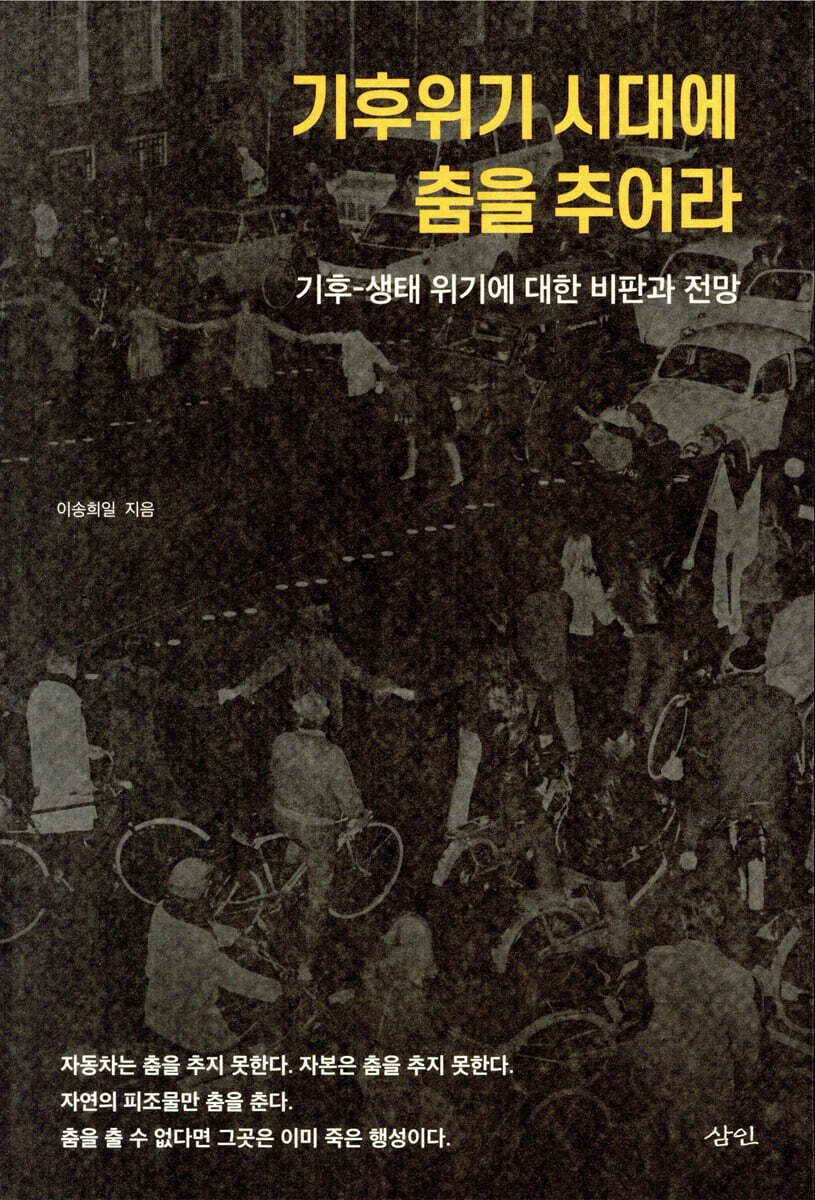
'Cars can't dance.
Capital cannot dance.
Only natural creatures dance.
If you can't dance, it's already a dead planet.'
Summoning the hidden politics and erased names of the climate crisis era
A Global History of Climate Crisis
The 'climate crisis', often understood as a natural disaster, is actually a patriarchal disaster, a capitalist disaster, a racist disaster, in other words, a clear political disaster. This book, 'Dance in the Age of Climate Crisis', argues with vast data transcending time and space, abundant field cases, and meticulous analysis, and forecasts how to deal with this disaster. This is the first solo book by film director Lee Song-hee-il, who has actively expressed his opinions on climate and ecological issues through social media, lectures, and columns.
The prologue of this book mentions the "underprivileged" people of Bangladesh, who cannot farm or travel to other places in the Bay of Bengal, which is being eroded by rising sea levels, and who are eaten by tigers in the forest while searching for forest resources to make a living, not only representing the tragedy of countless climate refugees around the world, but also showing the multi-layered current crisis of the Earth's planet.
That is, instead of identifying them as ‘climate crisis victims,’ the author asks these questions:
Is this water disaster in this delta, renowned for its fertility due to repeated flooding and sedimentation over many years, truly a climate disaster? Why did the designation of this tiger reserve deprive the poor of their forests? The questions expand and continue.
While Koreans are oblivious to carbon emissions from coal-fired power plants and irritated by rising coffee prices, why do Bangladesh's poor risk their lives by forcing themselves into the forests? Bangladesh, responsible for only 0.015% of global greenhouse gas emissions, is suffering from climate change before the "rich" nations.
Subtitled "Criticism and Prospects on the Climate-Ecological Crisis," "Dance in the Age of Climate Crisis" is a must-read for today's society, providing a faithful map of the "global history of the climate crisis" and the "global history of the climate justice movement." It consists of seven chapters.
Chapter 1, “Women Floating Water and Eucalyptus,” focuses on capitalist-colonial hydrology, which artificially altered natural flows.
Chapter 2, “The Psychology of the Climate Crisis,” discusses the collective psychology surrounding the climate crisis, including normalcy bias and climate depression.
Chapter 3, "Will Deleting Emails Put Out Wildfires?" examines the ideology of shifting responsibility for the climate crisis onto individuals and the environmentalism of billionaires.
Chapter 4, “Jane Goodall Was Wrong,” criticizes scholars who attribute the climate crisis to population growth and exposes the hypocrisy of so-called conservationism.
Chapter 5, “Climate Barriers and Ecofascism,” explores the history and current state of ecofascism and the growing barriers around the world as the climate crisis worsens.
Chapter 6, "Imperial Lifestyle: Burying the Car," explores how electric vehicles, often marketed as eco-friendly leaders, and fast fashion, which exploits female labor, are weaving imperialism into our times.
The final chapter, Chapter 7, "Planet of Stories," tells the story of the various movements of environmental movements and the history of imagination that has pursued ecosocialism and degrowth.
While "Dance in the Age of Climate Crisis" emphasizes that there is no way to overcome the crisis without maintaining the lifestyles that brought about the planetary crisis, it also emphasizes that the first thing we must do is to move beyond catastrophism and face the climate crisis head-on without being overwhelmed.
While objectively revealing the dark truths of capitalism that have been hidden or ignored, it also demonstrates, through abundant examples, that the history of climate justice movements, particularly in the Global South and indigenous communities, exists as an alternative narrative on this planet.
This book, which unpacks the self-evident truth that ecology is interconnected from beginning to end, makes us realize that what this planet needs most right now is not solutions to the climate crisis, but the courage to move forward toward those solutions.
Now is the time to turn the upside-down list of values back on its head and bring back the stories that have been erased from a world mired in collective oblivion.
Capital cannot dance.
Only natural creatures dance.
If you can't dance, it's already a dead planet.'
Summoning the hidden politics and erased names of the climate crisis era
A Global History of Climate Crisis
The 'climate crisis', often understood as a natural disaster, is actually a patriarchal disaster, a capitalist disaster, a racist disaster, in other words, a clear political disaster. This book, 'Dance in the Age of Climate Crisis', argues with vast data transcending time and space, abundant field cases, and meticulous analysis, and forecasts how to deal with this disaster. This is the first solo book by film director Lee Song-hee-il, who has actively expressed his opinions on climate and ecological issues through social media, lectures, and columns.
The prologue of this book mentions the "underprivileged" people of Bangladesh, who cannot farm or travel to other places in the Bay of Bengal, which is being eroded by rising sea levels, and who are eaten by tigers in the forest while searching for forest resources to make a living, not only representing the tragedy of countless climate refugees around the world, but also showing the multi-layered current crisis of the Earth's planet.
That is, instead of identifying them as ‘climate crisis victims,’ the author asks these questions:
Is this water disaster in this delta, renowned for its fertility due to repeated flooding and sedimentation over many years, truly a climate disaster? Why did the designation of this tiger reserve deprive the poor of their forests? The questions expand and continue.
While Koreans are oblivious to carbon emissions from coal-fired power plants and irritated by rising coffee prices, why do Bangladesh's poor risk their lives by forcing themselves into the forests? Bangladesh, responsible for only 0.015% of global greenhouse gas emissions, is suffering from climate change before the "rich" nations.
Subtitled "Criticism and Prospects on the Climate-Ecological Crisis," "Dance in the Age of Climate Crisis" is a must-read for today's society, providing a faithful map of the "global history of the climate crisis" and the "global history of the climate justice movement." It consists of seven chapters.
Chapter 1, “Women Floating Water and Eucalyptus,” focuses on capitalist-colonial hydrology, which artificially altered natural flows.
Chapter 2, “The Psychology of the Climate Crisis,” discusses the collective psychology surrounding the climate crisis, including normalcy bias and climate depression.
Chapter 3, "Will Deleting Emails Put Out Wildfires?" examines the ideology of shifting responsibility for the climate crisis onto individuals and the environmentalism of billionaires.
Chapter 4, “Jane Goodall Was Wrong,” criticizes scholars who attribute the climate crisis to population growth and exposes the hypocrisy of so-called conservationism.
Chapter 5, “Climate Barriers and Ecofascism,” explores the history and current state of ecofascism and the growing barriers around the world as the climate crisis worsens.
Chapter 6, "Imperial Lifestyle: Burying the Car," explores how electric vehicles, often marketed as eco-friendly leaders, and fast fashion, which exploits female labor, are weaving imperialism into our times.
The final chapter, Chapter 7, "Planet of Stories," tells the story of the various movements of environmental movements and the history of imagination that has pursued ecosocialism and degrowth.
While "Dance in the Age of Climate Crisis" emphasizes that there is no way to overcome the crisis without maintaining the lifestyles that brought about the planetary crisis, it also emphasizes that the first thing we must do is to move beyond catastrophism and face the climate crisis head-on without being overwhelmed.
While objectively revealing the dark truths of capitalism that have been hidden or ignored, it also demonstrates, through abundant examples, that the history of climate justice movements, particularly in the Global South and indigenous communities, exists as an alternative narrative on this planet.
This book, which unpacks the self-evident truth that ecology is interconnected from beginning to end, makes us realize that what this planet needs most right now is not solutions to the climate crisis, but the courage to move forward toward those solutions.
Now is the time to turn the upside-down list of values back on its head and bring back the stories that have been erased from a world mired in collective oblivion.
index
Prologue - The Tiger Widow
Chapter 1: Women Floating on Water and Eucalyptus
Sex for fish
wildfire pandemic
Who is the arsonist?
Chapter 2: The Psychology of the Climate Crisis
normality bias
Climate Depression and Solarstalgia
Why do you ignore it?
Chapter 3: Will deleting emails put out the forest fire?
Carbon Footprint Ideology
Environmentalism of the Rich
Chapter 4: Jane Goodall Was Wrong
The problem isn't population.
The Reality of Preservationism
From wildlife conservation to REDD+
The magic of carbon offsets
Chapter 5: Climate Barriers and Ecofascism
The dream of escaping Earth
History of Terraforming
The Exodus of Billionaires
eco-fascism
The population bomb and Malthusianism
Climate Apartheid, Climate Barriers
Lifeboats and spaceships
Chapter 6: Imperial Lifestyle: Bury Your Car
Patrice Lumumba's molars
Cobalt and Tesla
What are electric cars made of?
A car drives a person out
Imperial lifestyle
Women's Labor and Fast Fashion
Cheran's Bonfire Revolution
Chapter 7: The Planet of Stories
Sunflowers are innocent
Ecosocialism and Degrowth
Rebellion of the Sun
Fig Tree and Labor Union
Planet of the Fields
seed bomb
When Martians conquer Earth
Epilogue - Dance in the Age of Climate Crisis
References
Chapter 1: Women Floating on Water and Eucalyptus
Sex for fish
wildfire pandemic
Who is the arsonist?
Chapter 2: The Psychology of the Climate Crisis
normality bias
Climate Depression and Solarstalgia
Why do you ignore it?
Chapter 3: Will deleting emails put out the forest fire?
Carbon Footprint Ideology
Environmentalism of the Rich
Chapter 4: Jane Goodall Was Wrong
The problem isn't population.
The Reality of Preservationism
From wildlife conservation to REDD+
The magic of carbon offsets
Chapter 5: Climate Barriers and Ecofascism
The dream of escaping Earth
History of Terraforming
The Exodus of Billionaires
eco-fascism
The population bomb and Malthusianism
Climate Apartheid, Climate Barriers
Lifeboats and spaceships
Chapter 6: Imperial Lifestyle: Bury Your Car
Patrice Lumumba's molars
Cobalt and Tesla
What are electric cars made of?
A car drives a person out
Imperial lifestyle
Women's Labor and Fast Fashion
Cheran's Bonfire Revolution
Chapter 7: The Planet of Stories
Sunflowers are innocent
Ecosocialism and Degrowth
Rebellion of the Sun
Fig Tree and Labor Union
Planet of the Fields
seed bomb
When Martians conquer Earth
Epilogue - Dance in the Age of Climate Crisis
References
Into the book
Citizens of the wealthy Northern Hemisphere, including South Korea, are protesting at climate rallies, holding signs that say, "The Earth is dying" and "Save the Earth."
Every time I see that slogan, a feeling of hesitation wells up in me.
Is that Earth truly the same? Is it the same space for a Korean citizen worried about the price of apples and coffee and for a girl in Africa who walks the arduous path to fetch water?
--- p.23
Colonialism, which has destructively altered the Earth's landscape and enslaved nature and humans, is the root of climate change.
If we miss that connection, our understanding of climate change will inevitably wander into the black hole of the Anthropocene, which is “human fault.”
The "wildfire pandemic" unfolding amidst the current climate emergency is precisely what exposes the trajectory of colonialism and capitalism.
The time of the forest fire is, surprisingly, the time when unresolved grudges return.
--- p.34
Today, the norm of “personal responsibility and individual action” functions as another powerful dominant ideology that exacerbates the climate and ecological crisis.
While we are caught up in a petty sense of moral complacency, watching each other to see if we are doing a good job of recycling, Coca-Cola capital is polluting the last bits of the planet by spewing out 200,000 plastic bottles per minute.
While liberals clamor to raise heating costs for ordinary citizens to promote frugality and consumerism, South Korea's fossil fuel companies are pumping natural gas and building coal-fired power plants all over the world, receiving hefty government subsidies.
On the one hand, the overwhelming burden of personal responsibility and the helplessness of individual action can fuel climate depression or even lead to an attitude of indifference that turns a blind eye to the crisis.
This is why the endless cycle of personal responsibility sickens our conscience and devastates our soul.
Coincidentally, in Korea, the ideology of 'personal responsibility' is more firmly rooted.
[…] Ability is personal responsibility, incompetence is also personal responsibility.
In a society dominated by meritocracy, our life stories are inevitably marked by a solitary journey of competition and self-management, not by public care and reciprocity.
In short, the prison of personal responsibility is the current landscape of Korean society.
[…] This explains why Korean environmental groups are becoming increasingly conservative through neoliberalism.
--- p.106-107
From spaceships to utopian cities in the desert, the various utopian projects planned or attempted by the world's super-rich are a new map-making escape from the world they've ruined.
This tumultuous utopian project is all about the desire to scour space, deserts, and seas like a mole to terraform new lands in search of a world without climate-ecological crisis, a world free from interference and nagging like wealth taxes and state regulation, a tranquil world free from the rebellion of the proletariat, a privatized world where they reign supreme and rule, a transcendent world free from the destructive forces of planetary limits.
--- p.207
Automobiles not only exploit human labor, but also constantly extract the Earth's mineral and biological resources.
It absorbs everything.
Each time the metals that make up a car are mined deep underground, capital profits, but poverty and pollution remain.
As extraction accelerates, inequality and ecosystem collapse worsen.
As cars speed down the road, black particles fly from their tires, and Asian farmers squeeze and spray pesticides on rubber trees to increase production.
Congolese children squeeze their small bodies into black tunnels.
Every time an electric car speeds down the road, Andean farmers suffer from thirst and African indigenous people are driven from their homes.
Every time electric vehicles are touted as eco-friendly, habitats for endangered species around the world are destroyed.
Every time biofuels are touted as clean energy, indigenous peoples in Africa and South America are displaced and forced from their homes.
And countless poor people around the world suffer from hunger.
Extractivism never reproduces natural resources.
It only extracts.
--- p.316
The price of a hamburger excludes unpaid labor and health costs such as obesity and disease, which are passed on to consumers.
And crucially, the ecological cost is left out of the price of a burger.
According to a report by India's Centre for Science and Environment, a burger made with beef from cattle raised on deforested land or fed soybeans grown on that land can cost a whopping $200.
This study was conducted in 1994, so if converted to today's prices, hamburger prices would be much higher.
When rainforests are cut down, carbon sinks disappear and ecosystems collapse.
It is difficult to estimate the cost, as it is eating away at the future of humanity.
--- p.338
Jack Mundy and the Building and Construction Workers Union thus pursued the socio-political mission of labor.
This gave birth to the so-called 'social unionism', which critically considers the ecological problems and even the violation of public interest caused by capitalist labor.
It went beyond economic unionism, which was anchored solely in the economic conditions of workers, and believed that workers, as the main actors in production, should also be responsible for the social effects of production.
Jack Mundy sums it up in one word:
“Workers have the right not to have their labor used in a harmful way.
[…] Increasingly, we will be deciding what buildings we build.”
Furthermore, the Building and Construction Workers' Union imposed a green ban on the University of Sydney for discriminating against female students by excluding them from their research programs, and a pink ban on Macquarie University for expelling a gay student.
[…] It was a remarkable achievement that took place in Australia in the 1970s.
Naturally, both the left and the right hated Jack Mundy and the Green Ban movement.
--- p.400-401
Urban gardens in Detroit and Cuba demonstrate that economic and social catastrophes offer opportunities to reshape urban life and foster care.
When capitalism fails, when free trade and the commodity system cease to function, when inequality deepens, including the food crisis, people will be forced to fundamentally re-question what is most important in their lives, unless the fascist machine feeds off their anxiety and anger.
What do we most need to care for our lives? What have we lost? Sowing seeds, building our own lives and becoming self-reliant, and reconnecting with the land and nature.
And restoring the community again.
--- p.437-438
When we criticize consumerism, we often emphasize frugality, moderation, and compassion.
They urge you to be concerned about the environment and ask why you don't participate, or at best, they urge you to practice fair trade and ethical consumption.
However, this method of harassing an individual's sense of guilt is bound to encounter limitations.
First, it is because of the limitations of market-oriented and liberalism that are obsessed with branded consumption such as 'vegetarian', 'low-carbon', and 'organic' without imagining an alternative politics, and second, because ethical guilt can never offset the pleasure of consumerism.
Even knowing that chocolate contains West African child slave labor, it remains powerful and sweet.
Even if we realize that cars are destroying the environment, it is not easy to give them up under the dominant worldview that reveres cars as attractive status goods.
Even if we seek equity by progressively taxing the consumption of the wealthy, who overwhelmingly produce carbon emissions, the ecological crisis will persist as long as consumption continues to dominate our mentality as a supreme imperative.
To move beyond the path of relying on market-provided goods and services to satisfy our everyday needs and pleasures, we need not appeals to moderation, but rather to offer alternative pleasures, pleasures that transcend consumerism and are powerful pleasures.
Every time I see that slogan, a feeling of hesitation wells up in me.
Is that Earth truly the same? Is it the same space for a Korean citizen worried about the price of apples and coffee and for a girl in Africa who walks the arduous path to fetch water?
--- p.23
Colonialism, which has destructively altered the Earth's landscape and enslaved nature and humans, is the root of climate change.
If we miss that connection, our understanding of climate change will inevitably wander into the black hole of the Anthropocene, which is “human fault.”
The "wildfire pandemic" unfolding amidst the current climate emergency is precisely what exposes the trajectory of colonialism and capitalism.
The time of the forest fire is, surprisingly, the time when unresolved grudges return.
--- p.34
Today, the norm of “personal responsibility and individual action” functions as another powerful dominant ideology that exacerbates the climate and ecological crisis.
While we are caught up in a petty sense of moral complacency, watching each other to see if we are doing a good job of recycling, Coca-Cola capital is polluting the last bits of the planet by spewing out 200,000 plastic bottles per minute.
While liberals clamor to raise heating costs for ordinary citizens to promote frugality and consumerism, South Korea's fossil fuel companies are pumping natural gas and building coal-fired power plants all over the world, receiving hefty government subsidies.
On the one hand, the overwhelming burden of personal responsibility and the helplessness of individual action can fuel climate depression or even lead to an attitude of indifference that turns a blind eye to the crisis.
This is why the endless cycle of personal responsibility sickens our conscience and devastates our soul.
Coincidentally, in Korea, the ideology of 'personal responsibility' is more firmly rooted.
[…] Ability is personal responsibility, incompetence is also personal responsibility.
In a society dominated by meritocracy, our life stories are inevitably marked by a solitary journey of competition and self-management, not by public care and reciprocity.
In short, the prison of personal responsibility is the current landscape of Korean society.
[…] This explains why Korean environmental groups are becoming increasingly conservative through neoliberalism.
--- p.106-107
From spaceships to utopian cities in the desert, the various utopian projects planned or attempted by the world's super-rich are a new map-making escape from the world they've ruined.
This tumultuous utopian project is all about the desire to scour space, deserts, and seas like a mole to terraform new lands in search of a world without climate-ecological crisis, a world free from interference and nagging like wealth taxes and state regulation, a tranquil world free from the rebellion of the proletariat, a privatized world where they reign supreme and rule, a transcendent world free from the destructive forces of planetary limits.
--- p.207
Automobiles not only exploit human labor, but also constantly extract the Earth's mineral and biological resources.
It absorbs everything.
Each time the metals that make up a car are mined deep underground, capital profits, but poverty and pollution remain.
As extraction accelerates, inequality and ecosystem collapse worsen.
As cars speed down the road, black particles fly from their tires, and Asian farmers squeeze and spray pesticides on rubber trees to increase production.
Congolese children squeeze their small bodies into black tunnels.
Every time an electric car speeds down the road, Andean farmers suffer from thirst and African indigenous people are driven from their homes.
Every time electric vehicles are touted as eco-friendly, habitats for endangered species around the world are destroyed.
Every time biofuels are touted as clean energy, indigenous peoples in Africa and South America are displaced and forced from their homes.
And countless poor people around the world suffer from hunger.
Extractivism never reproduces natural resources.
It only extracts.
--- p.316
The price of a hamburger excludes unpaid labor and health costs such as obesity and disease, which are passed on to consumers.
And crucially, the ecological cost is left out of the price of a burger.
According to a report by India's Centre for Science and Environment, a burger made with beef from cattle raised on deforested land or fed soybeans grown on that land can cost a whopping $200.
This study was conducted in 1994, so if converted to today's prices, hamburger prices would be much higher.
When rainforests are cut down, carbon sinks disappear and ecosystems collapse.
It is difficult to estimate the cost, as it is eating away at the future of humanity.
--- p.338
Jack Mundy and the Building and Construction Workers Union thus pursued the socio-political mission of labor.
This gave birth to the so-called 'social unionism', which critically considers the ecological problems and even the violation of public interest caused by capitalist labor.
It went beyond economic unionism, which was anchored solely in the economic conditions of workers, and believed that workers, as the main actors in production, should also be responsible for the social effects of production.
Jack Mundy sums it up in one word:
“Workers have the right not to have their labor used in a harmful way.
[…] Increasingly, we will be deciding what buildings we build.”
Furthermore, the Building and Construction Workers' Union imposed a green ban on the University of Sydney for discriminating against female students by excluding them from their research programs, and a pink ban on Macquarie University for expelling a gay student.
[…] It was a remarkable achievement that took place in Australia in the 1970s.
Naturally, both the left and the right hated Jack Mundy and the Green Ban movement.
--- p.400-401
Urban gardens in Detroit and Cuba demonstrate that economic and social catastrophes offer opportunities to reshape urban life and foster care.
When capitalism fails, when free trade and the commodity system cease to function, when inequality deepens, including the food crisis, people will be forced to fundamentally re-question what is most important in their lives, unless the fascist machine feeds off their anxiety and anger.
What do we most need to care for our lives? What have we lost? Sowing seeds, building our own lives and becoming self-reliant, and reconnecting with the land and nature.
And restoring the community again.
--- p.437-438
When we criticize consumerism, we often emphasize frugality, moderation, and compassion.
They urge you to be concerned about the environment and ask why you don't participate, or at best, they urge you to practice fair trade and ethical consumption.
However, this method of harassing an individual's sense of guilt is bound to encounter limitations.
First, it is because of the limitations of market-oriented and liberalism that are obsessed with branded consumption such as 'vegetarian', 'low-carbon', and 'organic' without imagining an alternative politics, and second, because ethical guilt can never offset the pleasure of consumerism.
Even knowing that chocolate contains West African child slave labor, it remains powerful and sweet.
Even if we realize that cars are destroying the environment, it is not easy to give them up under the dominant worldview that reveres cars as attractive status goods.
Even if we seek equity by progressively taxing the consumption of the wealthy, who overwhelmingly produce carbon emissions, the ecological crisis will persist as long as consumption continues to dominate our mentality as a supreme imperative.
To move beyond the path of relying on market-provided goods and services to satisfy our everyday needs and pleasures, we need not appeals to moderation, but rather to offer alternative pleasures, pleasures that transcend consumerism and are powerful pleasures.
--- p.463
Publisher's Review
Disaster comes from within, not from without.
It happens by reviving memories of colonialism.
The Bay of Bengal, which was no longer suitable for farming due to rising sea levels, has a history of being forcibly converted into agricultural plantations by the British in the mid-19th century.
The origin of this vulnerable region, which can be helplessly submerged in water even with a slight rise in water level, is the existence of capitalist colonial hydrology that artificially altered the natural flow for agricultural commercialization and capital accumulation.
The catastrophic flood that submerged one-third of Pakistan's territory in 2022 also had its origins in colonial capital, which diverted the Indus River into a harmonious pastoral region to build an irrigation system and transform it into an agricultural region.
Tiger conservation projects, which began in the 1970s, forced the poor out of the forest.
The forced expulsion of indigenous peoples around the world, who have lived ecologically for generations, from wildlife sanctuaries continues to this day, not only in the Bay of Bengal mentioned above, but in countless other places.
This horrific scenario, where forest keepers are suddenly condemned as trespassers and forced to confront animals or animal protection groups for survival, is a reality concealed by neoliberal rewilding programs that treat nature as a commodity.
Meanwhile, eucalyptus, a variety that is attracting attention in the forestry industry and widely planted to purchase carbon emission rights, not only occupies the land of indigenous people, but as a fast-growing variety, it consumes a lot of water, making the soil infertile, and its tough leaves cannot be eaten by animals other than those native to Australia.
In addition, the volatility of the unique oil component is so strong that a single spark can cause a forest fire, exploding and spreading the fire for up to several hundred meters.
From California, which has been devastated by the recent wildfire pandemic, to the Mediterranean, a map of wildfires invariably reveals eucalyptus forests.
If we fail to understand the trajectory of capitalism, which began with colonial development, we will perceive climate change as an abstract concept, such as “human activity” or “human nature.”
The discourse of the 'Anthropocene' is a representative example.
The term "Anthropocene," which the International Union of Geologists decided not to introduce in March 2024 because there was no evidence that a new geological epoch had arrived, is summarized in the sentence "Humans have changed the Earth system."
Who does this "human" refer to? Can an African girl carrying a water jug across a long and dangerous distance due to drought and an executive at ExxonMobil, the world's largest oil company, truly be considered the same person? The concept of the Anthropocene inevitably faces criticism as an imperialist cognition that conceals the history of colonial rule and seeks to colonize again.
If you need hope for green growth, look elsewhere.
Electric cars and ethical consumption are both illusions.
Even though capital and the wealthy bear the overwhelming responsibility for carbon emissions, the government emphasizes the importance of individual action to achieve carbon neutrality, calling for unity, such as deleting emails, picking up trash, recycling, turning off lights, and using tumblers.
But individual goodwill alone will not save us from the climate crisis.
It is also absurd to think that switching to renewable energy for batteries will solve the planetary crisis.
As long as the accumulation model based on extractivism persists, such as automobiles, meat, fast fashion, electronics, and single crops.
Extractivism and the imperial lifestyle, which indiscriminately absorbs nature and human labor without understanding its value, do not reproduce our lives.
Capitalism erases the memories of hometown imprinted on material things and conceals the trajectory of roots.
The electric car is a symbol of green capitalism, which transmits the ideology that technological advancement is environmentally friendly.
Dissecting the material pathways that make up electric vehicles is a journey to understanding the true nature of capitalism and extractivism, and to realizing that we cannot overcome the climate and ecological crisis until we end our imperial lifestyle.
While internal combustion engine vehicles obtain energy by extracting oil, electric vehicles obtain energy by extracting metal.
In this process, mining companies that emit massive amounts of greenhouse gases either absolve themselves by purchasing carbon credits or install wind turbines and solar panels, but since the turbines and panels also contain metals, they are faced with a vicious cycle of having to increase the amount of metal mined again.
Electric vehicle manufacturers and green capitalists argue that expanding renewable energy can easily cover the environmental costs of mining, but they are unwilling or unable to accurately estimate the additional emissions, pollution, and harm to local communities that result from mining.
As the destructive damage caused by the extractive economy becomes more apparent, the hypocrisy of electric vehicles and the violence of green extractivism become more apparent.
What is scarier than the climate crisis?
It is a violent and exclusionary response to the climate crisis.
Forests and commons that once offered generous hospitality to both humans and non-humans have become scarce resources that are difficult to access as they are fenced off.
Capitalism transforms shared values into scarcity values, abundance into scarcity, and sharing into monopoly.
If we approach nature as a "scarcity" rather than a "shared" thing, ecological destruction is reduced to the evil nature of humans or the problem of overpopulation.
In this respect, the population problem pointed out by many scholars, including Jane Goodall, is not only wrong, but also unfair in that it implies discrimination based on race and region.
If we understand nature as a relationship of cooperation and collaboration between plants, animals, and humans, ecological destruction becomes a matter of power. However, if we objectify nature as a space with fixed and unchanging scarcity, ecological destruction becomes a matter of invasion and barriers.
It boils down to the logic that it's human nature to ruin the planet, that overpopulation is an ecological disaster, and that we should fortify protected areas to prevent invasion and pollution, erect barriers to prevent migration, and implement birth control.
Today, eco-fascism has expanded its influence by parasitizing on discourses that reduce climate and ecological issues to a problem of population growth.
The utopia of eco-fascism is thoroughly exclusive and racist.
Just as American eugenicist preservationists drove out all indigenous people and settlers to preserve the purity of Nordic whites and created national parks filled with wilderness, Nazi eco-fascism also planned a natural utopia for northern whites by expelling settlers.
When the fall of the Berlin Wall was broadcast live around the world, people thought the era of walls was over.
Soon after, globalization swept across the globe, commodity capital and labor crossed borders, and an era arrived in which borders and sovereignty seemed to have disappeared.
But as soon as the 21st century began, 9/11, the financial crisis, the immigration crisis, and the climate disaster struck one after another, leading to the construction of a proliferation of barriers for security and protection.
There are currently approximately 74 barriers on Earth, most of which were built in the last 20 years.
To cross over to another world
We need different stories, different imaginations, different pleasures.
Humans are narrative animals.
To cross over to another world, another story is needed.
We need pleasure as an alternative to the sweet pleasures of consumerism.
The question to ask at this point is:
Whose city does this belong to? Whose earth, truly, does this planet belong to? Drastically reducing cars and parking spaces and strengthening public transportation means returning the city to people, not capital.
Children will take to the streets with their bicycles, people will reclaim the square, and the birds that had left will return and make their nests.
The privatized and commercialized city is fertilized with publicness, and the seeds of democracy grow again.
Additionally, with less mining going on around the world for metals, ecosystems will naturally be less damaged and local indigenous peoples will be able to continue their lives in peace.
To achieve this kind of ecosocialism and degrowth, today's climate movement requires not only cold analysis and passionate organizing, but also resistance and alternatives.
Only then can the dance blossom.
From Africa to Latin America, wherever there is resistance, there is dance.
Dance is the song of the living, not the dead, and is itself a testimony to life.
From the blades of grass swaying in the wind, to the animals performing their mating dance, to the humans who have been dancing since time immemorial, Earth has been a planet of dance from the beginning.
There are stories to tell all over the world, from the diverse climate action groups and grassroots citizen movement networks, from the Diggers' revolt of 1649, to the potato fields of late 19th-century Detroit, to agroecology in Cuba, to the R-Urban network in Europe, where shared gardens and plots emerged as fundamental solutions to reproducing life, to the marriage of labor and environmental movements in the 1970s, starting with the union of housewives protesting the construction of high-rise apartments that were destroying forests and the Australian Building Workers' Federation's Jack Mundy.
As the climate emergency worsens, the dark shadows of fascism will cry out, but conversely, grassroots movements to land everyone's spaceship on safe ground will also intensify.
Because the Earth we live on is the only one in this universe.
It happens by reviving memories of colonialism.
The Bay of Bengal, which was no longer suitable for farming due to rising sea levels, has a history of being forcibly converted into agricultural plantations by the British in the mid-19th century.
The origin of this vulnerable region, which can be helplessly submerged in water even with a slight rise in water level, is the existence of capitalist colonial hydrology that artificially altered the natural flow for agricultural commercialization and capital accumulation.
The catastrophic flood that submerged one-third of Pakistan's territory in 2022 also had its origins in colonial capital, which diverted the Indus River into a harmonious pastoral region to build an irrigation system and transform it into an agricultural region.
Tiger conservation projects, which began in the 1970s, forced the poor out of the forest.
The forced expulsion of indigenous peoples around the world, who have lived ecologically for generations, from wildlife sanctuaries continues to this day, not only in the Bay of Bengal mentioned above, but in countless other places.
This horrific scenario, where forest keepers are suddenly condemned as trespassers and forced to confront animals or animal protection groups for survival, is a reality concealed by neoliberal rewilding programs that treat nature as a commodity.
Meanwhile, eucalyptus, a variety that is attracting attention in the forestry industry and widely planted to purchase carbon emission rights, not only occupies the land of indigenous people, but as a fast-growing variety, it consumes a lot of water, making the soil infertile, and its tough leaves cannot be eaten by animals other than those native to Australia.
In addition, the volatility of the unique oil component is so strong that a single spark can cause a forest fire, exploding and spreading the fire for up to several hundred meters.
From California, which has been devastated by the recent wildfire pandemic, to the Mediterranean, a map of wildfires invariably reveals eucalyptus forests.
If we fail to understand the trajectory of capitalism, which began with colonial development, we will perceive climate change as an abstract concept, such as “human activity” or “human nature.”
The discourse of the 'Anthropocene' is a representative example.
The term "Anthropocene," which the International Union of Geologists decided not to introduce in March 2024 because there was no evidence that a new geological epoch had arrived, is summarized in the sentence "Humans have changed the Earth system."
Who does this "human" refer to? Can an African girl carrying a water jug across a long and dangerous distance due to drought and an executive at ExxonMobil, the world's largest oil company, truly be considered the same person? The concept of the Anthropocene inevitably faces criticism as an imperialist cognition that conceals the history of colonial rule and seeks to colonize again.
If you need hope for green growth, look elsewhere.
Electric cars and ethical consumption are both illusions.
Even though capital and the wealthy bear the overwhelming responsibility for carbon emissions, the government emphasizes the importance of individual action to achieve carbon neutrality, calling for unity, such as deleting emails, picking up trash, recycling, turning off lights, and using tumblers.
But individual goodwill alone will not save us from the climate crisis.
It is also absurd to think that switching to renewable energy for batteries will solve the planetary crisis.
As long as the accumulation model based on extractivism persists, such as automobiles, meat, fast fashion, electronics, and single crops.
Extractivism and the imperial lifestyle, which indiscriminately absorbs nature and human labor without understanding its value, do not reproduce our lives.
Capitalism erases the memories of hometown imprinted on material things and conceals the trajectory of roots.
The electric car is a symbol of green capitalism, which transmits the ideology that technological advancement is environmentally friendly.
Dissecting the material pathways that make up electric vehicles is a journey to understanding the true nature of capitalism and extractivism, and to realizing that we cannot overcome the climate and ecological crisis until we end our imperial lifestyle.
While internal combustion engine vehicles obtain energy by extracting oil, electric vehicles obtain energy by extracting metal.
In this process, mining companies that emit massive amounts of greenhouse gases either absolve themselves by purchasing carbon credits or install wind turbines and solar panels, but since the turbines and panels also contain metals, they are faced with a vicious cycle of having to increase the amount of metal mined again.
Electric vehicle manufacturers and green capitalists argue that expanding renewable energy can easily cover the environmental costs of mining, but they are unwilling or unable to accurately estimate the additional emissions, pollution, and harm to local communities that result from mining.
As the destructive damage caused by the extractive economy becomes more apparent, the hypocrisy of electric vehicles and the violence of green extractivism become more apparent.
What is scarier than the climate crisis?
It is a violent and exclusionary response to the climate crisis.
Forests and commons that once offered generous hospitality to both humans and non-humans have become scarce resources that are difficult to access as they are fenced off.
Capitalism transforms shared values into scarcity values, abundance into scarcity, and sharing into monopoly.
If we approach nature as a "scarcity" rather than a "shared" thing, ecological destruction is reduced to the evil nature of humans or the problem of overpopulation.
In this respect, the population problem pointed out by many scholars, including Jane Goodall, is not only wrong, but also unfair in that it implies discrimination based on race and region.
If we understand nature as a relationship of cooperation and collaboration between plants, animals, and humans, ecological destruction becomes a matter of power. However, if we objectify nature as a space with fixed and unchanging scarcity, ecological destruction becomes a matter of invasion and barriers.
It boils down to the logic that it's human nature to ruin the planet, that overpopulation is an ecological disaster, and that we should fortify protected areas to prevent invasion and pollution, erect barriers to prevent migration, and implement birth control.
Today, eco-fascism has expanded its influence by parasitizing on discourses that reduce climate and ecological issues to a problem of population growth.
The utopia of eco-fascism is thoroughly exclusive and racist.
Just as American eugenicist preservationists drove out all indigenous people and settlers to preserve the purity of Nordic whites and created national parks filled with wilderness, Nazi eco-fascism also planned a natural utopia for northern whites by expelling settlers.
When the fall of the Berlin Wall was broadcast live around the world, people thought the era of walls was over.
Soon after, globalization swept across the globe, commodity capital and labor crossed borders, and an era arrived in which borders and sovereignty seemed to have disappeared.
But as soon as the 21st century began, 9/11, the financial crisis, the immigration crisis, and the climate disaster struck one after another, leading to the construction of a proliferation of barriers for security and protection.
There are currently approximately 74 barriers on Earth, most of which were built in the last 20 years.
To cross over to another world
We need different stories, different imaginations, different pleasures.
Humans are narrative animals.
To cross over to another world, another story is needed.
We need pleasure as an alternative to the sweet pleasures of consumerism.
The question to ask at this point is:
Whose city does this belong to? Whose earth, truly, does this planet belong to? Drastically reducing cars and parking spaces and strengthening public transportation means returning the city to people, not capital.
Children will take to the streets with their bicycles, people will reclaim the square, and the birds that had left will return and make their nests.
The privatized and commercialized city is fertilized with publicness, and the seeds of democracy grow again.
Additionally, with less mining going on around the world for metals, ecosystems will naturally be less damaged and local indigenous peoples will be able to continue their lives in peace.
To achieve this kind of ecosocialism and degrowth, today's climate movement requires not only cold analysis and passionate organizing, but also resistance and alternatives.
Only then can the dance blossom.
From Africa to Latin America, wherever there is resistance, there is dance.
Dance is the song of the living, not the dead, and is itself a testimony to life.
From the blades of grass swaying in the wind, to the animals performing their mating dance, to the humans who have been dancing since time immemorial, Earth has been a planet of dance from the beginning.
There are stories to tell all over the world, from the diverse climate action groups and grassroots citizen movement networks, from the Diggers' revolt of 1649, to the potato fields of late 19th-century Detroit, to agroecology in Cuba, to the R-Urban network in Europe, where shared gardens and plots emerged as fundamental solutions to reproducing life, to the marriage of labor and environmental movements in the 1970s, starting with the union of housewives protesting the construction of high-rise apartments that were destroying forests and the Australian Building Workers' Federation's Jack Mundy.
As the climate emergency worsens, the dark shadows of fascism will cry out, but conversely, grassroots movements to land everyone's spaceship on safe ground will also intensify.
Because the Earth we live on is the only one in this universe.
GOODS SPECIFICS
- Date of issue: June 25, 2024
- Page count, weight, size: 527 pages | 764g | 153*224*25mm
- ISBN13: 9788964362709
- ISBN10: 8964362705
You may also like
카테고리
korean


korean

![GQ KOREA Mark (Monthly): December [2025]](http://librairie.coreenne.fr/cdn/shop/files/8ef265dbbfbf186523ed75ba7319009d.jpg?v=1765340328&width=3840)


