

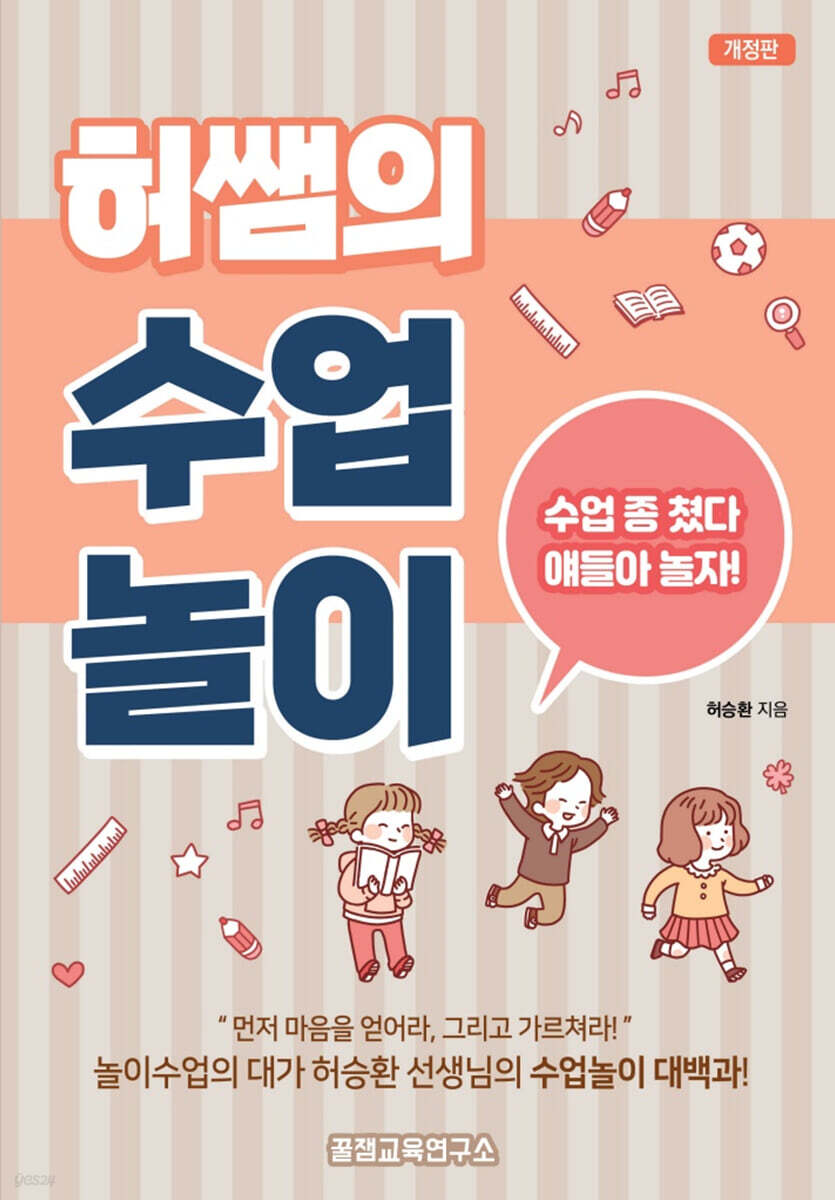
Teacher Heo's class play
 |
Description
Book Introduction
QR codes for flash, PPT, and learning materials included in the book
A class game that can be used comprehensively in any class
Having taught students for over 30 years, the author, who wanted to make classes more fun and student-centered, rather than one-sided and boring teacher-centered classes, began to think about and research play in the classroom.
As I was writing a class diary every day and organizing these records, I got the courage to start organizing my efforts.
In the revised edition of 'Teacher Heo's Class Play', there are 1 games that can be played during class time.
Using metacognition 2.
3. Leveraging common goals
4. Utilizing ‘luck’, one of the three elements of play.
5. Cooperate rather than compete.
It is packed with information divided into five sections for student-centered learning play.
For each class activity, add one or two activities to the 'It's more fun if you play like this' corner, so that you can apply them to more class activities.
This is enough to play a different game 2-3 times a week for 52 weeks a year.
This time, we have prepared materials such as flash, PPT, and worksheets that are especially necessary for class play so that you can download and use them.
A class game that can be used comprehensively in any class
Having taught students for over 30 years, the author, who wanted to make classes more fun and student-centered, rather than one-sided and boring teacher-centered classes, began to think about and research play in the classroom.
As I was writing a class diary every day and organizing these records, I got the courage to start organizing my efforts.
In the revised edition of 'Teacher Heo's Class Play', there are 1 games that can be played during class time.
Using metacognition 2.
3. Leveraging common goals
4. Utilizing ‘luck’, one of the three elements of play.
5. Cooperate rather than compete.
It is packed with information divided into five sections for student-centered learning play.
For each class activity, add one or two activities to the 'It's more fun if you play like this' corner, so that you can apply them to more class activities.
This is enough to play a different game 2-3 times a week for 52 weeks a year.
This time, we have prepared materials such as flash, PPT, and worksheets that are especially necessary for class play so that you can download and use them.
- You can preview some of the book's contents.
Preview
index
prolog
Part 1: Using Metacognition
00 Using metacognition
01 Telephone Quiz
02 Quiz Quiz Trade
03 Anagram Post-it Quiz
04 Initial Consonant Quiz Game
05 Making a study patchwork
06 Find a real expert!
07 Presentation Quiz
08 Teach your latecomer!
09 Survival Jigsaw Quiz
10 Let's go together!
11 Memory Market Games
12 Partner Quiz
13 Group Speed Quiz
14 Havruta Games
15 Marker Truth Game
16 Picture Bingo Quiz
17 Who am I?
Part 2: Leveraging Common Goals
00 Leveraging shared goals
01 Class Thermometer Quiz
02 Relay Quiz
03 Chalkboard Relay
04 Stage 6 Golden Bell
05 Spider-Man Golden Bell
06 Praise Golden Bell
07 Initial Consonant Treasure Hunt Game
08 Human Blue Marble Game
09 1 vs. 100 Quiz Show
10 Full Speed Quiz
Utilizing 'Luck', one of the three elements of play
00 Utilizing 'Luck', one of the three elements of play
01 Sentence Puzzle Game
02 Classroom Lottery Game
03 OX Soccer Game
04 Baseball Game
05 Lucky Bulbok Tear Bingo
06 Chair of Truth and Lies
07 Designation Survival Quiz
08 Lucky or Unlucky Bingo Game
09 Battleship Game
10 Taboo Words Quiz
11 Pyramid Bingo
12 Erased Blackboard Golden Bell
13 Guessing Hole Game
Unit 14 Introduction Bingo
15 OX Ladder Game
16 Smelly Feet Game
17 Post-it Bingo Game
18 Land Grabbing Game
Part 4: Cooperation over Competition
00 Cooperation over competition
01 Beat the teacher!
02 Balloon Bingo Game
03 Cooperative True or False Quiz
04 Flash Cooperative True or False Quiz
05 Save my friend!
06 Sit down on the chair!
07 Indian Card Review Game
08 Jigsaw Puzzle Game
09 Four-letter Golden Bell
10-letter Golden Bell
Part 5: Student-Centered Class Play
00 Student-centered class play
01 Cover the Post-it blanket!
02 Post-it Blue Marble Game
03 Post-it Treasure Hunt
04 Wandering Detective Activities
05 Knowledge Marketplace
06 Turn the corner!
07 Multiple Choice Quiz
08 Classroom World Cafe
09 Textbook Information Hunting Contest
10 Landmine Quiz
11 Team Scoot Game
12 Showdown Games
13 Matchup Card Game
14 Hwatu Review Game
15 Team Game Tournament
16 Lumicube Quiz
17 Throw the wad of paper!
18 Halli Galli Review Game
19 Dingo Card Game
20 Speak with your body
Part 1: Using Metacognition
00 Using metacognition
01 Telephone Quiz
02 Quiz Quiz Trade
03 Anagram Post-it Quiz
04 Initial Consonant Quiz Game
05 Making a study patchwork
06 Find a real expert!
07 Presentation Quiz
08 Teach your latecomer!
09 Survival Jigsaw Quiz
10 Let's go together!
11 Memory Market Games
12 Partner Quiz
13 Group Speed Quiz
14 Havruta Games
15 Marker Truth Game
16 Picture Bingo Quiz
17 Who am I?
Part 2: Leveraging Common Goals
00 Leveraging shared goals
01 Class Thermometer Quiz
02 Relay Quiz
03 Chalkboard Relay
04 Stage 6 Golden Bell
05 Spider-Man Golden Bell
06 Praise Golden Bell
07 Initial Consonant Treasure Hunt Game
08 Human Blue Marble Game
09 1 vs. 100 Quiz Show
10 Full Speed Quiz
Utilizing 'Luck', one of the three elements of play
00 Utilizing 'Luck', one of the three elements of play
01 Sentence Puzzle Game
02 Classroom Lottery Game
03 OX Soccer Game
04 Baseball Game
05 Lucky Bulbok Tear Bingo
06 Chair of Truth and Lies
07 Designation Survival Quiz
08 Lucky or Unlucky Bingo Game
09 Battleship Game
10 Taboo Words Quiz
11 Pyramid Bingo
12 Erased Blackboard Golden Bell
13 Guessing Hole Game
Unit 14 Introduction Bingo
15 OX Ladder Game
16 Smelly Feet Game
17 Post-it Bingo Game
18 Land Grabbing Game
Part 4: Cooperation over Competition
00 Cooperation over competition
01 Beat the teacher!
02 Balloon Bingo Game
03 Cooperative True or False Quiz
04 Flash Cooperative True or False Quiz
05 Save my friend!
06 Sit down on the chair!
07 Indian Card Review Game
08 Jigsaw Puzzle Game
09 Four-letter Golden Bell
10-letter Golden Bell
Part 5: Student-Centered Class Play
00 Student-centered class play
01 Cover the Post-it blanket!
02 Post-it Blue Marble Game
03 Post-it Treasure Hunt
04 Wandering Detective Activities
05 Knowledge Marketplace
06 Turn the corner!
07 Multiple Choice Quiz
08 Classroom World Cafe
09 Textbook Information Hunting Contest
10 Landmine Quiz
11 Team Scoot Game
12 Showdown Games
13 Matchup Card Game
14 Hwatu Review Game
15 Team Game Tournament
16 Lumicube Quiz
17 Throw the wad of paper!
18 Halli Galli Review Game
19 Dingo Card Game
20 Speak with your body
Publisher's Review
Full-time school attendance has begun.
Society and schools have returned to their pre-corona days.
It's time for elementary school students who have experienced COVID-19 to consider the "developmental gap," which is just as important as the "learning gap," through "play," which can fill in the emotional and psychological deficits as well as the "learning gap."
The problem, however, is that awareness is lacking compared to the learning gap.
Lack of movement delays brain development, leading to learning gaps. This gap becomes more severe for students from less fortunate families, as they lack the stimulation they need for development.
Children who had difficulty playing due to the coronavirus are back in the classroom.
How can we provide children with experiences that foster healthy relationships with their peers and allow them to have fun and happy experiences? Now is the time to give them back the "play" they've lost.
We need to restore and reclaim ‘play,’ which can be called children’s breath.
In accordance with the recently revised curriculum, textbooks for first and second graders in elementary school were developed to reduce the amount of learning and increase student participation activities.
Its features include the use of vocabulary appropriate for elementary school students, an easy structure for basic and fundamental learning, and the presentation of play-centered learning activities.
In the 2022 revised curriculum, elementary schools will focus on play-based learning and play-centered spatial innovation that takes into account students' developmental levels.
Now, we have no choice but to accept the reality that ‘fun’ has become the prerequisite for learning even in the classroom.
Just looking at a few statistics that appear in newspaper articles such as 'Korea's children and adolescents' happiness index ranks last among OECD countries', 'Suicide is the number one cause of death among adolescents', and 'One in five children and adolescents experience suicidal thoughts', it is easy to see how unhappy the lives of our students are.
I believe that nothing beats 'play' in helping students build healthy relationships with their peers in the classroom and have fun and happy experiences.
These days, as students disperse to after-school academies, the only place where they can meet their peers and spend the most time playing is 'school'.
This is why classrooms should be fun places for students.
For over 30 years, I have taught students and, above all, I have always wanted to have fun.
I wanted to make sure that in the classroom, where students spend more time than at home, they thought at least once a day, "Class is really fun!"
1.
Using metacognition 2.
3. Leveraging common goals
4. Utilizing ‘luck’, one of the three elements of play.
5. Cooperate rather than compete.
It is packed with information divided into five sections for student-centered learning play.
For each class activity, we add one or two activities to the "It's more fun if you play like this" corner, so there are even more activities to enjoy.
This is enough to play a different game 2-3 times a week for a 52-week year.
This time, we have prepared materials such as flash, PPT, and worksheets that are especially necessary for class play so that you can download and use them.
After finishing the class play, sit down with the students and ask them questions such as, "Were there any difficulties you encountered while playing the class play?", "How were you able to solve them?", and "Did you discover anything new while playing with your friends?", so that the students can see themselves and their friends in the activities they enjoyed.
Students learn and realize much more than their teachers intended.
Especially students who have been building relationships through play since the beginning of the semester begin to open up and express themselves through activities rather than words.
As your body becomes free and comfortable, your mind also becomes relaxed.
I believe this will be of great help to all teachers who want to provide quality lessons to their students, including flipped classrooms, Havruta classes, and learning communities, as well as to anyone who needs playful learning in the classroom, not just in the educational field.
Do you remember the first keys on your computer keyboard? No, they were 'Q', 'ㅂ', and '?'
It's not even '1' or '!'
It's not even the function key 'F1'.
It's 'ESC'.
This is the key used to exit a program or screen.
It means 'escape'.
Even though they know that their students really enjoy it, many of them feel offended by their rough reactions or competitive spirit and return to the quiet and controlled classroom.
But the original teacher is someone who fails every day.
If you ever get stuck while playing a class game with your students, quickly think of 'ESC'.
All the games in this book are the output of such 'ESC'.
And please create a better path with the collective intelligence of the teachers.
All roads lead to the end.
I sincerely hope that someday, the practices of my classroom and my play will connect and connect, helping to reduce the trial and error faced by my juniors who are just entering the teaching profession.
The English word 'Play' comes from the Latin word 'Plaga', which means 'thirst'.
Play is not something that is good to do, but rather an instinct that cannot be endured if not done.
'Is this class or play?!' We hope that teachers and students will be happier through the revised edition of 'Teacher Heo's Play Class'.
Society and schools have returned to their pre-corona days.
It's time for elementary school students who have experienced COVID-19 to consider the "developmental gap," which is just as important as the "learning gap," through "play," which can fill in the emotional and psychological deficits as well as the "learning gap."
The problem, however, is that awareness is lacking compared to the learning gap.
Lack of movement delays brain development, leading to learning gaps. This gap becomes more severe for students from less fortunate families, as they lack the stimulation they need for development.
Children who had difficulty playing due to the coronavirus are back in the classroom.
How can we provide children with experiences that foster healthy relationships with their peers and allow them to have fun and happy experiences? Now is the time to give them back the "play" they've lost.
We need to restore and reclaim ‘play,’ which can be called children’s breath.
In accordance with the recently revised curriculum, textbooks for first and second graders in elementary school were developed to reduce the amount of learning and increase student participation activities.
Its features include the use of vocabulary appropriate for elementary school students, an easy structure for basic and fundamental learning, and the presentation of play-centered learning activities.
In the 2022 revised curriculum, elementary schools will focus on play-based learning and play-centered spatial innovation that takes into account students' developmental levels.
Now, we have no choice but to accept the reality that ‘fun’ has become the prerequisite for learning even in the classroom.
Just looking at a few statistics that appear in newspaper articles such as 'Korea's children and adolescents' happiness index ranks last among OECD countries', 'Suicide is the number one cause of death among adolescents', and 'One in five children and adolescents experience suicidal thoughts', it is easy to see how unhappy the lives of our students are.
I believe that nothing beats 'play' in helping students build healthy relationships with their peers in the classroom and have fun and happy experiences.
These days, as students disperse to after-school academies, the only place where they can meet their peers and spend the most time playing is 'school'.
This is why classrooms should be fun places for students.
For over 30 years, I have taught students and, above all, I have always wanted to have fun.
I wanted to make sure that in the classroom, where students spend more time than at home, they thought at least once a day, "Class is really fun!"
1.
Using metacognition 2.
3. Leveraging common goals
4. Utilizing ‘luck’, one of the three elements of play.
5. Cooperate rather than compete.
It is packed with information divided into five sections for student-centered learning play.
For each class activity, we add one or two activities to the "It's more fun if you play like this" corner, so there are even more activities to enjoy.
This is enough to play a different game 2-3 times a week for a 52-week year.
This time, we have prepared materials such as flash, PPT, and worksheets that are especially necessary for class play so that you can download and use them.
After finishing the class play, sit down with the students and ask them questions such as, "Were there any difficulties you encountered while playing the class play?", "How were you able to solve them?", and "Did you discover anything new while playing with your friends?", so that the students can see themselves and their friends in the activities they enjoyed.
Students learn and realize much more than their teachers intended.
Especially students who have been building relationships through play since the beginning of the semester begin to open up and express themselves through activities rather than words.
As your body becomes free and comfortable, your mind also becomes relaxed.
I believe this will be of great help to all teachers who want to provide quality lessons to their students, including flipped classrooms, Havruta classes, and learning communities, as well as to anyone who needs playful learning in the classroom, not just in the educational field.
Do you remember the first keys on your computer keyboard? No, they were 'Q', 'ㅂ', and '?'
It's not even '1' or '!'
It's not even the function key 'F1'.
It's 'ESC'.
This is the key used to exit a program or screen.
It means 'escape'.
Even though they know that their students really enjoy it, many of them feel offended by their rough reactions or competitive spirit and return to the quiet and controlled classroom.
But the original teacher is someone who fails every day.
If you ever get stuck while playing a class game with your students, quickly think of 'ESC'.
All the games in this book are the output of such 'ESC'.
And please create a better path with the collective intelligence of the teachers.
All roads lead to the end.
I sincerely hope that someday, the practices of my classroom and my play will connect and connect, helping to reduce the trial and error faced by my juniors who are just entering the teaching profession.
The English word 'Play' comes from the Latin word 'Plaga', which means 'thirst'.
Play is not something that is good to do, but rather an instinct that cannot be endured if not done.
'Is this class or play?!' We hope that teachers and students will be happier through the revised edition of 'Teacher Heo's Play Class'.
GOODS SPECIFICS
- Date of issue: December 7, 2023
- Page count, weight, size: 416 pages | 170*240*30mm
- ISBN13: 9791196511760
- ISBN10: 1196511764
You may also like
카테고리
korean


korean

![GQ KOREA Mark (Monthly): December [2025]](http://librairie.coreenne.fr/cdn/shop/files/8ef265dbbfbf186523ed75ba7319009d.jpg?v=1765340328&width=3840)


