

Between past and future
 |
Description
Book Introduction
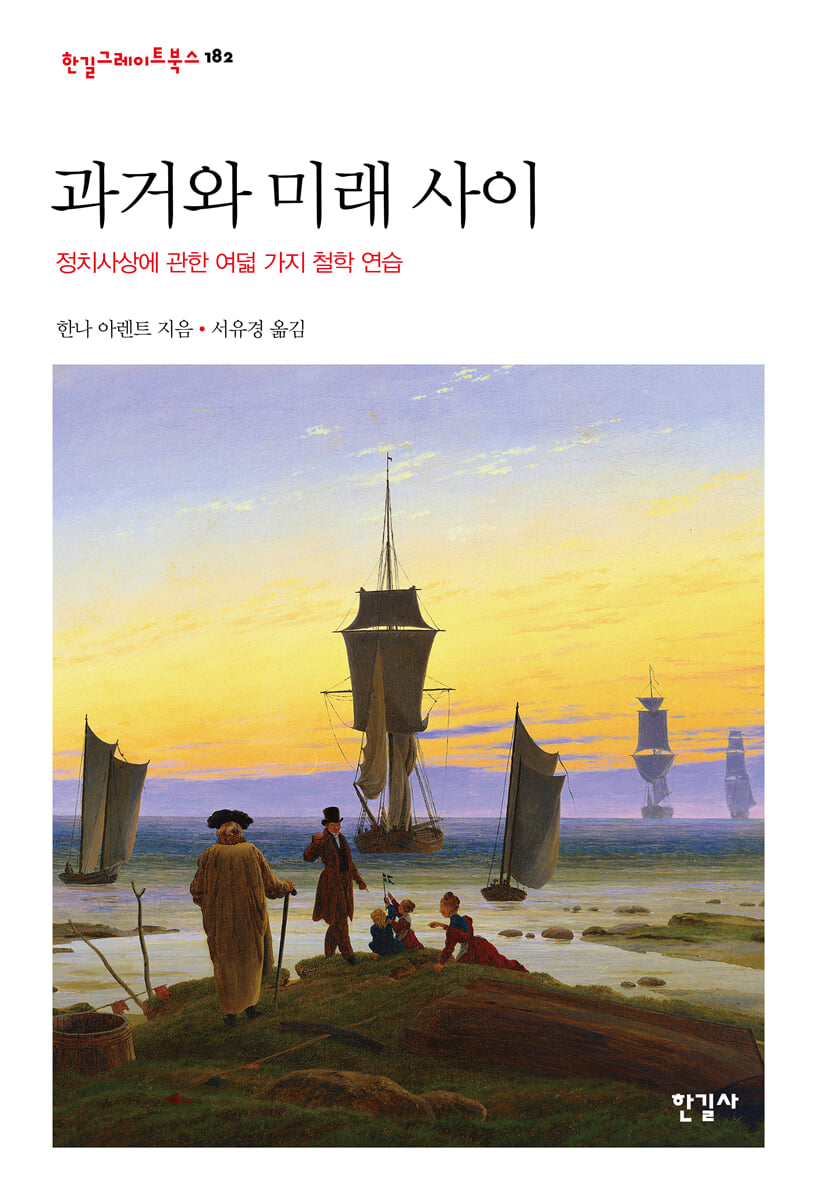
A collection of eight philosophical essays on political thought written by Hannah Arendt.
It is an accurate guide to Arendt's thought, so much so that it can be called a 'dictionary of Arendt's concepts', and is an important document that predicts the development of her thought.
Furthermore, it is also the work in which Arendt's deconstructive research methodology on the dichotomies of Western philosophy is most prominently displayed.
Why is the book titled 'Between Past and Future'?
Humans constantly create and expand their present by inserting themselves 'between the past and the future'.
This process is reason and is the condition of human existence.
The moment when the present begins with this human intrusion, that is, the moment of birth, is also the beginning of a human existence.
This ability to make new beginnings (choices) that continue until death, that is, the ability to act, is also what Arendt calls the 'human condition.'
Every act implies a new beginning, creating countless unpredictabilities, and thought once again floats and traverses 'between' countless variables.
It goes without saying that there is no 'absolute truth' here.
The way to achieve immortality among the overflowing ‘relative truths’ lies in ‘memory and tradition.’
This is what Arendt says in her eight essays.
How will we remember and how will we pass it on?
The creator of the world and the one who can be remembered forever, Hannah Arendt's 'Homo Deus', he is the 'citizen' of the public sphere.
It is an accurate guide to Arendt's thought, so much so that it can be called a 'dictionary of Arendt's concepts', and is an important document that predicts the development of her thought.
Furthermore, it is also the work in which Arendt's deconstructive research methodology on the dichotomies of Western philosophy is most prominently displayed.
Why is the book titled 'Between Past and Future'?
Humans constantly create and expand their present by inserting themselves 'between the past and the future'.
This process is reason and is the condition of human existence.
The moment when the present begins with this human intrusion, that is, the moment of birth, is also the beginning of a human existence.
This ability to make new beginnings (choices) that continue until death, that is, the ability to act, is also what Arendt calls the 'human condition.'
Every act implies a new beginning, creating countless unpredictabilities, and thought once again floats and traverses 'between' countless variables.
It goes without saying that there is no 'absolute truth' here.
The way to achieve immortality among the overflowing ‘relative truths’ lies in ‘memory and tradition.’
This is what Arendt says in her eight essays.
How will we remember and how will we pass it on?
The creator of the world and the one who can be remembered forever, Hannah Arendt's 'Homo Deus', he is the 'citizen' of the public sphere.
- You can preview some of the book's contents.
Preview
index
Between Past and Future: Eight Philosophical Exercises on Political Thought
Hannah Arendt's "Metaxy": A Feast of Political Philosophy│Seo Yu-kyung
Introduction by Jerome Cohn
Preface: The Gap Between Past and Future
Part 1: Break with the Past
Chapter 1: Tradition and Modernity
Chapter 2: The Concept of History: Ancient and Modern
Part II: The Origins of Authority and Freedom
Chapter 3: What is Authority?
Chapter 4: What is freedom?
Part 3: Crisis and Solutions in Modern Society
Chapter 5: The Crisis in Education
Chapter 6: The Crisis of Culture: Its Social and Political Implications
Chapter 7: Truth and Politics
Chapter 8: Conquest of Space and the Status of Humanity
Hannah Arendt and Homo Deus in the 21st Century│Translator's Note
Search
Hannah Arendt's "Metaxy": A Feast of Political Philosophy│Seo Yu-kyung
Introduction by Jerome Cohn
Preface: The Gap Between Past and Future
Part 1: Break with the Past
Chapter 1: Tradition and Modernity
Chapter 2: The Concept of History: Ancient and Modern
Part II: The Origins of Authority and Freedom
Chapter 3: What is Authority?
Chapter 4: What is freedom?
Part 3: Crisis and Solutions in Modern Society
Chapter 5: The Crisis in Education
Chapter 6: The Crisis of Culture: Its Social and Political Implications
Chapter 7: Truth and Politics
Chapter 8: Conquest of Space and the Status of Humanity
Hannah Arendt and Homo Deus in the 21st Century│Translator's Note
Search
Detailed image
Into the book
For if there were no process of completion through thought after the act was performed, that is, no elaboration of expression achieved with the help of memory, then, simply put, there would be no story left to tell people.
--- p.82
Human action, like all strictly political phenomena, is bound up with human plurality.
To the extent that this human plurality stems from human natality, it is one of the fundamental conditions of human life.
--- p.162
For instance, if we begin to act against nature by initiating natural processes, we are in effect introducing unpredictability into a realm previously thought to be governed by strict laws.
--- p.162
If there were no common world among them that would instantly connect and separate them, humans would either live in a state of extreme loneliness and separation or be forced to become some kind of mass.
For mass society is nothing more than an organized form of life that automatically fills the gap between people, who still relate to one another, but whose common world has disappeared.
--- p.204
No, more than that, it is because humans cannot reach depth without going through the process of remembering.
--- p.211
It is true that in childcare and education, the need for 'authority' seems more plausible and clear than in any other field.
It is a characteristic of our times that we want to eliminate even this extremely limited and politically irrelevant form of authority.
--- p.248
In contrast to our concept of growth, which holds that people grow toward the future, the Romans believed that people grow toward the past.
--- p.256
The raison d'être of politics is freedom, and the arena in which it is experienced is action.
--- p.287
Freedom required more than mere liberation; it also required the presence of others in the same position, and a common public sphere in which to meet them.
--- p.291
Education is where we decide whether we love our children enough not to evict them from our world and leave them to their own devices, and whether we love them enough not to rob them of the opportunity to do something new, something we have never seen before, but to prepare them for the task of renewing some kind of common world.
--- p.358
[The Romans thought] a man of a well-cultivated mind is one who knows how to choose his companions among people, things, and ideas, both past and present.
--- p.401
In contrast, modern political lies effectively deal with things that are never secrets, but are actually known to everyone.
This point is clear when rewriting modern history through the eyes of [contemporary] eyewitnesses, but the situation is similar in various image-making processes.
In the image-making process, even well-known established facts can be rejected or ignored if they appear to be detrimental to the image.
This is because an image must not be drawn to be more realistic than life itself, as in the case of an old-fashioned portrait, but must provide a complete substitute for the real thing.
And thanks to modern technology and mass media, this substitute is presented to the public in a way that the original could never have achieved.
--- p.442
From this perspective, technology as a whole no longer appears as “the result of a conscious human effort to expand human material capacities, but rather as a biological process of some grand scale.”
--- p.82
Human action, like all strictly political phenomena, is bound up with human plurality.
To the extent that this human plurality stems from human natality, it is one of the fundamental conditions of human life.
--- p.162
For instance, if we begin to act against nature by initiating natural processes, we are in effect introducing unpredictability into a realm previously thought to be governed by strict laws.
--- p.162
If there were no common world among them that would instantly connect and separate them, humans would either live in a state of extreme loneliness and separation or be forced to become some kind of mass.
For mass society is nothing more than an organized form of life that automatically fills the gap between people, who still relate to one another, but whose common world has disappeared.
--- p.204
No, more than that, it is because humans cannot reach depth without going through the process of remembering.
--- p.211
It is true that in childcare and education, the need for 'authority' seems more plausible and clear than in any other field.
It is a characteristic of our times that we want to eliminate even this extremely limited and politically irrelevant form of authority.
--- p.248
In contrast to our concept of growth, which holds that people grow toward the future, the Romans believed that people grow toward the past.
--- p.256
The raison d'être of politics is freedom, and the arena in which it is experienced is action.
--- p.287
Freedom required more than mere liberation; it also required the presence of others in the same position, and a common public sphere in which to meet them.
--- p.291
Education is where we decide whether we love our children enough not to evict them from our world and leave them to their own devices, and whether we love them enough not to rob them of the opportunity to do something new, something we have never seen before, but to prepare them for the task of renewing some kind of common world.
--- p.358
[The Romans thought] a man of a well-cultivated mind is one who knows how to choose his companions among people, things, and ideas, both past and present.
--- p.401
In contrast, modern political lies effectively deal with things that are never secrets, but are actually known to everyone.
This point is clear when rewriting modern history through the eyes of [contemporary] eyewitnesses, but the situation is similar in various image-making processes.
In the image-making process, even well-known established facts can be rejected or ignored if they appear to be detrimental to the image.
This is because an image must not be drawn to be more realistic than life itself, as in the case of an old-fashioned portrait, but must provide a complete substitute for the real thing.
And thanks to modern technology and mass media, this substitute is presented to the public in a way that the original could never have achieved.
--- p.442
From this perspective, technology as a whole no longer appears as “the result of a conscious human effort to expand human material capacities, but rather as a biological process of some grand scale.”
--- p.482
Publisher's Review
Between Past and Future is a collection of eight philosophical essays that explore Hannah Arendt's reflections on traditional political concepts such as history, tradition, authority, and freedom.
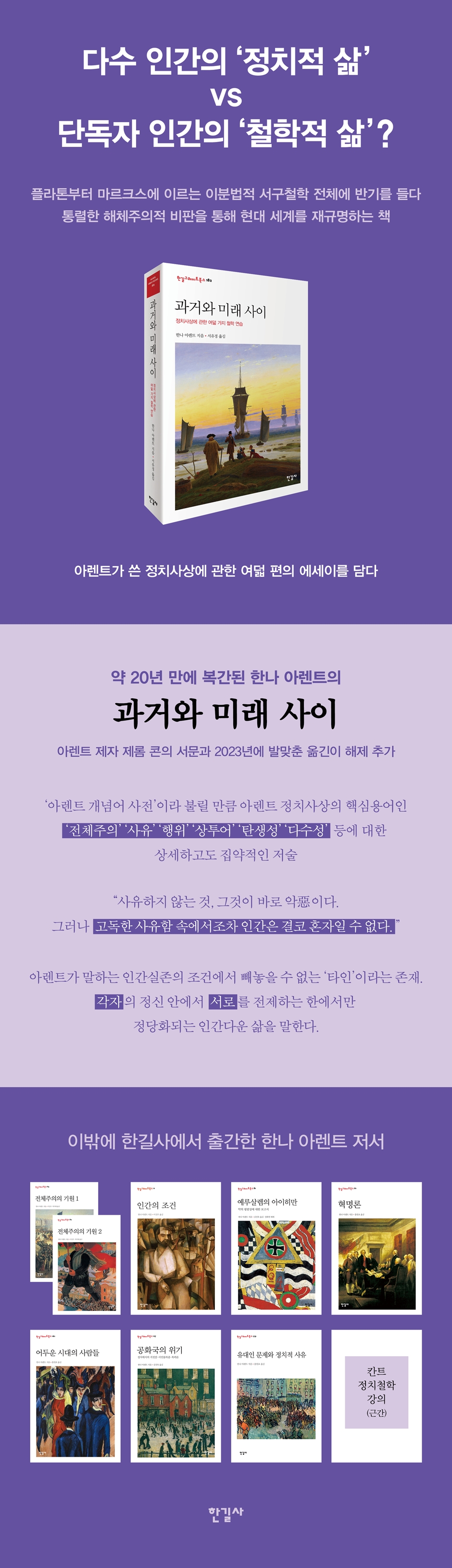
This edition, republished after about 20 years as a Penguin edition commemorating the 100th anniversary of Hannah Arendt's birth, includes a preface by Arendt's disciple Jerome Cohn and a translator's note and afterword for 2023.
This book provides a detailed and concise explanation of the core terms of Arendt's political thought, such as 'totalitarianism,' 'thought,' 'action,' 'cliché,' 'natality,' and 'plurality.'
It is an accurate guide to Arendt's thought, so much so that it can be called a 'dictionary of Arendt's concepts', and is an important document that predicts the development of her thought.
Furthermore, it is also the work in which Arendt's deconstructive research methodology on the dichotomies of Western philosophy is most prominently displayed.
In this book, Arendt interprets the world through a scathing deconstructive critique of the entire dichotomous Western philosophy from Plato to Marx, and she unearths concepts that have disappeared or been erased in the back alleys of history and invents new, present-day uses for them.
“Self-destruction: this is perhaps the only and most superficial characteristic shared by Kierkegaard, Marx, and Nietzsche among the three revolts against tradition that took place in the 19th century” (p. 124).
Redefining humanity
In her discussions of traditional political concepts such as history and tradition, authority and freedom, Arendt questions the ontological dichotomy of human existence.
That is, it focuses on the inseparable relationship between the 'political life' of the majority of humans, which has been separated for a long time, and the 'philosophical life' of an individual human being.
For Arendt, human existence was a complex of thought expressed by 'philosophical life' and multiplicity expressed by 'political life.'
This is also the reason why Arendt refused to be called a philosopher who deals only with humans as individuals.
The human life that Arendt speaks of is a life in which each person presupposes and acts on the other within their own spirit.
“Even the lives of saints are lives lived with others.”
(Socialis est vita sanctorum, page 182).
As Arendt argues that “the moment one begins to engage in the activity of thought, one must confront the world” (p. 34), “even in solitary thought, one can never be alone” (p. 36).
For Arendt, thought was simply the same structure through which humans act toward the world and toward others, unfolding within the human mind.
The eight essays in this book aim, as Arendt puts it, to “gain an experience of how to think” (p. 94).
Arendt does not hastily define the object of thought or prescribe a prescription.
His purpose is centered on the question “how we move in this world” (p. 94).
The concept of 'time' and human existence
Why is the book titled 'Between Past and Future'?
For Arendt, who calls herself a political thinker, the metaphysical time concepts of ‘past’ and ‘future’ may seem like an awkward topic at first.
But the word to note in this title is 'between'.
The core of this book lies in the story of the 'present', that is, between the past and the future.
Humans are the only beings that perceive the ‘present’.
Plotinus spoke of the ‘now’ as the ‘point’ where the past and the future meet, with the expression, “The past is the time that ends now, and the future is the time that begins now” (p. 18).
That is, it creates a point, or 'space', in time that can be perceived as a unity or continuum, and causes a crack.
As a space, the 'present' now becomes a location that can be physically occupied or recognized.
In this way, humans recognize the present and mark their 'coordinates' in the world.
Coordinate marking begins when a person is born and ends when he dies.
This 'historical process' is a thoroughly individualized journey, a "unique, non-marketable commodity" (p. 490) that cannot be evaluated in terms of exchange value.
Humans constantly create and expand their present by inserting themselves 'between the past and the future'.
This process is reason and is the condition of human existence.
That is, human existence and the emergence of time are simultaneous events.
“Because only humans are allowed to intrude into time,
Only as long as a person stands in his own position does the indifferent flow of time occur.
It is divided into tenses [past, present, and future]” (pp. 88-89).
Hannah Arendt's 'Homo Deus'
The moment when the present begins with this human intrusion, that is, the moment of birth, is also the beginning of a human existence.
Countless humans are born and at the moment of birth, they 'start' to mark their own coordinates.
Even after primary biological birth, humans have a secondary birth, or 'political natality', through free choice.
This ability to make new beginnings (choices) that continue until death, that is, the ability to act, is also what Arendt calls the 'human condition.'
This is why, in Arendt's existence, thinking and action cannot be separated.
Every individual human being possesses these existential conditions of human existence, namely the capacity for action and thought, which originate from their first birth.
Every act implies a new beginning, creating countless unpredictabilities, and thought once again floats and traverses 'between' countless variables.
It is natural that there is no 'absolute truth' in this place where each person takes their own coordinates.
For Arendt, the realm of human history is a space overflowing with various 'relative truths', and the essence of this realm lies in 'persuasion' rather than 'proof'.
“How do the Greeks understand [each other]? Not as individuals, but as
How to see the same world from each other's perspective, that is, the same thing very differently,
And I learned how to look at things from opposing perspectives” (pp. 149-150).
The way to achieve immortality among the overflowing ‘relative truths’ lies in ‘memory and tradition.’
This is what Arendt says in her eight essays.
How will we remember and how will we pass it on?
The human mission is to 'create' a common world, a common memory, that can be recalled and highly valued by the constantly emerging individual human beings.
Each of us, presupposing each other, gathers together to create values shared by the community, thereby establishing a common coordinate between the past and the future.
Thus, the creator of the world and the one who can be remembered forever, the 'Homo Deus' of which Hannah Arendt spoke, he is the 'citizen' of the public sphere.
This edition, republished after about 20 years as a Penguin edition commemorating the 100th anniversary of Hannah Arendt's birth, includes a preface by Arendt's disciple Jerome Cohn and a translator's note and afterword for 2023.
This book provides a detailed and concise explanation of the core terms of Arendt's political thought, such as 'totalitarianism,' 'thought,' 'action,' 'cliché,' 'natality,' and 'plurality.'
It is an accurate guide to Arendt's thought, so much so that it can be called a 'dictionary of Arendt's concepts', and is an important document that predicts the development of her thought.
Furthermore, it is also the work in which Arendt's deconstructive research methodology on the dichotomies of Western philosophy is most prominently displayed.
In this book, Arendt interprets the world through a scathing deconstructive critique of the entire dichotomous Western philosophy from Plato to Marx, and she unearths concepts that have disappeared or been erased in the back alleys of history and invents new, present-day uses for them.
“Self-destruction: this is perhaps the only and most superficial characteristic shared by Kierkegaard, Marx, and Nietzsche among the three revolts against tradition that took place in the 19th century” (p. 124).
Redefining humanity
In her discussions of traditional political concepts such as history and tradition, authority and freedom, Arendt questions the ontological dichotomy of human existence.
That is, it focuses on the inseparable relationship between the 'political life' of the majority of humans, which has been separated for a long time, and the 'philosophical life' of an individual human being.
For Arendt, human existence was a complex of thought expressed by 'philosophical life' and multiplicity expressed by 'political life.'
This is also the reason why Arendt refused to be called a philosopher who deals only with humans as individuals.
The human life that Arendt speaks of is a life in which each person presupposes and acts on the other within their own spirit.
“Even the lives of saints are lives lived with others.”
(Socialis est vita sanctorum, page 182).
As Arendt argues that “the moment one begins to engage in the activity of thought, one must confront the world” (p. 34), “even in solitary thought, one can never be alone” (p. 36).
For Arendt, thought was simply the same structure through which humans act toward the world and toward others, unfolding within the human mind.
The eight essays in this book aim, as Arendt puts it, to “gain an experience of how to think” (p. 94).
Arendt does not hastily define the object of thought or prescribe a prescription.
His purpose is centered on the question “how we move in this world” (p. 94).
The concept of 'time' and human existence
Why is the book titled 'Between Past and Future'?
For Arendt, who calls herself a political thinker, the metaphysical time concepts of ‘past’ and ‘future’ may seem like an awkward topic at first.
But the word to note in this title is 'between'.
The core of this book lies in the story of the 'present', that is, between the past and the future.
Humans are the only beings that perceive the ‘present’.
Plotinus spoke of the ‘now’ as the ‘point’ where the past and the future meet, with the expression, “The past is the time that ends now, and the future is the time that begins now” (p. 18).
That is, it creates a point, or 'space', in time that can be perceived as a unity or continuum, and causes a crack.
As a space, the 'present' now becomes a location that can be physically occupied or recognized.
In this way, humans recognize the present and mark their 'coordinates' in the world.
Coordinate marking begins when a person is born and ends when he dies.
This 'historical process' is a thoroughly individualized journey, a "unique, non-marketable commodity" (p. 490) that cannot be evaluated in terms of exchange value.
Humans constantly create and expand their present by inserting themselves 'between the past and the future'.
This process is reason and is the condition of human existence.
That is, human existence and the emergence of time are simultaneous events.
“Because only humans are allowed to intrude into time,
Only as long as a person stands in his own position does the indifferent flow of time occur.
It is divided into tenses [past, present, and future]” (pp. 88-89).
Hannah Arendt's 'Homo Deus'
The moment when the present begins with this human intrusion, that is, the moment of birth, is also the beginning of a human existence.
Countless humans are born and at the moment of birth, they 'start' to mark their own coordinates.
Even after primary biological birth, humans have a secondary birth, or 'political natality', through free choice.
This ability to make new beginnings (choices) that continue until death, that is, the ability to act, is also what Arendt calls the 'human condition.'
This is why, in Arendt's existence, thinking and action cannot be separated.
Every individual human being possesses these existential conditions of human existence, namely the capacity for action and thought, which originate from their first birth.
Every act implies a new beginning, creating countless unpredictabilities, and thought once again floats and traverses 'between' countless variables.
It is natural that there is no 'absolute truth' in this place where each person takes their own coordinates.
For Arendt, the realm of human history is a space overflowing with various 'relative truths', and the essence of this realm lies in 'persuasion' rather than 'proof'.
“How do the Greeks understand [each other]? Not as individuals, but as
How to see the same world from each other's perspective, that is, the same thing very differently,
And I learned how to look at things from opposing perspectives” (pp. 149-150).
The way to achieve immortality among the overflowing ‘relative truths’ lies in ‘memory and tradition.’
This is what Arendt says in her eight essays.
How will we remember and how will we pass it on?
The human mission is to 'create' a common world, a common memory, that can be recalled and highly valued by the constantly emerging individual human beings.
Each of us, presupposing each other, gathers together to create values shared by the community, thereby establishing a common coordinate between the past and the future.
Thus, the creator of the world and the one who can be remembered forever, the 'Homo Deus' of which Hannah Arendt spoke, he is the 'citizen' of the public sphere.
GOODS SPECIFICS
- Date of issue: January 13, 2023
- Format: Hardcover book binding method guide
- Page count, weight, size: 516 pages | 890g | 152*225*30mm
- ISBN13: 9788935666607
- ISBN10: 8935666602
You may also like
카테고리
korean


korean

![GQ KOREA Mark (Monthly): December [2025]](http://librairie.coreenne.fr/cdn/shop/files/8ef265dbbfbf186523ed75ba7319009d.jpg?v=1765340328&width=3840)


