

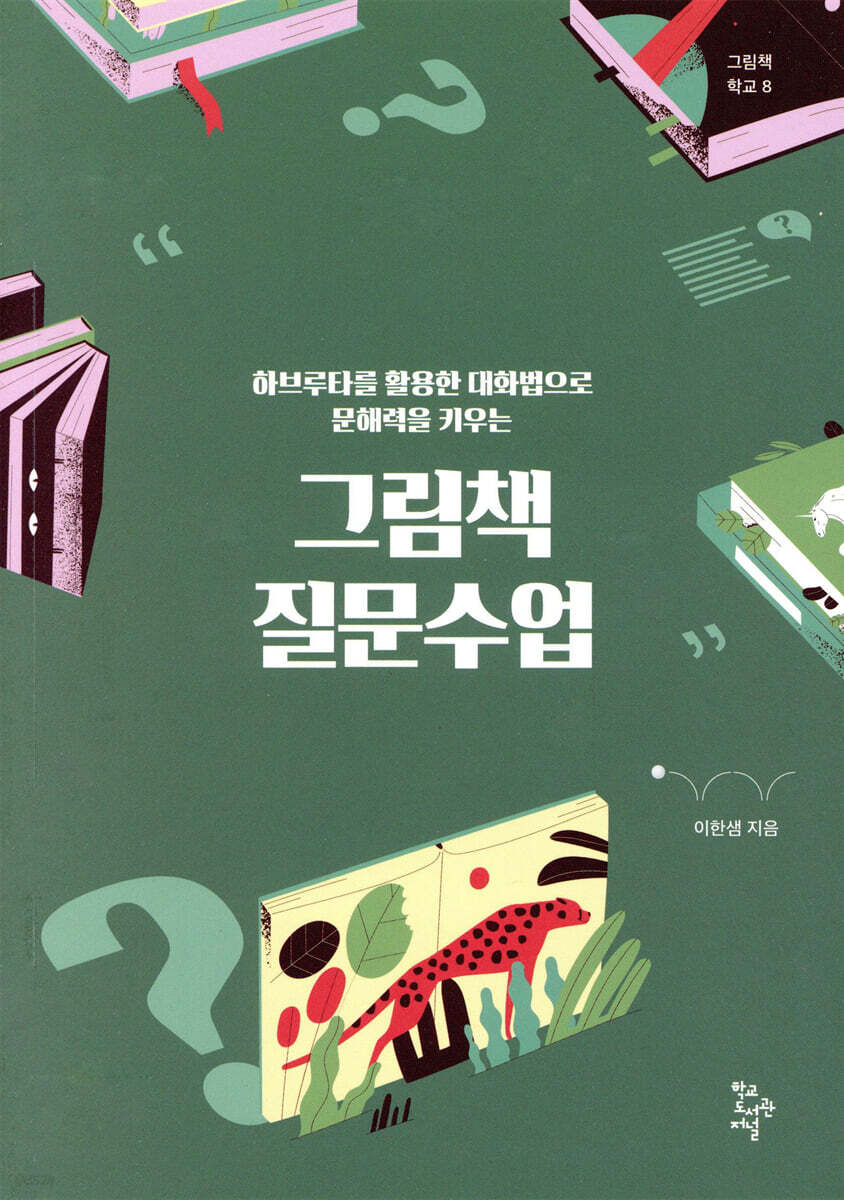
Picture book question class
 |
Description
Book Introduction
“Questions don’t just come to you, they’re created by you!”
Through questions, conversations and discussions
Picture book literacy classes that encourage independent exploration
A passionate teacher's project to create a "classroom where questions live" where even seemingly odd questions are meaningfully answered! Teacher Han-sam Lee, aka "Samcrates," guides students through the lens of questions, exploring diverse everyday issues through practical question-making techniques.
It introduces nine questioning techniques and explains in detailed and precise sentences how to create questions.
Next, we will delve into the know-how of thematic picture book question classes and utilize questioning techniques in depth.
This book covers a comprehensive method for actively communicating with children who usually remain silent when a teacher asks, “Kids, do you have any questions?”
'Picture Book Question Class' is a class where students read picture books together, create 'questions' about various topics related to the work, such as themes, materials, and personal experiences, and then answer those questions together to broaden their thinking.
The questioning technique in this book is an open-ended question-making method based on Havruta.
Questions without definitive answers spark diverse imaginations, allowing children to unleash their creativity.
The answer leads to another question, and the class soon becomes lively with discussion.
'Picture book question classes' that encourage children to speak freely help develop literacy skills.
In particular, the book includes a question and answer section at the end, which also includes the trial and error experiences of conducting picture book question classes with children.
The solutions derived from honest experiences can be of practical help to many teachers who are trying out 'picture book inquiry classes.'
Through questions, conversations and discussions
Picture book literacy classes that encourage independent exploration
A passionate teacher's project to create a "classroom where questions live" where even seemingly odd questions are meaningfully answered! Teacher Han-sam Lee, aka "Samcrates," guides students through the lens of questions, exploring diverse everyday issues through practical question-making techniques.
It introduces nine questioning techniques and explains in detailed and precise sentences how to create questions.
Next, we will delve into the know-how of thematic picture book question classes and utilize questioning techniques in depth.
This book covers a comprehensive method for actively communicating with children who usually remain silent when a teacher asks, “Kids, do you have any questions?”
'Picture Book Question Class' is a class where students read picture books together, create 'questions' about various topics related to the work, such as themes, materials, and personal experiences, and then answer those questions together to broaden their thinking.
The questioning technique in this book is an open-ended question-making method based on Havruta.
Questions without definitive answers spark diverse imaginations, allowing children to unleash their creativity.
The answer leads to another question, and the class soon becomes lively with discussion.
'Picture book question classes' that encourage children to speak freely help develop literacy skills.
In particular, the book includes a question and answer section at the end, which also includes the trial and error experiences of conducting picture book question classes with children.
The solutions derived from honest experiences can be of practical help to many teachers who are trying out 'picture book inquiry classes.'
- You can preview some of the book's contents.
Preview
index
Opening Remarks | "Creating a Happy Classroom with Picture Book Questioning Lessons"
Recommendation
Chapter 1: The Encounter of Picture Books and Questions
- Time to expand your thoughts through questions and answers
1.
Question classes that develop literacy skills
2.
Try a question-based class to develop your own philosophy.
Chapter 2: Question Class, How Should We Do It?
- Practical techniques to awaken sleeping questions
1.
When Kids Don't Talk | Connecting Questions for You and Me
2.
Questioning Dialogue, Starting with a Scene | Talking to Pictures
3.
Question Conversation, Start with One Sentence | Seven-Colored Rainbow Questions
4.
Read a Book, Create Questions, and Use the Power of Words | Word Popcorn Audition
5.
Group questions by personality | Stretching the Spider Web
6.
Fact-finding is also important | Detective Case Files / Multiple Choice Questions
7.
Reflect on your attitude toward life | Create your own values and emotional lotus flowers
8.
Put yourself in the character's situation | Change the protagonist
9.
Let's summarize the question lesson | 5-minute conversation / blank ending
Chapter 3: Going a Step Further with Questions
1.
When starting a question class
1-1 Question 86 Using Book Titles
1-2 Create questions using pictures 96
1-3 Why is a dialogue necessary? 105
2.
Looking at Myself (When Career Education Is Needed)
2-1 [Personality] Individuality and Independence 113
2-2 [Emotions] Emotions and Behavior 123
2-3 [hours] My History, My Present 132
3.
Reflecting on My Relationships with Others (When Parents' Open Classes and School Violence Prevention Education Are Needed)
3-1 [Family] Thinking about the meaning of family 140
3-2 [Friends] How do you make friends? 150
3-3 [Cooperation, Coexistence] What does it mean to be together? 161
4.
Broadening our perspectives to the world (when education on respect for life, economics, and the environment is needed)
4-1 [Life] Thinking About Death 170
4-2 [Material] How to Handle Money Wisely 181
4-3 [Environment] Environmental Issues 191
--- Appendix ---
Trials and Errors in Picture Book Question Classes and Solutions
Search
Recommendation
Chapter 1: The Encounter of Picture Books and Questions
- Time to expand your thoughts through questions and answers
1.
Question classes that develop literacy skills
2.
Try a question-based class to develop your own philosophy.
Chapter 2: Question Class, How Should We Do It?
- Practical techniques to awaken sleeping questions
1.
When Kids Don't Talk | Connecting Questions for You and Me
2.
Questioning Dialogue, Starting with a Scene | Talking to Pictures
3.
Question Conversation, Start with One Sentence | Seven-Colored Rainbow Questions
4.
Read a Book, Create Questions, and Use the Power of Words | Word Popcorn Audition
5.
Group questions by personality | Stretching the Spider Web
6.
Fact-finding is also important | Detective Case Files / Multiple Choice Questions
7.
Reflect on your attitude toward life | Create your own values and emotional lotus flowers
8.
Put yourself in the character's situation | Change the protagonist
9.
Let's summarize the question lesson | 5-minute conversation / blank ending
Chapter 3: Going a Step Further with Questions
1.
When starting a question class
1-1 Question 86 Using Book Titles
1-2 Create questions using pictures 96
1-3 Why is a dialogue necessary? 105
2.
Looking at Myself (When Career Education Is Needed)
2-1 [Personality] Individuality and Independence 113
2-2 [Emotions] Emotions and Behavior 123
2-3 [hours] My History, My Present 132
3.
Reflecting on My Relationships with Others (When Parents' Open Classes and School Violence Prevention Education Are Needed)
3-1 [Family] Thinking about the meaning of family 140
3-2 [Friends] How do you make friends? 150
3-3 [Cooperation, Coexistence] What does it mean to be together? 161
4.
Broadening our perspectives to the world (when education on respect for life, economics, and the environment is needed)
4-1 [Life] Thinking About Death 170
4-2 [Material] How to Handle Money Wisely 181
4-3 [Environment] Environmental Issues 191
--- Appendix ---
Trials and Errors in Picture Book Question Classes and Solutions
Search
Detailed image

Into the book
In question-and-answer classes, the core unit of questioning and answering is not an individual, but a 'pair' of two.
In a one-on-one conversation where one person asks a question and the other answers, even the most timid child can put down their burden and open their mouth.
(Omitted) What makes the “Questions that Connect You and Me” technique different from conventional self-introductions is that it brings up a story that connects to ‘me’ from a picture book.
--- p.24~25
Instead of the teacher asking the question first, the class will be more effective if the children look at the cover picture and create their own questions.
Children are much more active when answering teachers' questions.
I ask to zoom in to see the cover in more detail, and carefully examine even the small details drawn in the corners.
It is about breaking away from being a passive reader who just sits and reads or listens to picture books.
--- p.29
During coloring time, Chanwoo held a green colored pencil in his hand and spoke thoughtfully.
“Is this really green?” / “Then what is it?” Yeonju, the partner, asked back.
Then Chanwoo took turns coloring with Yeonju's colored pencils and his own plastic colored pencils.
The colors of the two were subtly different.
“Look, look.
They're clearly different, but they're both called green.
Then what is real green?” / “They’re both fake green.
The real green is the leaves.
“The colored pencils are made in a factory after seeing that.” / “Aha! So the color of green changes depending on what kind of leaves the factory saw!”
--- p.86~87
The second step in creating a story is to create the events that the character will experience.
At this point, the story becomes more interesting when it contains conflict.
For example, if you write, "Ms. Marie, who goes to work at the cloud airport, worked hard," you are clearly including the "event" of working at the airport, but the reader won't find it very interesting.
If you write something like, "Ms. Marie, who was late for work on her first day at Cloud Airport, started working frantically but ended up making a big mistake," you can create an interesting story by creating the conflict between "lateness" and "mistake."
--- p.100~101
How can Myungjin's weak animal, the meerkat, help our class? "I think it would be great if he was the class safety guard! Before physical education or other physical activities, he would check for dangerous objects or rocks and help prevent anyone from getting hurt." On the other hand, how can Jeyoon's weak animal, the hedgehog, who has thorns on his butt and can't sit still, help our class? "I think he would be great if he was the class lost and found leader.
“I wish Jeyoon would go around and find things for his friends when they lose something.”
--- p.121
“There’s a saying, ‘an eye for an eye, a tooth for a tooth.’
“If we keep bullying each other like this, we won’t solve the problem and our class will be a mess.” The children immediately said that responding to bullying with bullying was not a good approach.
If punishment or tit-for-tat bullying from someone in a higher position is not the solution, what could be the clue to a solution?
--- p.167
“I think I’ll go to heaven or hell when I die.” / “I think there’s no heaven or hell and this life is my last.” Saerom asked again at Seongchan’s words.
“If you think there is no afterlife, you think it’s okay to live this life to the fullest because you won’t have to go to heaven?” / “No? It’s the opposite.
“I believe that there is no world after death, so I try to live my one and only life without regrets.”
--- p.173
When a question that seems inappropriate is asked, instead of just ignoring or blocking the question, ask 'why' the person is curious.
Children who have experienced their thoughts being respected through questions will then think more about 'why' they are curious about something rather than just making questions for fun.
In a one-on-one conversation where one person asks a question and the other answers, even the most timid child can put down their burden and open their mouth.
(Omitted) What makes the “Questions that Connect You and Me” technique different from conventional self-introductions is that it brings up a story that connects to ‘me’ from a picture book.
--- p.24~25
Instead of the teacher asking the question first, the class will be more effective if the children look at the cover picture and create their own questions.
Children are much more active when answering teachers' questions.
I ask to zoom in to see the cover in more detail, and carefully examine even the small details drawn in the corners.
It is about breaking away from being a passive reader who just sits and reads or listens to picture books.
--- p.29
During coloring time, Chanwoo held a green colored pencil in his hand and spoke thoughtfully.
“Is this really green?” / “Then what is it?” Yeonju, the partner, asked back.
Then Chanwoo took turns coloring with Yeonju's colored pencils and his own plastic colored pencils.
The colors of the two were subtly different.
“Look, look.
They're clearly different, but they're both called green.
Then what is real green?” / “They’re both fake green.
The real green is the leaves.
“The colored pencils are made in a factory after seeing that.” / “Aha! So the color of green changes depending on what kind of leaves the factory saw!”
--- p.86~87
The second step in creating a story is to create the events that the character will experience.
At this point, the story becomes more interesting when it contains conflict.
For example, if you write, "Ms. Marie, who goes to work at the cloud airport, worked hard," you are clearly including the "event" of working at the airport, but the reader won't find it very interesting.
If you write something like, "Ms. Marie, who was late for work on her first day at Cloud Airport, started working frantically but ended up making a big mistake," you can create an interesting story by creating the conflict between "lateness" and "mistake."
--- p.100~101
How can Myungjin's weak animal, the meerkat, help our class? "I think it would be great if he was the class safety guard! Before physical education or other physical activities, he would check for dangerous objects or rocks and help prevent anyone from getting hurt." On the other hand, how can Jeyoon's weak animal, the hedgehog, who has thorns on his butt and can't sit still, help our class? "I think he would be great if he was the class lost and found leader.
“I wish Jeyoon would go around and find things for his friends when they lose something.”
--- p.121
“There’s a saying, ‘an eye for an eye, a tooth for a tooth.’
“If we keep bullying each other like this, we won’t solve the problem and our class will be a mess.” The children immediately said that responding to bullying with bullying was not a good approach.
If punishment or tit-for-tat bullying from someone in a higher position is not the solution, what could be the clue to a solution?
--- p.167
“I think I’ll go to heaven or hell when I die.” / “I think there’s no heaven or hell and this life is my last.” Saerom asked again at Seongchan’s words.
“If you think there is no afterlife, you think it’s okay to live this life to the fullest because you won’t have to go to heaven?” / “No? It’s the opposite.
“I believe that there is no world after death, so I try to live my one and only life without regrets.”
--- p.173
When a question that seems inappropriate is asked, instead of just ignoring or blocking the question, ask 'why' the person is curious.
Children who have experienced their thoughts being respected through questions will then think more about 'why' they are curious about something rather than just making questions for fun.
--- p.203
Publisher's Review
9 question techniques, 12 topic-based lessons
Develops vocabulary, reading comprehension, empathy, and creativity
A Careful and Systematic Question-Discussion Training Guide
While no teacher dreams of a class where questions are actively exchanged, many teachers face practical limitations.
Children who are accustomed to taking tests where only one answer is accepted are busy writing down and memorizing rather than confidently speaking about their questions.
『Picture Book Question Class』 is a collection of the know-how of teacher Han-Sam Lee, also known as 'Samcrates', who led classes through questions and discussions while researching various methods to open the mouths of children who were tightly shut.
First, we will specifically guide you through the questioning technique based on Havruta.
When asked to ask questions, children who only mechanically add 'why' and '~kka?' to sentences are able to expand their thinking by branching out in more subtle ways.
Instead of making a vague request like “let’s ask a question,” we go into detail and specifics about “how” to create a question.
Before explaining each technique, we have provided a quick overview of the class materials and progress so that teachers can use them as a guide.
After mastering the various questioning frameworks, we explore topics most closely related to children's lives and apply the questioning techniques in greater depth.
Starting with themes that explore the self, the 'I', it expands its gaze to others (family, friends, cooperation and coexistence), and extends its antenna further to observe people and the various worlds (life, material, environment).
Let's follow the path of a kind and systematically guided question-and-answer class and ask ourselves fresh and unexpected questions about ourselves, you, and the world surrounding 'us.'
If you're used to simply accepting the world as it appears, listening to questions and answers can cultivate the power of thought that allows you to look at your life in a new way.
The question is, 'how' should we make it?
*** Preview | Practical Questioning Techniques to Expand Your Thinking ***
Seven-Colored Rainbow Questions
Just as light, divided into tens of thousands of wavelengths, enters our eyes and converges into seven branches, becoming a condensed form called a 'rainbow', this technique also groups together questions that are floating around without being able to be sorted into seven branches.
Children who have too many questions to know how to tackle them can learn how to group the nature of their questions, and children who struggle with a lack of questions can learn how to create a "rainbow" question in one sentence.
Word Popcorn Audition
This technique, whose name suggests a playful sense of rhythm, consists of four steps.
First, we need a brainstorming process that spits out words related to the picture book, like a popcorn machine popping corn kernels.
Once you've chosen your word, it's time for the real audition! Choose the word that best describes the picture book from the list.
By carefully selecting picture book keywords, you can improve your reading comprehension and vocabulary by summarizing the book according to your own standards.
"Spider Web Stretching"
Even if twenty children each ask a question, it would be difficult to answer them all.
What if we gathered together these randomly scattered questions, like a powerful spider web pulling distant objects together? By clearly grouping children's questions according to criteria, teachers can easily determine the optimal direction for their lessons.
"Creating My Own Value-Emotional Lotus"
Using the four petals surrounding the circle, I summarize the problem situation and my solution that permeates one issue.
You can check what values and emotions you consider important to yourself.
Originally, it was a technique used for 'generating' ideas, but the author used it for 'organizing' ideas.
Develops vocabulary, reading comprehension, empathy, and creativity
A Careful and Systematic Question-Discussion Training Guide
While no teacher dreams of a class where questions are actively exchanged, many teachers face practical limitations.
Children who are accustomed to taking tests where only one answer is accepted are busy writing down and memorizing rather than confidently speaking about their questions.
『Picture Book Question Class』 is a collection of the know-how of teacher Han-Sam Lee, also known as 'Samcrates', who led classes through questions and discussions while researching various methods to open the mouths of children who were tightly shut.
First, we will specifically guide you through the questioning technique based on Havruta.
When asked to ask questions, children who only mechanically add 'why' and '~kka?' to sentences are able to expand their thinking by branching out in more subtle ways.
Instead of making a vague request like “let’s ask a question,” we go into detail and specifics about “how” to create a question.
Before explaining each technique, we have provided a quick overview of the class materials and progress so that teachers can use them as a guide.
After mastering the various questioning frameworks, we explore topics most closely related to children's lives and apply the questioning techniques in greater depth.
Starting with themes that explore the self, the 'I', it expands its gaze to others (family, friends, cooperation and coexistence), and extends its antenna further to observe people and the various worlds (life, material, environment).
Let's follow the path of a kind and systematically guided question-and-answer class and ask ourselves fresh and unexpected questions about ourselves, you, and the world surrounding 'us.'
If you're used to simply accepting the world as it appears, listening to questions and answers can cultivate the power of thought that allows you to look at your life in a new way.
The question is, 'how' should we make it?
*** Preview | Practical Questioning Techniques to Expand Your Thinking ***
Seven-Colored Rainbow Questions
Just as light, divided into tens of thousands of wavelengths, enters our eyes and converges into seven branches, becoming a condensed form called a 'rainbow', this technique also groups together questions that are floating around without being able to be sorted into seven branches.
Children who have too many questions to know how to tackle them can learn how to group the nature of their questions, and children who struggle with a lack of questions can learn how to create a "rainbow" question in one sentence.
Word Popcorn Audition
This technique, whose name suggests a playful sense of rhythm, consists of four steps.
First, we need a brainstorming process that spits out words related to the picture book, like a popcorn machine popping corn kernels.
Once you've chosen your word, it's time for the real audition! Choose the word that best describes the picture book from the list.
By carefully selecting picture book keywords, you can improve your reading comprehension and vocabulary by summarizing the book according to your own standards.
"Spider Web Stretching"
Even if twenty children each ask a question, it would be difficult to answer them all.
What if we gathered together these randomly scattered questions, like a powerful spider web pulling distant objects together? By clearly grouping children's questions according to criteria, teachers can easily determine the optimal direction for their lessons.
"Creating My Own Value-Emotional Lotus"
Using the four petals surrounding the circle, I summarize the problem situation and my solution that permeates one issue.
You can check what values and emotions you consider important to yourself.
Originally, it was a technique used for 'generating' ideas, but the author used it for 'organizing' ideas.
GOODS SPECIFICS
- Date of issue: January 12, 2022
- Page count, weight, size: 216 pages | 360g | 148*210*20mm
- ISBN13: 9788969151216
- ISBN10: 8969151214
You may also like
카테고리
korean


korean

![GQ KOREA Mark (Monthly): December [2025]](http://librairie.coreenne.fr/cdn/shop/files/8ef265dbbfbf186523ed75ba7319009d.jpg?v=1765340328&width=3840)


