

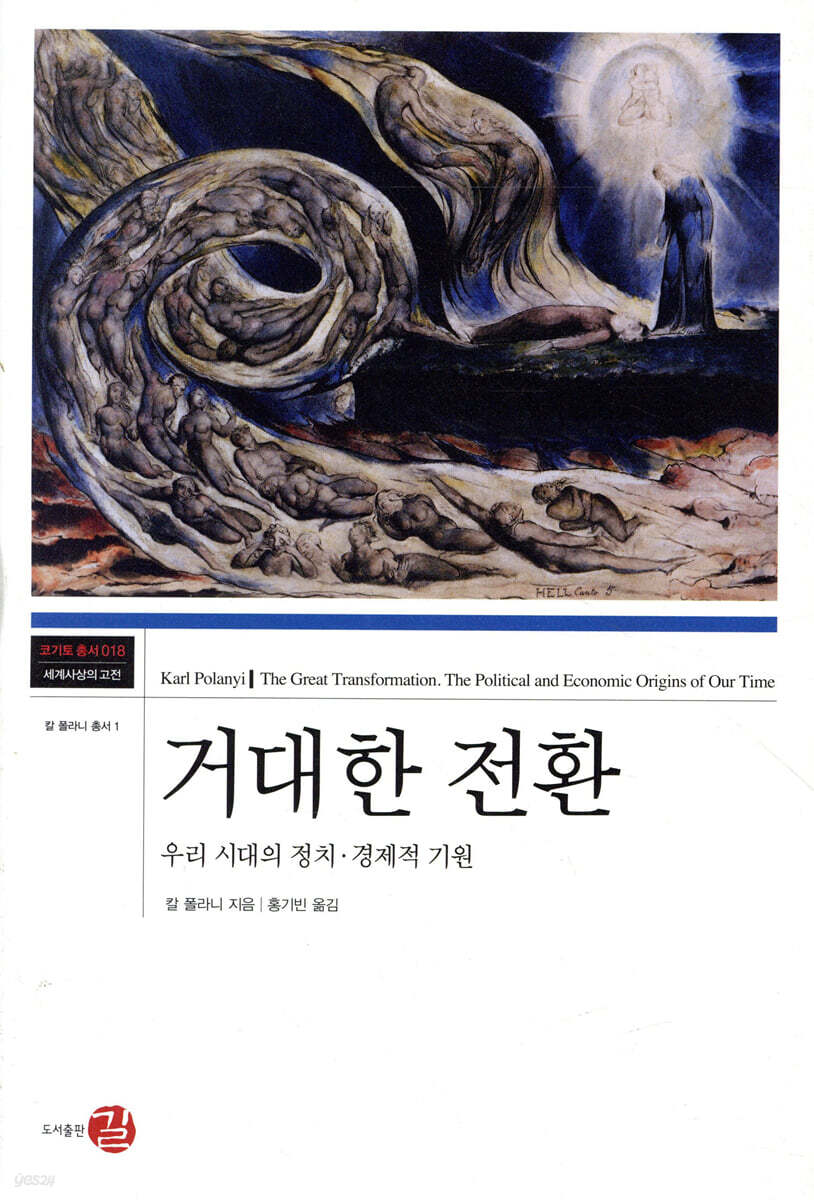
A huge shift
 |
Description
Book Introduction
This is a representative work by economist Karl Polanyi, who advocated 'economics for humanity' based on a harsh criticism of the market economy utopia.
This book strongly criticizes market liberalism, the belief that both national societies and the global economy can and should be organized through self-regulating markets.
Organizing all human economic activities entirely through a single system called the market and establishing a self-regulating market through it is, at least in light of the thousands or tens of thousands of years of human history, not only not “natural,” but also an extremely artificial, utopian delusion.
Based on these criticisms, the alternative the author proposes is ‘freedom.’
The way to coexist with the complex society of industrial society, which inevitably divides freedom into various functions, is to discard the utopia of the market, discover the reality of society that exists beneath it, and accept that reality.
The author argues for the recognition of the entity called 'society' and speaks of human 'freedom'.
This book is divided into three parts.
Parts I and III raise the question of how Europe, which had enjoyed a long period of relative peace and prosperity from 1815 to 1914, suddenly fell into a world war and then into economic collapse.
Then, in Part 2, the core of this book, the answer to that riddle is presented.
This book, which is once again receiving attention for its ability to understand the dilemmas facing global society in the 21st century, will serve as a valuable guide for envisioning the future amidst the crisis of the neoliberal economy.
This book strongly criticizes market liberalism, the belief that both national societies and the global economy can and should be organized through self-regulating markets.
Organizing all human economic activities entirely through a single system called the market and establishing a self-regulating market through it is, at least in light of the thousands or tens of thousands of years of human history, not only not “natural,” but also an extremely artificial, utopian delusion.
Based on these criticisms, the alternative the author proposes is ‘freedom.’
The way to coexist with the complex society of industrial society, which inevitably divides freedom into various functions, is to discard the utopia of the market, discover the reality of society that exists beneath it, and accept that reality.
The author argues for the recognition of the entity called 'society' and speaks of human 'freedom'.
This book is divided into three parts.
Parts I and III raise the question of how Europe, which had enjoyed a long period of relative peace and prosperity from 1815 to 1914, suddenly fell into a world war and then into economic collapse.
Then, in Part 2, the core of this book, the answer to that riddle is presented.
This book, which is once again receiving attention for its ability to understand the dilemmas facing global society in the 21st century, will serve as a valuable guide for envisioning the future amidst the crisis of the neoliberal economy.
- You can preview some of the book's contents.
Preview
index
Preface by Robert McIver
Preface by Joseph Stiglitz
Fred Block's release
Preface to the French edition by Louis Dumont
Acknowledgements
Part 1: The International System
Chapter 1: A Hundred Years of Peace
Chapter 2: The Conservative 1920s, the Revolutionary 1930s
Part 2: The Rise and Fall of the Market Economy
Ⅰ.
Satan's Millstone
Chapter 3: A Place to Live or Economic Development?
Chapter 4 Diversity of Social and Economic Systems
Chapter 5: The Evolution of Market Patterns
Chapter 6: Self-Regulating Markets and Fictional Commodities: Labor, Land, and Money
Chapter 7: Speenhamland, 1795
Chapter 8: Things Before the Speenhamland Act, and the Consequences of the Speenhamland Act
Chapter 9: The Problem of the Extremely Poor and Utopia
Chapter 10: The Discovery of Political Economy and Society
Ⅱ.
Social self-protection
Chapter 11: Humans, Nature, and the Organization of Production
Chapter 12: The Birth of Liberal Doctrine
Chapter 13: The Birth of Liberal Doctrine, Part 2: Class Understanding and Social Change
Chapter 14: Markets and Humans
Chapter 15: Markets and Nature
Chapter 16 Market and Production Organization
Chapter 17: Self-regulation, broken
Chapter 18: Tensions of Regime Collapse
Part 3: Ongoing Transition
Chapter 19: People's Government and Market Economy
Chapter 20: Social Transformation and History Intertwined
Chapter 21 Freedom in a Complex Society
Translator's Note
Translator's Note
Karl Polanyi Chronology
Search
Preface by Joseph Stiglitz
Fred Block's release
Preface to the French edition by Louis Dumont
Acknowledgements
Part 1: The International System
Chapter 1: A Hundred Years of Peace
Chapter 2: The Conservative 1920s, the Revolutionary 1930s
Part 2: The Rise and Fall of the Market Economy
Ⅰ.
Satan's Millstone
Chapter 3: A Place to Live or Economic Development?
Chapter 4 Diversity of Social and Economic Systems
Chapter 5: The Evolution of Market Patterns
Chapter 6: Self-Regulating Markets and Fictional Commodities: Labor, Land, and Money
Chapter 7: Speenhamland, 1795
Chapter 8: Things Before the Speenhamland Act, and the Consequences of the Speenhamland Act
Chapter 9: The Problem of the Extremely Poor and Utopia
Chapter 10: The Discovery of Political Economy and Society
Ⅱ.
Social self-protection
Chapter 11: Humans, Nature, and the Organization of Production
Chapter 12: The Birth of Liberal Doctrine
Chapter 13: The Birth of Liberal Doctrine, Part 2: Class Understanding and Social Change
Chapter 14: Markets and Humans
Chapter 15: Markets and Nature
Chapter 16 Market and Production Organization
Chapter 17: Self-regulation, broken
Chapter 18: Tensions of Regime Collapse
Part 3: Ongoing Transition
Chapter 19: People's Government and Market Economy
Chapter 20: Social Transformation and History Intertwined
Chapter 21 Freedom in a Complex Society
Translator's Note
Translator's Note
Karl Polanyi Chronology
Search
Publisher's Review
Why is this outdated book attracting attention in our 21st-century society?
One book is once again receiving renewed attention.
This phenomenon is the same both domestically and internationally.
Why is a book written in 1944 suddenly receiving attention again?
An economic historian once said, "There are books that refuse to disappear from the world." So why does this book, in this age of obsolescence, resurface before us?
In short, this book is essential for understanding the dilemmas facing global society in the 21st century.
In particular, this book offers the most powerful critique yet of market liberalism—the belief that both national societies and the global economy can and should be organized through self-regulating markets.
However, that point is not swayed by the logic of the left and right ideologically, but Karl Polanyi (1886-1964) himself advocates his own unique logic through meticulous criticism of both the left and right logic.
In other words, for him, both Hayek and Marx are objects of critical overcoming, and by analyzing 'economic' phenomena that they could not see, their power is still being exerted even now, even after the turn of the century.
In fact, market liberalism has dominated global politics since the 1980s, especially with the end of the Cold War in the early 1990s, under the names of Thatcherism, Reaganism, neoliberalism, and the "Washington Consensus."
However, as the Cold War intensified between the United States and the Soviet Union shortly after the book was first published in 1944, the significance of Polanyi's contribution was forgotten.
In the extremely polarized debate between advocates of capitalism and advocates of real socialism, there was no room for Polanyi's complex and nuanced logic.
Karl Polanyi's book is divided into three parts.
Parts I and III raise the question of how Europe, which had enjoyed a long period of relative peace and prosperity from 1815 to 1914, suddenly fell into a world war and then into economic collapse.
Then, in Part 2, the core of this book, the answer to that riddle is presented.
Economics and economics to date have failed to properly grasp the reality of human "society" - Economics for Humanity
First, Polanyi goes back to the era of the British Industrial Revolution in the early 19th century and explores how British thinkers, responding to the chaos of early industrialization, developed market liberalism, a core tenet of which was that human society should submit to self-regulating markets.
He explains that as a result of Britain's leading role as the 'world's factory', this belief became the organizing principle of the global economy.
This means that all humans are beings driven by 'economic interests' of self-interest, and therefore the economic laws of the market economy formed in this way have governed all economies and even societies throughout history.
However, in Polanyi's view, this idea is nothing more than a 'myth' of 19th-century people.
Regarding these myths, he borrowed from the latest economic anthropology and the achievements of ancient and medieval history to argue that the economy is 'embedded' in the social process, and that the market economy, far from being a universal economic form of human society, was thoroughly suppressed everywhere as a 'side effect' until at least 200 years ago.
The market, organized around the individual's profit motive, would rapidly destroy society, humanity, and nature if left unchecked, as it did in 16th-century England.
Therefore, organizing all human economic activities entirely through a single system called the market and establishing a self-regulating market through it is not ‘natural’ at least in light of the thousands or tens of thousands of years of human history, but rather an extremely artificial utopian delusion.
At this point, Karl Polanyi emphasizes the aforementioned term 'embeddedness' to describe how far the classical economists, especially Thomas Malthus and David Ricardo, are disconnected from their predecessors.
Simply put, this term means that the economy is not as autonomous as economic theory suggests, but is dependent on political, religious, and social relations.
So how did this unrealistic utopia of a self-regulating market economy come about? He attributes it to the mechanized production that emerged through the Industrial Revolution.
While machines of the past played a supporting role for human labor, the expensive machines that emerged through the Industrial Revolution ended up relegating humans to a supporting position.
Now, the producer has become an expensive machine, and humans and nature have been reduced to the position of 'inputs' that go into operating the machine.
Now, humans, nature, and money are treated like 'commodities'.
As a result, various measures were taken to realize the utopia of self-regulating market liberalism, such as the abolition of the 19th-century poor laws, the implementation of the gold standard, and free trade through the abolition of the Corn Laws.
However, the entity called 'society' could not tolerate even a single moment of these utopian actions becoming reality.
Workers resisted by forming unions and political parties, landowners resisted through offensives such as protective tariffs and reactionary militarism, and even capitalist enterprises resisted by demanding a smooth supply of currency and credit through the central bank.
The so-called 'dual movement' that Polanyi speaks of has emerged.
This dual movement is where the utopian nature of the market economy that Polanyi emphasizes and the discovery of social reality that opposes it are revealed.
Karl Polanyi takes this problem of the existence of 'society' from Robert Owen.
In other words, for Owen, 'society' is the true entity that endures beneath all these hardships and trials, despite the two realms of the state and the market, as well as the overwhelming reality of the machine.
What is a true economy, still needed in the 21st century? - Based on human freedom.
The title of the book, 'The Great Transformation,' is a metaphorical expression of this reality that faced human society in the 19th century.
Global market capitalism, consisting of liberal domestic governments, self-regulating markets, an international gold standard, and a balance of power system, immediately manifested itself in the catastrophic events of two world wars.
So what kind of society should we form now?
Karl Polanyi's answer is again 'freedom'.
Individual freedom and the human soul are inherently inseparable and cannot be abandoned.
The way to coexist with this 'complex society' called industrial society, which cannot help but be divided into various functions, is to kick away the utopia called the market, discover the reality that supports it, 'society', and accept that reality.
In some ways, this is an extremely moral answer, but isn't it true that acknowledging the reality of "society" and talking about human "freedom" is assuming that humans themselves exist and starting from there, saying that the "economy" is born?
What is the novelty of Polanyi's perspective as a political economist analyzing market capitalism?
This may also be related to the question of what framework is appropriate for properly analyzing the economic crisis of our time.
Let's look at it this way.
Marx denounced the inhumanity of market capitalism and argued that it should be abolished altogether by analyzing the internal contradictions of its operating laws, while Keynes argued that market capitalism, especially financial capitalism, must be controlled and regulated through appropriate intervention by the state, arguing that it is inherently irrational and thus cannot help but move.
However, Polanyi argues that a market economy cannot exist in reality, and that the commodity fiction that humans, nature, and money contained in it are nothing more than commodities is merely a kind of imagination and matrix that looks at our reality and makes a mistake.
So the direction of the solution he proposes is not simply to abolish the market economy or regulate it through appropriate intervention by the state.
The right direction is to grasp the reality of society and the human freedom, values, and ideals it embodies, and to return the state and the market to their proper place as functional institutions that can serve that purpose.
One book is once again receiving renewed attention.
This phenomenon is the same both domestically and internationally.
Why is a book written in 1944 suddenly receiving attention again?
An economic historian once said, "There are books that refuse to disappear from the world." So why does this book, in this age of obsolescence, resurface before us?
In short, this book is essential for understanding the dilemmas facing global society in the 21st century.
In particular, this book offers the most powerful critique yet of market liberalism—the belief that both national societies and the global economy can and should be organized through self-regulating markets.
However, that point is not swayed by the logic of the left and right ideologically, but Karl Polanyi (1886-1964) himself advocates his own unique logic through meticulous criticism of both the left and right logic.
In other words, for him, both Hayek and Marx are objects of critical overcoming, and by analyzing 'economic' phenomena that they could not see, their power is still being exerted even now, even after the turn of the century.
In fact, market liberalism has dominated global politics since the 1980s, especially with the end of the Cold War in the early 1990s, under the names of Thatcherism, Reaganism, neoliberalism, and the "Washington Consensus."
However, as the Cold War intensified between the United States and the Soviet Union shortly after the book was first published in 1944, the significance of Polanyi's contribution was forgotten.
In the extremely polarized debate between advocates of capitalism and advocates of real socialism, there was no room for Polanyi's complex and nuanced logic.
Karl Polanyi's book is divided into three parts.
Parts I and III raise the question of how Europe, which had enjoyed a long period of relative peace and prosperity from 1815 to 1914, suddenly fell into a world war and then into economic collapse.
Then, in Part 2, the core of this book, the answer to that riddle is presented.
Economics and economics to date have failed to properly grasp the reality of human "society" - Economics for Humanity
First, Polanyi goes back to the era of the British Industrial Revolution in the early 19th century and explores how British thinkers, responding to the chaos of early industrialization, developed market liberalism, a core tenet of which was that human society should submit to self-regulating markets.
He explains that as a result of Britain's leading role as the 'world's factory', this belief became the organizing principle of the global economy.
This means that all humans are beings driven by 'economic interests' of self-interest, and therefore the economic laws of the market economy formed in this way have governed all economies and even societies throughout history.
However, in Polanyi's view, this idea is nothing more than a 'myth' of 19th-century people.
Regarding these myths, he borrowed from the latest economic anthropology and the achievements of ancient and medieval history to argue that the economy is 'embedded' in the social process, and that the market economy, far from being a universal economic form of human society, was thoroughly suppressed everywhere as a 'side effect' until at least 200 years ago.
The market, organized around the individual's profit motive, would rapidly destroy society, humanity, and nature if left unchecked, as it did in 16th-century England.
Therefore, organizing all human economic activities entirely through a single system called the market and establishing a self-regulating market through it is not ‘natural’ at least in light of the thousands or tens of thousands of years of human history, but rather an extremely artificial utopian delusion.
At this point, Karl Polanyi emphasizes the aforementioned term 'embeddedness' to describe how far the classical economists, especially Thomas Malthus and David Ricardo, are disconnected from their predecessors.
Simply put, this term means that the economy is not as autonomous as economic theory suggests, but is dependent on political, religious, and social relations.
So how did this unrealistic utopia of a self-regulating market economy come about? He attributes it to the mechanized production that emerged through the Industrial Revolution.
While machines of the past played a supporting role for human labor, the expensive machines that emerged through the Industrial Revolution ended up relegating humans to a supporting position.
Now, the producer has become an expensive machine, and humans and nature have been reduced to the position of 'inputs' that go into operating the machine.
Now, humans, nature, and money are treated like 'commodities'.
As a result, various measures were taken to realize the utopia of self-regulating market liberalism, such as the abolition of the 19th-century poor laws, the implementation of the gold standard, and free trade through the abolition of the Corn Laws.
However, the entity called 'society' could not tolerate even a single moment of these utopian actions becoming reality.
Workers resisted by forming unions and political parties, landowners resisted through offensives such as protective tariffs and reactionary militarism, and even capitalist enterprises resisted by demanding a smooth supply of currency and credit through the central bank.
The so-called 'dual movement' that Polanyi speaks of has emerged.
This dual movement is where the utopian nature of the market economy that Polanyi emphasizes and the discovery of social reality that opposes it are revealed.
Karl Polanyi takes this problem of the existence of 'society' from Robert Owen.
In other words, for Owen, 'society' is the true entity that endures beneath all these hardships and trials, despite the two realms of the state and the market, as well as the overwhelming reality of the machine.
What is a true economy, still needed in the 21st century? - Based on human freedom.
The title of the book, 'The Great Transformation,' is a metaphorical expression of this reality that faced human society in the 19th century.
Global market capitalism, consisting of liberal domestic governments, self-regulating markets, an international gold standard, and a balance of power system, immediately manifested itself in the catastrophic events of two world wars.
So what kind of society should we form now?
Karl Polanyi's answer is again 'freedom'.
Individual freedom and the human soul are inherently inseparable and cannot be abandoned.
The way to coexist with this 'complex society' called industrial society, which cannot help but be divided into various functions, is to kick away the utopia called the market, discover the reality that supports it, 'society', and accept that reality.
In some ways, this is an extremely moral answer, but isn't it true that acknowledging the reality of "society" and talking about human "freedom" is assuming that humans themselves exist and starting from there, saying that the "economy" is born?
What is the novelty of Polanyi's perspective as a political economist analyzing market capitalism?
This may also be related to the question of what framework is appropriate for properly analyzing the economic crisis of our time.
Let's look at it this way.
Marx denounced the inhumanity of market capitalism and argued that it should be abolished altogether by analyzing the internal contradictions of its operating laws, while Keynes argued that market capitalism, especially financial capitalism, must be controlled and regulated through appropriate intervention by the state, arguing that it is inherently irrational and thus cannot help but move.
However, Polanyi argues that a market economy cannot exist in reality, and that the commodity fiction that humans, nature, and money contained in it are nothing more than commodities is merely a kind of imagination and matrix that looks at our reality and makes a mistake.
So the direction of the solution he proposes is not simply to abolish the market economy or regulate it through appropriate intervention by the state.
The right direction is to grasp the reality of society and the human freedom, values, and ideals it embodies, and to return the state and the market to their proper place as functional institutions that can serve that purpose.
GOODS SPECIFICS
- Date of issue: June 30, 2009
- Format: Hardcover book binding method guide
- Page count, weight, size: 658 pages | 1,071g | 153*224*35mm
- ISBN13: 9788987671314
- ISBN10: 8987671313
You may also like
카테고리
korean


korean

![GQ KOREA Mark (Monthly): December [2025]](http://librairie.coreenne.fr/cdn/shop/files/8ef265dbbfbf186523ed75ba7319009d.jpg?v=1765340328&width=3840)


