

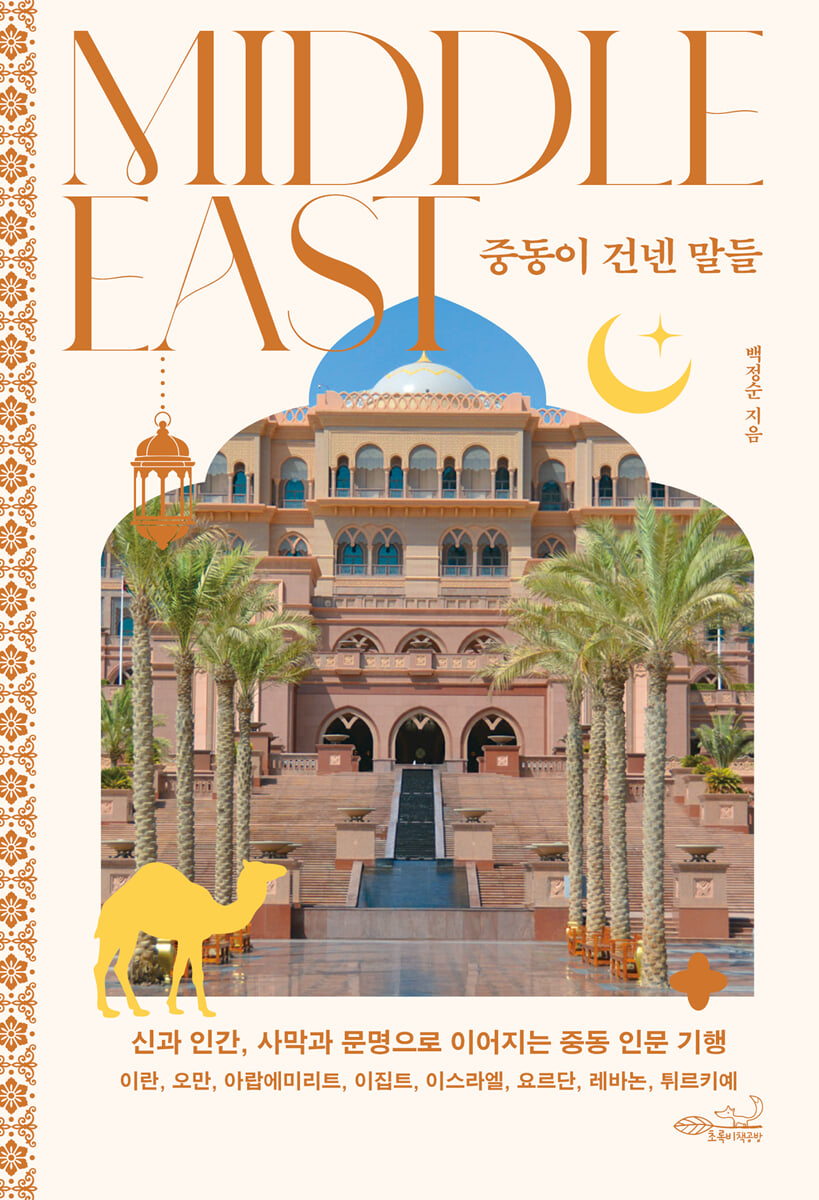
Words from the Middle East
 |
Description
Book Introduction
On the road where gods and humans, desert and civilization intersect
A Time of Reason from the Middle East
A humanistic journey unfolds in a desert where time seems to have stopped, heading to the land where human thought began.
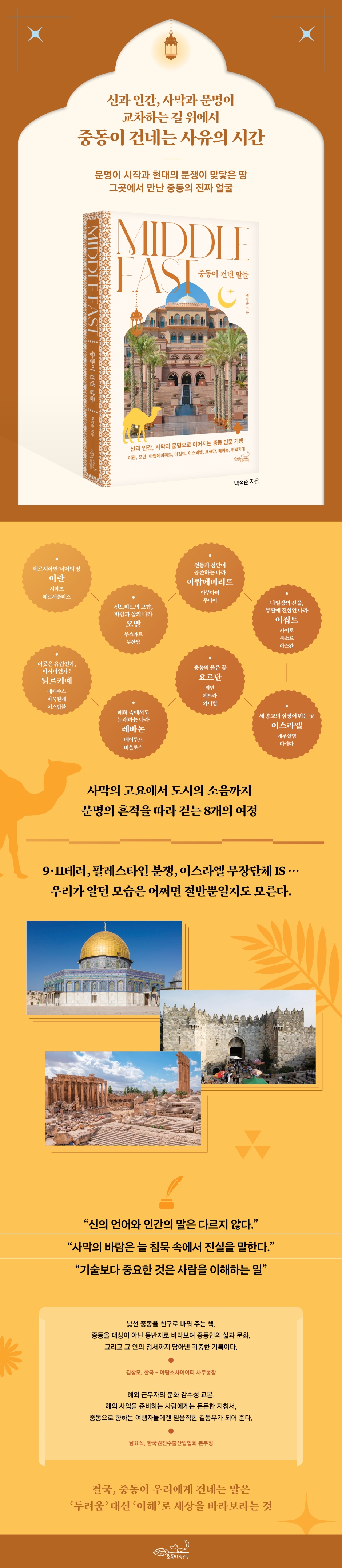
This book is a humanities travelogue that follows the eight Middle Eastern countries—Iran, Oman, the United Arab Emirates, Egypt, Israel, Jordan, Lebanon, and Turkey—where the dawn of civilization and modern conflict coexist, capturing the landscapes where history, culture, faith, and daily life intersect.
Author Baek Jeong-sun worked at the Barakah Nuclear Power Plant in the United Arab Emirates for four years and traveled throughout the Middle East in her spare time.
As the saying goes, "travel is like reading on foot," he accumulated learning and reflection through his travels, and looked at unfamiliar civilizations and people through the eyes of an engineer and explorer.
Amidst the desert wind and city lights, the stone walls of temples and the bustle of the marketplace, he listened to the questions the Middle East poses to us, recording a three-dimensional image of the place where the origins and present of civilization, faith and daily life intersect.
This book is not just a travelogue.
This is a cultural report on eight Middle Eastern countries written while walking through the Middle East, a place previously known only as a "land of conflict in the news," and a record of contemplation containing warm insights into humanity and civilization.
Through this book, we can encounter the true face of the Middle East, where "history written in the language of God" and "stories created by human life" intersect.
We can also hear the warm story of the origins of humanity that we have forgotten and the people who still live and breathe within it.
A Time of Reason from the Middle East
A humanistic journey unfolds in a desert where time seems to have stopped, heading to the land where human thought began.
This book is a humanities travelogue that follows the eight Middle Eastern countries—Iran, Oman, the United Arab Emirates, Egypt, Israel, Jordan, Lebanon, and Turkey—where the dawn of civilization and modern conflict coexist, capturing the landscapes where history, culture, faith, and daily life intersect.
Author Baek Jeong-sun worked at the Barakah Nuclear Power Plant in the United Arab Emirates for four years and traveled throughout the Middle East in her spare time.
As the saying goes, "travel is like reading on foot," he accumulated learning and reflection through his travels, and looked at unfamiliar civilizations and people through the eyes of an engineer and explorer.
Amidst the desert wind and city lights, the stone walls of temples and the bustle of the marketplace, he listened to the questions the Middle East poses to us, recording a three-dimensional image of the place where the origins and present of civilization, faith and daily life intersect.
This book is not just a travelogue.
This is a cultural report on eight Middle Eastern countries written while walking through the Middle East, a place previously known only as a "land of conflict in the news," and a record of contemplation containing warm insights into humanity and civilization.
Through this book, we can encounter the true face of the Middle East, where "history written in the language of God" and "stories created by human life" intersect.
We can also hear the warm story of the origins of humanity that we have forgotten and the people who still live and breathe within it.
- You can preview some of the book's contents.
Preview
index
prolog
Part 1: Iran: The Land Beyond the Persian Gulf
Shiraz: Wearing slippers to Shiraz
Persepolis: The Heroic Age of Persia
Islamic Culture: Sunni vs. Shia Sects
Part 2 Oman - Sinbad's Homeland, the Land of Wind and Stone
Muscat: A Traveler's Paradise Found Among Waters and Canyons
Musandam: The Story of How I Almost Went to Jail While Watching Dolphins
Islamic Culture: Arabs, Islam, and the Middle East
Camp Peek: Until the Azan Sounds Like a Lullaby
Part 3: The United Arab Emirates: A Country Where Tradition and Innovation Coexist
Abu Dhabi: City of Light and Sand
Dubai: Desert, Imagination, and Dreams of the Sea
Islamic Culture: The Prophet Muhammad, the Founder of Islam
Part 4: Egypt: The Gift of the Nile, a Nation Sincere about Resurrection
Cairo: Egyptian civilization began in 3000 BC
Luxor: The Racecourse of Egypt
Aswan: Ramses II's Abu Simbel Temple
Islamic Culture: Enjoy a Tolerant Ramadan, Ramadan Kareem
Camp Peek: In the Desert, Everyone Turns into an All-Athlete
Part 5: Israel: The Heartbeat of Three Religions
Jerusalem: Asking for Directions in Salt on the Way to the Holy Land
Masada: The Last Voice in the Wind
Islamic Culture: Jews and Arabs Share Their Ancestors
Camp Peek: Ruwaislog: Small Happinesses Outside Camp
Part 6 Jordan_Red Flower of the Middle East
Amman: From Amman to the Dead Sea
Petra: The Rose City Founded by the Nabataeans
Wadi Rum: Becoming a White Man in the Red Desert
Islamic Culture: Lamb and Pork
Part 7: Lebanon: A Country That Sings Even in Ruins
Beirut: Once the Paris of the Middle East
Byblos: The Roofless Phoenician Museum
Islamic Culture: Desert Survival Kit: Three Elements of an Oasis
Camp Peek: After work, head to a nearby restaurant or bar!
Part 8: Turkey_Is this Europe or Asia?
Ephesus: A Little Rome in Turkey
Pamukkale: Hot Springs on a White Hill
Istanbul: Where East Meets West
Islamic Culture: Same Words, Different Meanings, and Imams
A Peek Inside Camp: Rizwan, a Barber from Pakistan
References
Photo source
Part 1: Iran: The Land Beyond the Persian Gulf
Shiraz: Wearing slippers to Shiraz
Persepolis: The Heroic Age of Persia
Islamic Culture: Sunni vs. Shia Sects
Part 2 Oman - Sinbad's Homeland, the Land of Wind and Stone
Muscat: A Traveler's Paradise Found Among Waters and Canyons
Musandam: The Story of How I Almost Went to Jail While Watching Dolphins
Islamic Culture: Arabs, Islam, and the Middle East
Camp Peek: Until the Azan Sounds Like a Lullaby
Part 3: The United Arab Emirates: A Country Where Tradition and Innovation Coexist
Abu Dhabi: City of Light and Sand
Dubai: Desert, Imagination, and Dreams of the Sea
Islamic Culture: The Prophet Muhammad, the Founder of Islam
Part 4: Egypt: The Gift of the Nile, a Nation Sincere about Resurrection
Cairo: Egyptian civilization began in 3000 BC
Luxor: The Racecourse of Egypt
Aswan: Ramses II's Abu Simbel Temple
Islamic Culture: Enjoy a Tolerant Ramadan, Ramadan Kareem
Camp Peek: In the Desert, Everyone Turns into an All-Athlete
Part 5: Israel: The Heartbeat of Three Religions
Jerusalem: Asking for Directions in Salt on the Way to the Holy Land
Masada: The Last Voice in the Wind
Islamic Culture: Jews and Arabs Share Their Ancestors
Camp Peek: Ruwaislog: Small Happinesses Outside Camp
Part 6 Jordan_Red Flower of the Middle East
Amman: From Amman to the Dead Sea
Petra: The Rose City Founded by the Nabataeans
Wadi Rum: Becoming a White Man in the Red Desert
Islamic Culture: Lamb and Pork
Part 7: Lebanon: A Country That Sings Even in Ruins
Beirut: Once the Paris of the Middle East
Byblos: The Roofless Phoenician Museum
Islamic Culture: Desert Survival Kit: Three Elements of an Oasis
Camp Peek: After work, head to a nearby restaurant or bar!
Part 8: Turkey_Is this Europe or Asia?
Ephesus: A Little Rome in Turkey
Pamukkale: Hot Springs on a White Hill
Istanbul: Where East Meets West
Islamic Culture: Same Words, Different Meanings, and Imams
A Peek Inside Camp: Rizwan, a Barber from Pakistan
References
Photo source
Detailed image
Into the book
When we think of 'arrogance', the first symbol that comes to mind is definitely Sinbad.
The hometown of the adventurer in “Arabian Nights” is Oman.
Oman, located on a key sea route connecting East Africa and India, is a Middle Eastern country that has prospered through maritime trade as a maritime cultural sphere.
So this land naturally became the stage where the legend of Sinbad was born.
Sinbad was the incarnation of an Omani sailor who sailed the Indian Ocean in a traditional wooden boat called a dhow.
It is not a legend, but the life of Omani, who lived with the sea, is the story of Sinbad.
This adventure story goes beyond fiction and finds its roots in actual history.
The setting for Sinbad was Baghdad and the Indian Ocean during the 8th and 9th centuries, when the Islamic Abbasid Dynasty flourished.
Traces of the seafaring culture of the time remain even in the name.
Sindh refers to the present-day Sindh region of Pakistan, and Bad means wind.
In other words, Sindbad means 'the man of the wind blowing from the Sindh region'.
The seven voyages in The Arabian Nights were not superficial adventure stories, but rather the journeys of imaginary heroes and a condensed story of the experiences and maritime history of actual sailors who sailed the Indian Ocean.
--- p.44
Arab, Islamic, and Middle Eastern are not simply overlapping concepts.
These intersect on four axes: language, religion, geography, and history, creating a complex and three-dimensional identity.
Because of this complexity, we as outsiders often confuse the boundaries of concepts.
Moreover, just as the term 'Middle East' itself originated from an artificial division of the West, the modern Middle Eastern countries were also artificially established within the interests of Western powers after the dissolution of the Ottoman Empire.
Because the historical and ethnic context was not sufficiently reflected in this process, the region continues to experience political instability and conflict today.
Therefore, efforts to understand the Middle East must not stop at superficial geographical divisions.
We must examine the imperialist history and cultural context together, and the first step to correctly understanding Islam begins with recognizing this history and culture and accepting unfamiliar cultures with a perspective of 'difference' rather than 'similarity.'
--- p.80
At first glance, it may seem like an ordinary Korean restaurant, but Okryugwan is a symbolic space in North Korea where foreigners and high-ranking officials are entertained.
North Korean restaurants abroad are not just simple businesses.
It serves as a kind of cultural diplomacy hub for managing the regime's image and earning foreign currency, and sometimes also serves as a political window managed behind the scenes by diplomats and intelligence agencies.
North Korea has used this method to promote its regime, secure loyalist funds, and expand its overseas network.
The fact that such a place opened a branch in Abu Dhabi also meant that North Korean-style 'cultural diplomacy' had permeated the area.
(…) “Then give it to the Daedong River~.” Just a few minutes ago, people who had said “all the beer is the same” looked at each other with embarrassed faces and burst into laughter.
In that laughter, my guard disappeared for a moment.
It felt as if the barrier between North and South Korea had collapsed, and I was sitting in an ordinary Korean restaurant.
But how long will the boundaries broken down by a glass of beer last?
For this moment, it seemed as if the barrier between North and South had disappeared, but the moment I stepped out the door, reality would rise up again like a cold wall.
At that moment, this thought crossed my mind.
Division may be an illusion created by humans.
--- p.104~107
Dubai's obsession with excellence isn't just an economic strategy.
Behind it lies an instinctive desire that has been repeated throughout human civilization.
The Tower of Babel, which tried to reach the sky.
The pyramids that dreamed of eternity, the Tower of Babel with its Gothic cathedrals rising toward God, and the skyscrapers and artificial islands of Dubai are all modern versions of this ancient desire, built with modern technology and capital.
(…) Dubai’s excess is not mere vanity.
It is the way civilization proves itself and at the same time the latest version of humanity's repeated desires.
Will Dubai's "world-class" end up being too much, or will it become a model for a new civilization?
--- pp. 122-123
Why would they build such massive tombs? It's hard to explain why they were simply a means to flaunt the pharaoh's power.
The pyramid was a symbol that encapsulated the ancient people's beliefs and worldview about life beyond death, a meaning that went beyond a tomb.
This was possible because of the firm belief that death was not the end but the beginning of eternity, and the conviction that the Pharaoh's existence was a bridge to God.
There was another practical reason.
We think of the pyramids as being built by slaves who were whipped like in the movies, but the reality was different.
During the summer, when the Nile flooded and farming was impossible, the government commissioned massive construction projects to provide jobs for farmers.
This was not just a funeral construction project, but also a national project for the national economy and the welfare of the people.
--- p.155
Ramadan is the ninth month of the Islamic calendar, the holiest time of the year, when people abstain from eating and drinking during daylight hours for a month.
Fasting is a very important religious obligation for Muslims and is one of the five pillars of Islam: confession of faith, prayer, charity, pilgrimage, and fasting.
(…) For Muslims, Ramadan is not just about fasting on a physical level.
It is a time of mental, social, moral and physical training.
Through this, we learn moderation and patience, empathize with the suffering of our starving neighbors, and develop a sense of community.
Fasting dates back to the Hegira in 622.
The Hijra is considered a historical turning point in Islam, as it was the event in which Muhammad migrated from Mecca to Medina to preserve his faith.
Muhammad encountered God through silent fasting, and Ramadan was thus etched into time.
--- pp. 188-189
Around the 7th century, when Islamic forces defeated Byzantium, Jordan became part of the Islamic world.
After that, it was under the rule of the Ottoman Empire for nearly 400 years.
After the collapse of the Ottoman Empire following World War I, the region briefly came under British mandate before becoming independent as the Hashemite Kingdom of Jordan in 1946.
Throughout modern history, Jordan has always been at the center of Middle Eastern conflicts.
It took control of the West Bank and East Jerusalem in the First Middle East War of 1948, but lost the territory back to Israel in the 1967 war.
However, in 1994, it signed a peace treaty with Israel and took on the role of mediator in the Middle East.
However, the large number of Palestinian refugees and their descendants who have settled in Jordan remains a challenge for the country to this day.
--- p.227
Built in the 1st century BC, the Al-Khazneh temple is a masterpiece of exquisite fusion of Egyptian, Mesopotamian, Greek, and Roman architectural styles.
Al-Khazneh is more than just a tomb; it is the culmination of the fusion of Mediterranean civilizations.
It was hard to believe that such a complex civilization could blossom in the middle of a barren desert.
What was more amazing than the buildings were the people who created them.
The Nabataeans: Who were they? Originally a nomadic tribe in western Arabia, they settled in the area of present-day Petra around the 6th century BC and developed a dazzling civilization.
They were true desert engineers, taming the dry land with stone and water.
In the Sik Gorge, channels were built to collect rainwater, and dams were built here and there in the rocks to manage water.
Thanks to this, farming became possible in the dry desert.
--- p.239~240
The roots of the Lebanese civil war date back to the mandate period after World War I.
When Arab nationalists rose up in 1920 demanding independence, France suppressed them by force.
And the 'Greater Lebanon', centered around the Christian Maronites, was established by separating it from Syria.
The underlying intention was to make Lebanon a bridgehead for Western European culture and to instill French order.
Within the borders formed in this way, various sects, including Christians, Sunni Muslims, and Shiites, were artificially bound together, which later became a major cause of instability in the country.
Even after independence in 1943, power in Lebanon remained divided along religious lines.
The president was a member of the majority Maronite sect, and the prime minister was a Sunni Muslim.
But this was merely an extension of the political structure designed by France.
As time passed and the Shia population grew, calls for a redistribution of power grew louder.
Meanwhile, Palestinian armed forces expelled from Jordan in 1970 moved in, and Israel and Arab countries intervened, leading to the outbreak of civil war in 1975.
The current political instability is not unrelated to the legacy of France's colonial era.
True peace is not something given from outside, but comes from within.
--- p.259~260
Byblos was a key maritime trade hub in ancient times.
They imported Egyptian papyrus and sold it to Greece and other countries, and exported Lebanese cedar to Egypt.
During this process, the Greek word 'Byblos' meaning papyrus became the name of the city, and as the Bible was written on papyrus, the word 'Bible' was later created.
As trade became more active, merchants at the port needed a simple writing system to record their transactions.
At that time, Egyptian hieroglyphs were so complex that they were difficult to learn and write.
So they created the Phoenician alphabet, which consisted of only 22 consonants.
This became the spark for a literary revolution in human history.
The Greeks developed their writing system by adding vowels to it, and the Romans inherited it as the Latin alphabet.
And after thousands of years, this alphabet became the writing system shared by people all over the world.
The alphabet, which originated in Byblos, accelerated the spread of knowledge and brought about the ‘democratization of civilization’ to mankind.
--- p.276~277
Hagia Sophia, meaning "Holy Wisdom," is considered one of the greatest masterpieces of early Christian architecture.
This cathedral was first built during the reign of Emperor Constantine, but was destroyed by fire twice.
The current appearance is the third reconstruction by Emperor Justinian in 537.
Hagia Sophia and the Blue Mosque stand side by side across Sultanahmet Park.
Like good friends, sometimes like rivals, they are symbolic figures representing the Byzantine and Ottoman Empires.
In 1453, Mehmed II of the Ottoman Empire, who conquered Byzantium, converted the Hagia Sophia, a millennium-old Byzantine heritage, into a mosque.
This was not just a superficial renovation of the building, but also a declaration that civilization had changed.
--- p.310~311
When the Ottomans captured Constantinople in 1453, they were able to destroy the Hagia Sophia, a symbol of paganism.
However, rather than denying the Byzantine heritage, the Ottomans embraced it into their own culture.
Rather than rejecting the culture of the conquered land, it was a harmonious fusion of art, architecture, and scholarship that was reinterpreted.
This attitude of inclusion became the driving force behind the rapid spread of Islamic civilization to other regions.
That spirit of inclusion and re-creation also breathes above the blue dome of the Blue Mosque.
The hometown of the adventurer in “Arabian Nights” is Oman.
Oman, located on a key sea route connecting East Africa and India, is a Middle Eastern country that has prospered through maritime trade as a maritime cultural sphere.
So this land naturally became the stage where the legend of Sinbad was born.
Sinbad was the incarnation of an Omani sailor who sailed the Indian Ocean in a traditional wooden boat called a dhow.
It is not a legend, but the life of Omani, who lived with the sea, is the story of Sinbad.
This adventure story goes beyond fiction and finds its roots in actual history.
The setting for Sinbad was Baghdad and the Indian Ocean during the 8th and 9th centuries, when the Islamic Abbasid Dynasty flourished.
Traces of the seafaring culture of the time remain even in the name.
Sindh refers to the present-day Sindh region of Pakistan, and Bad means wind.
In other words, Sindbad means 'the man of the wind blowing from the Sindh region'.
The seven voyages in The Arabian Nights were not superficial adventure stories, but rather the journeys of imaginary heroes and a condensed story of the experiences and maritime history of actual sailors who sailed the Indian Ocean.
--- p.44
Arab, Islamic, and Middle Eastern are not simply overlapping concepts.
These intersect on four axes: language, religion, geography, and history, creating a complex and three-dimensional identity.
Because of this complexity, we as outsiders often confuse the boundaries of concepts.
Moreover, just as the term 'Middle East' itself originated from an artificial division of the West, the modern Middle Eastern countries were also artificially established within the interests of Western powers after the dissolution of the Ottoman Empire.
Because the historical and ethnic context was not sufficiently reflected in this process, the region continues to experience political instability and conflict today.
Therefore, efforts to understand the Middle East must not stop at superficial geographical divisions.
We must examine the imperialist history and cultural context together, and the first step to correctly understanding Islam begins with recognizing this history and culture and accepting unfamiliar cultures with a perspective of 'difference' rather than 'similarity.'
--- p.80
At first glance, it may seem like an ordinary Korean restaurant, but Okryugwan is a symbolic space in North Korea where foreigners and high-ranking officials are entertained.
North Korean restaurants abroad are not just simple businesses.
It serves as a kind of cultural diplomacy hub for managing the regime's image and earning foreign currency, and sometimes also serves as a political window managed behind the scenes by diplomats and intelligence agencies.
North Korea has used this method to promote its regime, secure loyalist funds, and expand its overseas network.
The fact that such a place opened a branch in Abu Dhabi also meant that North Korean-style 'cultural diplomacy' had permeated the area.
(…) “Then give it to the Daedong River~.” Just a few minutes ago, people who had said “all the beer is the same” looked at each other with embarrassed faces and burst into laughter.
In that laughter, my guard disappeared for a moment.
It felt as if the barrier between North and South Korea had collapsed, and I was sitting in an ordinary Korean restaurant.
But how long will the boundaries broken down by a glass of beer last?
For this moment, it seemed as if the barrier between North and South had disappeared, but the moment I stepped out the door, reality would rise up again like a cold wall.
At that moment, this thought crossed my mind.
Division may be an illusion created by humans.
--- p.104~107
Dubai's obsession with excellence isn't just an economic strategy.
Behind it lies an instinctive desire that has been repeated throughout human civilization.
The Tower of Babel, which tried to reach the sky.
The pyramids that dreamed of eternity, the Tower of Babel with its Gothic cathedrals rising toward God, and the skyscrapers and artificial islands of Dubai are all modern versions of this ancient desire, built with modern technology and capital.
(…) Dubai’s excess is not mere vanity.
It is the way civilization proves itself and at the same time the latest version of humanity's repeated desires.
Will Dubai's "world-class" end up being too much, or will it become a model for a new civilization?
--- pp. 122-123
Why would they build such massive tombs? It's hard to explain why they were simply a means to flaunt the pharaoh's power.
The pyramid was a symbol that encapsulated the ancient people's beliefs and worldview about life beyond death, a meaning that went beyond a tomb.
This was possible because of the firm belief that death was not the end but the beginning of eternity, and the conviction that the Pharaoh's existence was a bridge to God.
There was another practical reason.
We think of the pyramids as being built by slaves who were whipped like in the movies, but the reality was different.
During the summer, when the Nile flooded and farming was impossible, the government commissioned massive construction projects to provide jobs for farmers.
This was not just a funeral construction project, but also a national project for the national economy and the welfare of the people.
--- p.155
Ramadan is the ninth month of the Islamic calendar, the holiest time of the year, when people abstain from eating and drinking during daylight hours for a month.
Fasting is a very important religious obligation for Muslims and is one of the five pillars of Islam: confession of faith, prayer, charity, pilgrimage, and fasting.
(…) For Muslims, Ramadan is not just about fasting on a physical level.
It is a time of mental, social, moral and physical training.
Through this, we learn moderation and patience, empathize with the suffering of our starving neighbors, and develop a sense of community.
Fasting dates back to the Hegira in 622.
The Hijra is considered a historical turning point in Islam, as it was the event in which Muhammad migrated from Mecca to Medina to preserve his faith.
Muhammad encountered God through silent fasting, and Ramadan was thus etched into time.
--- pp. 188-189
Around the 7th century, when Islamic forces defeated Byzantium, Jordan became part of the Islamic world.
After that, it was under the rule of the Ottoman Empire for nearly 400 years.
After the collapse of the Ottoman Empire following World War I, the region briefly came under British mandate before becoming independent as the Hashemite Kingdom of Jordan in 1946.
Throughout modern history, Jordan has always been at the center of Middle Eastern conflicts.
It took control of the West Bank and East Jerusalem in the First Middle East War of 1948, but lost the territory back to Israel in the 1967 war.
However, in 1994, it signed a peace treaty with Israel and took on the role of mediator in the Middle East.
However, the large number of Palestinian refugees and their descendants who have settled in Jordan remains a challenge for the country to this day.
--- p.227
Built in the 1st century BC, the Al-Khazneh temple is a masterpiece of exquisite fusion of Egyptian, Mesopotamian, Greek, and Roman architectural styles.
Al-Khazneh is more than just a tomb; it is the culmination of the fusion of Mediterranean civilizations.
It was hard to believe that such a complex civilization could blossom in the middle of a barren desert.
What was more amazing than the buildings were the people who created them.
The Nabataeans: Who were they? Originally a nomadic tribe in western Arabia, they settled in the area of present-day Petra around the 6th century BC and developed a dazzling civilization.
They were true desert engineers, taming the dry land with stone and water.
In the Sik Gorge, channels were built to collect rainwater, and dams were built here and there in the rocks to manage water.
Thanks to this, farming became possible in the dry desert.
--- p.239~240
The roots of the Lebanese civil war date back to the mandate period after World War I.
When Arab nationalists rose up in 1920 demanding independence, France suppressed them by force.
And the 'Greater Lebanon', centered around the Christian Maronites, was established by separating it from Syria.
The underlying intention was to make Lebanon a bridgehead for Western European culture and to instill French order.
Within the borders formed in this way, various sects, including Christians, Sunni Muslims, and Shiites, were artificially bound together, which later became a major cause of instability in the country.
Even after independence in 1943, power in Lebanon remained divided along religious lines.
The president was a member of the majority Maronite sect, and the prime minister was a Sunni Muslim.
But this was merely an extension of the political structure designed by France.
As time passed and the Shia population grew, calls for a redistribution of power grew louder.
Meanwhile, Palestinian armed forces expelled from Jordan in 1970 moved in, and Israel and Arab countries intervened, leading to the outbreak of civil war in 1975.
The current political instability is not unrelated to the legacy of France's colonial era.
True peace is not something given from outside, but comes from within.
--- p.259~260
Byblos was a key maritime trade hub in ancient times.
They imported Egyptian papyrus and sold it to Greece and other countries, and exported Lebanese cedar to Egypt.
During this process, the Greek word 'Byblos' meaning papyrus became the name of the city, and as the Bible was written on papyrus, the word 'Bible' was later created.
As trade became more active, merchants at the port needed a simple writing system to record their transactions.
At that time, Egyptian hieroglyphs were so complex that they were difficult to learn and write.
So they created the Phoenician alphabet, which consisted of only 22 consonants.
This became the spark for a literary revolution in human history.
The Greeks developed their writing system by adding vowels to it, and the Romans inherited it as the Latin alphabet.
And after thousands of years, this alphabet became the writing system shared by people all over the world.
The alphabet, which originated in Byblos, accelerated the spread of knowledge and brought about the ‘democratization of civilization’ to mankind.
--- p.276~277
Hagia Sophia, meaning "Holy Wisdom," is considered one of the greatest masterpieces of early Christian architecture.
This cathedral was first built during the reign of Emperor Constantine, but was destroyed by fire twice.
The current appearance is the third reconstruction by Emperor Justinian in 537.
Hagia Sophia and the Blue Mosque stand side by side across Sultanahmet Park.
Like good friends, sometimes like rivals, they are symbolic figures representing the Byzantine and Ottoman Empires.
In 1453, Mehmed II of the Ottoman Empire, who conquered Byzantium, converted the Hagia Sophia, a millennium-old Byzantine heritage, into a mosque.
This was not just a superficial renovation of the building, but also a declaration that civilization had changed.
--- p.310~311
When the Ottomans captured Constantinople in 1453, they were able to destroy the Hagia Sophia, a symbol of paganism.
However, rather than denying the Byzantine heritage, the Ottomans embraced it into their own culture.
Rather than rejecting the culture of the conquered land, it was a harmonious fusion of art, architecture, and scholarship that was reinterpreted.
This attitude of inclusion became the driving force behind the rapid spread of Islamic civilization to other regions.
That spirit of inclusion and re-creation also breathes above the blue dome of the Blue Mosque.
--- p.319
Publisher's Review
A land where the dawn of civilization and modern conflict intersect
The real face of the Middle East I met there
The book begins in Shiraz, Iran, a city steeped in the scent of ancient Persia, and continues to the Nile in Egypt, the Temple Mount in Jerusalem, the high-tech city of Dubai, the ruins of Beirut, and the markets of Istanbul, Turkey.
Along the way, the author traces the history, religion, and culture of each city, exploring the essence of the Middle East as a land where God's will and human desire intersect.
People often think of the Middle East as a land of endless desert and religion, a land of conflict, but the author captures the everyday life and emotions behind it.
Locals chatting over coffee, a city where tradition and modernity coexist, and people who don't lose their sense of humor even amidst the fervor of their faith.
Through their lives, we encounter the Middle East that the news doesn't show.
You can vividly experience the complex and multifaceted nature of the Middle East by directly encountering the reality and daily life of the region that once felt unfamiliar, and discovering the common emotions that flow within that diversity.
Vivid perspectives from the field
A Journey Through Civilization Through the Eyes of a Humanist
Author Baek Jeong-sun is a rare traveler who possesses both engineering and humanistic thinking.
Having worked at a nuclear power plant and been in charge of ICT, he understands and empathizes with the unfamiliar world of the Middle East not as an outsider, but as someone who has lived there.
The Middle East, as seen through his realistic and thoughtful perspective, is not a 'remnant of civilization' but a living space that is still changing.
In a landscape where sand and wind, light and shadow intersect, he discovers the universal truth that 'humans everywhere seek their own god and meaning of life.'
From the Silence of the Desert to the Noise of the City
8 Journeys Following the Traces of Civilization
The book is structured around cities and stories from eight countries.
Part 1.
Iran_Land beyond the Persian Gulf
We often think of Iran as a dangerous and closed country, but the Iran we encounter in reality is a country with deep layers of history and culture.
The author explores the Pink Mosque, a harmonious blend of flowers, water, and architecture, the Eram Gardens, a World Heritage Site, and Persepolis, a testament to the glory of the Persian Empire, demonstrating that Iran is not simply a land of religion and sanctions, but a nation built on a cultural foundation where thousands of years of civilization and art live and breathe.
Contrary to the perception that Iran was a conservative and controlled society after the Islamic Revolution, the atmosphere on the streets is much more free and flexible.
In it, the author records how people go about their daily lives in their own ways and share warmth with one another.
Part 2.
Oman, the home of Sinbad, the land of wind and stone
Oman is a true oasis, a land of mountains, desert coastline, and valleys dotted with green trees.
It is also a quiet country that has preserved its old appearance instead of being developed because it does not produce oil.
If Iran shows the roots of civilization, the UAE the aspirations of the modern age, and Israel the struggles of faith and conflict, Oman represents the people who have managed to live naturally in the midst of all this.
The author illuminates Oman, a country filled with nature and the daily lives of traditional communities, by visiting Musandam, the limestone cliffs known as the "Norway of Arabia," the sea where dolphins play, and the livestock market of Nizwa, where sheep and goats are bought and sold at dawn.
Part 3.
United Arab Emirates: A country where tradition and modernity coexist
Through Abu Dhabi and Dubai, we capture the most rapidly evolving civilization in the desert through the eyes of an observer.
Both cities stand on the foundations of Islamic tradition, but they are also the sites where God and humanity, tradition and modernity, clash most sharply.
Oil-starved Dubai, in a state of anxiety and desperation for survival, built artificial cities like the Burj Khalifa, the Dubai Mall, and the Palm Jumeirah, embodying the human desire to reach for the sky—the 21st-century spire.
On the other hand, Abu Dhabi, based on its oil wealth, built the Louvre Abu Dhabi and the Grand Mosque, showing the face of a country with dignity and vision.
The contrast between the two cities raises questions about the desires and sustainability of modern civilization.
Part 4.
Egypt: A Gift of the Nile, a Country True to Resurrection
Egypt is viewed as the birthplace of civilization where gods and humans coexist.
Visit the Luxor Temple and the Valley of the Kings and discover that the pharaohs' tombs were not just symbols of power, but spaces filled with human aspirations for eternity.
In the tombs of Seti I and Ramses II, the author reads traces of a civilization where faith, art, and life intertwined.
Looking at the stone pillars of the temple, he says, “Life is about erecting small pillars within myself,” and reflects on how human faith continues through time through Egypt.
Part 5.
Where the Hearts of Three Religions Beat
Traveling through a land where biblical stories and the realities of contemporary conflict overlap, the author portrays a complex world where religion, politics, faith, and everyday life coexist through the eyes of an observer.
Under the rigorous security procedures and stares of soldiers at the King Hussein Allenby border crossing, one realizes that Israel is not just a tourist destination, but a place intertwined with thousands of years of beliefs and conflicts.
A tour of Jerusalem, where the Jewish Wailing Wall, the Christian Church of the Holy Sepulchre, and the Islamic Dome of the Rock all coexist, documents how faith is both a source of division and a means of coexistence.
Part 6.
Jordan_Red Flower of the Middle East
Travel through Jordan and discover the Middle Eastern landscape where red deserts and human traces coexist.
In Petra, we record traces of the Nabataean kingdom carved into the massive red cliffs, and in Wadi Rum, we record the surreal landscape created by red sand, wind, and camel caravans.
Through the desert leisure and robust lifestyle of the Jordanian people, the author experiences firsthand how humans coexist with nature and create their own order even in a harsh environment.
Part 7.
Lebanon: A Country That Sings Even in Ruins
Walking the ancient traces left by mankind.
Byblos, bordering the Mediterranean Sea, is where the Phoenician alphabet was created, which was passed on to Greece and Rome and became the basis of the alphabet we use today.
The story of Europa, the myth from which the name Europe was born, also originated in this land.
Even now, with the scars of war still lingering, people still drink coffee in cafes, and in such daily life, they realize that history is still in progress.
Part 8.
Turkey_Is this Europe or Asia?
As we conclude our journey, we visit the cities of Turkey, where ancient and modern, East and West coexist.
The history of how gods and power have changed like clothes with each era is shown through Hagia Sophia and the Blue Mosque.
In the process of the cathedral being transformed from a church to a mosque and then a museum, the author captures the ironic history of how a building has transformed from an object of faith to a symbol of politics, depending on the times, power, and religion.
In the streets and markets of Istanbul and the myths of the Bosphorus Strait, we record traces of coexistence rather than clashes between Eastern and Western civilizations, the face of a city where past and present, gods and humans live and breathe together.
What the author saw while traveling through Middle Eastern countries was not a place of conflict, but a space of coexistence where different values collide and create a new order.
Amidst the desert winds and city lights, the stone walls of temples and the bustle of the marketplace, the message the Middle East offers us is to view the world with understanding rather than fear.
This book will serve as a "textbook of cultural sensitivity" for professionals working overseas, a "trustworthy companion" for travelers heading to the Middle East, and a "guide to thought" for all readers seeking to understand an unfamiliar world.
The real face of the Middle East I met there
The book begins in Shiraz, Iran, a city steeped in the scent of ancient Persia, and continues to the Nile in Egypt, the Temple Mount in Jerusalem, the high-tech city of Dubai, the ruins of Beirut, and the markets of Istanbul, Turkey.
Along the way, the author traces the history, religion, and culture of each city, exploring the essence of the Middle East as a land where God's will and human desire intersect.
People often think of the Middle East as a land of endless desert and religion, a land of conflict, but the author captures the everyday life and emotions behind it.
Locals chatting over coffee, a city where tradition and modernity coexist, and people who don't lose their sense of humor even amidst the fervor of their faith.
Through their lives, we encounter the Middle East that the news doesn't show.
You can vividly experience the complex and multifaceted nature of the Middle East by directly encountering the reality and daily life of the region that once felt unfamiliar, and discovering the common emotions that flow within that diversity.
Vivid perspectives from the field
A Journey Through Civilization Through the Eyes of a Humanist
Author Baek Jeong-sun is a rare traveler who possesses both engineering and humanistic thinking.
Having worked at a nuclear power plant and been in charge of ICT, he understands and empathizes with the unfamiliar world of the Middle East not as an outsider, but as someone who has lived there.
The Middle East, as seen through his realistic and thoughtful perspective, is not a 'remnant of civilization' but a living space that is still changing.
In a landscape where sand and wind, light and shadow intersect, he discovers the universal truth that 'humans everywhere seek their own god and meaning of life.'
From the Silence of the Desert to the Noise of the City
8 Journeys Following the Traces of Civilization
The book is structured around cities and stories from eight countries.
Part 1.
Iran_Land beyond the Persian Gulf
We often think of Iran as a dangerous and closed country, but the Iran we encounter in reality is a country with deep layers of history and culture.
The author explores the Pink Mosque, a harmonious blend of flowers, water, and architecture, the Eram Gardens, a World Heritage Site, and Persepolis, a testament to the glory of the Persian Empire, demonstrating that Iran is not simply a land of religion and sanctions, but a nation built on a cultural foundation where thousands of years of civilization and art live and breathe.
Contrary to the perception that Iran was a conservative and controlled society after the Islamic Revolution, the atmosphere on the streets is much more free and flexible.
In it, the author records how people go about their daily lives in their own ways and share warmth with one another.
Part 2.
Oman, the home of Sinbad, the land of wind and stone
Oman is a true oasis, a land of mountains, desert coastline, and valleys dotted with green trees.
It is also a quiet country that has preserved its old appearance instead of being developed because it does not produce oil.
If Iran shows the roots of civilization, the UAE the aspirations of the modern age, and Israel the struggles of faith and conflict, Oman represents the people who have managed to live naturally in the midst of all this.
The author illuminates Oman, a country filled with nature and the daily lives of traditional communities, by visiting Musandam, the limestone cliffs known as the "Norway of Arabia," the sea where dolphins play, and the livestock market of Nizwa, where sheep and goats are bought and sold at dawn.
Part 3.
United Arab Emirates: A country where tradition and modernity coexist
Through Abu Dhabi and Dubai, we capture the most rapidly evolving civilization in the desert through the eyes of an observer.
Both cities stand on the foundations of Islamic tradition, but they are also the sites where God and humanity, tradition and modernity, clash most sharply.
Oil-starved Dubai, in a state of anxiety and desperation for survival, built artificial cities like the Burj Khalifa, the Dubai Mall, and the Palm Jumeirah, embodying the human desire to reach for the sky—the 21st-century spire.
On the other hand, Abu Dhabi, based on its oil wealth, built the Louvre Abu Dhabi and the Grand Mosque, showing the face of a country with dignity and vision.
The contrast between the two cities raises questions about the desires and sustainability of modern civilization.
Part 4.
Egypt: A Gift of the Nile, a Country True to Resurrection
Egypt is viewed as the birthplace of civilization where gods and humans coexist.
Visit the Luxor Temple and the Valley of the Kings and discover that the pharaohs' tombs were not just symbols of power, but spaces filled with human aspirations for eternity.
In the tombs of Seti I and Ramses II, the author reads traces of a civilization where faith, art, and life intertwined.
Looking at the stone pillars of the temple, he says, “Life is about erecting small pillars within myself,” and reflects on how human faith continues through time through Egypt.
Part 5.
Where the Hearts of Three Religions Beat
Traveling through a land where biblical stories and the realities of contemporary conflict overlap, the author portrays a complex world where religion, politics, faith, and everyday life coexist through the eyes of an observer.
Under the rigorous security procedures and stares of soldiers at the King Hussein Allenby border crossing, one realizes that Israel is not just a tourist destination, but a place intertwined with thousands of years of beliefs and conflicts.
A tour of Jerusalem, where the Jewish Wailing Wall, the Christian Church of the Holy Sepulchre, and the Islamic Dome of the Rock all coexist, documents how faith is both a source of division and a means of coexistence.
Part 6.
Jordan_Red Flower of the Middle East
Travel through Jordan and discover the Middle Eastern landscape where red deserts and human traces coexist.
In Petra, we record traces of the Nabataean kingdom carved into the massive red cliffs, and in Wadi Rum, we record the surreal landscape created by red sand, wind, and camel caravans.
Through the desert leisure and robust lifestyle of the Jordanian people, the author experiences firsthand how humans coexist with nature and create their own order even in a harsh environment.
Part 7.
Lebanon: A Country That Sings Even in Ruins
Walking the ancient traces left by mankind.
Byblos, bordering the Mediterranean Sea, is where the Phoenician alphabet was created, which was passed on to Greece and Rome and became the basis of the alphabet we use today.
The story of Europa, the myth from which the name Europe was born, also originated in this land.
Even now, with the scars of war still lingering, people still drink coffee in cafes, and in such daily life, they realize that history is still in progress.
Part 8.
Turkey_Is this Europe or Asia?
As we conclude our journey, we visit the cities of Turkey, where ancient and modern, East and West coexist.
The history of how gods and power have changed like clothes with each era is shown through Hagia Sophia and the Blue Mosque.
In the process of the cathedral being transformed from a church to a mosque and then a museum, the author captures the ironic history of how a building has transformed from an object of faith to a symbol of politics, depending on the times, power, and religion.
In the streets and markets of Istanbul and the myths of the Bosphorus Strait, we record traces of coexistence rather than clashes between Eastern and Western civilizations, the face of a city where past and present, gods and humans live and breathe together.
What the author saw while traveling through Middle Eastern countries was not a place of conflict, but a space of coexistence where different values collide and create a new order.
Amidst the desert winds and city lights, the stone walls of temples and the bustle of the marketplace, the message the Middle East offers us is to view the world with understanding rather than fear.
This book will serve as a "textbook of cultural sensitivity" for professionals working overseas, a "trustworthy companion" for travelers heading to the Middle East, and a "guide to thought" for all readers seeking to understand an unfamiliar world.
GOODS SPECIFICS
- Date of issue: October 30, 2025
- Page count, weight, size: 348 pages | 438g | 141*205*21mm
- ISBN13: 9791199385399
- ISBN10: 1199385395
You may also like
카테고리
korean


korean

![GQ KOREA Mark (Monthly): December [2025]](http://librairie.coreenne.fr/cdn/shop/files/8ef265dbbfbf186523ed75ba7319009d.jpg?v=1765340328&width=3840)


