

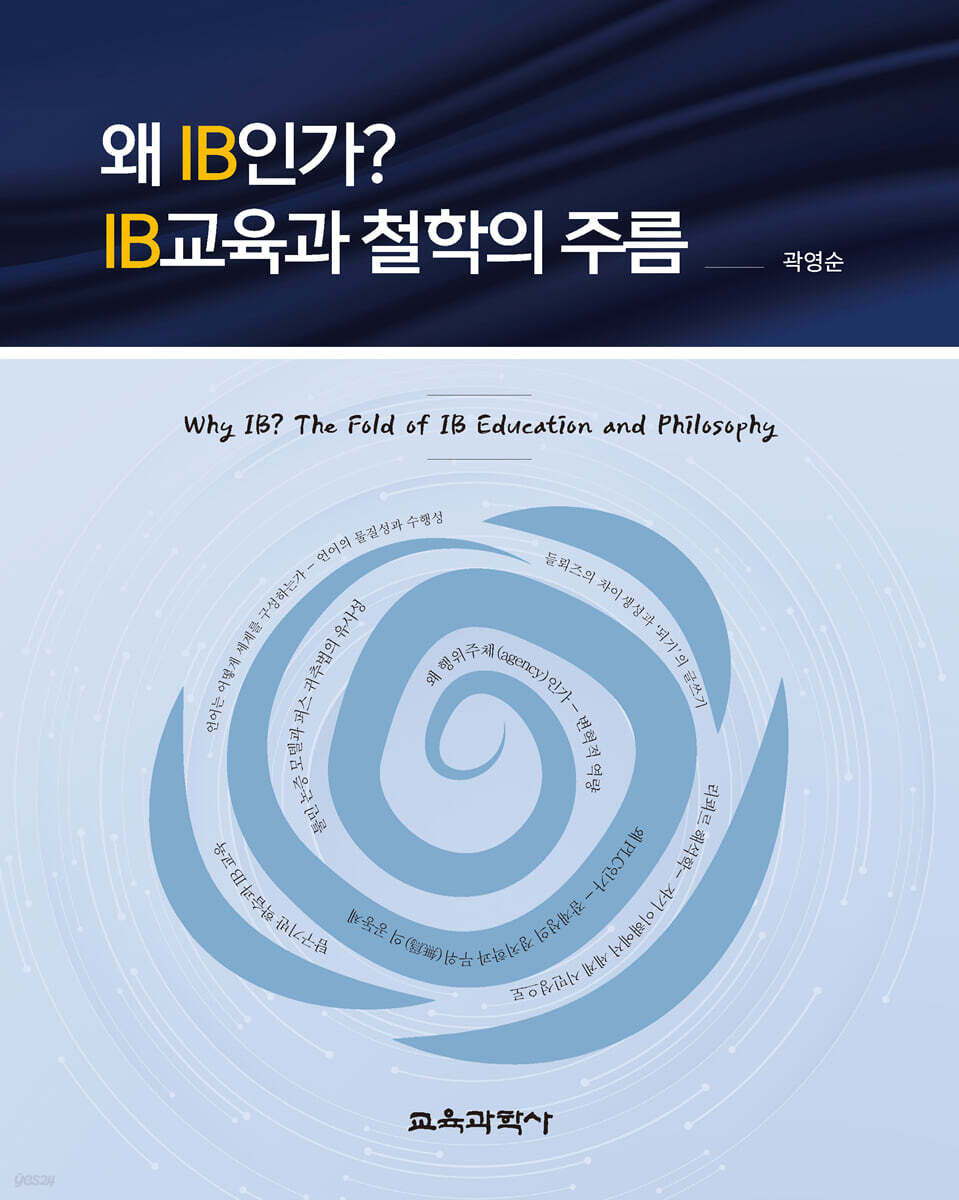
Why the IB? The IB Education and Philosophy
 |
Description
Book Introduction
IB education has presented its educational direction with unique expressions such as 'international education,' 'inquiry-based learning,' 'concept-centered education,' and 'global citizenship.'
However, the question of where these languages originated and what philosophical currents of thought they are associated with still remains a gap in the educational field.
Questions like “Why concepts?”, “Why inquiry?”, and “Why learner agency?” arise naturally whenever teachers construct lessons and meet students, but the philosophical origins of these questions are pushed outside the language of practice.
This book seeks to address this philosophical void. It provides a forum for teachers practicing IB education, IBEN experts, and prospective IB educators to reflect on the philosophical foundations of their practice and the lineage of thought within which it was born and expanded.
However, the question of where these languages originated and what philosophical currents of thought they are associated with still remains a gap in the educational field.
Questions like “Why concepts?”, “Why inquiry?”, and “Why learner agency?” arise naturally whenever teachers construct lessons and meet students, but the philosophical origins of these questions are pushed outside the language of practice.
This book seeks to address this philosophical void. It provides a forum for teachers practicing IB education, IBEN experts, and prospective IB educators to reflect on the philosophical foundations of their practice and the lineage of thought within which it was born and expanded.
index
Preface _ 3
Chapter 1 Why a Concept? … … … … … … … … … … … … … … … … … … … … … … 13
1. Alignment of the IB Curriculum, Teaching, Learning, and Assessment _ 18
2.
From Concept-Based Education to IB Education _ 24
[The Wrinkles of Philosophy]
3.
Does the 'concept' exist? _ 34
? ?3-1.
The Reality of Plato's Ideas and Universal Concepts _ 34
? ?3-2.
Linguistic Turn _ 36
? ?3-3.
Structuralism: In Search of the Unconscious in Language _ 37
? ?3-4.
Poststructuralism: Reality and Becoming Beyond Structure _ 39
? ?3-5.
Derrida's Deconstruction: A Poststructuralist Methodology _ 40
4.
How Language Constructs the World: The Materiality and Performativity of Language _ 44
? ?4-1.
Butler's Performativity and Gender Identity _ 47
? ?4-2.
Wittgenstein's Pragmatics _ 55
? ?4-3.
Peirce's semiotics, speech acts, and abductive reasoning: Exploration and habit formation _ 59
5.
How Language Becomes Power: Fields of Discursive and Non-Discursive Practices _ 71
? ?5-1.
Foucault: Discursive Construction and Non-Discursive Foundations _ 71
6.
How do concepts function socially? _ 76
? ?6-1.
Vygotsky: From Language to Thought; Language Begets Thought _ 77
? ?6-2.
From Language to Practice: Prairie Praxis _ 83
? ?6-3.
Language Performance and Concept-Based Education _ 85
Chapter 2 Why Agency? … … … … … … … … … … … … … 89
1. OECD Education 2030 and the Direction of IB Education _ 93
? ?1-1.
Transformative Capacity and Agency _ 95
? ?1-2.
Deep Understanding and Transfer Based on Values and Attitudes _ 98
[The Wrinkles of Philosophy]
2.
Form and Matter: The Transformative Capacity for Different Repetition _ 105
3.
From Anthropocentrism to a Post-Anthropocentrism Paradigm _ 113
? ?3-1.
The Rise of Posthumanism and New Materialism _ 113
? ?3-2.
Material Turn and New Materialism _ 115
? ?3-3.
Posthumanism and Ecocentrism _ 118
? ?3-4.
The Ethical and Ecophilosophical Shift of Posthumanism _ 124
4.
Deleuze, Bergsonian _ 128
? ?4-1.
The Unity of Existence and Creative Conspiracy _ 129
? ?4-2.
The Principle of Difference Generation: The Composition of Manifolds by Intensity and Singularity _ 133
? ?4-3.
The Field of Potentiality and the Plane of Creation: Kora, Qi, the Void Plane, and the De-Organizational Body _ 134
? ?4-4.
Meaning as Event: Deleuze's Ontological Philosophy of Language _ 137
? ?4-5.
Post-Institutional and Hybrid Surfaces: The Ethical Turn in Deleuze's Ontology _ 142
5.
Foucault: A Genealogy of Discourse, Power, and the Subject _ 145
? ?5-1.
Foucault's Structuralist Epistemology: Discourse, Power, and the Subject _ 146
? ?5-2.
The Order of Discourse and Knowledge-Power _ 147
? ?5-3.
Foucault's Subject Construction: Discursive Practices, Non-Discursive Practices, and Apparatuses _ 150
? ?5-4.
Knowledge-Power and Subjectivation _ 152
? ?5-5.
The Art of Self and the Aesthetics of Existence _ 155
6.
From Foucault to Barad: Reconstructing the Concept of 'Apparatus' _ 158
? ?6-1.
Barad's Performative New Materialism _ 158
? ?6-2.
Devices and Materialization _ 161
7.
Ricoeur's Hermeneutics and IB Learner Profiles: From Self-Understanding to Global Citizenship _ 167
? ?7-1.
Narrative Self-Understanding and Identity Formation _ 168
? ?7-2.
Hermeneutic Thinking and Narrative-Based Learning in the IB Education _ 171
? ?7-3.
Encounters with Others: Relational Identity and Understanding the World _ 175
Chapter 3: Why Inquiry? The Philosophy and Practice of IB Teaching and Learning… … … … … … 179
1.
Inquiry-Based Learning and the IB Education _ 182
2.
The Science of Learning: IB Education and Brain-Based Learning _ 184
? ?2-1.
Why the Science of Learning? _ 185
? ?2-2.
Why Brain-Based? _ 186
? ?2-3.
Learning and Brain Science: Principles of Brain-Based Learning _ 187
3.
Inquiry Questions and Teaching and Learning Design _ 195
[The Wrinkles of Philosophy]
4.
What is Exploration? _ 206
? ?4-1.
Inquiry and Experience: Dewey's Experimental Inquiry _ 207
5.
The Two Axis of Inquiry: Induction and Deduction _ 211
6.
Hypothetico-deductive inquiry _ 221
7.
Posthuman and Poststructuralist Exploration _ 230
Chapter 4: Why Essay-Based Evaluations?… … … … … … … … … … … … … … … … 235
1. IB Assessment and Essay/Argumentative Writing _ 239
? ?1-1.
The Evaluation Structure of Theory of Knowledge (TOK) _ 245
? ?1-2.
Extended Essay (EE) Evaluation Philosophy and Procedures _ 252
2. IB Essay Exams and Knowledge-Based Argumentative Writing _ 254
? ?2-1.
Argument-Based Writing: IB's Writing Teaching Strategies _ 257
3.
Assessment and Feedback: Writing Assessments That Develop Thinking _ 262
? ?3-1.
Expanding Your Mind and Exploring the World Through Writing _ 264
[The Wrinkles of Philosophy]
4.
Argumentation and the Act of Argumentation: Logic and Rhetoric _ 270
5.
Toulmin's Argumentation Model _ 275
? ?5-1.
Similarities between Toulmin's argument model and Peirce's abductive method _ 278
? ?5-2.
The Structure of Justification and Ideological Critique _ 283
6.
Deleuze's Writing of Difference and Becoming _ 286
? ?6-1.
The Philosophy of Difference: A Challenge to the Philosophy of Identity _ 287
? ?6-2.
Becoming and Creating Difference _ 289
? ?6-3.
The Ethics of Becoming and Writing _ 295
? ?6-4.
Curriculum as Writerly Text _ 298
? ?6-5.
The Pursuit of Rhizome Knowledge _ 303
Chapter 5 Why PLC?… … … … … … … … … … … … … … … … … … … … … 307
1.
Shifting from Teacher Accountability to School Accountability _ 310
? ?1-1.
Collaborative Practice and Sustainable School Communities _ 312
2.
Teacher Professionalism and Identity Development _ 314
? ?2-1.
School Culture Innovation _ 315
? ?2-2.
The Ontological Transformation of the Teacher Community and its Future Prospects _ 317
[The Wrinkles of Philosophy]
3.
Four Paradigms of Teacher Professionalism _ 321
? ?3-1.
Effective Teacher _ 322
? ?3-2.
The Reflective Teacher _ 324
? ?3-3.
The Inquiring Teacher _ 326
? ?3-4.
Transformational Teacher _ 328
? ?3-5.
The Paradigm Shift in Teacher Professionalism and the Role of PLCs _ 329
4.
The Gap Between Theory and Practice, and Action Research _ 331
? ?4-1.
Teachers' Expertise Base and the Theory-Practice Gap _ 331
? ?4-2.
Key Features of Action Research _ 334
? ?4-3.
Reconstructing IB Teacher Professionalism through Action Research and Programmatic Learning (PLC) _ 337
5.
Why Community: The Politics of Potentiality and the Community of 'Inaction' _ 341
? ?5-1.
The Neoliberal Education System and the Demands of PLCs _ 343
? ?5-2.
The Community of Inaction and PLC: Nancy's Theory of Community _ 346
? ?5-3.
Bartleby and the Politics of Potentiality: The Ethics of Not Doing _ 349
? ?5-4.
What kind of community should it be? _ 351
6.
Becoming Together: The Ontological Transformation of the Teacher Community _ 355
? ?6-1.
Becoming a Teacher: From Role to Being _ 355
? ?6-2.
Becoming Teacher and Becoming Student as Co-Beings _ 358
References _ 361
Search _ 379
Chapter 1 Why a Concept? … … … … … … … … … … … … … … … … … … … … … … 13
1. Alignment of the IB Curriculum, Teaching, Learning, and Assessment _ 18
2.
From Concept-Based Education to IB Education _ 24
[The Wrinkles of Philosophy]
3.
Does the 'concept' exist? _ 34
? ?3-1.
The Reality of Plato's Ideas and Universal Concepts _ 34
? ?3-2.
Linguistic Turn _ 36
? ?3-3.
Structuralism: In Search of the Unconscious in Language _ 37
? ?3-4.
Poststructuralism: Reality and Becoming Beyond Structure _ 39
? ?3-5.
Derrida's Deconstruction: A Poststructuralist Methodology _ 40
4.
How Language Constructs the World: The Materiality and Performativity of Language _ 44
? ?4-1.
Butler's Performativity and Gender Identity _ 47
? ?4-2.
Wittgenstein's Pragmatics _ 55
? ?4-3.
Peirce's semiotics, speech acts, and abductive reasoning: Exploration and habit formation _ 59
5.
How Language Becomes Power: Fields of Discursive and Non-Discursive Practices _ 71
? ?5-1.
Foucault: Discursive Construction and Non-Discursive Foundations _ 71
6.
How do concepts function socially? _ 76
? ?6-1.
Vygotsky: From Language to Thought; Language Begets Thought _ 77
? ?6-2.
From Language to Practice: Prairie Praxis _ 83
? ?6-3.
Language Performance and Concept-Based Education _ 85
Chapter 2 Why Agency? … … … … … … … … … … … … … 89
1. OECD Education 2030 and the Direction of IB Education _ 93
? ?1-1.
Transformative Capacity and Agency _ 95
? ?1-2.
Deep Understanding and Transfer Based on Values and Attitudes _ 98
[The Wrinkles of Philosophy]
2.
Form and Matter: The Transformative Capacity for Different Repetition _ 105
3.
From Anthropocentrism to a Post-Anthropocentrism Paradigm _ 113
? ?3-1.
The Rise of Posthumanism and New Materialism _ 113
? ?3-2.
Material Turn and New Materialism _ 115
? ?3-3.
Posthumanism and Ecocentrism _ 118
? ?3-4.
The Ethical and Ecophilosophical Shift of Posthumanism _ 124
4.
Deleuze, Bergsonian _ 128
? ?4-1.
The Unity of Existence and Creative Conspiracy _ 129
? ?4-2.
The Principle of Difference Generation: The Composition of Manifolds by Intensity and Singularity _ 133
? ?4-3.
The Field of Potentiality and the Plane of Creation: Kora, Qi, the Void Plane, and the De-Organizational Body _ 134
? ?4-4.
Meaning as Event: Deleuze's Ontological Philosophy of Language _ 137
? ?4-5.
Post-Institutional and Hybrid Surfaces: The Ethical Turn in Deleuze's Ontology _ 142
5.
Foucault: A Genealogy of Discourse, Power, and the Subject _ 145
? ?5-1.
Foucault's Structuralist Epistemology: Discourse, Power, and the Subject _ 146
? ?5-2.
The Order of Discourse and Knowledge-Power _ 147
? ?5-3.
Foucault's Subject Construction: Discursive Practices, Non-Discursive Practices, and Apparatuses _ 150
? ?5-4.
Knowledge-Power and Subjectivation _ 152
? ?5-5.
The Art of Self and the Aesthetics of Existence _ 155
6.
From Foucault to Barad: Reconstructing the Concept of 'Apparatus' _ 158
? ?6-1.
Barad's Performative New Materialism _ 158
? ?6-2.
Devices and Materialization _ 161
7.
Ricoeur's Hermeneutics and IB Learner Profiles: From Self-Understanding to Global Citizenship _ 167
? ?7-1.
Narrative Self-Understanding and Identity Formation _ 168
? ?7-2.
Hermeneutic Thinking and Narrative-Based Learning in the IB Education _ 171
? ?7-3.
Encounters with Others: Relational Identity and Understanding the World _ 175
Chapter 3: Why Inquiry? The Philosophy and Practice of IB Teaching and Learning… … … … … … 179
1.
Inquiry-Based Learning and the IB Education _ 182
2.
The Science of Learning: IB Education and Brain-Based Learning _ 184
? ?2-1.
Why the Science of Learning? _ 185
? ?2-2.
Why Brain-Based? _ 186
? ?2-3.
Learning and Brain Science: Principles of Brain-Based Learning _ 187
3.
Inquiry Questions and Teaching and Learning Design _ 195
[The Wrinkles of Philosophy]
4.
What is Exploration? _ 206
? ?4-1.
Inquiry and Experience: Dewey's Experimental Inquiry _ 207
5.
The Two Axis of Inquiry: Induction and Deduction _ 211
6.
Hypothetico-deductive inquiry _ 221
7.
Posthuman and Poststructuralist Exploration _ 230
Chapter 4: Why Essay-Based Evaluations?… … … … … … … … … … … … … … … … 235
1. IB Assessment and Essay/Argumentative Writing _ 239
? ?1-1.
The Evaluation Structure of Theory of Knowledge (TOK) _ 245
? ?1-2.
Extended Essay (EE) Evaluation Philosophy and Procedures _ 252
2. IB Essay Exams and Knowledge-Based Argumentative Writing _ 254
? ?2-1.
Argument-Based Writing: IB's Writing Teaching Strategies _ 257
3.
Assessment and Feedback: Writing Assessments That Develop Thinking _ 262
? ?3-1.
Expanding Your Mind and Exploring the World Through Writing _ 264
[The Wrinkles of Philosophy]
4.
Argumentation and the Act of Argumentation: Logic and Rhetoric _ 270
5.
Toulmin's Argumentation Model _ 275
? ?5-1.
Similarities between Toulmin's argument model and Peirce's abductive method _ 278
? ?5-2.
The Structure of Justification and Ideological Critique _ 283
6.
Deleuze's Writing of Difference and Becoming _ 286
? ?6-1.
The Philosophy of Difference: A Challenge to the Philosophy of Identity _ 287
? ?6-2.
Becoming and Creating Difference _ 289
? ?6-3.
The Ethics of Becoming and Writing _ 295
? ?6-4.
Curriculum as Writerly Text _ 298
? ?6-5.
The Pursuit of Rhizome Knowledge _ 303
Chapter 5 Why PLC?… … … … … … … … … … … … … … … … … … … … … 307
1.
Shifting from Teacher Accountability to School Accountability _ 310
? ?1-1.
Collaborative Practice and Sustainable School Communities _ 312
2.
Teacher Professionalism and Identity Development _ 314
? ?2-1.
School Culture Innovation _ 315
? ?2-2.
The Ontological Transformation of the Teacher Community and its Future Prospects _ 317
[The Wrinkles of Philosophy]
3.
Four Paradigms of Teacher Professionalism _ 321
? ?3-1.
Effective Teacher _ 322
? ?3-2.
The Reflective Teacher _ 324
? ?3-3.
The Inquiring Teacher _ 326
? ?3-4.
Transformational Teacher _ 328
? ?3-5.
The Paradigm Shift in Teacher Professionalism and the Role of PLCs _ 329
4.
The Gap Between Theory and Practice, and Action Research _ 331
? ?4-1.
Teachers' Expertise Base and the Theory-Practice Gap _ 331
? ?4-2.
Key Features of Action Research _ 334
? ?4-3.
Reconstructing IB Teacher Professionalism through Action Research and Programmatic Learning (PLC) _ 337
5.
Why Community: The Politics of Potentiality and the Community of 'Inaction' _ 341
? ?5-1.
The Neoliberal Education System and the Demands of PLCs _ 343
? ?5-2.
The Community of Inaction and PLC: Nancy's Theory of Community _ 346
? ?5-3.
Bartleby and the Politics of Potentiality: The Ethics of Not Doing _ 349
? ?5-4.
What kind of community should it be? _ 351
6.
Becoming Together: The Ontological Transformation of the Teacher Community _ 355
? ?6-1.
Becoming a Teacher: From Role to Being _ 355
? ?6-2.
Becoming Teacher and Becoming Student as Co-Beings _ 358
References _ 361
Search _ 379
GOODS SPECIFICS
- Date of issue: November 20, 2025
- Page count, weight, size: 384 pages | 128*188*30mm
- ISBN13: 9788925419527
- ISBN10: 8925419521
You may also like
카테고리
korean


korean

![GQ KOREA Mark (Monthly): December [2025]](http://librairie.coreenne.fr/cdn/shop/files/8ef265dbbfbf186523ed75ba7319009d.jpg?v=1765340328&width=3840)


