

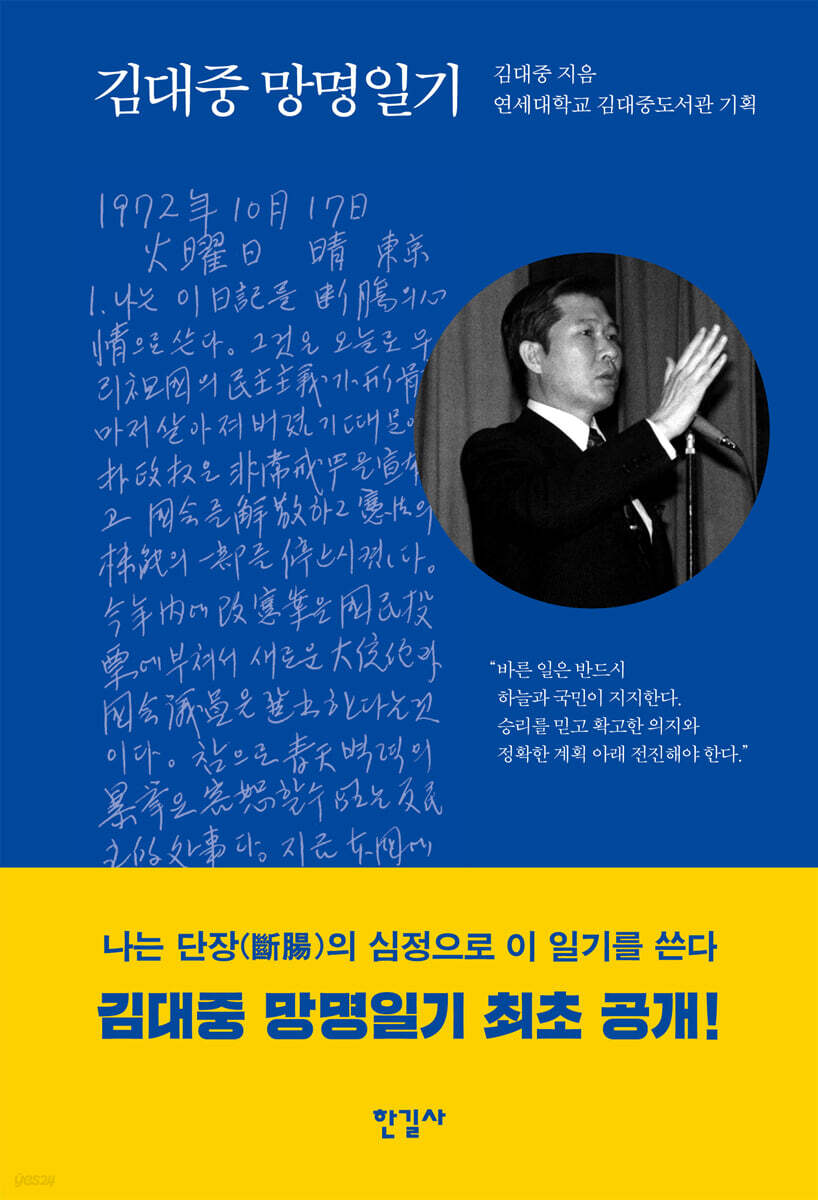
Kim Dae-jung's Diary in Exile
 |
Description
Book Introduction
President Kim Dae-jung never mentioned this diary once during his lifetime.
After the death of Mrs. Lee Hee-ho, her third son, Kim Hong-gul, chairman of the Kim Dae-jung and Lee Hee-ho Memorial Foundation, discovered six notebooks at her private residence in Donggyo-dong.
This notebook contained 223 handwritten diary entries by Kim Dae-jung from August 3, 1972 to May 11, 1973.
If Kim Dae-jung had continued writing his diary before he was kidnapped in Tokyo on August 8, 1973, there would have been two more volumes, but their whereabouts are unknown.
『Kim Dae-jung's Diary in Exile』 is a book that was published after deciphering and organizing a diary densely written in a mix of Chinese and English characters and adding a preface and an introduction.
It unfolds the true story of a man who faced his fate and life with the determination to face death.
After the death of Mrs. Lee Hee-ho, her third son, Kim Hong-gul, chairman of the Kim Dae-jung and Lee Hee-ho Memorial Foundation, discovered six notebooks at her private residence in Donggyo-dong.
This notebook contained 223 handwritten diary entries by Kim Dae-jung from August 3, 1972 to May 11, 1973.
If Kim Dae-jung had continued writing his diary before he was kidnapped in Tokyo on August 8, 1973, there would have been two more volumes, but their whereabouts are unknown.
『Kim Dae-jung's Diary in Exile』 is a book that was published after deciphering and organizing a diary densely written in a mix of Chinese and English characters and adding a preface and an introduction.
It unfolds the true story of a man who faced his fate and life with the determination to face death.
- You can preview some of the book's contents.
Preview
index
From Suffering to Glory, From Korea to the World | Park Myeong-rim
August 1972
September 1972
October 1972
November 1972
December 1972
January 1973
February 1973
March 1973
April 1973
May 1973
The Historical Value and Significance of Kim Dae-jung's Diary in Exile | Jang Shin-gi
August 1972
September 1972
October 1972
November 1972
December 1972
January 1973
February 1973
March 1973
April 1973
May 1973
The Historical Value and Significance of Kim Dae-jung's Diary in Exile | Jang Shin-gi
Detailed image

Into the book
(August 14, 1972) The value of life does not lie in how high a position one holds, but in how righteously and to the best of one's ability one lives.
But we forget this eternal truth and, using every means possible, we run wild, forgetting even ourselves, for the sake of money and high status, and eventually fall.
A life devoted to the people and humanity, without shame before God or one's own conscience, is of the highest value.
I will spend my life practicing this path.
--- p.55
(October 17, 1972) I write this diary with a broken heart.
That is because today, even the form of democracy in our country has disappeared.
The Park Chung-hee regime declared martial law, dissolved the National Assembly, and suspended some of the constitutional functions.
The plan is to put the constitutional amendment to a national referendum within this year to elect a new president and members of the National Assembly.
--- p.61
(November 23, 1972) Today is Thanksgiving Day, a day when Americans enjoy spending time with their families and eating turkey.
I had lunch with Seongho and then slept at the hotel all day.
Somehow I don't feel like doing anything.
--- p.137
(December 26, 1972) My image is 1) Conviction, 2) Generous, and 3) Cool.
--- p.197
(January 1, 1973) My responsibility for understanding will become even more crucial, and all the people of the Republic of Korea must bear in mind that it is no exaggeration to say that they are pinning their every hope on me.
My specific future course of action will be decided upon when I return to Japan, but my principle is that I must remain steadfast in my judgment on how to revive democracy, which is suffering unprecedented pain and is teetering on the brink of death, and I must never be swayed by personal convenience or fear.
--- p.210
(January 4, 1973) I went to the Japanese Embassy in Washington, D.C. to check and it turned out that the visa I had used had already been used, so I ended up being a visa-free entrant.
The road presents two options: stay for seven hours and then head to Seoul, or undergo a review by the Minister of Justice and receive a short-term stay permit. The latter option is less likely.
The passport expiration date is approaching on February 17th, and there is great concern that the Park Chung-hee regime may cancel it at any time.
--- p.215
(January 27, 1973) Jae-su Yoon arrived from Korea.
He called to tell me that he had been taken to the KCIA for meeting my wife in Korea and was questioned about what kind of communication we had had.
--- p.250
(April 4, 1973) Until taking power, it is very important to have a high-level ideology or cause and to use rhetoric to persuade and agitate the public.
However, once in power, policies that can improve the lives of the people and achieve national development are needed in addition to these just causes.
But we forget this eternal truth and, using every means possible, we run wild, forgetting even ourselves, for the sake of money and high status, and eventually fall.
A life devoted to the people and humanity, without shame before God or one's own conscience, is of the highest value.
I will spend my life practicing this path.
--- p.55
(October 17, 1972) I write this diary with a broken heart.
That is because today, even the form of democracy in our country has disappeared.
The Park Chung-hee regime declared martial law, dissolved the National Assembly, and suspended some of the constitutional functions.
The plan is to put the constitutional amendment to a national referendum within this year to elect a new president and members of the National Assembly.
--- p.61
(November 23, 1972) Today is Thanksgiving Day, a day when Americans enjoy spending time with their families and eating turkey.
I had lunch with Seongho and then slept at the hotel all day.
Somehow I don't feel like doing anything.
--- p.137
(December 26, 1972) My image is 1) Conviction, 2) Generous, and 3) Cool.
--- p.197
(January 1, 1973) My responsibility for understanding will become even more crucial, and all the people of the Republic of Korea must bear in mind that it is no exaggeration to say that they are pinning their every hope on me.
My specific future course of action will be decided upon when I return to Japan, but my principle is that I must remain steadfast in my judgment on how to revive democracy, which is suffering unprecedented pain and is teetering on the brink of death, and I must never be swayed by personal convenience or fear.
--- p.210
(January 4, 1973) I went to the Japanese Embassy in Washington, D.C. to check and it turned out that the visa I had used had already been used, so I ended up being a visa-free entrant.
The road presents two options: stay for seven hours and then head to Seoul, or undergo a review by the Minister of Justice and receive a short-term stay permit. The latter option is less likely.
The passport expiration date is approaching on February 17th, and there is great concern that the Park Chung-hee regime may cancel it at any time.
--- p.215
(January 27, 1973) Jae-su Yoon arrived from Korea.
He called to tell me that he had been taken to the KCIA for meeting my wife in Korea and was questioned about what kind of communication we had had.
--- p.250
(April 4, 1973) Until taking power, it is very important to have a high-level ideology or cause and to use rhetoric to persuade and agitate the public.
However, once in power, policies that can improve the lives of the people and achieve national development are needed in addition to these just causes.
--- p.358
Publisher's Review
Kim Dae-jung, who fought alone against Park Chung-hee's martial law
President Park Chung-hee declared martial law on October 17, 1972, neutralized the National Assembly, and then amended the Constitution to enable him to remain in power indefinitely.
When a person in power uses force to destroy the democratic constitutional order and strengthen his or her power and seek long-term rule, this is called a coup d'état, and the martial law declared on October 17, 1972 is an exact example of this.
Kim Dae-jung was the only person who fought against President Park Chung-hee's coup immediately after the declaration of martial law.
At the time, there was no proper resistance in the country due to the extreme suppression caused by martial law, and overseas, there was little understanding of the Park Chung-hee regime and the domestic reality, so no significant opposition voices or movements emerged.
Kim Dae-jung was in Japan when martial law was declared on October 17, and immediately thereafter chose to go into exile and began the anti-Yushin movement.
It was a lonely struggle.
By comparing President Yoon Seok-yeol's December 3 martial law and coup d'état in 2024 with the process of overcoming them, we can gauge the significance and value of Kim Dae-jung's struggle for exile.
Yoon Seok-yeol's martial law and civil war could have been brought to a peaceful and swift end by the National Assembly and the people.
However, immediately after the October 17, 1972 martial law and coup d'état, the only person who resisted it was Kim Dae-jung.
In this situation, Kim Dae-jung chose to fight in exile. This diary well expresses Kim Dae-jung's desperate and desperate feelings at the time.
Six notebooks, silent records
President Kim Dae-jung never mentioned this diary once during his lifetime.
After the death of Mrs. Lee Hee-ho, six notebooks were discovered at her home in Donggyo-dong by her third son, Kim Hong-gul, chairman of the Kim Dae-jung and Lee Hee-ho Memorial Foundation.
This notebook contained 223 handwritten diary entries by Kim Dae-jung from August 3, 1972 to May 11, 1973.
If Kim Dae-jung had continued writing his diary before he was kidnapped in Tokyo on August 8, 1973, there would have been two more volumes, but their whereabouts are unknown.
Kim Dae-jung wrote his diary mostly in Chinese characters, with some Japanese and English thrown in.
Because the diary contained many archaic words and Japanese-style kanji expressions, several experts joined forces to properly decipher it.
Through this process, after completing and organizing the text, a preface and an introduction are added and 『Kim Dae-jung's Diary in Exile』 is published to the world.
This book depicts the fierce struggle of a man who faced his fate and life with the determination to face death.
It vividly depicts the domestic and international situation at the time that Kim Dae-jung experienced and thought about.
Kim Dae-jung wrote in detail about who he met and what he did while staying in Japan, the United States, and then back in Japan, and even the weather.
It also contains many important facts about domestic and international trends after the Yushin regime, as well as information on the perceptions and actions of critical foreigners and overseas Koreans after the October Yushin regime.
Kim Dae-jung also recorded in his diary his standards for an ideal leader and his plans for running the country after a change of government.
For Kim Dae-jung, the period of exile was not only a time of resistance and struggle, but also a time to hone his post-democratization policies and his own leadership.
This is a very important basis for understanding the true nature of Kim Dae-jung, a prepared and successful president.
Until I decided to fight in exile
"Kim Dae-jung's Diary in Exile" begins in Tokyo on August 3, 1972.
About a year ago, in April 1971, Kim Dae-jung ran for the 7th presidential election, advocating for the "40s generation theory," but narrowly lost to Park Chung-hee.
Afterwards, just before the 8th general election, Kim Dae-jung was involved in a suspicious traffic accident and, judging that he would be at risk of being attacked if he received treatment at a domestic hospital, he went to Japan to receive treatment for his leg injury.
This diary was started during that very period of treatment.
On August 26, 1972, Kim Dae-jung wrote in his diary, "There will be no elections in 1975."
Park Chung-hee pushed for a third constitutional amendment in 1969, ahead of the 7th presidential election, but in the 8th general election, which was held thanks to Kim Dae-jung's propaganda, the main opposition New Democratic Party secured the threshold to block the constitutional amendment.
The Park Chung-hee regime, which had made it impossible to legally amend the constitution any longer, finally declared martial law across the country on October 17, 1972.
The October Yushin coup, which dissolved the National Assembly and banned all political activities, began.
“I write this diary with a broken heart.
“It is because today, even the form of democracy in our country has disappeared.”
(October 17, 1972)
On the day the Park Chung-hee regime declared martial law, Kim Dae-jung began his diary with this sentence in deep despair and anger.
The National Assembly was dissolved, the constitution was suspended, and it was announced that a new constitutional amendment would be submitted to a national referendum.
Kim Dae-jung called this “a bolt from the blue and an unforgivable anti-democratic act.”
On the afternoon of the day of the Yushin coup, Kim Dae-jung had just finished meeting with Japanese lawmakers.
He prepares for an unpredictable life in exile.
The feelings and anguish of Kim Dae-jung, a politician in exile
“People around me are worried about my safety, but what can I do?
“I leave life and death to God and just go forward according to my beliefs.” (October 27, 1972)
Kim Dae-jung left this sentence in his diary like a short prayer.
The diary entry from immediately after martial law begins with shock and despair, but as time passes, Kim Dae-jung's inner self, strengthening his convictions and determination, is revealed.
“Today is Thanksgiving, a day when Americans enjoy eating turkey and spending time with their families.
I had lunch with Seongho and then slept at the hotel all day.
“Somehow I don’t feel like doing anything.” (November 23, 1972)
A diary is a place to express one's private and intimate feelings without reservation.
So, Kim Dae-jung's complex emotions are clearly revealed throughout this diary.
The film vividly portrays the complex emotions of politician Kim Dae-jung during his time in exile: the anxiety and pain of a father who went into exile alone, leaving his wife and three sons behind amidst a mountain of debt; the agony of a politician continuing his struggle in exile with no hope for a bright future; the despair he feels at hearing news of his old comrades being swayed by the pressure and persuasion of the Yushin dictatorship; and the anger toward those who only care about their personal safety and ignore the reality of a country suffering under dictatorship.
At the end of the diary, which ends each day, he offers a fervent prayer to God to calm his wavering heart during the sudden exile.
Kim Dae-jung does his best every day.
However, he writes that he feels he must work harder in the future, while blaming himself for his lack of activity.
“For those who are currently fighting and enduring persecution in Korea and maintaining their integrity.
“My heart aches at the thought of what I will do.” (January 17, 1973)
“When I think of my family members who are suffering in my home country and my comrades in prison, I feel for them.
“It’s painful not being able to do anything.” (January 19, 1973)
Kim Dae-jung was determined not to waste a single moment and to dedicate himself solely to the restoration of democracy and peaceful unification of his country.
What should I do?
What kind of person should I be?
Between loneliness and guilt, anger and longing for his homeland, he rises again.
At the end of the diary, the words ‘hope,’ ‘success,’ and ‘victory’ appear frequently.
The wavering heart settles, and the voice of the leader, confident of victory over dictatorship and envisioning the future of the nation, begins to emerge clearly.
Fighting dictatorships in Japan and the United States
“Congressman Kennedy showed me the utmost kindness by telling me that he had read the New Yorker article on Korea and that I should feel free to ask him anything, that he was more interested in me as an individual than in Korea, and that I should not lose contact with him even if I went to Korea.” (December 13, 1972)
After the declaration of martial law, Kim Dae-jung began his exile in Japan with only the title of “former presidential candidate” and no money or organization.
The Japanese political and media circles welcomed Kim Dae-jung, and with the help of various sponsors, he established a political base and personal network.
However, since the United States has greater influence over Korea than Japan, Kim Dae-jung decides to pursue activities in the United States in parallel.
Kim Dae-jung made his position known to major American media outlets such as the Washington Post and the New York Times, and began to expand the scope of Korea's democratization by contacting various intellectuals, including Harvard University professor Edwin Reischauer.
He travels around the United States giving lectures at various universities.
John F.
He played a major role in forming international public opinion against the Yushin regime by strengthening cooperation with politicians such as Senator Edward Kennedy, President Kennedy's younger brother.
The successful struggle for exile and the kidnapping of Kim Dae-jung
As Kim Dae-jung's struggle for exile became successful, the Park Chung-hee regime became nervous and began to carry out blatant sabotage operations through the Central Intelligence Agency (CIA).
Kim Dae-jung's close associates in the country are oppressed.
People who met Kim Dae-jung abroad were investigated upon returning to Korea.
In addition, the Central Intelligence Agency interfered with Kim Dae-jung's lectures and hotel stays and monitored his activities.
As Kim Dae-jung's struggle for exile became more successful, the Yushin regime's reaction became more and more harsh, and eventually, an internal whistleblower reported that a plot to assassinate Kim Dae-jung was underway.
Eventually, the Yushin regime kidnapped Kim Dae-jung from the Grand Palace Hotel in Tokyo on August 8, 1973.
However, Kim Dae-jung survived death thanks to American intervention and was thrown in front of his home in Donggyo-dong on August 13, five days later.
This incident clearly demonstrated the anti-democratic and violent nature of Park Chung-hee's Yushin regime both domestically and internationally.
As a result, international solidarity for the democratization of Korea began in earnest, and various resistances emerged domestically as well.
However, the Yushin regime consistently responded in a rigid manner, and this became more severe over time, ultimately leading to its self-destruction without being able to resolve the problems within the system.
Ultimately, Kim Dae-jung's successful struggle for exile had a major impact on the collapse of the Yushin regime.
The diary that became the seed of Korean democracy today
"Kim Dae-jung's Diary in Exile" ended on May 11, 1973, but the ripple effects of the events and incidents recorded until that day continued.
Although the diary stopped after the kidnapping of Kim Dae-jung, the words and thoughts refined through the diary continued to have a profound influence on his later political actions.
Afterwards, Kim Dae-jung became a central figure in helping Korean democracy find its way back to its rightful place.
On December 3, 2024, more than half a century later, the Republic of Korea once again faced martial law.
It was the second coup in constitutional history, following the one on October 17, 1972.
On that day, when the political rights and freedoms of the citizens were suppressed with guns and swords, the Korean people demonstrated the remarkable resilience of democracy.
History tends to repeat what should not be repeated, and politics tends to forget what should not be forgotten.
“Kim Dae-jung’s Diary in Exile” is a record that holds onto that oblivion.
If Yi Sun-sin had his 『Nanjung Ilgi』, and during the independence movement, Kim Gu had his 『Baekbeom Ilji』 and Syngman Rhee's 『Rhee Syngman Diary』, then Kim Dae-jung, who went through the darkest period of modern Korean history after liberation, has his 『Kim Dae-jung's Diary in Exile』.
This diary, which reveals the suffering and conviction of one man who became the seed of democracy today, serves as a spiritual compass that reminds us of where we came from and what we must protect when darkness falls.
President Park Chung-hee declared martial law on October 17, 1972, neutralized the National Assembly, and then amended the Constitution to enable him to remain in power indefinitely.
When a person in power uses force to destroy the democratic constitutional order and strengthen his or her power and seek long-term rule, this is called a coup d'état, and the martial law declared on October 17, 1972 is an exact example of this.
Kim Dae-jung was the only person who fought against President Park Chung-hee's coup immediately after the declaration of martial law.
At the time, there was no proper resistance in the country due to the extreme suppression caused by martial law, and overseas, there was little understanding of the Park Chung-hee regime and the domestic reality, so no significant opposition voices or movements emerged.
Kim Dae-jung was in Japan when martial law was declared on October 17, and immediately thereafter chose to go into exile and began the anti-Yushin movement.
It was a lonely struggle.
By comparing President Yoon Seok-yeol's December 3 martial law and coup d'état in 2024 with the process of overcoming them, we can gauge the significance and value of Kim Dae-jung's struggle for exile.
Yoon Seok-yeol's martial law and civil war could have been brought to a peaceful and swift end by the National Assembly and the people.
However, immediately after the October 17, 1972 martial law and coup d'état, the only person who resisted it was Kim Dae-jung.
In this situation, Kim Dae-jung chose to fight in exile. This diary well expresses Kim Dae-jung's desperate and desperate feelings at the time.
Six notebooks, silent records
President Kim Dae-jung never mentioned this diary once during his lifetime.
After the death of Mrs. Lee Hee-ho, six notebooks were discovered at her home in Donggyo-dong by her third son, Kim Hong-gul, chairman of the Kim Dae-jung and Lee Hee-ho Memorial Foundation.
This notebook contained 223 handwritten diary entries by Kim Dae-jung from August 3, 1972 to May 11, 1973.
If Kim Dae-jung had continued writing his diary before he was kidnapped in Tokyo on August 8, 1973, there would have been two more volumes, but their whereabouts are unknown.
Kim Dae-jung wrote his diary mostly in Chinese characters, with some Japanese and English thrown in.
Because the diary contained many archaic words and Japanese-style kanji expressions, several experts joined forces to properly decipher it.
Through this process, after completing and organizing the text, a preface and an introduction are added and 『Kim Dae-jung's Diary in Exile』 is published to the world.
This book depicts the fierce struggle of a man who faced his fate and life with the determination to face death.
It vividly depicts the domestic and international situation at the time that Kim Dae-jung experienced and thought about.
Kim Dae-jung wrote in detail about who he met and what he did while staying in Japan, the United States, and then back in Japan, and even the weather.
It also contains many important facts about domestic and international trends after the Yushin regime, as well as information on the perceptions and actions of critical foreigners and overseas Koreans after the October Yushin regime.
Kim Dae-jung also recorded in his diary his standards for an ideal leader and his plans for running the country after a change of government.
For Kim Dae-jung, the period of exile was not only a time of resistance and struggle, but also a time to hone his post-democratization policies and his own leadership.
This is a very important basis for understanding the true nature of Kim Dae-jung, a prepared and successful president.
Until I decided to fight in exile
"Kim Dae-jung's Diary in Exile" begins in Tokyo on August 3, 1972.
About a year ago, in April 1971, Kim Dae-jung ran for the 7th presidential election, advocating for the "40s generation theory," but narrowly lost to Park Chung-hee.
Afterwards, just before the 8th general election, Kim Dae-jung was involved in a suspicious traffic accident and, judging that he would be at risk of being attacked if he received treatment at a domestic hospital, he went to Japan to receive treatment for his leg injury.
This diary was started during that very period of treatment.
On August 26, 1972, Kim Dae-jung wrote in his diary, "There will be no elections in 1975."
Park Chung-hee pushed for a third constitutional amendment in 1969, ahead of the 7th presidential election, but in the 8th general election, which was held thanks to Kim Dae-jung's propaganda, the main opposition New Democratic Party secured the threshold to block the constitutional amendment.
The Park Chung-hee regime, which had made it impossible to legally amend the constitution any longer, finally declared martial law across the country on October 17, 1972.
The October Yushin coup, which dissolved the National Assembly and banned all political activities, began.
“I write this diary with a broken heart.
“It is because today, even the form of democracy in our country has disappeared.”
(October 17, 1972)
On the day the Park Chung-hee regime declared martial law, Kim Dae-jung began his diary with this sentence in deep despair and anger.
The National Assembly was dissolved, the constitution was suspended, and it was announced that a new constitutional amendment would be submitted to a national referendum.
Kim Dae-jung called this “a bolt from the blue and an unforgivable anti-democratic act.”
On the afternoon of the day of the Yushin coup, Kim Dae-jung had just finished meeting with Japanese lawmakers.
He prepares for an unpredictable life in exile.
The feelings and anguish of Kim Dae-jung, a politician in exile
“People around me are worried about my safety, but what can I do?
“I leave life and death to God and just go forward according to my beliefs.” (October 27, 1972)
Kim Dae-jung left this sentence in his diary like a short prayer.
The diary entry from immediately after martial law begins with shock and despair, but as time passes, Kim Dae-jung's inner self, strengthening his convictions and determination, is revealed.
“Today is Thanksgiving, a day when Americans enjoy eating turkey and spending time with their families.
I had lunch with Seongho and then slept at the hotel all day.
“Somehow I don’t feel like doing anything.” (November 23, 1972)
A diary is a place to express one's private and intimate feelings without reservation.
So, Kim Dae-jung's complex emotions are clearly revealed throughout this diary.
The film vividly portrays the complex emotions of politician Kim Dae-jung during his time in exile: the anxiety and pain of a father who went into exile alone, leaving his wife and three sons behind amidst a mountain of debt; the agony of a politician continuing his struggle in exile with no hope for a bright future; the despair he feels at hearing news of his old comrades being swayed by the pressure and persuasion of the Yushin dictatorship; and the anger toward those who only care about their personal safety and ignore the reality of a country suffering under dictatorship.
At the end of the diary, which ends each day, he offers a fervent prayer to God to calm his wavering heart during the sudden exile.
Kim Dae-jung does his best every day.
However, he writes that he feels he must work harder in the future, while blaming himself for his lack of activity.
“For those who are currently fighting and enduring persecution in Korea and maintaining their integrity.
“My heart aches at the thought of what I will do.” (January 17, 1973)
“When I think of my family members who are suffering in my home country and my comrades in prison, I feel for them.
“It’s painful not being able to do anything.” (January 19, 1973)
Kim Dae-jung was determined not to waste a single moment and to dedicate himself solely to the restoration of democracy and peaceful unification of his country.
What should I do?
What kind of person should I be?
Between loneliness and guilt, anger and longing for his homeland, he rises again.
At the end of the diary, the words ‘hope,’ ‘success,’ and ‘victory’ appear frequently.
The wavering heart settles, and the voice of the leader, confident of victory over dictatorship and envisioning the future of the nation, begins to emerge clearly.
Fighting dictatorships in Japan and the United States
“Congressman Kennedy showed me the utmost kindness by telling me that he had read the New Yorker article on Korea and that I should feel free to ask him anything, that he was more interested in me as an individual than in Korea, and that I should not lose contact with him even if I went to Korea.” (December 13, 1972)
After the declaration of martial law, Kim Dae-jung began his exile in Japan with only the title of “former presidential candidate” and no money or organization.
The Japanese political and media circles welcomed Kim Dae-jung, and with the help of various sponsors, he established a political base and personal network.
However, since the United States has greater influence over Korea than Japan, Kim Dae-jung decides to pursue activities in the United States in parallel.
Kim Dae-jung made his position known to major American media outlets such as the Washington Post and the New York Times, and began to expand the scope of Korea's democratization by contacting various intellectuals, including Harvard University professor Edwin Reischauer.
He travels around the United States giving lectures at various universities.
John F.
He played a major role in forming international public opinion against the Yushin regime by strengthening cooperation with politicians such as Senator Edward Kennedy, President Kennedy's younger brother.
The successful struggle for exile and the kidnapping of Kim Dae-jung
As Kim Dae-jung's struggle for exile became successful, the Park Chung-hee regime became nervous and began to carry out blatant sabotage operations through the Central Intelligence Agency (CIA).
Kim Dae-jung's close associates in the country are oppressed.
People who met Kim Dae-jung abroad were investigated upon returning to Korea.
In addition, the Central Intelligence Agency interfered with Kim Dae-jung's lectures and hotel stays and monitored his activities.
As Kim Dae-jung's struggle for exile became more successful, the Yushin regime's reaction became more and more harsh, and eventually, an internal whistleblower reported that a plot to assassinate Kim Dae-jung was underway.
Eventually, the Yushin regime kidnapped Kim Dae-jung from the Grand Palace Hotel in Tokyo on August 8, 1973.
However, Kim Dae-jung survived death thanks to American intervention and was thrown in front of his home in Donggyo-dong on August 13, five days later.
This incident clearly demonstrated the anti-democratic and violent nature of Park Chung-hee's Yushin regime both domestically and internationally.
As a result, international solidarity for the democratization of Korea began in earnest, and various resistances emerged domestically as well.
However, the Yushin regime consistently responded in a rigid manner, and this became more severe over time, ultimately leading to its self-destruction without being able to resolve the problems within the system.
Ultimately, Kim Dae-jung's successful struggle for exile had a major impact on the collapse of the Yushin regime.
The diary that became the seed of Korean democracy today
"Kim Dae-jung's Diary in Exile" ended on May 11, 1973, but the ripple effects of the events and incidents recorded until that day continued.
Although the diary stopped after the kidnapping of Kim Dae-jung, the words and thoughts refined through the diary continued to have a profound influence on his later political actions.
Afterwards, Kim Dae-jung became a central figure in helping Korean democracy find its way back to its rightful place.
On December 3, 2024, more than half a century later, the Republic of Korea once again faced martial law.
It was the second coup in constitutional history, following the one on October 17, 1972.
On that day, when the political rights and freedoms of the citizens were suppressed with guns and swords, the Korean people demonstrated the remarkable resilience of democracy.
History tends to repeat what should not be repeated, and politics tends to forget what should not be forgotten.
“Kim Dae-jung’s Diary in Exile” is a record that holds onto that oblivion.
If Yi Sun-sin had his 『Nanjung Ilgi』, and during the independence movement, Kim Gu had his 『Baekbeom Ilji』 and Syngman Rhee's 『Rhee Syngman Diary』, then Kim Dae-jung, who went through the darkest period of modern Korean history after liberation, has his 『Kim Dae-jung's Diary in Exile』.
This diary, which reveals the suffering and conviction of one man who became the seed of democracy today, serves as a spiritual compass that reminds us of where we came from and what we must protect when darkness falls.
GOODS SPECIFICS
- Date of issue: July 22, 2025
- Format: Hardcover book binding method guide
- Page count, weight, size: 444 pages | 628g | 128*188*30mm
- ISBN13: 9788935679034
You may also like
카테고리
korean


korean

![GQ KOREA Mark (Monthly): December [2025]](http://librairie.coreenne.fr/cdn/shop/files/8ef265dbbfbf186523ed75ba7319009d.jpg?v=1765340328&width=3840)


