

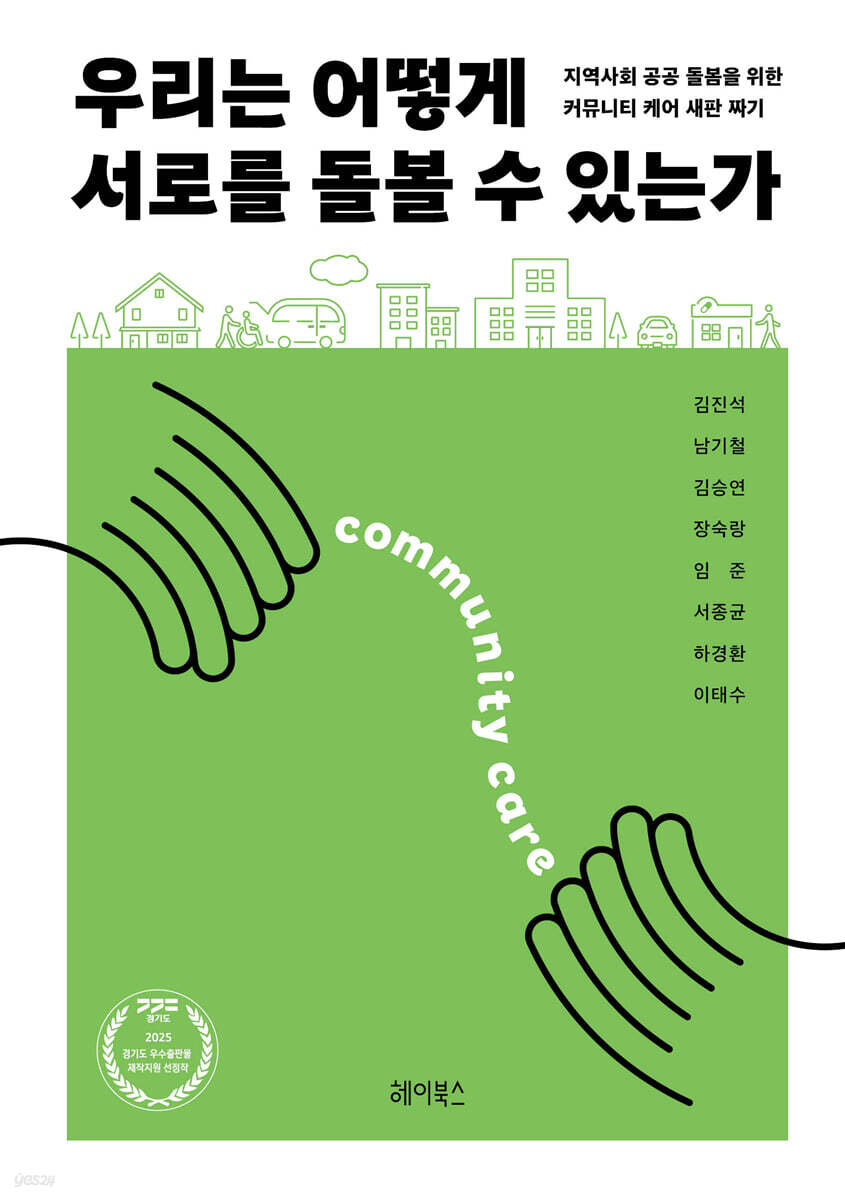
How can we care for each other?
 |
Description
Book Introduction
Caring isn't a special choice; it's why we live together!
No one can be an exception.
From infancy to illness and into old age, we all face moments in our lives when we desperately need care.
"Care-killing, young carers, care-deprivation, lonely deaths…" How do you and this society care for one another? We must move from a society that erases care to one that embraces it.
This book confronts the crisis of care and proposes a new solution: 'public-centered community care.'
The authors' "Ten Promises" for a Caring Society are the first step toward a society where everyone shares in caring.
No one can be an exception.
From infancy to illness and into old age, we all face moments in our lives when we desperately need care.
"Care-killing, young carers, care-deprivation, lonely deaths…" How do you and this society care for one another? We must move from a society that erases care to one that embraces it.
This book confronts the crisis of care and proposes a new solution: 'public-centered community care.'
The authors' "Ten Promises" for a Caring Society are the first step toward a society where everyone shares in caring.
- You can preview some of the book's contents.
Preview
index
preface
1 Now, the landscape of care
What does it mean to grow old in South Korea?
Growing old is more frightening than dying | Where is the right to grow old and die at home? | Are communities at risk? | The harsh reality of caregiving | Is it an inevitable fate?
Why does caregiving make everyone miserable?
Caregivers | Care that's too far away and too insufficient | Spinning multiple plates | The swamp of low wages and job insecurity | Can't we all live happily?
2 Subject of care
Why is care left to the family?
The False 'Myth of Self-Reliance' | The False 'Economics of Care' | The Distorted 'Sociology of Care' | The Ineffective 'Politics of Care' | The Path to a 'Care Society'
Why did care become women's work?
No One Takes Responsibility | The Problem of Social Recognition | The Transition of Care Responsibility | A Care Responsibility Society
Who is the subject of care?
Care Ecosystem | Key Players of the Care State
Can the village community also become a subject?
What is a Village Community? | Case Studies of Village Community-Based Care | Characteristics of Village Community-Based Care | Care Beyond the Service Delivery System
3 Breaking the Cartel of Care
The 'Cartel of Silence' Surrounding Care
A society that encourages hospitalization and institutionalization | Appropriate services for care needs | The true nature of cartels | The dilemma of nursing care coverage | The first step toward strengthening public services
A hospital that doesn't know how to care
The Landscape of Korean Hospitals | Am I Not Involved? | Tissue Workers, the Problem of Nursing Staff | Integrated Nursing and Care Services | A Careful Society Without the Worries of Caregiving
Those who don't come to my house
Why not just visit service? | Visits are a priority
Redesigning Care
Seniors Come First | Primary Care in the Community | Major Overhaul of the Health and Medical System | Transforming Community Health Facilities | Restructuring Nursing Homes | Living with Dignity, Dying with Dignity
4. Creating a public care system
Local governments and care
Why Are Local Governments Invisible? | The Role of Local Governments in Socializing Care | Local Governments as Entities in Social Care
The Ministry of Land, Infrastructure and Transport needs to change.
Housing: The Most Crucial Factor in Community Care | The Ministry of Land, Infrastructure and Transport's Ignorance of Care | Support for Home Renovation and Universal Design | Combining Housing and Services | Strengthening the Role of Local Governments
Caregiving Survives by Changing Finances
A Serious "Care Bankruptcy" | Three Families Under One Roof | Local Governments Lack Financial Capacity for Care | Reimagining Integrated Care Finance
5 The Future of Care: Community Care Again
Korean version of community care
Understanding the Care System as a Puzzle | Decentralization and Care | Guaranteeing Care as a Right | Public Leadership in Care Provision | Community as a Care Space | The Final Puzzle: The Three Pillars
A new landscape of care
The Future of Community Care | One-Stop Care Services | Three Concentric Circles for "Me" | Living in a World of Care
Ten Promises for a Careful Society
Promise 1: The government must create a caring nation where all stakeholders involved in care are respected. | Promise 2: The government organization and financial structure must be reformed so that local governments have the ultimate responsibility for care. | Promise 3: The cartel that promotes the oversupply of nursing hospitals, which promotes modern-day Goryeojang, must be broken. | Promise 4: The public nature of institutions related to the provision of care services must be secured. | Promise 5: A regional health and medical system must be established for community care. | Promise 6: A cooperative system between the central and local governments must be created for a care-friendly residential environment. | Promise 7: A comprehensive reform of the financial structure must be implemented for the integrated management of public resources related to care. | Promise 8: Concerns about care in hospitals must be resolved. | Promise 9: Community communities must be actively involved in providing care services. | Promise 10: All citizens must participate in care and recognize that they are contributing members in creating a caring nation.
1 Now, the landscape of care
What does it mean to grow old in South Korea?
Growing old is more frightening than dying | Where is the right to grow old and die at home? | Are communities at risk? | The harsh reality of caregiving | Is it an inevitable fate?
Why does caregiving make everyone miserable?
Caregivers | Care that's too far away and too insufficient | Spinning multiple plates | The swamp of low wages and job insecurity | Can't we all live happily?
2 Subject of care
Why is care left to the family?
The False 'Myth of Self-Reliance' | The False 'Economics of Care' | The Distorted 'Sociology of Care' | The Ineffective 'Politics of Care' | The Path to a 'Care Society'
Why did care become women's work?
No One Takes Responsibility | The Problem of Social Recognition | The Transition of Care Responsibility | A Care Responsibility Society
Who is the subject of care?
Care Ecosystem | Key Players of the Care State
Can the village community also become a subject?
What is a Village Community? | Case Studies of Village Community-Based Care | Characteristics of Village Community-Based Care | Care Beyond the Service Delivery System
3 Breaking the Cartel of Care
The 'Cartel of Silence' Surrounding Care
A society that encourages hospitalization and institutionalization | Appropriate services for care needs | The true nature of cartels | The dilemma of nursing care coverage | The first step toward strengthening public services
A hospital that doesn't know how to care
The Landscape of Korean Hospitals | Am I Not Involved? | Tissue Workers, the Problem of Nursing Staff | Integrated Nursing and Care Services | A Careful Society Without the Worries of Caregiving
Those who don't come to my house
Why not just visit service? | Visits are a priority
Redesigning Care
Seniors Come First | Primary Care in the Community | Major Overhaul of the Health and Medical System | Transforming Community Health Facilities | Restructuring Nursing Homes | Living with Dignity, Dying with Dignity
4. Creating a public care system
Local governments and care
Why Are Local Governments Invisible? | The Role of Local Governments in Socializing Care | Local Governments as Entities in Social Care
The Ministry of Land, Infrastructure and Transport needs to change.
Housing: The Most Crucial Factor in Community Care | The Ministry of Land, Infrastructure and Transport's Ignorance of Care | Support for Home Renovation and Universal Design | Combining Housing and Services | Strengthening the Role of Local Governments
Caregiving Survives by Changing Finances
A Serious "Care Bankruptcy" | Three Families Under One Roof | Local Governments Lack Financial Capacity for Care | Reimagining Integrated Care Finance
5 The Future of Care: Community Care Again
Korean version of community care
Understanding the Care System as a Puzzle | Decentralization and Care | Guaranteeing Care as a Right | Public Leadership in Care Provision | Community as a Care Space | The Final Puzzle: The Three Pillars
A new landscape of care
The Future of Community Care | One-Stop Care Services | Three Concentric Circles for "Me" | Living in a World of Care
Ten Promises for a Careful Society
Promise 1: The government must create a caring nation where all stakeholders involved in care are respected. | Promise 2: The government organization and financial structure must be reformed so that local governments have the ultimate responsibility for care. | Promise 3: The cartel that promotes the oversupply of nursing hospitals, which promotes modern-day Goryeojang, must be broken. | Promise 4: The public nature of institutions related to the provision of care services must be secured. | Promise 5: A regional health and medical system must be established for community care. | Promise 6: A cooperative system between the central and local governments must be created for a care-friendly residential environment. | Promise 7: A comprehensive reform of the financial structure must be implemented for the integrated management of public resources related to care. | Promise 8: Concerns about care in hospitals must be resolved. | Promise 9: Community communities must be actively involved in providing care services. | Promise 10: All citizens must participate in care and recognize that they are contributing members in creating a caring nation.
Detailed image

Into the book
This book is the first popular book to logically reveal the current state of care in South Korea, its structural causes, and ways to establish a true community care system.
--- From the "Preface"
In modern society, where small families are the norm, sometimes an elderly person in need of care is cared for by another elderly person (who may soon become the object of care).
This is the so-called ‘elderly care’.
If the period of elderly care is prolonged, it can end in social isolation, economic pressure, and even breakdown such as murder or suicide.
--- From Chapter 1, “What Does It Mean to Grow Old in Korea?”
Most elderly people in our country chose home as their preferred place of death, but in reality, more than 70% of elderly people die in hospitals because the services they can receive at home are severely lacking.
--- From Chapter 1, “Why Does Care Make Everyone Unhappy?”
Currently, our society is operating with a ‘false economics’, ‘distorted sociology’, and ‘ineffective politics’ regarding care.
--- From Chapter 2, “Why is care left as a family issue?”
The question, 'Why doesn't anyone take responsibility for care?' can be equated with the question, 'Why has care become women's work?'
--- From Chapter 2, “Why Has Care Become Women’s Work?”
The state is the entity that must be firmly established as the foundation among other entities that support those in need of care and fulfill their right to care.
Only when the community is established on top of that, and then neighbors and then families are established in a stable structure, can the care for the individual at the top be completed.
--- From Chapter 2, “Who is the subject of care?”
A safe town is said to be one where people's eyes are on the alleys and neighbors.
Complete care is also possible when people's eyes are focused on each other's neighbors.
Let's call this form of care that maintains a dignified life within a strong social network that includes various services village community care.
--- From Chapter 2, “Can a Village Community Become a Subject?”
If this happens, from the moment you are admitted to the hospital due to an illness, living and working at home and in the community and leading a dignified life becomes an impossible dream.
Gradually, with new complications arising, muscle strength is lost and even basic daily activities become difficult, leading to a difficult path.
--- From Chapter 3, “The ‘Cartel of Silence’ Surrounding Care”
“I am a victim of this harsh working environment, and I am also a perpetrator who failed to provide proper care to sick patients.” This nurse’s testimony is a confession that all of us who have visited a hospital at least once in our lives should listen to.
--- From Chapter 3, “Hospitals That Don’t Know About Care”
However, the reality is that it is impossible for those who need it to even experience the service, let alone receive the number of visits they need.
As a result, many people end up in nursing homes, crying and eating mustard.
--- From Chapter 3, "Those Who Don't Come to My House"
What is needed to enable individuals to live in their own homes, enjoy services tailored to their individual needs, and live in harmony with the community? This can only be achieved when the services necessary for daily living, such as housing, health and medical care, long-term care, and support for independent living, are integrated and secured within the community.
This is called community care.
--- From "Chapter 3: 'Redesigning a New Plan for Care'"
Care is considered something that the ‘king’ cannot do.
Our country's social care structure is deformed.
In it, local governments and private for-profit businesses are relatively comfortable and their interests align.
So, local governments and suppliers don't necessarily need to do anything.
--- From Chapter 4, “Local Governments and Care”
If the Ministry of Land, Infrastructure and Transport changes its passive attitude that this is not within their policy jurisdiction, our country's housing policy has the potential to make a significant contribution to ensuring that seniors in need of care can continue to live in their communities.
--- From Chapter 4, “The Ministry of Land, Infrastructure and Transport Must Change”
Only through bold fiscal reforms that empower local governments to assume real responsibility can a future in South Korea where people can "age where they are."
--- From Chapter 4, “Care Survives Only When Finances Change”
To reshape community care, the most crucial step is to provide integrated health, medical care, and housing in each resident's familiar living space, i.e., in the local area, rather than in facilities, and to reorganize this process around the user.
--- From "Chapter 5: Korean Community Care"
Now care is no longer miserable or painful.
At some point in life, someone takes care of you and you take care of someone else.
--- From the "Preface"
In modern society, where small families are the norm, sometimes an elderly person in need of care is cared for by another elderly person (who may soon become the object of care).
This is the so-called ‘elderly care’.
If the period of elderly care is prolonged, it can end in social isolation, economic pressure, and even breakdown such as murder or suicide.
--- From Chapter 1, “What Does It Mean to Grow Old in Korea?”
Most elderly people in our country chose home as their preferred place of death, but in reality, more than 70% of elderly people die in hospitals because the services they can receive at home are severely lacking.
--- From Chapter 1, “Why Does Care Make Everyone Unhappy?”
Currently, our society is operating with a ‘false economics’, ‘distorted sociology’, and ‘ineffective politics’ regarding care.
--- From Chapter 2, “Why is care left as a family issue?”
The question, 'Why doesn't anyone take responsibility for care?' can be equated with the question, 'Why has care become women's work?'
--- From Chapter 2, “Why Has Care Become Women’s Work?”
The state is the entity that must be firmly established as the foundation among other entities that support those in need of care and fulfill their right to care.
Only when the community is established on top of that, and then neighbors and then families are established in a stable structure, can the care for the individual at the top be completed.
--- From Chapter 2, “Who is the subject of care?”
A safe town is said to be one where people's eyes are on the alleys and neighbors.
Complete care is also possible when people's eyes are focused on each other's neighbors.
Let's call this form of care that maintains a dignified life within a strong social network that includes various services village community care.
--- From Chapter 2, “Can a Village Community Become a Subject?”
If this happens, from the moment you are admitted to the hospital due to an illness, living and working at home and in the community and leading a dignified life becomes an impossible dream.
Gradually, with new complications arising, muscle strength is lost and even basic daily activities become difficult, leading to a difficult path.
--- From Chapter 3, “The ‘Cartel of Silence’ Surrounding Care”
“I am a victim of this harsh working environment, and I am also a perpetrator who failed to provide proper care to sick patients.” This nurse’s testimony is a confession that all of us who have visited a hospital at least once in our lives should listen to.
--- From Chapter 3, “Hospitals That Don’t Know About Care”
However, the reality is that it is impossible for those who need it to even experience the service, let alone receive the number of visits they need.
As a result, many people end up in nursing homes, crying and eating mustard.
--- From Chapter 3, "Those Who Don't Come to My House"
What is needed to enable individuals to live in their own homes, enjoy services tailored to their individual needs, and live in harmony with the community? This can only be achieved when the services necessary for daily living, such as housing, health and medical care, long-term care, and support for independent living, are integrated and secured within the community.
This is called community care.
--- From "Chapter 3: 'Redesigning a New Plan for Care'"
Care is considered something that the ‘king’ cannot do.
Our country's social care structure is deformed.
In it, local governments and private for-profit businesses are relatively comfortable and their interests align.
So, local governments and suppliers don't necessarily need to do anything.
--- From Chapter 4, “Local Governments and Care”
If the Ministry of Land, Infrastructure and Transport changes its passive attitude that this is not within their policy jurisdiction, our country's housing policy has the potential to make a significant contribution to ensuring that seniors in need of care can continue to live in their communities.
--- From Chapter 4, “The Ministry of Land, Infrastructure and Transport Must Change”
Only through bold fiscal reforms that empower local governments to assume real responsibility can a future in South Korea where people can "age where they are."
--- From Chapter 4, “Care Survives Only When Finances Change”
To reshape community care, the most crucial step is to provide integrated health, medical care, and housing in each resident's familiar living space, i.e., in the local area, rather than in facilities, and to reorganize this process around the user.
--- From "Chapter 5: Korean Community Care"
Now care is no longer miserable or painful.
At some point in life, someone takes care of you and you take care of someone else.
--- From Chapter 5, “A New Landscape of Care”
Publisher's Review
A clear solution to the pressing care crisis: "Public-centered community care."
This book confronts the reality of Korean society, which has ignored the urgency of care, and proposes a new care paradigm called "public-centered community care" so that everyone can live a dignified life in their daily lives.
The eight authors are experts who participated in the integrated care pilot project, and based on their experiences, they present specific structural problems and solutions in care.
It criticizes the reality of Korean society in which care is solely left to families, especially women, and emphasizes the need for a systemic reform that guarantees care as a social right rather than an individual matter.
Although life expectancy has increased, the elderly still rely on nursing homes, and their right to live with dignity at home is not being realized.
The authors argue that a 'community-based integrated care' model should enable a life centered on 'the residence where I live' rather than 'hospital/facility-centered'.
To this end, it is emphasized that the establishment of a 'community care' model consisting of 'user-centered integrated support' that combines nursing care, health care, medical care, housing, and living support, care design centered on local governments, expansion of public care infrastructure, and an integrated financial system is urgently needed in Korean society.
This book reminds us that care is not a problem for the few, but for everyone, and aims to serve as a compass for civic participation and structural transformation of institutions to realize a caring society.
A society that fears aging, where are we headed?
In Chapter 1, “The Landscape of Care Now,” the distorted landscape of care in our society is described, along with the unfortunate reality and reasons for it for all care workers, including care recipients, care managers, and care providers.
Growing old in Korea is becoming increasingly difficult.
Many elderly people want to stay at home even if they are not feeling well, but the reality is that they have no choice but to go to nursing homes or facilities.
Although life expectancy has increased, care remains a burden on families, and public support is inadequate.
Nursing homes have effectively become 'last homes', and some are even causing problems such as human rights violations.
The desire to grow old and die with dignity at home remains difficult to achieve.
For communities to become spaces of care, efforts are needed to change the perception that 'care is a private responsibility' in addition to improving the physical environment.
A society that fears aging is ultimately not safe for anyone.
What we need now is not hospital beds, but social investment to protect living spaces.
Care must go beyond private suffering!
In Chapter 2, ‘Subject of Care’, the reality that families still have to shoulder the burden of care is diagnosed, the relationship between the four subjects of care – the state, the market, the family, and the community – is established, how the reality that the burden of care is concentrated on women should be viewed from a gender perspective and what solutions can be found, and although it is not particularly well known, the significance of village communities as subjects of care and what cases are accumulating around us at this very moment are described.
Caregiving is a condition of life that everyone experiences, but in Korean society it still remains the responsibility of individuals, especially families.
This is the result of the overlapping of the ideal of 'self-reliance', the logic of capitalist efficiency, and political apathy.
Self-reliance makes caregiving shameful, capitalism treats caregiving as unpaid or low-paid labor, and the state shifts the burden back onto families.
In this process, both the caregiver and the care recipient become exhausted and isolated.
However, care is inherently interdependent and a public task that requires the shared responsibility of multiple actors.
A care ecosystem involving individuals, families, neighbors, communities, and the nation can only function when each entity is organically connected.
In particular, the state must play a crucial role as the designer and coordinator of the system, supporting families to exercise their right to care without shifting responsibility onto them.
By reframing care as a responsibility of society as a whole, rather than a private struggle, we can open the way to a dignified life for all.
Nursing without recovery is a failure of society and institutions, not of the individual!
Chapter 3: Breaking the Cartel of Care exposes the silent cartel surrounding nursing hospitals, the reality that hospitals are passing on care to families, and the reality of our country's medical system where doctors and nurses cannot visit homes, ultimately proposing an alternative for a new model of healthcare.
Korea's elderly health care and care system is structured to prioritize hospitalization and institutionalization over the recovery and reintegration of older adults into the community.
After acute treatment, patients are hospitalized in nursing homes for a long time without receiving sufficient rehabilitation during the recovery period, and the possibility of returning home becomes slim.
This is not a matter of individual choice, but rather a lack of infrastructure and systems to support recovery and return to home life.
Community-based home visits and nursing care exist in the system, but in reality, they rarely work.
The background is a primary medical system centered on single-person practice, a lack of manpower, and an ineffective number of visits.
This problem is a structural failure and the government's responsibility.
This is not something that can be solved simply by investing money or improving the numbers.
There is an urgent need to transform the primary healthcare system into a regional one, including activating group practice openings, allowing connections with dedicated visiting institutions, and expanding public and cooperative infrastructure.
Home visit services must become routine within the community care system so that seniors can enjoy their final years at home.
Local governments closest to their residents should be the primary entity responsible for providing care!
Chapter 4, "Creating a Public Care System," describes the local government-centered responsibility for care, the innovative reforms related to housing, the necessity of establishing an integrated budget for integrated care, and a specific model for this.
In Korean society, do the local governments closest to me play a role in providing care? Unfortunately, they are indifferent.
No, it is a structure that cannot be helped but be indifferent.
The central government manages and controls the system in various ways, and most of the care funding also depends on central government subsidies.
As this practice has continued for a long time, local governments are not proactive or proactive in caring for local residents and remain in an unprofessional state.
Major reforms are needed to ensure that local governments serve as a strong support system for residents in need of care.
Meanwhile, care must begin at home, not in the hospital.
Many people want to live at home until the end, but poor housing conditions force them into hospitals or institutions.
‘Care without housing’ ultimately lowers the quality of life and increases social costs.
The cooperation between the Ministry of Land, Infrastructure and Transport and the Ministry of Health and Welfare was limited to declarations, and practical measures such as expanding public rental housing and renovating housing were put on the back burner.
There is no room for local governments to interfere in housing policy.
Additionally, care finances are fragmented into health insurance, long-term care insurance, and local government budgets, making them inefficient.
Without establishing a people-centered, integrated financial system, policies such as the subsidy system for nursing care could exacerbate distortions.
What is needed now is structural change rather than fiscal expansion.
Care at home, not in the hospital, care centered on the user, not the provider.
This basic premise should be the starting point for all institutional design and policy decisions.
For community care to be effective, structural restructuring of the system is essential!
Chapter 5, 'The Future of Care: Again, Community Care' presents a comprehensive picture of the Korean version of community care and a vision for the future of care that will change from the perspective of how it will work for citizens themselves.
Finally, we have outlined ten promises that we all must commit to and put into practice.
Korean-style community care works properly only when five elements—demand, supply, space, access, and system—are organically interlocked like a puzzle.
In particular, a user-centric, integrated approach plays a key role as the axis of the delivery system that connects all these elements.
However, the current policy reality is far from this ideal structure.
Local governments are limited to simply executing projects according to central government guidelines without any real planning and design authority, and public care infrastructure is severely lacking.
Care is still tied to selective logic and a family-dependent structure, and home- and community-based care is not becoming a reality due to limitations in infrastructure and institutional support.
The integrated delivery system is blocked by barriers between ministries and agencies, causing users to experience ‘floating care.’
For community care to be effective, four conditions must be met simultaneously: strengthening local government authority, expanding public provision, rights-based universal access, and establishing an integrated delivery system.
Now is the time for a structural reorganization of the system that goes beyond declarative goals.
This book confronts the reality of Korean society, which has ignored the urgency of care, and proposes a new care paradigm called "public-centered community care" so that everyone can live a dignified life in their daily lives.
The eight authors are experts who participated in the integrated care pilot project, and based on their experiences, they present specific structural problems and solutions in care.
It criticizes the reality of Korean society in which care is solely left to families, especially women, and emphasizes the need for a systemic reform that guarantees care as a social right rather than an individual matter.
Although life expectancy has increased, the elderly still rely on nursing homes, and their right to live with dignity at home is not being realized.
The authors argue that a 'community-based integrated care' model should enable a life centered on 'the residence where I live' rather than 'hospital/facility-centered'.
To this end, it is emphasized that the establishment of a 'community care' model consisting of 'user-centered integrated support' that combines nursing care, health care, medical care, housing, and living support, care design centered on local governments, expansion of public care infrastructure, and an integrated financial system is urgently needed in Korean society.
This book reminds us that care is not a problem for the few, but for everyone, and aims to serve as a compass for civic participation and structural transformation of institutions to realize a caring society.
A society that fears aging, where are we headed?
In Chapter 1, “The Landscape of Care Now,” the distorted landscape of care in our society is described, along with the unfortunate reality and reasons for it for all care workers, including care recipients, care managers, and care providers.
Growing old in Korea is becoming increasingly difficult.
Many elderly people want to stay at home even if they are not feeling well, but the reality is that they have no choice but to go to nursing homes or facilities.
Although life expectancy has increased, care remains a burden on families, and public support is inadequate.
Nursing homes have effectively become 'last homes', and some are even causing problems such as human rights violations.
The desire to grow old and die with dignity at home remains difficult to achieve.
For communities to become spaces of care, efforts are needed to change the perception that 'care is a private responsibility' in addition to improving the physical environment.
A society that fears aging is ultimately not safe for anyone.
What we need now is not hospital beds, but social investment to protect living spaces.
Care must go beyond private suffering!
In Chapter 2, ‘Subject of Care’, the reality that families still have to shoulder the burden of care is diagnosed, the relationship between the four subjects of care – the state, the market, the family, and the community – is established, how the reality that the burden of care is concentrated on women should be viewed from a gender perspective and what solutions can be found, and although it is not particularly well known, the significance of village communities as subjects of care and what cases are accumulating around us at this very moment are described.
Caregiving is a condition of life that everyone experiences, but in Korean society it still remains the responsibility of individuals, especially families.
This is the result of the overlapping of the ideal of 'self-reliance', the logic of capitalist efficiency, and political apathy.
Self-reliance makes caregiving shameful, capitalism treats caregiving as unpaid or low-paid labor, and the state shifts the burden back onto families.
In this process, both the caregiver and the care recipient become exhausted and isolated.
However, care is inherently interdependent and a public task that requires the shared responsibility of multiple actors.
A care ecosystem involving individuals, families, neighbors, communities, and the nation can only function when each entity is organically connected.
In particular, the state must play a crucial role as the designer and coordinator of the system, supporting families to exercise their right to care without shifting responsibility onto them.
By reframing care as a responsibility of society as a whole, rather than a private struggle, we can open the way to a dignified life for all.
Nursing without recovery is a failure of society and institutions, not of the individual!
Chapter 3: Breaking the Cartel of Care exposes the silent cartel surrounding nursing hospitals, the reality that hospitals are passing on care to families, and the reality of our country's medical system where doctors and nurses cannot visit homes, ultimately proposing an alternative for a new model of healthcare.
Korea's elderly health care and care system is structured to prioritize hospitalization and institutionalization over the recovery and reintegration of older adults into the community.
After acute treatment, patients are hospitalized in nursing homes for a long time without receiving sufficient rehabilitation during the recovery period, and the possibility of returning home becomes slim.
This is not a matter of individual choice, but rather a lack of infrastructure and systems to support recovery and return to home life.
Community-based home visits and nursing care exist in the system, but in reality, they rarely work.
The background is a primary medical system centered on single-person practice, a lack of manpower, and an ineffective number of visits.
This problem is a structural failure and the government's responsibility.
This is not something that can be solved simply by investing money or improving the numbers.
There is an urgent need to transform the primary healthcare system into a regional one, including activating group practice openings, allowing connections with dedicated visiting institutions, and expanding public and cooperative infrastructure.
Home visit services must become routine within the community care system so that seniors can enjoy their final years at home.
Local governments closest to their residents should be the primary entity responsible for providing care!
Chapter 4, "Creating a Public Care System," describes the local government-centered responsibility for care, the innovative reforms related to housing, the necessity of establishing an integrated budget for integrated care, and a specific model for this.
In Korean society, do the local governments closest to me play a role in providing care? Unfortunately, they are indifferent.
No, it is a structure that cannot be helped but be indifferent.
The central government manages and controls the system in various ways, and most of the care funding also depends on central government subsidies.
As this practice has continued for a long time, local governments are not proactive or proactive in caring for local residents and remain in an unprofessional state.
Major reforms are needed to ensure that local governments serve as a strong support system for residents in need of care.
Meanwhile, care must begin at home, not in the hospital.
Many people want to live at home until the end, but poor housing conditions force them into hospitals or institutions.
‘Care without housing’ ultimately lowers the quality of life and increases social costs.
The cooperation between the Ministry of Land, Infrastructure and Transport and the Ministry of Health and Welfare was limited to declarations, and practical measures such as expanding public rental housing and renovating housing were put on the back burner.
There is no room for local governments to interfere in housing policy.
Additionally, care finances are fragmented into health insurance, long-term care insurance, and local government budgets, making them inefficient.
Without establishing a people-centered, integrated financial system, policies such as the subsidy system for nursing care could exacerbate distortions.
What is needed now is structural change rather than fiscal expansion.
Care at home, not in the hospital, care centered on the user, not the provider.
This basic premise should be the starting point for all institutional design and policy decisions.
For community care to be effective, structural restructuring of the system is essential!
Chapter 5, 'The Future of Care: Again, Community Care' presents a comprehensive picture of the Korean version of community care and a vision for the future of care that will change from the perspective of how it will work for citizens themselves.
Finally, we have outlined ten promises that we all must commit to and put into practice.
Korean-style community care works properly only when five elements—demand, supply, space, access, and system—are organically interlocked like a puzzle.
In particular, a user-centric, integrated approach plays a key role as the axis of the delivery system that connects all these elements.
However, the current policy reality is far from this ideal structure.
Local governments are limited to simply executing projects according to central government guidelines without any real planning and design authority, and public care infrastructure is severely lacking.
Care is still tied to selective logic and a family-dependent structure, and home- and community-based care is not becoming a reality due to limitations in infrastructure and institutional support.
The integrated delivery system is blocked by barriers between ministries and agencies, causing users to experience ‘floating care.’
For community care to be effective, four conditions must be met simultaneously: strengthening local government authority, expanding public provision, rights-based universal access, and establishing an integrated delivery system.
Now is the time for a structural reorganization of the system that goes beyond declarative goals.
GOODS SPECIFICS
- Date of issue: May 16, 2025
- Page count, weight, size: 260 pages | 152*215*20mm
- ISBN13: 9791188366910
- ISBN10: 1188366912
You may also like
카테고리
korean


korean

![GQ KOREA Mark (Monthly): December [2025]](http://librairie.coreenne.fr/cdn/shop/files/8ef265dbbfbf186523ed75ba7319009d.jpg?v=1765340328&width=3840)


