

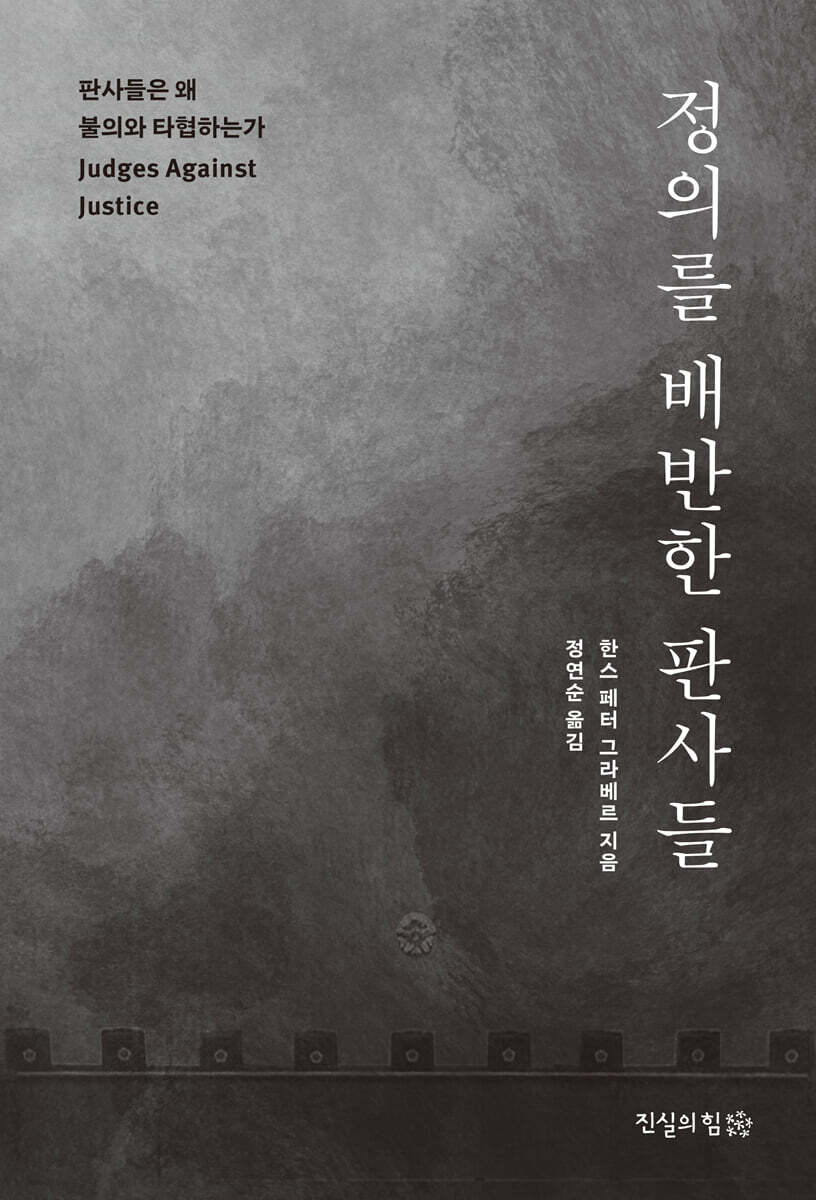
Judges who betrayed justice
 |
Description
Book Introduction
Nazi Germany, occupied Europe, South Africa,
Latin America, the United States and the United Kingdom… …
In an era when the rule of law is under attack,
An in-depth report on the role and limitations of the judiciary
'Will the judiciary truly stand on the side of democracy and the rule of law?'
This is the question our people pondered, losing sleep and worrying over on the night of December 3, 2024, amidst the civil war perpetrated by our current president.
The entire nation witnessed the desperate moment of crisis when fully armed martial law troops poured from special forces helicopters into the National Assembly hall, pushing the democratic constitutional order to the brink. However, the Constitutional Court endlessly delayed the impeachment ruling and the court, which overturned decades of law enforcement practices and released the leader of the rebellion, aroused deep anxiety and skepticism about "which side is the judiciary on?"
In fact, the Korean judiciary has been asking this question for a long time.
The court not only justified the military regime's declaration of martial law with absurd sophistry, but also supported the regime's intention to criminalize political opponents by accepting false confessions obtained through torture as evidence.
Even after democratization, as the 'forged will' case and the 'judicial corruption' incident show, the judiciary has not been faithful to its mission as the 'last bastion of the rule of law and human rights.'
Fortunately, the Constitutional Court's ruling to dismiss the leader of the rebellion has overcome a major crisis. However, there is ample reason for the public to remain distrustful and concerned about the judiciary, wondering what unexpected events might unfold in the process of legally resolving the rebellion.
Are Korean courts truly guardians of democracy and the rule of law? "Judges Who Betrayed Justice" is a book for those who ponder these questions.
Author Hans Peter Graber, who has studied the rule of law and the role of the judiciary across various fields such as the sociology of law, administrative law, and the history of legal investigation, explores the reality of 'judges who betrayed justice' through various cases from various countries such as Nazi Germany, apartheid in South Africa, military dictatorships in Argentina, Brazil, and Chile, European countries under Nazi occupation, and liberal societies such as the United States and the United Kingdom.
Living up to its reputation as a profound study (Mark Osiel, Professor of Law, University of Iowa) that “examines with unparalleled comparative perspective, historical depth, and legal-philosophical sophistication how those in robes can so often and easily implement the most heinous policies of oppressive leaders,” it contains in-depth legal-philosophical research based on rich historical examples.
As stated in the preface to the Korean edition, the author explores “the autonomy of the law and how that autonomy is shaken and attacked by laws that require judges to violate core principles of the rule of law” (p. 5), focusing on the following questions about the problems judges face in such situations:
First, what happens when a state becomes oppressive and the judiciary contributes to that oppression? Second, how should we evaluate judges who collaborate in oppression from a legal perspective? Third, how can we view their actions from a moral perspective and encourage them to stand up against oppression?
Translator Jeong Yeon-sun is a lawyer who has contributed to the realization of democracy and the rule of law through various practices, including serving as the Director of the Discrimination Correction Headquarters of the National Human Rights Commission and the President of the Lawyers for a Democratic Society. She has utilized the concerns and expertise she has gained in this process to accurately and easily translate the various cases and legal philosophical issues covered in the book.
"Judges Who Betrayed Justice" provides an opportunity to deeply contemplate and reflect on the crucial questions facing our society today: what role should the judiciary and judges play in a democratic society, and what attitude should judges take when democracy and the rule of law are under attack?
Latin America, the United States and the United Kingdom… …
In an era when the rule of law is under attack,
An in-depth report on the role and limitations of the judiciary
'Will the judiciary truly stand on the side of democracy and the rule of law?'
This is the question our people pondered, losing sleep and worrying over on the night of December 3, 2024, amidst the civil war perpetrated by our current president.
The entire nation witnessed the desperate moment of crisis when fully armed martial law troops poured from special forces helicopters into the National Assembly hall, pushing the democratic constitutional order to the brink. However, the Constitutional Court endlessly delayed the impeachment ruling and the court, which overturned decades of law enforcement practices and released the leader of the rebellion, aroused deep anxiety and skepticism about "which side is the judiciary on?"
In fact, the Korean judiciary has been asking this question for a long time.
The court not only justified the military regime's declaration of martial law with absurd sophistry, but also supported the regime's intention to criminalize political opponents by accepting false confessions obtained through torture as evidence.
Even after democratization, as the 'forged will' case and the 'judicial corruption' incident show, the judiciary has not been faithful to its mission as the 'last bastion of the rule of law and human rights.'
Fortunately, the Constitutional Court's ruling to dismiss the leader of the rebellion has overcome a major crisis. However, there is ample reason for the public to remain distrustful and concerned about the judiciary, wondering what unexpected events might unfold in the process of legally resolving the rebellion.
Are Korean courts truly guardians of democracy and the rule of law? "Judges Who Betrayed Justice" is a book for those who ponder these questions.
Author Hans Peter Graber, who has studied the rule of law and the role of the judiciary across various fields such as the sociology of law, administrative law, and the history of legal investigation, explores the reality of 'judges who betrayed justice' through various cases from various countries such as Nazi Germany, apartheid in South Africa, military dictatorships in Argentina, Brazil, and Chile, European countries under Nazi occupation, and liberal societies such as the United States and the United Kingdom.
Living up to its reputation as a profound study (Mark Osiel, Professor of Law, University of Iowa) that “examines with unparalleled comparative perspective, historical depth, and legal-philosophical sophistication how those in robes can so often and easily implement the most heinous policies of oppressive leaders,” it contains in-depth legal-philosophical research based on rich historical examples.
As stated in the preface to the Korean edition, the author explores “the autonomy of the law and how that autonomy is shaken and attacked by laws that require judges to violate core principles of the rule of law” (p. 5), focusing on the following questions about the problems judges face in such situations:
First, what happens when a state becomes oppressive and the judiciary contributes to that oppression? Second, how should we evaluate judges who collaborate in oppression from a legal perspective? Third, how can we view their actions from a moral perspective and encourage them to stand up against oppression?
Translator Jeong Yeon-sun is a lawyer who has contributed to the realization of democracy and the rule of law through various practices, including serving as the Director of the Discrimination Correction Headquarters of the National Human Rights Commission and the President of the Lawyers for a Democratic Society. She has utilized the concerns and expertise she has gained in this process to accurately and easily translate the various cases and legal philosophical issues covered in the book.
"Judges Who Betrayed Justice" provides an opportunity to deeply contemplate and reflect on the crucial questions facing our society today: what role should the judiciary and judges play in a democratic society, and what attitude should judges take when democracy and the rule of law are under attack?
- You can preview some of the book's contents.
Preview
index
Preface to the Korean edition
Acknowledgements
Chapter 1: The Role of the Judiciary and the Rule of Law
Introduction | Book Structure
Part 1: The War on the Rule of Law
Chapter 2: State Oppression and the Rule of Law
Rule of Law and Evil Rulers | From Rule of Law to Tyranny | Oppression in the Form of Law: Is It Real Law? | Inside and Outside the Law
Chapter 3: Oppression of the Judiciary
The Pursuit of Legitimacy | The Independence of the Judiciary | Judge Purges and Court Reorganization | Jurisdiction Limits and Special Courts | Distortions in Legal Thinking: The Carrot and the Stick
Chapter 4 Judicial Responsibility for Oppression
Accepting the legitimacy of authoritarian regimes | Accepting oppressive goals and policies | Beyond race | Consent to oppression in liberal societies
Chapter 5 Resistance
"The Flame of Law Never Goes Out" | The Problem of Legality | Restrictive Interpretation | Resistance in the Decline of Authoritarianism | Resistance and Legal Methodology
Part 2: Judges' Responsibility for Injustice
Chapter 6: Debate Surrounding Criminal Responsibility
Introduction
Chapter 7 Conditions of illegality under international law
The Legal Basis of the Allied War Crimes Tribunals | The Trial of Legal Professionals by US Military Tribunals | The Acquittal of Nazi Judges
Chapter 8: Conditions of Illegal Power and Illegality
Judges and Revolution | Judges under Occupation
Chapter 9 Conditions of Illegality in Transitional Situations
Rebuilding Germany after the Nazis | Judges in East Germany
Chapter 10 Judges of the Special Court
Authoritarian Regimes and Special Courts | US Military Tribunals and Special Courts | Post-Nazi Views on Special Courts | Is Participation in a Special Court a Crime?
Chapter 11 Justification of Judicial Oppression
Criminal intent | Ignorance of law | Coercion | Discussion
Chapter 12: 'Special Immunity for Judges?'
Duties and Commands | Judicial Immunity and the Role of Judges | Judicial Independence and Immunity | Separation of Powers
Chapter 13 Punishment of Judges
The Unchanging Nature of Justice | Why Are Judges Unpunished? | The Difficulties of Retroactive Punishment | Was Accountability Enough?
Moral Aspects of the Third Division Judgment
Chapter 14 Propositions of Legal Positivism
Why the Judiciary Colluded | Radbruch and Nazi Germany
Chapter 15: What Kind of Legal Positivism?
Undefined Legal Positivism | Legal Positivism that Separates Law and Morality | Legal Positivism as Formalism | Alternatives to Legal Positivism
Chapter 16: Different Methods of Legal Interpretation
Simple Facts Approach
Chapter 17 Beyond Explanation through Legal Theory
Does Legal Theory Influence Judicial Decisions? | Psychological Factors | Institutional Factors | The Traps and Loss of Moral Identity
Chapter 18: The Logic of Choosing the Lesser Evil
The Holocaust | Exceptions to the Rule of Law | The Lesser Evil Argument | Is Resignation the Only Alternative? | A Realistic Calculation | Avoiding the "Slippery Slope" Fallacy
Chapter 19 Judges in Pursuit of Justice
Not Hiding Behind the Law | Can Constitutional Provisions Prevent Authoritarianism? | International Standards | The Politics of Legal Methodology | Resistance for the Rule of Law
Translator's Note
main
References
Acknowledgements
Chapter 1: The Role of the Judiciary and the Rule of Law
Introduction | Book Structure
Part 1: The War on the Rule of Law
Chapter 2: State Oppression and the Rule of Law
Rule of Law and Evil Rulers | From Rule of Law to Tyranny | Oppression in the Form of Law: Is It Real Law? | Inside and Outside the Law
Chapter 3: Oppression of the Judiciary
The Pursuit of Legitimacy | The Independence of the Judiciary | Judge Purges and Court Reorganization | Jurisdiction Limits and Special Courts | Distortions in Legal Thinking: The Carrot and the Stick
Chapter 4 Judicial Responsibility for Oppression
Accepting the legitimacy of authoritarian regimes | Accepting oppressive goals and policies | Beyond race | Consent to oppression in liberal societies
Chapter 5 Resistance
"The Flame of Law Never Goes Out" | The Problem of Legality | Restrictive Interpretation | Resistance in the Decline of Authoritarianism | Resistance and Legal Methodology
Part 2: Judges' Responsibility for Injustice
Chapter 6: Debate Surrounding Criminal Responsibility
Introduction
Chapter 7 Conditions of illegality under international law
The Legal Basis of the Allied War Crimes Tribunals | The Trial of Legal Professionals by US Military Tribunals | The Acquittal of Nazi Judges
Chapter 8: Conditions of Illegal Power and Illegality
Judges and Revolution | Judges under Occupation
Chapter 9 Conditions of Illegality in Transitional Situations
Rebuilding Germany after the Nazis | Judges in East Germany
Chapter 10 Judges of the Special Court
Authoritarian Regimes and Special Courts | US Military Tribunals and Special Courts | Post-Nazi Views on Special Courts | Is Participation in a Special Court a Crime?
Chapter 11 Justification of Judicial Oppression
Criminal intent | Ignorance of law | Coercion | Discussion
Chapter 12: 'Special Immunity for Judges?'
Duties and Commands | Judicial Immunity and the Role of Judges | Judicial Independence and Immunity | Separation of Powers
Chapter 13 Punishment of Judges
The Unchanging Nature of Justice | Why Are Judges Unpunished? | The Difficulties of Retroactive Punishment | Was Accountability Enough?
Moral Aspects of the Third Division Judgment
Chapter 14 Propositions of Legal Positivism
Why the Judiciary Colluded | Radbruch and Nazi Germany
Chapter 15: What Kind of Legal Positivism?
Undefined Legal Positivism | Legal Positivism that Separates Law and Morality | Legal Positivism as Formalism | Alternatives to Legal Positivism
Chapter 16: Different Methods of Legal Interpretation
Simple Facts Approach
Chapter 17 Beyond Explanation through Legal Theory
Does Legal Theory Influence Judicial Decisions? | Psychological Factors | Institutional Factors | The Traps and Loss of Moral Identity
Chapter 18: The Logic of Choosing the Lesser Evil
The Holocaust | Exceptions to the Rule of Law | The Lesser Evil Argument | Is Resignation the Only Alternative? | A Realistic Calculation | Avoiding the "Slippery Slope" Fallacy
Chapter 19 Judges in Pursuit of Justice
Not Hiding Behind the Law | Can Constitutional Provisions Prevent Authoritarianism? | International Standards | The Politics of Legal Methodology | Resistance for the Rule of Law
Translator's Note
main
References
Publisher's Review
Nazi Germany, occupied Europe, South Africa,
Latin America, the United States and the United Kingdom… …
In an age when the rule of law is under attack,
An in-depth report on the role and limitations of the judiciary
'Will the judiciary truly stand on the side of democracy and the rule of law?'
This is the question our people pondered, losing sleep and worrying over on the night of December 3, 2024, amidst the civil war perpetrated by our current president.
The entire nation witnessed the desperate moment of crisis when fully armed martial law troops poured from special forces helicopters into the National Assembly hall, pushing the democratic constitutional order to the brink. However, the Constitutional Court endlessly delayed the impeachment ruling and the court, which overturned decades of law enforcement practices and released the leader of the rebellion, aroused deep anxiety and skepticism about "which side is the judiciary on?"
In fact, the Korean judiciary has been asking this question for a long time.
The court not only justified the military regime's declaration of martial law with absurd sophistry, but also supported the regime's intention to criminalize political opponents by accepting false confessions obtained through torture as evidence.
Even after democratization, as the 'forged will' case and the 'judicial corruption' incident show, the judiciary has not been faithful to its mission as the 'last bastion of the rule of law and human rights.'
Fortunately, the Constitutional Court's ruling to dismiss the leader of the rebellion has overcome a major crisis. However, there is ample reason for the public to remain distrustful and concerned about the judiciary, wondering what unexpected events might unfold in the process of legally resolving the rebellion.
Are Korean courts truly guardians of democracy and the rule of law?
"Judges Who Betrayed Justice" is a book for those who have such questions.
Author Hans Peter Graber, who has studied the rule of law and the role of the judiciary across various fields such as the sociology of law, administrative law, and the history of legal investigation, explores the reality of 'judges who betrayed justice' through various cases from various countries such as Nazi Germany, apartheid in South Africa, military dictatorships in Argentina, Brazil, and Chile, European countries under Nazi occupation, and liberal societies such as the United States and the United Kingdom.
Living up to its reputation as a profound study (Mark Osiel, Professor of Law, University of Iowa) that “examines with unparalleled comparative perspective, historical depth, and legal-philosophical sophistication how those in robes can so often and easily implement the most heinous policies of oppressive leaders,” it contains in-depth legal-philosophical research based on rich historical examples.
As stated in the preface to the Korean edition, the author explores “the autonomy of the law and how that autonomy is shaken and attacked by laws that require judges to violate core principles of the rule of law” (p. 5), focusing on the following questions about the problems judges face in such situations:
First, what happens when a state becomes oppressive and the judiciary contributes to that oppression? Second, how should we evaluate judges who collaborate in oppression from a legal perspective? Third, how can we view their actions from a moral perspective and encourage them to stand up against oppression?
Translator Jeong Yeon-sun is a lawyer who has contributed to the realization of democracy and the rule of law through various practices, including serving as the Director of the Discrimination Correction Headquarters of the National Human Rights Commission and the President of the Lawyers for a Democratic Society. She has utilized the concerns and expertise she has gained in this process to accurately and easily translate the various cases and legal philosophical issues covered in the book.
"Judges Who Betrayed Justice" provides an opportunity to deeply contemplate and reflect on the crucial questions facing our society today: what role should the judiciary and judges play in a democratic society, and what attitude should judges take when democracy and the rule of law are under attack?
Judges who demonstrated 'legal creativity' and took the lead in combating injustice.
People want the judiciary and judges to be the last bastion of justice and human rights, even in authoritarian regimes.
It guarantees independence and grants them a lot of authority to perform such roles.
But the real judiciary and judges are usually not like that.
South Africa's Truth and Reconciliation Commission assessed the apartheid-era judiciary this way:
The courts and the legal profession have generally complicit, consciously or unconsciously, in the injustices perpetrated by the legislature and executive.
… … A significant number of lawyers were actively involved in establishing and defending apartheid through the courts. (p. 48)
This isn't just a South African story.
In many countries, the judiciary has legitimized and compromised the regime's oppression.
“In most cases, courts, by failing to resist oppression, give it the appearance of legitimacy and ultimately legitimize power.” (p. 66)
Authoritarian regimes do not just enforce the laws they create, but sometimes even take the lead in suppressing them by exercising “legal creativity.”
Even before the Nuremberg Blood Laws, which prohibited marriage and sexual relations between Jews and Germans, were enacted, the German Supreme Court ruled that “mixed-race marriages are not permissible based on a reasonable understanding of the nature of marriage as assumed in the National Socialist worldview.”
After the enactment of the Nuremberg Blood Laws, the scope of marriage prohibitions was expanded beyond what the law provided, ruling that “the fact that the law does not prohibit a particular marriage does not lead to the conclusion that such a marriage is not problematic from a racial point of view,” even when only one of the spouse’s grandparents was Jewish.
There are many reasons why judges side with governments that destroy the rule of law.
There are various explanations for the behavior of judges, such as that judges are subject to overwhelming power, that judges, as members of the elite, tend to support authoritarian governments for class interests, and that they cooperate with the regime for career advancement and promotion.
While all of this makes sense, it is insufficient to fully explain the circumstances in which judges have been complicit in persecution and oppression that undermine the very essence of the rule of law.
The book emphasizes that the core point is that 'judges are essentially beings who are subject to the authority of the law, so they cannot ignore the positive law created by an authoritarian regime.'
Judges have a duty to apply the law.
Legal reasoning differs from ordinary moral or political reasoning in that it relies on authoritative legal sources provided by the state, namely the courts.
No matter what legal theory approach one takes, judges cannot completely ignore such sources of law and enforce the law.
That is, when power is solidified and oppressive measures are legislated, judges will accept those oppressive measures as at least one of the prima facie, authoritative sources of law.
Afterwards, the role of the judiciary and the basic power relations are reorganized so that the courts rarely challenge core interests, such as the regime's legitimacy and key power mechanisms. (p. 99)
Judges who betray justice are everywhere.
Judges' complicity in oppression does not only occur in dictatorships.
It happens even in liberal societies like the US and UK.
If we accept the government's argument that strong measures are necessary for national security or to address a social threat, judges in liberal societies will also make rulings that violate individual freedom and rights.
In 1940, during World War II, the British Home Secretary issued 1,874 detention orders under Defence Regulation 18B targeting “any person who has recently been engaged in, or who has reasonable grounds to believe has prepared or incited, any act prejudicial to public safety or national defence.”
One detainee challenged the decision in court, but the Senate ruled that the court could not review it.
If the Secretary of the Interior "believes" that there is reasonable cause to detain, then there can be no review of whether there is actually reasonable cause.
The author criticizes this as "a measure that effectively grants unlimited power to the executive branch and neutralizes judicial review."
Eugenics, which seeks to protect society from the "manifestly unfit," is a prime example of the trampling on human dignity under the pretext of a hypothetical social threat.
A representative example is the trial that dealt with the legality of the forced sterilization of Carrie Buck, a person with an intellectual disability.
U.S. Supreme Court Justice Oliver Wendell Holmes, famous for ruling that free speech must be guaranteed unless there is a “clear and present danger,” once said, “If there were a way to prevent people who are clearly unfit from procreating in the first place, it would be better for the world.”
They justified forced sterilization with the malicious excuse that “three generations are enough for fools.”
These cases show that "judges who betray justice" are not an exception that appears only in countries with overt repression, such as Nazi Germany or the military dictatorships of Latin America, but are a universal entity that can appear in all countries and societies at any time.
The problem of criminal punishment and judicial immunity for judges
How can we prevent judges from complicit in government oppression? The author broadly discusses whether judges who engage in injustice can be held criminally accountable.
The author argues that, in theory, it is right for judges to punish those who have committed serious human rights violations through trials, but in reality, it is not easy.
Judges have judicial immunity.
Most countries recognize judges' immunity because, for judges to be independent and apply the law fairly, they must be able to make decisions freely without fear of consequences.
While the author states that “judges accused of undermining the foundation of the rule of law should not use judicial immunity as a defense” (pp. 255-256), he also acknowledges that broadly holding judges accountable could undermine the independence of the judiciary.
In reality, there are few historical examples of judges being punished for colluding with oppression.
“Judges, almost without exception, did not stand before the courts to hold them accountable for their complicity in the atrocities and oppression of previous regimes.” (p. 185) While the Nuremberg trials held judges who sympathized with Nazi Germany accountable, only one person was criminally punished simply for performing his judicial duties.
Most of those convicted were people directly involved in policymaking and law enforcement within the Department of Justice.
In terms of judgment, he was punished only when “he, as a judge, enforced the law in an extremely cruel, fanatical, and discriminatory manner” (p. 186).
No judge has ever been punished simply for applying oppressive positive law.
After German reunification, German courts rarely punished judges for Nazi-era rulings, except in cases involving East German judges.
There are several international norms for human rights protection, such as the Rome Statute of the International Criminal Court, but these too have limitations.
Since the various rulings discussed in this book, a wealth of case law has accumulated on the interpretation and application of international norms, and mechanisms to support this work are functioning effectively. However, cases where international norms have actually spurred reform remain rare.
The difficulty in overcoming the existing precedents that narrowly interpret the criminal responsibility of judges also makes criminal punishment difficult.
There is no 'correct' legal methodology.
It has also been argued that choosing a particular legal interpretation, or the 'correct' legal methodology, can prevent judges from engaging in oppression.
According to them, the key variable in the relationship between judges and the rule of law or tyranny is legal methodology.
A representative example is the argument by legal scholar Gustav Radbruch that the judicial system of Nazi Germany collapsed because of legal positivism, which regards laws as simply having the form of norms without considering the morality or correctness of the law.
However, the author counters that “oppression can be justified through a variety of legal approaches and methodologies” (p. 410).
In fact, legal positivism was not the dominant legal methodology in Nazi Germany, and leading legal positivists such as Hans Kelsen opposed the Nazis.
Rather, the author argues that the German legal system collapsed as a result of lawyers interpreting statutes and legal concepts in accordance with legal sources that legal positivism does not recognize, such as racial ideologies that lack the form of norms or the common good and purpose of the German people.
The fact that judges in South Africa and Nazi Germany used different legal methodologies and yet both resulted in complicity with the regime's oppression also shows that legal methodologies were not the central issue.
Judges in apartheid South Africa applied a “simple facts approach” that valued the legislator’s purpose and intent, while judges in Nazi Germany used a methodology that “objectively” interpreted statutes regardless of the legislator’s intent.
As a result, South African judges interpreted the law in a way that best reflected the legislators' racist ideology, and German judges interpreted the law in a way that suited the ideology and demands of the Nazi era, ignoring the legislative intent of the Weimar Republic.
Judges who pursued justice according to their conscience
Without the ability to punish judges who engage in injustice and without the "correct" legal methodology to prevent them from complicity in oppression, are judges simply powerless to cooperate with those in power? Many judges compromise with injustice and then justify their actions by applying the "logic of the lesser evil."
If they refused to cooperate, the government might have been more blatant in its repression beyond the law, or more compliant judges might have been appointed, creating a "worse situation."
But this claim is wrong.
Radbruch clearly shows why their logic is flawed by citing the American military tribunal's verdicts on Nazi judicial leaders.
Do not believe that you can avoid evil by engaging in it.
This has been tried enough times and has failed time and time again, and is often nothing more than an excuse for cowardly collusion.
… … When we associate with evil, we inevitably become blinded, unable to clearly perceive the true nature of the evil we have joined. (p. 374)
Even if we look at actual history, judges have enjoyed a certain degree of autonomy and space to resist even under oppressive regimes.
Even authoritarian regimes find it difficult to punish judges who make unpalatable decisions, as they need to be recognized as legitimate and justifiable through an “independent judiciary,” even if only formally. In reality, this rarely happens.
As long as power needs the judiciary to have the appearance of legitimacy, the judiciary and judges can exercise considerable discretion.
For example, one might think that Nazi Germany was the worst political system in human history, stained with genocide, war crimes, and racial discrimination, so the law itself did not work and there was nothing a single judge could do, but the reality was different.
Karl Löwenstein, professor of political science at the University of Munich, said this in a report on the reconstruction of German law after Nazism:
There has never been a single reported case of a judge who resigned being sent to a concentration camp or having his pension revoked.
… … Even if some judges publicly criticized the regime, they were transferred to other regions, excluded from promotions, and in some cases, resigned and reduced to pensioner status.
There was no sanction heavier than that. (p. 76)
A representative example of resistance to evil laws in Nazi Germany is Judge Lothar Kreisig, who refused to support the euthanasia program.
After Kreizich, who worked as a guardian for the mentally ill, learned that some of the people he warded were murdered after being transferred to medical institutions, he sent a letter to the medical institutions stating that euthanasia could not be performed without prior approval from a judge.
Although the Attorney General ordered him to withdraw the letter, Kreizig refused and eventually resigned.
However, the Nazi regime no longer persecuted him, and Kreizig spent the rest of his life devoted to religious activities on an ecological farm.
The anecdote that Kreizig, who was the only judge to protest the euthanasia program while there were more than 1,400 judges in Germany at the time who were guardians of the mentally ill, makes us wonder if things might have been different if more judges had resisted the oppressive regime.
We can also find examples of judges resisting in European countries occupied by the Nazis.
In Norway, when the occupying forces attempted to reform the judicial system, including appointing pro-German figures to head administrative departments, the Supreme Court opposed it.
The Reichstag argued that Norwegian courts had no jurisdiction to review the laws of the occupying powers, and the Supreme Court justices all resigned in protest.
These people also received no sanctions.
Belgian judges, who were also under German occupation, resisted the occupying authorities from the beginning and refused to apply the laws they enacted.
“They also resisted attempts to expel Jews from the professions of judges and lawyers, which seems to have been one of the reasons why they were able to prevent the later introduction of racial categories and racist elements into Belgian law” (p. 356). The author assesses that this resistance was not an exception to a few cases and that “the Belgian courts resisted the German occupation relatively successfully throughout the war” (p. 365).
These cases demonstrate that even in the most oppressive environments imaginable, judges and courts have the leeway to pursue justice according to their consciences and, by exercising their discretion, can check or significantly mitigate the oppression of power.
Therefore, what is important is the attitude of the judges, that each judge judges according to his or her conscience and recognize the impact of his or her judgment.
Lawyers are often trained to perceive people in abstract legal categories such as parties with rights or obligations, criminals, and defendants. This, rather than fostering empathy for the individuals involved, desensitizes them to their suffering and prevents them from properly recognizing the potentially inhumane consequences of their decisions.
The historical examples we've reviewed demonstrate that judges can make a significant difference if they exercise their discretion with a proper understanding of the human suffering their rulings will cause to the parties and the societal consequences.
To bridge the gap between the ideal and reality surrounding the judiciary
This book, which deeply analyzes why judges sympathize with oppression, offers several implications for Korean society today.
There is a huge gap between the ideal of the judiciary being a bastion of the rule of law and human rights and the reality of the judiciary, and since December 3, 2024, citizens have felt this gap firsthand.
For all of us who ponder why this gap has arisen, how it can be bridged, and what is needed for the judiciary to fulfill its role as a guardian of the rule of law, "Judges Who Betrayed Justice" offers clues and answers through rich historical examples and meticulous theoretical analysis.
The book concludes:
First, judges themselves must strive to be moral agents, not mechanical experts who formally apply the law.
This means that we must refuse to remain “legal technicians who are immersed only in the abstract requirements and legal theories established by the law and ignore the concrete human situations and the real-world consequences of judgments” (p. 439).
Furthermore, the translator emphasizes that at the community level, we must “consider the education, culture, ethics, and systems that can foster judges who can uphold democracy and the rule of law” (p. 439).
It is not an easy task, but in today's world, where the crisis of democracy and the rule of law is spreading, it is a task that cannot be ignored if we are to have a judiciary that stands on the side of the sovereign people and the Constitution and strives to protect democracy and the rule of law.
This is the message that attorney Jeong Yeon-sun wants to convey to readers and our society by translating this book.
If we ignore these difficult questions and become immersed in easy solutions, we will remain at the mercy of bureaucrats who compromise with injustice and betray the people and justice at a time when the judiciary's role is most desperately needed. (p. 439)
Latin America, the United States and the United Kingdom… …
In an age when the rule of law is under attack,
An in-depth report on the role and limitations of the judiciary
'Will the judiciary truly stand on the side of democracy and the rule of law?'
This is the question our people pondered, losing sleep and worrying over on the night of December 3, 2024, amidst the civil war perpetrated by our current president.
The entire nation witnessed the desperate moment of crisis when fully armed martial law troops poured from special forces helicopters into the National Assembly hall, pushing the democratic constitutional order to the brink. However, the Constitutional Court endlessly delayed the impeachment ruling and the court, which overturned decades of law enforcement practices and released the leader of the rebellion, aroused deep anxiety and skepticism about "which side is the judiciary on?"
In fact, the Korean judiciary has been asking this question for a long time.
The court not only justified the military regime's declaration of martial law with absurd sophistry, but also supported the regime's intention to criminalize political opponents by accepting false confessions obtained through torture as evidence.
Even after democratization, as the 'forged will' case and the 'judicial corruption' incident show, the judiciary has not been faithful to its mission as the 'last bastion of the rule of law and human rights.'
Fortunately, the Constitutional Court's ruling to dismiss the leader of the rebellion has overcome a major crisis. However, there is ample reason for the public to remain distrustful and concerned about the judiciary, wondering what unexpected events might unfold in the process of legally resolving the rebellion.
Are Korean courts truly guardians of democracy and the rule of law?
"Judges Who Betrayed Justice" is a book for those who have such questions.
Author Hans Peter Graber, who has studied the rule of law and the role of the judiciary across various fields such as the sociology of law, administrative law, and the history of legal investigation, explores the reality of 'judges who betrayed justice' through various cases from various countries such as Nazi Germany, apartheid in South Africa, military dictatorships in Argentina, Brazil, and Chile, European countries under Nazi occupation, and liberal societies such as the United States and the United Kingdom.
Living up to its reputation as a profound study (Mark Osiel, Professor of Law, University of Iowa) that “examines with unparalleled comparative perspective, historical depth, and legal-philosophical sophistication how those in robes can so often and easily implement the most heinous policies of oppressive leaders,” it contains in-depth legal-philosophical research based on rich historical examples.
As stated in the preface to the Korean edition, the author explores “the autonomy of the law and how that autonomy is shaken and attacked by laws that require judges to violate core principles of the rule of law” (p. 5), focusing on the following questions about the problems judges face in such situations:
First, what happens when a state becomes oppressive and the judiciary contributes to that oppression? Second, how should we evaluate judges who collaborate in oppression from a legal perspective? Third, how can we view their actions from a moral perspective and encourage them to stand up against oppression?
Translator Jeong Yeon-sun is a lawyer who has contributed to the realization of democracy and the rule of law through various practices, including serving as the Director of the Discrimination Correction Headquarters of the National Human Rights Commission and the President of the Lawyers for a Democratic Society. She has utilized the concerns and expertise she has gained in this process to accurately and easily translate the various cases and legal philosophical issues covered in the book.
"Judges Who Betrayed Justice" provides an opportunity to deeply contemplate and reflect on the crucial questions facing our society today: what role should the judiciary and judges play in a democratic society, and what attitude should judges take when democracy and the rule of law are under attack?
Judges who demonstrated 'legal creativity' and took the lead in combating injustice.
People want the judiciary and judges to be the last bastion of justice and human rights, even in authoritarian regimes.
It guarantees independence and grants them a lot of authority to perform such roles.
But the real judiciary and judges are usually not like that.
South Africa's Truth and Reconciliation Commission assessed the apartheid-era judiciary this way:
The courts and the legal profession have generally complicit, consciously or unconsciously, in the injustices perpetrated by the legislature and executive.
… … A significant number of lawyers were actively involved in establishing and defending apartheid through the courts. (p. 48)
This isn't just a South African story.
In many countries, the judiciary has legitimized and compromised the regime's oppression.
“In most cases, courts, by failing to resist oppression, give it the appearance of legitimacy and ultimately legitimize power.” (p. 66)
Authoritarian regimes do not just enforce the laws they create, but sometimes even take the lead in suppressing them by exercising “legal creativity.”
Even before the Nuremberg Blood Laws, which prohibited marriage and sexual relations between Jews and Germans, were enacted, the German Supreme Court ruled that “mixed-race marriages are not permissible based on a reasonable understanding of the nature of marriage as assumed in the National Socialist worldview.”
After the enactment of the Nuremberg Blood Laws, the scope of marriage prohibitions was expanded beyond what the law provided, ruling that “the fact that the law does not prohibit a particular marriage does not lead to the conclusion that such a marriage is not problematic from a racial point of view,” even when only one of the spouse’s grandparents was Jewish.
There are many reasons why judges side with governments that destroy the rule of law.
There are various explanations for the behavior of judges, such as that judges are subject to overwhelming power, that judges, as members of the elite, tend to support authoritarian governments for class interests, and that they cooperate with the regime for career advancement and promotion.
While all of this makes sense, it is insufficient to fully explain the circumstances in which judges have been complicit in persecution and oppression that undermine the very essence of the rule of law.
The book emphasizes that the core point is that 'judges are essentially beings who are subject to the authority of the law, so they cannot ignore the positive law created by an authoritarian regime.'
Judges have a duty to apply the law.
Legal reasoning differs from ordinary moral or political reasoning in that it relies on authoritative legal sources provided by the state, namely the courts.
No matter what legal theory approach one takes, judges cannot completely ignore such sources of law and enforce the law.
That is, when power is solidified and oppressive measures are legislated, judges will accept those oppressive measures as at least one of the prima facie, authoritative sources of law.
Afterwards, the role of the judiciary and the basic power relations are reorganized so that the courts rarely challenge core interests, such as the regime's legitimacy and key power mechanisms. (p. 99)
Judges who betray justice are everywhere.
Judges' complicity in oppression does not only occur in dictatorships.
It happens even in liberal societies like the US and UK.
If we accept the government's argument that strong measures are necessary for national security or to address a social threat, judges in liberal societies will also make rulings that violate individual freedom and rights.
In 1940, during World War II, the British Home Secretary issued 1,874 detention orders under Defence Regulation 18B targeting “any person who has recently been engaged in, or who has reasonable grounds to believe has prepared or incited, any act prejudicial to public safety or national defence.”
One detainee challenged the decision in court, but the Senate ruled that the court could not review it.
If the Secretary of the Interior "believes" that there is reasonable cause to detain, then there can be no review of whether there is actually reasonable cause.
The author criticizes this as "a measure that effectively grants unlimited power to the executive branch and neutralizes judicial review."
Eugenics, which seeks to protect society from the "manifestly unfit," is a prime example of the trampling on human dignity under the pretext of a hypothetical social threat.
A representative example is the trial that dealt with the legality of the forced sterilization of Carrie Buck, a person with an intellectual disability.
U.S. Supreme Court Justice Oliver Wendell Holmes, famous for ruling that free speech must be guaranteed unless there is a “clear and present danger,” once said, “If there were a way to prevent people who are clearly unfit from procreating in the first place, it would be better for the world.”
They justified forced sterilization with the malicious excuse that “three generations are enough for fools.”
These cases show that "judges who betray justice" are not an exception that appears only in countries with overt repression, such as Nazi Germany or the military dictatorships of Latin America, but are a universal entity that can appear in all countries and societies at any time.
The problem of criminal punishment and judicial immunity for judges
How can we prevent judges from complicit in government oppression? The author broadly discusses whether judges who engage in injustice can be held criminally accountable.
The author argues that, in theory, it is right for judges to punish those who have committed serious human rights violations through trials, but in reality, it is not easy.
Judges have judicial immunity.
Most countries recognize judges' immunity because, for judges to be independent and apply the law fairly, they must be able to make decisions freely without fear of consequences.
While the author states that “judges accused of undermining the foundation of the rule of law should not use judicial immunity as a defense” (pp. 255-256), he also acknowledges that broadly holding judges accountable could undermine the independence of the judiciary.
In reality, there are few historical examples of judges being punished for colluding with oppression.
“Judges, almost without exception, did not stand before the courts to hold them accountable for their complicity in the atrocities and oppression of previous regimes.” (p. 185) While the Nuremberg trials held judges who sympathized with Nazi Germany accountable, only one person was criminally punished simply for performing his judicial duties.
Most of those convicted were people directly involved in policymaking and law enforcement within the Department of Justice.
In terms of judgment, he was punished only when “he, as a judge, enforced the law in an extremely cruel, fanatical, and discriminatory manner” (p. 186).
No judge has ever been punished simply for applying oppressive positive law.
After German reunification, German courts rarely punished judges for Nazi-era rulings, except in cases involving East German judges.
There are several international norms for human rights protection, such as the Rome Statute of the International Criminal Court, but these too have limitations.
Since the various rulings discussed in this book, a wealth of case law has accumulated on the interpretation and application of international norms, and mechanisms to support this work are functioning effectively. However, cases where international norms have actually spurred reform remain rare.
The difficulty in overcoming the existing precedents that narrowly interpret the criminal responsibility of judges also makes criminal punishment difficult.
There is no 'correct' legal methodology.
It has also been argued that choosing a particular legal interpretation, or the 'correct' legal methodology, can prevent judges from engaging in oppression.
According to them, the key variable in the relationship between judges and the rule of law or tyranny is legal methodology.
A representative example is the argument by legal scholar Gustav Radbruch that the judicial system of Nazi Germany collapsed because of legal positivism, which regards laws as simply having the form of norms without considering the morality or correctness of the law.
However, the author counters that “oppression can be justified through a variety of legal approaches and methodologies” (p. 410).
In fact, legal positivism was not the dominant legal methodology in Nazi Germany, and leading legal positivists such as Hans Kelsen opposed the Nazis.
Rather, the author argues that the German legal system collapsed as a result of lawyers interpreting statutes and legal concepts in accordance with legal sources that legal positivism does not recognize, such as racial ideologies that lack the form of norms or the common good and purpose of the German people.
The fact that judges in South Africa and Nazi Germany used different legal methodologies and yet both resulted in complicity with the regime's oppression also shows that legal methodologies were not the central issue.
Judges in apartheid South Africa applied a “simple facts approach” that valued the legislator’s purpose and intent, while judges in Nazi Germany used a methodology that “objectively” interpreted statutes regardless of the legislator’s intent.
As a result, South African judges interpreted the law in a way that best reflected the legislators' racist ideology, and German judges interpreted the law in a way that suited the ideology and demands of the Nazi era, ignoring the legislative intent of the Weimar Republic.
Judges who pursued justice according to their conscience
Without the ability to punish judges who engage in injustice and without the "correct" legal methodology to prevent them from complicity in oppression, are judges simply powerless to cooperate with those in power? Many judges compromise with injustice and then justify their actions by applying the "logic of the lesser evil."
If they refused to cooperate, the government might have been more blatant in its repression beyond the law, or more compliant judges might have been appointed, creating a "worse situation."
But this claim is wrong.
Radbruch clearly shows why their logic is flawed by citing the American military tribunal's verdicts on Nazi judicial leaders.
Do not believe that you can avoid evil by engaging in it.
This has been tried enough times and has failed time and time again, and is often nothing more than an excuse for cowardly collusion.
… … When we associate with evil, we inevitably become blinded, unable to clearly perceive the true nature of the evil we have joined. (p. 374)
Even if we look at actual history, judges have enjoyed a certain degree of autonomy and space to resist even under oppressive regimes.
Even authoritarian regimes find it difficult to punish judges who make unpalatable decisions, as they need to be recognized as legitimate and justifiable through an “independent judiciary,” even if only formally. In reality, this rarely happens.
As long as power needs the judiciary to have the appearance of legitimacy, the judiciary and judges can exercise considerable discretion.
For example, one might think that Nazi Germany was the worst political system in human history, stained with genocide, war crimes, and racial discrimination, so the law itself did not work and there was nothing a single judge could do, but the reality was different.
Karl Löwenstein, professor of political science at the University of Munich, said this in a report on the reconstruction of German law after Nazism:
There has never been a single reported case of a judge who resigned being sent to a concentration camp or having his pension revoked.
… … Even if some judges publicly criticized the regime, they were transferred to other regions, excluded from promotions, and in some cases, resigned and reduced to pensioner status.
There was no sanction heavier than that. (p. 76)
A representative example of resistance to evil laws in Nazi Germany is Judge Lothar Kreisig, who refused to support the euthanasia program.
After Kreizich, who worked as a guardian for the mentally ill, learned that some of the people he warded were murdered after being transferred to medical institutions, he sent a letter to the medical institutions stating that euthanasia could not be performed without prior approval from a judge.
Although the Attorney General ordered him to withdraw the letter, Kreizig refused and eventually resigned.
However, the Nazi regime no longer persecuted him, and Kreizig spent the rest of his life devoted to religious activities on an ecological farm.
The anecdote that Kreizig, who was the only judge to protest the euthanasia program while there were more than 1,400 judges in Germany at the time who were guardians of the mentally ill, makes us wonder if things might have been different if more judges had resisted the oppressive regime.
We can also find examples of judges resisting in European countries occupied by the Nazis.
In Norway, when the occupying forces attempted to reform the judicial system, including appointing pro-German figures to head administrative departments, the Supreme Court opposed it.
The Reichstag argued that Norwegian courts had no jurisdiction to review the laws of the occupying powers, and the Supreme Court justices all resigned in protest.
These people also received no sanctions.
Belgian judges, who were also under German occupation, resisted the occupying authorities from the beginning and refused to apply the laws they enacted.
“They also resisted attempts to expel Jews from the professions of judges and lawyers, which seems to have been one of the reasons why they were able to prevent the later introduction of racial categories and racist elements into Belgian law” (p. 356). The author assesses that this resistance was not an exception to a few cases and that “the Belgian courts resisted the German occupation relatively successfully throughout the war” (p. 365).
These cases demonstrate that even in the most oppressive environments imaginable, judges and courts have the leeway to pursue justice according to their consciences and, by exercising their discretion, can check or significantly mitigate the oppression of power.
Therefore, what is important is the attitude of the judges, that each judge judges according to his or her conscience and recognize the impact of his or her judgment.
Lawyers are often trained to perceive people in abstract legal categories such as parties with rights or obligations, criminals, and defendants. This, rather than fostering empathy for the individuals involved, desensitizes them to their suffering and prevents them from properly recognizing the potentially inhumane consequences of their decisions.
The historical examples we've reviewed demonstrate that judges can make a significant difference if they exercise their discretion with a proper understanding of the human suffering their rulings will cause to the parties and the societal consequences.
To bridge the gap between the ideal and reality surrounding the judiciary
This book, which deeply analyzes why judges sympathize with oppression, offers several implications for Korean society today.
There is a huge gap between the ideal of the judiciary being a bastion of the rule of law and human rights and the reality of the judiciary, and since December 3, 2024, citizens have felt this gap firsthand.
For all of us who ponder why this gap has arisen, how it can be bridged, and what is needed for the judiciary to fulfill its role as a guardian of the rule of law, "Judges Who Betrayed Justice" offers clues and answers through rich historical examples and meticulous theoretical analysis.
The book concludes:
First, judges themselves must strive to be moral agents, not mechanical experts who formally apply the law.
This means that we must refuse to remain “legal technicians who are immersed only in the abstract requirements and legal theories established by the law and ignore the concrete human situations and the real-world consequences of judgments” (p. 439).
Furthermore, the translator emphasizes that at the community level, we must “consider the education, culture, ethics, and systems that can foster judges who can uphold democracy and the rule of law” (p. 439).
It is not an easy task, but in today's world, where the crisis of democracy and the rule of law is spreading, it is a task that cannot be ignored if we are to have a judiciary that stands on the side of the sovereign people and the Constitution and strives to protect democracy and the rule of law.
This is the message that attorney Jeong Yeon-sun wants to convey to readers and our society by translating this book.
If we ignore these difficult questions and become immersed in easy solutions, we will remain at the mercy of bureaucrats who compromise with injustice and betray the people and justice at a time when the judiciary's role is most desperately needed. (p. 439)
GOODS SPECIFICS
- Date of issue: April 25, 2025
- Page count, weight, size: 488 pages | 153*225*30mm
- ISBN13: 9791198505651
- ISBN10: 1198505656
You may also like
카테고리
korean


korean

![GQ KOREA Mark (Monthly): December [2025]](http://librairie.coreenne.fr/cdn/shop/files/8ef265dbbfbf186523ed75ba7319009d.jpg?v=1765340328&width=3840)


