

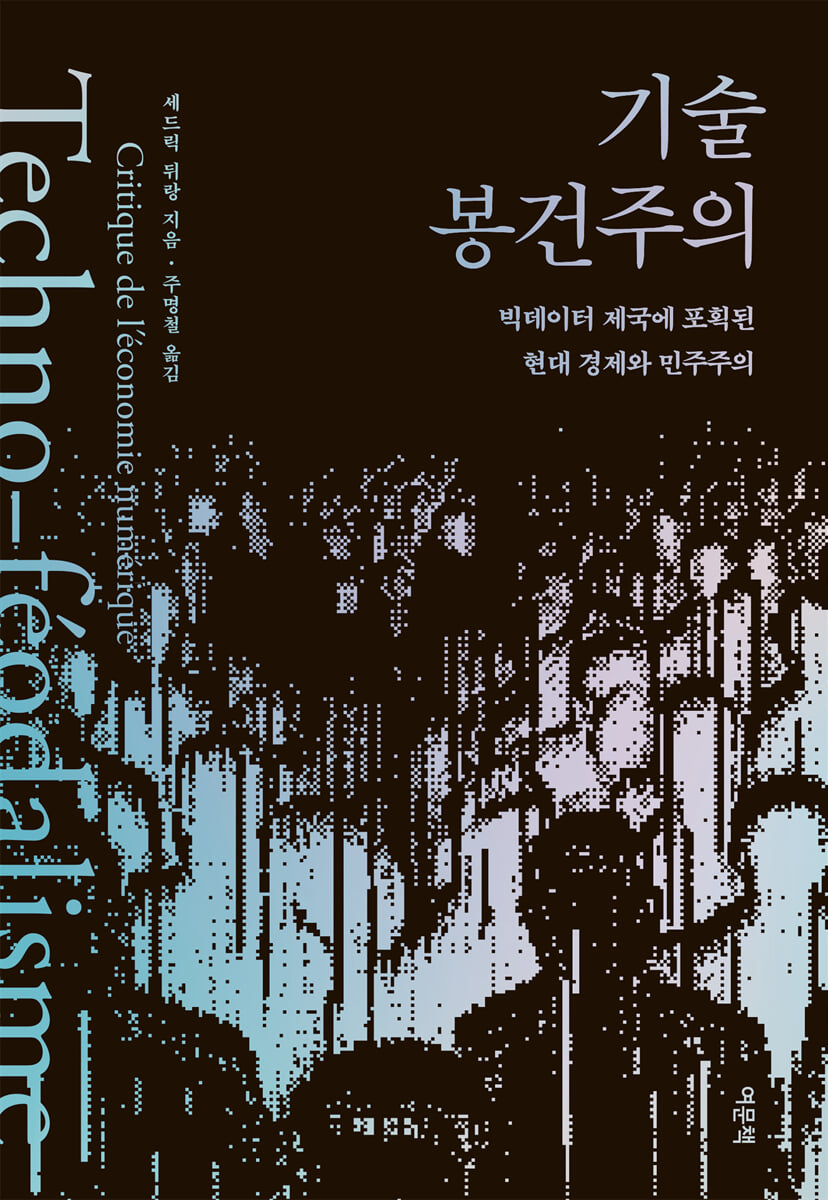
Technological feudalism
 |
Description
Book Introduction
In the AI era, where digital-centric technological innovation is rapidly occurring,
A brilliant insight to avoid becoming a slave to the big data empire!
Compared to now, the 1990s, 30 years ago, feels like the 'Stone Age'.
This was a time when there was no internet, no smartphones, and no chat GPT, which are now taken for granted.
In other words, the pace of new technological changes over the past 30 years has been dizzying.
Will this explosive technological advancement truly enrich human life and bring us one step closer to utopia? To maximize this hopeful possibility, it's crucial to accurately recognize and minimize the potential negative consequences of technological revolution.
In this respect, this book is very important and valuable.
This is a rare book that clearly explains and sounds the alarm about the various possibilities that technological innovation, centered on digital technology, could bring about dystopia.
The warning sounded by this book is summed up in the phrase 'technological feudalism'.
The phrase comparing 21st century cutting-edge technology to medieval feudalism from 1,000 years ago is somewhat paradoxical and poetic.
This book is highly persuasive because it argues based on rigorous economic theories.
The economic theories used for argumentation also encompass classical economists like John Stuart Mill, as well as Marx and Veblen, Keynes, Hayek, and modern mainstream economists, adding to the persuasiveness by providing a balanced perspective that transcends left and right and time and space.
I highly recommend this book to everyone, including workers, businesspeople, and students, living in this new era of AI, represented by ChatGPT.
This is a very interesting book! A must-read! _Kim Se-jik (Professor Emeritus, Department of Economics, Seoul National University)
A brilliant insight to avoid becoming a slave to the big data empire!
Compared to now, the 1990s, 30 years ago, feels like the 'Stone Age'.
This was a time when there was no internet, no smartphones, and no chat GPT, which are now taken for granted.
In other words, the pace of new technological changes over the past 30 years has been dizzying.
Will this explosive technological advancement truly enrich human life and bring us one step closer to utopia? To maximize this hopeful possibility, it's crucial to accurately recognize and minimize the potential negative consequences of technological revolution.
In this respect, this book is very important and valuable.
This is a rare book that clearly explains and sounds the alarm about the various possibilities that technological innovation, centered on digital technology, could bring about dystopia.
The warning sounded by this book is summed up in the phrase 'technological feudalism'.
The phrase comparing 21st century cutting-edge technology to medieval feudalism from 1,000 years ago is somewhat paradoxical and poetic.
This book is highly persuasive because it argues based on rigorous economic theories.
The economic theories used for argumentation also encompass classical economists like John Stuart Mill, as well as Marx and Veblen, Keynes, Hayek, and modern mainstream economists, adding to the persuasiveness by providing a balanced perspective that transcends left and right and time and space.
I highly recommend this book to everyone, including workers, businesspeople, and students, living in this new era of AI, represented by ChatGPT.
This is a very interesting book! A must-read! _Kim Se-jik (Professor Emeritus, Department of Economics, Seoul National University)
- You can preview some of the book's contents.
Preview
index
introduction
Chapter 1: The Poverty of California Ideology
Silicon Valley Accord
Five Paradoxes of New Capitalism
re-feudalization of the public sphere
Chapter 2: Digital Dominance
Age of Conquest
Algorithmic governance and surveillance capitalism
New Farmland in the Digital Age
Automation of social control
Chapter 3: Beneficiaries of Intangible Asset Rentals
Globalization and Intellectual Monopolization
Land mechanism
The chaos of monopoly
Chapter 4: The Technological Feudalism Hypothesis
What is feudalism?
The logic of technological feudalism
Conclusion: The Fortunes and Misfortunes of Socialization
Appendix I · Productivity and Price Indexes: Highly Political Questions
Appendix II: Hipster Antitrust and Chicago
The Amazon Paradox | The Limits of Competition
Acknowledgements
Translator's Note
Chapter 1: The Poverty of California Ideology
Silicon Valley Accord
Five Paradoxes of New Capitalism
re-feudalization of the public sphere
Chapter 2: Digital Dominance
Age of Conquest
Algorithmic governance and surveillance capitalism
New Farmland in the Digital Age
Automation of social control
Chapter 3: Beneficiaries of Intangible Asset Rentals
Globalization and Intellectual Monopolization
Land mechanism
The chaos of monopoly
Chapter 4: The Technological Feudalism Hypothesis
What is feudalism?
The logic of technological feudalism
Conclusion: The Fortunes and Misfortunes of Socialization
Appendix I · Productivity and Price Indexes: Highly Political Questions
Appendix II: Hipster Antitrust and Chicago
The Amazon Paradox | The Limits of Competition
Acknowledgements
Translator's Note
Into the book
Habermas points out that capitalist development tends to weaken the political structures that historically supported it and erode their democratic potential.
The internal dynamics of this system are not linear, and in the long run they create regressive currents that revive the legacy of feudalism.
This analysis politically exposes the fiction of the liberal argument that capitalism is reduced to a market economy, namely, that this economic system is based on exchange between equals.
This argument, developed by 19th-century liberal theorists, lives on in the empty claims of politicians like Newt Gingrich, who embraced Silicon Valley ideology in the 1990s.
They promised small business capitalism.
But what if open competition among startup founders leads to the dominance of new monopolies? What if society becomes polarized between owners of the means of production and a proletarianized social class, with a tiny, ultra-wealthy class monopolizing profits, as it is today, and global inequality deepens?
--- p.105
The democratic potential of the Internet is currently threatened by the ambitions of large IT companies.
This is exacerbated by the proliferation of digital rights management (DRM) and the weakening of network neutrality principles.
Ultimately, the massive data collection by large corporations and national security apparatuses poses unprecedented threats to individual and collective freedom.
In this context, the concept of 'digital feudalism' began to be used in the field of cultural and media studies, referring to the concept of re-feudalization of the public sphere proposed by Habermas.
This idea is worth exploring in more depth.
To this end, I will examine the relationship between capitalism and control in the era of big data from the following perspectives.
If we approach it in this way, bit by bit—surveillance, dependence, capture, monopoly, the creation of new rents—a structure will emerge that goes beyond simply recalling specific aspects of feudalism and evokes the entirety of feudal logic.
That is, the possibility of technological feudalism is discussed.
--- pp.108~109
There is more than just a similarity between society and big data.
Big data is not the entire society, but it is clearly a part of society.
Big data arises from dialectical movement.
First, there is a symbolic crystallization of collective capacities captured in statistical regularities, which then in turn influences individuals and their actions.
The power of big data is a product of scale.
The algorithmic excess, the transcendent effect resulting from the collection and processing of intrinsic data, becomes more powerful as the amount of data increases.
But the power of this massive data carries the risk of loss of control.
--- p.155
We should think of platforms that have become indispensable as infrastructure, like electricity, railways, and communications networks.
Just as the failure of infrastructure that plays a vital social role can throw society into chaos, platforms, like any other infrastructure, need to be managed.
(160
The platform is now turning into a fiefdom.
Beyond the territorial logic of monopolizing the source of original data, the feedback loops inherent in digital services create a dependent situation for users.
First, because algorithms that simply observe our behavior and provide data are becoming essential means of production for our everyday existence.
Second, individuals' continued entanglement with platforms stems from the lock-in effect of interface personalization and high churn costs.
--- p.163
Marx warned that economics was generally incapable of thinking about fundamental changes in the forms of social organization.
The classical economists of his time, like mainstream economists today, regarded the market relations that constituted the contemporary economy as natural and believed that its principles would remain valid forever.
From their perspective, what is rational is what conforms to the operating rules of the industrial capitalist and commercial capitalist economy.
Anything that does not conform to it is considered irrational, outdated, and ultimately incomprehensible.
To refresh our perspective and perhaps gain a better understanding of the changes currently underway, we must pay closer attention to the persistent anomalies that plague the "naturalness" of capitalism.
If we pay even a little attention today, we can see the ghosts of feudalism everywhere.
--- pp.223~224
In feudalism, it was considered more advantageous to steal wealth than to produce it.
Feudal lords engaged in wars of conquest, reaping far more attractive returns than they could hope for from agricultural investments.
As a result, the superiority of military competition turned feudal competition into a zero-sum game.
Their primary goal was not to improve production efficiency, but to control the land and the people who worked there.
--- p.241
There are companies here that are well aware of the situation.
But even in situations where their own selves are taken away, humans simply run away.
Unless individuals have new forms of control, they will be forced to accept that machines will take away their choices.
The internal dynamics of this system are not linear, and in the long run they create regressive currents that revive the legacy of feudalism.
This analysis politically exposes the fiction of the liberal argument that capitalism is reduced to a market economy, namely, that this economic system is based on exchange between equals.
This argument, developed by 19th-century liberal theorists, lives on in the empty claims of politicians like Newt Gingrich, who embraced Silicon Valley ideology in the 1990s.
They promised small business capitalism.
But what if open competition among startup founders leads to the dominance of new monopolies? What if society becomes polarized between owners of the means of production and a proletarianized social class, with a tiny, ultra-wealthy class monopolizing profits, as it is today, and global inequality deepens?
--- p.105
The democratic potential of the Internet is currently threatened by the ambitions of large IT companies.
This is exacerbated by the proliferation of digital rights management (DRM) and the weakening of network neutrality principles.
Ultimately, the massive data collection by large corporations and national security apparatuses poses unprecedented threats to individual and collective freedom.
In this context, the concept of 'digital feudalism' began to be used in the field of cultural and media studies, referring to the concept of re-feudalization of the public sphere proposed by Habermas.
This idea is worth exploring in more depth.
To this end, I will examine the relationship between capitalism and control in the era of big data from the following perspectives.
If we approach it in this way, bit by bit—surveillance, dependence, capture, monopoly, the creation of new rents—a structure will emerge that goes beyond simply recalling specific aspects of feudalism and evokes the entirety of feudal logic.
That is, the possibility of technological feudalism is discussed.
--- pp.108~109
There is more than just a similarity between society and big data.
Big data is not the entire society, but it is clearly a part of society.
Big data arises from dialectical movement.
First, there is a symbolic crystallization of collective capacities captured in statistical regularities, which then in turn influences individuals and their actions.
The power of big data is a product of scale.
The algorithmic excess, the transcendent effect resulting from the collection and processing of intrinsic data, becomes more powerful as the amount of data increases.
But the power of this massive data carries the risk of loss of control.
--- p.155
We should think of platforms that have become indispensable as infrastructure, like electricity, railways, and communications networks.
Just as the failure of infrastructure that plays a vital social role can throw society into chaos, platforms, like any other infrastructure, need to be managed.
(160
The platform is now turning into a fiefdom.
Beyond the territorial logic of monopolizing the source of original data, the feedback loops inherent in digital services create a dependent situation for users.
First, because algorithms that simply observe our behavior and provide data are becoming essential means of production for our everyday existence.
Second, individuals' continued entanglement with platforms stems from the lock-in effect of interface personalization and high churn costs.
--- p.163
Marx warned that economics was generally incapable of thinking about fundamental changes in the forms of social organization.
The classical economists of his time, like mainstream economists today, regarded the market relations that constituted the contemporary economy as natural and believed that its principles would remain valid forever.
From their perspective, what is rational is what conforms to the operating rules of the industrial capitalist and commercial capitalist economy.
Anything that does not conform to it is considered irrational, outdated, and ultimately incomprehensible.
To refresh our perspective and perhaps gain a better understanding of the changes currently underway, we must pay closer attention to the persistent anomalies that plague the "naturalness" of capitalism.
If we pay even a little attention today, we can see the ghosts of feudalism everywhere.
--- pp.223~224
In feudalism, it was considered more advantageous to steal wealth than to produce it.
Feudal lords engaged in wars of conquest, reaping far more attractive returns than they could hope for from agricultural investments.
As a result, the superiority of military competition turned feudal competition into a zero-sum game.
Their primary goal was not to improve production efficiency, but to control the land and the people who worked there.
--- p.241
There are companies here that are well aware of the situation.
But even in situations where their own selves are taken away, humans simply run away.
Unless individuals have new forms of control, they will be forced to accept that machines will take away their choices.
--- p.285
Publisher's Review
◆ What is technological feudalism?
Feudalism is a historical concept related to the organization of Western European medieval society, and also refers to a very unique socioeconomic form.
Medieval Western Europe in the 9th and 10th centuries was “a sharply stratified society in which a small number of powerful people exploited and overwhelmingly dominated the majority of peasants.”
Historians use three basic categories to understand feudal society: dominion, serfdom, and vassalage.
In feudal society, politics and economics are not separated, and violence serves as the dominant disciplinary principle.
For this reason, feudal relations are organized around the issues of domination and protection.
The term 'dominium', meaning 'social relationship between ruler and ruled', and the vassal relationship, another core system of feudalism, are limited to the aristocratic class, a very small minority of the population.
At the heart of this asymmetrical relationship is control over land, exploitation and plunder based on violence.
Many people may wonder why we are talking about feudalism in the 21st century, an era of technological revolution that is advancing at an astonishing pace.
Author Cédric Durand does not simply point out that the current socio-economic situation has the characteristics of a past feudalism, but rather points out that these problems not only threaten the capitalist system but also seriously undermine individual autonomy and democracy, thereby sounding the alarm and hoping to prevent the world from falling into a dark dystopia.
As surpluses were concentrated in the hands of lords far from the production process and used unproductively, and as factors of production became fixed, productivity stagnated, and the feudal system disappeared into the back alleys of history.
However, if the current situation continues in which the entire world is subordinated to a small number of multinational technology companies and is bound to a "digital fiefdom" under a surveillance system of algorithmic rule as technology advances at a rapid pace, not only will capitalism lose its self-correcting function, but a dystopian world will eventually unfold.
Therefore, before it is too late, we must penetrate the essence and core of "technological feudalism," strengthen our subjectivity so as not to be helplessly swayed by it, and be reborn as "fully developed individuals."
The Betrayal of Liberal Technological Optimism
At the end of the 20th century, the emergence of the Internet created a new social space where information technology, communications, and media intersect.
Suddenly, routines changed, new competitive advantages emerged, and information began to be transmitted through unfamiliar channels.
Amidst this upheaval, a libertarian techno-optimism known as the "California Ideology" spread rapidly.
Added to this was the rosy outlook that the world would be revitalized by the development of democracy amid the wave of market opening in the 1990s.
But this optimism did not last long.
The 'Silicon Valley myth' is an exceptional phenomenon, stemming purely from regional specificities, and in no way representing a common global future.
It turns out that the practice of referencing Silicon Valley is quite paradoxical.
The startup spirit has disappeared, replaced by the predatory behavior of private monopolies.
The atmosphere that celebrated individual autonomy and creativity ultimately gave way to computerized management tools that deepened employment dependence.
Regional polarization, the concentration of profits in the hands of a few "winners," and obstacles to the diffusion of knowledge have fueled marginalization.
This hinders not only innovation but also the potential benefits that innovation can bring.
Silicon Valley, and by extension the world of innovation it represents, has transformed into a reality diametrically opposed to the principles that drove its early success.
(syncopation)
The cracks in the Silicon Valley consensus prove this.
Contrary to predictions, the rapid socioeconomic changes brought about by the development of digital technology have failed to inject new vitality into capitalism.
Rather, accumulating evidence tends to suggest a decline in this mode of production.
(Pages 99-100)
As a result, the author diagnoses that democracy has entered a winter in the West (and we are no exception).
The reason is “first, the increase in undemocratic forms of regulating capitalism.
If China and Russia exemplify this social pattern, the electoral victories of authoritarian leaders in Europe and the United States demonstrate that even in the West, highly undemocratic political options can come to power.
Second, Silicon Valley companies are showing an attitude of disregard for individual freedom and democratic rights.”
◆ A new power called 'Big Other'
As we live in a society where information and communication technologies based on the Internet run the world, there is no way to avoid the "Big Other" infrastructure of giant technology companies.
Big Other says, “As we absorb all the data we provide, we end up knowing ourselves better than we know ourselves.
It explores everything from our communications to our bedroom movements to our spending lists.
We learn how to guide our behavior through large-scale online experiments, ultimately leading to a new form of totalitarianism.
If 20th-century totalitarianism operated through violence, this new power, which Zubov characterizes as “instrumentalist,” operates through changes in behavior.”
The 'big data' collected through Big Data has three characteristics.
First, it is continuously generated; second, it aims for both comprehensiveness and detail; and third, it is produced flexibly so that additional data sources can be integrated at any time.
The problem is that this big data is inherently biased and dominated by social forces, making it anything but neutral.
Moreover, the rapidly developing AI programs not only reflect racial discrimination and gender inequality deeply rooted in institutions and power relations, but may also contribute to amplifying them.
The biases inherent in these programs are then re-incorporated into the results of other algorithms.
The author's observation and warning are significant in that even if the biases and prejudices it implies are corrected, concerns will not be completely resolved.
◆ The digital economy captured by big data
The modern economy is caught up in big data within the vast current of the "digital economy," and now nations, societies, and individuals are all trapped in the inescapable domain of digital services.
According to the author, “The reliance of these subordinate entities on digital land is significant.
This is because it determines the ability of the ruling class to capture economic surplus.
“The dependence of everyone on the owner is a characteristic of the digital economy, and it shows that the liberalism of the algorithmic age has become predatory.”
Why is this situation dangerous? Because "digital advancements disrupt competitive relationships, favoring dependency, which tends to disrupt the overall mechanism and prioritize predation over production," resulting in what the author calls "technological feudalism." The harmful effects of this excessive concentration of economic power include undue pressure on suppliers, consumer capture, control of the political system through the media, and the creation of structures that receive various undue benefits and support from public institutions. For companies too big to fail, their potential bankruptcy alone can jeopardize the system itself.
Moreover, the serious problem is that there is a very high possibility that everyone will have to bear the full brunt of the damage caused by the monopolization of mega-corporations at any time.
The Invisible Hand of Algorithms and the Strengthening of Individual Subjectivity
As the author points out, the trajectory of modern capitalism is paradoxical.
While advances in digital technology signal a richness of innovation and qualitative changes across the spectrum of production, consumption, and exchange—in other words, a revitalized economy—hidden beneath the surface are persistent slowdowns in GDP growth and productivity, a growing unproductive share of the financial sector, persistent underemployment, and, crucially, a rapid deterioration in ecological conditions.
Therefore, the author repeatedly emphasizes that we must not ignore the fact that a significant portion of the effects of digital innovation are not captured by market exchange structures and the corresponding accounting systems, and that many of the most beneficial effects of digital fall outside the market economy.
This is because it is one of the symptoms that shows the vulnerability of modern capitalism.
Furthermore, he points out the risks of a society dominated by algorithms as follows:
A society dominated by algorithms is increasingly resembling a “technological society like termites or ants,” and is transforming into a “society in which people are slaves to probability.”
Any attempt to reduce existence to probability risks robbing individuals and communities of the ability to control their own futures.
When a subject is deprived of the ability to challenge probability, that is, the ability to challenge reality, he loses all power.
While the risk of such distortions of reality is not necessarily present, they are increasingly present as digital corporations increasingly instrumentalize algorithmic governance in their pursuit of profit.
(Page 131)
The author points out that the structural inequality of capitalism, which has become particularly severe in modern times, has made it impossible to distinguish between the private sphere and public action, thereby annihilating the very concept of public interest. At the same time, the disintegration of public services and social protection systems and the intensification of the advertising offensive have further accelerated the commercialization of everyday life.
This tends to trap people in the role of passive consumers and atomize them into performance-obsessed individuals.
The author diagnoses our current reality as follows:
Human civilization has slowly become subservient to capital, and has finally come to stand at the top of a precarious mountain.
(Page 283)
The desire of algorithmic government to control individuals does not allow the formation of desires, and thus ultimately reduces individuals to machines of 'sad passions'.
Beginning with his work, the individual is increasingly neglected in all stages of his life.
The philosopher Étienne Balibar calls this possibility of final defeat 'total subjection'.
This means “complete loss of personal identity and autonomy.”
As technological feudalism intensifies, the logic of oppression also accelerates.
(Page 284)
However, the author does not tell only dark stories from beginning to end.
In these difficult times, when the world is facing political and economic difficulties, it is especially important to listen carefully to the author's suggestions.
The future lies in the invisible hand of algorithms.
Thanks to digital feedback loops, tedious and confusing logistical detours are increasingly unnecessary and no longer an obstacle to maintaining the division of labor.
As we enter this new era of economic calculation, the question becomes who will do it.
Those who defend the citadel of technological feudalism claim to monopolize intellectual control over the socio-economic processes of production and consumption.
However, the individual's resistance to unrealization poses a very serious obstacle to this project.
For a "fully developed individual" to emerge, true economic democracy must be achieved, and individual subjectivity must be strengthened by breaking away from the market.
At that time, the extent of autonomy that individuals determine for themselves will be related not only to economic issues but also to their place in the ecosystem, and will be well-harmonized with collective control.
(Page 288)
Feudalism is a historical concept related to the organization of Western European medieval society, and also refers to a very unique socioeconomic form.
Medieval Western Europe in the 9th and 10th centuries was “a sharply stratified society in which a small number of powerful people exploited and overwhelmingly dominated the majority of peasants.”
Historians use three basic categories to understand feudal society: dominion, serfdom, and vassalage.
In feudal society, politics and economics are not separated, and violence serves as the dominant disciplinary principle.
For this reason, feudal relations are organized around the issues of domination and protection.
The term 'dominium', meaning 'social relationship between ruler and ruled', and the vassal relationship, another core system of feudalism, are limited to the aristocratic class, a very small minority of the population.
At the heart of this asymmetrical relationship is control over land, exploitation and plunder based on violence.
Many people may wonder why we are talking about feudalism in the 21st century, an era of technological revolution that is advancing at an astonishing pace.
Author Cédric Durand does not simply point out that the current socio-economic situation has the characteristics of a past feudalism, but rather points out that these problems not only threaten the capitalist system but also seriously undermine individual autonomy and democracy, thereby sounding the alarm and hoping to prevent the world from falling into a dark dystopia.
As surpluses were concentrated in the hands of lords far from the production process and used unproductively, and as factors of production became fixed, productivity stagnated, and the feudal system disappeared into the back alleys of history.
However, if the current situation continues in which the entire world is subordinated to a small number of multinational technology companies and is bound to a "digital fiefdom" under a surveillance system of algorithmic rule as technology advances at a rapid pace, not only will capitalism lose its self-correcting function, but a dystopian world will eventually unfold.
Therefore, before it is too late, we must penetrate the essence and core of "technological feudalism," strengthen our subjectivity so as not to be helplessly swayed by it, and be reborn as "fully developed individuals."
The Betrayal of Liberal Technological Optimism
At the end of the 20th century, the emergence of the Internet created a new social space where information technology, communications, and media intersect.
Suddenly, routines changed, new competitive advantages emerged, and information began to be transmitted through unfamiliar channels.
Amidst this upheaval, a libertarian techno-optimism known as the "California Ideology" spread rapidly.
Added to this was the rosy outlook that the world would be revitalized by the development of democracy amid the wave of market opening in the 1990s.
But this optimism did not last long.
The 'Silicon Valley myth' is an exceptional phenomenon, stemming purely from regional specificities, and in no way representing a common global future.
It turns out that the practice of referencing Silicon Valley is quite paradoxical.
The startup spirit has disappeared, replaced by the predatory behavior of private monopolies.
The atmosphere that celebrated individual autonomy and creativity ultimately gave way to computerized management tools that deepened employment dependence.
Regional polarization, the concentration of profits in the hands of a few "winners," and obstacles to the diffusion of knowledge have fueled marginalization.
This hinders not only innovation but also the potential benefits that innovation can bring.
Silicon Valley, and by extension the world of innovation it represents, has transformed into a reality diametrically opposed to the principles that drove its early success.
(syncopation)
The cracks in the Silicon Valley consensus prove this.
Contrary to predictions, the rapid socioeconomic changes brought about by the development of digital technology have failed to inject new vitality into capitalism.
Rather, accumulating evidence tends to suggest a decline in this mode of production.
(Pages 99-100)
As a result, the author diagnoses that democracy has entered a winter in the West (and we are no exception).
The reason is “first, the increase in undemocratic forms of regulating capitalism.
If China and Russia exemplify this social pattern, the electoral victories of authoritarian leaders in Europe and the United States demonstrate that even in the West, highly undemocratic political options can come to power.
Second, Silicon Valley companies are showing an attitude of disregard for individual freedom and democratic rights.”
◆ A new power called 'Big Other'
As we live in a society where information and communication technologies based on the Internet run the world, there is no way to avoid the "Big Other" infrastructure of giant technology companies.
Big Other says, “As we absorb all the data we provide, we end up knowing ourselves better than we know ourselves.
It explores everything from our communications to our bedroom movements to our spending lists.
We learn how to guide our behavior through large-scale online experiments, ultimately leading to a new form of totalitarianism.
If 20th-century totalitarianism operated through violence, this new power, which Zubov characterizes as “instrumentalist,” operates through changes in behavior.”
The 'big data' collected through Big Data has three characteristics.
First, it is continuously generated; second, it aims for both comprehensiveness and detail; and third, it is produced flexibly so that additional data sources can be integrated at any time.
The problem is that this big data is inherently biased and dominated by social forces, making it anything but neutral.
Moreover, the rapidly developing AI programs not only reflect racial discrimination and gender inequality deeply rooted in institutions and power relations, but may also contribute to amplifying them.
The biases inherent in these programs are then re-incorporated into the results of other algorithms.
The author's observation and warning are significant in that even if the biases and prejudices it implies are corrected, concerns will not be completely resolved.
◆ The digital economy captured by big data
The modern economy is caught up in big data within the vast current of the "digital economy," and now nations, societies, and individuals are all trapped in the inescapable domain of digital services.
According to the author, “The reliance of these subordinate entities on digital land is significant.
This is because it determines the ability of the ruling class to capture economic surplus.
“The dependence of everyone on the owner is a characteristic of the digital economy, and it shows that the liberalism of the algorithmic age has become predatory.”
Why is this situation dangerous? Because "digital advancements disrupt competitive relationships, favoring dependency, which tends to disrupt the overall mechanism and prioritize predation over production," resulting in what the author calls "technological feudalism." The harmful effects of this excessive concentration of economic power include undue pressure on suppliers, consumer capture, control of the political system through the media, and the creation of structures that receive various undue benefits and support from public institutions. For companies too big to fail, their potential bankruptcy alone can jeopardize the system itself.
Moreover, the serious problem is that there is a very high possibility that everyone will have to bear the full brunt of the damage caused by the monopolization of mega-corporations at any time.
The Invisible Hand of Algorithms and the Strengthening of Individual Subjectivity
As the author points out, the trajectory of modern capitalism is paradoxical.
While advances in digital technology signal a richness of innovation and qualitative changes across the spectrum of production, consumption, and exchange—in other words, a revitalized economy—hidden beneath the surface are persistent slowdowns in GDP growth and productivity, a growing unproductive share of the financial sector, persistent underemployment, and, crucially, a rapid deterioration in ecological conditions.
Therefore, the author repeatedly emphasizes that we must not ignore the fact that a significant portion of the effects of digital innovation are not captured by market exchange structures and the corresponding accounting systems, and that many of the most beneficial effects of digital fall outside the market economy.
This is because it is one of the symptoms that shows the vulnerability of modern capitalism.
Furthermore, he points out the risks of a society dominated by algorithms as follows:
A society dominated by algorithms is increasingly resembling a “technological society like termites or ants,” and is transforming into a “society in which people are slaves to probability.”
Any attempt to reduce existence to probability risks robbing individuals and communities of the ability to control their own futures.
When a subject is deprived of the ability to challenge probability, that is, the ability to challenge reality, he loses all power.
While the risk of such distortions of reality is not necessarily present, they are increasingly present as digital corporations increasingly instrumentalize algorithmic governance in their pursuit of profit.
(Page 131)
The author points out that the structural inequality of capitalism, which has become particularly severe in modern times, has made it impossible to distinguish between the private sphere and public action, thereby annihilating the very concept of public interest. At the same time, the disintegration of public services and social protection systems and the intensification of the advertising offensive have further accelerated the commercialization of everyday life.
This tends to trap people in the role of passive consumers and atomize them into performance-obsessed individuals.
The author diagnoses our current reality as follows:
Human civilization has slowly become subservient to capital, and has finally come to stand at the top of a precarious mountain.
(Page 283)
The desire of algorithmic government to control individuals does not allow the formation of desires, and thus ultimately reduces individuals to machines of 'sad passions'.
Beginning with his work, the individual is increasingly neglected in all stages of his life.
The philosopher Étienne Balibar calls this possibility of final defeat 'total subjection'.
This means “complete loss of personal identity and autonomy.”
As technological feudalism intensifies, the logic of oppression also accelerates.
(Page 284)
However, the author does not tell only dark stories from beginning to end.
In these difficult times, when the world is facing political and economic difficulties, it is especially important to listen carefully to the author's suggestions.
The future lies in the invisible hand of algorithms.
Thanks to digital feedback loops, tedious and confusing logistical detours are increasingly unnecessary and no longer an obstacle to maintaining the division of labor.
As we enter this new era of economic calculation, the question becomes who will do it.
Those who defend the citadel of technological feudalism claim to monopolize intellectual control over the socio-economic processes of production and consumption.
However, the individual's resistance to unrealization poses a very serious obstacle to this project.
For a "fully developed individual" to emerge, true economic democracy must be achieved, and individual subjectivity must be strengthened by breaking away from the market.
At that time, the extent of autonomy that individuals determine for themselves will be related not only to economic issues but also to their place in the ecosystem, and will be well-harmonized with collective control.
(Page 288)
GOODS SPECIFICS
- Date of issue: March 21, 2025
- Page count, weight, size: 312 pages | 418g | 145*210*16mm
- ISBN13: 9791187700098
You may also like
카테고리
korean


korean

![GQ KOREA Mark (Monthly): December [2025]](http://librairie.coreenne.fr/cdn/shop/files/8ef265dbbfbf186523ed75ba7319009d.jpg?v=1765340328&width=3840)


