

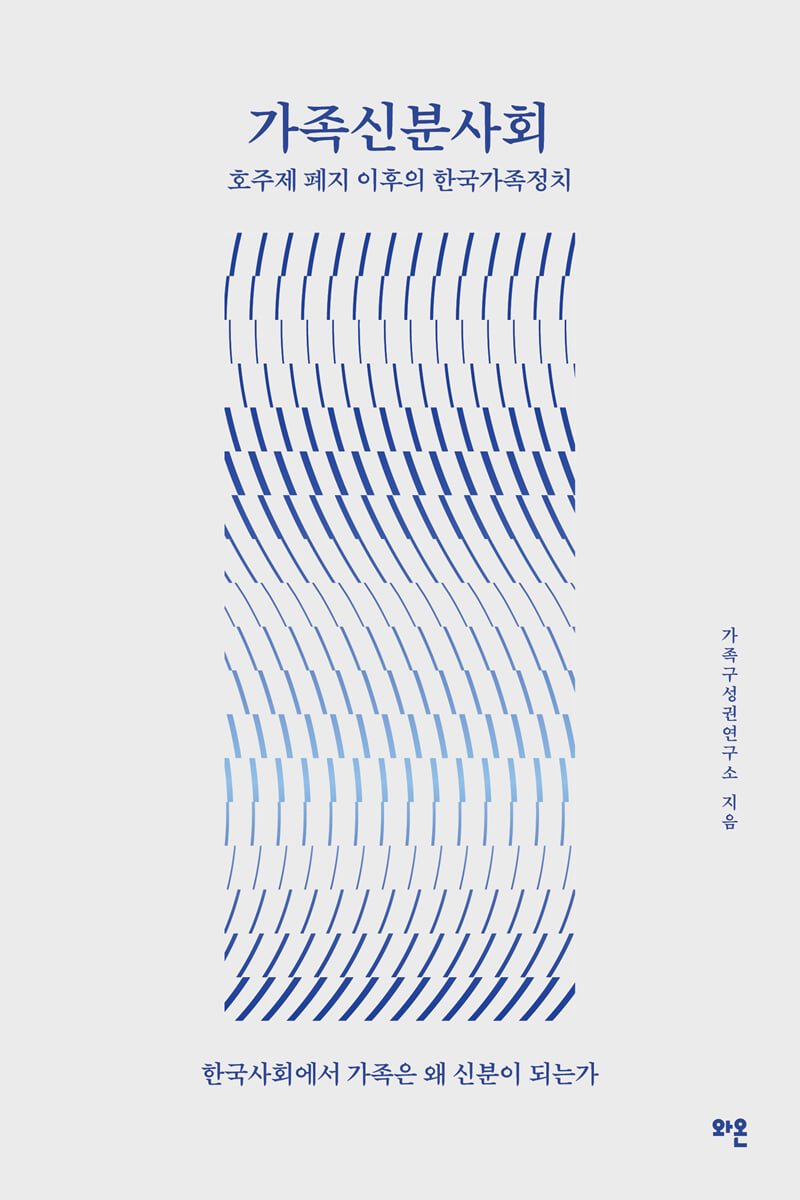
Family-based society
 |
Description
Book Introduction
On February 3, 2005, the Constitutional Court ruled that the household system was unconstitutional.
With this, the household head system, which played a central role in gender discrimination in Korean society, was abolished.
The family head system, which grants the head of the household exclusive parental rights and property rights and passes them on to male direct descendants first, has created countless instances of inequality and discrimination in Korean society over the past half century.
Although the legal head of household disappeared with the abolition of the household system, its legacy remains in civil law, social welfare systems, and numerous other legal systems, and continues to exert a strong influence.
Korean society still demands that individuals acquire social 'status' through the formation of a 'normal family' that follows heteronormativity.
Only relationships “formed by marriage, blood, or adoption” are recognized as legal families, and individuals/relationships that do not meet this standard are denied the right to be considered family and experience inequality, discrimination, and stigma.
This book names this Korean society as a "family status society" and examines Korean family politics over the 20 years since the abolition of the household head system.
Thirteen authors analyze the scene of family politics with agendas generated from their respective positions.
In particular, it persistently questions 'family' from the perspectives of minorities such as transgender people, children and adolescents, single parents, married immigrant women, unmarried women, people with disabilities, same-sex couples, and single-person households.
This is because the space of care, intimacy, and solidarity created by those who have been oppressed and expelled from the existing family system is driving a new society.
With this, the household head system, which played a central role in gender discrimination in Korean society, was abolished.
The family head system, which grants the head of the household exclusive parental rights and property rights and passes them on to male direct descendants first, has created countless instances of inequality and discrimination in Korean society over the past half century.
Although the legal head of household disappeared with the abolition of the household system, its legacy remains in civil law, social welfare systems, and numerous other legal systems, and continues to exert a strong influence.
Korean society still demands that individuals acquire social 'status' through the formation of a 'normal family' that follows heteronormativity.
Only relationships “formed by marriage, blood, or adoption” are recognized as legal families, and individuals/relationships that do not meet this standard are denied the right to be considered family and experience inequality, discrimination, and stigma.
This book names this Korean society as a "family status society" and examines Korean family politics over the 20 years since the abolition of the household head system.
Thirteen authors analyze the scene of family politics with agendas generated from their respective positions.
In particular, it persistently questions 'family' from the perspectives of minorities such as transgender people, children and adolescents, single parents, married immigrant women, unmarried women, people with disabilities, same-sex couples, and single-person households.
This is because the space of care, intimacy, and solidarity created by those who have been oppressed and expelled from the existing family system is driving a new society.
- You can preview some of the book's contents.
Preview
index
Preface | Post-Australianism and Queer Family Politics
Part 1: Why Family Becomes a Status
The Family Law Reform Movement and the Challenges After the Abolition of the Head of Household System - Kim Dae-hyun
Transgender Gender Change and the Family System - Na Young-jeong
Children and Adolescents' Right to Family Formation - Kim Hyun-kyung
Part 2: Is it possible for citizens to live outside the "normal family"?
Criticism of the State and Social Welfare System's "Family" Calls, Which Hide Behind the Family - Seong Jeong-sook
A single mother seeking survival outside the family - Kim Soon-nam
Women's Reproductive Rights as Seen Through Unmarried Single Parenthood - Kim So-hyung
Multicultural Family Policy and Marriage Immigrant Women - Jang Seo-yeon
Part 3: How Life and Death Become the Agenda of Family Politics
The Deinstitutionalization Movement and Family Rights - Kim Da-jeong
Queer-Single Politics: Questioning the Inside and Outside of Family - Lee Yu-na
Family After Death - Han Garam
Part 4: How New Bonds Are Formed
Creating Institutional Spaces for Diverse Intimacy and Care Relationships - Jeong Hyeon-hee
The Practice of Same-Sex Unions and the Marriage Equality Movement - Lee Jong-geol
Single-Person Households: Changing Relationships and Citizenship Defaults - Hong Han-sol
annotation
Part 1: Why Family Becomes a Status
The Family Law Reform Movement and the Challenges After the Abolition of the Head of Household System - Kim Dae-hyun
Transgender Gender Change and the Family System - Na Young-jeong
Children and Adolescents' Right to Family Formation - Kim Hyun-kyung
Part 2: Is it possible for citizens to live outside the "normal family"?
Criticism of the State and Social Welfare System's "Family" Calls, Which Hide Behind the Family - Seong Jeong-sook
A single mother seeking survival outside the family - Kim Soon-nam
Women's Reproductive Rights as Seen Through Unmarried Single Parenthood - Kim So-hyung
Multicultural Family Policy and Marriage Immigrant Women - Jang Seo-yeon
Part 3: How Life and Death Become the Agenda of Family Politics
The Deinstitutionalization Movement and Family Rights - Kim Da-jeong
Queer-Single Politics: Questioning the Inside and Outside of Family - Lee Yu-na
Family After Death - Han Garam
Part 4: How New Bonds Are Formed
Creating Institutional Spaces for Diverse Intimacy and Care Relationships - Jeong Hyeon-hee
The Practice of Same-Sex Unions and the Marriage Equality Movement - Lee Jong-geol
Single-Person Households: Changing Relationships and Citizenship Defaults - Hong Han-sol
annotation
Detailed image
Into the book
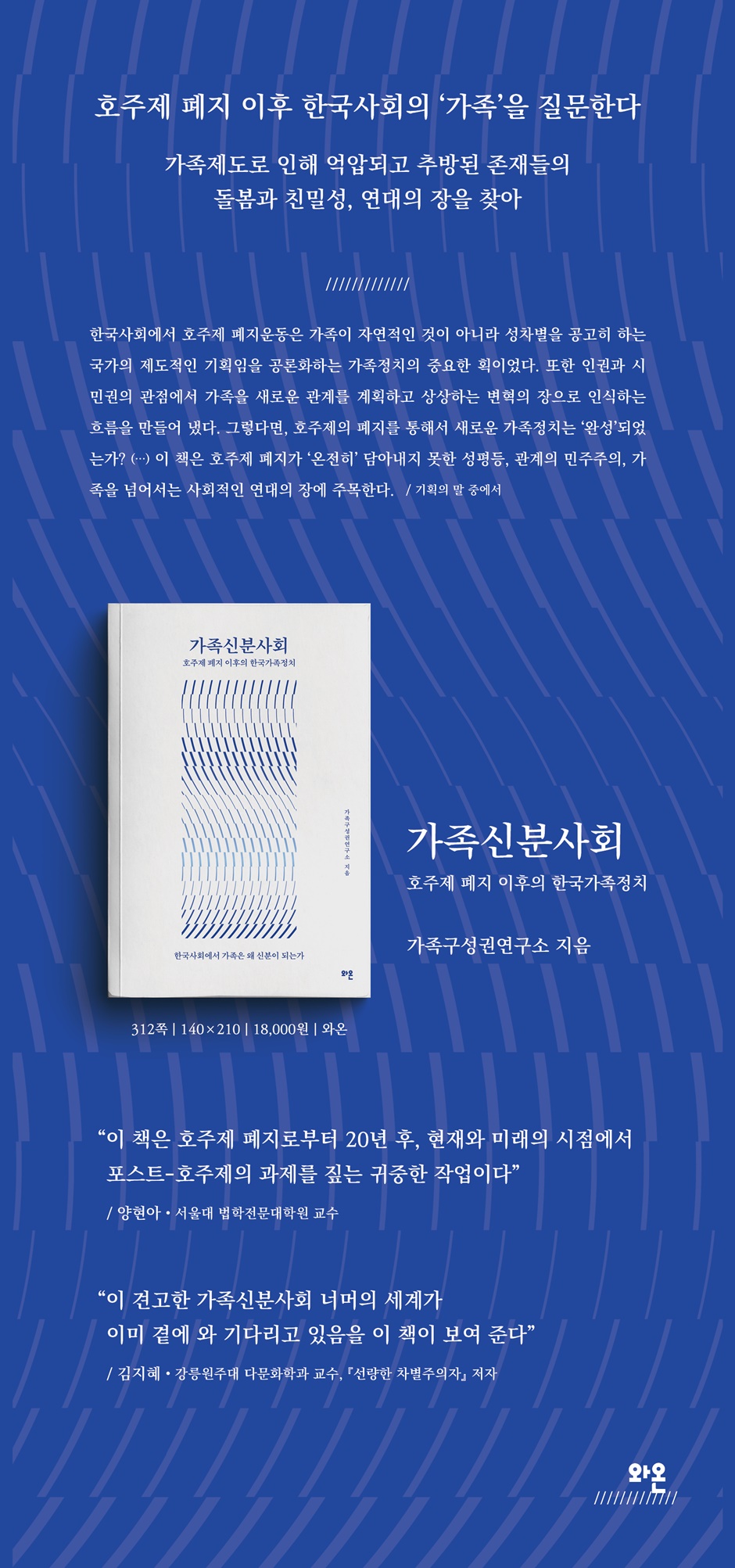
In Korean society, the movement to abolish the household headship system was an important step in family politics, publicizing that the family is not a natural thing but an institutional project of the state that reinforces gender discrimination.
It also created a trend that recognized the family as a transformative space for planning and imagining new relationships from a human rights and civil rights perspective.
So, has the abolition of the household head system "completed" the new family politics? If the abolition of the household head system is viewed solely as the legal disappearance of the household head, then the post-household head system may already be complete.
However, even after the abolition of the household headship system, the family system continues to reinforce the "normality of the family" through a patriarchal and capitalist system centered on men, heterosexuality, marriage, and the non-disabled. We can easily confirm this normality operating throughout Korean society.
--- p.7~8
Crucially, the foundation of the Japanese colonial era's household system, such as the sole inheritance of the eldest son, and the legal incompetence of married women who were tied to a householder and could not even have their own personal seal or property rights, were not Joseon customs but originated from the Meiji Civil Code of Japan.
The customary investigation was conducted based on this gender-inequality system of Japanese civil law.
In other words, Japan virtually invented and created Korean customs through custom research, and applied the household system of Japanese civil law to Korea based on these invented customs.
--- p.29~30
Everyone is born with a designated gender and, within the family registration system, women are assigned roles as daughter, wife, or mother, while men are assigned roles as son, husband, or father.
The family system, built on the foundation of gender distinction, cannot properly recognize those who are in conflict with it because it does not imagine a system outside of this distinction, and cannot properly recognize them as a status system.
The discrimination and disadvantages that arise as a result become solely the burden of the individual.
This gender system is also closely linked to state control over sexuality.
--- p.61~62
The state has shifted the responsibility for the survival and care of individual family members onto families through a controlling and restrictive welfare system and a "family first, welfare later" operating method, and has even passed on the costs.
The key to this strategy is to reliably reproduce the family that will take charge of it.
The state has defined the policy targets as 'households' and 'generations' and has implemented policies by delivering and managing services, regarding the family, rather than the individual, as the basic unit of society.
It has always made us identify individuals within the group of household/generation/family.
--- p.114~115
Ultimately, the category of "women in need of protection" functions as a mechanism that systematically and socially calls out poor, homeless, and husbandless women, while simultaneously pathologizing and stigmatizing the labor of women who have survived in poverty, rendering them invisible.
It is also a hierarchical gender norm that is constructed by distinguishing the lives of heterosexual, middle-class women who have the potential to carry out ‘normal families,’ ‘normal childbirth,’ and ‘normal parenting,’ from the lives of ‘unqualified’ women who already lack the possibility of doing so.
The normal family order, which has operated through the intersection of sexual stigma, poverty, and the gender system, limits women's place in life to their roles within the heterosexual patriarchal family.
--- p.143
Under current law, family members can make decisions on behalf of individuals (Act on Organ Transplantation, Public Official Election Act) and access personal information of family members (Medical Service Act, Basic Disaster and Safety Management Act).
The family is supported as a unified community (National Pension Act, Act on Prevention and Compensation for School Accidents), a community of care (Act on Equal Employment Opportunity for Men and Women and Support for Work-Family Balance), and recognized as a community of economic interests (Income Tax Act).
In other words, the family is involved in the overall design of a citizen's social safety net.
--- p.242~243
The right to form a family shifts the current family-centered social model to one centered on the individual by defining family based on the relationships that each individual imagines and creates.
And when we shift the smallest unit of modern society from the family group to the individual, the defaults for relationships and citizens change.
Single-person households are one of the main agents of this social change, realizing the right to form a family at the smallest level.
(…) It is time for systems and policies to change so that everyone can enjoy equal citizenship rights as an individual, not just as a family member, but as an individual, included in the social safety net.
It also created a trend that recognized the family as a transformative space for planning and imagining new relationships from a human rights and civil rights perspective.
So, has the abolition of the household head system "completed" the new family politics? If the abolition of the household head system is viewed solely as the legal disappearance of the household head, then the post-household head system may already be complete.
However, even after the abolition of the household headship system, the family system continues to reinforce the "normality of the family" through a patriarchal and capitalist system centered on men, heterosexuality, marriage, and the non-disabled. We can easily confirm this normality operating throughout Korean society.
--- p.7~8
Crucially, the foundation of the Japanese colonial era's household system, such as the sole inheritance of the eldest son, and the legal incompetence of married women who were tied to a householder and could not even have their own personal seal or property rights, were not Joseon customs but originated from the Meiji Civil Code of Japan.
The customary investigation was conducted based on this gender-inequality system of Japanese civil law.
In other words, Japan virtually invented and created Korean customs through custom research, and applied the household system of Japanese civil law to Korea based on these invented customs.
--- p.29~30
Everyone is born with a designated gender and, within the family registration system, women are assigned roles as daughter, wife, or mother, while men are assigned roles as son, husband, or father.
The family system, built on the foundation of gender distinction, cannot properly recognize those who are in conflict with it because it does not imagine a system outside of this distinction, and cannot properly recognize them as a status system.
The discrimination and disadvantages that arise as a result become solely the burden of the individual.
This gender system is also closely linked to state control over sexuality.
--- p.61~62
The state has shifted the responsibility for the survival and care of individual family members onto families through a controlling and restrictive welfare system and a "family first, welfare later" operating method, and has even passed on the costs.
The key to this strategy is to reliably reproduce the family that will take charge of it.
The state has defined the policy targets as 'households' and 'generations' and has implemented policies by delivering and managing services, regarding the family, rather than the individual, as the basic unit of society.
It has always made us identify individuals within the group of household/generation/family.
--- p.114~115
Ultimately, the category of "women in need of protection" functions as a mechanism that systematically and socially calls out poor, homeless, and husbandless women, while simultaneously pathologizing and stigmatizing the labor of women who have survived in poverty, rendering them invisible.
It is also a hierarchical gender norm that is constructed by distinguishing the lives of heterosexual, middle-class women who have the potential to carry out ‘normal families,’ ‘normal childbirth,’ and ‘normal parenting,’ from the lives of ‘unqualified’ women who already lack the possibility of doing so.
The normal family order, which has operated through the intersection of sexual stigma, poverty, and the gender system, limits women's place in life to their roles within the heterosexual patriarchal family.
--- p.143
Under current law, family members can make decisions on behalf of individuals (Act on Organ Transplantation, Public Official Election Act) and access personal information of family members (Medical Service Act, Basic Disaster and Safety Management Act).
The family is supported as a unified community (National Pension Act, Act on Prevention and Compensation for School Accidents), a community of care (Act on Equal Employment Opportunity for Men and Women and Support for Work-Family Balance), and recognized as a community of economic interests (Income Tax Act).
In other words, the family is involved in the overall design of a citizen's social safety net.
--- p.242~243
The right to form a family shifts the current family-centered social model to one centered on the individual by defining family based on the relationships that each individual imagines and creates.
And when we shift the smallest unit of modern society from the family group to the individual, the defaults for relationships and citizens change.
Single-person households are one of the main agents of this social change, realizing the right to form a family at the smallest level.
(…) It is time for systems and policies to change so that everyone can enjoy equal citizenship rights as an individual, not just as a family member, but as an individual, included in the social safety net.
--- p.287~288
Publisher's Review
The Legacy of the Household: A Family-Based Society
On February 3, 2005, the Constitutional Court ruled that the household system was unconstitutional.
With this, the household head system, which played a central role in gender discrimination in Korean society, was abolished.
The household head system is not a part of Korea's traditional culture or customs, but was introduced by Japan during the colonial period. Since Japan abolished the household head system in 1947, it has been a family law system that has existed only in Korea in the world.
The family head system, which grants the head of the household exclusive parental rights and property rights and passes them on to male direct descendants first, has created countless instances of inequality and discrimination in Korean society over the past half century.
With the abolition of the Australian system, legal Australia disappeared.
However, its legacy remains and continues to exert a strong influence on civil law, social welfare systems, and numerous other legal systems.
Korean society still demands that individuals acquire social 'status' through the formation of a 'normal family' that follows heteronormativity.
As defined by the Basic Act on Healthy Families and the Civil Act, only relationships “formed by marriage, blood, or adoption” are recognized as legal families, and individuals/relationships that do not meet these criteria are denied the right to be considered family and experience inequality, discrimination, and stigma.
The family system, which is based on a binary gender system, cannot even properly capture the existence of those who are in conflict with it.
If the core of the abolition of the household system is seen as the abolition of social status, then the plan is not yet 'complete'.
This book calls this Korean society a ‘family status society.’
The Post-Australian Challenge: From 'Family' to 'Families'
This book looks back on Korean family politics over the past 20 years since the abolition of the household headship system, examining the rapidly changing population structure and family composition.
Thirteen authors analyze the scene of family politics with agendas generated from their respective positions.
In Korean society, there are already quite a few people who are building a life model that is different from that of a normal family.
The authors focus on 'diverse families' that disrupt heteronormative relationships and fight against discriminatory family systems.
In particular, it persistently questions 'family' from the perspectives of minorities such as transgender people, children and adolescents, single mothers, married immigrant women, unmarried women, people with disabilities, same-sex couples, and single-person households.
This is because the space of care, intimacy, and solidarity created by those who have been oppressed and expelled from the existing family system will drive a new society.
Their relationship, based on voluntary care, is bringing “a world beyond the family status society” into reality.
Until now, the term "family diversity" has been closer to a euphemism for "vulnerable family" or "family in crisis," but the time has now come for true "family diversity" to be achieved.
Towards a world beyond the family-based society
This book is divided into four parts, each of which is structured around the following four questions:
Why does family become a status? Is it possible for citizens to live outside the "normal family"? How do life and death become agendas for family politics? How are new bonds formed?
These questions have long been agonizing for countless people who have experienced poverty, inequality, and discrimination due to the family/status system.
Therefore, each question is a problem in itself and a driving force toward a new society.
The decades-long struggle over the Australian system is not over yet.
The solidarity of those who led the abolition of the Australian system 20 years ago continues and continues to expand.
This book is also part of that solidarity.
Everyone is calling for a world beyond the family status system, where everyone has the right to form a family and is guaranteed a social safety net as an individual, not just a family member.
On February 3, 2005, the Constitutional Court ruled that the household system was unconstitutional.
With this, the household head system, which played a central role in gender discrimination in Korean society, was abolished.
The household head system is not a part of Korea's traditional culture or customs, but was introduced by Japan during the colonial period. Since Japan abolished the household head system in 1947, it has been a family law system that has existed only in Korea in the world.
The family head system, which grants the head of the household exclusive parental rights and property rights and passes them on to male direct descendants first, has created countless instances of inequality and discrimination in Korean society over the past half century.
With the abolition of the Australian system, legal Australia disappeared.
However, its legacy remains and continues to exert a strong influence on civil law, social welfare systems, and numerous other legal systems.
Korean society still demands that individuals acquire social 'status' through the formation of a 'normal family' that follows heteronormativity.
As defined by the Basic Act on Healthy Families and the Civil Act, only relationships “formed by marriage, blood, or adoption” are recognized as legal families, and individuals/relationships that do not meet these criteria are denied the right to be considered family and experience inequality, discrimination, and stigma.
The family system, which is based on a binary gender system, cannot even properly capture the existence of those who are in conflict with it.
If the core of the abolition of the household system is seen as the abolition of social status, then the plan is not yet 'complete'.
This book calls this Korean society a ‘family status society.’
The Post-Australian Challenge: From 'Family' to 'Families'
This book looks back on Korean family politics over the past 20 years since the abolition of the household headship system, examining the rapidly changing population structure and family composition.
Thirteen authors analyze the scene of family politics with agendas generated from their respective positions.
In Korean society, there are already quite a few people who are building a life model that is different from that of a normal family.
The authors focus on 'diverse families' that disrupt heteronormative relationships and fight against discriminatory family systems.
In particular, it persistently questions 'family' from the perspectives of minorities such as transgender people, children and adolescents, single mothers, married immigrant women, unmarried women, people with disabilities, same-sex couples, and single-person households.
This is because the space of care, intimacy, and solidarity created by those who have been oppressed and expelled from the existing family system will drive a new society.
Their relationship, based on voluntary care, is bringing “a world beyond the family status society” into reality.
Until now, the term "family diversity" has been closer to a euphemism for "vulnerable family" or "family in crisis," but the time has now come for true "family diversity" to be achieved.
Towards a world beyond the family-based society
This book is divided into four parts, each of which is structured around the following four questions:
Why does family become a status? Is it possible for citizens to live outside the "normal family"? How do life and death become agendas for family politics? How are new bonds formed?
These questions have long been agonizing for countless people who have experienced poverty, inequality, and discrimination due to the family/status system.
Therefore, each question is a problem in itself and a driving force toward a new society.
The decades-long struggle over the Australian system is not over yet.
The solidarity of those who led the abolition of the Australian system 20 years ago continues and continues to expand.
This book is also part of that solidarity.
Everyone is calling for a world beyond the family status system, where everyone has the right to form a family and is guaranteed a social safety net as an individual, not just a family member.
GOODS SPECIFICS
- Date of issue: February 3, 2025
- Page count, weight, size: 312 pages | 504g | 140*210*19mm
- ISBN13: 9791196767495
- ISBN10: 1196767491
You may also like
카테고리
korean


korean

![GQ KOREA Mark (Monthly): December [2025]](http://librairie.coreenne.fr/cdn/shop/files/8ef265dbbfbf186523ed75ba7319009d.jpg?v=1765340328&width=3840)


