

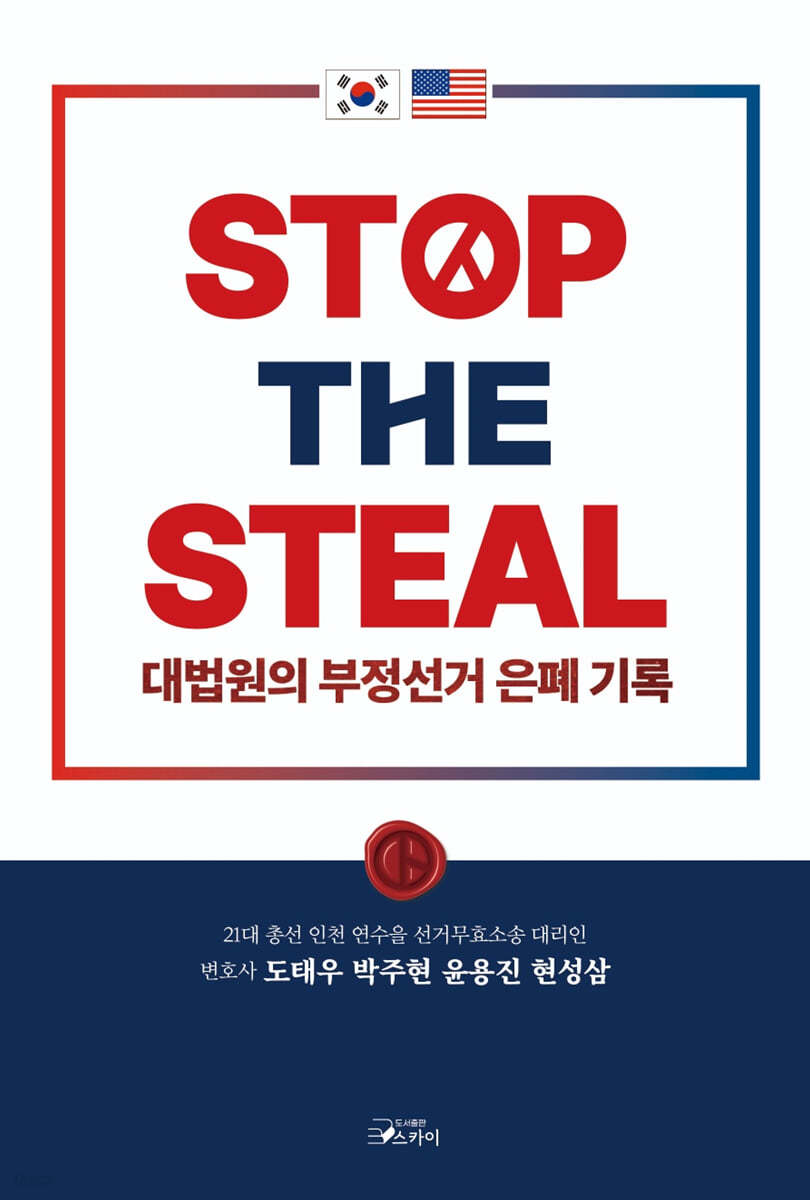
STOP THE STEAL: The Supreme Court's Election Fraud Cover-Up
 |
Description
Book Introduction
Criticism of the ruling on the Incheon Yeonsu-gu district election invalidation lawsuit in the April 15 general election
Criticism of the problems with the Supreme Court ruling
Four lawyers who represented former lawmaker Min Kyung-wook, who ran for Incheon Yeonsu-gu in the April 15, 2020 general election, have published a book criticizing the Supreme Court's ruling.
The April 15, 2020 general election served as a catalyst for the National Election Commission to raise suspicions of election fraud, with over 120 election lawsuits filed.
Among the election lawsuits related to the April 15th general election, the Yeonsu-gu lawsuit was the first to have evidence preserved and a complaint filed, and was a representative case in which the most arguments were made.
The book criticized the problems with the Supreme Court's ruling, which was handed down after 2 years and 3 months, or 820 days, in violation of the law that requires the Supreme Court to decide election lawsuits within 180 days of filing the lawsuit.
Criticism of the problems with the Supreme Court ruling
Four lawyers who represented former lawmaker Min Kyung-wook, who ran for Incheon Yeonsu-gu in the April 15, 2020 general election, have published a book criticizing the Supreme Court's ruling.
The April 15, 2020 general election served as a catalyst for the National Election Commission to raise suspicions of election fraud, with over 120 election lawsuits filed.
Among the election lawsuits related to the April 15th general election, the Yeonsu-gu lawsuit was the first to have evidence preserved and a complaint filed, and was a representative case in which the most arguments were made.
The book criticized the problems with the Supreme Court's ruling, which was handed down after 2 years and 3 months, or 820 days, in violation of the law that requires the Supreme Court to decide election lawsuits within 180 days of filing the lawsuit.
- You can preview some of the book's contents.
Preview
index
preface
An 820-day election lawsuit, a symbolic ruling in the dark history of the judiciary.
The distortions and hidden fraud revealed in the Supreme Court ruling
The desperate struggle of bare-handed lawyers and citizens, and its fruits
Summary of the Supreme Court's Cover-Up of Election Fraud
1.
judgment without standards
go.
Election lawsuit ruling without provisions for regular elections
me.
An election trial that has determined the outcome of the plaintiff's loss
all.
The unconstitutional election litigation structure and election laws that have brought the court and the National Election Commission into an alliance
la.
The structure of the judgment distorts the plaintiff's claims about election justice.
mind.
Failure to understand or deliberately reject the framework of digital election fraud, which involves both online and offline operations.
Bar. Ignoring the violation of the secret ballot principle due to the use of QR codes.
buy.
The number of rolls of ballot paper for early voting was not managed, the sealing paper and sealing tape were not managed in quantity even though they were non-residue types, and the integrity of the early voting ballot papers could not be verified after the fact was ignored.
2.
Illegal evidence collection and obstruction of proof
go.
outline
me.
The defendant acknowledged the temporary office's "network separation" based solely on the defendant's PPT presentation.
all.
Even when evidence supporting the plaintiff's claims is presented, the defendant's claims are accepted without providing evidence (regarding the Japanese flag ballot).
la.
Despite the submission of evidence showing that the postal delivery records for overseas advance voting were 40.4% abnormal, the results were determined to be false without any evidence or rebuttal.
mind.
During the recount verification, the plaintiff's side was prohibited from filming and even photography was restricted, and the original court-filmed videos and photos were deleted.
bar.
The court accepted the ballot image file submitted by the National Election Commission as evidence, even though the plaintiff did not accept it as evidence because it was a copy.
buy.
The court completely rejected the server's request for preservation of evidence, and the National Election Commission dismantled and relocated the server.
ah.
Evidence investigation into the implementation of communication functions such as electronic voting machines has not been conducted.
ruler.
In addition to the two types of ballot papers used in the election in question, all 37 types of unidentified ballot papers brought by the defendant were used as subjects for comparison in the ballot paper appraisal.
car.
The court refused to send a fact-finding inquiry to Epson headquarters in Japan, and the Korea Post refused to respond to the inquiry regarding delivery records.
card.
No recounting/re-verification of the 300 additional overseas early voting ballots at the recount center.
get on.
Refusing to submit the unified voter list, the plaintiff submitted a list with personal information modified so that it could not be verified.
green onion.
The Supreme Court ignored even the testimony that was provided after only two witness examinations.
under.
Requesting the plaintiff to identify the perpetrator and method of the crime in a situation where no compulsory investigation has been conducted.
thing.
Refusing to reasonably share the burden of proof, placing an impossible burden of proof on the plaintiff, and then losing the case due to insufficient evidence.
3.
Evidence of election fraud
go.
outline
me.
Japanese flag ballot
all.
New Voting Cards
la.
Cabbage leaf ballot paper
mind.
Extremely biased, discolored, damaged, and skewed ballots
bar.
Ballots with glue on them, ballots that fall off with a clicking sound, and ballots with multiple sheets stuck together
buy.
Ballots of different lengths, with crooked seals, without official seals, and without serial numbers
ah.
Ballot evaluation results
ruler.
Discrepancies in the numbers of overseas advance voting and delivery records
car.
impossible numbers
4.
The changed ballot storage room doorknobs in Incheon Yeonsu-eul, Bucheon, Paju-eul, Buyeo, Seongbuk-eul, and Yeongdeungpo-eul
A. Distortion of the plaintiff's claims regarding QR code verification and the sick judiciary
me.
The National Election Commission broadcast a notice at the counting center asking people not to film the electronic voting machines.
all.
The case of the Sinjung-dong polling station in Bucheon City, where 10,000 people voted in one day
la.
The incident in which 20 ballots were missing from the election management office in Geumchon 2-dong, Paju City, without the official seal and one ballot that was issued without the serial number sheet being removed.
mind.
Let's reset the electronic voting machines in Buyeo, South Chungcheong Province, and Seongbuk, Seoul.
bar.
The doorknob of the changed ballot storage room in Yeongdeungpo-eul, Seoul
Conclusion: The Ruling's Future Implications
Reference material: Supreme Court Decision No. 2020su30 on the Invalidity of the National Assembly Election
Postscript: If only the trial had gone well, there would have been no martial law. - Min Kyung-wook
About the Author
An 820-day election lawsuit, a symbolic ruling in the dark history of the judiciary.
The distortions and hidden fraud revealed in the Supreme Court ruling
The desperate struggle of bare-handed lawyers and citizens, and its fruits
Summary of the Supreme Court's Cover-Up of Election Fraud
1.
judgment without standards
go.
Election lawsuit ruling without provisions for regular elections
me.
An election trial that has determined the outcome of the plaintiff's loss
all.
The unconstitutional election litigation structure and election laws that have brought the court and the National Election Commission into an alliance
la.
The structure of the judgment distorts the plaintiff's claims about election justice.
mind.
Failure to understand or deliberately reject the framework of digital election fraud, which involves both online and offline operations.
Bar. Ignoring the violation of the secret ballot principle due to the use of QR codes.
buy.
The number of rolls of ballot paper for early voting was not managed, the sealing paper and sealing tape were not managed in quantity even though they were non-residue types, and the integrity of the early voting ballot papers could not be verified after the fact was ignored.
2.
Illegal evidence collection and obstruction of proof
go.
outline
me.
The defendant acknowledged the temporary office's "network separation" based solely on the defendant's PPT presentation.
all.
Even when evidence supporting the plaintiff's claims is presented, the defendant's claims are accepted without providing evidence (regarding the Japanese flag ballot).
la.
Despite the submission of evidence showing that the postal delivery records for overseas advance voting were 40.4% abnormal, the results were determined to be false without any evidence or rebuttal.
mind.
During the recount verification, the plaintiff's side was prohibited from filming and even photography was restricted, and the original court-filmed videos and photos were deleted.
bar.
The court accepted the ballot image file submitted by the National Election Commission as evidence, even though the plaintiff did not accept it as evidence because it was a copy.
buy.
The court completely rejected the server's request for preservation of evidence, and the National Election Commission dismantled and relocated the server.
ah.
Evidence investigation into the implementation of communication functions such as electronic voting machines has not been conducted.
ruler.
In addition to the two types of ballot papers used in the election in question, all 37 types of unidentified ballot papers brought by the defendant were used as subjects for comparison in the ballot paper appraisal.
car.
The court refused to send a fact-finding inquiry to Epson headquarters in Japan, and the Korea Post refused to respond to the inquiry regarding delivery records.
card.
No recounting/re-verification of the 300 additional overseas early voting ballots at the recount center.
get on.
Refusing to submit the unified voter list, the plaintiff submitted a list with personal information modified so that it could not be verified.
green onion.
The Supreme Court ignored even the testimony that was provided after only two witness examinations.
under.
Requesting the plaintiff to identify the perpetrator and method of the crime in a situation where no compulsory investigation has been conducted.
thing.
Refusing to reasonably share the burden of proof, placing an impossible burden of proof on the plaintiff, and then losing the case due to insufficient evidence.
3.
Evidence of election fraud
go.
outline
me.
Japanese flag ballot
all.
New Voting Cards
la.
Cabbage leaf ballot paper
mind.
Extremely biased, discolored, damaged, and skewed ballots
bar.
Ballots with glue on them, ballots that fall off with a clicking sound, and ballots with multiple sheets stuck together
buy.
Ballots of different lengths, with crooked seals, without official seals, and without serial numbers
ah.
Ballot evaluation results
ruler.
Discrepancies in the numbers of overseas advance voting and delivery records
car.
impossible numbers
4.
The changed ballot storage room doorknobs in Incheon Yeonsu-eul, Bucheon, Paju-eul, Buyeo, Seongbuk-eul, and Yeongdeungpo-eul
A. Distortion of the plaintiff's claims regarding QR code verification and the sick judiciary
me.
The National Election Commission broadcast a notice at the counting center asking people not to film the electronic voting machines.
all.
The case of the Sinjung-dong polling station in Bucheon City, where 10,000 people voted in one day
la.
The incident in which 20 ballots were missing from the election management office in Geumchon 2-dong, Paju City, without the official seal and one ballot that was issued without the serial number sheet being removed.
mind.
Let's reset the electronic voting machines in Buyeo, South Chungcheong Province, and Seongbuk, Seoul.
bar.
The doorknob of the changed ballot storage room in Yeongdeungpo-eul, Seoul
Conclusion: The Ruling's Future Implications
Reference material: Supreme Court Decision No. 2020su30 on the Invalidity of the National Assembly Election
Postscript: If only the trial had gone well, there would have been no martial law. - Min Kyung-wook
About the Author
Publisher's Review
The book President Yoon has been waiting for has finally been released.
Attorneys Do Tae-woo, Park Joo-hyun, Yoon Yong-jin, and Hyun Seong-sam publish "Stop the Steal."
Criticism of the ruling on the Incheon Yeonsu-gu district election invalidation lawsuit in the April 15 general election
A point-by-point critique of the problems with the Supreme Court's ruling.
Four lawyers who represented former lawmaker Min Kyung-wook, who ran for Incheon Yeonsu-gu in the April 15, 2020 general election, have published a book criticizing the Supreme Court's ruling.
The April 15, 2020 general election served as a catalyst for the National Election Commission to raise suspicions of election fraud, with over 120 election lawsuits filed.
Among the election lawsuits related to the April 15th general election, the Yeonsu-gu lawsuit was the first to have evidence preserved and a complaint filed, and was a representative case in which the most arguments were made.
The book criticized the problems with the Supreme Court's ruling, which was handed down after 2 years and 3 months, or 820 days, in violation of the law that requires the Supreme Court to decide election lawsuits within 180 days of filing the lawsuit.
As a representative problem with the ruling, lawyers say that the Supreme Court distorted the testimony, evidence, and verification results by fully accepting only the National Election Commission's claims, despite the fact that numerous abnormal ballots appeared at the recount site on June 28, 2021, including Japanese flag ballots (ballots with the election supervisor's seal blurred), stiff ballots like a bundle of new bills, cabbage leaf ballots (ballots with the top of the proportional representation ballot printed at the bottom of the district ballot), and ballots with glue that did not separate from each other.
The lawyers also strongly criticized the fact that the early voting rate, which was 12.19% in the 20th general election in 2016, increased significantly to 26.69% in the 21st general election, and that the number of early voters was managed only on the National Election Commission's server, and that their request for server verification to confirm whether the actual number of early voters and the number of early voters announced by the National Election Commission matched was not accepted.
According to the lawyers, the verdict mentions "on-site verification on December 14, 2020" several times, expressing that digital verification was thoroughly conducted. However, in reality, the on-site verification consisted of listening to a two-hour PPT presentation by an election commission employee.
The ruling cites this on-site verification as the basis for its judgment on several suspicions of computer manipulation, including the fact that the computer networks between the National Election Commission and the temporary office were separated.
Meanwhile, in October 2024, the National Intelligence Service discovered through verification that the National Election Commission's computer network was not isolated from the outside world.
The book's 'Summary of the Supreme Court's Election Fraud Records' presents, along with photos, the facts about the irregular ballots and the falsity of the on-site verification, the fact that the National Election Commission's copy of the integrated voter list had the voters' names and addresses deleted, yet the verdict states, "Whether or not they actually voted could have been confirmed, but there is no assertion or evidence on this," the fact that 39 unidentified types of roll paper were suddenly included in the ballot paper evaluation, the fact that the Korea Post did not submit an official delivery record despite discovering many problems with the postal delivery of overseas early voting, the fact that the management of overseas early voting was poor, citing the incident in 2022 where 50,000 overseas early voting ballots were discovered in the office of the Bucheon City Election Commission secretary, and the fact that the doorknob of the ballot storage room at the Yeongdeungpo-eul recount site for the April 15 general election in August 2021 was different from the doorknob in the photo taken when the ballots were stored a year ago.
Late last year, President Yoon Seok-yeol declared martial law and deployed more martial law troops to three National Election Commission facilities than to the National Assembly.
And in the president's first post-martial law speech, announced on December 12, he clearly mentioned the problems with the National Election Commission's computer system and the public's distrust of the election results.
In this situation, the fact that four lawyers who directly participated in the Yeonsu-gu election invalidation lawsuit, which is at the center of the controversy over election fraud, have written a book criticizing the verdict is expected to attract great interest during the impeachment trial of President Yoon.
Attorneys Do Tae-woo, Park Joo-hyun, Yoon Yong-jin, and Hyun Seong-sam publish "Stop the Steal."
Criticism of the ruling on the Incheon Yeonsu-gu district election invalidation lawsuit in the April 15 general election
A point-by-point critique of the problems with the Supreme Court's ruling.
Four lawyers who represented former lawmaker Min Kyung-wook, who ran for Incheon Yeonsu-gu in the April 15, 2020 general election, have published a book criticizing the Supreme Court's ruling.
The April 15, 2020 general election served as a catalyst for the National Election Commission to raise suspicions of election fraud, with over 120 election lawsuits filed.
Among the election lawsuits related to the April 15th general election, the Yeonsu-gu lawsuit was the first to have evidence preserved and a complaint filed, and was a representative case in which the most arguments were made.
The book criticized the problems with the Supreme Court's ruling, which was handed down after 2 years and 3 months, or 820 days, in violation of the law that requires the Supreme Court to decide election lawsuits within 180 days of filing the lawsuit.
As a representative problem with the ruling, lawyers say that the Supreme Court distorted the testimony, evidence, and verification results by fully accepting only the National Election Commission's claims, despite the fact that numerous abnormal ballots appeared at the recount site on June 28, 2021, including Japanese flag ballots (ballots with the election supervisor's seal blurred), stiff ballots like a bundle of new bills, cabbage leaf ballots (ballots with the top of the proportional representation ballot printed at the bottom of the district ballot), and ballots with glue that did not separate from each other.
The lawyers also strongly criticized the fact that the early voting rate, which was 12.19% in the 20th general election in 2016, increased significantly to 26.69% in the 21st general election, and that the number of early voters was managed only on the National Election Commission's server, and that their request for server verification to confirm whether the actual number of early voters and the number of early voters announced by the National Election Commission matched was not accepted.
According to the lawyers, the verdict mentions "on-site verification on December 14, 2020" several times, expressing that digital verification was thoroughly conducted. However, in reality, the on-site verification consisted of listening to a two-hour PPT presentation by an election commission employee.
The ruling cites this on-site verification as the basis for its judgment on several suspicions of computer manipulation, including the fact that the computer networks between the National Election Commission and the temporary office were separated.
Meanwhile, in October 2024, the National Intelligence Service discovered through verification that the National Election Commission's computer network was not isolated from the outside world.
The book's 'Summary of the Supreme Court's Election Fraud Records' presents, along with photos, the facts about the irregular ballots and the falsity of the on-site verification, the fact that the National Election Commission's copy of the integrated voter list had the voters' names and addresses deleted, yet the verdict states, "Whether or not they actually voted could have been confirmed, but there is no assertion or evidence on this," the fact that 39 unidentified types of roll paper were suddenly included in the ballot paper evaluation, the fact that the Korea Post did not submit an official delivery record despite discovering many problems with the postal delivery of overseas early voting, the fact that the management of overseas early voting was poor, citing the incident in 2022 where 50,000 overseas early voting ballots were discovered in the office of the Bucheon City Election Commission secretary, and the fact that the doorknob of the ballot storage room at the Yeongdeungpo-eul recount site for the April 15 general election in August 2021 was different from the doorknob in the photo taken when the ballots were stored a year ago.
Late last year, President Yoon Seok-yeol declared martial law and deployed more martial law troops to three National Election Commission facilities than to the National Assembly.
And in the president's first post-martial law speech, announced on December 12, he clearly mentioned the problems with the National Election Commission's computer system and the public's distrust of the election results.
In this situation, the fact that four lawyers who directly participated in the Yeonsu-gu election invalidation lawsuit, which is at the center of the controversy over election fraud, have written a book criticizing the verdict is expected to attract great interest during the impeachment trial of President Yoon.
GOODS SPECIFICS
- Date of issue: January 20, 2025
- Page count, weight, size: 215 pages | 409g | 158*231*20mm
- ISBN13: 9791198718532
- ISBN10: 1198718536
You may also like
카테고리
korean


korean

![GQ KOREA Mark (Monthly): December [2025]](http://librairie.coreenne.fr/cdn/shop/files/8ef265dbbfbf186523ed75ba7319009d.jpg?v=1765340328&width=3840)


