

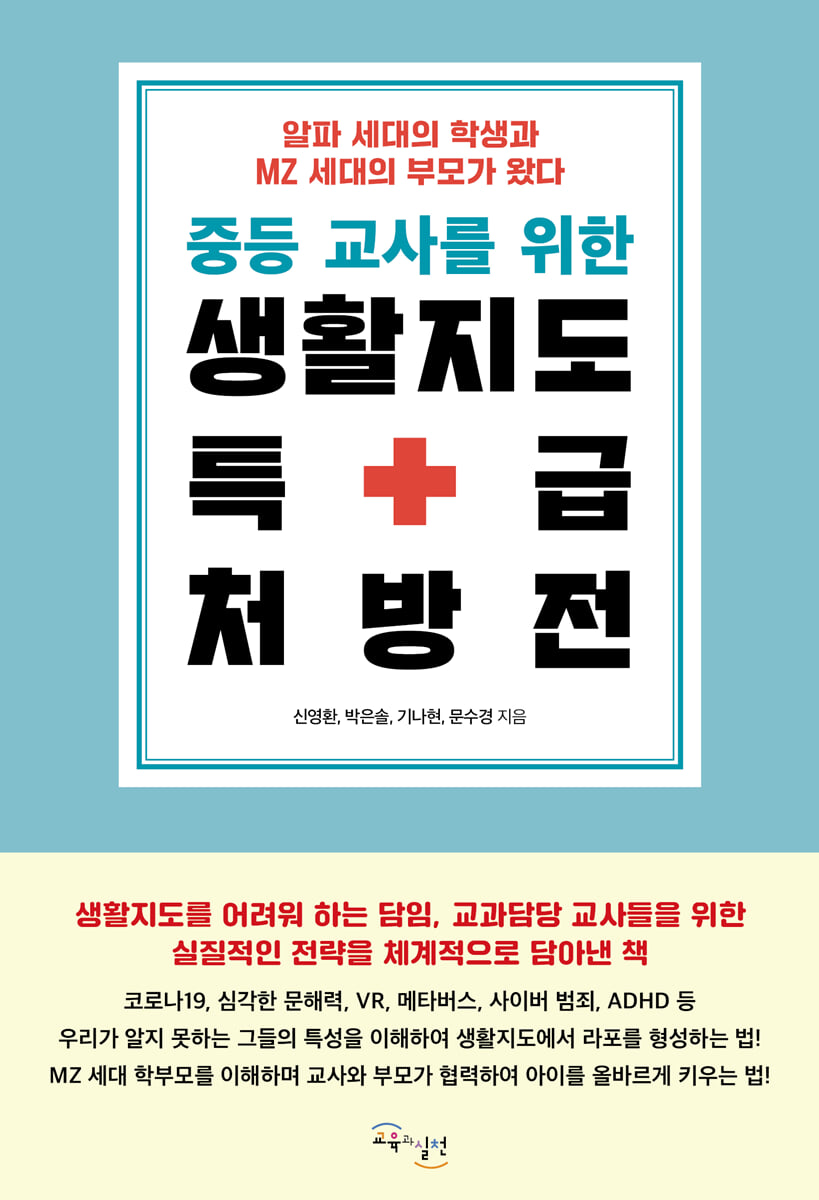
A Special Prescription for Life Guidance for Secondary School Teachers
 |
Description
Book Introduction
Students from Generation Alpha and their parents from Generation MZ have arrived.
For homeroom teachers and subject teachers who have difficulty in providing guidance
A book that systematically contains practical strategies
COVID-19, critical literacy, VR, the metaverse, cybercrime, ADHD, and more
How to build rapport in life guidance by understanding their characteristics that we do not know about!
Understanding the MZ generation and how teachers and parents can work together to raise children properly!
This book is a systematic collection of know-how and practical strategies for guiding students' lives, based on the extensive experience and expertise of four teachers.
In particular, the study deeply analyzes the educational environment and the characteristics of students from the MZ and Alpha generations that have changed during the COVID-19 era, and proposes teaching methods that take these characteristics into account, along with various real-life examples.
This book is comprised of four chapters, covering everything from understanding the characteristics of children in keeping with the changing times, to how to effectively manage a classroom as a homeroom teacher, how to practice guidance during class as a subject teacher, and even how teachers and parents can collaborate to guide students. It broadly covers all aspects of guidance, making it a special prescription for teachers who find guidance difficult.
For homeroom teachers and subject teachers who have difficulty in providing guidance
A book that systematically contains practical strategies
COVID-19, critical literacy, VR, the metaverse, cybercrime, ADHD, and more
How to build rapport in life guidance by understanding their characteristics that we do not know about!
Understanding the MZ generation and how teachers and parents can work together to raise children properly!
This book is a systematic collection of know-how and practical strategies for guiding students' lives, based on the extensive experience and expertise of four teachers.
In particular, the study deeply analyzes the educational environment and the characteristics of students from the MZ and Alpha generations that have changed during the COVID-19 era, and proposes teaching methods that take these characteristics into account, along with various real-life examples.
This book is comprised of four chapters, covering everything from understanding the characteristics of children in keeping with the changing times, to how to effectively manage a classroom as a homeroom teacher, how to practice guidance during class as a subject teacher, and even how teachers and parents can collaborate to guide students. It broadly covers all aspects of guidance, making it a special prescription for teachers who find guidance difficult.
- You can preview some of the book's contents.
Preview
index
index
Recommendation
Prologue Class or Life Guidance? That is the Question
Chapter 1: Understanding the Unknown Characteristics of Generation Alpha - Shin Young-hwan
Generation Alpha and the Relationships They Form
Students' Perceptions of Teachers Affected by COVID-19
A generation with a serious lack of literacy
The generation that plays in virtual reality and the metaverse
Generations highly exposed to cybercrime
A classroom where everyone is rife with ADHD
A generation where Korean, English, math, and English are important
The generation that receives New Year's money in stocks
Chapter 2: Classroom Guidance as a Homeroom Teacher - Eunsol Park
The month of March determines the entire year of the class.
Everything starts with the basics
Determining the direction of life guidance between autonomy and compulsion
Who Are You?: Understanding Your Student's Potential
Operating a class mentor/mentee system
Small teachings cultivate great character.
MEMEWE Project
Fill out your school records in advance
Chapter 3: Guidance Methods for Classroom Life as a Subject Teacher - Gina-Hyeon
My class is a life class
If you have a child who sleeps during class
Don't skimp on praise for the presentation king.
Sometimes teachers do more counseling than homeroom teachers
Student-led class time
It's okay to take a day off
The intersection of character education and performance assessment
Catch up on media/digital literacy
Chapter 4: How Teachers and Parents Collaborate to Guide Our Children's Lives - Moon Soo-kyung
Understanding Generation MZ Parents
Understanding Different Types of Parents
First Meetings Are So Hard: Preparing for a Parent-Teacher Meeting
When and how should parent-teacher conferences be held?
Collaborating with Parents: Becoming a Messenger for Your Adolescent
A collaborative project to prevent smartphone addiction
From Crisis to Growth: Responding to Complaints About Violations of Teacher Rights
Working with parents to address school violence
Epilogue: I hope that at least one person will change positively.
Recommendation
Prologue Class or Life Guidance? That is the Question
Chapter 1: Understanding the Unknown Characteristics of Generation Alpha - Shin Young-hwan
Generation Alpha and the Relationships They Form
Students' Perceptions of Teachers Affected by COVID-19
A generation with a serious lack of literacy
The generation that plays in virtual reality and the metaverse
Generations highly exposed to cybercrime
A classroom where everyone is rife with ADHD
A generation where Korean, English, math, and English are important
The generation that receives New Year's money in stocks
Chapter 2: Classroom Guidance as a Homeroom Teacher - Eunsol Park
The month of March determines the entire year of the class.
Everything starts with the basics
Determining the direction of life guidance between autonomy and compulsion
Who Are You?: Understanding Your Student's Potential
Operating a class mentor/mentee system
Small teachings cultivate great character.
MEMEWE Project
Fill out your school records in advance
Chapter 3: Guidance Methods for Classroom Life as a Subject Teacher - Gina-Hyeon
My class is a life class
If you have a child who sleeps during class
Don't skimp on praise for the presentation king.
Sometimes teachers do more counseling than homeroom teachers
Student-led class time
It's okay to take a day off
The intersection of character education and performance assessment
Catch up on media/digital literacy
Chapter 4: How Teachers and Parents Collaborate to Guide Our Children's Lives - Moon Soo-kyung
Understanding Generation MZ Parents
Understanding Different Types of Parents
First Meetings Are So Hard: Preparing for a Parent-Teacher Meeting
When and how should parent-teacher conferences be held?
Collaborating with Parents: Becoming a Messenger for Your Adolescent
A collaborative project to prevent smartphone addiction
From Crisis to Growth: Responding to Complaints About Violations of Teacher Rights
Working with parents to address school violence
Epilogue: I hope that at least one person will change positively.
Publisher's Review
Understanding Generation Alpha Traits We Don't Know About
First, let's learn about the characteristics of the Alpha Generation!
As we experience COVID-19, our physical and emotional connections with others have become looser.
Because of this, it is not easy to guide children, whether in class or in life guidance.
I sympathize with the situation in which the issue of the collapse of the authority of the church has occurred repeatedly.
I think that in order to guide children, whether in class or in life guidance, it is advantageous to first build a close relationship.
For that reason, I planned this book with the thought that understanding the Alpha Generation was necessary first.
Additionally, since this book focuses on life guidance rather than classroom guidance, it shares experiences through case studies on how to best guide children as a homeroom teacher or subject teacher.
How to Lead Classroom Life as a Homeroom Teacher
The class is another society.
After spending a year with children, you will begin to see their tendencies and characteristics, and the children will begin to understand each other and their classmates.
For example, I once had to mediate a fight between a friend with a T tendency and a friend with an F tendency because of their speech patterns. The atmosphere was serious at first, but after I explained our differences by talking about MBTI tendencies, it was successfully resolved and it didn't turn into a big issue.
At first, I wondered if this was the right system to use, but at the end of the school year, I felt proud when the children told me that the special seating arrangements were the most memorable part of our class activities.
Children in their teens are immature beings, soft and easily broken, like soft tofu.
I think that students who have deeply explored who they are and what their tendencies are can be helped to overcome that immaturity.
Also, because the classroom is another society, if the homeroom teacher understands the children's tendencies, they can get through the year more easily than anyone else.
How to Lead Class Life as a Subject Teacher
Children's initiative is the essence of class.
Even if it takes more time, the learning content becomes the learner's own when the class is filled with self-directed experiences rather than just listening to the teacher's explanations.
In a survey conducted at the end of each semester, the majority of students cite performance assessments as the most memorable class.
Although there were some trial and errors along the way, I felt that the classes in which I took the initiative were the most 'learning-worthy'.
Sometimes teachers focus so much on effectively conveying the lesson material that they lose sight of what is truly important.
We must not forget that true learning is accomplished through students' proactive participation and experiences, not through the teacher's explanations.
Our Child Guidance Method through Collaboration Between Teachers and Parents
Let's understand and cooperate with the parents of the MZ generation.
Just as there are different types of students in schools, parents also have different tendencies and needs.
Although they are different, they have a common goal.
Our children's happiness at school, and their happiness at school, in turn, helps them grow into good adults and become healthy members of society.
The teacher's goal is the same.
So we need to work together with parents.
The basis of collaboration is understanding each other.
When you understand the environment and values your parents grew up in, it becomes easier to establish principles for conversation.
Listening, or attentive listening, is the most useful weapon in any relationship.
You need to be able to accurately pinpoint what parents want through listening.
And every student is precious.
We must show our valued students through praise.
Giving specific examples of a student's strengths, even if they are small, can help parents build trust in the teacher.
Advice from a trusted teacher can be invaluable information for parents.
First, let's learn about the characteristics of the Alpha Generation!
As we experience COVID-19, our physical and emotional connections with others have become looser.
Because of this, it is not easy to guide children, whether in class or in life guidance.
I sympathize with the situation in which the issue of the collapse of the authority of the church has occurred repeatedly.
I think that in order to guide children, whether in class or in life guidance, it is advantageous to first build a close relationship.
For that reason, I planned this book with the thought that understanding the Alpha Generation was necessary first.
Additionally, since this book focuses on life guidance rather than classroom guidance, it shares experiences through case studies on how to best guide children as a homeroom teacher or subject teacher.
How to Lead Classroom Life as a Homeroom Teacher
The class is another society.
After spending a year with children, you will begin to see their tendencies and characteristics, and the children will begin to understand each other and their classmates.
For example, I once had to mediate a fight between a friend with a T tendency and a friend with an F tendency because of their speech patterns. The atmosphere was serious at first, but after I explained our differences by talking about MBTI tendencies, it was successfully resolved and it didn't turn into a big issue.
At first, I wondered if this was the right system to use, but at the end of the school year, I felt proud when the children told me that the special seating arrangements were the most memorable part of our class activities.
Children in their teens are immature beings, soft and easily broken, like soft tofu.
I think that students who have deeply explored who they are and what their tendencies are can be helped to overcome that immaturity.
Also, because the classroom is another society, if the homeroom teacher understands the children's tendencies, they can get through the year more easily than anyone else.
How to Lead Class Life as a Subject Teacher
Children's initiative is the essence of class.
Even if it takes more time, the learning content becomes the learner's own when the class is filled with self-directed experiences rather than just listening to the teacher's explanations.
In a survey conducted at the end of each semester, the majority of students cite performance assessments as the most memorable class.
Although there were some trial and errors along the way, I felt that the classes in which I took the initiative were the most 'learning-worthy'.
Sometimes teachers focus so much on effectively conveying the lesson material that they lose sight of what is truly important.
We must not forget that true learning is accomplished through students' proactive participation and experiences, not through the teacher's explanations.
Our Child Guidance Method through Collaboration Between Teachers and Parents
Let's understand and cooperate with the parents of the MZ generation.
Just as there are different types of students in schools, parents also have different tendencies and needs.
Although they are different, they have a common goal.
Our children's happiness at school, and their happiness at school, in turn, helps them grow into good adults and become healthy members of society.
The teacher's goal is the same.
So we need to work together with parents.
The basis of collaboration is understanding each other.
When you understand the environment and values your parents grew up in, it becomes easier to establish principles for conversation.
Listening, or attentive listening, is the most useful weapon in any relationship.
You need to be able to accurately pinpoint what parents want through listening.
And every student is precious.
We must show our valued students through praise.
Giving specific examples of a student's strengths, even if they are small, can help parents build trust in the teacher.
Advice from a trusted teacher can be invaluable information for parents.
GOODS SPECIFICS
- Date of issue: January 17, 2025
- Page count, weight, size: 220 pages | 312g | 140*205*17mm
- ISBN13: 9791191724776
- ISBN10: 1191724778
You may also like
카테고리
korean


korean

![GQ KOREA Mark (Monthly): December [2025]](http://librairie.coreenne.fr/cdn/shop/files/8ef265dbbfbf186523ed75ba7319009d.jpg?v=1765340328&width=3840)


