

Jeong Yeong-jin's Regrets of the Times
 |
Description
Book Introduction
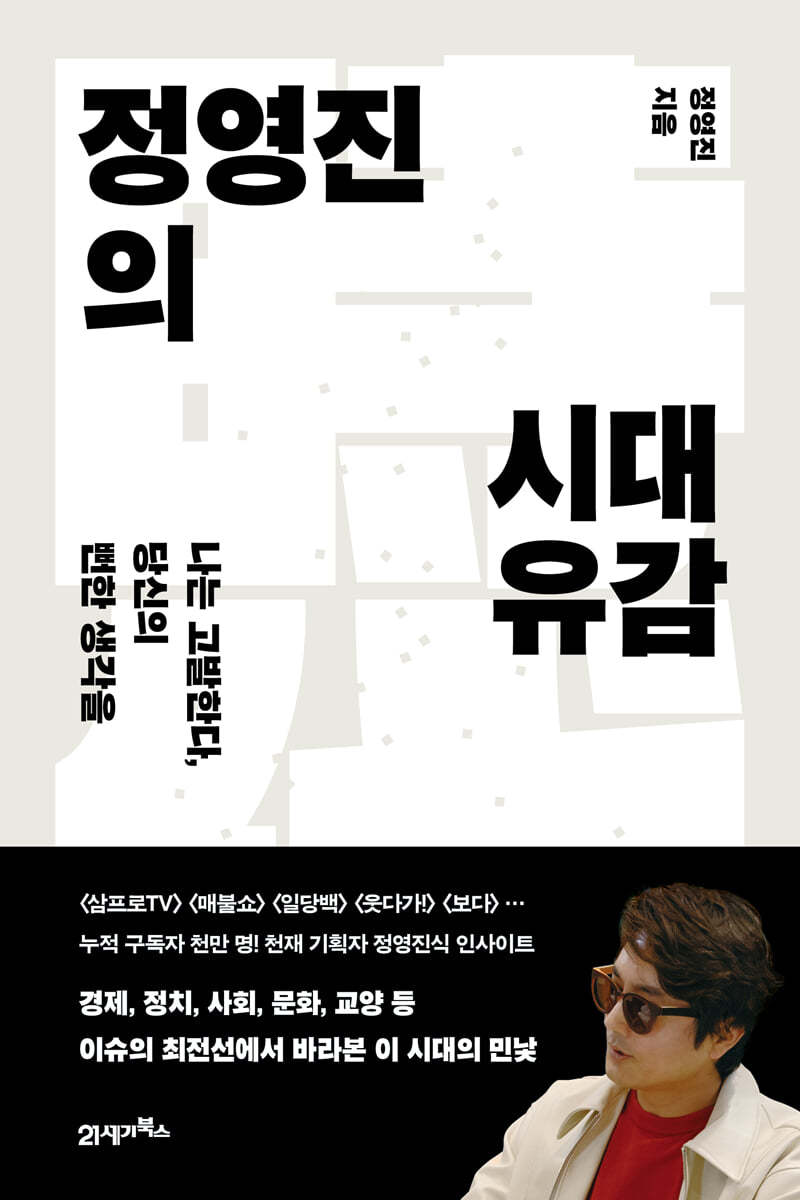
〈Sampro TV〉, 〈Maebul Show〉, 〈One in a Million〉, 〈Laugh and See〉, 〈See〉 …
Ten Million Cumulative Subscribers! Insights from Genius Planner Jeong Young-jin
Economy, politics, society, culture, liberal arts, etc.
The true face of this era, seen from the forefront of issues
“Rather than offering feeble consolation or sympathy,
“Let me ask you an uncomfortable question.”
MC Jeong Young-jin, a unique new media content planner
In the field of the fastest information and the widest knowledge
Things I've thought about while rolling around for over 10 years
A book has been published by Jeong Young-jin, a genius planner and MC with 10 million cumulative subscribers on YouTube channels such as Sampro TV, Maebul Show, and Boda.
Many people have been curious about what goes on in his head as he continues to create excellent plans that exquisitely capture the intersection between expert insight and the public's desires, and asks sharp questions that pique viewers' curiosity.
But because he mostly played the role of a presenter, his thoughts were as elusive as his signature black sunglasses.
Accordingly, Jeong Yeong-jin decided to convey various thoughts and honest views on our times, which were difficult to convey through broadcasting, through books.
As the title, ‘Regret of the Times’, suggests, the author states that he wrote this book out of frustration.
This is because most people have no thoughts of their own on the various issues that are happening in our time, but rather parrot the words of politicians they support, YouTubers they subscribe to, philosophers they respect, and close friends, or they go along with the mainstream opinion.
So the author deliberately chose a topic that was expected to provoke sharp conflict and expressed his thoughts on it.
And if any complaints or objections arise here, I tell them to think carefully about whether it is solely their own thoughts or something someone else said.
This concern will enable us to live a life of self-direction, free from the sway of others' gaze or authority, and will become the first step toward a better society.
In this book, author Jeong Yeong-jin unravels 64 issues that are shaking South Korea in sharp, blunt sentences.
This clearly demonstrates his inner strength as a planner and the insight he has gained from dealing with top-tier experts.
The author sharply criticizes MBTI, empathy addiction, social media, and nationalism, while also reflecting on weighty topics such as humanity, happiness, and death from a humanistic perspective, and does not shy away from political issues such as the recent martial law.
In fact, the core of this book lies in the 'uncomfortable questions' it poses on sensitive topics such as equality, the weak, wealth, class, generational theory, and gender.
The author is convinced that not avoiding such stories and allowing everyone to have their own opinions is the path to a truly good society.
So, I intentionally excluded numbers and expert opinions so as not to hesitate in front of authority and statistics.
As the author says, “When thinking ends, life ends,” so if you “think and fight, fight and think again,” you will soon break free from obvious thoughts and arrive at an era without regrets.
Ten Million Cumulative Subscribers! Insights from Genius Planner Jeong Young-jin
Economy, politics, society, culture, liberal arts, etc.
The true face of this era, seen from the forefront of issues
“Rather than offering feeble consolation or sympathy,
“Let me ask you an uncomfortable question.”
MC Jeong Young-jin, a unique new media content planner
In the field of the fastest information and the widest knowledge
Things I've thought about while rolling around for over 10 years
A book has been published by Jeong Young-jin, a genius planner and MC with 10 million cumulative subscribers on YouTube channels such as Sampro TV, Maebul Show, and Boda.
Many people have been curious about what goes on in his head as he continues to create excellent plans that exquisitely capture the intersection between expert insight and the public's desires, and asks sharp questions that pique viewers' curiosity.
But because he mostly played the role of a presenter, his thoughts were as elusive as his signature black sunglasses.
Accordingly, Jeong Yeong-jin decided to convey various thoughts and honest views on our times, which were difficult to convey through broadcasting, through books.
As the title, ‘Regret of the Times’, suggests, the author states that he wrote this book out of frustration.
This is because most people have no thoughts of their own on the various issues that are happening in our time, but rather parrot the words of politicians they support, YouTubers they subscribe to, philosophers they respect, and close friends, or they go along with the mainstream opinion.
So the author deliberately chose a topic that was expected to provoke sharp conflict and expressed his thoughts on it.
And if any complaints or objections arise here, I tell them to think carefully about whether it is solely their own thoughts or something someone else said.
This concern will enable us to live a life of self-direction, free from the sway of others' gaze or authority, and will become the first step toward a better society.
In this book, author Jeong Yeong-jin unravels 64 issues that are shaking South Korea in sharp, blunt sentences.
This clearly demonstrates his inner strength as a planner and the insight he has gained from dealing with top-tier experts.
The author sharply criticizes MBTI, empathy addiction, social media, and nationalism, while also reflecting on weighty topics such as humanity, happiness, and death from a humanistic perspective, and does not shy away from political issues such as the recent martial law.
In fact, the core of this book lies in the 'uncomfortable questions' it poses on sensitive topics such as equality, the weak, wealth, class, generational theory, and gender.
The author is convinced that not avoiding such stories and allowing everyone to have their own opinions is the path to a truly good society.
So, I intentionally excluded numbers and expert opinions so as not to hesitate in front of authority and statistics.
As the author says, “When thinking ends, life ends,” so if you “think and fight, fight and think again,” you will soon break free from obvious thoughts and arrive at an era without regrets.
- You can preview some of the book's contents.
Preview
index
As I enter, I accuse you of your obvious thinking.
PART 1 [Revealing the Contradiction]
Living without worries is a great crisis.
01 Why are you human?
02 When you remember death, only the truly precious things remain.
03 Move quickly to a life that needs no explanation.
04 Adults must endure ambiguity
05 The World's Most Pathetic Word: "Empathy"
06 Anyone who knows me doesn't need MBTI.
07 Why are the values of sea turtles and barnacles different?
08 Can we distrust AI judges?
09 Why no one steals your laptop from a cafe
Even those who eat 10 need tolerance
11 The illusion that happiness is a given
12 People Trapped in the Modern Class System
13 How about we all speak informally?
14 Where did all the trash cans go?
15 Instead of anger management disorder, say ‘I’m good at anger management’
16 Knowing the Reason for Anxiety Brings Peace of Mind
17 101 Reasons to Decide to Get Married
18 Are you feeling frustrated too? I feel frustrated too.
19 Selfies are not your face
20 Reasons Why People Give Up Their Privacy and Become Instagram Enthusiasts
PART 2 [Laughing at Pretense]
- Beware of people who tell stories that everyone likes.
01 A single 'warm' word that ruins your life
02 Rather than lying still and waiting for death…
03 Buy food for your successful friend first
04 If you are stupid, the people around you will suffer.
05 You can be proud without being 'nationalistic'
06 Why is Hangul superior? Because it must be superior.
07 Why the original debate is meaningless
08 Obsessing over the past is just a mental victory.
09 The lie that I was disappointed in your lies
10 There is no such thing as a good voter
11 How about using 'Baemin' a little?
12 What do I have to say to those of you who can't sleep because of the price of chicken?
13 Where is there an excuse in life?
14 How great would it be if we could discount our telecommunications charges?
15 A society that seeks only the rich and avoids the crumbs
16 There's nothing to celebrate, it's so damn sad.
17 Idol Tribute, That Foolish Unrequited Love
Where do the billions of dollars celebrities earn come from?
19 There is no middle ground between admiration and contempt.
20 countries obsessed with eating
21. A hasty apology is surprisingly dangerous.
22 The driving forces of life are survival, reproduction, and comfort.
PART 3 [Speaking of Beliefs]
- The oblivious person changed the world.
01 I'm sorry for creating a pathetic generation like yours.
02 Don't leave the revolution to others.
03 The degree of suffering is determined by society.
04 One hero, Lim Young-woong, is enough.
05 The misconception that the weak are good people
06 Why the Social Safety Net Increases Birth Rates
07 To those who say that sexual commercialization is wrong
08 Let's live by watching some dirty stuff
09 A world where the minority oppresses the majority
10 If women's rights were higher, would better menstrual pain medications be available?
11 The difference between a genius and a madman is one step
12 Equal Opportunity? Let's give it a try.
13 Let's save the planet by banning plastic use.
14 Why are milk and rice so expensive in our country?
Balanced Regional Development? There's No Balance in Human Desire
16 Apartments are the optimal housing type to prevent waste of resources.
17 I can't live because of gentrification.
18 Greatness is to expand the boundaries of the times by an inch.
19 To YouTubers who have experienced racial discrimination overseas
20 To what extent should religious freedom be respected?
21 Where is my right to die as I please?
22 I want to live a life that balances my life rather than choosing my side.
Asking while leaving may be a little embarrassing, but not asking will be a lifelong embarrassment.
Regret of the Times: Martial Law
PART 1 [Revealing the Contradiction]
Living without worries is a great crisis.
01 Why are you human?
02 When you remember death, only the truly precious things remain.
03 Move quickly to a life that needs no explanation.
04 Adults must endure ambiguity
05 The World's Most Pathetic Word: "Empathy"
06 Anyone who knows me doesn't need MBTI.
07 Why are the values of sea turtles and barnacles different?
08 Can we distrust AI judges?
09 Why no one steals your laptop from a cafe
Even those who eat 10 need tolerance
11 The illusion that happiness is a given
12 People Trapped in the Modern Class System
13 How about we all speak informally?
14 Where did all the trash cans go?
15 Instead of anger management disorder, say ‘I’m good at anger management’
16 Knowing the Reason for Anxiety Brings Peace of Mind
17 101 Reasons to Decide to Get Married
18 Are you feeling frustrated too? I feel frustrated too.
19 Selfies are not your face
20 Reasons Why People Give Up Their Privacy and Become Instagram Enthusiasts
PART 2 [Laughing at Pretense]
- Beware of people who tell stories that everyone likes.
01 A single 'warm' word that ruins your life
02 Rather than lying still and waiting for death…
03 Buy food for your successful friend first
04 If you are stupid, the people around you will suffer.
05 You can be proud without being 'nationalistic'
06 Why is Hangul superior? Because it must be superior.
07 Why the original debate is meaningless
08 Obsessing over the past is just a mental victory.
09 The lie that I was disappointed in your lies
10 There is no such thing as a good voter
11 How about using 'Baemin' a little?
12 What do I have to say to those of you who can't sleep because of the price of chicken?
13 Where is there an excuse in life?
14 How great would it be if we could discount our telecommunications charges?
15 A society that seeks only the rich and avoids the crumbs
16 There's nothing to celebrate, it's so damn sad.
17 Idol Tribute, That Foolish Unrequited Love
Where do the billions of dollars celebrities earn come from?
19 There is no middle ground between admiration and contempt.
20 countries obsessed with eating
21. A hasty apology is surprisingly dangerous.
22 The driving forces of life are survival, reproduction, and comfort.
PART 3 [Speaking of Beliefs]
- The oblivious person changed the world.
01 I'm sorry for creating a pathetic generation like yours.
02 Don't leave the revolution to others.
03 The degree of suffering is determined by society.
04 One hero, Lim Young-woong, is enough.
05 The misconception that the weak are good people
06 Why the Social Safety Net Increases Birth Rates
07 To those who say that sexual commercialization is wrong
08 Let's live by watching some dirty stuff
09 A world where the minority oppresses the majority
10 If women's rights were higher, would better menstrual pain medications be available?
11 The difference between a genius and a madman is one step
12 Equal Opportunity? Let's give it a try.
13 Let's save the planet by banning plastic use.
14 Why are milk and rice so expensive in our country?
Balanced Regional Development? There's No Balance in Human Desire
16 Apartments are the optimal housing type to prevent waste of resources.
17 I can't live because of gentrification.
18 Greatness is to expand the boundaries of the times by an inch.
19 To YouTubers who have experienced racial discrimination overseas
20 To what extent should religious freedom be respected?
21 Where is my right to die as I please?
22 I want to live a life that balances my life rather than choosing my side.
Asking while leaving may be a little embarrassing, but not asking will be a lifelong embarrassment.
Regret of the Times: Martial Law
Detailed image

Into the book
We have been running without rest for a long time without asking why.
Still, there was always someone ahead of me, so there was no major problem getting here.
No one can deny that this alone is a great achievement.
So, now is the time to ask why, but instead, the question seems to have disappeared.
It is the result of the inertia of the older generations who did not ask why, and the fact that they raised the current generation without any deficiencies.
--- From "Why Are You Human?"
If you want to become a socially successful person rather than just a person with personal satisfaction, and you are not sure about what you are doing now, it is worth testing it out.
Compared to 3 or 5 years ago, have the words you use to describe yourself become longer or shorter?
If it's shorter, then you're on the right track.
On the other hand, if the explanation becomes longer and more complicated, it would not be wrong to conclude that the current direction is not right.
--- From "Move quickly to a life that needs no explanation"
There was a man who studied hard from a young age to become a doctor, and then married his girlfriend who studied with him.
His family was not well off, so the two worked without holidays and eventually took out a loan to buy a fairly large apartment in Gangnam.
The couple, who moved into a large apartment with a view of the Han River, planned to put on some nice music and have a cup of coffee on the terrace.
But to pay off the loan, the two worked hard to earn money again.
Even plans to have children are postponed.
Then one day, he left his cell phone behind and had to go back home.
At that time, I saw the cleaning lady sitting at the tea table on her apartment terrace enjoying a cup of coffee after finishing her morning cleaning.
Looking at the Han River.
--- From "The Illusion That Happiness Is Natural"
As responsible adults, especially those who have personally experienced these differences in the world, we must tell the next generation.
There is a tremendous amount of inequality in the world that is unfortunate but unavoidable, and overcoming it is not easy with just a little effort.
And that to reverse that gap, we need to put in a lot more effort than the gap that has widened.
And even if you put all your effort into it, there is no guarantee that you will overcome it.
That's the world.
--- From "A 'Warm' Word That Ruins a Life"
You might think the world is so cruel and bleak.
But if the world were not like that, we would not exist.
The human race today has survived against slim odds in the grasslands where life and death reign every day, and has survived wars that broke out every day and equally brutal famine and disease.
If we had enough to eat and live, we might not be humans now, but pandas, koalas, or sloths.
It is not that humans are living on the edge of death because they are too greedy, but rather that humans are beings that survived the competition, living on the edge of death.
--- From "I'm sorry for creating a pathetic generation like you"
This result is the result of people making foolish choices, and people will continue to make foolish choices in the future, just as they have in the past.
And there will definitely be a price to pay for that.
It is not known whether we will pay it off little by little in installments as foreign media outlets have assessed, or whether we will experience a major crisis like the IMF crisis and have it etched in our bones for quite some time.
In some way, we must take responsibility for our choices.
Even if you don't want to take responsibility, you have no choice but to take it.
At that time, I hope that we all feel deeply that even if it is a group choice, individual responsibility is not diminished, without blaming others or the world.
Still, there was always someone ahead of me, so there was no major problem getting here.
No one can deny that this alone is a great achievement.
So, now is the time to ask why, but instead, the question seems to have disappeared.
It is the result of the inertia of the older generations who did not ask why, and the fact that they raised the current generation without any deficiencies.
--- From "Why Are You Human?"
If you want to become a socially successful person rather than just a person with personal satisfaction, and you are not sure about what you are doing now, it is worth testing it out.
Compared to 3 or 5 years ago, have the words you use to describe yourself become longer or shorter?
If it's shorter, then you're on the right track.
On the other hand, if the explanation becomes longer and more complicated, it would not be wrong to conclude that the current direction is not right.
--- From "Move quickly to a life that needs no explanation"
There was a man who studied hard from a young age to become a doctor, and then married his girlfriend who studied with him.
His family was not well off, so the two worked without holidays and eventually took out a loan to buy a fairly large apartment in Gangnam.
The couple, who moved into a large apartment with a view of the Han River, planned to put on some nice music and have a cup of coffee on the terrace.
But to pay off the loan, the two worked hard to earn money again.
Even plans to have children are postponed.
Then one day, he left his cell phone behind and had to go back home.
At that time, I saw the cleaning lady sitting at the tea table on her apartment terrace enjoying a cup of coffee after finishing her morning cleaning.
Looking at the Han River.
--- From "The Illusion That Happiness Is Natural"
As responsible adults, especially those who have personally experienced these differences in the world, we must tell the next generation.
There is a tremendous amount of inequality in the world that is unfortunate but unavoidable, and overcoming it is not easy with just a little effort.
And that to reverse that gap, we need to put in a lot more effort than the gap that has widened.
And even if you put all your effort into it, there is no guarantee that you will overcome it.
That's the world.
--- From "A 'Warm' Word That Ruins a Life"
You might think the world is so cruel and bleak.
But if the world were not like that, we would not exist.
The human race today has survived against slim odds in the grasslands where life and death reign every day, and has survived wars that broke out every day and equally brutal famine and disease.
If we had enough to eat and live, we might not be humans now, but pandas, koalas, or sloths.
It is not that humans are living on the edge of death because they are too greedy, but rather that humans are beings that survived the competition, living on the edge of death.
--- From "I'm sorry for creating a pathetic generation like you"
This result is the result of people making foolish choices, and people will continue to make foolish choices in the future, just as they have in the past.
And there will definitely be a price to pay for that.
It is not known whether we will pay it off little by little in installments as foreign media outlets have assessed, or whether we will experience a major crisis like the IMF crisis and have it etched in our bones for quite some time.
In some way, we must take responsibility for our choices.
Even if you don't want to take responsibility, you have no choice but to take it.
At that time, I hope that we all feel deeply that even if it is a group choice, individual responsibility is not diminished, without blaming others or the world.
--- From "Regret of the Times: Martial Law"
Publisher's Review
“Laugh at my logical flaws and make me look like a pathetic idiot.”
64 keywords accumulated over 10 years by new media icon Jeong Young-jin
The book 『Jeong Young-jin's Regrets of the Times』 (21st Century Books) by Jeong Young-jin, an icon of the new media world who plans and hosts Podbbang's #1 podcast, Maebul Show, YouTube's #1 domestic economics podcast, Sampro TV, and Boda with 1 billion cumulative views, has been published.
Since 2014, when "Jung Young-jin's Friday Night Show" was launched, the author has been leading the new media industry for 10 years, building a large fan base with his excellent planning, smooth presentation, and witty wit.
However, outside of broadcasting, he is shy and does not do much outside activities such as SNS or interviews, so he is still shrouded in mystery.
As a former winner of 〈1 vs. 100〉, a current affairs reporter, and a student at an American law school, he boasts a wide range of knowledge, and as he asks sharp questions that fluster experts from all walks of life, many people are curious about his usual thoughts and perspective on the world.
For such readers, this book will be the best gift to open 2025.
The book is a collection of 64 topics chosen by the author himself, in which he expresses his honest thoughts.
Fans of Jeong Yeong-jin will read between the lines of the topics he selects and compare his broadcasts with his writings. Those who have always been curious about his thoughts will be interested in the topics of 2025 that the author, who is truly the best planner in Korea, has focused on.
Even those unfamiliar with the author will surely find the book fascinating, as it offers insights into the problems facing every corner of our society, gleaned from 10 years of daily meetings and conversations with leading experts in their respective fields—university professors, political commentators, analysts, influencers, and more.
Above all, no matter what your motivation for reading this book is, you will find it difficult to take your eyes off the fascinating stories of MC Jeong Young-jin, who has grown "Maebul Show" into the number one channel on Podbbang and a YouTube channel with 2 million subscribers, and has accumulated 10 million subscribers.
An era where critical thinking has disappeared and only the famous quotes of great men remain.
Regret for modern people who have lost the habit of thinking for themselves.
In the introduction, the author is skeptical about the utility of writing, saying, “Writing a book is unlikely to be of much help financially, and if your words and actions differ from what you say in the book, you can easily find fault with them. Also, since people’s thoughts are bound to change, leaving a record is likely to be an unwise idea that you will regret.”
So why did he expend so much effort to publish a book titled "A Regret of Our Times" and with the provocative subtitle, "Exposing Your Obvious Thinking"? The author explains that his reason was his frustration with the fact that while many criticize our society, few actually have solutions that they have actually thought through.
This book begins by questioning propositions we believe should be true, such as “Everyone should be happy,” “We shouldn’t eat dog meat,” and “We should reduce plastic use.”
This is because it is necessary to go through the process of thinking about the reasons and causes that led you to agree with this claim to the point of saying it is obvious.
Furthermore, he points out the superficiality of MBTI, which is popular among people in their 20s and 30s, and strongly criticizes the 'resting' population as a pitiful group full of complaints and no effort, while addressing the issue of youth unemployment.
Furthermore, as readers witness the author's bold assertions on a variety of issues, including the weak and minorities, gender issues, euthanasia, AI judges, celebrity tributes, and gentrification, they are encouraged to step back from the answers they took for granted and discover new perspectives.
At the same time, the author confesses that he himself does not have the perfect answer.
In fact, the world we live in has no clear answers.
The only people who can clearly tell right from wrong are children or political content creators who want to be sponsored.
However, the author says that it is certain that fierce thinking and discussion that creates 'one's own answer' creates a better society.
The introductory declaration, “Please laugh at my logical flaws and make me a pathetic fool,” is an admission that the contents of this book are merely the opinions of one person, Jeong Yeong-jin, and thus may be wrong.
Therefore, the author was concerned that readers might be pressured by authority and find it difficult to present their own arguments, so he intentionally excluded quotes or statistics from authority figures to help them express their opinions more freely.
“Is it really right to live like this?”
I hope we can become a more rational society than we are now.
A book that gives direction to anyone who wants it
The book is divided into three parts.
The 64 topics below were selected by the author based on social phenomena that people are most interested in when watching broadcasts or news.
Examining how Jeong Yeong-jin 'critiques' the phenomenon in one sentence is also a good opportunity to see what the people planning today's most talked-about channels and content are paying attention to.
At the same time, Jeong Young-jin, who was unable to express his opinions much on the show due to his role as a host, shows how interesting and brilliant his insights are on each topic.
Part 1 [Revealing the Contradiction] Living Without Worry is a Great Crisis
Part 1 focuses on various topics that appear in the daily conversations of modern people.
In the chapter “The World’s Pathetic Word, ‘Empathy’,” the author criticizes those who use the word ‘empathy’ when they actually want to take sides, and reveals what the true ‘empathy’ is. In the chapter “Why We Give Up Our Privacy and Become Clingy to Instagram,” the author discusses the reasons why modern people cannot help but be addicted to social media from an evolutionary psychology perspective.
Furthermore, keywords like self-development and AI are easy topics to talk about lightly these days, but they also warn against the contradiction of accepting and reproducing other people's stories without serious consideration.
In particular, it points out that topics that are fundamental to humanity, such as death and happiness, are not thought about deeply or are taken too lightly.
Part 2 [Laughing at Pretense] Beware of People Who Tell Stories Everyone Will Like
Part 2 reveals the masks of hypocrites armed with sweet words and pleasant-sounding phrases.
In the chapter “A ‘Warm’ Word That Ruins Your Life,” the author argues that those who offer cheap consolation with stories that “blow your mind” are the ones who know better than anyone that this world is not that easy, and that true adults should be honest about the unfairness of this world. In the chapter “The Driving Force of Life is Survival, Reproduction, and Comfort,” the author asks those who give hypocritical reasons to the desires that move humans if that is what they really think, and says that after pondering what humans are, the author concluded that humans are those who are blatantly faithful to their instincts.
Unlike the relatively light and relatable story of Part 1, Part 2 may make some people feel uncomfortable with the author's arguments, but as mentioned earlier, it is time to reflect on that resistance.
Part 3 [Speaking of Beliefs] The Oblivious One Changed the World
Part 3 focuses on social issues such as equality, generationalism, justice, and gender.
As you can see from the titles of each chapter, such as “To those who say that the commercialization of sex is wrong,” “Let’s live by watching some dirty stuff,” “The misconception that the weak are good people,” and “I’m sorry for creating a pathetic generation like you,” the topics of Part 3 are topics that are the subject of sharp confrontations and arguments on the Internet, but in reality, they are topics that are difficult to bring up even among friends, let alone in everyday conversation.
But in fact, these are the most important topics to discuss as they determine the direction our society will take.
In an effort to break the culture of keeping quiet because “good things are good” or “I don’t want to ruin the mood,” the author says, “I tried hard to leave behind stories that were likely to be attacked.”
Just as there are hypocrites who only say sweet things, there must also be people who tell people the unpleasant truth, so it seems that he mustered up the courage to be hated in order to open the floodgates for change.
He also did not remain silent about the martial law that took place in December 1924.
The author diagnoses that this situation occurred because of listening to extreme stories on YouTube channels that only repeat and exacerbate the same story.
Jeong Yeong-jin's assertion that "a society that does not think for itself and create new perspectives and its own ideas will end up being a society that tries to suppress opposition forces with force rather than dialogue and discussion" suggests how important the ability to "think and fight" that this book demands is in Korea today, here and now.
The more the topics covered in this book are thought about and fought for, the less regrettable our times will become.
In conclusion, this book will serve as an excellent guide for those who wish to live a life in which they take the initiative in their own thoughts, free from the sway of others' gaze or authority.
64 keywords accumulated over 10 years by new media icon Jeong Young-jin
The book 『Jeong Young-jin's Regrets of the Times』 (21st Century Books) by Jeong Young-jin, an icon of the new media world who plans and hosts Podbbang's #1 podcast, Maebul Show, YouTube's #1 domestic economics podcast, Sampro TV, and Boda with 1 billion cumulative views, has been published.
Since 2014, when "Jung Young-jin's Friday Night Show" was launched, the author has been leading the new media industry for 10 years, building a large fan base with his excellent planning, smooth presentation, and witty wit.
However, outside of broadcasting, he is shy and does not do much outside activities such as SNS or interviews, so he is still shrouded in mystery.
As a former winner of 〈1 vs. 100〉, a current affairs reporter, and a student at an American law school, he boasts a wide range of knowledge, and as he asks sharp questions that fluster experts from all walks of life, many people are curious about his usual thoughts and perspective on the world.
For such readers, this book will be the best gift to open 2025.
The book is a collection of 64 topics chosen by the author himself, in which he expresses his honest thoughts.
Fans of Jeong Yeong-jin will read between the lines of the topics he selects and compare his broadcasts with his writings. Those who have always been curious about his thoughts will be interested in the topics of 2025 that the author, who is truly the best planner in Korea, has focused on.
Even those unfamiliar with the author will surely find the book fascinating, as it offers insights into the problems facing every corner of our society, gleaned from 10 years of daily meetings and conversations with leading experts in their respective fields—university professors, political commentators, analysts, influencers, and more.
Above all, no matter what your motivation for reading this book is, you will find it difficult to take your eyes off the fascinating stories of MC Jeong Young-jin, who has grown "Maebul Show" into the number one channel on Podbbang and a YouTube channel with 2 million subscribers, and has accumulated 10 million subscribers.
An era where critical thinking has disappeared and only the famous quotes of great men remain.
Regret for modern people who have lost the habit of thinking for themselves.
In the introduction, the author is skeptical about the utility of writing, saying, “Writing a book is unlikely to be of much help financially, and if your words and actions differ from what you say in the book, you can easily find fault with them. Also, since people’s thoughts are bound to change, leaving a record is likely to be an unwise idea that you will regret.”
So why did he expend so much effort to publish a book titled "A Regret of Our Times" and with the provocative subtitle, "Exposing Your Obvious Thinking"? The author explains that his reason was his frustration with the fact that while many criticize our society, few actually have solutions that they have actually thought through.
This book begins by questioning propositions we believe should be true, such as “Everyone should be happy,” “We shouldn’t eat dog meat,” and “We should reduce plastic use.”
This is because it is necessary to go through the process of thinking about the reasons and causes that led you to agree with this claim to the point of saying it is obvious.
Furthermore, he points out the superficiality of MBTI, which is popular among people in their 20s and 30s, and strongly criticizes the 'resting' population as a pitiful group full of complaints and no effort, while addressing the issue of youth unemployment.
Furthermore, as readers witness the author's bold assertions on a variety of issues, including the weak and minorities, gender issues, euthanasia, AI judges, celebrity tributes, and gentrification, they are encouraged to step back from the answers they took for granted and discover new perspectives.
At the same time, the author confesses that he himself does not have the perfect answer.
In fact, the world we live in has no clear answers.
The only people who can clearly tell right from wrong are children or political content creators who want to be sponsored.
However, the author says that it is certain that fierce thinking and discussion that creates 'one's own answer' creates a better society.
The introductory declaration, “Please laugh at my logical flaws and make me a pathetic fool,” is an admission that the contents of this book are merely the opinions of one person, Jeong Yeong-jin, and thus may be wrong.
Therefore, the author was concerned that readers might be pressured by authority and find it difficult to present their own arguments, so he intentionally excluded quotes or statistics from authority figures to help them express their opinions more freely.
“Is it really right to live like this?”
I hope we can become a more rational society than we are now.
A book that gives direction to anyone who wants it
The book is divided into three parts.
The 64 topics below were selected by the author based on social phenomena that people are most interested in when watching broadcasts or news.
Examining how Jeong Yeong-jin 'critiques' the phenomenon in one sentence is also a good opportunity to see what the people planning today's most talked-about channels and content are paying attention to.
At the same time, Jeong Young-jin, who was unable to express his opinions much on the show due to his role as a host, shows how interesting and brilliant his insights are on each topic.
Part 1 [Revealing the Contradiction] Living Without Worry is a Great Crisis
Part 1 focuses on various topics that appear in the daily conversations of modern people.
In the chapter “The World’s Pathetic Word, ‘Empathy’,” the author criticizes those who use the word ‘empathy’ when they actually want to take sides, and reveals what the true ‘empathy’ is. In the chapter “Why We Give Up Our Privacy and Become Clingy to Instagram,” the author discusses the reasons why modern people cannot help but be addicted to social media from an evolutionary psychology perspective.
Furthermore, keywords like self-development and AI are easy topics to talk about lightly these days, but they also warn against the contradiction of accepting and reproducing other people's stories without serious consideration.
In particular, it points out that topics that are fundamental to humanity, such as death and happiness, are not thought about deeply or are taken too lightly.
Part 2 [Laughing at Pretense] Beware of People Who Tell Stories Everyone Will Like
Part 2 reveals the masks of hypocrites armed with sweet words and pleasant-sounding phrases.
In the chapter “A ‘Warm’ Word That Ruins Your Life,” the author argues that those who offer cheap consolation with stories that “blow your mind” are the ones who know better than anyone that this world is not that easy, and that true adults should be honest about the unfairness of this world. In the chapter “The Driving Force of Life is Survival, Reproduction, and Comfort,” the author asks those who give hypocritical reasons to the desires that move humans if that is what they really think, and says that after pondering what humans are, the author concluded that humans are those who are blatantly faithful to their instincts.
Unlike the relatively light and relatable story of Part 1, Part 2 may make some people feel uncomfortable with the author's arguments, but as mentioned earlier, it is time to reflect on that resistance.
Part 3 [Speaking of Beliefs] The Oblivious One Changed the World
Part 3 focuses on social issues such as equality, generationalism, justice, and gender.
As you can see from the titles of each chapter, such as “To those who say that the commercialization of sex is wrong,” “Let’s live by watching some dirty stuff,” “The misconception that the weak are good people,” and “I’m sorry for creating a pathetic generation like you,” the topics of Part 3 are topics that are the subject of sharp confrontations and arguments on the Internet, but in reality, they are topics that are difficult to bring up even among friends, let alone in everyday conversation.
But in fact, these are the most important topics to discuss as they determine the direction our society will take.
In an effort to break the culture of keeping quiet because “good things are good” or “I don’t want to ruin the mood,” the author says, “I tried hard to leave behind stories that were likely to be attacked.”
Just as there are hypocrites who only say sweet things, there must also be people who tell people the unpleasant truth, so it seems that he mustered up the courage to be hated in order to open the floodgates for change.
He also did not remain silent about the martial law that took place in December 1924.
The author diagnoses that this situation occurred because of listening to extreme stories on YouTube channels that only repeat and exacerbate the same story.
Jeong Yeong-jin's assertion that "a society that does not think for itself and create new perspectives and its own ideas will end up being a society that tries to suppress opposition forces with force rather than dialogue and discussion" suggests how important the ability to "think and fight" that this book demands is in Korea today, here and now.
The more the topics covered in this book are thought about and fought for, the less regrettable our times will become.
In conclusion, this book will serve as an excellent guide for those who wish to live a life in which they take the initiative in their own thoughts, free from the sway of others' gaze or authority.
GOODS SPECIFICS
- Date of issue: January 15, 2025
- Page count, weight, size: 360 pages | 140*210*30mm
- ISBN13: 9791171179565
- ISBN10: 1171179561
You may also like
카테고리
korean


korean

![GQ KOREA Mark (Monthly): December [2025]](http://librairie.coreenne.fr/cdn/shop/files/8ef265dbbfbf186523ed75ba7319009d.jpg?v=1765340328&width=3840)


