

Survivalist Modernity
 |
Description
Book Introduction
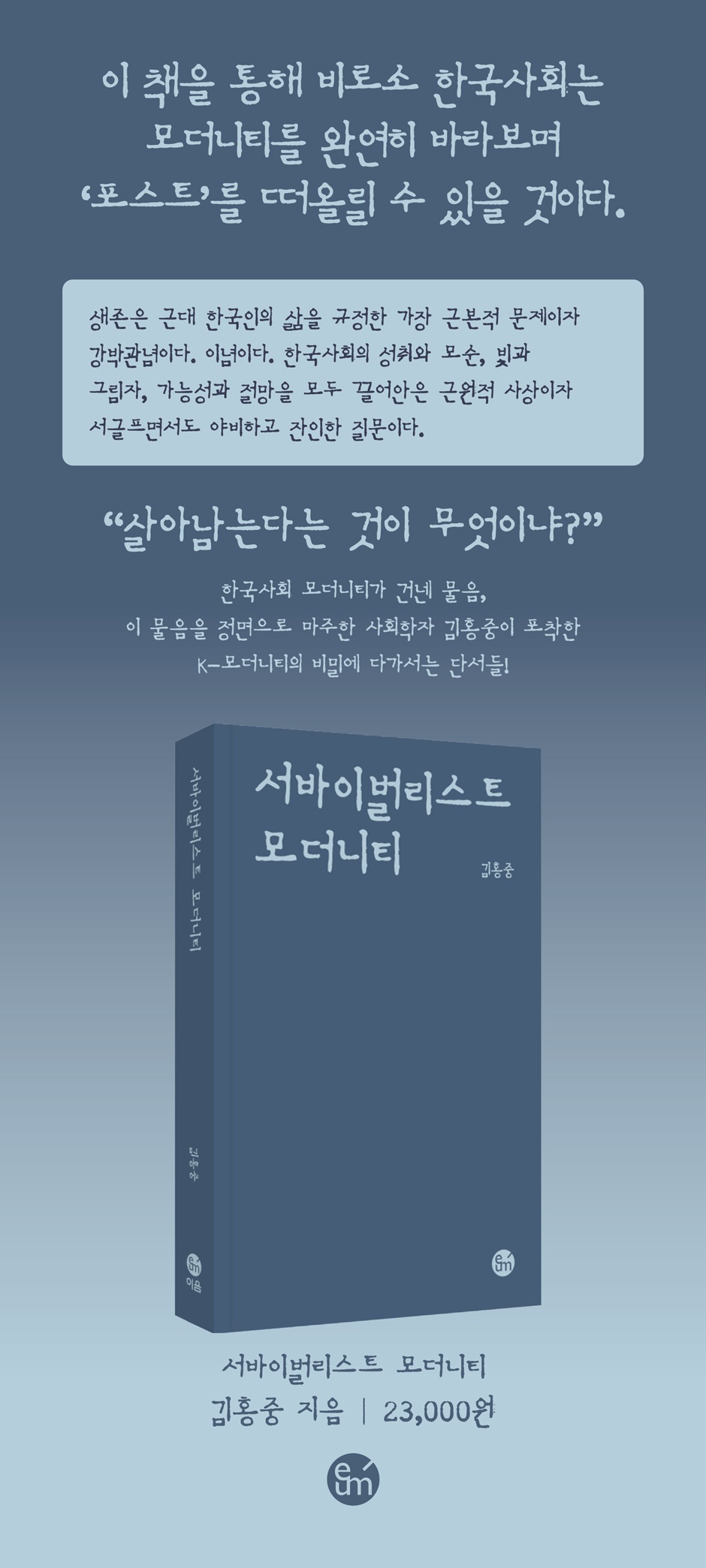
Sociologist Kim Hong-joong, who has keenly explored the collective psychology of Korean society, reveals that the fundamental ideology that led Korean society in the 20th century was 'survivalism.'
Survivalism, a value system, ethic, and aesthetic that prioritizes 'survival,' is a key word that explains how Korean society survived through war, dictatorship, democratization, and rapid economic growth.
The in-depth reflection and analysis this book presents through the keyword of survival will help us understand the time we have lived through, while also guiding us to examine how the values and desires currently pursued by Korean society originated and where they are headed.
Survivalism, a value system, ethic, and aesthetic that prioritizes 'survival,' is a key word that explains how Korean society survived through war, dictatorship, democratization, and rapid economic growth.
The in-depth reflection and analysis this book presents through the keyword of survival will help us understand the time we have lived through, while also guiding us to examine how the values and desires currently pursued by Korean society originated and where they are headed.
- You can preview some of the book's contents.
Preview
index
Entering
Chapter 1.
The Thought of the Naked Tree - The Case of Park Soo-geun and Park Wan-seo
Chapter 2.
Survivalist Desire Machines - Kim Ki-young's Cinema
Chapter 3.
What is survivalist modernity?
Chapter 4.
Survivalist Rulership and the Dream of Modernity - Focusing on Park Chung-hee
Chapter 5.
The Spirit of Korean Capitalism - Focusing on Chung Ju-yung
Chapter 6.
Portrait of a Neoliberal Survivalist
Chapter 7.
Survivalism, Social Values, and the Problem of Death
Chapter 8.
People's Self-Transcendence: From People's Theology to the Ecological Level
Chapter 9.
Reconstructing 21st-Century Survivalism: Public, Kenosis, and the Anthropocene
References
source
Chapter 1.
The Thought of the Naked Tree - The Case of Park Soo-geun and Park Wan-seo
Chapter 2.
Survivalist Desire Machines - Kim Ki-young's Cinema
Chapter 3.
What is survivalist modernity?
Chapter 4.
Survivalist Rulership and the Dream of Modernity - Focusing on Park Chung-hee
Chapter 5.
The Spirit of Korean Capitalism - Focusing on Chung Ju-yung
Chapter 6.
Portrait of a Neoliberal Survivalist
Chapter 7.
Survivalism, Social Values, and the Problem of Death
Chapter 8.
People's Self-Transcendence: From People's Theology to the Ecological Level
Chapter 9.
Reconstructing 21st-Century Survivalism: Public, Kenosis, and the Anthropocene
References
source
Detailed image
Into the book
The sad, vulgar, cruel, persistent, and cruel questions that shaped the way Koreans live, die, and frame their existence and experience.
What does it mean to survive? It's a philosophical question that arises not in scholarly laboratories or libraries, but in the heart of the city.
What is survival?
--- p.7
The proposition 'I survived' is inextricably linked to the proposition 'they died'.
In other words, what must be identified with my survival is someone's death.
That I survived because he died.
This awareness is the starting point of ethical thinking.
A question arises here.
That is, when the death of others and my own survival are inseparable, can we truly rejoice in our own survival? Can we endure it?
--- p.27
Surviving is not an intransitive state of affairs, but a transitive state of affairs.
Survival has a purpose.
Survival is achieved only through a relationship with something that threatens one's life, through the destruction and loss of one's self by others.
All survivors are those who survived partially destroyed by dragging their lives as close to death as possible.
--- p.50
We live in a society that has experienced dizzying changes.
(Omitted) In other words, many Koreans are developmentalists, democrats, and neoliberals at the same time.
(Omitted) In some ways, they are fiercely competitive, in others, they have an egalitarian mindset, and deep down, they still secretly desire development and advancement.
This schizophrenic multiplicity is an important characteristic of Koreanness.
--- p.103
The implicit belief that growth will be eternal, the can-do mentality, the Faustian complex that we can conquer nature to create paradise, and the materialistic value system that the economy is everything in life can now pose new 'risks' if they are not fundamentally reconstructed.
This is the paradox of so-called reflexive modernity.
--- pp.188-189
So, what exactly is the general landscape of Korean society brought about by this survivalist modernity? (Omitted) If the pursuit of political power and economic wealth gains normative legitimacy as legitimate, right, and rational, then social values are more likely to be perceived as empty illusions.
(Omitted) What are the consequences of suppressing social values? How does the "social" survive when social values are suppressed?
--- pp.240-241
For those who consider winning a survival game through harsh competition to be the normal course of life, society is a 'jungle'.
What does peace, cooperation, and sacrifice mean to people who dedicate their lives to suppressing others while suffering from the pressure of survival?
--- p.243
Why do feminists become vegans, more sensitive to animal rights, and more environmentalists? Why do they draw closer to the experiences of those who suffer, extending their practice beyond the human? Why do victims, the broken, and the afflicted move together? Because they share the positionality of those in destructive relationships and the sensibilities of those who suffer.
What does it mean to survive? It's a philosophical question that arises not in scholarly laboratories or libraries, but in the heart of the city.
What is survival?
--- p.7
The proposition 'I survived' is inextricably linked to the proposition 'they died'.
In other words, what must be identified with my survival is someone's death.
That I survived because he died.
This awareness is the starting point of ethical thinking.
A question arises here.
That is, when the death of others and my own survival are inseparable, can we truly rejoice in our own survival? Can we endure it?
--- p.27
Surviving is not an intransitive state of affairs, but a transitive state of affairs.
Survival has a purpose.
Survival is achieved only through a relationship with something that threatens one's life, through the destruction and loss of one's self by others.
All survivors are those who survived partially destroyed by dragging their lives as close to death as possible.
--- p.50
We live in a society that has experienced dizzying changes.
(Omitted) In other words, many Koreans are developmentalists, democrats, and neoliberals at the same time.
(Omitted) In some ways, they are fiercely competitive, in others, they have an egalitarian mindset, and deep down, they still secretly desire development and advancement.
This schizophrenic multiplicity is an important characteristic of Koreanness.
--- p.103
The implicit belief that growth will be eternal, the can-do mentality, the Faustian complex that we can conquer nature to create paradise, and the materialistic value system that the economy is everything in life can now pose new 'risks' if they are not fundamentally reconstructed.
This is the paradox of so-called reflexive modernity.
--- pp.188-189
So, what exactly is the general landscape of Korean society brought about by this survivalist modernity? (Omitted) If the pursuit of political power and economic wealth gains normative legitimacy as legitimate, right, and rational, then social values are more likely to be perceived as empty illusions.
(Omitted) What are the consequences of suppressing social values? How does the "social" survive when social values are suppressed?
--- pp.240-241
For those who consider winning a survival game through harsh competition to be the normal course of life, society is a 'jungle'.
What does peace, cooperation, and sacrifice mean to people who dedicate their lives to suppressing others while suffering from the pressure of survival?
--- p.243
Why do feminists become vegans, more sensitive to animal rights, and more environmentalists? Why do they draw closer to the experiences of those who suffer, extending their practice beyond the human? Why do victims, the broken, and the afflicted move together? Because they share the positionality of those in destructive relationships and the sensibilities of those who suffer.
--- p.302
Publisher's Review
Why didn't you say it was to survive?
What was the consciousness that drove Korea's 20th century? What were the values and desires we most passionately pursued during that time? Sociologist Kim Hong-joong, who has keenly explored the collective psychology of Korean society, suggests "survivalism" as the most crucial driving force that enabled us to "finally" survive through war, dictatorship, democratization, and rapid economic growth.
According to survivalism, the world is a jungle.
It is a space of competition and elimination.
For survivalists, survival is the most important thing.
Therefore, values that do not help survival are excluded or pushed down in priority.
The 20th century in Korea was characterized by survivalism, which considered survival to be the most important thing and took for granted avoiding or eliminating anything that hindered it.
There have been many theories explaining Korea's modern history.
These include 'compressed modernity', which rapidly adopted Western institutions and had a complex and mixed modernization process; 'reductive modernity', which gave excessive centrality to politics and the economy; 'militarized modernity', which emphasized war and the military during the Cold War; and 'Confucian modernity', which viewed Korean modernity within the larger framework of East Asian Confucian civilization, with Confucianism as its main cultural resource.
However, these theories fail to adequately capture the lives of citizens who have directly experienced and lived through dynamic and complex times.
The sad, vulgar, cruel, and tenacious moments we had to endure in order to survive were not touched upon.
Even though these moments clearly existed, why didn't we seize them? Survival was so crucial, yet because they remained unspoken, the door to Korea's modernity, "K-modernity," remained closed.
Through the key of survivalism presented in this book, we can now fully open the door and fully understand 20th-century Korean society and envision what comes next.
What does it mean to survive?
Kim Hong-joong explains that there were three major turning points in 20th-century survivalism in Korean society.
First, the ‘international public law survivalism’ that was formed in the midst of the shock caused by the Donghak Peasant Revolution of 1894, the Gabo Reform, and the Sino-Japanese War.
Second, ‘Cold War survivalism’ formed in the Cold War system after the Korean War in 1950.
Third, there is the ‘neoliberal survivalism’ that was formed in the process of being incorporated into the neoliberal international order following the 1997 foreign exchange crisis.
A particular focus of this book is Cold War survivalism.
Kim Hong-joong interprets Park Chung-hee's ruling ideology from the perspective of survivalist rulingness, and the spirit of Korean capitalism dreamed of by Chung Ju-young as survival-oriented developmentalism.
Kim Hong-joong also points out the survivalism embodied in art and literary texts.
We analyze the image of Park Soo-keun and Park Wan-seo's "Naked Tree," which depicts the vitality of the Korean people surviving on the border between life and death in the post-war ruins, and interpret the fundamental imagination of Kim Ki-young's films as an expression of the desire to "survive."
Meanwhile, in a society rife with survivalism, where the pursuit of political power and economic wealth is taken for granted, how are the values that are "ultimately right, desirable, and reasonable in human life" pursued? Is it even possible to pursue them? Kim Hong-joong explains the perceived uselessness of these social values in a society steeped in survivalism as the "hollowing out of the social." Through the minjung theology of Ahn Byung-mu and Seo Nam-dong, he introduces a new imagination of survival that pursues the social and seeks coexistence with others.
Now, beyond the modern era, into the 21st century, finally, into today and tomorrow
The signature ideology of modern Korea is neither ‘existence’ nor ‘existence,’ but ‘survival.’
Survival is the most fundamental problem, obsession, and ideology that defines the lives of modern Koreans.
It is a fundamental thought that embraces all of Korean society's achievements and contradictions, light and shadow, possibilities and despair, and it is a sad, vulgar, and cruel question.
In other words, our modern era was formed around the question, “What does it mean to survive?”
This book, which attempts to confront this question head-on, is a fierce self-reflection on modern Korea, a reflection on the identity of Korean sociology, and at the same time, a record of experimental exploration of the values and desires of the new Korean society of the 21st century.
Understanding the time we have lived and will live in, centered around the keyword of survival, is one way to understand how the values and desires pursued by 21st century Korean society originated.
It will be a starting point for us to reflect and gauge where we are headed now and where we will head in the future.
What was the consciousness that drove Korea's 20th century? What were the values and desires we most passionately pursued during that time? Sociologist Kim Hong-joong, who has keenly explored the collective psychology of Korean society, suggests "survivalism" as the most crucial driving force that enabled us to "finally" survive through war, dictatorship, democratization, and rapid economic growth.
According to survivalism, the world is a jungle.
It is a space of competition and elimination.
For survivalists, survival is the most important thing.
Therefore, values that do not help survival are excluded or pushed down in priority.
The 20th century in Korea was characterized by survivalism, which considered survival to be the most important thing and took for granted avoiding or eliminating anything that hindered it.
There have been many theories explaining Korea's modern history.
These include 'compressed modernity', which rapidly adopted Western institutions and had a complex and mixed modernization process; 'reductive modernity', which gave excessive centrality to politics and the economy; 'militarized modernity', which emphasized war and the military during the Cold War; and 'Confucian modernity', which viewed Korean modernity within the larger framework of East Asian Confucian civilization, with Confucianism as its main cultural resource.
However, these theories fail to adequately capture the lives of citizens who have directly experienced and lived through dynamic and complex times.
The sad, vulgar, cruel, and tenacious moments we had to endure in order to survive were not touched upon.
Even though these moments clearly existed, why didn't we seize them? Survival was so crucial, yet because they remained unspoken, the door to Korea's modernity, "K-modernity," remained closed.
Through the key of survivalism presented in this book, we can now fully open the door and fully understand 20th-century Korean society and envision what comes next.
What does it mean to survive?
Kim Hong-joong explains that there were three major turning points in 20th-century survivalism in Korean society.
First, the ‘international public law survivalism’ that was formed in the midst of the shock caused by the Donghak Peasant Revolution of 1894, the Gabo Reform, and the Sino-Japanese War.
Second, ‘Cold War survivalism’ formed in the Cold War system after the Korean War in 1950.
Third, there is the ‘neoliberal survivalism’ that was formed in the process of being incorporated into the neoliberal international order following the 1997 foreign exchange crisis.
A particular focus of this book is Cold War survivalism.
Kim Hong-joong interprets Park Chung-hee's ruling ideology from the perspective of survivalist rulingness, and the spirit of Korean capitalism dreamed of by Chung Ju-young as survival-oriented developmentalism.
Kim Hong-joong also points out the survivalism embodied in art and literary texts.
We analyze the image of Park Soo-keun and Park Wan-seo's "Naked Tree," which depicts the vitality of the Korean people surviving on the border between life and death in the post-war ruins, and interpret the fundamental imagination of Kim Ki-young's films as an expression of the desire to "survive."
Meanwhile, in a society rife with survivalism, where the pursuit of political power and economic wealth is taken for granted, how are the values that are "ultimately right, desirable, and reasonable in human life" pursued? Is it even possible to pursue them? Kim Hong-joong explains the perceived uselessness of these social values in a society steeped in survivalism as the "hollowing out of the social." Through the minjung theology of Ahn Byung-mu and Seo Nam-dong, he introduces a new imagination of survival that pursues the social and seeks coexistence with others.
Now, beyond the modern era, into the 21st century, finally, into today and tomorrow
The signature ideology of modern Korea is neither ‘existence’ nor ‘existence,’ but ‘survival.’
Survival is the most fundamental problem, obsession, and ideology that defines the lives of modern Koreans.
It is a fundamental thought that embraces all of Korean society's achievements and contradictions, light and shadow, possibilities and despair, and it is a sad, vulgar, and cruel question.
In other words, our modern era was formed around the question, “What does it mean to survive?”
This book, which attempts to confront this question head-on, is a fierce self-reflection on modern Korea, a reflection on the identity of Korean sociology, and at the same time, a record of experimental exploration of the values and desires of the new Korean society of the 21st century.
Understanding the time we have lived and will live in, centered around the keyword of survival, is one way to understand how the values and desires pursued by 21st century Korean society originated.
It will be a starting point for us to reflect and gauge where we are headed now and where we will head in the future.
GOODS SPECIFICS
- Date of issue: October 30, 2024
- Page count, weight, size: 368 pages | 490g | 135*210*22mm
- ISBN13: 9791194172079
- ISBN10: 1194172075
You may also like
카테고리
korean


korean

![GQ KOREA Mark (Monthly): December [2025]](http://librairie.coreenne.fr/cdn/shop/files/8ef265dbbfbf186523ed75ba7319009d.jpg?v=1765340328&width=3840)


