

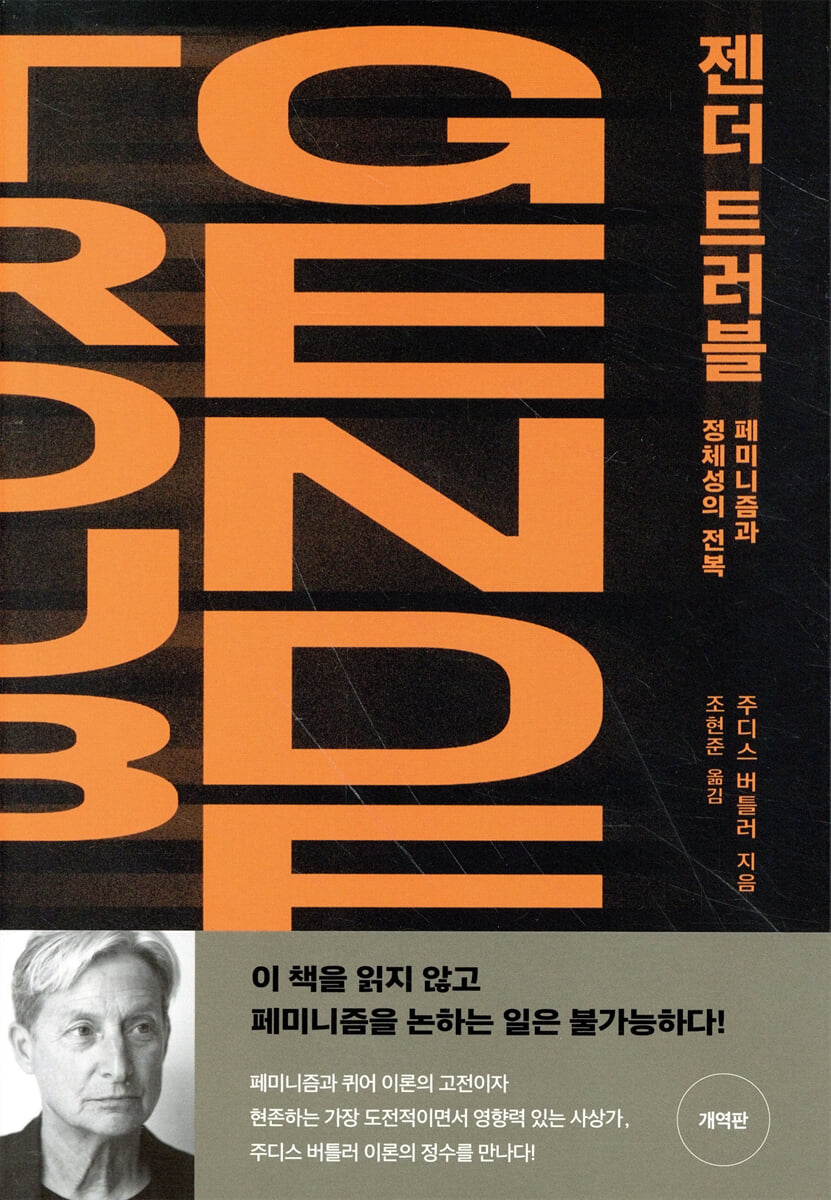
Gender Trouble
 |
Description
Book Introduction
There is no gender as an essence
Hating other sexes, other genders, other sexualities
In the age of feminist backlash, let's rethink gender!
The revised edition of "Gender Trouble" is now available.
Published in Korean in 2008, "Gender Trouble," which has become a classic in feminist theory today, has been reissued in a revised edition with a polished translation.
Since its first Korean edition was published, this book has established itself as an essential gateway to understanding gender and a work of immense influence, to the point where it has been said that "one cannot discuss feminism without reading this book."
This revised edition of "Gender Trouble," presented with a new translation and a new cover, has undergone a comprehensive review of the previous translation to correct mistranslations and significantly refined the translated language to clearly convey the meaning of concepts and terms.
Furthermore, we have strived to further solidify this book's status as an enduring classic in feminist theory by meticulously examining the context to ensure that no meaning is missed while still conveying the original text's meaning in a readable manner.
Since its first publication in the United States in 1990, over a quarter of a century has passed, and the perspectives on feminism in academia and other fields have undergone various changes. Nevertheless, Gender Trouble remains influential.
This is because the issues raised in this book still address important challenges and issues in feminism today.
Moreover, isn't the backlash against feminism growing stronger worldwide, and isn't there a backlash every time feminist discourse attempts to drive social change?
The most fundamental questions that arise at such times are: what is gender, how should we understand gender, and why does gender matter?
Judith Butler, through Gender Trouble, sought to free the meaning of gender from its conventional meaning.
Furthermore, with the aim of “opening the field of gender possibility,” the fixed nature of gender was questioned in an attempt to “shake up all attempts to wield the discourse of truth to criminalize the actions of gender minorities and sexual minorities.”
Therefore, in today's era of feminist backlash that abhors other sexes, other genders, and other sexualities, Butler's critical awareness of gender, which seeks to rethink gender, remains important and valid.
Over the years, many of Judith Butler's other works and related commentaries have been published in Korea, creating a richer theoretical forum, and making it possible to trace the trajectory of her thought and the evolution of her arguments.
In this regard, understanding 『Gender Trouble』, the essence of Butler's theory, is of indispensable value.
This revised edition includes a supplement to "Butler's Key Concepts," which organizes key concepts and terms to aid understanding of "Gender Trouble," and an additional translator's note written from a contemporary perspective to coincide with the publication of the revised edition.
Hating other sexes, other genders, other sexualities
In the age of feminist backlash, let's rethink gender!
The revised edition of "Gender Trouble" is now available.
Published in Korean in 2008, "Gender Trouble," which has become a classic in feminist theory today, has been reissued in a revised edition with a polished translation.
Since its first Korean edition was published, this book has established itself as an essential gateway to understanding gender and a work of immense influence, to the point where it has been said that "one cannot discuss feminism without reading this book."
This revised edition of "Gender Trouble," presented with a new translation and a new cover, has undergone a comprehensive review of the previous translation to correct mistranslations and significantly refined the translated language to clearly convey the meaning of concepts and terms.
Furthermore, we have strived to further solidify this book's status as an enduring classic in feminist theory by meticulously examining the context to ensure that no meaning is missed while still conveying the original text's meaning in a readable manner.
Since its first publication in the United States in 1990, over a quarter of a century has passed, and the perspectives on feminism in academia and other fields have undergone various changes. Nevertheless, Gender Trouble remains influential.
This is because the issues raised in this book still address important challenges and issues in feminism today.
Moreover, isn't the backlash against feminism growing stronger worldwide, and isn't there a backlash every time feminist discourse attempts to drive social change?
The most fundamental questions that arise at such times are: what is gender, how should we understand gender, and why does gender matter?
Judith Butler, through Gender Trouble, sought to free the meaning of gender from its conventional meaning.
Furthermore, with the aim of “opening the field of gender possibility,” the fixed nature of gender was questioned in an attempt to “shake up all attempts to wield the discourse of truth to criminalize the actions of gender minorities and sexual minorities.”
Therefore, in today's era of feminist backlash that abhors other sexes, other genders, and other sexualities, Butler's critical awareness of gender, which seeks to rethink gender, remains important and valid.
Over the years, many of Judith Butler's other works and related commentaries have been published in Korea, creating a richer theoretical forum, and making it possible to trace the trajectory of her thought and the evolution of her arguments.
In this regard, understanding 『Gender Trouble』, the essence of Butler's theory, is of indispensable value.
This revised edition includes a supplement to "Butler's Key Concepts," which organizes key concepts and terms to aid understanding of "Gender Trouble," and an additional translator's note written from a contemporary perspective to coincide with the publication of the revised edition.
- You can preview some of the book's contents.
Preview
index
Translator's Note for the Revised Edition
First edition translator's note
Preface to the Revised Edition (1999)
Preface to the first edition (1990)
Chapter 1: Sex/Gender/Subject of Desire
'Women' as the subject of feminism
The forced order of sex/gender/desire
Gender: A Circulating Remnant in Contemporary Debates
Theorizing Dichotomy, Monism, and Beyond
Metaphysics of Identity, Gender, and Substance
Language, Power, and Strategies of Transposition
Chapter 2: Prohibition, Psychoanalysis, and Heterosexual Production
Critical Exchange of Structuralism
Lacan, Rivière, and the Strategy of the Mask
Freud and Gender Depression
Gender Complexity and the Limits of Identification
Transforming taboos into power
Chapter 3: Subversive Gestures
Julia Kristeva's Body Politics
Foucault, Herculine, and the Politics of Sexual Discontinuity
Monique Vitique: Deconstruction of the Body and Fictional Sex
Body imprint, performative subversion
Conclusion: From Parody to Politics
Butler's Key Concepts
Search
First edition translator's note
Preface to the Revised Edition (1999)
Preface to the first edition (1990)
Chapter 1: Sex/Gender/Subject of Desire
'Women' as the subject of feminism
The forced order of sex/gender/desire
Gender: A Circulating Remnant in Contemporary Debates
Theorizing Dichotomy, Monism, and Beyond
Metaphysics of Identity, Gender, and Substance
Language, Power, and Strategies of Transposition
Chapter 2: Prohibition, Psychoanalysis, and Heterosexual Production
Critical Exchange of Structuralism
Lacan, Rivière, and the Strategy of the Mask
Freud and Gender Depression
Gender Complexity and the Limits of Identification
Transforming taboos into power
Chapter 3: Subversive Gestures
Julia Kristeva's Body Politics
Foucault, Herculine, and the Politics of Sexual Discontinuity
Monique Vitique: Deconstruction of the Body and Fictional Sex
Body imprint, performative subversion
Conclusion: From Parody to Politics
Butler's Key Concepts
Search
Into the book
"Gender Trouble" seeks to show how the very idea of what is possible in a gendered life is precluded by certain habitual and violent assumptions.
This book also seeks to shake up all attempts to wield the discourse of truth to criminalize the actions of gender minorities and sexual minorities.
That doesn't mean we should condone or praise all minority behavior, but it does mean we should be able to think about such behavior before drawing any conclusions.
What worried me most was how people would be so shocked when confronted with this behavior that they would find it unthinkable.
--- p.47~48
Some readers have questioned whether Gender Trouble is, in any way, intended to expand the realm of gender possibility.
They asked for what purpose these new gender arrangements were created and how they should be distinguished.
This question often involves a presupposition: that this book does not speak to the normative or prescriptive dimensions of feminist thought.
The word 'normative' clearly has at least two meanings in feminist criticism.
I use this word often, too, primarily to describe the violence perpetrated routinely by certain types of gender abnormalities.
I usually use the word “normative” to mean “relating to the norms that govern gender.”
But the word 'normative' has to do with ethical legitimacy, how this ethical legitimacy is established, and what specific consequences follow from it.
--- p.65
The seemingly self-founded autonomy of men conceals the oppression that is both their foundation and the possibility of their eternal non-foundation.
But this process of meaning construction demands that women reflect such masculine power and guarantee them the real power associated with such delusional autonomy wherever they may be.
If the demand that women reflect the autonomous power of the masculine subject/signifier becomes the core of women's autonomy, and thus the basis of a fundamental dependency that effectively weakens their functioning, then the issue is, to say the least, confusing.
Yet, this dependence is something that the male subject both denies and pursues, for the woman, the sign of confirmation, is the mother's body in a changed position and a vain but persistent promise to restore the pre-individualized subjectivity.
--- p.171
What does it mean to claim that fantasy is literally meaningful? If gender differentiation follows the incest taboo and, prior to that, the homosexual taboo, then "becoming" a certain gender is a process that requires effort to become natural, and this requires differentiating bodily pleasure and body parts based on gendered meanings.
Pleasure is said to be located in or come from the penis, vagina, and breasts.
But these explanations are already geared towards gender-specifically constructed or naturalized bodies.
In other words, certain parts of the body become central to the imagination of pleasure because they are aligned with the normative ideal of a gender-specific body.
Pleasure is in some sense determined by a depressive gender structure, which renders some organs insensitive to pleasure and others sensitive to it.
Which pleasures live and which pleasures die, sometimes becomes a question of what constitutes a legitimate practice in identity formation within the framework of gender norms.
--- p.216~217
Gender should not be interpreted as a stable identity or site of agency that follows multiple acts.
Rather, gender is an identity that is vaguely constructed over time and institutionalized in external space through the repetition of stylized acts.
Gender effects are produced through the stylization of the body, and thus must be understood as the everyday ways in which bodily gestures, movements, and various forms construct the illusion of a fixed and gendered self.
This formalized concept of gender moves away from the foundation of a substantial identity model and towards a foundation that demands a concept of gender as a constructed social temporality.
Significantly, if gender is institutionalized through internally discontinuous acts, then the appearance of reality is precisely that constructed identity, a performative outcome that ordinary social audiences, including actors, believe in and act out in the form of beliefs.
This book also seeks to shake up all attempts to wield the discourse of truth to criminalize the actions of gender minorities and sexual minorities.
That doesn't mean we should condone or praise all minority behavior, but it does mean we should be able to think about such behavior before drawing any conclusions.
What worried me most was how people would be so shocked when confronted with this behavior that they would find it unthinkable.
--- p.47~48
Some readers have questioned whether Gender Trouble is, in any way, intended to expand the realm of gender possibility.
They asked for what purpose these new gender arrangements were created and how they should be distinguished.
This question often involves a presupposition: that this book does not speak to the normative or prescriptive dimensions of feminist thought.
The word 'normative' clearly has at least two meanings in feminist criticism.
I use this word often, too, primarily to describe the violence perpetrated routinely by certain types of gender abnormalities.
I usually use the word “normative” to mean “relating to the norms that govern gender.”
But the word 'normative' has to do with ethical legitimacy, how this ethical legitimacy is established, and what specific consequences follow from it.
--- p.65
The seemingly self-founded autonomy of men conceals the oppression that is both their foundation and the possibility of their eternal non-foundation.
But this process of meaning construction demands that women reflect such masculine power and guarantee them the real power associated with such delusional autonomy wherever they may be.
If the demand that women reflect the autonomous power of the masculine subject/signifier becomes the core of women's autonomy, and thus the basis of a fundamental dependency that effectively weakens their functioning, then the issue is, to say the least, confusing.
Yet, this dependence is something that the male subject both denies and pursues, for the woman, the sign of confirmation, is the mother's body in a changed position and a vain but persistent promise to restore the pre-individualized subjectivity.
--- p.171
What does it mean to claim that fantasy is literally meaningful? If gender differentiation follows the incest taboo and, prior to that, the homosexual taboo, then "becoming" a certain gender is a process that requires effort to become natural, and this requires differentiating bodily pleasure and body parts based on gendered meanings.
Pleasure is said to be located in or come from the penis, vagina, and breasts.
But these explanations are already geared towards gender-specifically constructed or naturalized bodies.
In other words, certain parts of the body become central to the imagination of pleasure because they are aligned with the normative ideal of a gender-specific body.
Pleasure is in some sense determined by a depressive gender structure, which renders some organs insensitive to pleasure and others sensitive to it.
Which pleasures live and which pleasures die, sometimes becomes a question of what constitutes a legitimate practice in identity formation within the framework of gender norms.
--- p.216~217
Gender should not be interpreted as a stable identity or site of agency that follows multiple acts.
Rather, gender is an identity that is vaguely constructed over time and institutionalized in external space through the repetition of stylized acts.
Gender effects are produced through the stylization of the body, and thus must be understood as the everyday ways in which bodily gestures, movements, and various forms construct the illusion of a fixed and gendered self.
This formalized concept of gender moves away from the foundation of a substantial identity model and towards a foundation that demands a concept of gender as a constructed social temporality.
Significantly, if gender is institutionalized through internally discontinuous acts, then the appearance of reality is precisely that constructed identity, a performative outcome that ordinary social audiences, including actors, believe in and act out in the form of beliefs.
--- p.345
Publisher's Review
It is a work of the century that overturned the existing paradigm of feminism in one fell swoop.
A timeless classic representing modern feminism and queer theory.
The essence of Judith Butler's theory, one of the most challenging and influential thinkers alive today.
"Gender Trouble" is a book that criticizes patriarchal heterosexism within feminism, breaks down the binary framework of sex and gender, and raises provocative questions about existing feminism. It has been translated and published in various languages around the world and has garnered significant attention from the academic community.
This book made Butler a star in feminist scholarship in her mid-thirties, and she is considered one of the most challenging and influential thinkers alive today.
This book begins by revealing in the preface to the first edition that the very definition of "gender" is a "trouble." Since trouble is unavoidable in feminist discourse, Butler herself expresses her will to create as much trouble as possible and to fall into trouble in the most stylish way possible.
True to the author's intention, Gender Trouble caused a stir in the academic world immediately after its publication, and this radical thinking not only opened new horizons for feminism, but also proved its influence across academia, including queer theory, sociology, and political science.
Contemporary feminist debates about the meaning of gender have repeatedly caused trouble, as if insisting on the uncertainty of gender would ultimately lead to the failure of feminism.
However, this does not mean that trouble only has negative connotations.
In the discourse that prevailed when I was young, trouble was something that should not be caused, because if you caused trouble, you would get into trouble.
It seemed as if rebellion and its condemnation were being woven into the same coin, and seeing this phenomenon gave me, for the first time, the critical insight to see through the subtle machinations of power.
The prevailing law threatens us with trouble and gets us into trouble, all in order to escape from trouble.
So I concluded that trouble was inevitable, and that my job was to create as much trouble as possible and get into it in the best way possible.
Page 74
In this book, Butler, a poststructuralist feminist philosopher, draws on the theories of prominent poststructuralist philosophers such as Freud, Lacan, Derrida, and Foucault, and transforms them to fit the theory of feminism to develop her own argument.
And in order to fundamentally reexamine the oppressive structure of patriarchy and the problem of women's liberation that the so-called second wave feminism of the 1960s to 1980s focused on, we critically analyze and examine the French feminist theories of Simone de Beauvoir, Luce Irigaray, Julia Kristeva, and Monique Wittig.
As Foucault makes clear, the project of culturally contradictory mechanisms of repression is both prohibitive and generative, and it particularly addresses the question of 'liberation'.
The female body, freed from the shackles of the father's law, assumes a subversive position, but it will prove to be another embodiment of the father's law, as the father's law operates to expand and expand itself.
If we are to avoid liberating the oppressor in the name of the oppressed, we must take into account the full complexity and subtlety of the law and correct the illusion of a true body beyond the law.
If subversion is possible, it will be from within the law, through the possibility that the law will act against itself and produce unforeseen permutations.
If so, the culturally constituted body will be liberated not into its 'natural' past, nor into its original pleasures, but into an open future of cultural possibilities.
Pages 259-260
A subversive imagination that overturns the imposed order of sex, gender, and sexuality
Examining aspects of gender as manifested in parody, performativity, and depressive identity.
Beauvoir's famous proposition, “One is not born, but becomes, a woman,” influenced the entrenchment of the concepts of biologically determined sex and socioculturally constructed sex as social norms.
Here, gender is understood as a cultural interpretation of gender, distinct from biological sex, or derived from gender.
Butler questions the order of sex/gender/sexuality maintained under compulsory heterosexual norms and exposes the fiction of gender.
In other words, sex/gender/sexuality are not distinct, but are fictional constructs produced by institutions and power and effects of discourse.
This argument, which questions the fixedness of gender, is also connected to the issue of the 'subject' in feminism.
The first question Butler poses when she opens the text of Gender Trouble is whether feminism should assume a collective category called “women.”
The perception of women as a category is based on patriarchal heterosexism and can only be established by assuming a binary gender and gender hierarchy of men and women under the premise of a heterosexual system.
However, Butler places the category of women, who are also the subject of feminist politics, at the center of her critique, and opposes feminism that presupposes compulsory heterosexuality, gender hierarchy, and gender dualism, while rebelling against the 'unity' of the category of women.
Another groundbreaking point of Butler's thought is that it explains the way gender operates in terms of 'performativity.'
According to Butler's discussion of identity, the actor is not behind the action, but is variably constituted through and within the action.
Since every actor is constituted through the repeated performance of actions, the subject he speaks of is a discursive construct.
In other words, gender is “a repeated stylization of the body and a series of repeated acts within a very rigid regulatory framework that has long been solidified to create the natural appearance of existence.”
To illustrate the constitutive and performative dimensions of gender, Butler uses the example of drag to expose the opacity of the gender reality we commonly assume, and argues for the impoverishment of the expressive forms of gender and the concepts of gender identity.
Here, we go further and explain the concept of gender parody, revealing that gender identity itself is an imitation without origin, a copy without an original.
The discussion on 'gender parody' suggests the possibility of moving towards 'queer theory' through a process of theoretical critique, reexamination, and re-signification of performativity, repeated submission, and depression.
In addition, Butler approaches and meticulously examines from various angles, including the critique of Levi-Strauss and Koo Joo-jo's anthropology, Freud and Lacan's psychoanalytic themes and analysis of depression, the limitations of theories that attempt to signify women's identity through masks, and Kristeva's critique of maternal discourse, in order to overturn existing common sense regarding the aspects of gender and reveal their limitations.
Is "unity" absolutely necessary for effective political action? Rather, isn't a hasty obsession with the goal of unity actually leading to even more severe fragmentation within the hierarchy? Because "unity" within the category of women is neither a necessary condition nor a requirement, certain forms of overt division can facilitate unity.
At the level of identity, does "unity" create a norm of exclusive solidarity, either by dismantling the boundaries of the concept of identity or by eliminating the possibility of a series of actions aimed at achieving such dismantling for a clear political purpose? In either case, if the premise or purpose of "unity," always formed at the conceptual level, is absent, temporary unity will emerge in the context of concrete actions, not for the purpose of expressing identity.
Without the mandatory expectation that feminist action must begin with a stable, unified, and agreed-upon identity, such action would likely begin sooner and seem more appropriate for the many "women" for whom the meaning of this category is perpetually contested. _112-113
The structure of this book and the main issues in each chapter.
The main text of this book consists of three chapters.
Chapter 1 is primarily a space for raising provocative questions to explore the necessity and possibility of 'feminism without women', or more precisely, feminism without the category of women.
Chapter 2 is devoted to criticizing Lacan's psychoanalysis while partially accepting Freud's psychoanalysis.
Chapter 3 critiques Julia Kristeva's discussion of the maternal body and semiotics, and organizes Butler's own discussion of gender by pointing out the parts acknowledged, contradictions, and limitations in the theories of Wittig and Foucault.
Chapter 1, "Sex/Gender/Subject of Desire," seeks a fundamental shift in thinking about the subject of feminism, drawing on the critical awareness of Luce Irigarena and Monique Wittig to illuminate their contributions and limitations.
Irigaray attempted to overcome the Freudian femininity as deficiency or lack, but was criticized for fixing women as unrepresentable within a phallologocentric language.
Monique Wittig, who claimed that “lesbians are not women,” has fixed and idealized lesbians as a third alternative gender that is neither female nor male in compulsory heterosexuality and phallocentrism.
The central idea in this chapter is that 'women' as feminist subjects cannot be categorized, no matter how plural they may be.
This is because the very act of dividing sex/gender/sexuality into biologically determined sex, culturally constructed sex, and fundamental and original desire is in accordance with a coercive order.
Chapter 2, “Prohibition, Psychoanalysis, and the Production of Heterosexist Bases,” critiques perspectives on women within the frameworks of structuralism, psychoanalysis, and feminism.
Not only Levi-Strauss's structuralist anthropology, which views women as objects of exchange, but also psychoanalytic discussions since Joan Rivière that have attempted to signify women as masks are subject to criticism.
In particular, Lacan's discussion of the symbolic position of women as 'becoming/having a phallus' as a mask to hide deficiency is at the core of the criticism.
Gayle Rubin and Luce Irigaray are also not free from criticism for reifying femininity in other ways.
Butler argues for the univocity of the female gender and criticizes all discussions that rely on the binary nature of gender identity, discussing the process by which gender is formed in the manner of Freud's melancholia, that is, in which the object of love is 'incompletely incorporated' into the subject's ego.
Psychoanalysis presupposes desire and then tells us how to prohibit that desire, but Butler wants to show the problem of this norm, that is, assuming desire as a cause a priori.
Like the critique of the repression hypothesis in Foucault's 『History of Sexuality』, the structure of prohibition or judicial structure seems to presuppose a desire that must be repressed, but the argument is that this desire is also a construct created by the dominant power structure of the time.
Therefore, it is not the body that is the prison that imprisons the soul, but the soul becomes the prison of the body.
The final chapter, “Subversive Gestures,” begins with a critique of Julia Kristeva.
Kristeva basically assumed all sexuality as heterosexuality and set homosexuality as something close to mental illness, which is why she became a target of criticism from Butler.
His theory centers on heterosexuality for the purpose of reproduction and specializes in motherhood, and he fails in his attempts to resist and overcome Lacan.
The criticism is that the semiotic system of Korana, or the mother's body, has lost its subversive power of resistance as something that cannot be recognized unless it is uttered in the language of the symbolic system, and that Kristeva's argument rather strengthens the reproduction of motherhood and contributes to the consolidation of patriarchy by idealizing the mother.
Foucault, who conducted the discussion from the perspective of a universal subject, has been criticized by feminists because he only recognizes men as a universal subject and is not interested in the gender difference of women. In addition, Butler criticizes Foucault in the preface to Herculine Barbin's diary, unlike in 'History of Sexuality', for focusing on the romanticization and idealization of a specific sexuality rather than the social tragedy that the androgynous Herculine experienced under institutional norms.
In the latter part of Chapter 3, Butler draws on the arguments of Mary Douglas and Julia Kristeva to emphasize that the boundaries and surfaces of the body are politically constructed.
The argument is that by making the category of the body unnatural and opening it up to a new field of meaning, we can achieve a subversive re-signification that goes beyond the dichotomies of sex, gender, and sexuality, destroying all fixed categories.
Butler titled the concluding essay of this book "From Parody to Politics."
This suggests the possibility that the gender discussion, which started from 'gender parody' such as drag or cross-dressing, can progress to the political nature of 'queer theory' through a process of theoretical critique, reexamination, and re-signification of performativity, repeated submission, and depression, and organizes discussions on complex philosophical levels.
A timeless classic representing modern feminism and queer theory.
The essence of Judith Butler's theory, one of the most challenging and influential thinkers alive today.
"Gender Trouble" is a book that criticizes patriarchal heterosexism within feminism, breaks down the binary framework of sex and gender, and raises provocative questions about existing feminism. It has been translated and published in various languages around the world and has garnered significant attention from the academic community.
This book made Butler a star in feminist scholarship in her mid-thirties, and she is considered one of the most challenging and influential thinkers alive today.
This book begins by revealing in the preface to the first edition that the very definition of "gender" is a "trouble." Since trouble is unavoidable in feminist discourse, Butler herself expresses her will to create as much trouble as possible and to fall into trouble in the most stylish way possible.
True to the author's intention, Gender Trouble caused a stir in the academic world immediately after its publication, and this radical thinking not only opened new horizons for feminism, but also proved its influence across academia, including queer theory, sociology, and political science.
Contemporary feminist debates about the meaning of gender have repeatedly caused trouble, as if insisting on the uncertainty of gender would ultimately lead to the failure of feminism.
However, this does not mean that trouble only has negative connotations.
In the discourse that prevailed when I was young, trouble was something that should not be caused, because if you caused trouble, you would get into trouble.
It seemed as if rebellion and its condemnation were being woven into the same coin, and seeing this phenomenon gave me, for the first time, the critical insight to see through the subtle machinations of power.
The prevailing law threatens us with trouble and gets us into trouble, all in order to escape from trouble.
So I concluded that trouble was inevitable, and that my job was to create as much trouble as possible and get into it in the best way possible.
Page 74
In this book, Butler, a poststructuralist feminist philosopher, draws on the theories of prominent poststructuralist philosophers such as Freud, Lacan, Derrida, and Foucault, and transforms them to fit the theory of feminism to develop her own argument.
And in order to fundamentally reexamine the oppressive structure of patriarchy and the problem of women's liberation that the so-called second wave feminism of the 1960s to 1980s focused on, we critically analyze and examine the French feminist theories of Simone de Beauvoir, Luce Irigaray, Julia Kristeva, and Monique Wittig.
As Foucault makes clear, the project of culturally contradictory mechanisms of repression is both prohibitive and generative, and it particularly addresses the question of 'liberation'.
The female body, freed from the shackles of the father's law, assumes a subversive position, but it will prove to be another embodiment of the father's law, as the father's law operates to expand and expand itself.
If we are to avoid liberating the oppressor in the name of the oppressed, we must take into account the full complexity and subtlety of the law and correct the illusion of a true body beyond the law.
If subversion is possible, it will be from within the law, through the possibility that the law will act against itself and produce unforeseen permutations.
If so, the culturally constituted body will be liberated not into its 'natural' past, nor into its original pleasures, but into an open future of cultural possibilities.
Pages 259-260
A subversive imagination that overturns the imposed order of sex, gender, and sexuality
Examining aspects of gender as manifested in parody, performativity, and depressive identity.
Beauvoir's famous proposition, “One is not born, but becomes, a woman,” influenced the entrenchment of the concepts of biologically determined sex and socioculturally constructed sex as social norms.
Here, gender is understood as a cultural interpretation of gender, distinct from biological sex, or derived from gender.
Butler questions the order of sex/gender/sexuality maintained under compulsory heterosexual norms and exposes the fiction of gender.
In other words, sex/gender/sexuality are not distinct, but are fictional constructs produced by institutions and power and effects of discourse.
This argument, which questions the fixedness of gender, is also connected to the issue of the 'subject' in feminism.
The first question Butler poses when she opens the text of Gender Trouble is whether feminism should assume a collective category called “women.”
The perception of women as a category is based on patriarchal heterosexism and can only be established by assuming a binary gender and gender hierarchy of men and women under the premise of a heterosexual system.
However, Butler places the category of women, who are also the subject of feminist politics, at the center of her critique, and opposes feminism that presupposes compulsory heterosexuality, gender hierarchy, and gender dualism, while rebelling against the 'unity' of the category of women.
Another groundbreaking point of Butler's thought is that it explains the way gender operates in terms of 'performativity.'
According to Butler's discussion of identity, the actor is not behind the action, but is variably constituted through and within the action.
Since every actor is constituted through the repeated performance of actions, the subject he speaks of is a discursive construct.
In other words, gender is “a repeated stylization of the body and a series of repeated acts within a very rigid regulatory framework that has long been solidified to create the natural appearance of existence.”
To illustrate the constitutive and performative dimensions of gender, Butler uses the example of drag to expose the opacity of the gender reality we commonly assume, and argues for the impoverishment of the expressive forms of gender and the concepts of gender identity.
Here, we go further and explain the concept of gender parody, revealing that gender identity itself is an imitation without origin, a copy without an original.
The discussion on 'gender parody' suggests the possibility of moving towards 'queer theory' through a process of theoretical critique, reexamination, and re-signification of performativity, repeated submission, and depression.
In addition, Butler approaches and meticulously examines from various angles, including the critique of Levi-Strauss and Koo Joo-jo's anthropology, Freud and Lacan's psychoanalytic themes and analysis of depression, the limitations of theories that attempt to signify women's identity through masks, and Kristeva's critique of maternal discourse, in order to overturn existing common sense regarding the aspects of gender and reveal their limitations.
Is "unity" absolutely necessary for effective political action? Rather, isn't a hasty obsession with the goal of unity actually leading to even more severe fragmentation within the hierarchy? Because "unity" within the category of women is neither a necessary condition nor a requirement, certain forms of overt division can facilitate unity.
At the level of identity, does "unity" create a norm of exclusive solidarity, either by dismantling the boundaries of the concept of identity or by eliminating the possibility of a series of actions aimed at achieving such dismantling for a clear political purpose? In either case, if the premise or purpose of "unity," always formed at the conceptual level, is absent, temporary unity will emerge in the context of concrete actions, not for the purpose of expressing identity.
Without the mandatory expectation that feminist action must begin with a stable, unified, and agreed-upon identity, such action would likely begin sooner and seem more appropriate for the many "women" for whom the meaning of this category is perpetually contested. _112-113
The structure of this book and the main issues in each chapter.
The main text of this book consists of three chapters.
Chapter 1 is primarily a space for raising provocative questions to explore the necessity and possibility of 'feminism without women', or more precisely, feminism without the category of women.
Chapter 2 is devoted to criticizing Lacan's psychoanalysis while partially accepting Freud's psychoanalysis.
Chapter 3 critiques Julia Kristeva's discussion of the maternal body and semiotics, and organizes Butler's own discussion of gender by pointing out the parts acknowledged, contradictions, and limitations in the theories of Wittig and Foucault.
Chapter 1, "Sex/Gender/Subject of Desire," seeks a fundamental shift in thinking about the subject of feminism, drawing on the critical awareness of Luce Irigarena and Monique Wittig to illuminate their contributions and limitations.
Irigaray attempted to overcome the Freudian femininity as deficiency or lack, but was criticized for fixing women as unrepresentable within a phallologocentric language.
Monique Wittig, who claimed that “lesbians are not women,” has fixed and idealized lesbians as a third alternative gender that is neither female nor male in compulsory heterosexuality and phallocentrism.
The central idea in this chapter is that 'women' as feminist subjects cannot be categorized, no matter how plural they may be.
This is because the very act of dividing sex/gender/sexuality into biologically determined sex, culturally constructed sex, and fundamental and original desire is in accordance with a coercive order.
Chapter 2, “Prohibition, Psychoanalysis, and the Production of Heterosexist Bases,” critiques perspectives on women within the frameworks of structuralism, psychoanalysis, and feminism.
Not only Levi-Strauss's structuralist anthropology, which views women as objects of exchange, but also psychoanalytic discussions since Joan Rivière that have attempted to signify women as masks are subject to criticism.
In particular, Lacan's discussion of the symbolic position of women as 'becoming/having a phallus' as a mask to hide deficiency is at the core of the criticism.
Gayle Rubin and Luce Irigaray are also not free from criticism for reifying femininity in other ways.
Butler argues for the univocity of the female gender and criticizes all discussions that rely on the binary nature of gender identity, discussing the process by which gender is formed in the manner of Freud's melancholia, that is, in which the object of love is 'incompletely incorporated' into the subject's ego.
Psychoanalysis presupposes desire and then tells us how to prohibit that desire, but Butler wants to show the problem of this norm, that is, assuming desire as a cause a priori.
Like the critique of the repression hypothesis in Foucault's 『History of Sexuality』, the structure of prohibition or judicial structure seems to presuppose a desire that must be repressed, but the argument is that this desire is also a construct created by the dominant power structure of the time.
Therefore, it is not the body that is the prison that imprisons the soul, but the soul becomes the prison of the body.
The final chapter, “Subversive Gestures,” begins with a critique of Julia Kristeva.
Kristeva basically assumed all sexuality as heterosexuality and set homosexuality as something close to mental illness, which is why she became a target of criticism from Butler.
His theory centers on heterosexuality for the purpose of reproduction and specializes in motherhood, and he fails in his attempts to resist and overcome Lacan.
The criticism is that the semiotic system of Korana, or the mother's body, has lost its subversive power of resistance as something that cannot be recognized unless it is uttered in the language of the symbolic system, and that Kristeva's argument rather strengthens the reproduction of motherhood and contributes to the consolidation of patriarchy by idealizing the mother.
Foucault, who conducted the discussion from the perspective of a universal subject, has been criticized by feminists because he only recognizes men as a universal subject and is not interested in the gender difference of women. In addition, Butler criticizes Foucault in the preface to Herculine Barbin's diary, unlike in 'History of Sexuality', for focusing on the romanticization and idealization of a specific sexuality rather than the social tragedy that the androgynous Herculine experienced under institutional norms.
In the latter part of Chapter 3, Butler draws on the arguments of Mary Douglas and Julia Kristeva to emphasize that the boundaries and surfaces of the body are politically constructed.
The argument is that by making the category of the body unnatural and opening it up to a new field of meaning, we can achieve a subversive re-signification that goes beyond the dichotomies of sex, gender, and sexuality, destroying all fixed categories.
Butler titled the concluding essay of this book "From Parody to Politics."
This suggests the possibility that the gender discussion, which started from 'gender parody' such as drag or cross-dressing, can progress to the political nature of 'queer theory' through a process of theoretical critique, reexamination, and re-signification of performativity, repeated submission, and depression, and organizes discussions on complex philosophical levels.
GOODS SPECIFICS
- Date of issue: November 22, 2024
- Page count, weight, size: 380 pages | 656g | 153*224*23mm
- ISBN13: 9791141608026
- ISBN10: 1141608022
You may also like
카테고리
korean


korean

![GQ KOREA Mark (Monthly): December [2025]](http://librairie.coreenne.fr/cdn/shop/files/8ef265dbbfbf186523ed75ba7319009d.jpg?v=1765340328&width=3840)


