

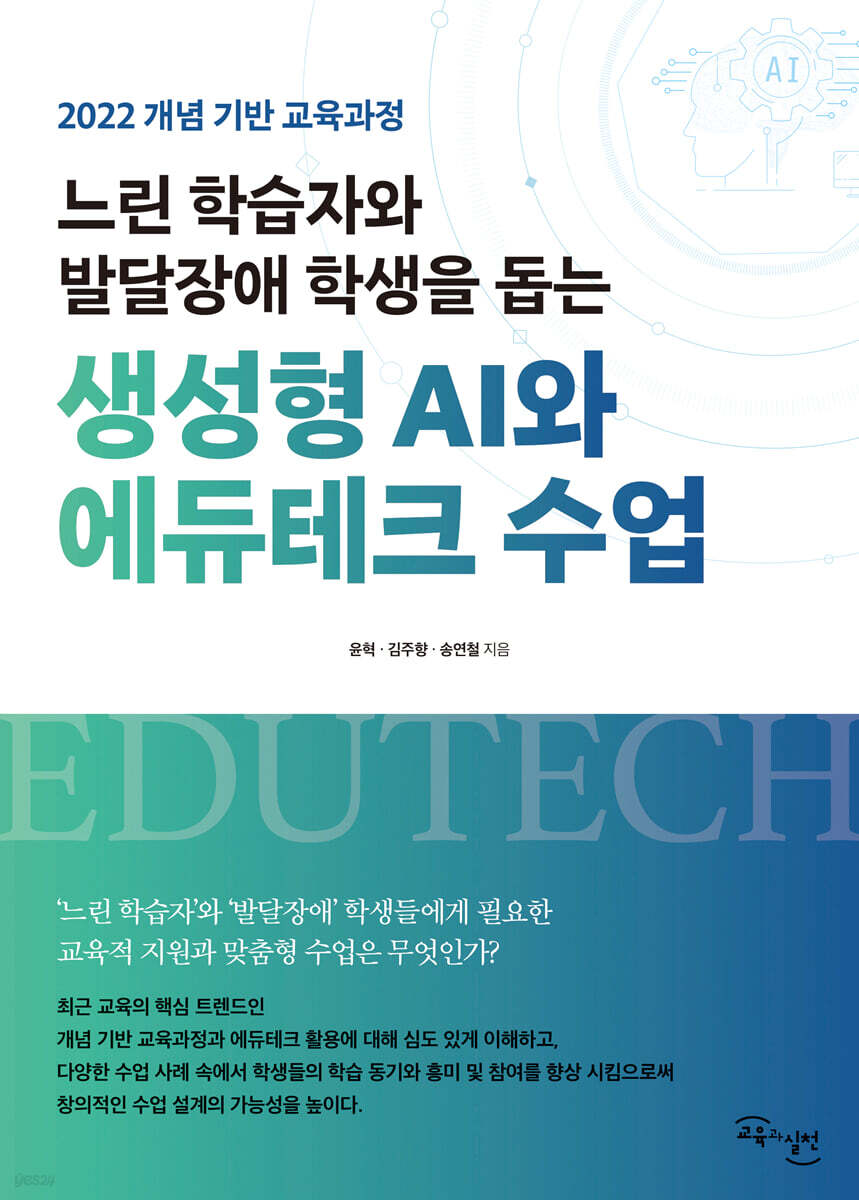
Generative AI and EdTech Classes Help Slow Learners and Students with Developmental Disabilities
 |
Description
Book Introduction
To implement the concept-based curriculum contained in the 2022 revised curriculum,
By planning step-by-step with generative AI and revealing personalized learning preparation and class examples through edutech, we are implementing universal education that leaves no child behind.
AI and edtech to help slow learners and students with developmental disabilities through education and open classes!
For those interested in edutech for slow learners and students with developmental disabilities but unsure where to get information or how to get started, this guide provides basic guidance and introduces how to prepare edutech classes for slow learners and students with developmental disabilities.
It also contains basic educational materials necessary for students to participate smoothly in edutech classes.
We also detailed how the 2022 revised curriculum reflects and addresses this approach in applying edutech to classes.
You will gain an in-depth understanding of concept-based curriculum and edutech utilization, key trends in recent education, and confirm the essence and importance of concept-based curriculum.
This is an innovative teaching method that aims for deep understanding and practical application beyond simple memorization.
It covers simple concepts such as structure, three-dimensional curriculum, and backward design centered on 'core ideas' and 'deep learning'.
We propose a method to design the characteristic elements of these concept-based curricula using generative AI.
This will provide appropriate ideas for lesson design.
In particular, we are providing guidance on methods and tools for designing detailed first-class projects using generative AI.
Above all, this book contains a curriculum design method using generative AI.
From establishing core concepts to structuring strands and designing unit lessons, we provide step-by-step guidance on how to design an efficient curriculum with the help of generative AI.
Additionally, in line with the 2022 revised curriculum's emphasis on digital technology utilization, the book offers practical advice on how to integrate various types of edutech and their applications into classes. It also explores an approach where teachers can gradually develop their own methods by referencing other teachers' successful examples of edutech use.
By planning step-by-step with generative AI and revealing personalized learning preparation and class examples through edutech, we are implementing universal education that leaves no child behind.
AI and edtech to help slow learners and students with developmental disabilities through education and open classes!
For those interested in edutech for slow learners and students with developmental disabilities but unsure where to get information or how to get started, this guide provides basic guidance and introduces how to prepare edutech classes for slow learners and students with developmental disabilities.
It also contains basic educational materials necessary for students to participate smoothly in edutech classes.
We also detailed how the 2022 revised curriculum reflects and addresses this approach in applying edutech to classes.
You will gain an in-depth understanding of concept-based curriculum and edutech utilization, key trends in recent education, and confirm the essence and importance of concept-based curriculum.
This is an innovative teaching method that aims for deep understanding and practical application beyond simple memorization.
It covers simple concepts such as structure, three-dimensional curriculum, and backward design centered on 'core ideas' and 'deep learning'.
We propose a method to design the characteristic elements of these concept-based curricula using generative AI.
This will provide appropriate ideas for lesson design.
In particular, we are providing guidance on methods and tools for designing detailed first-class projects using generative AI.
Above all, this book contains a curriculum design method using generative AI.
From establishing core concepts to structuring strands and designing unit lessons, we provide step-by-step guidance on how to design an efficient curriculum with the help of generative AI.
Additionally, in line with the 2022 revised curriculum's emphasis on digital technology utilization, the book offers practical advice on how to integrate various types of edutech and their applications into classes. It also explores an approach where teachers can gradually develop their own methods by referencing other teachers' successful examples of edutech use.
- You can preview some of the book's contents.
Preview
index
Introduction
Chapter 1: EdTech for Diverse Children
01 Learning characteristics of various children
02 Positive Effects of EdTech
Chapter 2: First Steps in EdTech
01 Become interested in edutech
02. Prepare and Create a Digital Education Environment
03 Build a solid foundation and become familiar with edutech.
04 Learning is easy, start with these tips
Chapter 3: EdTech for Concept-Based Curriculum Design
01 A brief overview of the concept-based curriculum in the 2022 revised curriculum.
02 Planning a concept-based curriculum step-by-step using generative AI
03 Knowing the Type of EdTech That's Right for Your Teaching Method
Chapter 4: EdTech for Personalized Learning
01 Mentimeter
02 Padlet
03 Release AI (Lylis AI)
04 Videoant
05 Popplet
06 Sketchbook (Autodesk Sketchbook)
07 Suno
08 ZEP
Chapter 5: Class Case Study Disclosure
01 Lesson Design Using Generative AI
02 Project 1: Why is the climate crisis occurring?
Project 03: Why is the climate crisis dangerous?
Project 04: What We Can Do to Prevent the Climate Crisis
05 Project 4 Expressing the Climate Crisis
Project 06: Creating a Climate Crisis Metaverse
Chapter 1: EdTech for Diverse Children
01 Learning characteristics of various children
02 Positive Effects of EdTech
Chapter 2: First Steps in EdTech
01 Become interested in edutech
02. Prepare and Create a Digital Education Environment
03 Build a solid foundation and become familiar with edutech.
04 Learning is easy, start with these tips
Chapter 3: EdTech for Concept-Based Curriculum Design
01 A brief overview of the concept-based curriculum in the 2022 revised curriculum.
02 Planning a concept-based curriculum step-by-step using generative AI
03 Knowing the Type of EdTech That's Right for Your Teaching Method
Chapter 4: EdTech for Personalized Learning
01 Mentimeter
02 Padlet
03 Release AI (Lylis AI)
04 Videoant
05 Popplet
06 Sketchbook (Autodesk Sketchbook)
07 Suno
08 ZEP
Chapter 5: Class Case Study Disclosure
01 Lesson Design Using Generative AI
02 Project 1: Why is the climate crisis occurring?
Project 03: Why is the climate crisis dangerous?
Project 04: What We Can Do to Prevent the Climate Crisis
05 Project 4 Expressing the Climate Crisis
Project 06: Creating a Climate Crisis Metaverse
Into the book
Learning Characteristics of Slow Learners
Slow learners can be further categorized into those at risk for functional intellectual disability, those with learning difficulties, those at risk for learning disabilities, those at risk for borderline intellectual functioning, and those at risk for typical borderline intelligence.
However, this chapter integrates these classifications and presents general characteristics of slow learners without going into detail by naming them "borderline intellectual functioning students," a term that can encompass more specific characteristics.
Students with borderline intellectual functioning experience a variety of difficulties during their school years.
They typically face challenges that they perceive as relatively difficult in terms of academic achievement and social skills, and these characteristics significantly impact their school performance.
--- p.17
Learning Characteristics of Students with Developmental Disabilities
Developmental disability is a condition in which development is significantly delayed or difficult compared to peers in various areas such as intelligence, language, sociality, movement, and behavior, due to developmental delay or difficulty that appears before the age of 18.
It is characterized by the fact that each individual has different development speeds and areas of difficulty.
This causes difficulties in learning, peer relationships, and social adaptation at school.
Intellectual disability and autism spectrum disorder are representative developmental disabilities, and other disorders may include language and communication developmental disorders, behavioral and psychological developmental disorders (including ADHD), and students with developmental disabilities require educational support tailored to their individual characteristics and needs.
--- p.21
Setting 10 Rules with Students
Establishing activity rules for edutech activities can ensure stable educational activities.
Setting rules can help students focus in class, use their devices appropriately, and manage their time effectively.
At this time, rather than providing one-sided guidance on the rules, it is important to present each problem situation and discuss solutions together to establish the rules.
--- p.85
Concept-based curriculum in the 2022 revised curriculum
The 2022 revised curriculum aims to internalize core ideas by experiencing concepts and principles through integrated education and integrating and applying them to daily life.
What will make this revised 2022 curriculum different from the existing curriculum is the 'transfer' process.
The pace of change in the future society that students will live in is likely to be much faster than it is now, and will likely flow in unexpected directions.
This is why students must have a deep understanding of the knowledge they have learned and be able to apply it outside of school.
The following presents how the key elements of the concept-based curriculum are reflected in the 2022 revised curriculum.
Key elements include core concepts, big ideas, conceptual understanding, generalization, transfer, three-dimensional curriculum, backward design, and inquiry-based instruction.
--- p.103
The Educational Effects of EdTech on Slow Learners and Students with Developmental Disabilities
The specific effects of each edutech on slow learners and students with developmental disabilities are as follows.
Mentimeter
Slow learners and students with developmental disabilities may feel pressured to express their opinions due to their slower learning speed compared to typical students.
Mentimeter helps you express your opinions without pressure.
In particular, the word cloud function encourages students to actively participate in class by entering simple words or sentences.
Additionally, the visual feedback provided by word clouds increases students' interest and engagement.
Padlet
Padlet provides an environment for slow learners and students with developmental disabilities to collect, organize, and share research materials on a collaborative board.
And then, by referring to the posts written by other students, you write a post about what you have researched.
Additionally, you can get immediate feedback from students you are collaborating with to achieve better results.
Release AI
Release AI improves access to information for slow learners and students with developmental disabilities.
Slow learners and students with developmental disabilities have short attention spans, making it difficult to quickly read and understand videos or internet news articles.
It is especially difficult to grasp the key points from videos and internet news articles within a limited time.
However, Release AI can significantly save time when analyzing the content of videos or online articles.
Check out the summary notes provided by Release AI to quickly grasp the key points.
This compensates for the slow learning rate and low comprehension of slow learners and students with developmental disabilities.
Slow learners can be further categorized into those at risk for functional intellectual disability, those with learning difficulties, those at risk for learning disabilities, those at risk for borderline intellectual functioning, and those at risk for typical borderline intelligence.
However, this chapter integrates these classifications and presents general characteristics of slow learners without going into detail by naming them "borderline intellectual functioning students," a term that can encompass more specific characteristics.
Students with borderline intellectual functioning experience a variety of difficulties during their school years.
They typically face challenges that they perceive as relatively difficult in terms of academic achievement and social skills, and these characteristics significantly impact their school performance.
--- p.17
Learning Characteristics of Students with Developmental Disabilities
Developmental disability is a condition in which development is significantly delayed or difficult compared to peers in various areas such as intelligence, language, sociality, movement, and behavior, due to developmental delay or difficulty that appears before the age of 18.
It is characterized by the fact that each individual has different development speeds and areas of difficulty.
This causes difficulties in learning, peer relationships, and social adaptation at school.
Intellectual disability and autism spectrum disorder are representative developmental disabilities, and other disorders may include language and communication developmental disorders, behavioral and psychological developmental disorders (including ADHD), and students with developmental disabilities require educational support tailored to their individual characteristics and needs.
--- p.21
Setting 10 Rules with Students
Establishing activity rules for edutech activities can ensure stable educational activities.
Setting rules can help students focus in class, use their devices appropriately, and manage their time effectively.
At this time, rather than providing one-sided guidance on the rules, it is important to present each problem situation and discuss solutions together to establish the rules.
--- p.85
Concept-based curriculum in the 2022 revised curriculum
The 2022 revised curriculum aims to internalize core ideas by experiencing concepts and principles through integrated education and integrating and applying them to daily life.
What will make this revised 2022 curriculum different from the existing curriculum is the 'transfer' process.
The pace of change in the future society that students will live in is likely to be much faster than it is now, and will likely flow in unexpected directions.
This is why students must have a deep understanding of the knowledge they have learned and be able to apply it outside of school.
The following presents how the key elements of the concept-based curriculum are reflected in the 2022 revised curriculum.
Key elements include core concepts, big ideas, conceptual understanding, generalization, transfer, three-dimensional curriculum, backward design, and inquiry-based instruction.
--- p.103
The Educational Effects of EdTech on Slow Learners and Students with Developmental Disabilities
The specific effects of each edutech on slow learners and students with developmental disabilities are as follows.
Mentimeter
Slow learners and students with developmental disabilities may feel pressured to express their opinions due to their slower learning speed compared to typical students.
Mentimeter helps you express your opinions without pressure.
In particular, the word cloud function encourages students to actively participate in class by entering simple words or sentences.
Additionally, the visual feedback provided by word clouds increases students' interest and engagement.
Padlet
Padlet provides an environment for slow learners and students with developmental disabilities to collect, organize, and share research materials on a collaborative board.
And then, by referring to the posts written by other students, you write a post about what you have researched.
Additionally, you can get immediate feedback from students you are collaborating with to achieve better results.
Release AI
Release AI improves access to information for slow learners and students with developmental disabilities.
Slow learners and students with developmental disabilities have short attention spans, making it difficult to quickly read and understand videos or internet news articles.
It is especially difficult to grasp the key points from videos and internet news articles within a limited time.
However, Release AI can significantly save time when analyzing the content of videos or online articles.
Check out the summary notes provided by Release AI to quickly grasp the key points.
This compensates for the slow learning rate and low comprehension of slow learners and students with developmental disabilities.
--- p.243
GOODS SPECIFICS
- Date of issue: October 18, 2024
- Page count, weight, size: 280 pages | 600g | 172*240*20mm
- ISBN13: 9791191724677
- ISBN10: 1191724670
You may also like
카테고리
korean


korean

![GQ KOREA Mark (Monthly): December [2025]](http://librairie.coreenne.fr/cdn/shop/files/8ef265dbbfbf186523ed75ba7319009d.jpg?v=1765340328&width=3840)


