

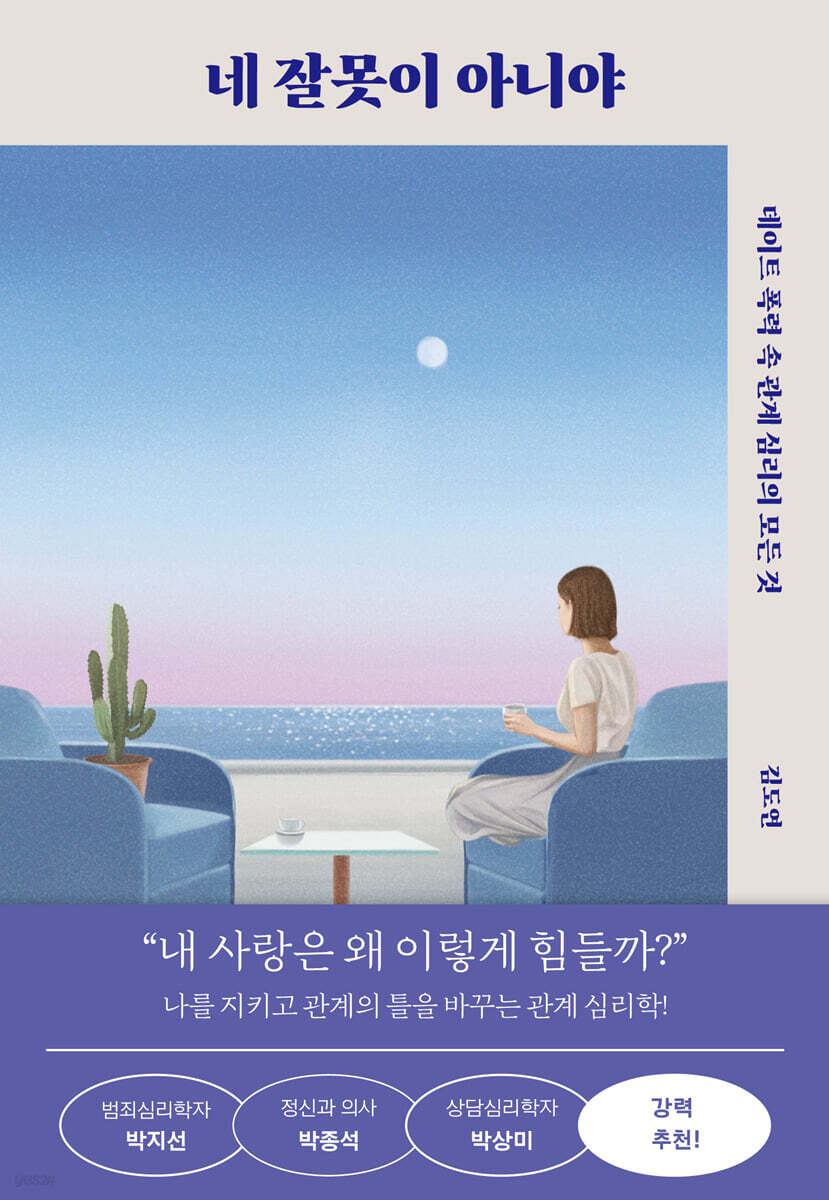
It's not your fault
 |
Description
Book Introduction
“Why is my love so difficult?” “Is it really my fault?” “Why on earth would that person do that to me?” Relationship psychology that protects you from regret and self-reproach and changes the framework of your relationships! We all have expectations about love. When you feel love for someone, you feel like you are having the ideal relationship you always wanted through that person's kind words and actions. In a normal, intimate romantic relationship, the two become friends and colleagues who walk together with respect and consideration for each other without a power structure. However, in a distorted and misaligned relationship, a subtle power structure arises. If a power structure of dominance and control, A and B, is created between lovers, it can lead to perpetrators and victims of dating violence. Dating violence is often referred to as violence that occurs in 'intimate relationships'. Being in a violent situation is painful and shocking enough, but when violence comes from someone close to you, the psychological aftereffects leave deep scars on a person's life. People often ask victims of dating violence why they got into a situation where they were dating violently, why they didn't actively defend themselves, and why they didn't end the relationship quickly. People ask these questions because they don't understand the psychological mechanisms underlying dating violence or the personality traits of perpetrators. No one wants to stay in a violent situation. It just doesn't work out the way you want it to. "It's Not Your Fault" delves into the psychology of dating violence by deeply analyzing the relationship between the perpetrator and the victim hidden within dating violence. The author, a clinical psychologist and dating violence counselor, has counseled countless people for over 20 years and draws on this experience to clearly and concisely explain how abusers fulfill their desires and needs and why victims remain trapped in distorted relationships that destroy them. At the same time, it offers specific ways for victims to protect their lives from trauma and build resilience. Dating violence is not a gender issue or an age issue. Anyone can be affected, anytime, anywhere. By accurately understanding the psychology of the perpetrator and victim in dating violence, you can avoid being in that situation, and even if you are, you can escape from it. This book comprehensively examines the various types and characteristics of dating violence, detailing the six personality traits and psychology of perpetrators and victims, and the defense mechanisms they employ. It clearly shows the characteristics and psychology of the relationship between A and B, dominance and control, and perpetrator and victim. If you are a victim of dating violence, you will learn how to break free from the cycle of violence. If you are not a victim, you will learn how to avoid being subjected to it. |
- You can preview some of the book's contents.
Preview
index
Recommendation
Author's Note
# PART 01 Where did it go wrong?
Dating violence is everywhere
The Beginning of Interest and Obsession_Behavioral Control
Invisible, covert abuse_emotional violence
The cycle of violence repeated countless times_physical violence
Body Memories Left Behind by Trauma_Sexual Violence
A Trap Disguised as Love: Gaslighting
The Shadow Following Me_Stalking
People around you who cause secondary damage
# PART 02 As time passed, I disappeared and only I was left.
They don't feel sorry
I'm a special person_Narcissistic personality disorder
The problem is that person_antisocial personality disorder
Is it wrong to confirm love? _Borderline personality disorder
It's because I didn't receive love when I was young_childhood attachment disorder
I'm a little angry_Anger management and impulsivity
You'll eventually leave me_Rejection sensitivity and defensiveness
7 Defense Mechanisms of Abusers
# PART 03 I want to escape too.
however ······
Wanting to rely on someone_dependence on others
I'm so lonely alone_Relationship addiction
I'm worried that he'll leave me_Adult Separation Anxiety
I feel like that person's parent_dysfunctional altruism
I'm always alone_Chronic loneliness and self-absorption
If you date, that's what happens_victimization
# PART 04 Yeah, it wasn't my fault
From victim to survivor
So as not to get caught up in a flood of emotions
The body remembers pain
Escape from the tunnel of depression
I am not a shameful being
So that anxiety doesn't eat me up
As sleep improves, sensitivity also decreases.
Bringing up traumatic experiences around you
The one who will help me is me
I create the value of life.
# PART 05 Overcoming trauma and growing up
Trauma is not a sign of psychological weakness.
Overcoming Cognitive Distortions and Creating an Inner Safe Zone
Healing the physical and mental wounds left by trauma
Building Resilience
Author's Note
# PART 01 Where did it go wrong?
Dating violence is everywhere
The Beginning of Interest and Obsession_Behavioral Control
Invisible, covert abuse_emotional violence
The cycle of violence repeated countless times_physical violence
Body Memories Left Behind by Trauma_Sexual Violence
A Trap Disguised as Love: Gaslighting
The Shadow Following Me_Stalking
People around you who cause secondary damage
# PART 02 As time passed, I disappeared and only I was left.
They don't feel sorry
I'm a special person_Narcissistic personality disorder
The problem is that person_antisocial personality disorder
Is it wrong to confirm love? _Borderline personality disorder
It's because I didn't receive love when I was young_childhood attachment disorder
I'm a little angry_Anger management and impulsivity
You'll eventually leave me_Rejection sensitivity and defensiveness
7 Defense Mechanisms of Abusers
# PART 03 I want to escape too.
however ······
Wanting to rely on someone_dependence on others
I'm so lonely alone_Relationship addiction
I'm worried that he'll leave me_Adult Separation Anxiety
I feel like that person's parent_dysfunctional altruism
I'm always alone_Chronic loneliness and self-absorption
If you date, that's what happens_victimization
# PART 04 Yeah, it wasn't my fault
From victim to survivor
So as not to get caught up in a flood of emotions
The body remembers pain
Escape from the tunnel of depression
I am not a shameful being
So that anxiety doesn't eat me up
As sleep improves, sensitivity also decreases.
Bringing up traumatic experiences around you
The one who will help me is me
I create the value of life.
# PART 05 Overcoming trauma and growing up
Trauma is not a sign of psychological weakness.
Overcoming Cognitive Distortions and Creating an Inner Safe Zone
Healing the physical and mental wounds left by trauma
Building Resilience
Detailed image
.png)
Into the book
Victims of dating violence struggle to meet others due to feelings of despair, betrayal, fear, and dread, and they develop distrust and anxiety toward the world.
Even in previously successful relationships, anxiety begins to grow, and it becomes difficult to maintain stability in work or studies.
In particular, many people live in extreme depression, suicidal thoughts, and anxiety while repeating self-reproach and regret.
--- p.20
Many people who come to psychological counseling due to dating violence have one thing in common:
People around you are suspicious of why you didn't break up sooner and why you have been struggling emotionally for so long.
Psychological recovery is not that simple or easy.
We have all experienced being hurt by the words and actions of others.
Sometimes it's not easy to put even the smallest things out of your mind for a long time.
What if you have suffered mental and physical abuse from your lover?
If emotions could be organized as we thought, wouldn't there be little suffering?
--- p.20
In the early stages of a relationship, victims often find it difficult to reject the pleas of an intimate partner, so they forgive them with the mindset of "just this once," only to fall into a cycle of violence and forgiveness.
This is why the cycle of violence and forgiveness is a hallmark of dating violence.
Forgiveness is not a better step toward healing a relationship, but rather a relationship trap that starts a vicious cycle of violence.
And the price of forgiveness is harsh.
This is because the victim, who had barely maintained hope and expectations for the other person, must now live with even deeper despair and regret than before.
--- p.25
Dating violence is often thought of as something that only happens to women, but it can happen to men too.
In fact, many of the male victims I met in the counseling room were unable to even tell their stories to those close to them.
Most of them ask, “What kind of dating violence can a man experience?”, “I don’t understand.
They often hear things like, “How could you be so verbally and physically abused by your girlfriend?” and even if they show even a little bit of dating violence, they are often misunderstood as if there is something seriously wrong with the victim, so they suffer without anyone understanding them and end up seeking counseling.
--- p.28
What we must not forget is how the other person resolves the problem when a conflict arises.
In other words, if you react emotionally, aggressively, and impulsively when conflict arises rather than when you are having a good time or having a good time, you should reconsider the relationship.
Because not everyone solves problems in a violent way.
Especially if you are someone who fails to control your emotions even in trivial matters, there is a very high possibility that you will continue to exhibit violent behavior in the future.
--- p.45
The brutality of sexual assault does not change just because it is an intimate relationship.
In that moment, all consideration and respect disappear, and only desire remains.
The locations of sexual assault also vary.
Sometimes it happens in classrooms, public restrooms, or quiet streets, and sometimes it happens when the other person is drunk.
Is it really the victim's fault that this happens?
Is it the victim's fault that they chose someone as immature, impulsive, and aggressive as the perpetrator?
--- p.62
Gaslighters tend to lack empathy and focus solely on communicating through possession.
They express anger and resistance when the other person does not give them what they want, but they do not pay attention to the other person's needs.
Yet, it can be difficult to recognize that you're being gaslighted because their words and actions aren't always bad.
--- p.75
For victims to recover quickly, they need supportive caregivers by their side.
Even just one person can be a ray of sunshine in the victim's life and a strong fence that blocks the wind.
This is also very important for the rapid progress of psychotherapy.
Even now, victims of dating violence may be enduring a long period of time alone.
You may live in fear of the gaze of those around you, and sometimes you may feel hurt, blame yourself, and resent yourself.
We need to think about what it takes to overcome the hurt.
Because a single word from someone around you can either make the wound worse or help it heal.
--- p.89
Dating violence is not a one-time thing, but is repetitive and ongoing.
The perpetrator's violent behavior tends to become more aggressive over time and does not easily subside even if the target changes.
In recent studies on dating violence, attempts have been made to identify the personality traits of perpetrators.
Looking at the characteristics of dating violence perpetrators, personality disorders (narcissistic, borderline, antisocial, and paranoid), anger and impulse control problems, and attachment problems with childhood caregivers influence violence, but the question is whether violent behavior can be improved.
--- p.93
The primary characteristic of people with borderline personality disorder is dramatic emotional instability.
Deep within them lies the fear of being abandoned.
(Omitted) But, he is overly sensitive to the other person's demands.
They are particularly sensitive to signals of rejection from others, and if their desires are not met, they psychologically bind the other person by attempting suicide or making threats, like Jeong-Hoon and Yoon-Ju.
In a romantic relationship, you demand that your partner understand and accept you, but you don't see the psychological pain your partner experiences because of your own unstable emotions and behavior.
--- p.117
One victim who sought counseling said that she had decided to break up several times when the other person's emotional instability and longing for affection became unbearable, but she stayed in the relationship because she thought, "If not me, who will understand and care for this person?"
Falling into this 'savior' mentality allows us to re-enable violent situations, which becomes a psychological trap that creates dysfunctional relationships.
--- p.121
People with high rejection sensitivity tend to misinterpret rejection as a complete rejection rather than accepting it as such.
As a result, even in romantic relationships, we often fail to see the other person's intentions objectively and instead make subjective inferences, becoming trapped in negative interpretations and easily showing excessive responses that are not appropriate for the situation.
They often feel anxious and imagine a catastrophic ending to their relationship, even if no specific problems arise.
They live in worry, making negative predictions like, “We’ll end up breaking up,” “I’ll be abandoned,” or “That person will leave me and go to someone else.”
--- p.141
People with a high tendency to dependence often feel fearful of making decisions or taking responsibility.
If you lack confidence or self-confidence in doing things independently, the more important the task, the more you need someone to help you.
Especially in romantic relationships, when your partner helps you make decisions or assists you with everyday matters, you become more psychologically dependent on them.
--- p.172
The craving and dependence on the object that appears in relationship addiction is similar to the pattern exhibited by alcoholics.
Just as alcoholics crave alcohol and cannot stop drinking despite knowing it is harmful, people with relationship addictions cannot escape harmful relationships despite the many obstacles they cause in their daily lives.
They crave relationships and struggle to control them, and they remain dependent on certain people and maintain relationships despite the negative consequences.
--- p.182
The feeling of loneliness is not a bad feeling.
However, if you perceive it as a negative emotion or feel uncomfortable and try to escape from it, you may become miserable every time you feel that emotion.
If you try to resolve your loneliness through relationships or rely on others for comfort rather than accepting it yourself, you will always seek out others to manage your emotions.
--- p.198
Repeat victimization occurs when a person experiences multiple or continuous forms of violence or abuse over a long period of time.
Repeated experiences of victimization can have long-term effects on an individual's mental health and quality of life.
As a result, not only do they suffer from various psychological problems such as post-traumatic stress disorder, depression, and anxiety, but their connections with society also weaken.
--- p.204
The trauma experienced by victims of dating violence has psychological, emotional, and physical effects.
One of these effects is that the victim experiences their body and mind becoming hyper-vigilant or 'hyperactive'.
This is called a state of 'hyperarousal' or 'hypersensitivity' and is caused by the fight-or-flight response, also known as the 'stress response' or 'emergency response'.
(Omitted) That is, the victims' bodies and minds continue to perceive themselves as being in danger and maintain a state of excessive alertness.
So, they overreact to small stimuli in everyday life, and certain movements or situations can amplify their stress response.
--- p.225
If you're overly concerned about your self-esteem, thinking, "I can't let my self-esteem get low," or "I need high self-esteem to be able to do anything," you may end up being less psychologically flexible even when faced with minor changes.
It is important to have a mental attitude that is not obsessed with self-esteem, as normative thoughts about self-esteem can create psychological rigidity and become a trap that entangles oneself.
--- p.238
These memory deficits act as a defense mechanism to protect oneself from stressful events.
It appears when the experience at the time of the incident is painful or unexpected and the situation is difficult to handle.
Damaged memories are often information that causes psychological distress or details of traumatic events.
These memory impairments are characterized by sudden onset, persistence, and then abrupt recovery.
Memory errors occur even in everyday stressful situations, but the memory impairment that occurs as a result of dissociative reactions is severe.
Dissociative amnesia protects and represses psychological content that causes anxiety or fear, preventing it from becoming conscious.
Although lost memories are not remembered in everyday situations, partial content may enter consciousness and be recalled when aroused or emotionally reacts in a situation similar to the traumatic situation.
--- p.303
Exposure to relational violence, such as complex trauma, often leads to symptoms of hyperarousal, characterized by emotional symptoms such as anxiety, aggression, and restlessness.
Because of these hyperarousal symptoms, you may often feel invaded, emotionally overwhelmed, and experience a sense of helplessness that you cannot control.
Additionally, as people repeatedly re-experience traumatic events, they become very sensitive to the environment or hyper-vigilant to protect themselves, which becomes a vicious cycle that hinders their ability to adapt to daily life.
Even in previously successful relationships, anxiety begins to grow, and it becomes difficult to maintain stability in work or studies.
In particular, many people live in extreme depression, suicidal thoughts, and anxiety while repeating self-reproach and regret.
--- p.20
Many people who come to psychological counseling due to dating violence have one thing in common:
People around you are suspicious of why you didn't break up sooner and why you have been struggling emotionally for so long.
Psychological recovery is not that simple or easy.
We have all experienced being hurt by the words and actions of others.
Sometimes it's not easy to put even the smallest things out of your mind for a long time.
What if you have suffered mental and physical abuse from your lover?
If emotions could be organized as we thought, wouldn't there be little suffering?
--- p.20
In the early stages of a relationship, victims often find it difficult to reject the pleas of an intimate partner, so they forgive them with the mindset of "just this once," only to fall into a cycle of violence and forgiveness.
This is why the cycle of violence and forgiveness is a hallmark of dating violence.
Forgiveness is not a better step toward healing a relationship, but rather a relationship trap that starts a vicious cycle of violence.
And the price of forgiveness is harsh.
This is because the victim, who had barely maintained hope and expectations for the other person, must now live with even deeper despair and regret than before.
--- p.25
Dating violence is often thought of as something that only happens to women, but it can happen to men too.
In fact, many of the male victims I met in the counseling room were unable to even tell their stories to those close to them.
Most of them ask, “What kind of dating violence can a man experience?”, “I don’t understand.
They often hear things like, “How could you be so verbally and physically abused by your girlfriend?” and even if they show even a little bit of dating violence, they are often misunderstood as if there is something seriously wrong with the victim, so they suffer without anyone understanding them and end up seeking counseling.
--- p.28
What we must not forget is how the other person resolves the problem when a conflict arises.
In other words, if you react emotionally, aggressively, and impulsively when conflict arises rather than when you are having a good time or having a good time, you should reconsider the relationship.
Because not everyone solves problems in a violent way.
Especially if you are someone who fails to control your emotions even in trivial matters, there is a very high possibility that you will continue to exhibit violent behavior in the future.
--- p.45
The brutality of sexual assault does not change just because it is an intimate relationship.
In that moment, all consideration and respect disappear, and only desire remains.
The locations of sexual assault also vary.
Sometimes it happens in classrooms, public restrooms, or quiet streets, and sometimes it happens when the other person is drunk.
Is it really the victim's fault that this happens?
Is it the victim's fault that they chose someone as immature, impulsive, and aggressive as the perpetrator?
--- p.62
Gaslighters tend to lack empathy and focus solely on communicating through possession.
They express anger and resistance when the other person does not give them what they want, but they do not pay attention to the other person's needs.
Yet, it can be difficult to recognize that you're being gaslighted because their words and actions aren't always bad.
--- p.75
For victims to recover quickly, they need supportive caregivers by their side.
Even just one person can be a ray of sunshine in the victim's life and a strong fence that blocks the wind.
This is also very important for the rapid progress of psychotherapy.
Even now, victims of dating violence may be enduring a long period of time alone.
You may live in fear of the gaze of those around you, and sometimes you may feel hurt, blame yourself, and resent yourself.
We need to think about what it takes to overcome the hurt.
Because a single word from someone around you can either make the wound worse or help it heal.
--- p.89
Dating violence is not a one-time thing, but is repetitive and ongoing.
The perpetrator's violent behavior tends to become more aggressive over time and does not easily subside even if the target changes.
In recent studies on dating violence, attempts have been made to identify the personality traits of perpetrators.
Looking at the characteristics of dating violence perpetrators, personality disorders (narcissistic, borderline, antisocial, and paranoid), anger and impulse control problems, and attachment problems with childhood caregivers influence violence, but the question is whether violent behavior can be improved.
--- p.93
The primary characteristic of people with borderline personality disorder is dramatic emotional instability.
Deep within them lies the fear of being abandoned.
(Omitted) But, he is overly sensitive to the other person's demands.
They are particularly sensitive to signals of rejection from others, and if their desires are not met, they psychologically bind the other person by attempting suicide or making threats, like Jeong-Hoon and Yoon-Ju.
In a romantic relationship, you demand that your partner understand and accept you, but you don't see the psychological pain your partner experiences because of your own unstable emotions and behavior.
--- p.117
One victim who sought counseling said that she had decided to break up several times when the other person's emotional instability and longing for affection became unbearable, but she stayed in the relationship because she thought, "If not me, who will understand and care for this person?"
Falling into this 'savior' mentality allows us to re-enable violent situations, which becomes a psychological trap that creates dysfunctional relationships.
--- p.121
People with high rejection sensitivity tend to misinterpret rejection as a complete rejection rather than accepting it as such.
As a result, even in romantic relationships, we often fail to see the other person's intentions objectively and instead make subjective inferences, becoming trapped in negative interpretations and easily showing excessive responses that are not appropriate for the situation.
They often feel anxious and imagine a catastrophic ending to their relationship, even if no specific problems arise.
They live in worry, making negative predictions like, “We’ll end up breaking up,” “I’ll be abandoned,” or “That person will leave me and go to someone else.”
--- p.141
People with a high tendency to dependence often feel fearful of making decisions or taking responsibility.
If you lack confidence or self-confidence in doing things independently, the more important the task, the more you need someone to help you.
Especially in romantic relationships, when your partner helps you make decisions or assists you with everyday matters, you become more psychologically dependent on them.
--- p.172
The craving and dependence on the object that appears in relationship addiction is similar to the pattern exhibited by alcoholics.
Just as alcoholics crave alcohol and cannot stop drinking despite knowing it is harmful, people with relationship addictions cannot escape harmful relationships despite the many obstacles they cause in their daily lives.
They crave relationships and struggle to control them, and they remain dependent on certain people and maintain relationships despite the negative consequences.
--- p.182
The feeling of loneliness is not a bad feeling.
However, if you perceive it as a negative emotion or feel uncomfortable and try to escape from it, you may become miserable every time you feel that emotion.
If you try to resolve your loneliness through relationships or rely on others for comfort rather than accepting it yourself, you will always seek out others to manage your emotions.
--- p.198
Repeat victimization occurs when a person experiences multiple or continuous forms of violence or abuse over a long period of time.
Repeated experiences of victimization can have long-term effects on an individual's mental health and quality of life.
As a result, not only do they suffer from various psychological problems such as post-traumatic stress disorder, depression, and anxiety, but their connections with society also weaken.
--- p.204
The trauma experienced by victims of dating violence has psychological, emotional, and physical effects.
One of these effects is that the victim experiences their body and mind becoming hyper-vigilant or 'hyperactive'.
This is called a state of 'hyperarousal' or 'hypersensitivity' and is caused by the fight-or-flight response, also known as the 'stress response' or 'emergency response'.
(Omitted) That is, the victims' bodies and minds continue to perceive themselves as being in danger and maintain a state of excessive alertness.
So, they overreact to small stimuli in everyday life, and certain movements or situations can amplify their stress response.
--- p.225
If you're overly concerned about your self-esteem, thinking, "I can't let my self-esteem get low," or "I need high self-esteem to be able to do anything," you may end up being less psychologically flexible even when faced with minor changes.
It is important to have a mental attitude that is not obsessed with self-esteem, as normative thoughts about self-esteem can create psychological rigidity and become a trap that entangles oneself.
--- p.238
These memory deficits act as a defense mechanism to protect oneself from stressful events.
It appears when the experience at the time of the incident is painful or unexpected and the situation is difficult to handle.
Damaged memories are often information that causes psychological distress or details of traumatic events.
These memory impairments are characterized by sudden onset, persistence, and then abrupt recovery.
Memory errors occur even in everyday stressful situations, but the memory impairment that occurs as a result of dissociative reactions is severe.
Dissociative amnesia protects and represses psychological content that causes anxiety or fear, preventing it from becoming conscious.
Although lost memories are not remembered in everyday situations, partial content may enter consciousness and be recalled when aroused or emotionally reacts in a situation similar to the traumatic situation.
--- p.303
Exposure to relational violence, such as complex trauma, often leads to symptoms of hyperarousal, characterized by emotional symptoms such as anxiety, aggression, and restlessness.
Because of these hyperarousal symptoms, you may often feel invaded, emotionally overwhelmed, and experience a sense of helplessness that you cannot control.
Additionally, as people repeatedly re-experience traumatic events, they become very sensitive to the environment or hyper-vigilant to protect themselves, which becomes a vicious cycle that hinders their ability to adapt to daily life.
--- p.305
Publisher's Review
It stands out for its three-dimensional analysis and deep insight into the psychology of the perpetrator and the victim.
A must-read for anyone who wants to get closer to the essence of dating violence!
Park Ji-seon (criminal psychologist, professor of social psychology at Sookmyung Women's University)
A nightmare time and re-experience.
Shattered self-esteem and identity, the fear that I will never be able to recover my original self.
This book teaches us that we can overcome all these traumas and emerge stronger.
Park Jong-seok (psychiatrist, author of "We're a Little Tired")
We can save potential victims and rescue those who are suffering but cannot escape.
Park Sang-mi (Vice President of the Korean Society of Aesthetic Therapy, Dean of Healing Campus The Gonggam, Author of "How to Become a Stronger Mind")
What we need to know
Everything You Need to Know About Relationship Psychology in Dating Violence!
Relationship psychology that protects you from regret and self-reproach and changes the framework of your relationships!
In relationships, intimacy is an important element of happiness.
To become close to someone, you need consideration and respect, and based on this, you can open your heart to the other person and develop an intimate relationship.
In a normal, intimate relationship, people are friends and colleagues who walk together with respect and consideration for each other without a power structure, but in a distorted and misaligned relationship, a subtle power structure arises.
This is also true between lovers.
If a power structure of dominance and control, A and B, arises between lovers, it can lead to a relationship between the perpetrator and victim of dating violence.
People often ask victims of dating violence why they got into a situation where they were dating violently, why they didn't actively defend themselves, and why they didn't end the relationship quickly.
But no one wants to stay in such a violent situation.
It just didn't work out the way I wanted.
People ask these questions because they don't understand the psychological mechanisms underlying dating violence or the personality traits of perpetrators.
"It's Not Your Fault" deeply analyzes the psychology of the relationship between the perpetrator and the victim hidden in dating violence.
The author, a clinical psychologist and dating violence counselor, has counseled countless people for over 20 years, and based on this experience, he has clearly and easily explained how perpetrators exploit their victims' psychology to satisfy their own desires and needs, and why victims are unable to escape the distorted relationships that destroy them.
At the same time, it includes specific ways for victims to protect their lives from trauma and build resilience.
Dating violence is not a gender issue or an age issue.
Anyone can be affected, anytime, anywhere.
By accurately understanding the psychology of the perpetrator and victim in dating violence, you can avoid being in that situation, and even if you are, you can escape from it.
This book comprehensively examines the various types and characteristics of dating violence, detailing the six personality traits and psychology of perpetrators and victims, and the defense mechanisms they employ.
If you are a victim of dating violence, you will learn how to break free from its cycle; if you are not a victim, you will learn how to avoid it.
Why on earth did that person do that to me?
Case 1
Minji and Hyunwoo are a couple who met in college and quickly became close because they had similar hobbies.
However, Hyunwoo's frequent lies and breaking promises led to frequent fights.
Additionally, when Hyunwoo drank, he would often get into fights with other people, and he would swear at Minji, verbally abuse her, and even commit violence against her.
There were times when I was threatened by being pulled hard by my arm or strangled to the point of losing consciousness.
After the violence occurred, Hyunwoo apologized for his actions, saying he was sorry, but it soon happened again.
Case 2
Jihye and Jeonghoon met through a college friend and became lovers.
However, when Jihye started working part-time and the time they spent together decreased, Jeonghoon started complaining and asking her to quit her job, and he got angry when she didn't talk to him on the phone or meet him late at night.
Jihye was having a hard time maintaining her daily life, and when she confided her feelings, that evening Jeonghoon sent her a message and photo suggesting suicide.
In the end, Jihye went to see Jeonghoon and apologized, and only then did she finally calm down.
Case 3
Seungsu and Jihyun have promised to get married.
However, when Jihyun got angry, she expressed her emotions through destructive behavior, such as yelling or destroying things, instead of talking.
One time, while we were having dinner together at a restaurant, Seungsu sent several messages to his coworker about something urgent.
Then, instead of asking what was going on, Jihyun got angry and threw the cup on the floor and expressed her anger loudly without caring about the people around her.
As Seungsu continued to speak, his angry behavior grew and eventually he was only able to stop after the people around him stepped in to stop him.
Perpetrators of dating violence, like the example above, tend to have strong impulsive, aggressive, and self-centered characteristics, and often have personality disorders.
The author presents six personality types of perpetrators with various examples.
It covers in detail the psychology of how perpetrators push their victims into a swamp of suffering under the guise of love, from narcissistic personality disorder, which we commonly call narcissism, to antisocial personality disorder, which we call sociopathic personality disorder, borderline personality disorder, childhood attachment disorder, anger management and impulsivity, rejection sensitivity and defensiveness.
People with personality disorders tend to be particularly obsessive and possessive towards their partners, but behind this, they have abandonment anxiety and an inferiority complex due to the fear of being abandoned, and they try to hide their weaknesses through violent means.
However, before developing an intimate relationship, these unique and distinctive inner personality traits are not easily revealed.
So, in the early stages of a relationship, you don't notice their violent tendencies and personality disorders.
In severe cases, the image shown to the victim and the image presented to the public are so different that those around the victim may not believe what they say.
Additionally, perpetrators use defense mechanisms to avoid responsibility for their wrongdoings or to justify violence.
The author presents seven defense mechanisms deeply rooted in the psychological needs and behavioral patterns of abusers, helping us avoid being manipulated by these individuals when we encounter them.
Why can't I get away from that person?
Case 1
Hye-kyung, 25, met Hyeon-woo about three months after breaking up with her ex-boyfriend.
I didn't know enough about him, but I couldn't stand the emptiness, so I started dating him.
However, Hyunwoo seemed to view Hye-kyung only as a sexual partner and demanded money for various reasons.
Hye-kyung barely managed to break up with Hyeon-woo despite financial and emotional distress, but she is struggling with the emptiness that often comes to her.
Case 2
After Jin-kyung and Gyeong-hwan became lovers in graduate school, they were initially happy to be able to discuss their studies and career paths together.
Jin-kyung actively helped Gyeong-hwan when he was conducting research and took meticulous care of his meals and clothes.
But after graduating, when Kyung-Hwan went to work as a researcher in another region, I felt like my role had disappeared and I was anxious because I felt like I was no longer important to him.
When Jin-kyung was young, her parents often had conflicts, and she was the one who mediated and took care of her family. Now that she looks back, she feels sorry for herself and regrets having lived a sacrificial life.
Case 3
Mina is a woman in her early 20s who currently lives with her boyfriend, Taejun.
The two met in college, started dating, and started living together a year later.
At first everything went well.
But as time went by, Taejun became more and more dominant and when he got angry, he would throw things or use harsh language.
On several occasions, it even escalated to physical violence.
Mina experienced domestic violence as a child and wanted to protect her love at all costs.
And it was thought that if a fight broke out in a romantic relationship, violence could ensue.
“Then why didn’t you break up sooner?” “You should have cut it off right away when you first noticed!” These are the things victims hear most often from family, friends, or other close friends.
People around them may say this out of pity, but from the victim's perspective, it feels like it's all their fault, so they can't help but cringe again.
But why can't victims escape their perpetrators? Why are they exposed to violence? These questions, which many people wonder about, reveal the psychology of victims vulnerable to dating violence.
And the perpetrator uses the victim's weak link to satisfy his own desires.
The author shows six psychological states of victims that are revealed in dating violence situations.
It clearly presents the psychology that dominates victims of dating violence, such as being highly dependent on others, being unable to tolerate being alone, becoming addicted to relationships, taking the violence for granted, or thinking that they will save the other person through their own sacrifice.
Because dating violence occurs in intimate relationships, victims may feel affection or sympathy for the perpetrator.
Additionally, the victim may expect the perpetrator to repent and change, or may believe that he or she was actually at fault.
It is for this very reason that victims often fail to recognize or report dating violence.
But the important thing is that dating violence is never a one-time thing; it usually happens repeatedly.
Dating violence occurs in stages and repeats in a certain cycle.
Therefore, not a single act of violence should be permitted.
As the tolerance for violence increases, the perpetrators increase their violence through self-rationalization.
Psychological Healing Solutions for Those of You Who Still Blame Yourself
The most significant characteristic of victims of dating violence is regret and self-blame.
Victims of dating violence struggle to meet others due to feelings of despair, betrayal, fear, and dread, and they develop distrust and anxiety toward the world.
Even in previously successful relationships, anxiety begins to grow, and it becomes difficult to maintain stability in work or studies.
In particular, many people experience severe depression, suicidal thoughts, and anxiety while repeating self-reproach and regret, and suffer from post-traumatic stress disorder, enduring the symptoms alone.
In fact, one victim, who sought counseling, complained of extreme pain due to her boyfriend's controlling behavior, saying, "He prevented me from seeing my long-time close friend.
I always gossiped about that guy because he seemed like he had problems.
I've always hated meeting other people.
So I met up with my friend secretly a few times, but we had a huge fight every time, and eventually we ended up breaking up.
“I was such a fool,” he said, berating himself for being manipulated by the other person.
This book contains a prescription for psychological healing that can help victims who are suffering from psychological helplessness due to regret and self-reproach protect themselves and change the framework of their relationships.
It contains various cognitive behavioral therapy techniques to help you break free from cognitive distortions and negative thoughts, mindful breathing techniques to increase mental stability and positive energy, and self-assessment checklists to help you overcome depression and anxiety.
Victims are prone to feeling psychologically helpless and falling into the mindset of being victims of violence, and the healing process is delayed as they continue to look back on the past and blame themselves.
However, if you use the various techniques in this book to achieve psychological healing, you will be able to escape the dark tunnel created by dating violence.
A must-read for anyone who wants to get closer to the essence of dating violence!
Park Ji-seon (criminal psychologist, professor of social psychology at Sookmyung Women's University)
A nightmare time and re-experience.
Shattered self-esteem and identity, the fear that I will never be able to recover my original self.
This book teaches us that we can overcome all these traumas and emerge stronger.
Park Jong-seok (psychiatrist, author of "We're a Little Tired")
We can save potential victims and rescue those who are suffering but cannot escape.
Park Sang-mi (Vice President of the Korean Society of Aesthetic Therapy, Dean of Healing Campus The Gonggam, Author of "How to Become a Stronger Mind")
What we need to know
Everything You Need to Know About Relationship Psychology in Dating Violence!
Relationship psychology that protects you from regret and self-reproach and changes the framework of your relationships!
In relationships, intimacy is an important element of happiness.
To become close to someone, you need consideration and respect, and based on this, you can open your heart to the other person and develop an intimate relationship.
In a normal, intimate relationship, people are friends and colleagues who walk together with respect and consideration for each other without a power structure, but in a distorted and misaligned relationship, a subtle power structure arises.
This is also true between lovers.
If a power structure of dominance and control, A and B, arises between lovers, it can lead to a relationship between the perpetrator and victim of dating violence.
People often ask victims of dating violence why they got into a situation where they were dating violently, why they didn't actively defend themselves, and why they didn't end the relationship quickly.
But no one wants to stay in such a violent situation.
It just didn't work out the way I wanted.
People ask these questions because they don't understand the psychological mechanisms underlying dating violence or the personality traits of perpetrators.
"It's Not Your Fault" deeply analyzes the psychology of the relationship between the perpetrator and the victim hidden in dating violence.
The author, a clinical psychologist and dating violence counselor, has counseled countless people for over 20 years, and based on this experience, he has clearly and easily explained how perpetrators exploit their victims' psychology to satisfy their own desires and needs, and why victims are unable to escape the distorted relationships that destroy them.
At the same time, it includes specific ways for victims to protect their lives from trauma and build resilience.
Dating violence is not a gender issue or an age issue.
Anyone can be affected, anytime, anywhere.
By accurately understanding the psychology of the perpetrator and victim in dating violence, you can avoid being in that situation, and even if you are, you can escape from it.
This book comprehensively examines the various types and characteristics of dating violence, detailing the six personality traits and psychology of perpetrators and victims, and the defense mechanisms they employ.
If you are a victim of dating violence, you will learn how to break free from its cycle; if you are not a victim, you will learn how to avoid it.
Why on earth did that person do that to me?
Case 1
Minji and Hyunwoo are a couple who met in college and quickly became close because they had similar hobbies.
However, Hyunwoo's frequent lies and breaking promises led to frequent fights.
Additionally, when Hyunwoo drank, he would often get into fights with other people, and he would swear at Minji, verbally abuse her, and even commit violence against her.
There were times when I was threatened by being pulled hard by my arm or strangled to the point of losing consciousness.
After the violence occurred, Hyunwoo apologized for his actions, saying he was sorry, but it soon happened again.
Case 2
Jihye and Jeonghoon met through a college friend and became lovers.
However, when Jihye started working part-time and the time they spent together decreased, Jeonghoon started complaining and asking her to quit her job, and he got angry when she didn't talk to him on the phone or meet him late at night.
Jihye was having a hard time maintaining her daily life, and when she confided her feelings, that evening Jeonghoon sent her a message and photo suggesting suicide.
In the end, Jihye went to see Jeonghoon and apologized, and only then did she finally calm down.
Case 3
Seungsu and Jihyun have promised to get married.
However, when Jihyun got angry, she expressed her emotions through destructive behavior, such as yelling or destroying things, instead of talking.
One time, while we were having dinner together at a restaurant, Seungsu sent several messages to his coworker about something urgent.
Then, instead of asking what was going on, Jihyun got angry and threw the cup on the floor and expressed her anger loudly without caring about the people around her.
As Seungsu continued to speak, his angry behavior grew and eventually he was only able to stop after the people around him stepped in to stop him.
Perpetrators of dating violence, like the example above, tend to have strong impulsive, aggressive, and self-centered characteristics, and often have personality disorders.
The author presents six personality types of perpetrators with various examples.
It covers in detail the psychology of how perpetrators push their victims into a swamp of suffering under the guise of love, from narcissistic personality disorder, which we commonly call narcissism, to antisocial personality disorder, which we call sociopathic personality disorder, borderline personality disorder, childhood attachment disorder, anger management and impulsivity, rejection sensitivity and defensiveness.
People with personality disorders tend to be particularly obsessive and possessive towards their partners, but behind this, they have abandonment anxiety and an inferiority complex due to the fear of being abandoned, and they try to hide their weaknesses through violent means.
However, before developing an intimate relationship, these unique and distinctive inner personality traits are not easily revealed.
So, in the early stages of a relationship, you don't notice their violent tendencies and personality disorders.
In severe cases, the image shown to the victim and the image presented to the public are so different that those around the victim may not believe what they say.
Additionally, perpetrators use defense mechanisms to avoid responsibility for their wrongdoings or to justify violence.
The author presents seven defense mechanisms deeply rooted in the psychological needs and behavioral patterns of abusers, helping us avoid being manipulated by these individuals when we encounter them.
Why can't I get away from that person?
Case 1
Hye-kyung, 25, met Hyeon-woo about three months after breaking up with her ex-boyfriend.
I didn't know enough about him, but I couldn't stand the emptiness, so I started dating him.
However, Hyunwoo seemed to view Hye-kyung only as a sexual partner and demanded money for various reasons.
Hye-kyung barely managed to break up with Hyeon-woo despite financial and emotional distress, but she is struggling with the emptiness that often comes to her.
Case 2
After Jin-kyung and Gyeong-hwan became lovers in graduate school, they were initially happy to be able to discuss their studies and career paths together.
Jin-kyung actively helped Gyeong-hwan when he was conducting research and took meticulous care of his meals and clothes.
But after graduating, when Kyung-Hwan went to work as a researcher in another region, I felt like my role had disappeared and I was anxious because I felt like I was no longer important to him.
When Jin-kyung was young, her parents often had conflicts, and she was the one who mediated and took care of her family. Now that she looks back, she feels sorry for herself and regrets having lived a sacrificial life.
Case 3
Mina is a woman in her early 20s who currently lives with her boyfriend, Taejun.
The two met in college, started dating, and started living together a year later.
At first everything went well.
But as time went by, Taejun became more and more dominant and when he got angry, he would throw things or use harsh language.
On several occasions, it even escalated to physical violence.
Mina experienced domestic violence as a child and wanted to protect her love at all costs.
And it was thought that if a fight broke out in a romantic relationship, violence could ensue.
“Then why didn’t you break up sooner?” “You should have cut it off right away when you first noticed!” These are the things victims hear most often from family, friends, or other close friends.
People around them may say this out of pity, but from the victim's perspective, it feels like it's all their fault, so they can't help but cringe again.
But why can't victims escape their perpetrators? Why are they exposed to violence? These questions, which many people wonder about, reveal the psychology of victims vulnerable to dating violence.
And the perpetrator uses the victim's weak link to satisfy his own desires.
The author shows six psychological states of victims that are revealed in dating violence situations.
It clearly presents the psychology that dominates victims of dating violence, such as being highly dependent on others, being unable to tolerate being alone, becoming addicted to relationships, taking the violence for granted, or thinking that they will save the other person through their own sacrifice.
Because dating violence occurs in intimate relationships, victims may feel affection or sympathy for the perpetrator.
Additionally, the victim may expect the perpetrator to repent and change, or may believe that he or she was actually at fault.
It is for this very reason that victims often fail to recognize or report dating violence.
But the important thing is that dating violence is never a one-time thing; it usually happens repeatedly.
Dating violence occurs in stages and repeats in a certain cycle.
Therefore, not a single act of violence should be permitted.
As the tolerance for violence increases, the perpetrators increase their violence through self-rationalization.
Psychological Healing Solutions for Those of You Who Still Blame Yourself
The most significant characteristic of victims of dating violence is regret and self-blame.
Victims of dating violence struggle to meet others due to feelings of despair, betrayal, fear, and dread, and they develop distrust and anxiety toward the world.
Even in previously successful relationships, anxiety begins to grow, and it becomes difficult to maintain stability in work or studies.
In particular, many people experience severe depression, suicidal thoughts, and anxiety while repeating self-reproach and regret, and suffer from post-traumatic stress disorder, enduring the symptoms alone.
In fact, one victim, who sought counseling, complained of extreme pain due to her boyfriend's controlling behavior, saying, "He prevented me from seeing my long-time close friend.
I always gossiped about that guy because he seemed like he had problems.
I've always hated meeting other people.
So I met up with my friend secretly a few times, but we had a huge fight every time, and eventually we ended up breaking up.
“I was such a fool,” he said, berating himself for being manipulated by the other person.
This book contains a prescription for psychological healing that can help victims who are suffering from psychological helplessness due to regret and self-reproach protect themselves and change the framework of their relationships.
It contains various cognitive behavioral therapy techniques to help you break free from cognitive distortions and negative thoughts, mindful breathing techniques to increase mental stability and positive energy, and self-assessment checklists to help you overcome depression and anxiety.
Victims are prone to feeling psychologically helpless and falling into the mindset of being victims of violence, and the healing process is delayed as they continue to look back on the past and blame themselves.
However, if you use the various techniques in this book to achieve psychological healing, you will be able to escape the dark tunnel created by dating violence.
GOODS SPECIFICS
- Date of issue: April 22, 2024
- Page count, weight, size: 312 pages | 344g | 130*188*20mm
- ISBN13: 9788931023541
- ISBN10: 8931023545
You may also like
카테고리
korean


korean

![GQ KOREA Mark (Monthly): December [2025]](http://librairie.coreenne.fr/cdn/shop/files/8ef265dbbfbf186523ed75ba7319009d.jpg?v=1765340328&width=3840)


