

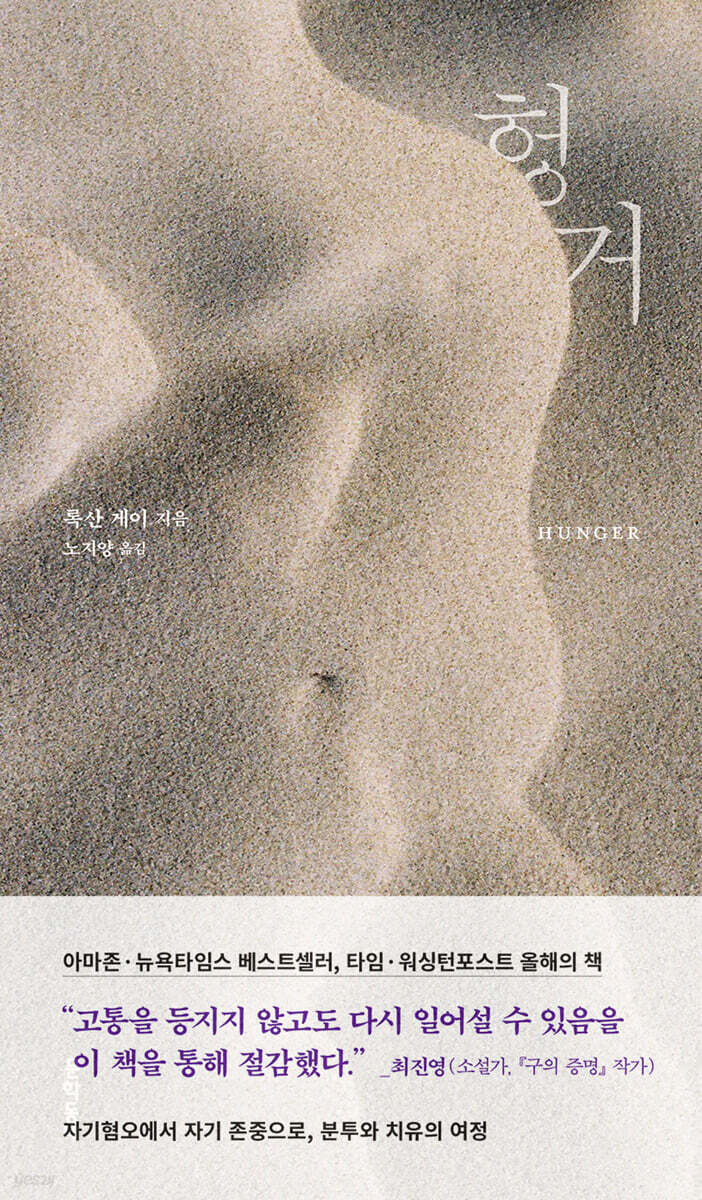
hunger
 |
Description
Book Introduction
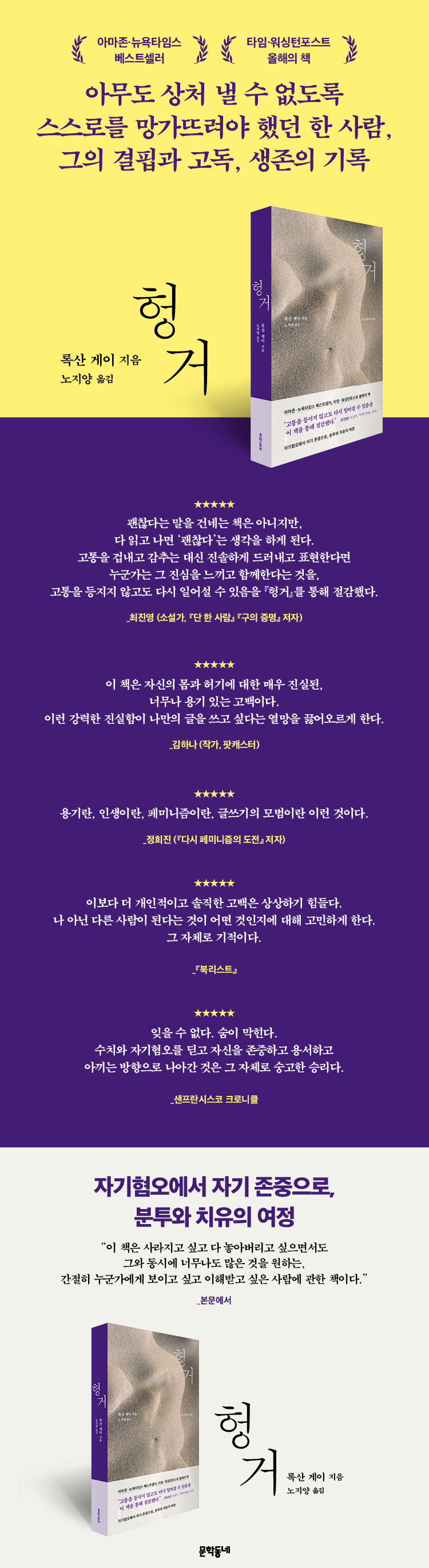
* Amazon · New York Times Bestseller * Time and Washington Post Book of the Year So that no one can get hurt A man who had to destroy himself, His record of poverty, loneliness, and survival Roxane Gay's memoir, Hunger, was published by Munhakdongne. This book became an Amazon and New York Times bestseller immediately after its publication in the United States, and was selected as a 'Book of the Year' by major media outlets such as Time, People, Kirkus Reviews, Booklist, The Washington Post, and the Chicago Tribune. Even now, many years later, it is still talked about by bibliophiles as 'the book of a lifetime' and 'the best essay'. Published three years after Roxane Gay made her name as the author of Bad Feminist, a humorous yet sharply written memoir that shattered misconceptions about feminism, this book surprised critics and readers alike, receiving praise as “a shockingly honest memoir.” Gay painfully recounts an incident that has haunted him since childhood, and poignantly confesses the impact shame and loneliness have had on his life and his journey to overcome those wounds. The inner voice that delves into the essence of 'hunger' is vivid and even chilling, and its sharp awareness of the body, desire, and pain has resonated with many contemporary women. As can be seen in author Kim Ha-na's recommendation, "This powerful truthfulness fuels my desire to write my own story," "Hunger" will undoubtedly remain a memoir read for centuries, awakening us to the power of truthfulness. “This book is about my body, my hunger, and ultimately, it’s about a person who wants to disappear, to let go, but at the same time wants so much, desperately wants to be seen and understood. “This is a book about a person who finally learned that it was possible to show up and be understood, even if the process was incredibly slow.” (p. 16) |
- You can preview some of the book's contents.
Preview
index
Part 1
1·2·3·4·5·6·7·8·9
Part 2
10·11·12·13·14·15·16·17·18·19·20·21·22·23·24·25·26·27·28·29
Part 3
30·31·32·33·34·35·36·37·38·39·40·41
Part 4
42·43·44·45·46·47·48·49·50·51·52·53·54·55·56·57·58·59·60·61·62
Part 5
63·64·65·66·67·68·69·70·71·72·73·74·75·76·77·78·79·80
Part 6
81·82·83·84·85·86·87·88
Acknowledgements
1·2·3·4·5·6·7·8·9
Part 2
10·11·12·13·14·15·16·17·18·19·20·21·22·23·24·25·26·27·28·29
Part 3
30·31·32·33·34·35·36·37·38·39·40·41
Part 4
42·43·44·45·46·47·48·49·50·51·52·53·54·55·56·57·58·59·60·61·62
Part 5
63·64·65·66·67·68·69·70·71·72·73·74·75·76·77·78·79·80
Part 6
81·82·83·84·85·86·87·88
Acknowledgements
Detailed image
Into the book
I was forced to reflect on the countless hardships my body had endured, the weight I had gained and the mental burden I had endured, and how difficult it had been to live with this weight and to shed it.
I had no choice but to force myself to look into embarrassing secrets that I absolutely did not want to reveal.
I had to split open the middle of my heart and spread it out.
I was stripped naked.
It's never comfortable.
It's not an easy task.
--- p.15
I was a body, a body in need of repair.
And in this world, there were many people like us, living with terribly human bodies.
--- p.21
I often hear that I have a presence.
I take up a lot of space.
I am a threat.
I don't want to take up a lot of space.
I don't want to stand out.
I want to hide.
I want to disappear for a moment until I can take control of my body.
--- p.23
Something terrible happened.
I'd like to stop here and just cover it up, but I'm a writer and a woman, and I don't want to be defined by the worst thing that's ever happened to me.
I don't want my personality to be consumed in that way.
I also do not want my work to be consumed or interpreted based on that one terrible incident.
--- p.52
I don't know why I became dependent on food.
No, I know.
I was lonely and scared, and food gave me instant gratification.
When I wanted comfort but didn't know how to ask for it from those who loved me, food comforted me.
The food was delicious and I felt better after eating it.
Food was the only comfort within my reach.
--- p.72
Throughout my twenties, my personal life was a never-ending quagmire.
I haven't met many people who have treated me with any consideration or respect in any way.
I was a lightning rod for indifference, contempt, and outright hostility, and I endured all of it.
Because I've messed up once in the past, and I've messed up my body ever since, so I don't think I deserve to be treated well.
--- p.144
I am very conscious of how I occupy space.
As a woman, as a fat woman, I shouldn't be taking up too much space.
But as a feminist, I have to believe that I can take my place.
I live in a contradictory space where I must occupy space, but not too much, and not in the wrong way, and when I think about my body, I can be wrong in any way.
--- p.205
The story of my life is a story of intense desire for what I don't have, an endless hunger, and perhaps a longing for things I dare not allow myself.
--- p.211
I know what it means to be hungry without being hungry.
My father believes that hunger is in the heart.
What I know is different.
As far as I know, hunger resides in the mind, body, heart, and soul.
--- p.232
We suffer from loss, and the pain of loss has destroyed me.
I blamed myself because I needed something to blame, someone to blame.
I blamed my body for collapsing so mercilessly.
The doctor didn't even try to dissuade me, and it was a hell of its own.
Your worst fears have been acknowledged by a qualified medical professional.
--- p.234
Skinny people don't really know how to talk to fat people about their bodies.
Whether I asked for their opinions or not.
I understand too.
But it's also incredibly insulting to pretend I'm not fat or to deny my body and its reality.
It is insulting to think that I am in any way unaware of my physical appearance.
And it's also insulting to assume that I'm ashamed of myself because I'm fat.
No matter how close it is to the truth.
--- p.241~242
I often tell my students that novels are, in some way, about desire.
As we get older, it seems that life tends to flow in the direction we pursue our desires.
Because we want it and we want it.
Oh, how we want it.
We are full of hunger.
--- p.292
Some people have the shallow idea that we are lucky to still be alive.
I'm tired of our sad stories.
It's not that I have to hear sad stories, but the fact that we all have these stories and there are so many of them that it tires me out.
I had no choice but to force myself to look into embarrassing secrets that I absolutely did not want to reveal.
I had to split open the middle of my heart and spread it out.
I was stripped naked.
It's never comfortable.
It's not an easy task.
--- p.15
I was a body, a body in need of repair.
And in this world, there were many people like us, living with terribly human bodies.
--- p.21
I often hear that I have a presence.
I take up a lot of space.
I am a threat.
I don't want to take up a lot of space.
I don't want to stand out.
I want to hide.
I want to disappear for a moment until I can take control of my body.
--- p.23
Something terrible happened.
I'd like to stop here and just cover it up, but I'm a writer and a woman, and I don't want to be defined by the worst thing that's ever happened to me.
I don't want my personality to be consumed in that way.
I also do not want my work to be consumed or interpreted based on that one terrible incident.
--- p.52
I don't know why I became dependent on food.
No, I know.
I was lonely and scared, and food gave me instant gratification.
When I wanted comfort but didn't know how to ask for it from those who loved me, food comforted me.
The food was delicious and I felt better after eating it.
Food was the only comfort within my reach.
--- p.72
Throughout my twenties, my personal life was a never-ending quagmire.
I haven't met many people who have treated me with any consideration or respect in any way.
I was a lightning rod for indifference, contempt, and outright hostility, and I endured all of it.
Because I've messed up once in the past, and I've messed up my body ever since, so I don't think I deserve to be treated well.
--- p.144
I am very conscious of how I occupy space.
As a woman, as a fat woman, I shouldn't be taking up too much space.
But as a feminist, I have to believe that I can take my place.
I live in a contradictory space where I must occupy space, but not too much, and not in the wrong way, and when I think about my body, I can be wrong in any way.
--- p.205
The story of my life is a story of intense desire for what I don't have, an endless hunger, and perhaps a longing for things I dare not allow myself.
--- p.211
I know what it means to be hungry without being hungry.
My father believes that hunger is in the heart.
What I know is different.
As far as I know, hunger resides in the mind, body, heart, and soul.
--- p.232
We suffer from loss, and the pain of loss has destroyed me.
I blamed myself because I needed something to blame, someone to blame.
I blamed my body for collapsing so mercilessly.
The doctor didn't even try to dissuade me, and it was a hell of its own.
Your worst fears have been acknowledged by a qualified medical professional.
--- p.234
Skinny people don't really know how to talk to fat people about their bodies.
Whether I asked for their opinions or not.
I understand too.
But it's also incredibly insulting to pretend I'm not fat or to deny my body and its reality.
It is insulting to think that I am in any way unaware of my physical appearance.
And it's also insulting to assume that I'm ashamed of myself because I'm fat.
No matter how close it is to the truth.
--- p.241~242
I often tell my students that novels are, in some way, about desire.
As we get older, it seems that life tends to flow in the direction we pursue our desires.
Because we want it and we want it.
Oh, how we want it.
We are full of hunger.
--- p.292
Some people have the shallow idea that we are lucky to still be alive.
I'm tired of our sad stories.
It's not that I have to hear sad stories, but the fact that we all have these stories and there are so many of them that it tires me out.
--- p.295
Publisher's Review
A memoir about the body by Roxane Gay, author of "Bad Feminist"
A traumatic event at age twelve, before and after.
From Self-Loathing to Self-Respect: A Journey of Struggle and Healing
"Hunger" is Roxane Gay's memoir about her "body."
He confesses that this book was “the most difficult writing of my life,” as it revealed in detail his true self, filled with “countless stories,” “mental burdens,” and “shameful secrets” that he had endured as a morbidly obese person.
On the gay side, there's the man who grew up in a loving, middle-class Haitian-American family, got into a prestigious university with excellent grades, became a successful writer with sharp writing skills, and is a proud feminist.
On the other hand, there is him, the “victim” of sexual violence, who lives with a “body out of control” and feels ashamed.
When she was twelve, Gay was sexually assaulted by a male classmate she liked and his friends.
After that incident, Gaye inflated his body by “eating and eating and eating” to relieve the indescribable pain and hunger, and to make sure that no one could desire him or invade him easily.
“A big hole has formed inside me.
I decided to fill that void and used food to create a shield around what little was left of me.
I ate and ate and ate to make myself bigger and to make my body safe.
(…) I was trapped in a prison called my body, which I had created but which even I could no longer recognize or understand.
It was a disaster, but it was safe.
“At least I could consider myself safe.” (p. 34)
“I decided to make my body what it needed to be.
“I will make it a safe harbor, not a small, weak ship that betrays me.” (p. 85)
Her parents tried to control her body and eating habits without even knowing it, and Gay spent her teenage years pretending to be a good daughter as if nothing had happened.
But when he entered college and was finally free from the protection of his family, he voluntarily "disappeared," wandering and destroying himself in a place where no one knew him.
He confesses that even after 30 years, he still cannot let go of the teenage girl he once was.
For him, the body was a “prison” that “I had created, but which even I could no longer recognize or understand.”
In the prison of his body, he kept asking himself whether the incident, his way of dealing with it, his silence, his gluttony, and his wandering were all his fault.
What he hoped to achieve by revealing a secret he had kept hidden for decades was to set free himself and countless other women struggling with similar issues.
By revealing the countless pages of his pain-stained life, Gay hoped that those with even a passing resemblance to him could find courage and be liberated from their oppression.
In this book, which traces the struggle and healing journey from self-loathing to self-respect, Gay shows that he and his writing were able to emerge not "in spite of" being a victim of sexual assault or having a fat body, but precisely because of those events and his way of being.
This makes us fully aware of the meaning of sharing the history of violence.
Against prejudice and attacks against women's bodies
The work of revealing existence, desire, and language
This book is both a memoir and a vivid cultural critique.
He sharply criticizes the blatant discrimination against fat people in American society, which is “so eager to dissect, define, and denigrate our bodies so mercilessly and publicly.”
People make wild assumptions about obese people and seem completely uninterested in the truth about their bodies.
They even declare obesity an epidemic and loudly proclaim that it is harmful to individuals and society.
Amidst this frenzy and panic, popular culture goes even further, stoking fears about obesity.
Obese people on weight loss programs must endure humiliation and criticism from "experts."
By only showing the unfortunate parts of obese people's lives, they portray their lives as evil and thinness as salvation.
Gay's sharp criticism is naturally interspersed with personal reflections.
She is honest about the complexities of her emotions and the impact her body has had on her relationships with family, lovers, and friends.
In his actions, such as trying to make himself smaller in public, not wearing bright colors, and refusing affectionate physical contact, he “denies himself almost everything he desires,” society’s desire for a slim and healthy body and the individual’s desire to be free as he is are intricately intertwined.
"Hunger" is not a triumphant story of weight loss.
It doesn't even offer a psychological solution to accept yourself as you are.
Gay's writing, which asks about his place and rights while pondering "how to protect myself from the cruelty of this world," clearly shows what true 'victory' means.
This is why Jeong Hee-jin recommended it, saying, “This is what courage, life, feminism, and the model of writing are.”
“No matter what you say or do, your body is the only thing that is ever subject to public discourse, whether to family, friends, or even strangers.
(…) they forget that you are human too.
“You are your body and nothing more, and your body must become smaller, not to mention smaller.” (p. 151)
Recommended by Choi Jin-young, Kim Ha-na, and Jeong Hee-jin!
A story that gives true strength and courage
“It’s not a book that says ‘it’s okay,’ but after reading it, you end up thinking, ‘it’s okay.’” Novelist Choi Jin-young said this while recommending ‘Hunger.’
The unconditional self-affirmation narrative that is sweetly whispered in many self-help discourses often encourages fragile self-esteem like a sandcastle, driving an individual into a vicious cycle.
Roxane Gay speaks out against a world that makes assumptions and judgements about other people's lives.
That I can love myself even if I hate my body, hate my weakness, hate the feelings my body makes me feel, and hate the way other people look at me.
That you can affirm your sense of humor, your kindness, your way of living, your way of seeing the world.
This book, which honestly unfolds the history of wounds and pain, love and freedom, experiences and memories in a surprising way, will give those who feel an unexplained hunger the strength to form a "self-esteem that is right for them" and the courage to accept themselves.
“I opened my heart here, and here is the mark it left.
Here I unfold the truth of my intense hunger.
(…) right here.
“See what I hungered for, and what my truth has caused me to create.” (p. 364)
A traumatic event at age twelve, before and after.
From Self-Loathing to Self-Respect: A Journey of Struggle and Healing
"Hunger" is Roxane Gay's memoir about her "body."
He confesses that this book was “the most difficult writing of my life,” as it revealed in detail his true self, filled with “countless stories,” “mental burdens,” and “shameful secrets” that he had endured as a morbidly obese person.
On the gay side, there's the man who grew up in a loving, middle-class Haitian-American family, got into a prestigious university with excellent grades, became a successful writer with sharp writing skills, and is a proud feminist.
On the other hand, there is him, the “victim” of sexual violence, who lives with a “body out of control” and feels ashamed.
When she was twelve, Gay was sexually assaulted by a male classmate she liked and his friends.
After that incident, Gaye inflated his body by “eating and eating and eating” to relieve the indescribable pain and hunger, and to make sure that no one could desire him or invade him easily.
“A big hole has formed inside me.
I decided to fill that void and used food to create a shield around what little was left of me.
I ate and ate and ate to make myself bigger and to make my body safe.
(…) I was trapped in a prison called my body, which I had created but which even I could no longer recognize or understand.
It was a disaster, but it was safe.
“At least I could consider myself safe.” (p. 34)
“I decided to make my body what it needed to be.
“I will make it a safe harbor, not a small, weak ship that betrays me.” (p. 85)
Her parents tried to control her body and eating habits without even knowing it, and Gay spent her teenage years pretending to be a good daughter as if nothing had happened.
But when he entered college and was finally free from the protection of his family, he voluntarily "disappeared," wandering and destroying himself in a place where no one knew him.
He confesses that even after 30 years, he still cannot let go of the teenage girl he once was.
For him, the body was a “prison” that “I had created, but which even I could no longer recognize or understand.”
In the prison of his body, he kept asking himself whether the incident, his way of dealing with it, his silence, his gluttony, and his wandering were all his fault.
What he hoped to achieve by revealing a secret he had kept hidden for decades was to set free himself and countless other women struggling with similar issues.
By revealing the countless pages of his pain-stained life, Gay hoped that those with even a passing resemblance to him could find courage and be liberated from their oppression.
In this book, which traces the struggle and healing journey from self-loathing to self-respect, Gay shows that he and his writing were able to emerge not "in spite of" being a victim of sexual assault or having a fat body, but precisely because of those events and his way of being.
This makes us fully aware of the meaning of sharing the history of violence.
Against prejudice and attacks against women's bodies
The work of revealing existence, desire, and language
This book is both a memoir and a vivid cultural critique.
He sharply criticizes the blatant discrimination against fat people in American society, which is “so eager to dissect, define, and denigrate our bodies so mercilessly and publicly.”
People make wild assumptions about obese people and seem completely uninterested in the truth about their bodies.
They even declare obesity an epidemic and loudly proclaim that it is harmful to individuals and society.
Amidst this frenzy and panic, popular culture goes even further, stoking fears about obesity.
Obese people on weight loss programs must endure humiliation and criticism from "experts."
By only showing the unfortunate parts of obese people's lives, they portray their lives as evil and thinness as salvation.
Gay's sharp criticism is naturally interspersed with personal reflections.
She is honest about the complexities of her emotions and the impact her body has had on her relationships with family, lovers, and friends.
In his actions, such as trying to make himself smaller in public, not wearing bright colors, and refusing affectionate physical contact, he “denies himself almost everything he desires,” society’s desire for a slim and healthy body and the individual’s desire to be free as he is are intricately intertwined.
"Hunger" is not a triumphant story of weight loss.
It doesn't even offer a psychological solution to accept yourself as you are.
Gay's writing, which asks about his place and rights while pondering "how to protect myself from the cruelty of this world," clearly shows what true 'victory' means.
This is why Jeong Hee-jin recommended it, saying, “This is what courage, life, feminism, and the model of writing are.”
“No matter what you say or do, your body is the only thing that is ever subject to public discourse, whether to family, friends, or even strangers.
(…) they forget that you are human too.
“You are your body and nothing more, and your body must become smaller, not to mention smaller.” (p. 151)
Recommended by Choi Jin-young, Kim Ha-na, and Jeong Hee-jin!
A story that gives true strength and courage
“It’s not a book that says ‘it’s okay,’ but after reading it, you end up thinking, ‘it’s okay.’” Novelist Choi Jin-young said this while recommending ‘Hunger.’
The unconditional self-affirmation narrative that is sweetly whispered in many self-help discourses often encourages fragile self-esteem like a sandcastle, driving an individual into a vicious cycle.
Roxane Gay speaks out against a world that makes assumptions and judgements about other people's lives.
That I can love myself even if I hate my body, hate my weakness, hate the feelings my body makes me feel, and hate the way other people look at me.
That you can affirm your sense of humor, your kindness, your way of living, your way of seeing the world.
This book, which honestly unfolds the history of wounds and pain, love and freedom, experiences and memories in a surprising way, will give those who feel an unexplained hunger the strength to form a "self-esteem that is right for them" and the courage to accept themselves.
“I opened my heart here, and here is the mark it left.
Here I unfold the truth of my intense hunger.
(…) right here.
“See what I hungered for, and what my truth has caused me to create.” (p. 364)
GOODS SPECIFICS
- Date of issue: March 8, 2024
- Page count, weight, size: 368 pages | 398g | 120*205*22mm
- ISBN13: 9788954698344
- ISBN10: 8954698344
You may also like
카테고리
korean


korean

![GQ KOREA Mark (Monthly): December [2025]](http://librairie.coreenne.fr/cdn/shop/files/8ef265dbbfbf186523ed75ba7319009d.jpg?v=1765340328&width=3840)


