

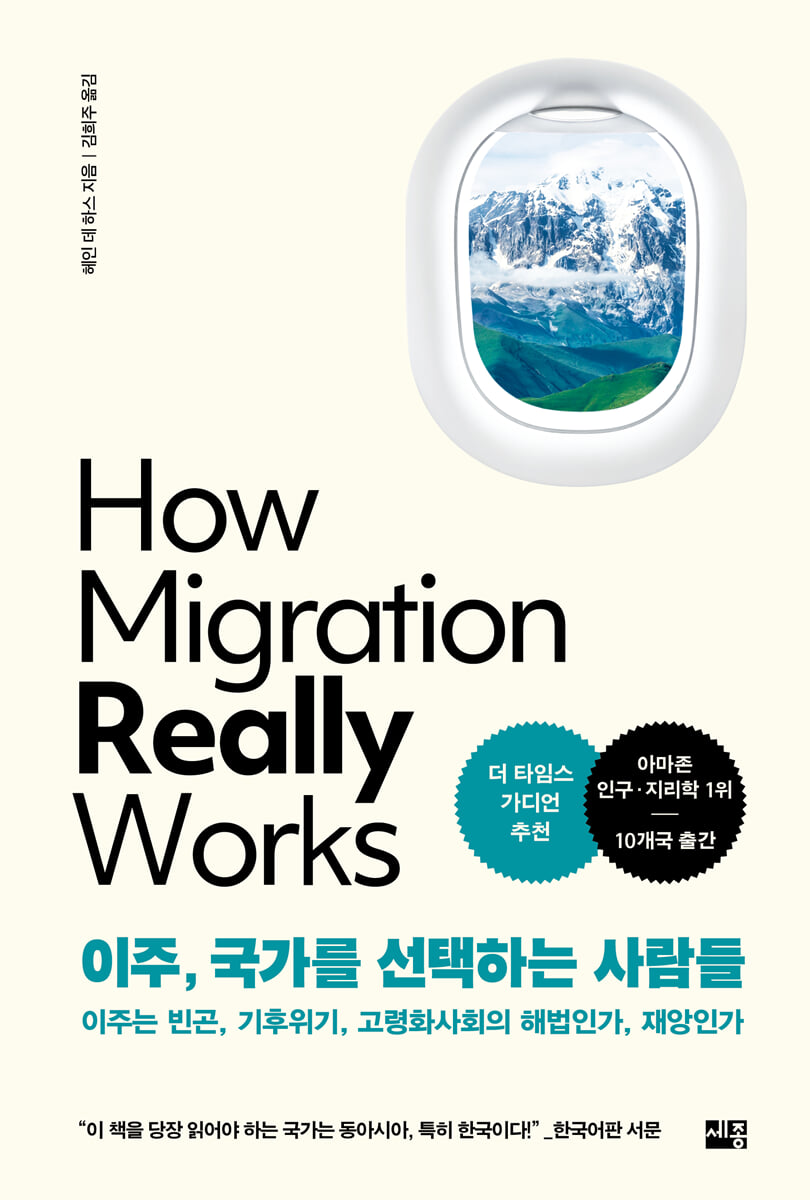
Immigration, people who choose a country
 |
Description
Book Introduction
- A word from MD
- South Korea is facing the problem of low birth rate and super-aging population.
Immigration is cited as one of the solutions.
To develop immigration policies, we must understand the various aspects surrounding migration.
Written by Hein de Haas, a professor at the University of Amsterdam and an expert on migration, this book is the most objective and comprehensive guide to migration.
- Son Min-gyu, Social and Political PD
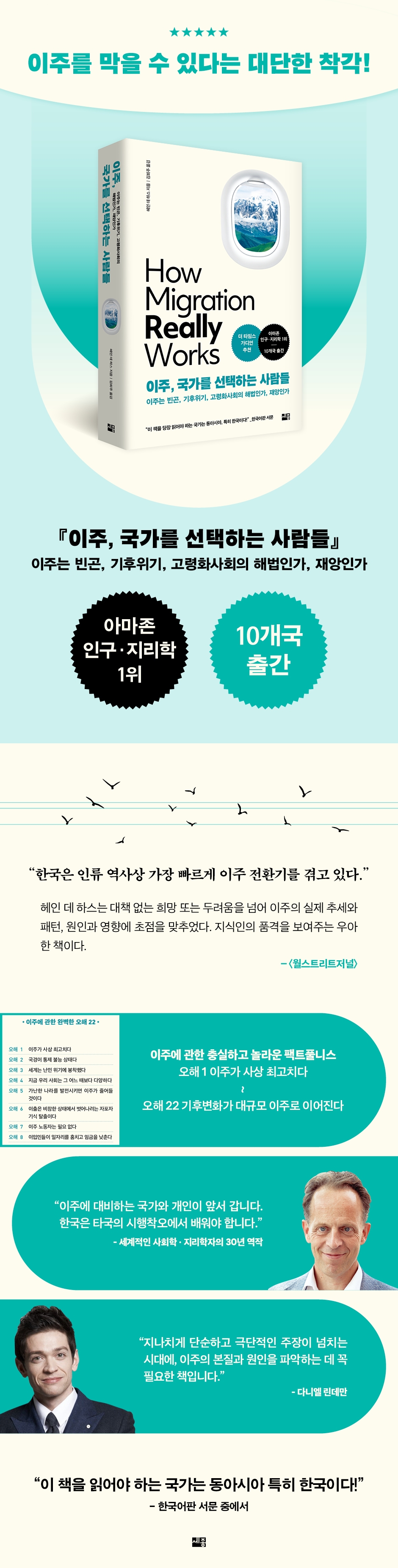
The great illusion that migration can be stopped!
Countries and individuals who prepare for migration are ahead.
- The 30-year masterpiece of world-renowned sociologist Hein de Haas
“The countries that should read this book are East Asia, especially Korea!
- From the preface to the Korean edition
*Amazon ranks first in population and geography
In the past, Korea was a country where people would emigrate to earn foreign currency, but now it has developed into an attractive country where foreigners want to work.
Even within Korean society, there is a growing call to proactively address the issue of migration as an alternative to overcoming the problems of an aging population and low birth rate.
The establishment of the immigration office also appears to be proceeding smoothly.
On the other hand, concerns that an increase in immigrants will cause problems for our society continue to grow.
Hein de Haas, professor of social geography at the University of Amsterdam and a founding member of the International Migration Institute (IMI) at Oxford University, refutes “22 fears and misconceptions” about migration with numerous data and research cases in his book “Migration: The People Who Choose Their Country,” and sounds the alarm, saying, “It is a great mistake to stop migration!”
Migration is an essential part of the development process, just like rural urbanization and environmental issues.
We cannot just single out and omit migration.
Even if we look at neighboring Japan, it is changing its stance with an active immigration policy.
“Societies with high levels of education, aging populations, and affluent societies have an inherent demand for migrant workers.
This demand cannot be eliminated as long as the economy continues to grow.
From this perspective, the most effective way to reduce immigration is to bankrupt the economy.” - From ‘Misconception 7: We Don’t Need Migrant Workers’
But author Hein de Haas also cautions against romantic claims that migration is a panacea for the economy.
When migration increases and production and consumption improve, the biggest beneficiaries are the wealthy in the destination countries.
Companies quietly co-opt migrants, and governments and politicians are quick to ignore this thorny issue or exploit it for political propaganda.
The failure and negative consequences of integration become a burden on ordinary people who live with immigrants as neighbors.
Therefore, when it comes to migration, the important question is not “why” but “how.”
Immediately after its release, this book, which ranked #1 in the Demography and Geography categories on Amazon in the US, UK, and Germany, will spark discussions large and small about migration.
What's clear is that anyone who reads this book will have a different perspective. ([New Scientist]) If Korea wants to avoid falling into a mechanical pros and cons when dealing with migration issues, it must first examine the truth—the facts—about migration through this book.
Countries and individuals who prepare for migration are ahead.
- The 30-year masterpiece of world-renowned sociologist Hein de Haas
“The countries that should read this book are East Asia, especially Korea!
- From the preface to the Korean edition
*Amazon ranks first in population and geography
In the past, Korea was a country where people would emigrate to earn foreign currency, but now it has developed into an attractive country where foreigners want to work.
Even within Korean society, there is a growing call to proactively address the issue of migration as an alternative to overcoming the problems of an aging population and low birth rate.
The establishment of the immigration office also appears to be proceeding smoothly.
On the other hand, concerns that an increase in immigrants will cause problems for our society continue to grow.
Hein de Haas, professor of social geography at the University of Amsterdam and a founding member of the International Migration Institute (IMI) at Oxford University, refutes “22 fears and misconceptions” about migration with numerous data and research cases in his book “Migration: The People Who Choose Their Country,” and sounds the alarm, saying, “It is a great mistake to stop migration!”
Migration is an essential part of the development process, just like rural urbanization and environmental issues.
We cannot just single out and omit migration.
Even if we look at neighboring Japan, it is changing its stance with an active immigration policy.
“Societies with high levels of education, aging populations, and affluent societies have an inherent demand for migrant workers.
This demand cannot be eliminated as long as the economy continues to grow.
From this perspective, the most effective way to reduce immigration is to bankrupt the economy.” - From ‘Misconception 7: We Don’t Need Migrant Workers’
But author Hein de Haas also cautions against romantic claims that migration is a panacea for the economy.
When migration increases and production and consumption improve, the biggest beneficiaries are the wealthy in the destination countries.
Companies quietly co-opt migrants, and governments and politicians are quick to ignore this thorny issue or exploit it for political propaganda.
The failure and negative consequences of integration become a burden on ordinary people who live with immigrants as neighbors.
Therefore, when it comes to migration, the important question is not “why” but “how.”
Immediately after its release, this book, which ranked #1 in the Demography and Geography categories on Amazon in the US, UK, and Germany, will spark discussions large and small about migration.
What's clear is that anyone who reads this book will have a different perspective. ([New Scientist]) If Korea wants to avoid falling into a mechanical pros and cons when dealing with migration issues, it must first examine the truth—the facts—about migration through this book.
- You can preview some of the book's contents.
Preview
index
Recommendation
To Korean readers
Before entering
introduction
Part 1: Misconceptions About Immigration
Myth 1: Migration is at an all-time high.
Myth 2: The border is out of control.
Myth 3: The world is facing a refugee crisis.
Myth 4: Our society is more diverse than ever before.
Myth 5: Developing poor countries will reduce migration.
Misconception #6: Deportation is a desperate escape from a miserable situation.
Myth 7: We Don't Need Migrant Workers
Part 2: Immigration: Threat or Solution?
Myth 8: Immigrants steal jobs and drive down wages.
Myth 9: Immigration Undermines the Welfare State
Myth 10: Immigrant Integration Has Failed
Myth 11: Mass Migration Leads to Mass Segregation
Myth 12: Crime Surges Due to Immigration
Myth 13: Emigration Leads to Brain Drain
Myth 14: Immigration Solves All Economic Problems
Misconception 15: Immigrants Are Needed to Solve the Problems of an Aging Society
Part 3: Agitation for Migration
Myth 16: Borders are closing.
Myth 17: Conservatives are more aggressive about empathy.
Misconception 18: Public opinion has turned against immigration.
Myth 19: Illegal immigration is the cause of illegal immigration.
Myth 20: Human trafficking is modern-day slavery.
Myth 21: Border restrictions reduce immigration.
Myth 22: Climate Change Leads to Mass Migration
The way forward
Acknowledgements
Americas
Search
To Korean readers
Before entering
introduction
Part 1: Misconceptions About Immigration
Myth 1: Migration is at an all-time high.
Myth 2: The border is out of control.
Myth 3: The world is facing a refugee crisis.
Myth 4: Our society is more diverse than ever before.
Myth 5: Developing poor countries will reduce migration.
Misconception #6: Deportation is a desperate escape from a miserable situation.
Myth 7: We Don't Need Migrant Workers
Part 2: Immigration: Threat or Solution?
Myth 8: Immigrants steal jobs and drive down wages.
Myth 9: Immigration Undermines the Welfare State
Myth 10: Immigrant Integration Has Failed
Myth 11: Mass Migration Leads to Mass Segregation
Myth 12: Crime Surges Due to Immigration
Myth 13: Emigration Leads to Brain Drain
Myth 14: Immigration Solves All Economic Problems
Misconception 15: Immigrants Are Needed to Solve the Problems of an Aging Society
Part 3: Agitation for Migration
Myth 16: Borders are closing.
Myth 17: Conservatives are more aggressive about empathy.
Misconception 18: Public opinion has turned against immigration.
Myth 19: Illegal immigration is the cause of illegal immigration.
Myth 20: Human trafficking is modern-day slavery.
Myth 21: Border restrictions reduce immigration.
Myth 22: Climate Change Leads to Mass Migration
The way forward
Acknowledgements
Americas
Search
Detailed image
Into the book
I wrote this book with a sense of urgency.
Although there is a wealth of academic research on migration, little of it has penetrated the policies proposed by politicians and international organizations or the public sphere.
This is one of the reasons why so many immigration policies have failed or backfired.
After years of conducting personal and collaborative research, giving public lectures, participating in radio and television debates, and working with governments and international organizations, I have come to the conclusion that simply delivering "truth to those in power" is not enough to change the climate and elevate the quality of debate.
---From the "Preface"
The most important thing to know is that more than three-quarters of the world's population lives in the place and region where they were born.
Geographic inequalities in economic opportunity are enormous, yet the majority remain in their hometowns.
Only 3% of the population lives abroad, a proportion that has remained remarkably stable over the past several decades.
Contrary to political rhetoric and media imagery, in reality, large-scale migration of entire populations from their homes is rare.
Even if people are forced to leave their homes due to natural disasters such as floods and earthquakes or war, it often ends up as a temporary, short-distance migration.
Most of them stay close to their hometown.
Long-distance migration across continents is an exceptional case.
---「Misunderstanding 1.
“Immigration is at an all-time high”
There is a widespread belief that the West is overwhelmed by a flood of refugees that has overwhelmed its asylum systems, but the data clearly contradict this belief.
As we have seen, many Western countries, especially those in Europe, have accommodated far more refugees in the postwar decades.
The number of refugees is not significantly higher today than in the past, most remain close to home, and the world's poorest countries bear the brunt of the burden.
Ultimately, the 'refugee crisis' we often talk about is not a numerical crisis, but a political crisis.
It reflects a lack of political will to accept refugees and share the responsibility with other destination countries.
---「Misunderstanding 3.
The world is facing a refugee crisis"
In the Todga Valley region of southern Morocco, for example, rising education and increased media exposure have led to a rapid shift in the material and social aspirations of the younger generation.
While living conditions in the region have improved significantly in recent decades, residents' aspirations for life have grown even faster, and so has their desire to migrate.
Migrants who returned to their hometowns every summer vacation season and showed off their relative wealth were 'role models' who changed the social aspirations of the people living in the valley area.
International migration, in particular, has become so strongly linked to success that many young people have become almost obsessed with leaving their hometowns.
In addition, the number of people among the Todd Valley residents with the resources, skills, and knowledge necessary for migration increased.
As the desire and ability to migrate grew, Todd was inspired to leave the canyon, and more people actually did leave.
Even though local living standards, incomes, and education levels have improved.
Paradoxically, it was the rising standards of living, income, and education that drove them to leave the valley.
---「Misunderstanding 5.
“If poor countries develop, migration will decrease.”
Our society is richer than ever before, but inequality has grown and wages have stagnated or even fallen.
Young people face more financial insecurity than their parents due to issues like student loans and the ability to secure stable jobs and affordable housing.
Job security is declining, and more and more young people are being forced into unstable, temporary work in the gig economy.
But the real reason these problems arose was not immigration, but deliberate policy choices.
Because politicians have deliberately chosen policies that deregulate labor markets, reduce job security, weaken unions, erode workers' rights, drive down wages, and widen income inequality.
These policies have worsened the economic situation for low-income earners and the younger generation, and have left the middle class increasingly unsure of their ability to maintain their standard of living in the future.
---「Misunderstanding 8.
From "Immigrants Steal Jobs and Lower Wages"
Has unification failed? Is the culture or religion of a particular group an obstacle to integration? The short answer is no.
Many immigrant groups face challenges with integration, discrimination, and adaptation during the first few decades after settlement.
But in the long run, these problems are usually temporary.
Evidence suggests that the vast majority of immigrants, including those from disadvantaged or completely different cultural backgrounds, achieved remarkable success in "self-sufficiency" within one or two generations through education and hard work.
The progress made by the children and grandchildren of immigrants in terms of language, education, employment, and income is impressive.5 And this success is almost entirely the result of the immigrants' own efforts to overcome disadvantage and discrimination.
There is also no evidence that irreconcilable cultural differences generally hinder the integration of so-called non-Western immigrants.
---「Misunderstanding 10.
From “Immigrant Integration Has Failed”
Ordinary citizens are very likely to face difficulties due to the social and cultural changes that come with immigration.
Because we often work in the same places as immigrants and live as neighbors with immigrants.
The wealthy who live in affluent neighborhoods or 'gateway communities' do not directly experience the impact of immigration on their daily lives.
The problem is not just the influx of low-skilled workers.
As highly skilled immigrant workers move in and settle next to wealthy, native-born residents in gentrifying inner-city areas, long-time residents, whether immigrants or natives, may find it increasingly difficult to survive and may even be forced to leave.
They are leaving because they cannot afford the rising rent, or they are being evicted from their homes due to construction of new apartments or shopping centers.
It's only natural that ordinary citizens are skeptical of businesspeople who praise immigration.
---「Misunderstanding 14.
From “Immigration Solves All Economic Problems”
Ultimately, despite political rhetoric and media reports, there are few noticeable differences between left-wing and right-wing parties in terms of policy implementation.
In general, ideological differences between political parties have little influence on the policies adopted by governments.
Factors other than ideological differences have a much greater influence.
Economic fluctuations have a significant impact on migration policy.
As the economy grows and labor shortages arise, pressure from businesses to pressure governments to accept more migrant workers will increase, and public opposition to immigration will likely ease.
As the economy slows and unemployment rises, calls from unions and conservatives to halt recruitment of migrant workers and limit immigration will gain traction.
Ultimately, it is the business cycle that influences the political will to accept more immigrants.
The ruling party's ideology generally has no effect on voter turnout.
---「Misunderstanding 17.
From "Conservatives are more aggressive on immigration"
Racism has no direct relationship with immigration.
Throughout Western history, non-immigrant people have often suffered from racial discrimination, including African Americans and Native Americans in the United States, Gypsies and Jews in Europe, and so on.
However, historically, racial discrimination has often been intertwined with human mobility, as Europeans invaded other continents, conquered non-Europeans, and enslaved them.
The root of modern racism is colonialism.
This is because an ideology that dehumanizes non-Europeans was needed to justify the denial of human rights due to colonialism.
Europeans justified colonialism as a "civilizing mission" by denigrating their own culture and genetic characteristics as "inferior."
Controlling the colored labor force has always been central to the colonial economy.
This unequal treatment still affects us today.
---「Misunderstanding 18.
Public opinion turned its back on immigration.
Border controls clearly cannot prevent illegal immigrants from entering the country as long as people have a valid reason to migrate.
It's not a problem that can be solved with a simple 'solution,' but past solutions have not only been wasteful and ineffective, but have also made the problem more difficult.
In fact, the reason why migrants and refugees use the services of smugglers is because there are no legal migration channels.
Immigration restrictions and border controls have only increased the size of the smuggling market and increased the costs and risks of land and sea travel.
It has not and will not stop migrants from coming, only increasing human suffering and loss of life.
Any policy of 'fighting' illegal immigration is bound to fail.
Because the very policy of 'fighting' illegal immigration is one of the causes of illegal immigration.
---「Misunderstanding 19.
“Illegal immigration is the cause of illegal immigration”
Policies aimed at regulating migration fail to achieve the expected results because they fail to accurately understand the realities of migration.
Because politicians are so fixated on the sheer number of people entering the country, they fail to see the impact of immigration control policies on returns and overall circulation patterns.
Indeed, the evidence suggests that politicians' desire to reduce inflows is incompatible with their desire to encourage circulation and the return of migrant workers.
---「Misunderstanding 21.
From "Border Restrictions Reduce Immigration"
Climate change is real.
If global warming accelerates as expected, it will have serious implications for productivity, livelihoods, and the stability of the entire Earth's ecosystem, reaching dangerous tipping points.
Urgent action is needed to prevent irreversible damage.
But apocalyptic predictions warning of climate change-induced mass migration have no empirical basis.
It is based on an overly simplistic assumption about the relationship between environmental change and migration.
The climate change narrative obscures the fact that most environmental risks are human-induced and that the primary cause of environmental migration is governments, not climate change.
Although there is a wealth of academic research on migration, little of it has penetrated the policies proposed by politicians and international organizations or the public sphere.
This is one of the reasons why so many immigration policies have failed or backfired.
After years of conducting personal and collaborative research, giving public lectures, participating in radio and television debates, and working with governments and international organizations, I have come to the conclusion that simply delivering "truth to those in power" is not enough to change the climate and elevate the quality of debate.
---From the "Preface"
The most important thing to know is that more than three-quarters of the world's population lives in the place and region where they were born.
Geographic inequalities in economic opportunity are enormous, yet the majority remain in their hometowns.
Only 3% of the population lives abroad, a proportion that has remained remarkably stable over the past several decades.
Contrary to political rhetoric and media imagery, in reality, large-scale migration of entire populations from their homes is rare.
Even if people are forced to leave their homes due to natural disasters such as floods and earthquakes or war, it often ends up as a temporary, short-distance migration.
Most of them stay close to their hometown.
Long-distance migration across continents is an exceptional case.
---「Misunderstanding 1.
“Immigration is at an all-time high”
There is a widespread belief that the West is overwhelmed by a flood of refugees that has overwhelmed its asylum systems, but the data clearly contradict this belief.
As we have seen, many Western countries, especially those in Europe, have accommodated far more refugees in the postwar decades.
The number of refugees is not significantly higher today than in the past, most remain close to home, and the world's poorest countries bear the brunt of the burden.
Ultimately, the 'refugee crisis' we often talk about is not a numerical crisis, but a political crisis.
It reflects a lack of political will to accept refugees and share the responsibility with other destination countries.
---「Misunderstanding 3.
The world is facing a refugee crisis"
In the Todga Valley region of southern Morocco, for example, rising education and increased media exposure have led to a rapid shift in the material and social aspirations of the younger generation.
While living conditions in the region have improved significantly in recent decades, residents' aspirations for life have grown even faster, and so has their desire to migrate.
Migrants who returned to their hometowns every summer vacation season and showed off their relative wealth were 'role models' who changed the social aspirations of the people living in the valley area.
International migration, in particular, has become so strongly linked to success that many young people have become almost obsessed with leaving their hometowns.
In addition, the number of people among the Todd Valley residents with the resources, skills, and knowledge necessary for migration increased.
As the desire and ability to migrate grew, Todd was inspired to leave the canyon, and more people actually did leave.
Even though local living standards, incomes, and education levels have improved.
Paradoxically, it was the rising standards of living, income, and education that drove them to leave the valley.
---「Misunderstanding 5.
“If poor countries develop, migration will decrease.”
Our society is richer than ever before, but inequality has grown and wages have stagnated or even fallen.
Young people face more financial insecurity than their parents due to issues like student loans and the ability to secure stable jobs and affordable housing.
Job security is declining, and more and more young people are being forced into unstable, temporary work in the gig economy.
But the real reason these problems arose was not immigration, but deliberate policy choices.
Because politicians have deliberately chosen policies that deregulate labor markets, reduce job security, weaken unions, erode workers' rights, drive down wages, and widen income inequality.
These policies have worsened the economic situation for low-income earners and the younger generation, and have left the middle class increasingly unsure of their ability to maintain their standard of living in the future.
---「Misunderstanding 8.
From "Immigrants Steal Jobs and Lower Wages"
Has unification failed? Is the culture or religion of a particular group an obstacle to integration? The short answer is no.
Many immigrant groups face challenges with integration, discrimination, and adaptation during the first few decades after settlement.
But in the long run, these problems are usually temporary.
Evidence suggests that the vast majority of immigrants, including those from disadvantaged or completely different cultural backgrounds, achieved remarkable success in "self-sufficiency" within one or two generations through education and hard work.
The progress made by the children and grandchildren of immigrants in terms of language, education, employment, and income is impressive.5 And this success is almost entirely the result of the immigrants' own efforts to overcome disadvantage and discrimination.
There is also no evidence that irreconcilable cultural differences generally hinder the integration of so-called non-Western immigrants.
---「Misunderstanding 10.
From “Immigrant Integration Has Failed”
Ordinary citizens are very likely to face difficulties due to the social and cultural changes that come with immigration.
Because we often work in the same places as immigrants and live as neighbors with immigrants.
The wealthy who live in affluent neighborhoods or 'gateway communities' do not directly experience the impact of immigration on their daily lives.
The problem is not just the influx of low-skilled workers.
As highly skilled immigrant workers move in and settle next to wealthy, native-born residents in gentrifying inner-city areas, long-time residents, whether immigrants or natives, may find it increasingly difficult to survive and may even be forced to leave.
They are leaving because they cannot afford the rising rent, or they are being evicted from their homes due to construction of new apartments or shopping centers.
It's only natural that ordinary citizens are skeptical of businesspeople who praise immigration.
---「Misunderstanding 14.
From “Immigration Solves All Economic Problems”
Ultimately, despite political rhetoric and media reports, there are few noticeable differences between left-wing and right-wing parties in terms of policy implementation.
In general, ideological differences between political parties have little influence on the policies adopted by governments.
Factors other than ideological differences have a much greater influence.
Economic fluctuations have a significant impact on migration policy.
As the economy grows and labor shortages arise, pressure from businesses to pressure governments to accept more migrant workers will increase, and public opposition to immigration will likely ease.
As the economy slows and unemployment rises, calls from unions and conservatives to halt recruitment of migrant workers and limit immigration will gain traction.
Ultimately, it is the business cycle that influences the political will to accept more immigrants.
The ruling party's ideology generally has no effect on voter turnout.
---「Misunderstanding 17.
From "Conservatives are more aggressive on immigration"
Racism has no direct relationship with immigration.
Throughout Western history, non-immigrant people have often suffered from racial discrimination, including African Americans and Native Americans in the United States, Gypsies and Jews in Europe, and so on.
However, historically, racial discrimination has often been intertwined with human mobility, as Europeans invaded other continents, conquered non-Europeans, and enslaved them.
The root of modern racism is colonialism.
This is because an ideology that dehumanizes non-Europeans was needed to justify the denial of human rights due to colonialism.
Europeans justified colonialism as a "civilizing mission" by denigrating their own culture and genetic characteristics as "inferior."
Controlling the colored labor force has always been central to the colonial economy.
This unequal treatment still affects us today.
---「Misunderstanding 18.
Public opinion turned its back on immigration.
Border controls clearly cannot prevent illegal immigrants from entering the country as long as people have a valid reason to migrate.
It's not a problem that can be solved with a simple 'solution,' but past solutions have not only been wasteful and ineffective, but have also made the problem more difficult.
In fact, the reason why migrants and refugees use the services of smugglers is because there are no legal migration channels.
Immigration restrictions and border controls have only increased the size of the smuggling market and increased the costs and risks of land and sea travel.
It has not and will not stop migrants from coming, only increasing human suffering and loss of life.
Any policy of 'fighting' illegal immigration is bound to fail.
Because the very policy of 'fighting' illegal immigration is one of the causes of illegal immigration.
---「Misunderstanding 19.
“Illegal immigration is the cause of illegal immigration”
Policies aimed at regulating migration fail to achieve the expected results because they fail to accurately understand the realities of migration.
Because politicians are so fixated on the sheer number of people entering the country, they fail to see the impact of immigration control policies on returns and overall circulation patterns.
Indeed, the evidence suggests that politicians' desire to reduce inflows is incompatible with their desire to encourage circulation and the return of migrant workers.
---「Misunderstanding 21.
From "Border Restrictions Reduce Immigration"
Climate change is real.
If global warming accelerates as expected, it will have serious implications for productivity, livelihoods, and the stability of the entire Earth's ecosystem, reaching dangerous tipping points.
Urgent action is needed to prevent irreversible damage.
But apocalyptic predictions warning of climate change-induced mass migration have no empirical basis.
It is based on an overly simplistic assumption about the relationship between environmental change and migration.
The climate change narrative obscures the fact that most environmental risks are human-induced and that the primary cause of environmental migration is governments, not climate change.
---「Misunderstanding 22.
From “Climate change leads to mass migration”
From “Climate change leads to mass migration”
Publisher's Review
*Daniel Lindemann, [Guardian] recommended reading
“A book that will completely change your perspective on immigration.”
Daniel Lindemann, a German broadcaster active in [JTBC Abnormal Summit] and others, recommended this book based on his long experience as an immigrant, saying, “In an era overflowing with overly simplistic and extreme claims like ‘now is a migration crisis’ and ‘migration is a great opportunity,’ this is an essential book for understanding the nature and causes of migration.”
This book was written by author Hein de Haas out of desperation.
Every time he explained various aspects of immigration, politicians branded him as “a pro-immigration person.”
However, just as it is absurd to oppose the import and export of goods, the same is true for the migration of people.
There can be no complete blocking or complete opening.
The key is how natives and immigrants create a successful collaborative process.
Eventually, De Haas decided to write directly to the public.
The somewhat heavy topic of 'immigration' is presented in an interesting format of overturning 22 misunderstandings.
Rare data and graphs, such as global migration maps, add to the enjoyment of reading.
It's no longer someone else's story
Factfulness on Migration 22
What are some of the common misconceptions about migration that have been widely accepted in our society? Not only politicians and the media, but even humanitarian organizations have often exaggerated the severity of migration and refugee issues to suit their own agendas.
“Misunderstanding 1.
“Immigrants at an all-time high?”
- The majority of migration is domestic.
Despite the serious problems of poverty and inequality, the proportion of migrants has remained at around 3% of the world's population.
This is similar to the rate of global population growth.
(Currently, the number of immigrants to Korea is around 3-4%, depending on the statistical method.)
“Misunderstanding 6.
“Immigration is a desperate escape from a miserable state?”
- As a country develops, people's desire for a better life grows, which leads to migration to other cities and beyond its borders.
Considering the burdensome cost of moving, “capable” people are actively joining the migration procession.
When considering a destination, first consider a nearby country that is close to home and has relatively little cultural heterogeneity.
“Misunderstanding 7.
“No need for migrant workers?”
The majority of migrants are actually people who crossed the border because companies in the destination country wanted them! As living standards rise, "difficult" jobs become vacant, and outsiders are needed to fill them.
A lot of care work is like that.
“Misunderstanding 14.
“Immigration solves all economic problems?”
- Migrant workers contribute to the societies they migrate to, especially the wealthy, by expanding the population and economic scale and by stimulating innovation and investment.
Although migrants send remittances back home, this does not provide significant benefits to their countries of origin, as it offsets the loss of their own human capital.
The author also addresses all the concerns about immigration that we may have had at least once.
Will raising immigration thresholds reduce illegal migration? Is it true that opinions on migration are sharply divided along political lines? Is the world facing a refugee crisis? How much of an impact do migrants have on crime rates? Do they actually undermine the very foundations of the welfare state? What are the motives and effects of vested interests attacking migration through the media while quietly accepting migrants? Will the climate crisis truly lead to a surge in migration?
To introduce some facts, it's said that more immigrants should be accepted to alleviate the low birth rate, but in reality, there are too few immigrants to expect a population increase. (Misconception 15) The claim that climate change causes mass migration is also unfounded. (Misconception 22) People don't leave their homes just because of flooding.
Korea can avoid trial and error.
A book that prepares appropriate responses based on facts
"Immigration: People Who Choose Their Country" helps us filter out baseless claims and critically analyze relevant news.
It is useful for understanding the assumptions behind extreme claims in the market and the interests of those who make such claims.
Furthermore, it will help us find realistic solutions to the migration issues that we face in our countries, communities, workplaces, and personal lives.
The author urges Korea, which stands at a critical juncture of migration, to prepare wisely for this issue.
Below is an excerpt from the Korean edition's preface by Professor Hein de Haas.
The original title of this book is 'How Migration Really Works', and the Korean title 'Migration, People Who Choose a Country' represents someone or ourselves who leaves for a better life, whether to a large city in our country or across the border.
“Immigration is emerging as a critical issue in East Asia, including Korea.
Korea is one of the countries that has undergone the fastest migration transition in human history.
Korea, which once had a high proportion of outbound migration, is now increasingly attracting attention as an important migration destination in East Asia.
(...) Swiss writer Max Frisch summarized the conundrum of guest workers this way:
“We wanted workers, but what we got instead were people.” Japan and Korea now appear to be in a similarly ambiguous situation.
Therefore, I believe that the scientific insights contained in this book will play a significant role in the future debate and policy regarding immigration in Korea.
As I will discuss in more detail later, immigration policies that fail to properly understand the reality of migration often fail or even have the opposite effect.
I sincerely hope that this book will encourage high-level discussion on immigration in Korean society and politics and serve as a catalyst for developing more realistic ideas about future migration trends.
Above all, I hope that Korea will not repeat the mistakes of many countries that have immigrated in the past.
And I sincerely hope that this book will help Korea design better and more effective immigration policies that benefit all members of society.”
-From 'To Korean Readers'
“What will our future look like as a result of immigration?”
In the current situation where the establishment of an immigration office is being discussed,
A book that provides insights into immigration!
"Immigration: People Who Choose Their Country" is a book in which the author has put a lot of effort into conveying the reality of immigration in detail and as it is.
It was written to spark a truly needed discussion about migration, based on the best data and scientific insights.
As the majority learns the truth, even those who raise legitimate concerns about migration, integration, and separation will begin to acknowledge that migration is, to some extent, inevitable, that migrant workers play an essential role in our society, and that migrants and refugees also have fundamental rights.
This is why the author sees hope in the migration issue.
This book is divided into three parts and 22 chapters.
The virtue of this book is that it avoids unnecessary academic jargon, but does not avoid the nuanced and complex knowledge necessary for a fundamental understanding of the migration process, covering it in detail.
Part 1: Misconceptions about Migration explores trends in international migration patterns.
We examine the changes in the scope, scale, and direction of recent migration and the factors driving these changes.
It also debunks common claims and misconceptions about the causes of migration and reveals the real factors driving recent shifts in international migration patterns.
Part 2, “Immigration: Threat or Solution,” explores the impact of migration on both destination and origin societies.
It analyzes why most immigrant groups have integrated fairly smoothly, while others have remained marginalized and segregated for long periods.
We also critically examine various arguments regarding the negative and positive impacts of migration on society, culture, and the economy.
Part 3: Propaganda on Migration exposes the various myths championed by politicians, interest groups, and international organizations as part of a strategy to distort the truth about immigration.
It exposes the significant gap between the hardline rhetoric of anti-immigration politicians and the implementation of far more lenient policies, and it also reveals that the intuitive notion that immigration restrictions reduce migration is a widely misunderstood conventional wisdom.
Each chapter begins with a brief explanation of the misconception.
It tells the story of a typical misunderstanding, along with the origins of how politicians, interest groups, and international organizations create and recycle such misunderstandings.
In 'Reality', the misunderstanding is cleared up by citing data and evidence from history, anthropology, sociology, geography, demography, and economics.
As with the overall goal of this book, the goals of each chapter are to demonstrate that migration is an inherent part of broader social, cultural, and economic changes in both origin and destination societies, and to present evidence on the true trends, causes, and impacts of migration.
The ultimate goal of this book is to dispel unnecessary misconceptions by providing insights grounded in the latest evidence throughout each chapter, and to offer a fresh, holistic perspective that views migration as an integral part of broader national and global transformations.
Each chapter is written independently, so you can read only the parts that particularly interest you. However, because the entire book forms an overarching narrative, reading it in order from beginning to end will deepen your insight into the issue of migration as you reach the conclusion.
“A book that will completely change your perspective on immigration.”
Daniel Lindemann, a German broadcaster active in [JTBC Abnormal Summit] and others, recommended this book based on his long experience as an immigrant, saying, “In an era overflowing with overly simplistic and extreme claims like ‘now is a migration crisis’ and ‘migration is a great opportunity,’ this is an essential book for understanding the nature and causes of migration.”
This book was written by author Hein de Haas out of desperation.
Every time he explained various aspects of immigration, politicians branded him as “a pro-immigration person.”
However, just as it is absurd to oppose the import and export of goods, the same is true for the migration of people.
There can be no complete blocking or complete opening.
The key is how natives and immigrants create a successful collaborative process.
Eventually, De Haas decided to write directly to the public.
The somewhat heavy topic of 'immigration' is presented in an interesting format of overturning 22 misunderstandings.
Rare data and graphs, such as global migration maps, add to the enjoyment of reading.
It's no longer someone else's story
Factfulness on Migration 22
What are some of the common misconceptions about migration that have been widely accepted in our society? Not only politicians and the media, but even humanitarian organizations have often exaggerated the severity of migration and refugee issues to suit their own agendas.
“Misunderstanding 1.
“Immigrants at an all-time high?”
- The majority of migration is domestic.
Despite the serious problems of poverty and inequality, the proportion of migrants has remained at around 3% of the world's population.
This is similar to the rate of global population growth.
(Currently, the number of immigrants to Korea is around 3-4%, depending on the statistical method.)
“Misunderstanding 6.
“Immigration is a desperate escape from a miserable state?”
- As a country develops, people's desire for a better life grows, which leads to migration to other cities and beyond its borders.
Considering the burdensome cost of moving, “capable” people are actively joining the migration procession.
When considering a destination, first consider a nearby country that is close to home and has relatively little cultural heterogeneity.
“Misunderstanding 7.
“No need for migrant workers?”
The majority of migrants are actually people who crossed the border because companies in the destination country wanted them! As living standards rise, "difficult" jobs become vacant, and outsiders are needed to fill them.
A lot of care work is like that.
“Misunderstanding 14.
“Immigration solves all economic problems?”
- Migrant workers contribute to the societies they migrate to, especially the wealthy, by expanding the population and economic scale and by stimulating innovation and investment.
Although migrants send remittances back home, this does not provide significant benefits to their countries of origin, as it offsets the loss of their own human capital.
The author also addresses all the concerns about immigration that we may have had at least once.
Will raising immigration thresholds reduce illegal migration? Is it true that opinions on migration are sharply divided along political lines? Is the world facing a refugee crisis? How much of an impact do migrants have on crime rates? Do they actually undermine the very foundations of the welfare state? What are the motives and effects of vested interests attacking migration through the media while quietly accepting migrants? Will the climate crisis truly lead to a surge in migration?
To introduce some facts, it's said that more immigrants should be accepted to alleviate the low birth rate, but in reality, there are too few immigrants to expect a population increase. (Misconception 15) The claim that climate change causes mass migration is also unfounded. (Misconception 22) People don't leave their homes just because of flooding.
Korea can avoid trial and error.
A book that prepares appropriate responses based on facts
"Immigration: People Who Choose Their Country" helps us filter out baseless claims and critically analyze relevant news.
It is useful for understanding the assumptions behind extreme claims in the market and the interests of those who make such claims.
Furthermore, it will help us find realistic solutions to the migration issues that we face in our countries, communities, workplaces, and personal lives.
The author urges Korea, which stands at a critical juncture of migration, to prepare wisely for this issue.
Below is an excerpt from the Korean edition's preface by Professor Hein de Haas.
The original title of this book is 'How Migration Really Works', and the Korean title 'Migration, People Who Choose a Country' represents someone or ourselves who leaves for a better life, whether to a large city in our country or across the border.
“Immigration is emerging as a critical issue in East Asia, including Korea.
Korea is one of the countries that has undergone the fastest migration transition in human history.
Korea, which once had a high proportion of outbound migration, is now increasingly attracting attention as an important migration destination in East Asia.
(...) Swiss writer Max Frisch summarized the conundrum of guest workers this way:
“We wanted workers, but what we got instead were people.” Japan and Korea now appear to be in a similarly ambiguous situation.
Therefore, I believe that the scientific insights contained in this book will play a significant role in the future debate and policy regarding immigration in Korea.
As I will discuss in more detail later, immigration policies that fail to properly understand the reality of migration often fail or even have the opposite effect.
I sincerely hope that this book will encourage high-level discussion on immigration in Korean society and politics and serve as a catalyst for developing more realistic ideas about future migration trends.
Above all, I hope that Korea will not repeat the mistakes of many countries that have immigrated in the past.
And I sincerely hope that this book will help Korea design better and more effective immigration policies that benefit all members of society.”
-From 'To Korean Readers'
“What will our future look like as a result of immigration?”
In the current situation where the establishment of an immigration office is being discussed,
A book that provides insights into immigration!
"Immigration: People Who Choose Their Country" is a book in which the author has put a lot of effort into conveying the reality of immigration in detail and as it is.
It was written to spark a truly needed discussion about migration, based on the best data and scientific insights.
As the majority learns the truth, even those who raise legitimate concerns about migration, integration, and separation will begin to acknowledge that migration is, to some extent, inevitable, that migrant workers play an essential role in our society, and that migrants and refugees also have fundamental rights.
This is why the author sees hope in the migration issue.
This book is divided into three parts and 22 chapters.
The virtue of this book is that it avoids unnecessary academic jargon, but does not avoid the nuanced and complex knowledge necessary for a fundamental understanding of the migration process, covering it in detail.
Part 1: Misconceptions about Migration explores trends in international migration patterns.
We examine the changes in the scope, scale, and direction of recent migration and the factors driving these changes.
It also debunks common claims and misconceptions about the causes of migration and reveals the real factors driving recent shifts in international migration patterns.
Part 2, “Immigration: Threat or Solution,” explores the impact of migration on both destination and origin societies.
It analyzes why most immigrant groups have integrated fairly smoothly, while others have remained marginalized and segregated for long periods.
We also critically examine various arguments regarding the negative and positive impacts of migration on society, culture, and the economy.
Part 3: Propaganda on Migration exposes the various myths championed by politicians, interest groups, and international organizations as part of a strategy to distort the truth about immigration.
It exposes the significant gap between the hardline rhetoric of anti-immigration politicians and the implementation of far more lenient policies, and it also reveals that the intuitive notion that immigration restrictions reduce migration is a widely misunderstood conventional wisdom.
Each chapter begins with a brief explanation of the misconception.
It tells the story of a typical misunderstanding, along with the origins of how politicians, interest groups, and international organizations create and recycle such misunderstandings.
In 'Reality', the misunderstanding is cleared up by citing data and evidence from history, anthropology, sociology, geography, demography, and economics.
As with the overall goal of this book, the goals of each chapter are to demonstrate that migration is an inherent part of broader social, cultural, and economic changes in both origin and destination societies, and to present evidence on the true trends, causes, and impacts of migration.
The ultimate goal of this book is to dispel unnecessary misconceptions by providing insights grounded in the latest evidence throughout each chapter, and to offer a fresh, holistic perspective that views migration as an integral part of broader national and global transformations.
Each chapter is written independently, so you can read only the parts that particularly interest you. However, because the entire book forms an overarching narrative, reading it in order from beginning to end will deepen your insight into the issue of migration as you reach the conclusion.
GOODS SPECIFICS
- Date of issue: March 1, 2024
- Page count, weight, size: 512 pages | 746g | 152*225*32mm
- ISBN13: 9788984078499
- ISBN10: 8984078492
You may also like
카테고리
korean


korean

![GQ KOREA Mark (Monthly): December [2025]](http://librairie.coreenne.fr/cdn/shop/files/8ef265dbbfbf186523ed75ba7319009d.jpg?v=1765340328&width=3840)


