

How to not speak of pain
 |
Description
Book Introduction
I believe that I can understand the suffering of others.
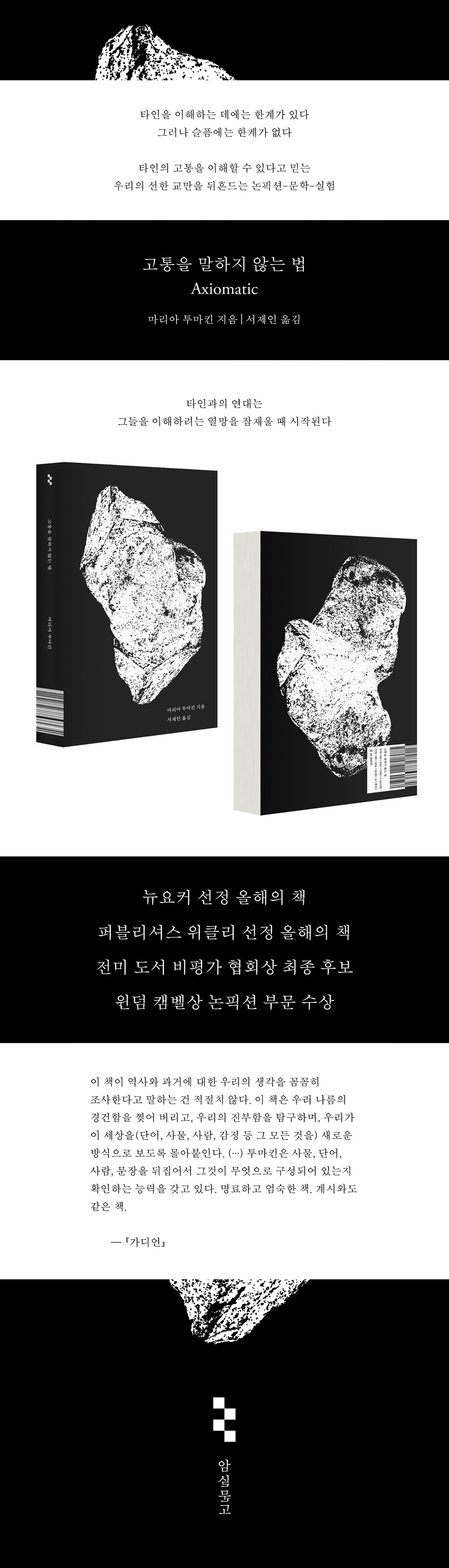
A nonfiction experiment that shakes our good arrogance.
Many people believe that before we can connect with someone (especially the weak), we must understand them.
Because I think that I can't give something that's right for him, that is, what he needs, to someone I don't understand.
According to this thinking, solidarity that does not prioritize understanding is closer to one-sided reciprocity, which can ultimately degenerate into an act of rudeness and arrogance.
But Maria Tumarkin says even that understanding can be a hasty reciprocity from someone who “wants to understand.”
To be more precise, the effort to understand itself is a legitimate attitude toward others.
But according to Tumarkin, the happy ending of understanding others is a (self-satisfying) illusion that can never be achieved.
The effort to understand others, the world around me, is an eternal process that can never reach a conclusion.
Moreover, the process is more often met with failure and frustration than success.
Therefore, solidarity with others can only continue under the following circumstances:
Accepting that the day will never come when you fully understand the other person, and continuing to try despite countless setbacks.
This book does not explain or theorize these claims, but rather demonstrates them naturally through the structure of the text itself.
The memories that are shattered through each person's pain are actually shown in this book in a shattered form.
That is, the episodes are not arranged sequentially.
Two or three different stories appear mixed together, and even the chronological order is mixed up.
Even fragments of some episodes are suddenly discovered over a hundred pages away.
So, readers who first start reading this book may be confused and think, 'So what happened to that story? Who is this person who suddenly appeared?', but they soon realize that this narrative style is a design that embodies the 'fact' that it is not easy to trace the inner self of a person.
This is because, by the time a chapter ends, you have the unique experience of the fragments you've collected being reassembled in your head.
That is, the stories and events in this book are constructed before they can be understood.
Or it happens when you refuse to understand.
Some critics have read this book and said that W.
That's probably why I thought of G. Sebald.
A nonfiction experiment that shakes our good arrogance.
Many people believe that before we can connect with someone (especially the weak), we must understand them.
Because I think that I can't give something that's right for him, that is, what he needs, to someone I don't understand.
According to this thinking, solidarity that does not prioritize understanding is closer to one-sided reciprocity, which can ultimately degenerate into an act of rudeness and arrogance.
But Maria Tumarkin says even that understanding can be a hasty reciprocity from someone who “wants to understand.”
To be more precise, the effort to understand itself is a legitimate attitude toward others.
But according to Tumarkin, the happy ending of understanding others is a (self-satisfying) illusion that can never be achieved.
The effort to understand others, the world around me, is an eternal process that can never reach a conclusion.
Moreover, the process is more often met with failure and frustration than success.
Therefore, solidarity with others can only continue under the following circumstances:
Accepting that the day will never come when you fully understand the other person, and continuing to try despite countless setbacks.
This book does not explain or theorize these claims, but rather demonstrates them naturally through the structure of the text itself.
The memories that are shattered through each person's pain are actually shown in this book in a shattered form.
That is, the episodes are not arranged sequentially.
Two or three different stories appear mixed together, and even the chronological order is mixed up.
Even fragments of some episodes are suddenly discovered over a hundred pages away.
So, readers who first start reading this book may be confused and think, 'So what happened to that story? Who is this person who suddenly appeared?', but they soon realize that this narrative style is a design that embodies the 'fact' that it is not easy to trace the inner self of a person.
This is because, by the time a chapter ends, you have the unique experience of the fragments you've collected being reassembled in your head.
That is, the stories and events in this book are constructed before they can be understood.
Or it happens when you refuse to understand.
Some critics have read this book and said that W.
That's probably why I thought of G. Sebald.
- You can preview some of the book's contents.
Preview
index
1.
Time heals all wounds
2.
Those who forget the past are condemned to repeat it.
3.
History repeats itself
4.
Bring me a girl before she turns seven, and I will tell you what kind of woman she will grow up to be.
5.
You can't step into the same river twice.
Acknowledgements
Time heals all wounds
2.
Those who forget the past are condemned to repeat it.
3.
History repeats itself
4.
Bring me a girl before she turns seven, and I will tell you what kind of woman she will grow up to be.
5.
You can't step into the same river twice.
Acknowledgements
Detailed image
Into the book
There are limits to our ability to understand the suffering of others.
--- p.212
There is a limit to everything, including sadness.
No, it's not sadness.
There is no limit to sorrow.
--- p.90
The cleaner came once a week.
Each time, Frances's mother hid all of Katie's pictures and erased all traces of her absence.
Don't touch that room.
My mother used to say to the cleaner.
Our youngest also needs to learn how to clean on his own.
Loving is also difficult.
Mom said she didn't want the cleaner to know someone had died in the house, but I know she did it so she could pretend Katie was still alive for three hours every week.
("Confession to Mother," 3rd grade creative writing assignment)
Joan Didion couldn't get rid of her dead husband's shoes because she knew he would have to wear them when he returned.
Even the smartest people on this planet wait for the dead to return.
--- p.72
Facts about a person are often unknown to others, and most of them are things that others could never have known about in the first place.
There are limits to our ability to understand the suffering of others.
If we ignore that limitation, people become a collection of symbols.
It turns into a kind of tool, a water bottle filled with only our favorite drinks.
Accepting another person as a complete human being means recognizing what makes them different from us, and not necessarily distorting those differences into something approaching the sublime.
Like people anywhere else, people living on the streets are both good and bad.
Their pasts of poverty, neglect, abuse, and disadvantage do not protect them like magic dust.
In other words, it does not provide them with a moral absolution for all their actions.
If we judge some people's morality to be more noble than it really is because they have suffered misfortune, and if only then can we (as fellow human beings) be angry... well, that would be really sad.
--- p.212
For the Greeks, the word compassion did not carry the connotations of superiority that it often does for us today.
Compassion is a word that expresses a feeling of sadness and pity.
The heart that is revealed every time we accept the vulnerability that we humans inevitably reveal in the face of misfortune as a kind of wonder.
--- p.36~37
Among Wisława Szymborska's poems there is a work called "Self-Mutilation."
Automutilation is when an animal cuts off a part of its body in self-defense, as the sea cucumber does in this poem.
A sea cucumber in danger cuts itself in half.
Leaving one's self in a hungry world
Run away with your other self
One part is salvation, hope.
Salvation does not reach the other side.
Letting one part die allows the other part to reconstitute itself and grow into a living 'whole' again.
Survivors are like sea cucumbers.
What this means is that survival is not the opposite of death.
In some ways, survival can be much closer to death than life.
Years after the war, Charlotte Delvaux's friend and fellow survivor, Madou, would say to Delvaux:
“I died in Auschwitz and no one knew it.”
--- p.212
There is a limit to everything, including sadness.
No, it's not sadness.
There is no limit to sorrow.
--- p.90
The cleaner came once a week.
Each time, Frances's mother hid all of Katie's pictures and erased all traces of her absence.
Don't touch that room.
My mother used to say to the cleaner.
Our youngest also needs to learn how to clean on his own.
Loving is also difficult.
Mom said she didn't want the cleaner to know someone had died in the house, but I know she did it so she could pretend Katie was still alive for three hours every week.
("Confession to Mother," 3rd grade creative writing assignment)
Joan Didion couldn't get rid of her dead husband's shoes because she knew he would have to wear them when he returned.
Even the smartest people on this planet wait for the dead to return.
--- p.72
Facts about a person are often unknown to others, and most of them are things that others could never have known about in the first place.
There are limits to our ability to understand the suffering of others.
If we ignore that limitation, people become a collection of symbols.
It turns into a kind of tool, a water bottle filled with only our favorite drinks.
Accepting another person as a complete human being means recognizing what makes them different from us, and not necessarily distorting those differences into something approaching the sublime.
Like people anywhere else, people living on the streets are both good and bad.
Their pasts of poverty, neglect, abuse, and disadvantage do not protect them like magic dust.
In other words, it does not provide them with a moral absolution for all their actions.
If we judge some people's morality to be more noble than it really is because they have suffered misfortune, and if only then can we (as fellow human beings) be angry... well, that would be really sad.
--- p.212
For the Greeks, the word compassion did not carry the connotations of superiority that it often does for us today.
Compassion is a word that expresses a feeling of sadness and pity.
The heart that is revealed every time we accept the vulnerability that we humans inevitably reveal in the face of misfortune as a kind of wonder.
--- p.36~37
Among Wisława Szymborska's poems there is a work called "Self-Mutilation."
Automutilation is when an animal cuts off a part of its body in self-defense, as the sea cucumber does in this poem.
A sea cucumber in danger cuts itself in half.
Leaving one's self in a hungry world
Run away with your other self
One part is salvation, hope.
Salvation does not reach the other side.
Letting one part die allows the other part to reconstitute itself and grow into a living 'whole' again.
Survivors are like sea cucumbers.
What this means is that survival is not the opposite of death.
In some ways, survival can be much closer to death than life.
Years after the war, Charlotte Delvaux's friend and fellow survivor, Madou, would say to Delvaux:
“I died in Auschwitz and no one knew it.”
--- p.342~343
Publisher's Review
*The New Yorker's Best Books of the Year (2019)
*Publisher's Weekly Book of the Year (2019)
*National Book Critics Circle Award Finalist (2019)
*Winner of the Wyndham Campbell Award for Nonfiction (2020)
The deeper you go into the darkness
The human mind becomes incomprehensible
Based on the novel by Lionel Shriver, the film "We Need to Talk About Kevin" depicts Kevin, a teenager who commits mass murder at school, and his mother.
One of the reasons this film is so impressive is that it doesn't reveal the exact motive for the murder.
At the end of the film, Kevin's mother asks him in prison:
“Now tell me, why did you do that?” Kevin replies.
“I thought I knew, but now I don’t.” The reason for killing his classmates is either unclear, or no one (not even the parties involved) has discovered it.
Gus Van Sant's film Elephant, which depicts a real-life mass shooting more directly, takes a more cynical stance.
The film briefly touches on the causes that "ordinary people" might point to as causes of youth gun violence, such as violent video games, and then shows that these are far too small and trivial to be the causes of this empty criminal behavior.
Why did children go to school and kill people? No one knows why, and that's the saddest and most terrifying message this film presents.
A similar anecdote appears in 『How to Not Speak of Pain』.
This is the story of Andrew Solomon, the famous author of "The Noonday Blues," visiting the parents of one of the perpetrators of the Columbine High School shooting.
After interviewing the couple, he concludes:
“We are victims of the terrible fact, which is often found even in the most intimate of human relationships: that we are completely unaware of others.”
Then darkness and,
How do I face the minds I cannot understand?
Many people believe that before we can connect with someone (especially the weak), we must understand them.
Because I think that I can't give something that's right for him, that is, what he needs, to someone I don't understand.
According to this thinking, solidarity that does not prioritize understanding is closer to one-sided reciprocity, which can ultimately degenerate into an act of rudeness and arrogance.
But Maria Tumarkin says even that understanding can be a hasty reciprocity from someone who “wants to understand.”
To be more precise, the effort to understand itself is a legitimate attitude toward others.
But according to Tumarkin, the happy ending of understanding others is a (self-satisfying) illusion that can never be achieved.
The effort to understand others, the world around me, is an eternal process that can never reach a conclusion.
Moreover, the process is more often met with failure and frustration than success.
Therefore, solidarity with others can only continue under the following circumstances:
Accepting that the day will never come when you fully understand the other person, and continuing to try despite countless setbacks.
Then why can't we understand each other?
First, Tumarkin addresses various social problems existing in so-called advanced countries, including Australia, and talks with the parties involved.
Suicide survivors, drug addicts, the homeless, war immigrants, survivors of Nazi concentration camps, victims of domestic violence… … But the testimonies of these individuals and the circumstances surrounding them deviate somewhat from common sense.
There are teenagers who habitually attempt suicide without any emotional trauma, there are incidents where helping a homeless person ends up killing him, and there are three- and four-year-olds who seamlessly absorb and act out fake identities to avoid the Nazis.
Tumacin brings in people of various types, such as suicide survivors and drug addicts, and shows them the common perceptions surrounding them, and then presents cases that overturn those common perceptions.
And this naturally leads to one argument.
When it comes to understanding a person's inner self, theories and preconceptions are merely auxiliary tools, and often have a detrimental effect.
This book says that understanding someone is incredibly difficult.
Only after engaging in intense communication with each of those personalities can one vaguely guess at it.
Therefore, almost any social system that requires humans to be classified and grouped ultimately fails at that point.
Because of this, some critics have described the book as bleak and without solutions.
But Tumarkin points out that if we don't face that gloom, we will end up treating the weak as the 'good and powerful' want.
The reason Tumarkin reveals the grim reality of the difficulty of understanding others in this book is because that very point is the starting point of 'understanding, speaking, and solidarity.'
He says in the text of the book:
"To say, 'That person could have been me,' shouldn't we first ask who that person was? And doesn't it usually take eons to decipher the answer to that question? Facts about a human being are often unknown to others, and most of them are never discoverable to others in the first place.
There are limits to our ability to understand the suffering of others.
If we ignore that limitation, people become a collection of symbols.
It turns into a kind of tool, a water bottle filled with only our favorite drinks.
“Accepting another person as a complete human being means recognizing what makes them different from us, and not necessarily distorting those differences into something approaching the sublime.”
A symbol of broken hearts and memories,
W.
A unique narrative reminiscent of G. Sebald
The reason why "How to Speak of Pain" has received international attention is because it naturally presents these claims through the structure of the text itself, without explaining or theorizing them.
The memories that are shattered through each person's pain are actually shown in this book in a shattered form.
That is, the episodes are not arranged sequentially.
Two or three different stories appear mixed together, and even the chronological order is mixed up.
Even fragments of some episodes are suddenly discovered over a hundred pages away.
So, readers who start this book for the first time may be confused and think, 'So what happened to that story? Who is this person who suddenly appeared?'
But the reader soon realizes that this narrative style is a design that embodies the 'fact' that it is not easy to trace the inner self of a human being.
This is because, by the time a chapter ends, you have the unique experience of the fragments you've collected being reassembled in your head.
That is, the stories and events in this book are constructed before they can be understood.
Or it happens when you refuse to understand.
Some critics have described the structure of the book as W.
That may be why it was compared to G. Sebald's work.
The National Book Critics Circle's 2019 introduction to this book, which was a finalist in the nonfiction category, captures this characteristic well.
“No matter who you are or what you’ve read before, I can guarantee you’ve never read anything like this book.
To say I 'read' this book seems inaccurate in terms of my experience with it.
You encounter his language as if you were encountering a stranger.
We cannot trace its outlines at the moment, and we must continually return to it and settle into its unique variations.
“Toumakin’s work makes completely strange phenomena we have become so accustomed to—not just language, but also gun violence, mass murder, persistent structural poverty, and so on.”
*Publisher's Weekly Book of the Year (2019)
*National Book Critics Circle Award Finalist (2019)
*Winner of the Wyndham Campbell Award for Nonfiction (2020)
The deeper you go into the darkness
The human mind becomes incomprehensible
Based on the novel by Lionel Shriver, the film "We Need to Talk About Kevin" depicts Kevin, a teenager who commits mass murder at school, and his mother.
One of the reasons this film is so impressive is that it doesn't reveal the exact motive for the murder.
At the end of the film, Kevin's mother asks him in prison:
“Now tell me, why did you do that?” Kevin replies.
“I thought I knew, but now I don’t.” The reason for killing his classmates is either unclear, or no one (not even the parties involved) has discovered it.
Gus Van Sant's film Elephant, which depicts a real-life mass shooting more directly, takes a more cynical stance.
The film briefly touches on the causes that "ordinary people" might point to as causes of youth gun violence, such as violent video games, and then shows that these are far too small and trivial to be the causes of this empty criminal behavior.
Why did children go to school and kill people? No one knows why, and that's the saddest and most terrifying message this film presents.
A similar anecdote appears in 『How to Not Speak of Pain』.
This is the story of Andrew Solomon, the famous author of "The Noonday Blues," visiting the parents of one of the perpetrators of the Columbine High School shooting.
After interviewing the couple, he concludes:
“We are victims of the terrible fact, which is often found even in the most intimate of human relationships: that we are completely unaware of others.”
Then darkness and,
How do I face the minds I cannot understand?
Many people believe that before we can connect with someone (especially the weak), we must understand them.
Because I think that I can't give something that's right for him, that is, what he needs, to someone I don't understand.
According to this thinking, solidarity that does not prioritize understanding is closer to one-sided reciprocity, which can ultimately degenerate into an act of rudeness and arrogance.
But Maria Tumarkin says even that understanding can be a hasty reciprocity from someone who “wants to understand.”
To be more precise, the effort to understand itself is a legitimate attitude toward others.
But according to Tumarkin, the happy ending of understanding others is a (self-satisfying) illusion that can never be achieved.
The effort to understand others, the world around me, is an eternal process that can never reach a conclusion.
Moreover, the process is more often met with failure and frustration than success.
Therefore, solidarity with others can only continue under the following circumstances:
Accepting that the day will never come when you fully understand the other person, and continuing to try despite countless setbacks.
Then why can't we understand each other?
First, Tumarkin addresses various social problems existing in so-called advanced countries, including Australia, and talks with the parties involved.
Suicide survivors, drug addicts, the homeless, war immigrants, survivors of Nazi concentration camps, victims of domestic violence… … But the testimonies of these individuals and the circumstances surrounding them deviate somewhat from common sense.
There are teenagers who habitually attempt suicide without any emotional trauma, there are incidents where helping a homeless person ends up killing him, and there are three- and four-year-olds who seamlessly absorb and act out fake identities to avoid the Nazis.
Tumacin brings in people of various types, such as suicide survivors and drug addicts, and shows them the common perceptions surrounding them, and then presents cases that overturn those common perceptions.
And this naturally leads to one argument.
When it comes to understanding a person's inner self, theories and preconceptions are merely auxiliary tools, and often have a detrimental effect.
This book says that understanding someone is incredibly difficult.
Only after engaging in intense communication with each of those personalities can one vaguely guess at it.
Therefore, almost any social system that requires humans to be classified and grouped ultimately fails at that point.
Because of this, some critics have described the book as bleak and without solutions.
But Tumarkin points out that if we don't face that gloom, we will end up treating the weak as the 'good and powerful' want.
The reason Tumarkin reveals the grim reality of the difficulty of understanding others in this book is because that very point is the starting point of 'understanding, speaking, and solidarity.'
He says in the text of the book:
"To say, 'That person could have been me,' shouldn't we first ask who that person was? And doesn't it usually take eons to decipher the answer to that question? Facts about a human being are often unknown to others, and most of them are never discoverable to others in the first place.
There are limits to our ability to understand the suffering of others.
If we ignore that limitation, people become a collection of symbols.
It turns into a kind of tool, a water bottle filled with only our favorite drinks.
“Accepting another person as a complete human being means recognizing what makes them different from us, and not necessarily distorting those differences into something approaching the sublime.”
A symbol of broken hearts and memories,
W.
A unique narrative reminiscent of G. Sebald
The reason why "How to Speak of Pain" has received international attention is because it naturally presents these claims through the structure of the text itself, without explaining or theorizing them.
The memories that are shattered through each person's pain are actually shown in this book in a shattered form.
That is, the episodes are not arranged sequentially.
Two or three different stories appear mixed together, and even the chronological order is mixed up.
Even fragments of some episodes are suddenly discovered over a hundred pages away.
So, readers who start this book for the first time may be confused and think, 'So what happened to that story? Who is this person who suddenly appeared?'
But the reader soon realizes that this narrative style is a design that embodies the 'fact' that it is not easy to trace the inner self of a human being.
This is because, by the time a chapter ends, you have the unique experience of the fragments you've collected being reassembled in your head.
That is, the stories and events in this book are constructed before they can be understood.
Or it happens when you refuse to understand.
Some critics have described the structure of the book as W.
That may be why it was compared to G. Sebald's work.
The National Book Critics Circle's 2019 introduction to this book, which was a finalist in the nonfiction category, captures this characteristic well.
“No matter who you are or what you’ve read before, I can guarantee you’ve never read anything like this book.
To say I 'read' this book seems inaccurate in terms of my experience with it.
You encounter his language as if you were encountering a stranger.
We cannot trace its outlines at the moment, and we must continually return to it and settle into its unique variations.
“Toumakin’s work makes completely strange phenomena we have become so accustomed to—not just language, but also gun violence, mass murder, persistent structural poverty, and so on.”
GOODS SPECIFICS
- Date of issue: December 5, 2023
- Page count, weight, size: 432 pages | 372g | 115*190*23mm
- ISBN13: 9788932461403
- ISBN10: 8932461406
You may also like
카테고리
korean


korean

![GQ KOREA Mark (Monthly): December [2025]](http://librairie.coreenne.fr/cdn/shop/files/8ef265dbbfbf186523ed75ba7319009d.jpg?v=1765340328&width=3840)


