

The moment when economics is needed
 |
Description
Book Introduction
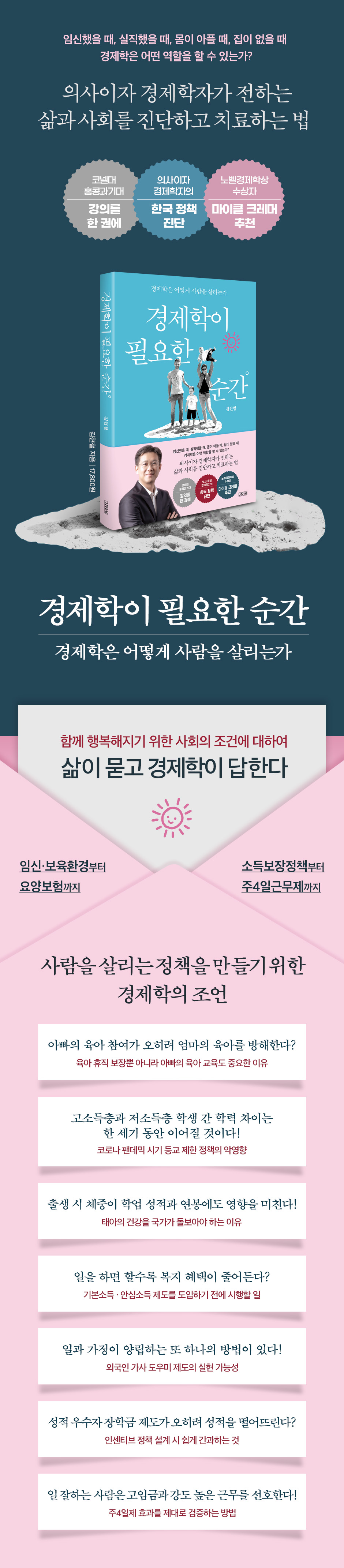
*Cornell University and Hong Kong University of Science and Technology's Hot Topic Lectures!* *Recommended by Nobel Prize-winning economics professor Michael Kremer* Life asks, and economics answers, about the conditions for a society to be happy together. When you're pregnant, unemployed, sick, or homeless, what role can economics play? Diagnosing and Treating Life and Society: A Physician and Economist's Guide Economics closely related to daily life, encompassing health, education, labor, care, and welfare policies necessary throughout the life cycle, from the womb to the grave. Conditions for a happy society proposed by Professor Kim Hyun-chul of the Department of Economics and Policy Studies at the Hong Kong University of Science and Technology. Just as a doctor precisely diagnoses illness and prescribes and treats based on medical evidence, we diagnose and advise on policy problems through experiments and data, not just normativity and intuition. We ask and answer, from the perspective of a doctor and economist, what economics can do to ensure the survival and happiness of people trapped in poverty and misfortune. |
- You can preview some of the book's contents.
Preview
index
Recommendation
introduction
Entering.
Why we need economics in every moment of our lives
Part 1.
From the Belly to the Grave: Why the State Should Care for Our Lives
1.
80% of life's achievements are luck: The limits of individual ability and effort, and the role of the state.
2.
The 10 Months in the Womb Shape Your Life: The Importance of Pregnancy
3.
The Secret to Overcoming the Trap of Misfortune: Why You Should Invest in Your Children
4.
At the Crossroads of Working Moms and Stay-at-Home Moms: The Freedom to Choose Your Parenting Style
5.
Fathers Need Parenting Education Too: Conditions for Successful Father Participation in Parenting
6.
Friends Change My Life: The Impact of Good and Bad Friends
7.
Losing Your Job Makes You Healthier?: The Long-Term Effects of Unemployment
8.
The Source of Life's Vitality and the Cause of Chronic Pain: The Landscape of Twilight Parenting
9.
For a comfortable and dignified old age: The desire to spend one's old age at home
10.
Dreaming of a Work-Family Balance: Why We Need to Introduce a Foreign Domestic Helper System
Part 2.
A Passion Isn't Everything: The Truth and Fiction of Policies Made by Duty and Intuition
11.
When Good Intentions Alone Can't Save People: Why Policy Effectiveness Must Be Proven in Advance
12.
The Alternative: Secure Income or Basic Income: Korea's Cheap Welfare
13.
The High Price of Cheap Healthcare: The Pros and Cons of Expanding Coverage
14.
For doctors, life achievements take precedence over service: Why public medical schools struggle to succeed.
15.
How to Hire High-Performance People: How to Design Incentives
16.
For a Four-Day Workweek to Be Possible: The Problem of Labor Productivity
17.
Elegant Policies Advance Gender Equality: Family-Friendly Nudges
18.
More Deaths Than Coronavirus: Evaluating Policies During the Coronavirus Pandemic
19.
A Huge Loss for Students: Why Schools Must Remain Open During the Coronavirus Pandemic
20.
School Restrictions Accelerated Learning Inequality: A Two-Year Report Card on Pandemic School Restrictions
Coming out.
A good community has the power to overcome misfortune.
Acknowledgements
main
introduction
Entering.
Why we need economics in every moment of our lives
Part 1.
From the Belly to the Grave: Why the State Should Care for Our Lives
1.
80% of life's achievements are luck: The limits of individual ability and effort, and the role of the state.
2.
The 10 Months in the Womb Shape Your Life: The Importance of Pregnancy
3.
The Secret to Overcoming the Trap of Misfortune: Why You Should Invest in Your Children
4.
At the Crossroads of Working Moms and Stay-at-Home Moms: The Freedom to Choose Your Parenting Style
5.
Fathers Need Parenting Education Too: Conditions for Successful Father Participation in Parenting
6.
Friends Change My Life: The Impact of Good and Bad Friends
7.
Losing Your Job Makes You Healthier?: The Long-Term Effects of Unemployment
8.
The Source of Life's Vitality and the Cause of Chronic Pain: The Landscape of Twilight Parenting
9.
For a comfortable and dignified old age: The desire to spend one's old age at home
10.
Dreaming of a Work-Family Balance: Why We Need to Introduce a Foreign Domestic Helper System
Part 2.
A Passion Isn't Everything: The Truth and Fiction of Policies Made by Duty and Intuition
11.
When Good Intentions Alone Can't Save People: Why Policy Effectiveness Must Be Proven in Advance
12.
The Alternative: Secure Income or Basic Income: Korea's Cheap Welfare
13.
The High Price of Cheap Healthcare: The Pros and Cons of Expanding Coverage
14.
For doctors, life achievements take precedence over service: Why public medical schools struggle to succeed.
15.
How to Hire High-Performance People: How to Design Incentives
16.
For a Four-Day Workweek to Be Possible: The Problem of Labor Productivity
17.
Elegant Policies Advance Gender Equality: Family-Friendly Nudges
18.
More Deaths Than Coronavirus: Evaluating Policies During the Coronavirus Pandemic
19.
A Huge Loss for Students: Why Schools Must Remain Open During the Coronavirus Pandemic
20.
School Restrictions Accelerated Learning Inequality: A Two-Year Report Card on Pandemic School Restrictions
Coming out.
A good community has the power to overcome misfortune.
Acknowledgements
main
Detailed image
Into the book
"Why did you quit medicine to study economics?" It's been over 20 years since I started studying economics, but people I meet still ask me this question.
As a doctor, I wanted to become a doctor who could treat society, so I left the clinic and started studying economics.
This decision was made because of the socially disadvantaged people I met.
--- p.16
A winner-take-all society is unhealthy.
It is the government's responsibility to provide an environment where children can overcome the misfortune of being born to bad parents and the various misfortunes they face in life.
It is an important role of the state to distribute the unevenly distributed fortune more evenly.
--- p.36
The symbolic slogan of an ideal social security system, “from cradle to grave,” is no longer valid.
It should be rewritten as 'From mother's womb to the grave'.
--- p.51
Simply keeping people who have committed similar crimes out of the prison system can have a deterrent effect.
Those who argue that juvenile offenders should be severely punished and forced to spend long periods in prison have failed to adequately consider the effect of friends in prison.
Severe punishment is not the only solution.
--- p.97
The reality for male manufacturing workers in Korea is that their health actually improves after losing their jobs because they work in jobs that expose them to serious industrial risks.
I can't help but feel bitter about losing my job and becoming healthier.
--- p.107
The best way for seniors is to receive adequate care at home.
However, state care is currently limited to four hours per day.
Our society must agree to a doubling of long-term care insurance premiums to enable eight hours of home care per day and better facility services, but that won't be easy in the short term.
--- p.126
The foreign domestic helper system is not a panacea.
The ideal society would be one in which parents who want to care for their children themselves can do so.
For this to happen, working hours must be reduced.
At the same time, children need to be able to receive proper care even when parents need to devote more time to work.
--- p.144
How is it that the opportunity to receive an academic scholarship actually lowers your grades? This is because the message of "get in the top 15% and get a scholarship" discourages lower-performing students.
(…) My research shows that even well-intentioned scholarships can discourage students and actually lower their academic achievement.
--- p.158
Before introducing a groundbreaking income security policy, we must first carefully design the specifics to suit our circumstances and prove its effectiveness through social experiments, as Finland did.
(…) policies should be implemented like medical procedures.
Rigorous research is necessary to accurately diagnose and find a solution.
Policies that truly save lives are those in which doctors precisely diagnose diseases and prescribe and treat them based on medical evidence.
--- p.161
People who work for themselves are more productive than those with a high sense of service.
--- p.194
The long-term negative impact on society of the educational gap caused by school restrictions is unfathomable.
I dare to predict that school restrictions will be evaluated as the biggest mistake our society has made during the COVID-19 era.
As a doctor, I wanted to become a doctor who could treat society, so I left the clinic and started studying economics.
This decision was made because of the socially disadvantaged people I met.
--- p.16
A winner-take-all society is unhealthy.
It is the government's responsibility to provide an environment where children can overcome the misfortune of being born to bad parents and the various misfortunes they face in life.
It is an important role of the state to distribute the unevenly distributed fortune more evenly.
--- p.36
The symbolic slogan of an ideal social security system, “from cradle to grave,” is no longer valid.
It should be rewritten as 'From mother's womb to the grave'.
--- p.51
Simply keeping people who have committed similar crimes out of the prison system can have a deterrent effect.
Those who argue that juvenile offenders should be severely punished and forced to spend long periods in prison have failed to adequately consider the effect of friends in prison.
Severe punishment is not the only solution.
--- p.97
The reality for male manufacturing workers in Korea is that their health actually improves after losing their jobs because they work in jobs that expose them to serious industrial risks.
I can't help but feel bitter about losing my job and becoming healthier.
--- p.107
The best way for seniors is to receive adequate care at home.
However, state care is currently limited to four hours per day.
Our society must agree to a doubling of long-term care insurance premiums to enable eight hours of home care per day and better facility services, but that won't be easy in the short term.
--- p.126
The foreign domestic helper system is not a panacea.
The ideal society would be one in which parents who want to care for their children themselves can do so.
For this to happen, working hours must be reduced.
At the same time, children need to be able to receive proper care even when parents need to devote more time to work.
--- p.144
How is it that the opportunity to receive an academic scholarship actually lowers your grades? This is because the message of "get in the top 15% and get a scholarship" discourages lower-performing students.
(…) My research shows that even well-intentioned scholarships can discourage students and actually lower their academic achievement.
--- p.158
Before introducing a groundbreaking income security policy, we must first carefully design the specifics to suit our circumstances and prove its effectiveness through social experiments, as Finland did.
(…) policies should be implemented like medical procedures.
Rigorous research is necessary to accurately diagnose and find a solution.
Policies that truly save lives are those in which doctors precisely diagnose diseases and prescribe and treat them based on medical evidence.
--- p.161
People who work for themselves are more productive than those with a high sense of service.
--- p.194
The long-term negative impact on society of the educational gap caused by school restrictions is unfathomable.
I dare to predict that school restrictions will be evaluated as the biggest mistake our society has made during the COVID-19 era.
--- p.241
Publisher's Review
★Cornell University and Hong Kong University of Science and Technology's Hot Topic Lectures!★
★Recommended by Nobel Prize-winning economics professor Michael Kremer★
Life asks, and economics answers, about the conditions for a society to be happy together.
What role can economics play when you're pregnant, unemployed, sick, or homeless?
Diagnosing and Treating Life and Society: A Physician and Economist's Guide
How is an individual's achievement determined? The country they were born in and the parents they were raised with can largely explain their achievements.
It is all a matter of 'luck' that we cannot control.
If individual achievement hinges on luck, and that luck isn't shared equally, who will help the unlucky? Should we give up happiness just because we don't live in a country with a well-established welfare system or because our parents lack financial resources? A book titled "The Moment We Need Economics" has been published, answering these questions.
The author of this book, Professor Kim Hyeon-cheol, is a 'doctor and economist' who graduated from Yonsei University College of Medicine and received a doctorate in economics from Columbia University.
He served as a professor in the Department of Policy Studies at Cornell University and is currently a professor in the Department of Economics and Department of Policy Studies at the Hong Kong University of Science and Technology.
He is a world-renowned public policy expert who has experimented with and analyzed various policies in Korea, Malawi, Ethiopia, Ghana, India, the Philippines, Bhutan, and Hong Kong.
A joint study published in Science, which tracked the lives of Malawian girls from high school through adulthood, found that education improves the quality of decision-making.
Professor Kim Hyun-chul's research achievements have long attracted the attention of world-renowned economists and policy experts, and his economics lectures at Cornell University and the Hong Kong University of Science and Technology have generated significant buzz.
Even before its publication, this book received praise from numerous scholars at home and abroad for its clear and practical solutions and profound insights, demonstrating how economics contributes to understanding life and society and how it can solve problems.
The impetus for Professor Kim Hyun-chul to contemplate more deeply the misfortunes of individuals and the responsibilities of the state can be found in the author's unique background as both a physician and an economist.
During his senior year of medical school, he witnessed a cancer patient visiting a hospital in Gangnam in a state where metastasis had progressed so far that there was no room to do anything.
There were many people who died simply because they were poor and could not learn.
It wasn't their fault, they were just unlucky.
He left the clinic and became an economist who studies policies that have a wide range of impacts on our lives.
But warm goodwill alone cannot save people.
The author presents the results of several studies, including his own, to create policies based on data and evidence, rather than norms and intuition.
Based on this, we propose life-oriented policies that can be implemented in real-world situations.
Specifically, we examine the pros and cons of Seoul's "Safe Income System," the first social experiment in Korea; school attendance restrictions during the COVID-19 pandemic; the four-day workweek, which coincides with the trend of reduced working hours; and the "Foreign Domestic Helper System," which is emerging as one of the solutions to Korea's low birth rate.
In addition, we examine how the health, education, labor, care, and welfare necessary for each stage of a human life cycle, from the moment of conception in the mother's womb until the end of life, should be designed and operated.
An era where people are denied access to education and employment, are reluctant to marry and have children, cannot go to the hospital when sick, are denied care in old age, and can fall into the abyss with just one disaster.
Even if we cannot overcome the randomness of birth, our individual lives can shine with the help of the community.
This is why we need to pay attention to this book now.
From the womb to the grave, the essential systems and procedures for the life cycle
Economic Advice for Creating Policies That Save People
The author uses various economic studies to illustrate how policies can fail, using several examples.
For example, why do academic performance decline despite scholarships given to students with excellent grades? Why do national cancer screening programs with a budget of 1 trillion won fail to reduce cancer mortality rates? Why do fathers' involvement in childcare not help much? Why do adolescents' health not improve despite lowering their medical expenses?
There are too many policies that are well-intentioned but don't work.
To prevent this, the author emphasizes that the effectiveness of the project must be sufficiently proven through thorough pilot projects from the design stage before implementation.
If the results are not good, you can find another way.
But in reality, many policies are being introduced based on poor evidence.
Have the policies currently implemented or planned in our country truly undergone proper verification? The author, from the perspective of a physician and economist, offers advice on how to create policies that save lives, like a surgeon's sharp knife that removes only cancer cells.
Birth weight affects academic performance and salary!: Why the government should care for fetal health.
Those who were fetuses during the 1918 Spanish flu pandemic had lower rates of high school graduation and higher rates of disability in later life.
For men, wages were also lower than those of their peers.
If we fail to protect the fetus from a bad environment, the socially vulnerable will suffer greatly.
However, there are virtually no policies for fetuses in our country.
The authors argue that proactive policies should be considered to increase parental leave available during pregnancy to protect pregnant women and their fetuses.
· Does fathers' involvement in childcare actually hinder mothers' childcare?: Why parenting education is important, not just for fathers' guaranteed parental leave.
A study in Ethiopia found that providing food vouchers and parent-focused childcare programs improved children's nutritional status.
The problem came when a parenting program targeting fathers was added.
When fathers who received parenting education interfered with mothers' food purchasing decisions, children's nutritional diversity scores were lower.
There were unintended side effects caused by fathers, who were relatively immature compared to mothers, participating in childcare.
For fathers' participation in childcare to be helpful rather than intrusive, we must recognize that it is essential to go beyond simply guaranteeing fathers parental leave and also to cultivate their practical childcare skills.
The achievement gap between high-income and low-income students will persist for a century!: The negative impact of school closures during the COVID-19 pandemic.
Our country has been very late in ending the pandemic and returning to normal life.
The number of deaths from COVID-19 isn't significantly different from the number of deaths from pneumonia or suicide, so why have we focused so exclusively on COVID-19 prevention? Every policy decision carries an opportunity cost.
The goal of the policy should have been to minimize the sum of losses caused by the pandemic and losses resulting from the side effects of the policy.
Long-term restrictions on student attendance have deprived future generations of educational opportunities, and the decline in academic achievement has been concentrated among low-income families.
This will lead to significant differences in wage levels in adulthood and rates of disability in old age.
The author says school restrictions will be evaluated as the biggest mistake our society has made during the COVID-19 era.
· The more you work, the less welfare benefits you receive?: What to do before introducing a new income security system.
There are loopholes in our country's basic livelihood security system.
You may not be eligible for benefits because of your lost child's income, a run-down house, or a $2 million car.
Also, under this system there is little incentive to work.
Since most of the money you earn from working is deducted from your living wage, you may end up losing money by working due to expenses such as transportation costs.
The alternative that emerged was the ‘negative income tax.’
The idea is to provide subsidies, or negative taxes, to those below a certain income level.
Currently, the Seoul Metropolitan Government is experimenting with a "security income" system that provides more support to those with lower incomes as a way to combat this negative income tax.
This is our country's first social experiment, and if proven effective, it will fundamentally change our social system.
· Another Way to Balance Work and Family: The Feasibility of a Foreign Domestic Helper System
Hiring a live-in nanny costs an average of 3 to 4 million won per month.
Expanding daycare centers alone cannot meet the diverse needs of caregivers, and the reality is that if a child becomes seriously ill, one of the parents will have to give up their career.
The author, who had to raise her first child while pursuing her doctorate in the United States, also had to struggle with childcare.
Hong Kong's foreign childcare and housekeeping system was a decisive factor in Professor Kim Hyun-chul's decision to move to Hong Kong.
It was to balance school and childcare.
The author says that this system is not simply a low birth rate measure, but an "economic and care policy" aimed at increasing women's labor force participation and improving the quality of life for families.
· People who excel at their jobs prefer high wages and intense work! : How to properly verify the effectiveness of the 4-day workweek.
After the five-day workweek was implemented, working hours decreased and labor productivity increased.
If a four-day workweek is introduced, hourly labor productivity should increase by more than 20%.
For companies that need to hire highly productive workers, it is important to determine whether workers prefer "high wages, 40-hour workweek" or "low wages, 32-hour workweek."
The study results showed that highly productive people tend to be distributed to 'high-paying, 5-day workweek' jobs, while those with low productivity tend to be distributed to 'low-paying, 4-day workweek' jobs.
★Recommended by Nobel Prize-winning economics professor Michael Kremer★
Life asks, and economics answers, about the conditions for a society to be happy together.
What role can economics play when you're pregnant, unemployed, sick, or homeless?
Diagnosing and Treating Life and Society: A Physician and Economist's Guide
How is an individual's achievement determined? The country they were born in and the parents they were raised with can largely explain their achievements.
It is all a matter of 'luck' that we cannot control.
If individual achievement hinges on luck, and that luck isn't shared equally, who will help the unlucky? Should we give up happiness just because we don't live in a country with a well-established welfare system or because our parents lack financial resources? A book titled "The Moment We Need Economics" has been published, answering these questions.
The author of this book, Professor Kim Hyeon-cheol, is a 'doctor and economist' who graduated from Yonsei University College of Medicine and received a doctorate in economics from Columbia University.
He served as a professor in the Department of Policy Studies at Cornell University and is currently a professor in the Department of Economics and Department of Policy Studies at the Hong Kong University of Science and Technology.
He is a world-renowned public policy expert who has experimented with and analyzed various policies in Korea, Malawi, Ethiopia, Ghana, India, the Philippines, Bhutan, and Hong Kong.
A joint study published in Science, which tracked the lives of Malawian girls from high school through adulthood, found that education improves the quality of decision-making.
Professor Kim Hyun-chul's research achievements have long attracted the attention of world-renowned economists and policy experts, and his economics lectures at Cornell University and the Hong Kong University of Science and Technology have generated significant buzz.
Even before its publication, this book received praise from numerous scholars at home and abroad for its clear and practical solutions and profound insights, demonstrating how economics contributes to understanding life and society and how it can solve problems.
The impetus for Professor Kim Hyun-chul to contemplate more deeply the misfortunes of individuals and the responsibilities of the state can be found in the author's unique background as both a physician and an economist.
During his senior year of medical school, he witnessed a cancer patient visiting a hospital in Gangnam in a state where metastasis had progressed so far that there was no room to do anything.
There were many people who died simply because they were poor and could not learn.
It wasn't their fault, they were just unlucky.
He left the clinic and became an economist who studies policies that have a wide range of impacts on our lives.
But warm goodwill alone cannot save people.
The author presents the results of several studies, including his own, to create policies based on data and evidence, rather than norms and intuition.
Based on this, we propose life-oriented policies that can be implemented in real-world situations.
Specifically, we examine the pros and cons of Seoul's "Safe Income System," the first social experiment in Korea; school attendance restrictions during the COVID-19 pandemic; the four-day workweek, which coincides with the trend of reduced working hours; and the "Foreign Domestic Helper System," which is emerging as one of the solutions to Korea's low birth rate.
In addition, we examine how the health, education, labor, care, and welfare necessary for each stage of a human life cycle, from the moment of conception in the mother's womb until the end of life, should be designed and operated.
An era where people are denied access to education and employment, are reluctant to marry and have children, cannot go to the hospital when sick, are denied care in old age, and can fall into the abyss with just one disaster.
Even if we cannot overcome the randomness of birth, our individual lives can shine with the help of the community.
This is why we need to pay attention to this book now.
From the womb to the grave, the essential systems and procedures for the life cycle
Economic Advice for Creating Policies That Save People
The author uses various economic studies to illustrate how policies can fail, using several examples.
For example, why do academic performance decline despite scholarships given to students with excellent grades? Why do national cancer screening programs with a budget of 1 trillion won fail to reduce cancer mortality rates? Why do fathers' involvement in childcare not help much? Why do adolescents' health not improve despite lowering their medical expenses?
There are too many policies that are well-intentioned but don't work.
To prevent this, the author emphasizes that the effectiveness of the project must be sufficiently proven through thorough pilot projects from the design stage before implementation.
If the results are not good, you can find another way.
But in reality, many policies are being introduced based on poor evidence.
Have the policies currently implemented or planned in our country truly undergone proper verification? The author, from the perspective of a physician and economist, offers advice on how to create policies that save lives, like a surgeon's sharp knife that removes only cancer cells.
Birth weight affects academic performance and salary!: Why the government should care for fetal health.
Those who were fetuses during the 1918 Spanish flu pandemic had lower rates of high school graduation and higher rates of disability in later life.
For men, wages were also lower than those of their peers.
If we fail to protect the fetus from a bad environment, the socially vulnerable will suffer greatly.
However, there are virtually no policies for fetuses in our country.
The authors argue that proactive policies should be considered to increase parental leave available during pregnancy to protect pregnant women and their fetuses.
· Does fathers' involvement in childcare actually hinder mothers' childcare?: Why parenting education is important, not just for fathers' guaranteed parental leave.
A study in Ethiopia found that providing food vouchers and parent-focused childcare programs improved children's nutritional status.
The problem came when a parenting program targeting fathers was added.
When fathers who received parenting education interfered with mothers' food purchasing decisions, children's nutritional diversity scores were lower.
There were unintended side effects caused by fathers, who were relatively immature compared to mothers, participating in childcare.
For fathers' participation in childcare to be helpful rather than intrusive, we must recognize that it is essential to go beyond simply guaranteeing fathers parental leave and also to cultivate their practical childcare skills.
The achievement gap between high-income and low-income students will persist for a century!: The negative impact of school closures during the COVID-19 pandemic.
Our country has been very late in ending the pandemic and returning to normal life.
The number of deaths from COVID-19 isn't significantly different from the number of deaths from pneumonia or suicide, so why have we focused so exclusively on COVID-19 prevention? Every policy decision carries an opportunity cost.
The goal of the policy should have been to minimize the sum of losses caused by the pandemic and losses resulting from the side effects of the policy.
Long-term restrictions on student attendance have deprived future generations of educational opportunities, and the decline in academic achievement has been concentrated among low-income families.
This will lead to significant differences in wage levels in adulthood and rates of disability in old age.
The author says school restrictions will be evaluated as the biggest mistake our society has made during the COVID-19 era.
· The more you work, the less welfare benefits you receive?: What to do before introducing a new income security system.
There are loopholes in our country's basic livelihood security system.
You may not be eligible for benefits because of your lost child's income, a run-down house, or a $2 million car.
Also, under this system there is little incentive to work.
Since most of the money you earn from working is deducted from your living wage, you may end up losing money by working due to expenses such as transportation costs.
The alternative that emerged was the ‘negative income tax.’
The idea is to provide subsidies, or negative taxes, to those below a certain income level.
Currently, the Seoul Metropolitan Government is experimenting with a "security income" system that provides more support to those with lower incomes as a way to combat this negative income tax.
This is our country's first social experiment, and if proven effective, it will fundamentally change our social system.
· Another Way to Balance Work and Family: The Feasibility of a Foreign Domestic Helper System
Hiring a live-in nanny costs an average of 3 to 4 million won per month.
Expanding daycare centers alone cannot meet the diverse needs of caregivers, and the reality is that if a child becomes seriously ill, one of the parents will have to give up their career.
The author, who had to raise her first child while pursuing her doctorate in the United States, also had to struggle with childcare.
Hong Kong's foreign childcare and housekeeping system was a decisive factor in Professor Kim Hyun-chul's decision to move to Hong Kong.
It was to balance school and childcare.
The author says that this system is not simply a low birth rate measure, but an "economic and care policy" aimed at increasing women's labor force participation and improving the quality of life for families.
· People who excel at their jobs prefer high wages and intense work! : How to properly verify the effectiveness of the 4-day workweek.
After the five-day workweek was implemented, working hours decreased and labor productivity increased.
If a four-day workweek is introduced, hourly labor productivity should increase by more than 20%.
For companies that need to hire highly productive workers, it is important to determine whether workers prefer "high wages, 40-hour workweek" or "low wages, 32-hour workweek."
The study results showed that highly productive people tend to be distributed to 'high-paying, 5-day workweek' jobs, while those with low productivity tend to be distributed to 'low-paying, 4-day workweek' jobs.
GOODS SPECIFICS
- Date of issue: September 20, 2023
- Page count, weight, size: 292 pages | 426g | 140*210*17mm
- ISBN13: 9788934971696
You may also like
카테고리
korean


korean

![GQ KOREA Mark (Monthly): December [2025]](http://librairie.coreenne.fr/cdn/shop/files/8ef265dbbfbf186523ed75ba7319009d.jpg?v=1765340328&width=3840)


