

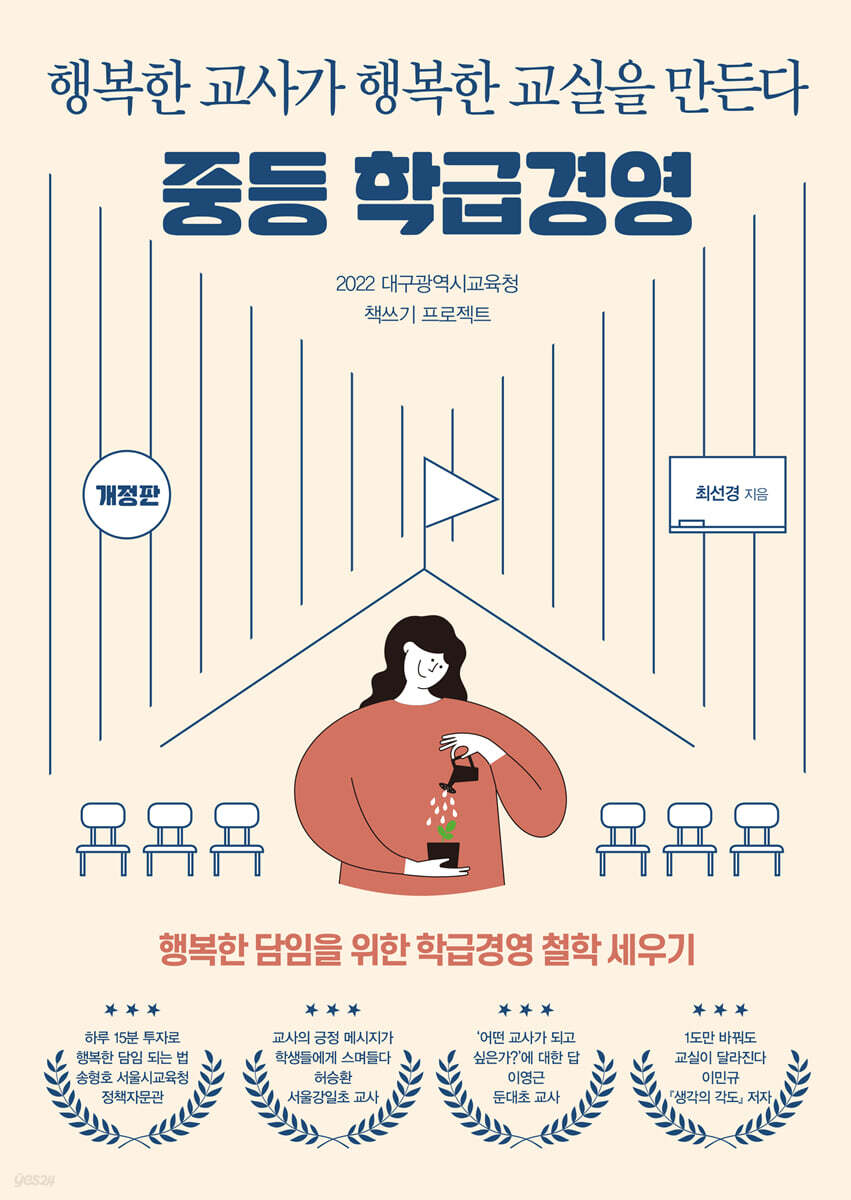
Secondary School Classroom Management
 |
Description
Book Introduction
Establishing a Classroom Management Philosophy for a Happy Homeroom Teacher
“When teachers are happy, children are happy.”
Happy Classroom Management Healing Book!
The first condition for becoming a happy teacher is a classroom management philosophy.
While it is important to faithfully conduct one-hour classes, it is equally important to develop students' ability to learn independently in any situation.
Therefore, teachers, especially homeroom teachers, can grow together with their children when they recognize their professionalism in their role, establish their own classroom management philosophy, and gain experience.
This revised edition of "Secondary Classroom Management," which was recently published with supplementary classroom management cases, is rich in information, from the establishment of the classroom management philosophy of teacher Seon-gyeong Choi of "Whale School," a teacher development school, to the successful classroom management process and know-how.
Furthermore, it presents techniques to become a happy homeroom teacher.
This is a 'Happy Classroom Management Healing Book' that will help teachers who are tired and struggling with online and offline classes and relationships with students, teachers, and parents to find strength and take a big step forward.
“When teachers are happy, children are happy.”
Happy Classroom Management Healing Book!
The first condition for becoming a happy teacher is a classroom management philosophy.
While it is important to faithfully conduct one-hour classes, it is equally important to develop students' ability to learn independently in any situation.
Therefore, teachers, especially homeroom teachers, can grow together with their children when they recognize their professionalism in their role, establish their own classroom management philosophy, and gain experience.
This revised edition of "Secondary Classroom Management," which was recently published with supplementary classroom management cases, is rich in information, from the establishment of the classroom management philosophy of teacher Seon-gyeong Choi of "Whale School," a teacher development school, to the successful classroom management process and know-how.
Furthermore, it presents techniques to become a happy homeroom teacher.
This is a 'Happy Classroom Management Healing Book' that will help teachers who are tired and struggling with online and offline classes and relationships with students, teachers, and parents to find strength and take a big step forward.
- You can preview some of the book's contents.
Preview
index
Recommendation
prolog
Chapter 1: The Homeroom Teacher, the Flower of the Teacher
1.
Classroom management, its importance│2.
Classroom Management, Establishing a Philosophy│3.
Classroom Management: Its Principles and Practice│4.
Classroom Management, Design│5.
Teacher Ko's unique classroom management know-how
(Special Corner) Advice for Middle School Life from a Middle School Student to a Junior _Kim Ah-yoon
Chapter 2: Distinctive Classroom Management
1.
Preparing for the first meeting in March│2.
One line of the day│3.
Whale Card Transcription 100 |4.
Growth Diary 106│5.
100 Day Party 115│6.
Teacher's Manual |7.
Ice Breaking Activities│8.
Democratic Class Officer Elections│9.
Parents' Association for Communication
(Special Corner) Use your tuition like this!
Chapter 3: A Classroom Management Story Created Together by Teachers and Students
1.
The ups and downs of being a new teacher in class management _ Choi Seon-gyeong, teacher at Seodong Middle School│2.
Homeroom teacher after 2 years _ Kim Young-rim, teacher at Saeron Middle School│3.
There is no magic formula for classroom management _ Choi Seon-gyeong, teacher at Seodong Middle School│4.
66-day project and whale card utilization _ Lee Kyung-hee, teacher at Simwon High School│5.
Classroom management that 'thinks 7 times' _ Choi Seon-gyeong, teacher at Seodong Middle School│6.
Good Class Selection Project _ Lee Yong-geol, Daegu Health High School Teacher│7.
Please Take Care of Momo! Reading Classics _ Choi Seon-gyeong, Seodong Middle School Teacher
Chapter 4: Skills for Becoming a Happy Homeroom Teacher
1.
When teachers are happy, children are happy│2.
Use training as an opportunity for growth│3.
Become a true homeroom teacher through self-development│4.
Grow in a professional learning community│5.
Communication skills for dealing with unfamiliar behavior
Epilogue
References
prolog
Chapter 1: The Homeroom Teacher, the Flower of the Teacher
1.
Classroom management, its importance│2.
Classroom Management, Establishing a Philosophy│3.
Classroom Management: Its Principles and Practice│4.
Classroom Management, Design│5.
Teacher Ko's unique classroom management know-how
(Special Corner) Advice for Middle School Life from a Middle School Student to a Junior _Kim Ah-yoon
Chapter 2: Distinctive Classroom Management
1.
Preparing for the first meeting in March│2.
One line of the day│3.
Whale Card Transcription 100 |4.
Growth Diary 106│5.
100 Day Party 115│6.
Teacher's Manual |7.
Ice Breaking Activities│8.
Democratic Class Officer Elections│9.
Parents' Association for Communication
(Special Corner) Use your tuition like this!
Chapter 3: A Classroom Management Story Created Together by Teachers and Students
1.
The ups and downs of being a new teacher in class management _ Choi Seon-gyeong, teacher at Seodong Middle School│2.
Homeroom teacher after 2 years _ Kim Young-rim, teacher at Saeron Middle School│3.
There is no magic formula for classroom management _ Choi Seon-gyeong, teacher at Seodong Middle School│4.
66-day project and whale card utilization _ Lee Kyung-hee, teacher at Simwon High School│5.
Classroom management that 'thinks 7 times' _ Choi Seon-gyeong, teacher at Seodong Middle School│6.
Good Class Selection Project _ Lee Yong-geol, Daegu Health High School Teacher│7.
Please Take Care of Momo! Reading Classics _ Choi Seon-gyeong, Seodong Middle School Teacher
Chapter 4: Skills for Becoming a Happy Homeroom Teacher
1.
When teachers are happy, children are happy│2.
Use training as an opportunity for growth│3.
Become a true homeroom teacher through self-development│4.
Grow in a professional learning community│5.
Communication skills for dealing with unfamiliar behavior
Epilogue
References
Into the book
When the homeroom teacher is announced, teachers often say, "We have to do well in farming this year too..."
This saying, which compares classroom management to 'a year of farming,' clearly captures the mindset of teachers who dedicate themselves to teaching children throughout the year.
This is a word that expresses the weight and responsibility that a homeroom teacher must carry out for a year, whether they like it or not, with the children in the class.
--- p.18
Classroom management philosophy includes everything from what philosophy and rules you will have with your students, what message you will convey to them, and what kind of adults you want your students to grow up to be.
A great way to convey this classroom management philosophy to parents is through the 'Letter to Parents' distributed on the first day of school.
This also has a positive effect on forming relationships with parents.
Since I was first assigned in 2000, every year I was a homeroom teacher, I always sent a letter to parents on the first day of school on March 2nd and had them reply.
--- p.26
There are two ways to understand students: through counseling and having students fill out questionnaires themselves.
First, we recommend having students write their own answers to the questionnaire and then supplementing this with counseling.
You can also get information about special circumstances from your previous grade's homeroom teacher, but you should be careful not to accept the teacher's prejudices about you.
When understanding a student, you need to know their upbringing, family environment, hobbies, special skills, physical characteristics (medical history, etc.), outlook on life, future hopes, grades, relationships with friends, concerns, wishes, or suggestions.
--- p.34
A 'class' is a teaching and learning organization where teachers and students carry out educational activities based on the curriculum to achieve the purpose of school education, and is the basic unit for classroom management design.
By planning and operating various educational activities such as 'Creating a Class with a Story' and 'Creating a Class with Communication and Empathy' that design classroom management, we can develop students' talents and maximize their abilities, allowing them to independently cultivate their dreams and talents, thereby creating a classroom where everyone is happy.
This is precisely the need for classroom management design.
--- p.44
During the semester, various educational activities are carried out according to the classroom management plan, and students experience true learning and growth through these activities.
Accordingly, teachers must run their classes based on their own convictions and educational philosophy, and do their best to achieve educational goals through continuous inspection and improvement.
During the semester, classroom management focuses on student guidance, safety guidance, and counseling activities.
Activities during the semester include school events, academic guidance, guidance on tardiness, absence, and running away from home, guidance on preventing school violence, guidance on volunteer work, guidance on preventing drug abuse, guidance on preventing safety accidents, counseling and character education, proper sex education, and guidance on proper lifestyle habits.
This saying, which compares classroom management to 'a year of farming,' clearly captures the mindset of teachers who dedicate themselves to teaching children throughout the year.
This is a word that expresses the weight and responsibility that a homeroom teacher must carry out for a year, whether they like it or not, with the children in the class.
--- p.18
Classroom management philosophy includes everything from what philosophy and rules you will have with your students, what message you will convey to them, and what kind of adults you want your students to grow up to be.
A great way to convey this classroom management philosophy to parents is through the 'Letter to Parents' distributed on the first day of school.
This also has a positive effect on forming relationships with parents.
Since I was first assigned in 2000, every year I was a homeroom teacher, I always sent a letter to parents on the first day of school on March 2nd and had them reply.
--- p.26
There are two ways to understand students: through counseling and having students fill out questionnaires themselves.
First, we recommend having students write their own answers to the questionnaire and then supplementing this with counseling.
You can also get information about special circumstances from your previous grade's homeroom teacher, but you should be careful not to accept the teacher's prejudices about you.
When understanding a student, you need to know their upbringing, family environment, hobbies, special skills, physical characteristics (medical history, etc.), outlook on life, future hopes, grades, relationships with friends, concerns, wishes, or suggestions.
--- p.34
A 'class' is a teaching and learning organization where teachers and students carry out educational activities based on the curriculum to achieve the purpose of school education, and is the basic unit for classroom management design.
By planning and operating various educational activities such as 'Creating a Class with a Story' and 'Creating a Class with Communication and Empathy' that design classroom management, we can develop students' talents and maximize their abilities, allowing them to independently cultivate their dreams and talents, thereby creating a classroom where everyone is happy.
This is precisely the need for classroom management design.
--- p.44
During the semester, various educational activities are carried out according to the classroom management plan, and students experience true learning and growth through these activities.
Accordingly, teachers must run their classes based on their own convictions and educational philosophy, and do their best to achieve educational goals through continuous inspection and improvement.
During the semester, classroom management focuses on student guidance, safety guidance, and counseling activities.
Activities during the semester include school events, academic guidance, guidance on tardiness, absence, and running away from home, guidance on preventing school violence, guidance on volunteer work, guidance on preventing drug abuse, guidance on preventing safety accidents, counseling and character education, proper sex education, and guidance on proper lifestyle habits.
--- p.48
Publisher's Review
Happy teachers create happy classrooms.
Teachers cannot change every child.
But every day, every moment, we can give students the opportunity to change.
Even if you can change just one child's life a year, you can change the lives of more than 30 people in your lifetime as a teacher. And if each of those students can change someone else's life, then the impact of a teacher, while seemingly small at the moment, is truly significant.
Teacher Choi Seon-gyeong, who runs the Teacher Growth School ('Whale School'), has been practicing classroom management for over 20 years as a homeroom teacher, paying attention to each and every child based on this philosophy and belief.
And this book contains such philosophy, classroom management know-how, and classroom management cases of many teachers at Whale School.
Above all, under the belief that “happy teachers create happy classrooms,” we teach teacher ‘recovery’ techniques that enable homeroom teachers to continue to guide students and manage classes without getting tired.
Why Secondary School Classroom Management Expertise Matters
For secondary school teachers, classroom management skills, or classroom leadership skills, are just as important as teaching the subject matter.
This is why it is important to develop students to be self-directed learners in any situation.
Activities conducted in class units enable students to fulfill their roles as members of the class and have an enjoyable and meaningful school life.
Moreover, its educational significance is great as a practical process that allows me to feel and accept the knowledge acquired during class as living knowledge and as knowledge that I need.
Therefore, secondary school teachers need classroom management expertise as well as teaching expertise.
The role of the homeroom teacher is very important for middle school students going through the so-called storm and stress period.
A Big Release of "Secondary Classroom Management Know-How"
For elementary schools, there is a wealth of material on classroom management and well-organized manuals.
In comparison, there is a severe lack of reference materials for classroom management in middle school.
Even the data that exists is not actively shared.
As such, there are significant differences among teachers when it comes to classroom management, and sometimes some teachers end up burning out as they struggle to lead the classroom alone.
This is why Professor Choi Seon-gyeong published 『Middle School Classroom Management』.
Teacher Choi Seon-gyeong stated in her publication comments, “I hope that more people will take an interest in classroom management, which has the most decisive influence on student guidance, and that a culture of sharing even the smallest information will take root.”
★ Middle School Classroom Management Know-How in Books
Chapter 1: The author discusses the importance of classroom management and the need to establish a classroom management philosophy, introducing the methods he has implemented at each period.
〈Chapter 2〉 I have compiled ‘unique classroom management cases’ that have been well-received by both students and teachers during my many years as a homeroom teacher.
〈Chapter 3〉 Introduces classroom management cases of several experienced teachers.
We share systematic classroom management know-how through activities at 'Whale School,' a professional learning community and teacher development school.
Chapter 4: We share solutions to classroom management concerns and small tips to increase ‘teacher self-esteem’ and introduce ‘techniques for becoming a happy teacher.’
Teachers cannot change every child.
But every day, every moment, we can give students the opportunity to change.
Even if you can change just one child's life a year, you can change the lives of more than 30 people in your lifetime as a teacher. And if each of those students can change someone else's life, then the impact of a teacher, while seemingly small at the moment, is truly significant.
Teacher Choi Seon-gyeong, who runs the Teacher Growth School ('Whale School'), has been practicing classroom management for over 20 years as a homeroom teacher, paying attention to each and every child based on this philosophy and belief.
And this book contains such philosophy, classroom management know-how, and classroom management cases of many teachers at Whale School.
Above all, under the belief that “happy teachers create happy classrooms,” we teach teacher ‘recovery’ techniques that enable homeroom teachers to continue to guide students and manage classes without getting tired.
Why Secondary School Classroom Management Expertise Matters
For secondary school teachers, classroom management skills, or classroom leadership skills, are just as important as teaching the subject matter.
This is why it is important to develop students to be self-directed learners in any situation.
Activities conducted in class units enable students to fulfill their roles as members of the class and have an enjoyable and meaningful school life.
Moreover, its educational significance is great as a practical process that allows me to feel and accept the knowledge acquired during class as living knowledge and as knowledge that I need.
Therefore, secondary school teachers need classroom management expertise as well as teaching expertise.
The role of the homeroom teacher is very important for middle school students going through the so-called storm and stress period.
A Big Release of "Secondary Classroom Management Know-How"
For elementary schools, there is a wealth of material on classroom management and well-organized manuals.
In comparison, there is a severe lack of reference materials for classroom management in middle school.
Even the data that exists is not actively shared.
As such, there are significant differences among teachers when it comes to classroom management, and sometimes some teachers end up burning out as they struggle to lead the classroom alone.
This is why Professor Choi Seon-gyeong published 『Middle School Classroom Management』.
Teacher Choi Seon-gyeong stated in her publication comments, “I hope that more people will take an interest in classroom management, which has the most decisive influence on student guidance, and that a culture of sharing even the smallest information will take root.”
★ Middle School Classroom Management Know-How in Books
Chapter 1: The author discusses the importance of classroom management and the need to establish a classroom management philosophy, introducing the methods he has implemented at each period.
〈Chapter 2〉 I have compiled ‘unique classroom management cases’ that have been well-received by both students and teachers during my many years as a homeroom teacher.
〈Chapter 3〉 Introduces classroom management cases of several experienced teachers.
We share systematic classroom management know-how through activities at 'Whale School,' a professional learning community and teacher development school.
Chapter 4: We share solutions to classroom management concerns and small tips to increase ‘teacher self-esteem’ and introduce ‘techniques for becoming a happy teacher.’
GOODS SPECIFICS
- Date of issue: January 15, 2023
- Page count, weight, size: 236 pages | 494g | 170*240*15mm
- ISBN13: 9791163461678
- ISBN10: 1163461679
You may also like
카테고리
korean


korean

![GQ KOREA Mark (Monthly): December [2025]](http://librairie.coreenne.fr/cdn/shop/files/8ef265dbbfbf186523ed75ba7319009d.jpg?v=1765340328&width=3840)


