

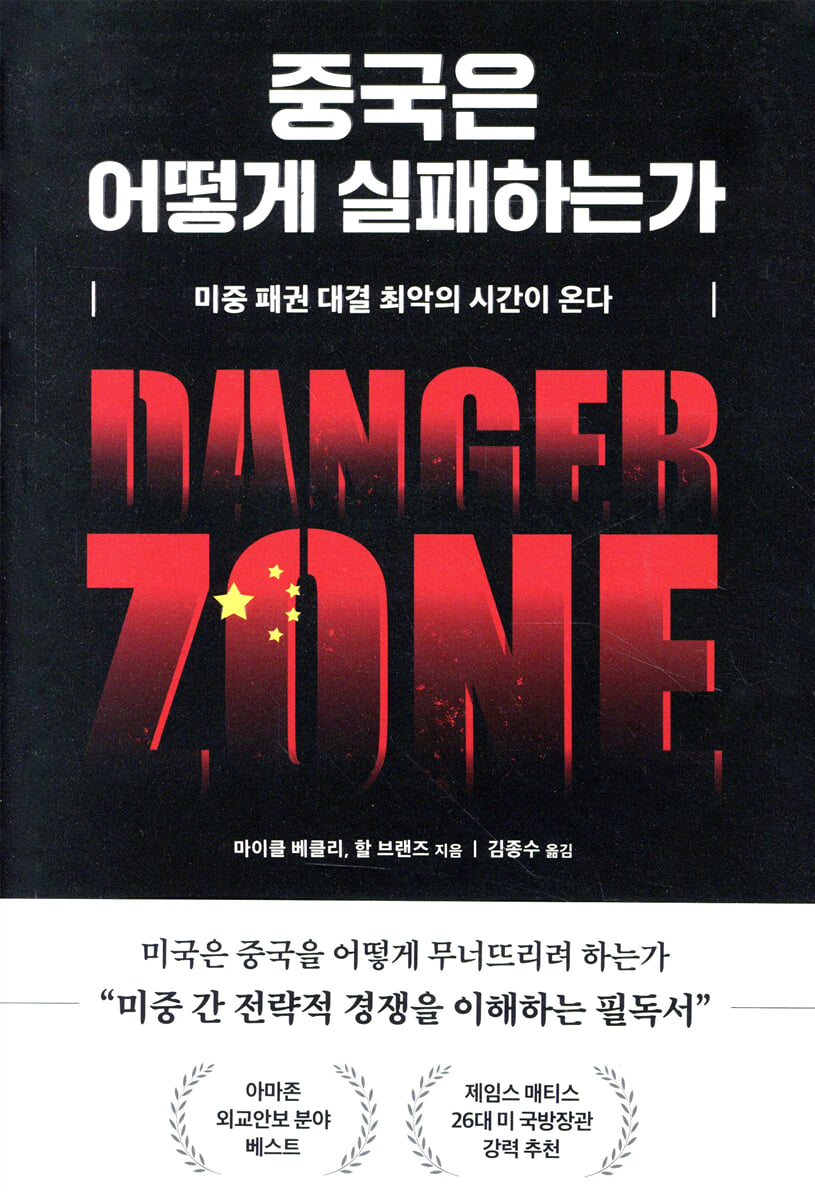
How China Fails
 |
Description
Book Introduction
The world is now going through its most dangerous decade! This book has a significant impact on Korean readers. The world is now passing through the most dangerous decade in the history of the US-China hegemony struggle. While many commentators have viewed the US-China competition as a century-long marathon, this book directly refutes that view. Currently, the two countries are in a short-term all-out competition from 2021 to 2030, and the possibility of war during this period is very high. China has already passed its peak and is starting to decline. A great power challenging hegemony risks everything to confront it head-on when the window of opportunity begins to close. Germany, which started World War I in 1914, and Japan, which started the Pacific War in 1941, both fell into this 'trap of a great power past its peak.' Co-authors Michael Beckley and Hal Brands are both academics and active foreign policy and security strategists who advise the Department of Defense and other U.S. national security agencies. How does the United States contain and pressure China? Why is China collapsing from within? A must-read to understand the newly emerging new Cold War international order. |
- You can preview some of the book's contents.
Preview
index
Part 1: China's Dream of Being a Single Superpower
1.
Chinese Dream
What China Really Wants | Evidence Revealed in China's Actions | The US as an Obstacle to China's Influence | Why China Embraces a Dangerous Competition with the US | There Has Never Been a Time Like Now
2.
China at its peak
Five Factors That Created a Miracle | A World Friendly to China | Reform and Opening Policies / Sophisticated Autocracy / A Demographic Optimized for Productivity / Abundant Resources / When the Windfall Runs Out / A Demographic Catastrophe / Dwindling Resources / Institutional Collapse / A Hostile Geopolitical Environment / China's Economy in the Middle of Nowhere | Red Alert
3.
The closing ring of siege
Eurasia: A Geopolitical Cauldron | The End of Strategic Heydays | Slowly at First, Then Suddenly | Frontlines Spread Out on All Sides | China's Dark Future
4.
The Perils of a Declining Great Power
Was Thucydides Wrong? | Powers at a Dead End | When Authoritarian Regimes Fall | Now or Never: Germany and World War I | 'Jump in with Your Blind Eyes': Japan and World War II
5.
Signs of a storm
China's Sensitive Security Strategy | The Lenin Trap That 'Communist' China Has Fallen Into | The Blueprint for an Economic Empire: AI Technology and Global Networks | China's Efforts to Block Democracy | China's Efforts to Spread Digital Authoritarianism | When Will the Opportunity for War Come? | Taiwan: A Likely Target
Part 2: How the US Will Contain China
6.
Lessons from the Cold War
The Cold War's Danger Zone | First Things First | The Key to Improvisation | A Calculated Risk-Taking Strategy | To Win a Protracted War
7.
Into the danger zone
Anti-Imperial Strategies in the Digital Age | Protecting Democracy from Digital Despotism | Strategies for Saving Taiwan | Preparing for a Long-Term War | Europe as the Heart of the Democratic Bloc | Urgently, Yet Wisely
8.
Prospects and Countermeasures for the US-China Competition
If the Risk Zone Strategy Works | China in the 2030s | Warning Against Saboteurs | Ten Principles for Preparing for the Long Run
Release | Acknowledgements | Notes | Search
1.
Chinese Dream
What China Really Wants | Evidence Revealed in China's Actions | The US as an Obstacle to China's Influence | Why China Embraces a Dangerous Competition with the US | There Has Never Been a Time Like Now
2.
China at its peak
Five Factors That Created a Miracle | A World Friendly to China | Reform and Opening Policies / Sophisticated Autocracy / A Demographic Optimized for Productivity / Abundant Resources / When the Windfall Runs Out / A Demographic Catastrophe / Dwindling Resources / Institutional Collapse / A Hostile Geopolitical Environment / China's Economy in the Middle of Nowhere | Red Alert
3.
The closing ring of siege
Eurasia: A Geopolitical Cauldron | The End of Strategic Heydays | Slowly at First, Then Suddenly | Frontlines Spread Out on All Sides | China's Dark Future
4.
The Perils of a Declining Great Power
Was Thucydides Wrong? | Powers at a Dead End | When Authoritarian Regimes Fall | Now or Never: Germany and World War I | 'Jump in with Your Blind Eyes': Japan and World War II
5.
Signs of a storm
China's Sensitive Security Strategy | The Lenin Trap That 'Communist' China Has Fallen Into | The Blueprint for an Economic Empire: AI Technology and Global Networks | China's Efforts to Block Democracy | China's Efforts to Spread Digital Authoritarianism | When Will the Opportunity for War Come? | Taiwan: A Likely Target
Part 2: How the US Will Contain China
6.
Lessons from the Cold War
The Cold War's Danger Zone | First Things First | The Key to Improvisation | A Calculated Risk-Taking Strategy | To Win a Protracted War
7.
Into the danger zone
Anti-Imperial Strategies in the Digital Age | Protecting Democracy from Digital Despotism | Strategies for Saving Taiwan | Preparing for a Long-Term War | Europe as the Heart of the Democratic Bloc | Urgently, Yet Wisely
8.
Prospects and Countermeasures for the US-China Competition
If the Risk Zone Strategy Works | China in the 2030s | Warning Against Saboteurs | Ten Principles for Preparing for the Long Run
Release | Acknowledgements | Notes | Search
Detailed image

Into the book
Many of the US containment strategies against China presented in this book have already been implemented or are in the process of being implemented.
Huawei and ZTE, the vanguard of China's digital absolutism, have effectively been expelled from the West, and a semiconductor alliance is being formed to exclude China from the advanced semiconductor supply chain.
Militarily, while strengthening Taiwan's defense capabilities, the US Pacific forces and Japanese military forces are being deployed forward near Taiwan.
The Quadrilateral Security Dialogue (Quad), involving the United States, India, Japan, and Australia, is evolving beyond a simple conference body into a military and economic alliance in the Indo-Pacific region.
---From "Before Reading This Book"
Xi Jinping has centralized power to become the world's most powerful dictator since Joseph Stalin.
Meanwhile, American politics remained divided and in disarray, and crises and conflicts around the world distracted the nation's attention.
Never before has the People's Republic of China (PRC) possessed this level of military strength and economic influence over its competitors.
On the surface, Xi Jinping's ambition to establish China as a dominant force not only in Asia but also around the world, the so-called "China Dream," was on the verge of becoming a reality.
---From "Introductory Remarks"
We are not living in an era of ever-rising China, but rather an era of China that has already 'reached its peak.'
China is a revisionist power that seeks to reshape the world, but its time to do so is already running out.
---From "Introductory Remarks"
From China's perspective, the US-led world order, which forces China to remain a second-tier power, is not only historically abnormal but also deeply infuriating.
The current international order was formed after World War II, at the end of a "century of humiliation" in which a divided China was pillaged by greedy foreign powers.
It is the natural mission of the Chinese Communist Party to correct history by restoring China to its former position.
---「1.
From "The Chinese Dream"
The United States is not the only threat the Chinese Communist Party fears.
In 2021, the Chinese Communist Party has set its sights on another critical enemy to China's resurgence.
It is 'divorce'.
For decades, China's birth rate has been well below the level needed to maintain its current population size.
Population decline and aging cannot lead to robust economic growth.
Without robust economic growth, the Chinese dream is nothing more than an illusion.
From the Chinese Communist Party's perspective, divorced or childless women and vasectomies pose a threat to China's geopolitical future.
---「2.
From "China at its peak"
For a generation after the Cold War, China managed to avoid the fate that befell other ambitious Eurasian powers.
This refers to the emergence of a coalition of opposing forces that have gathered together to check the hegemonic power.
China's achievements are now a thing of the past.
China, through its own greed, has turned into an enemy the superpower that had been sparing no effort in supporting its revival.
China has provoked fear and resistance everywhere, both in near and far countries.
The strategic heyday that China enjoyed for decades is over.
This is because the Chinese Communist Party's competitors are strategically squeezing China by surrounding it from all sides.
---「3.
From "Closing the Ring of Siege"
In December 2017, the Trump administration's National Security Strategy document portrayed China as an outlaw seeking to reshape the world in ways that run counter to "American values and interests."
A month later, the U.S. Department of Defense declared in a document titled “National Defense Strategy” that “long-term strategic competition with status quo revisionist forces” was America’s strategic guiding principle.
A report prepared by the National Security Council (NSC) laid out a detailed plan to prevent China from seizing the high ground of technological innovation, from threatening the free world, and from incorporating the Western Pacific into China's internal waters.
---「3.
From "Closing the Ring of Siege"
Thucydides is considered the father of international relations, and his accounts of conflict between great powers remain central to the discipline.
According to power transition theory, war is more likely to occur when a rising power threatens to overtake an existing hegemon.
As challengers become increasingly powerful, the existing system becomes unstable.
The emerging powers attempt to challenge the established hegemons, and the result is a spiral of hostile confrontation.
---「4.
From "The Perils of a Declining Great Power"
The German Empire is a textbook example.
The Anglo-German rivalry of the late 19th and early 20th centuries is often seen as a precursor to the American-Chinese rivalry.
In both cases, a rapidly growing authoritarian power challenges the liberal superpower of the time.
But the more ominous omen is this.
The fact is that the war broke out precisely when a cornered and declining Germany realized that it could not overtake its rivals without fighting.
---「4.
From "The Perils of a Declining Great Power"
Historians often think of pre-World War I Germany and pre-World War II Japan as emerging powers.
Japan grew from a weak nation to a powerful one over the decades following 1868.
The Japanese Empire grew rapidly, especially in the 1930s.
In 1914, Germany was a far more formidable competitor than it had been in 1871.
Both countries have already grown rapidly enough to fundamentally challenge the existing world order.
But at that climactic moment, the leaders of the German and Japanese empires had no sense that they were continuing to grow.
I came to believe that the climactic moment was passing, either by stagnation, siege, or some combination of the two.
A rising power that is beginning to change its status quo and is beginning to feel anxious about the future is more likely to act impulsively than a country that believes tomorrow will be better than today.
This is the trap we really need to worry about.
---「4.
From "The Perils of a Declining Great Power"
The most important factor fueling China's efforts is the ongoing digital revolution.
Consider the data collection and messaging capabilities of Apple, Amazon, Facebook, Google, and Twitter.
Now imagine that such power is in the hands of the Chinese Communist Party.
The Chinese government is developing a system that combines AI, big data, cyber, biometric, voice, and facial recognition technologies to give dictators complete knowledge of their citizens.
---「5.
From "Signs of the Storm"
If China were to subdue Taiwan, it would not only gain control of Taiwan's world-class semiconductor industry, but also free up the dozens of ships, hundreds of missile launchers, hundreds of fighter jets, and billions of dollars in defense spending deployed to invade Taiwan to destroy enemies on farther-flung battlefields.
China will use Taiwan as an "unsinkable aircraft carrier" to project military power into the Pacific, blockade Japan and the Philippines, and undermine US alliances in East Asia.
In particular, a successful attack on Taiwan would eliminate the world's only remaining democratic country in the Chinese speaking world, thus eliminating a persistent threat to the legitimacy of the Chinese Communist Party.
---「5.
From "Signs of the Storm"
Therefore, the United States must devise a strategy appropriate to the situation.
The United States must have a long-term strategy to deal with a challenging, authoritarian China over the next generation or more.
But navigating the tense times ahead, a short-term strategy is also necessary.
If the United States is to win this uncertain fight peacefully, it must first cross the danger zone.
Here again we can learn lessons from history.
---「5.
From "Signs of the Storm"
Truman could proudly say upon leaving office in 1953, “When history says that the Cold War began during my presidency, it will also say that during those eight years we paved the way for our victory in the Cold War.”
In fact, the early Cold War is perhaps the best historical example of a successful risk zone strategy.
---「6.
From “Lessons Learned from the Cold War”
In February 2021, US President Joe Biden declared a technological cold war against China from the White House.
Just weeks after taking office, he signed an executive order mandating a thorough review of America's technology supply chain.
The Biden administration believes that securing sources of rare earths and other key inputs will be crucial in its long-term competition with China.
Long-term investment was needed for the United States to maintain its overwhelming lead in advanced semiconductors and other technologies.
---「7.
From "Into the Danger Zone"
History shows that whoever controls the core technologies of their time controls that time.
Britain was able to build an empire on which the sun never sets because it developed technologies such as the steam engine, iron and steel, and the telegraph ahead of other countries.
Today's American hegemony owes much to its superiority in fields such as steel, electronics, aerospace, chemicals, and, more recently, information technology.
Now, China aims to leapfrog its competitors and subjugate other countries by leveraging its exceptional capabilities in fields such as artificial intelligence, telecommunications, quantum computing, and synthetic biology.
---「7.
From "Into the Danger Zone"
Since the Industrial Revolution and the advent of large armies, wars between great powers have often been protracted rather than short.
The Napoleonic Wars, the American Civil War, World War I, and World War II all resulted in a prolonged war of attrition rather than a short-term annihilation of one side.
Even if China fails to invade Taiwan, it has several compelling reasons to continue the war.
If Xi Jinping admits defeat to Taiwanese rebels and US imperialists, China will undoubtedly be left in a geopolitical predicament, the legitimacy of the Chinese Communist Party will be at risk, and he will fear that his power will ultimately be overthrown.
---「7.
From "Into the Danger Zone"
We learned that the Soviet Union missed its best opportunity to win the Cold War in the first decade.
In the 1960s, the Soviet Union began to disintegrate.
The 1970s saw the beginning of a political and ideological death spiral.
However, Soviet military power and geopolitical expansion did not reach their peak until the late 1970s.
Because of this, even astute observers barely noticed the fatal stagnation of the Soviet system.
The Soviet empire finally collapsed in the late 1980s and early 1990s.
Even after the United States passed the danger zone of the Cold War, it took decades of pressure and effort for the Cold War to end with a decisive victory for the United States.
---「8.
From "Prospects and Countermeasures for US-China Competition"
America's challenge this decade will be to prevent a China that has reached its peak from imposing its will on the world.
But strategic urgency must be followed by strategic patience.
The reward America receives for crossing the danger zone may be merely a ticket into a long struggle that will decisively prove American superiority over a generation or more.
This may seem like an inadequate reward for a country that prefers quick and decisive solutions.
But given the risks facing America and the world today, it's certainly a reward well deserved.
---「8.
From "Prospects and Countermeasures for US-China Competition"
If the current contradictory situation of a new Cold War and cooperation intensifies over the next decade and persists for a long time thereafter, it will have significant repercussions on the Korean Peninsula.
20th-century Berlin was a place where Americans and Soviets were anxious to light each other's cigarettes in a place filled with the fumes of oil.
Today, the Berlin of the 21st century is Taiwan.
And the 21st century Cuba (the risk of World War III) is everywhere, in the South China Sea and Ukraine.
Are we truly exempt from the metaphor of "21st-century Cuba"? As we experienced with the THAAD crisis, the Republic of Korea, where we live, is not only embroiled in a standoff with North Korea, but also in a massive power struggle between the US and China.
Huawei and ZTE, the vanguard of China's digital absolutism, have effectively been expelled from the West, and a semiconductor alliance is being formed to exclude China from the advanced semiconductor supply chain.
Militarily, while strengthening Taiwan's defense capabilities, the US Pacific forces and Japanese military forces are being deployed forward near Taiwan.
The Quadrilateral Security Dialogue (Quad), involving the United States, India, Japan, and Australia, is evolving beyond a simple conference body into a military and economic alliance in the Indo-Pacific region.
---From "Before Reading This Book"
Xi Jinping has centralized power to become the world's most powerful dictator since Joseph Stalin.
Meanwhile, American politics remained divided and in disarray, and crises and conflicts around the world distracted the nation's attention.
Never before has the People's Republic of China (PRC) possessed this level of military strength and economic influence over its competitors.
On the surface, Xi Jinping's ambition to establish China as a dominant force not only in Asia but also around the world, the so-called "China Dream," was on the verge of becoming a reality.
---From "Introductory Remarks"
We are not living in an era of ever-rising China, but rather an era of China that has already 'reached its peak.'
China is a revisionist power that seeks to reshape the world, but its time to do so is already running out.
---From "Introductory Remarks"
From China's perspective, the US-led world order, which forces China to remain a second-tier power, is not only historically abnormal but also deeply infuriating.
The current international order was formed after World War II, at the end of a "century of humiliation" in which a divided China was pillaged by greedy foreign powers.
It is the natural mission of the Chinese Communist Party to correct history by restoring China to its former position.
---「1.
From "The Chinese Dream"
The United States is not the only threat the Chinese Communist Party fears.
In 2021, the Chinese Communist Party has set its sights on another critical enemy to China's resurgence.
It is 'divorce'.
For decades, China's birth rate has been well below the level needed to maintain its current population size.
Population decline and aging cannot lead to robust economic growth.
Without robust economic growth, the Chinese dream is nothing more than an illusion.
From the Chinese Communist Party's perspective, divorced or childless women and vasectomies pose a threat to China's geopolitical future.
---「2.
From "China at its peak"
For a generation after the Cold War, China managed to avoid the fate that befell other ambitious Eurasian powers.
This refers to the emergence of a coalition of opposing forces that have gathered together to check the hegemonic power.
China's achievements are now a thing of the past.
China, through its own greed, has turned into an enemy the superpower that had been sparing no effort in supporting its revival.
China has provoked fear and resistance everywhere, both in near and far countries.
The strategic heyday that China enjoyed for decades is over.
This is because the Chinese Communist Party's competitors are strategically squeezing China by surrounding it from all sides.
---「3.
From "Closing the Ring of Siege"
In December 2017, the Trump administration's National Security Strategy document portrayed China as an outlaw seeking to reshape the world in ways that run counter to "American values and interests."
A month later, the U.S. Department of Defense declared in a document titled “National Defense Strategy” that “long-term strategic competition with status quo revisionist forces” was America’s strategic guiding principle.
A report prepared by the National Security Council (NSC) laid out a detailed plan to prevent China from seizing the high ground of technological innovation, from threatening the free world, and from incorporating the Western Pacific into China's internal waters.
---「3.
From "Closing the Ring of Siege"
Thucydides is considered the father of international relations, and his accounts of conflict between great powers remain central to the discipline.
According to power transition theory, war is more likely to occur when a rising power threatens to overtake an existing hegemon.
As challengers become increasingly powerful, the existing system becomes unstable.
The emerging powers attempt to challenge the established hegemons, and the result is a spiral of hostile confrontation.
---「4.
From "The Perils of a Declining Great Power"
The German Empire is a textbook example.
The Anglo-German rivalry of the late 19th and early 20th centuries is often seen as a precursor to the American-Chinese rivalry.
In both cases, a rapidly growing authoritarian power challenges the liberal superpower of the time.
But the more ominous omen is this.
The fact is that the war broke out precisely when a cornered and declining Germany realized that it could not overtake its rivals without fighting.
---「4.
From "The Perils of a Declining Great Power"
Historians often think of pre-World War I Germany and pre-World War II Japan as emerging powers.
Japan grew from a weak nation to a powerful one over the decades following 1868.
The Japanese Empire grew rapidly, especially in the 1930s.
In 1914, Germany was a far more formidable competitor than it had been in 1871.
Both countries have already grown rapidly enough to fundamentally challenge the existing world order.
But at that climactic moment, the leaders of the German and Japanese empires had no sense that they were continuing to grow.
I came to believe that the climactic moment was passing, either by stagnation, siege, or some combination of the two.
A rising power that is beginning to change its status quo and is beginning to feel anxious about the future is more likely to act impulsively than a country that believes tomorrow will be better than today.
This is the trap we really need to worry about.
---「4.
From "The Perils of a Declining Great Power"
The most important factor fueling China's efforts is the ongoing digital revolution.
Consider the data collection and messaging capabilities of Apple, Amazon, Facebook, Google, and Twitter.
Now imagine that such power is in the hands of the Chinese Communist Party.
The Chinese government is developing a system that combines AI, big data, cyber, biometric, voice, and facial recognition technologies to give dictators complete knowledge of their citizens.
---「5.
From "Signs of the Storm"
If China were to subdue Taiwan, it would not only gain control of Taiwan's world-class semiconductor industry, but also free up the dozens of ships, hundreds of missile launchers, hundreds of fighter jets, and billions of dollars in defense spending deployed to invade Taiwan to destroy enemies on farther-flung battlefields.
China will use Taiwan as an "unsinkable aircraft carrier" to project military power into the Pacific, blockade Japan and the Philippines, and undermine US alliances in East Asia.
In particular, a successful attack on Taiwan would eliminate the world's only remaining democratic country in the Chinese speaking world, thus eliminating a persistent threat to the legitimacy of the Chinese Communist Party.
---「5.
From "Signs of the Storm"
Therefore, the United States must devise a strategy appropriate to the situation.
The United States must have a long-term strategy to deal with a challenging, authoritarian China over the next generation or more.
But navigating the tense times ahead, a short-term strategy is also necessary.
If the United States is to win this uncertain fight peacefully, it must first cross the danger zone.
Here again we can learn lessons from history.
---「5.
From "Signs of the Storm"
Truman could proudly say upon leaving office in 1953, “When history says that the Cold War began during my presidency, it will also say that during those eight years we paved the way for our victory in the Cold War.”
In fact, the early Cold War is perhaps the best historical example of a successful risk zone strategy.
---「6.
From “Lessons Learned from the Cold War”
In February 2021, US President Joe Biden declared a technological cold war against China from the White House.
Just weeks after taking office, he signed an executive order mandating a thorough review of America's technology supply chain.
The Biden administration believes that securing sources of rare earths and other key inputs will be crucial in its long-term competition with China.
Long-term investment was needed for the United States to maintain its overwhelming lead in advanced semiconductors and other technologies.
---「7.
From "Into the Danger Zone"
History shows that whoever controls the core technologies of their time controls that time.
Britain was able to build an empire on which the sun never sets because it developed technologies such as the steam engine, iron and steel, and the telegraph ahead of other countries.
Today's American hegemony owes much to its superiority in fields such as steel, electronics, aerospace, chemicals, and, more recently, information technology.
Now, China aims to leapfrog its competitors and subjugate other countries by leveraging its exceptional capabilities in fields such as artificial intelligence, telecommunications, quantum computing, and synthetic biology.
---「7.
From "Into the Danger Zone"
Since the Industrial Revolution and the advent of large armies, wars between great powers have often been protracted rather than short.
The Napoleonic Wars, the American Civil War, World War I, and World War II all resulted in a prolonged war of attrition rather than a short-term annihilation of one side.
Even if China fails to invade Taiwan, it has several compelling reasons to continue the war.
If Xi Jinping admits defeat to Taiwanese rebels and US imperialists, China will undoubtedly be left in a geopolitical predicament, the legitimacy of the Chinese Communist Party will be at risk, and he will fear that his power will ultimately be overthrown.
---「7.
From "Into the Danger Zone"
We learned that the Soviet Union missed its best opportunity to win the Cold War in the first decade.
In the 1960s, the Soviet Union began to disintegrate.
The 1970s saw the beginning of a political and ideological death spiral.
However, Soviet military power and geopolitical expansion did not reach their peak until the late 1970s.
Because of this, even astute observers barely noticed the fatal stagnation of the Soviet system.
The Soviet empire finally collapsed in the late 1980s and early 1990s.
Even after the United States passed the danger zone of the Cold War, it took decades of pressure and effort for the Cold War to end with a decisive victory for the United States.
---「8.
From "Prospects and Countermeasures for US-China Competition"
America's challenge this decade will be to prevent a China that has reached its peak from imposing its will on the world.
But strategic urgency must be followed by strategic patience.
The reward America receives for crossing the danger zone may be merely a ticket into a long struggle that will decisively prove American superiority over a generation or more.
This may seem like an inadequate reward for a country that prefers quick and decisive solutions.
But given the risks facing America and the world today, it's certainly a reward well deserved.
---「8.
From "Prospects and Countermeasures for US-China Competition"
If the current contradictory situation of a new Cold War and cooperation intensifies over the next decade and persists for a long time thereafter, it will have significant repercussions on the Korean Peninsula.
20th-century Berlin was a place where Americans and Soviets were anxious to light each other's cigarettes in a place filled with the fumes of oil.
Today, the Berlin of the 21st century is Taiwan.
And the 21st century Cuba (the risk of World War III) is everywhere, in the South China Sea and Ukraine.
Are we truly exempt from the metaphor of "21st-century Cuba"? As we experienced with the THAAD crisis, the Republic of Korea, where we live, is not only embroiled in a standoff with North Korea, but also in a massive power struggle between the US and China.
---From "Release"
Publisher's Review
The most dangerous decade: 2021-2030
“The United States and China have already entered a race for supersprint power by 2030.
“A completely different international order will unfold depending on the outcome of this 10-year all-out war, the most dangerous period (Danger Zone) in the history of the US-China hegemony competition.” Most of the books that have been introduced in Korea so far that deal with the US-China confrontation have assumed that the relationship between the two countries is a ‘marathon competition that will continue for the next century.’
Examples include The Hundred Year Marathon (Michael Pillsbury, 2015) and The Long Game (Rush Dorsey, 2022).
But "How China Fails" directly refutes this familiar conventional wisdom.
Our central argument in this book is that this common sense is wrong on two counts.
Americans urgently need to view the Central American competition as a fierce sprint over a decade rather than a century-long marathon.
Because China will become a 'declining power' much sooner than most people think.
- Page 20
US-China relations entered a period of breakdown under the Trump administration in 2017, and the two countries have already entered a state of silent war in the 2020s.
Authors Michael Beckley and Hal Brands predict that a military confrontation between the United States and China is almost inevitable, and that the most likely target for a preemptive strike by China would be Taiwan, with the timing of the strike expected to be in the mid-2020s.
The worst crisis is unfolding, with the possibility of nuclear weapons being used and even the outbreak of World War III being considered.
The most likely scenario is that war begins with thousands of missiles launched from the ground and air raining down on US bases in Taiwan, Okinawa and Guam, and US aircraft carrier strike groups based in Japan.
Chinese special forces and intelligence agents who had been hiding will emerge from all over Taiwan, detonating bombs at military facilities and assassinating Taiwan's leaders.
(Omitted) Meanwhile, as hundreds of thousands of Chinese troops stationed on the Chinese mainland begin boarding ships and helicopters for a full-scale attack, a Chinese flotilla that previously conducted military exercises in the Taiwan Strait will rush toward the Taiwanese coast.
(Omitted) The United States will face a painful choice, and American troops deployed in the Pacific will suffer losses on a scale not experienced since the Vietnam War or World War II.
American leaders may find themselves facing a dilemma.
The dilemma is whether to accept a humiliating military failure or threaten to use nuclear weapons if China does not back down.
- Pages 223-224
A bipartisan consensus has emerged in Washington over a strategy to contain China.
The quoted sentence is, of course, one of the scenarios for China's invasion of Taiwan, but the authors who develop this argument are not ordinary.
Co-author Michael Beckley is an associate professor of political science at Tufts University. He has worked for the U.S. Department of Defense, the RAND Corporation, and the Carnegie Endowment for International Peace, and has received awards from the American Political Science Association and the Academy of International Relations for his research on great power hegemony competition.
Another co-author, Hal Brands, a professor of international relations at Johns Hopkins University, served as special assistant to the director of strategic planning at the U.S. Department of Defense and as senior writer for the National Defense Strategy Board.
Both are active foreign affairs and security advisors and strategists who advise various agencies in the U.S. intelligence and national security fields, including the Department of Defense.
James Mattis, the 26th Secretary of Defense of the United States who retired in 2019, and Eric S. Mattis, former Under Secretary of Defense for Policy.
It is also noteworthy that former key figures in the Department of Defense, including Edelman, strongly recommended this book as a "must-read for the era of US-China strategic competition."
The authors present several reasons for placing a likely outbreak of war in the mid-2020s.
China currently spends 25 times more on its military annually than Taiwan, and has brought forward the completion date for its military modernization from 2034 to 2027.
In March 2021, Admiral Philip Davidson, then commander of US forces in the Indo-Pacific region, warned that China could invade Taiwan within the next six years.
According to a 2020 survey conducted by China's state-run Global Times, 70% of mainland Chinese residents strongly supported the use of force to unify Taiwan.
What's even more striking is that the atmosphere in American politics, regardless of whether it's Democratic or Republican, has already formed a new Cold War climate that views China as the most dangerous strategic challenger.
Professor Ahn Byeong-jin of Kyunghee University, an expert on American politics who wrote the book's introduction, says the following:
The authors' argument accurately reflects a clear shift in Washington and academia today from conventional "constructive engagement" with China to "tailored containment."
Today, while the United States faces internal differences across a wide ideological and strategic spectrum, there is a bipartisan consensus on the fundamental crisis facing China, which is pursuing an aggressive foreign and security strategy based on illiberal ideology.
And to counter this, there is a consensus that a surgical decoupling strategy is needed across the entire spectrum of economic security, including space, semiconductors, quantum cryptography, and digital technologies.
This is reflected in multifaceted initiatives today, including the Inflation Reduction Act, the Semiconductor Supply Chain Council, and the Quad.
- Page 346
In this way, "How China Fails" can be said to be a book that clearly and unfilteredly exposes the true intentions and strategies of the United States, the existing hegemon, amidst the international order transitioning into a new Cold War.
This is supported by the fact that most of the specific China containment strategies mentioned in the book were already in place around 2020.
How China Falls
Why is the US-China relationship incapable of avoiding a worst-case scenario? The authors explain this as "the trap of a superpower past its peak."
This is a different approach from the 'Thucydides Trap', which has been most often mentioned when predicting the US-China confrontation.
According to Thucydides, the Greek historian who is considered the father of international relations today for his work History of the Peloponnesian War, which covers the war between Athens and Sparta, the international order is severely shaken when a newly rising power tries to overtake a declining existing hegemon (Thucydides' Trap).
But Michael Beckley and Hal Brands argue that this perspective falls short of explaining the deadliest war in history.
Based on the 'Thucydides Trap', it is reasonable for emerging powers to refrain from extreme confrontation with each other until they have sufficiently surpassed the existing hegemon.
However, this was not the case for Germany in 1914, which started World War I, or for Japan in 1941, which opened the Pacific War with the attack on Pearl Harbor.
These two countries, in a situation where growth was limited, waged the worst war with national powers far inferior to those of the existing great powers.
Problems began to arise as the period of prosperity ended.
Japan's growth rate fell to 1.8 percent during the 1920s.
A massive earthquake and the collapse of the financial system shook the Japanese economy.
(Omitted) At this point, a strategic noose was tightening around Japan's neck.
From the perspective of the hardliners who advocated all-out war in Japan, Japan had to continue pushing, especially into Indochina and the Dutch East Indies, to build a self-sufficient empire.
(Omitted) It was revealed that World War II was almost an act of suicide for Japan.
But the cause was not that Japan was crazy, but rather the desperation of a country whose dream of breaking the status quo was on the verge of being shattered.
- Pages 168-175
When a latecomer power's growth slows or it is on the decline due to checks from the existing hegemon or a coalition of rivals, and the window of opportunity begins to close, it will make a final, almost all-out effort to break the status quo.
This is precisely what the authors call the "trap of a past-peak great power."
The most recent Russian invasion of Ukraine is of a similar nature.
On the surface, China appears to still be in the midst of rapid growth.
Between 1978 and 2018, China's real GDP grew 37-fold.
More than half of the world's countries already trade more with China than with the United States, and China is also the world's largest foreign lender.
However, the authors analyze that China's seemingly unstoppable growth has already reached its limits.
By 2050, China will only have two working-age people to support each retiree.
(Compare that to the early 2000s, when there were ten working-age people for every retiree.) And nearly a third of the population will be over 60.
China's population will shrink to half its current size by the end of this century, perhaps as early as the 2060s.
- Pages 77-78
In 2011, China became the world's largest importer of agricultural products.
The government tried to restore food self-sufficiency by providing massive subsidies to farmers, but such policies only accelerated the destruction of farmland.
In 2014, Xinhua News Agency reported that more than 40 percent of China's cultivated land was suffering from soil degradation due to overuse.
(Omitted) China, which has grown at a rapid pace, has become the world's largest energy importer.
Today, China imports nearly 75 percent of its oil and 45 percent of its natural gas.
- Pages 81-82
Total factor productivity, an essential element for wealth creation, declined by an average of 1.3 percent per year between 2008 and 2019.
These figures mean that China is spending more and producing less every year.
(Omitted) The Chinese government estimates that it lost at least $6 trillion between 2009 and 2014 alone due to “inefficient investment.”
Not since the Soviet Union in the 1980s has global productivity fallen so sharply.
- Page 90
The factors that have driven China's splendid success—geopolitics, reform and opening-up policies, demographic dividend, and abundant resources—have all turned hostile.
In addition, the ring of encirclement surrounding China began to strengthen.
The world's 20 major economies that make up the G20 imposed more than 2,000 restrictions on Chinese companies between 2008 and 2019.
Between 2008 and 2021, China faced nearly 11,000 new trade barriers abroad.
By 2021, roughly a dozen countries had withdrawn from China's Belt and Road Initiative, and 16 countries, primarily Western economic powers, had cut off their telecommunications networks from China's sphere of influence.
The United States and several of its allies have imposed harsh technology transfer bans on major Chinese companies.
- Page 88
China is becoming more isolated not only economically but also politically and culturally.
During the coronavirus pandemic, antipathy toward China has surged worldwide.
The Trump administration exported $20 billion worth of weapons to Taiwan, which was considered a discarded card when the US-China diplomatic relationship was established. Even after the Biden administration took office, House Speaker Pelosi visited Taiwan, clearly revealing the US' intentions.
China's neighbors include 15 of the world's most populous nations, four of which are nuclear-armed, five of which have been at war with China in the past 80 years, and 10 of which still have territorial disputes with China.
In the face of the new Cold War order and the fate of the Korean Peninsula
The latter half of "How China Fails" is filled with detailed US strategic tactics on how to surround and isolate China, which has fallen into this trap.
The authors' advice is thoroughly based on the experiences of the Cold War.
This is a strategy whose effectiveness has already been proven throughout history, through confrontations with the former Soviet Union, and it is also the strategy most familiar to the mainstream forces of American politics, diplomacy, and security.
Based on this advice, the authors ultimately envision what China will look like after Xi Jinping.
Perhaps the best-case scenario is that Xi Jinping is replaced by China's Gorbachev.
In other words, a reformist figure who is willing to liberalize China and reduce foreign spending will eventually take power.
(Omitted) But another, more likely outcome is that Xi Jinping will be replaced by a Chinese Putin-like figure.
In other words, a vengeful martial artist is in power, overseeing China's transition from an ambitious superpower to a prickly troublemaker.
Then, the threat of China as an equal competitor will quickly disappear, but in its place, a giant rogue state will emerge.
- Pages 324-325
This book has a significant impact on Korean readers who hope for a new era based on global connectivity and peace after the end of the Cold War.
The Korean Peninsula is currently the world's most dangerous powder keg of war, and South Korea has already experienced major conflict with China over the THAAD deployment issue.
The pragmatic diplomatic path of growth through 'the US for security and China for the economy' is in danger of being stranded.
Just 20 years after the dawn of the hopeful 21st century, we are now entering the most dangerous decade in the history of the US-China hegemony struggle.
In that respect, the content of this book is by no means something that Korean readers will welcome.
However, even in this chaotic time of strengthening of the new Cold War order, the pursuit of peace on the Korean Peninsula, the security of the Republic of Korea, and its continued development is unstoppable.
At a time when we need to gather national wisdom more than ever, this book will provide rich insights for readers who wish to delve into the inner workings of the most powerful nations and objectively observe the shifting global order.
The authors have given us a lot to think about, most of it scary.
An authoritative and worrying analysis of the potential for a full-scale conflict in the coming years.
- [Kirkus]
“The United States and China have already entered a race for supersprint power by 2030.
“A completely different international order will unfold depending on the outcome of this 10-year all-out war, the most dangerous period (Danger Zone) in the history of the US-China hegemony competition.” Most of the books that have been introduced in Korea so far that deal with the US-China confrontation have assumed that the relationship between the two countries is a ‘marathon competition that will continue for the next century.’
Examples include The Hundred Year Marathon (Michael Pillsbury, 2015) and The Long Game (Rush Dorsey, 2022).
But "How China Fails" directly refutes this familiar conventional wisdom.
Our central argument in this book is that this common sense is wrong on two counts.
Americans urgently need to view the Central American competition as a fierce sprint over a decade rather than a century-long marathon.
Because China will become a 'declining power' much sooner than most people think.
- Page 20
US-China relations entered a period of breakdown under the Trump administration in 2017, and the two countries have already entered a state of silent war in the 2020s.
Authors Michael Beckley and Hal Brands predict that a military confrontation between the United States and China is almost inevitable, and that the most likely target for a preemptive strike by China would be Taiwan, with the timing of the strike expected to be in the mid-2020s.
The worst crisis is unfolding, with the possibility of nuclear weapons being used and even the outbreak of World War III being considered.
The most likely scenario is that war begins with thousands of missiles launched from the ground and air raining down on US bases in Taiwan, Okinawa and Guam, and US aircraft carrier strike groups based in Japan.
Chinese special forces and intelligence agents who had been hiding will emerge from all over Taiwan, detonating bombs at military facilities and assassinating Taiwan's leaders.
(Omitted) Meanwhile, as hundreds of thousands of Chinese troops stationed on the Chinese mainland begin boarding ships and helicopters for a full-scale attack, a Chinese flotilla that previously conducted military exercises in the Taiwan Strait will rush toward the Taiwanese coast.
(Omitted) The United States will face a painful choice, and American troops deployed in the Pacific will suffer losses on a scale not experienced since the Vietnam War or World War II.
American leaders may find themselves facing a dilemma.
The dilemma is whether to accept a humiliating military failure or threaten to use nuclear weapons if China does not back down.
- Pages 223-224
A bipartisan consensus has emerged in Washington over a strategy to contain China.
The quoted sentence is, of course, one of the scenarios for China's invasion of Taiwan, but the authors who develop this argument are not ordinary.
Co-author Michael Beckley is an associate professor of political science at Tufts University. He has worked for the U.S. Department of Defense, the RAND Corporation, and the Carnegie Endowment for International Peace, and has received awards from the American Political Science Association and the Academy of International Relations for his research on great power hegemony competition.
Another co-author, Hal Brands, a professor of international relations at Johns Hopkins University, served as special assistant to the director of strategic planning at the U.S. Department of Defense and as senior writer for the National Defense Strategy Board.
Both are active foreign affairs and security advisors and strategists who advise various agencies in the U.S. intelligence and national security fields, including the Department of Defense.
James Mattis, the 26th Secretary of Defense of the United States who retired in 2019, and Eric S. Mattis, former Under Secretary of Defense for Policy.
It is also noteworthy that former key figures in the Department of Defense, including Edelman, strongly recommended this book as a "must-read for the era of US-China strategic competition."
The authors present several reasons for placing a likely outbreak of war in the mid-2020s.
China currently spends 25 times more on its military annually than Taiwan, and has brought forward the completion date for its military modernization from 2034 to 2027.
In March 2021, Admiral Philip Davidson, then commander of US forces in the Indo-Pacific region, warned that China could invade Taiwan within the next six years.
According to a 2020 survey conducted by China's state-run Global Times, 70% of mainland Chinese residents strongly supported the use of force to unify Taiwan.
What's even more striking is that the atmosphere in American politics, regardless of whether it's Democratic or Republican, has already formed a new Cold War climate that views China as the most dangerous strategic challenger.
Professor Ahn Byeong-jin of Kyunghee University, an expert on American politics who wrote the book's introduction, says the following:
The authors' argument accurately reflects a clear shift in Washington and academia today from conventional "constructive engagement" with China to "tailored containment."
Today, while the United States faces internal differences across a wide ideological and strategic spectrum, there is a bipartisan consensus on the fundamental crisis facing China, which is pursuing an aggressive foreign and security strategy based on illiberal ideology.
And to counter this, there is a consensus that a surgical decoupling strategy is needed across the entire spectrum of economic security, including space, semiconductors, quantum cryptography, and digital technologies.
This is reflected in multifaceted initiatives today, including the Inflation Reduction Act, the Semiconductor Supply Chain Council, and the Quad.
- Page 346
In this way, "How China Fails" can be said to be a book that clearly and unfilteredly exposes the true intentions and strategies of the United States, the existing hegemon, amidst the international order transitioning into a new Cold War.
This is supported by the fact that most of the specific China containment strategies mentioned in the book were already in place around 2020.
How China Falls
Why is the US-China relationship incapable of avoiding a worst-case scenario? The authors explain this as "the trap of a superpower past its peak."
This is a different approach from the 'Thucydides Trap', which has been most often mentioned when predicting the US-China confrontation.
According to Thucydides, the Greek historian who is considered the father of international relations today for his work History of the Peloponnesian War, which covers the war between Athens and Sparta, the international order is severely shaken when a newly rising power tries to overtake a declining existing hegemon (Thucydides' Trap).
But Michael Beckley and Hal Brands argue that this perspective falls short of explaining the deadliest war in history.
Based on the 'Thucydides Trap', it is reasonable for emerging powers to refrain from extreme confrontation with each other until they have sufficiently surpassed the existing hegemon.
However, this was not the case for Germany in 1914, which started World War I, or for Japan in 1941, which opened the Pacific War with the attack on Pearl Harbor.
These two countries, in a situation where growth was limited, waged the worst war with national powers far inferior to those of the existing great powers.
Problems began to arise as the period of prosperity ended.
Japan's growth rate fell to 1.8 percent during the 1920s.
A massive earthquake and the collapse of the financial system shook the Japanese economy.
(Omitted) At this point, a strategic noose was tightening around Japan's neck.
From the perspective of the hardliners who advocated all-out war in Japan, Japan had to continue pushing, especially into Indochina and the Dutch East Indies, to build a self-sufficient empire.
(Omitted) It was revealed that World War II was almost an act of suicide for Japan.
But the cause was not that Japan was crazy, but rather the desperation of a country whose dream of breaking the status quo was on the verge of being shattered.
- Pages 168-175
When a latecomer power's growth slows or it is on the decline due to checks from the existing hegemon or a coalition of rivals, and the window of opportunity begins to close, it will make a final, almost all-out effort to break the status quo.
This is precisely what the authors call the "trap of a past-peak great power."
The most recent Russian invasion of Ukraine is of a similar nature.
On the surface, China appears to still be in the midst of rapid growth.
Between 1978 and 2018, China's real GDP grew 37-fold.
More than half of the world's countries already trade more with China than with the United States, and China is also the world's largest foreign lender.
However, the authors analyze that China's seemingly unstoppable growth has already reached its limits.
By 2050, China will only have two working-age people to support each retiree.
(Compare that to the early 2000s, when there were ten working-age people for every retiree.) And nearly a third of the population will be over 60.
China's population will shrink to half its current size by the end of this century, perhaps as early as the 2060s.
- Pages 77-78
In 2011, China became the world's largest importer of agricultural products.
The government tried to restore food self-sufficiency by providing massive subsidies to farmers, but such policies only accelerated the destruction of farmland.
In 2014, Xinhua News Agency reported that more than 40 percent of China's cultivated land was suffering from soil degradation due to overuse.
(Omitted) China, which has grown at a rapid pace, has become the world's largest energy importer.
Today, China imports nearly 75 percent of its oil and 45 percent of its natural gas.
- Pages 81-82
Total factor productivity, an essential element for wealth creation, declined by an average of 1.3 percent per year between 2008 and 2019.
These figures mean that China is spending more and producing less every year.
(Omitted) The Chinese government estimates that it lost at least $6 trillion between 2009 and 2014 alone due to “inefficient investment.”
Not since the Soviet Union in the 1980s has global productivity fallen so sharply.
- Page 90
The factors that have driven China's splendid success—geopolitics, reform and opening-up policies, demographic dividend, and abundant resources—have all turned hostile.
In addition, the ring of encirclement surrounding China began to strengthen.
The world's 20 major economies that make up the G20 imposed more than 2,000 restrictions on Chinese companies between 2008 and 2019.
Between 2008 and 2021, China faced nearly 11,000 new trade barriers abroad.
By 2021, roughly a dozen countries had withdrawn from China's Belt and Road Initiative, and 16 countries, primarily Western economic powers, had cut off their telecommunications networks from China's sphere of influence.
The United States and several of its allies have imposed harsh technology transfer bans on major Chinese companies.
- Page 88
China is becoming more isolated not only economically but also politically and culturally.
During the coronavirus pandemic, antipathy toward China has surged worldwide.
The Trump administration exported $20 billion worth of weapons to Taiwan, which was considered a discarded card when the US-China diplomatic relationship was established. Even after the Biden administration took office, House Speaker Pelosi visited Taiwan, clearly revealing the US' intentions.
China's neighbors include 15 of the world's most populous nations, four of which are nuclear-armed, five of which have been at war with China in the past 80 years, and 10 of which still have territorial disputes with China.
In the face of the new Cold War order and the fate of the Korean Peninsula
The latter half of "How China Fails" is filled with detailed US strategic tactics on how to surround and isolate China, which has fallen into this trap.
The authors' advice is thoroughly based on the experiences of the Cold War.
This is a strategy whose effectiveness has already been proven throughout history, through confrontations with the former Soviet Union, and it is also the strategy most familiar to the mainstream forces of American politics, diplomacy, and security.
Based on this advice, the authors ultimately envision what China will look like after Xi Jinping.
Perhaps the best-case scenario is that Xi Jinping is replaced by China's Gorbachev.
In other words, a reformist figure who is willing to liberalize China and reduce foreign spending will eventually take power.
(Omitted) But another, more likely outcome is that Xi Jinping will be replaced by a Chinese Putin-like figure.
In other words, a vengeful martial artist is in power, overseeing China's transition from an ambitious superpower to a prickly troublemaker.
Then, the threat of China as an equal competitor will quickly disappear, but in its place, a giant rogue state will emerge.
- Pages 324-325
This book has a significant impact on Korean readers who hope for a new era based on global connectivity and peace after the end of the Cold War.
The Korean Peninsula is currently the world's most dangerous powder keg of war, and South Korea has already experienced major conflict with China over the THAAD deployment issue.
The pragmatic diplomatic path of growth through 'the US for security and China for the economy' is in danger of being stranded.
Just 20 years after the dawn of the hopeful 21st century, we are now entering the most dangerous decade in the history of the US-China hegemony struggle.
In that respect, the content of this book is by no means something that Korean readers will welcome.
However, even in this chaotic time of strengthening of the new Cold War order, the pursuit of peace on the Korean Peninsula, the security of the Republic of Korea, and its continued development is unstoppable.
At a time when we need to gather national wisdom more than ever, this book will provide rich insights for readers who wish to delve into the inner workings of the most powerful nations and objectively observe the shifting global order.
The authors have given us a lot to think about, most of it scary.
An authoritative and worrying analysis of the potential for a full-scale conflict in the coming years.
- [Kirkus]
GOODS SPECIFICS
- Date of issue: February 6, 2023
- Page count, weight, size: 416 pages | 570g | 147*219*20mm
- ISBN13: 9788960519695
- ISBN10: 8960519693
You may also like
카테고리
korean


korean

![GQ KOREA Mark (Monthly): December [2025]](http://librairie.coreenne.fr/cdn/shop/files/8ef265dbbfbf186523ed75ba7319009d.jpg?v=1765340328&width=3840)


