

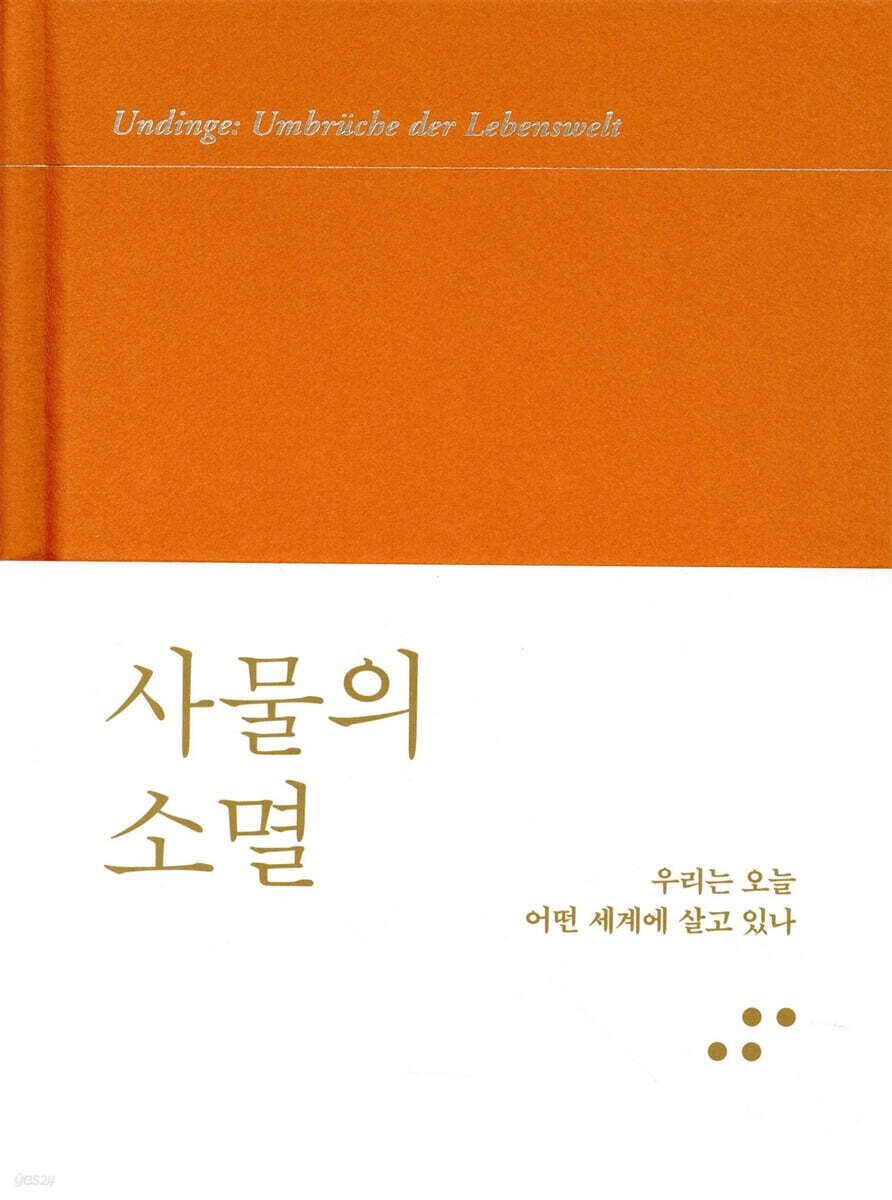
The extinction of things
 |
Description
Book Introduction
From smartphones to selfies, smart homes, the Internet of Things, and artificial intelligence
A philosophical reflection on how we relate to the world in a digitalized world.
The phenomenology of information as depicted by Han Byung-chul, who dreams of becoming a "physiognomist of the world of things."
“We no longer live on the ground and in the sky, but in Google Earth and the cloud.
We store enormous amounts of data, but we don't recall our memories.
Knowing everything but not reaching enlightenment.
You build up friends and followers, but you don't meet any typists.
We live in a dematerialized world, a ghostly world dominated by information.”
A new work by German philosopher Han Byung-chul.
According to his diagnosis, we are living in a transitional period from the age of things to the age of reflections, that is, information.
Our attention increasingly shifts from objects to their reflections.
Smartphones are becoming 'digital relics' that function like rosaries, and 'likes' are 'digital Amens.'
Information dominates our lives, and communication intoxicates us.
There is little material contact with reality, and reality is deprived of its own presence.
Han Byung-chul sharply points out the craze for information and communication and the problems it creates, calling for a return to the "magic of things" and the retrieval of the silence lost amidst the noise of information.
A philosophical reflection on how we relate to the world in a digitalized world.
The phenomenology of information as depicted by Han Byung-chul, who dreams of becoming a "physiognomist of the world of things."
“We no longer live on the ground and in the sky, but in Google Earth and the cloud.
We store enormous amounts of data, but we don't recall our memories.
Knowing everything but not reaching enlightenment.
You build up friends and followers, but you don't meet any typists.
We live in a dematerialized world, a ghostly world dominated by information.”
A new work by German philosopher Han Byung-chul.
According to his diagnosis, we are living in a transitional period from the age of things to the age of reflections, that is, information.
Our attention increasingly shifts from objects to their reflections.
Smartphones are becoming 'digital relics' that function like rosaries, and 'likes' are 'digital Amens.'
Information dominates our lives, and communication intoxicates us.
There is little material contact with reality, and reality is deprived of its own presence.
Han Byung-chul sharply points out the craze for information and communication and the problems it creates, calling for a return to the "magic of things" and the retrieval of the silence lost amidst the noise of information.
- You can preview some of the book's contents.
Preview
index
introduction
From objects to reflections
From ownership to experience
smartphone
Selfie
artificial intelligence
Aspects of Things
The Perversity of Things | The Back of Things | Ghosts | The Magic of Things | Forgetting Things in Art | Heidegger's Hand | The Loyalty of Things
still
A side note about the jukebox
main
Appendix - Author Interview
Translator's Note
From objects to reflections
From ownership to experience
smartphone
Selfie
artificial intelligence
Aspects of Things
The Perversity of Things | The Back of Things | Ghosts | The Magic of Things | Forgetting Things in Art | Heidegger's Hand | The Loyalty of Things
still
A side note about the jukebox
main
Appendix - Author Interview
Translator's Note
Detailed image

Into the book
The freedom at your fingertips is actually an illusion.
Free choice is actually choosing for consumption.
Future humans without hands truly have no other choice.
Because he does not act.
--- p.23
Fromm's criticism that modern society values possession over existence is not entirely valid today.
Because we live in a society of experience and communication that prefers being over ownership.
The old adage, “The more I own, the more I am,” is no longer valid.
The new experiential maxim is this:
“The more I experience, the more I exist.”
--- p.25
Only an intensive relationship with a thing makes it a possession.
People do not own electronic devices.
The reason consumer goods end up in the trash so quickly these days is because we don't own them.
--- p.29
It is the owner's hand that gives a book a distinct face and physiognomy.
E-books have no face and no history.
People put their hands aside and read e-books.
There is a tactile sensation to turning the pages of a book.
Touch is an essential element of all relationships.
Without physical contact, there is no bonding.
--- p.31
Information capitalism is a sharpened form of capitalism.
Unlike industrial capitalism, information capitalism turns even immaterial things into commodities.
Life itself takes the form of a commodity.
All human relationships are commercialized.
Social media completely exploits communication.
Platforms like Airbnb commercialize hospitality.
Information capitalism conquers every corner of our lives, indeed every corner of our souls.
Human likability is replaced by star ratings and 'likes'.
Friends are the first and foremost things to be counted.
Culture itself becomes a complete commodity.
Even the history of a place is slaughtered through storytelling as a source of added value.
--- p.32
Communication through smartphones is disembodied, non-blick communication.
Community has a physical dimension.
Digital communication weakens community simply by lacking physicality.
Looking at it also strengthens the community.
Digitalization annihilates the other as a being.
The absence of perspective is one of the reasons for the loss of empathy in the digital age.
Even children are not allowed to look.
Because the person caring for the child is looking at his or her smartphone.
--- p.37
Smartphones, with their smooth surfaces, act as digital sycophants, constantly luring us into giving them 'likes'.
...
But it is precisely the negativity of resistance that is essential to the experience.
Digital resistance and smart environments create a lack of worldliness and experience.
--- p.39
If you think about it, your smartphone is a moving forced labor camp.
We are trapped there voluntarily.
Furthermore, smartphones are pornophones.
We are naked voluntarily.
In this way, smartphones function as mobile confessionals.
Smartphones continue the “sacred dominion of high resolution” in a different form.
--- pp.41~42
Snapchat's "Story" isn't a true story.
The story is not epic, it is additive.
The story is nothing more than a series of snapshots.
Digital time bursts into a series of mere present points.
There is no narrative continuity in digital time.
Thus, digital time makes life itself fleeting.
--- p.56
Another feature that dominates selfies is extreme poses.
Analog portraits, on the other hand, are usually quiet.
The photo doesn't beg for attention.
It is this very stillness that gives expressive power to analog portrait photography.
Selfies are flashy but poor in expression.
Because of the exaggerated expressions, selfies feel like masks.
--- p.57
Big data provides rudimentary knowledge.
That knowledge remains limited to correlations and pattern recognition, and fails to conceptualize anything.
--- p.66
Artificial intelligence learns from the past.
The future predicted by artificial intelligence is not the true future.
Artificial intelligence is event-blind.
On the other hand, thinking has the character of an event.
Thinking places something entirely different within the world.
What artificial intelligence lacks is nothing other than the negativity of disconnection that allows for the beginning of something new with a definite meaning.
Artificial intelligence ultimately continues the same.
--- p.67
The Internet of Things is a prison for things.
The Internet of Things controls objects and turns them into benevolent agents that fulfill our desires.
--- p.75
Who today feels that things are staring at them or speaking to them? Who perceives their faces? Who recognizes the vibrant physiognomy in things? Who feels that things possess a soul? Who senses their inherent life? Who feels that things threaten or fascinate them? Who makes happy the warm gaze of things? Who marvels at their strangeness?
--- pp.79~80
The screen is sorely lacking in world and reality.
Without any opponent, without any 'you', we just revolve around ourselves.
Depression is nothing other than a pathologically deepened lack of worldliness.
Digitalization is one factor contributing to the spread of depression.
The information sphere deepens our self-relationship.
We subordinate everything to our desires.
Only the resurrection of the other can free us from the world's lack.
--- p.81
Without the wounds, I ultimately only hear my own echoes.
A wound is a hole, an ear open to the other.
--- p.87
There is no information featuring the breakage (Bruch).
So there is no erotic information.
Information is inherently pornographic.
--- p.90
Silence enhances attention to a higher order.
At this time, the higher order does not necessarily have to be the ruling order or the power order.
Silence can be incredibly peaceful, even friendly, and bring great happiness.
A ruler can force the silence of the subordinate, but enforced silence is not stillness.
True silence is unforced.
True stillness lifts up, not crushes down.
True tranquility is not taken away, it is given.
--- p.114
The world is polluted not only by excrement and material waste, but also by communication waste and information waste.
--- p.118
Negative Potential is the ability to do nothing.
This ability is not the same as the lack of ability to do something.
Negative ability is not the negation of positive ability, but is an ability in its own right.
--- p.120
Everything that is in a hurry is destined to disappear.
〈Tangple Road〉 can be interpreted as the world seen through the eyes of God.
The gaze of the God who saves the world only captures things that remain in a contemplative state and remain indefinitely.
It's quiet.
Silence saves.
--- p.124
Nowadays, things are almost born dead.
Things are consumed without being used.
Only long use gives soul to things.
Only things of sincerity have soul.
Flaubert wished to be buried with his inkwell.
Free choice is actually choosing for consumption.
Future humans without hands truly have no other choice.
Because he does not act.
--- p.23
Fromm's criticism that modern society values possession over existence is not entirely valid today.
Because we live in a society of experience and communication that prefers being over ownership.
The old adage, “The more I own, the more I am,” is no longer valid.
The new experiential maxim is this:
“The more I experience, the more I exist.”
--- p.25
Only an intensive relationship with a thing makes it a possession.
People do not own electronic devices.
The reason consumer goods end up in the trash so quickly these days is because we don't own them.
--- p.29
It is the owner's hand that gives a book a distinct face and physiognomy.
E-books have no face and no history.
People put their hands aside and read e-books.
There is a tactile sensation to turning the pages of a book.
Touch is an essential element of all relationships.
Without physical contact, there is no bonding.
--- p.31
Information capitalism is a sharpened form of capitalism.
Unlike industrial capitalism, information capitalism turns even immaterial things into commodities.
Life itself takes the form of a commodity.
All human relationships are commercialized.
Social media completely exploits communication.
Platforms like Airbnb commercialize hospitality.
Information capitalism conquers every corner of our lives, indeed every corner of our souls.
Human likability is replaced by star ratings and 'likes'.
Friends are the first and foremost things to be counted.
Culture itself becomes a complete commodity.
Even the history of a place is slaughtered through storytelling as a source of added value.
--- p.32
Communication through smartphones is disembodied, non-blick communication.
Community has a physical dimension.
Digital communication weakens community simply by lacking physicality.
Looking at it also strengthens the community.
Digitalization annihilates the other as a being.
The absence of perspective is one of the reasons for the loss of empathy in the digital age.
Even children are not allowed to look.
Because the person caring for the child is looking at his or her smartphone.
--- p.37
Smartphones, with their smooth surfaces, act as digital sycophants, constantly luring us into giving them 'likes'.
...
But it is precisely the negativity of resistance that is essential to the experience.
Digital resistance and smart environments create a lack of worldliness and experience.
--- p.39
If you think about it, your smartphone is a moving forced labor camp.
We are trapped there voluntarily.
Furthermore, smartphones are pornophones.
We are naked voluntarily.
In this way, smartphones function as mobile confessionals.
Smartphones continue the “sacred dominion of high resolution” in a different form.
--- pp.41~42
Snapchat's "Story" isn't a true story.
The story is not epic, it is additive.
The story is nothing more than a series of snapshots.
Digital time bursts into a series of mere present points.
There is no narrative continuity in digital time.
Thus, digital time makes life itself fleeting.
--- p.56
Another feature that dominates selfies is extreme poses.
Analog portraits, on the other hand, are usually quiet.
The photo doesn't beg for attention.
It is this very stillness that gives expressive power to analog portrait photography.
Selfies are flashy but poor in expression.
Because of the exaggerated expressions, selfies feel like masks.
--- p.57
Big data provides rudimentary knowledge.
That knowledge remains limited to correlations and pattern recognition, and fails to conceptualize anything.
--- p.66
Artificial intelligence learns from the past.
The future predicted by artificial intelligence is not the true future.
Artificial intelligence is event-blind.
On the other hand, thinking has the character of an event.
Thinking places something entirely different within the world.
What artificial intelligence lacks is nothing other than the negativity of disconnection that allows for the beginning of something new with a definite meaning.
Artificial intelligence ultimately continues the same.
--- p.67
The Internet of Things is a prison for things.
The Internet of Things controls objects and turns them into benevolent agents that fulfill our desires.
--- p.75
Who today feels that things are staring at them or speaking to them? Who perceives their faces? Who recognizes the vibrant physiognomy in things? Who feels that things possess a soul? Who senses their inherent life? Who feels that things threaten or fascinate them? Who makes happy the warm gaze of things? Who marvels at their strangeness?
--- pp.79~80
The screen is sorely lacking in world and reality.
Without any opponent, without any 'you', we just revolve around ourselves.
Depression is nothing other than a pathologically deepened lack of worldliness.
Digitalization is one factor contributing to the spread of depression.
The information sphere deepens our self-relationship.
We subordinate everything to our desires.
Only the resurrection of the other can free us from the world's lack.
--- p.81
Without the wounds, I ultimately only hear my own echoes.
A wound is a hole, an ear open to the other.
--- p.87
There is no information featuring the breakage (Bruch).
So there is no erotic information.
Information is inherently pornographic.
--- p.90
Silence enhances attention to a higher order.
At this time, the higher order does not necessarily have to be the ruling order or the power order.
Silence can be incredibly peaceful, even friendly, and bring great happiness.
A ruler can force the silence of the subordinate, but enforced silence is not stillness.
True silence is unforced.
True stillness lifts up, not crushes down.
True tranquility is not taken away, it is given.
--- p.114
The world is polluted not only by excrement and material waste, but also by communication waste and information waste.
--- p.118
Negative Potential is the ability to do nothing.
This ability is not the same as the lack of ability to do something.
Negative ability is not the negation of positive ability, but is an ability in its own right.
--- p.120
Everything that is in a hurry is destined to disappear.
〈Tangple Road〉 can be interpreted as the world seen through the eyes of God.
The gaze of the God who saves the world only captures things that remain in a contemplative state and remain indefinitely.
It's quiet.
Silence saves.
--- p.124
Nowadays, things are almost born dead.
Things are consumed without being used.
Only long use gives soul to things.
Only things of sincerity have soul.
Flaubert wished to be buried with his inkwell.
--- p.142
Publisher's Review
From smartphones to selfies, smart homes, the Internet of Things, and artificial intelligence
A philosophical reflection on how we relate to the world in a digitalized world.
“Today we are racing after information, but we cannot reach knowledge.
We know everything (zur Kenntnis nehmen), but we do not reach enlightenment (Erkenntnis).
We drive around (farhen) everywhere, but we don't have a single experience (Erfahrung).
We communicate constantly, but we do not belong to a community.
We store enormous amounts of data, but we don't recall our memories.
We build up friends and followers, but we don't encounter typists.
Thus, information develops a life form that has no existence or continuity.” (p. 19)
We live in a transitional period from the age of objects to the age of reflections, that is, information.
Our attention increasingly shifts from objects to their reflections.
Smartphones are becoming 'digital relics' that function like rosaries, and 'likes' are 'digital Amens.'
Information dominates our lives, and we are intoxicated by communication.
There is little material contact with reality, and reality is deprived of even its own presence.
Han Byung-chul, a philosopher living in Germany, sharply criticizes the craze for information and communication and the problems it creates, calling for a return to the "magic of things" and the retrieval of the silence lost amidst the noise of information.
What kind of world do we live in today?
The phenomenology of information presented by a philosopher who dreams of becoming a "physiognomist of the world of things."
Han Byung-chul has been studying the 'phenomenology of information' to conceptually understand the kind of world we live in today.
In his new work, Unginge, he continues media theorist Villem Flusser's analysis from decades ago of how "reflections (Unding)"—what people call "information"—are driving out objects, and examines how this situation is deepening in the 2020s.
Referencing Erich Fromm, Roland Barthes, Walter Benjamin, Hannah Arendt, Hegel, Nietzsche, Hans Ulrich Gumbrecht, Robert Walser, Peter Handke, Shosanna Zuboff, and Heidegger, the author portrays the true face of a world dominated by 'information capitalism' with a sharp eye.
“The arguments I put forward in “The Disappearance of Things” are as follows:
Today, when we perceive reality, we do so primarily to obtain information.
Thus, there is little physical contact with reality.
Reality is deprived of its own unique presence.
We no longer perceive the material resonances of reality.
The information layer that surrounds objects like a seamless membrane blocks the perception of concentration.
Perception reduced to information makes us insensitive to moods and atmospheres.
Spaces lose their own poetics.
Within it, spaceless networks, through which information is distributed, push spaces apart.
The digital age, which focuses on the present and the moment, drives out the scent of time.
Time is atomized into a series of present-day points.
Atoms do not emit fragrance.
Only the execution of time narratively creates fragrant molecules of time.
In short, the informatization of reality leads to the loss of space and time.
These claims have nothing to do with painting things in a dark light.
This is phenomenology.” (pp. 175-176)
From smartphones and selfies to smart homes and artificial intelligence
What kind of life will the global digitalization lead us to?
He carefully depicts the world moving from objects to reflections, contrasting 'ownership/collection of objects' and 'experience/connection', the heavy landline telephone that gave the young Walter Benjamin an eerie feeling with today's smartphones, analog and digital photography, especially selfies, and human conceptual thinking with artificial intelligence calculations.
That world is one where the solid objects that held our existence together have been forgotten and the Other has disappeared.
The technologies that modern people are crazy about cannot escape the author's harsh criticism. For him, smartphones are either "mobile forced labor camps" or "digital confessionals" (pp. 41-42), and the Internet of Things is a "prison of things" (p. 75).
Artificial intelligence cannot even experience the first stage of the thought "goosebumps" (p. 59), and big data only shows correlations (p. 65).
As the translator clearly summarizes, to Han Byung-chul, “Information is a monster that carries a high risk of destroying our lives.
Thus, he calls out and praises things that stand at the opposite end of digitalization or informatization: objects, bodies, memories, resistance, difference, pauses, and solidarity.
A representative is a thing.
“Things resist by pushing their bodies forward, providing a place for memories to dwell, offering pause to fleeting lives, and uniting individuals who are fragmented and absorbed in meaningless communication.” (p. 188)
The age of distracting information
For the time of seeing, presence, and truth
There are probably few who would disagree with the author's point that "before we knew it, we had all become information junkies" (page 12).
Aren't we all so consumed by the constant barrage of information, scrolling endlessly, desperately trying to "learn" something, and hoarding data until the cloud overflows? Of course, the "information sphere" surrounding humanity today also brings us greater freedom (p. 15).
It is thought that collecting massive amounts of data and making good use of it will open new horizons in human life.
In this age of 'subscriptions', 'likes', 'comments', and 'request notifications', we also participate in activities like the above as a sign of support and solidarity.
But what's actually happening here? This book tells a story quite different from the narrative of "communication" and "sharing" we're currently diligently crafting, thanks to the technologies that enabled Big Tech companies.
This is a story about what makes human existence meaningful and what sustains our anxious daily lives.
Recently, a large company called Meta caused controversy by suggesting that users would not be able to use Facebook and Instagram unless they agreed to their personal information being used to provide customized advertising.
Those who have been observing this incident and pondering the "right to disagree" will find this book a more fundamental way to consider our current situation in the digital world and what we can do about it.
Jukebox and lightning-struck jujube tree stamp,
Philosopher Han Byung-chul's Things of Loyalty
As with his previous works, the book unfolds largely in short, powerful sentences, and he adds an elegant philosophical essay, "A Side Note on the Jukebox," which is based on the author's personal experience of accidentally owning a jukebox, to the very end of the text.
The pleasure of reading this book is not only the appearance of a cool-headed social critic who depicts the core of today's world with short sentences as sharp as a scalpel, but also the aspect of the author who does not hide his affection for old and familiar things.
“My quiet room might not be the right place for a jukebox.
Sitting at my desk, I sometimes feel the loneliness of the jukebox, the isolation of the jukebox.
I often get the feeling that I've displaced that jukebox, that ownership in this case is an insult.
But where on earth could that jukebox be today?” (p. 131) “The seal was made by a Korean sealer from a special wood.
The wood obtained from a jujube tree struck by lightning is said to have magical powers that ward off evil.
As the master was leaving, he gave me a few small pieces of that rare wood as a bonus.
“I carry one of them in my wallet.” (p. 142) The appendix includes interviews with El Pais and Art Review conducted after the publication of the German and Spanish editions of this book, allowing readers to hear more specific stories about the author’s thoughts.
A philosophical reflection on how we relate to the world in a digitalized world.
“Today we are racing after information, but we cannot reach knowledge.
We know everything (zur Kenntnis nehmen), but we do not reach enlightenment (Erkenntnis).
We drive around (farhen) everywhere, but we don't have a single experience (Erfahrung).
We communicate constantly, but we do not belong to a community.
We store enormous amounts of data, but we don't recall our memories.
We build up friends and followers, but we don't encounter typists.
Thus, information develops a life form that has no existence or continuity.” (p. 19)
We live in a transitional period from the age of objects to the age of reflections, that is, information.
Our attention increasingly shifts from objects to their reflections.
Smartphones are becoming 'digital relics' that function like rosaries, and 'likes' are 'digital Amens.'
Information dominates our lives, and we are intoxicated by communication.
There is little material contact with reality, and reality is deprived of even its own presence.
Han Byung-chul, a philosopher living in Germany, sharply criticizes the craze for information and communication and the problems it creates, calling for a return to the "magic of things" and the retrieval of the silence lost amidst the noise of information.
What kind of world do we live in today?
The phenomenology of information presented by a philosopher who dreams of becoming a "physiognomist of the world of things."
Han Byung-chul has been studying the 'phenomenology of information' to conceptually understand the kind of world we live in today.
In his new work, Unginge, he continues media theorist Villem Flusser's analysis from decades ago of how "reflections (Unding)"—what people call "information"—are driving out objects, and examines how this situation is deepening in the 2020s.
Referencing Erich Fromm, Roland Barthes, Walter Benjamin, Hannah Arendt, Hegel, Nietzsche, Hans Ulrich Gumbrecht, Robert Walser, Peter Handke, Shosanna Zuboff, and Heidegger, the author portrays the true face of a world dominated by 'information capitalism' with a sharp eye.
“The arguments I put forward in “The Disappearance of Things” are as follows:
Today, when we perceive reality, we do so primarily to obtain information.
Thus, there is little physical contact with reality.
Reality is deprived of its own unique presence.
We no longer perceive the material resonances of reality.
The information layer that surrounds objects like a seamless membrane blocks the perception of concentration.
Perception reduced to information makes us insensitive to moods and atmospheres.
Spaces lose their own poetics.
Within it, spaceless networks, through which information is distributed, push spaces apart.
The digital age, which focuses on the present and the moment, drives out the scent of time.
Time is atomized into a series of present-day points.
Atoms do not emit fragrance.
Only the execution of time narratively creates fragrant molecules of time.
In short, the informatization of reality leads to the loss of space and time.
These claims have nothing to do with painting things in a dark light.
This is phenomenology.” (pp. 175-176)
From smartphones and selfies to smart homes and artificial intelligence
What kind of life will the global digitalization lead us to?
He carefully depicts the world moving from objects to reflections, contrasting 'ownership/collection of objects' and 'experience/connection', the heavy landline telephone that gave the young Walter Benjamin an eerie feeling with today's smartphones, analog and digital photography, especially selfies, and human conceptual thinking with artificial intelligence calculations.
That world is one where the solid objects that held our existence together have been forgotten and the Other has disappeared.
The technologies that modern people are crazy about cannot escape the author's harsh criticism. For him, smartphones are either "mobile forced labor camps" or "digital confessionals" (pp. 41-42), and the Internet of Things is a "prison of things" (p. 75).
Artificial intelligence cannot even experience the first stage of the thought "goosebumps" (p. 59), and big data only shows correlations (p. 65).
As the translator clearly summarizes, to Han Byung-chul, “Information is a monster that carries a high risk of destroying our lives.
Thus, he calls out and praises things that stand at the opposite end of digitalization or informatization: objects, bodies, memories, resistance, difference, pauses, and solidarity.
A representative is a thing.
“Things resist by pushing their bodies forward, providing a place for memories to dwell, offering pause to fleeting lives, and uniting individuals who are fragmented and absorbed in meaningless communication.” (p. 188)
The age of distracting information
For the time of seeing, presence, and truth
There are probably few who would disagree with the author's point that "before we knew it, we had all become information junkies" (page 12).
Aren't we all so consumed by the constant barrage of information, scrolling endlessly, desperately trying to "learn" something, and hoarding data until the cloud overflows? Of course, the "information sphere" surrounding humanity today also brings us greater freedom (p. 15).
It is thought that collecting massive amounts of data and making good use of it will open new horizons in human life.
In this age of 'subscriptions', 'likes', 'comments', and 'request notifications', we also participate in activities like the above as a sign of support and solidarity.
But what's actually happening here? This book tells a story quite different from the narrative of "communication" and "sharing" we're currently diligently crafting, thanks to the technologies that enabled Big Tech companies.
This is a story about what makes human existence meaningful and what sustains our anxious daily lives.
Recently, a large company called Meta caused controversy by suggesting that users would not be able to use Facebook and Instagram unless they agreed to their personal information being used to provide customized advertising.
Those who have been observing this incident and pondering the "right to disagree" will find this book a more fundamental way to consider our current situation in the digital world and what we can do about it.
Jukebox and lightning-struck jujube tree stamp,
Philosopher Han Byung-chul's Things of Loyalty
As with his previous works, the book unfolds largely in short, powerful sentences, and he adds an elegant philosophical essay, "A Side Note on the Jukebox," which is based on the author's personal experience of accidentally owning a jukebox, to the very end of the text.
The pleasure of reading this book is not only the appearance of a cool-headed social critic who depicts the core of today's world with short sentences as sharp as a scalpel, but also the aspect of the author who does not hide his affection for old and familiar things.
“My quiet room might not be the right place for a jukebox.
Sitting at my desk, I sometimes feel the loneliness of the jukebox, the isolation of the jukebox.
I often get the feeling that I've displaced that jukebox, that ownership in this case is an insult.
But where on earth could that jukebox be today?” (p. 131) “The seal was made by a Korean sealer from a special wood.
The wood obtained from a jujube tree struck by lightning is said to have magical powers that ward off evil.
As the master was leaving, he gave me a few small pieces of that rare wood as a bonus.
“I carry one of them in my wallet.” (p. 142) The appendix includes interviews with El Pais and Art Review conducted after the publication of the German and Spanish editions of this book, allowing readers to hear more specific stories about the author’s thoughts.
GOODS SPECIFICS
- Date of issue: September 5, 2022
- Format: Hardcover book binding method guide
- Page count, weight, size: 192 pages | 286g | 124*190*20mm
- ISBN13: 9788934943686
- ISBN10: 8934943688
You may also like
카테고리
korean


korean

![GQ KOREA Mark (Monthly): December [2025]](http://librairie.coreenne.fr/cdn/shop/files/8ef265dbbfbf186523ed75ba7319009d.jpg?v=1765340328&width=3840)


