

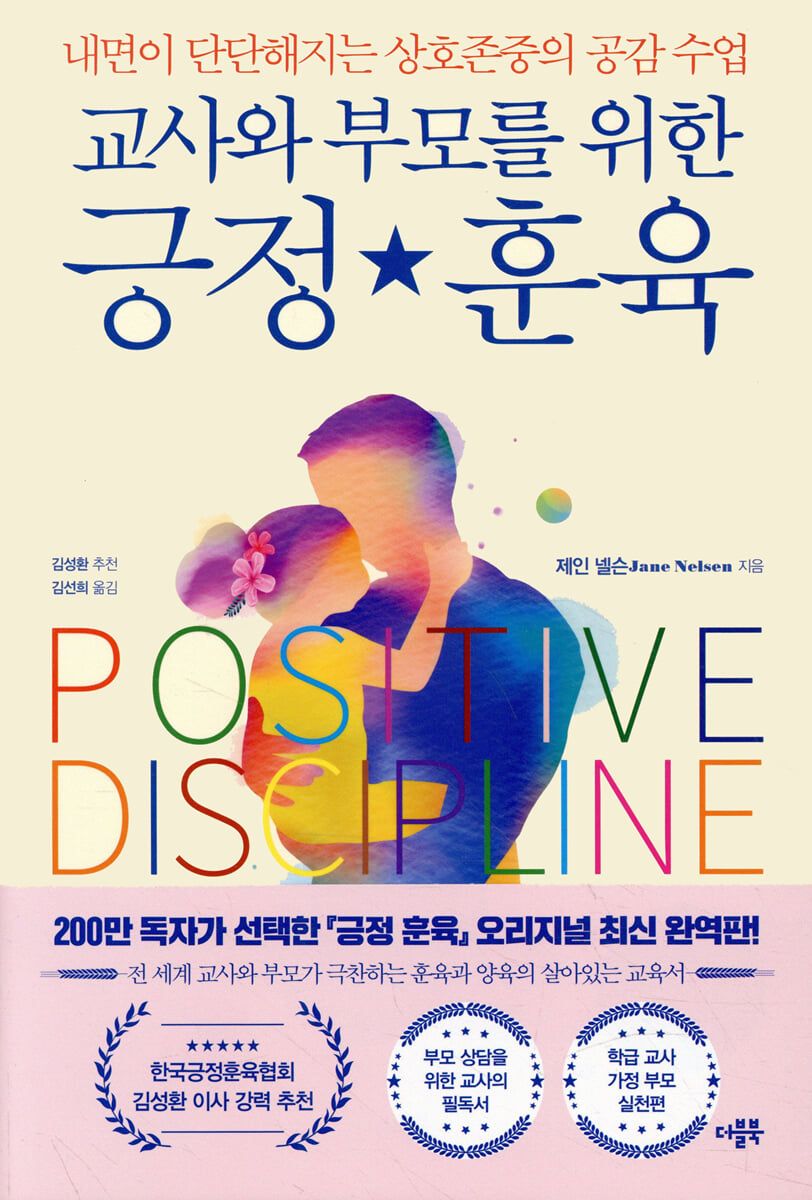
Positive Discipline for Teachers and Parents
 |
Description
Book Introduction
The latest complete translation of the original "Positive Discipline," chosen by 2 million readers!
Correcting the outdated disciplinary methods of teachers and parents
A classic parenting book that presents a new way of disciplinary approach to understanding children.
The latest complete edition of the internationally bestselling Positive Discipline series has been published.
Jane Nelson, the lead author, studied child development and education, worked as an elementary school counselor for 10 years, and lectured to universities, teachers, and parents for several decades.
'Positive discipline', which was introduced on [The Oprah Winfrey Show] and became a hot topic, is a new type of discipline method that corrects wrong behavior by respecting and encouraging children.
Rather than a short-term method of punishing children from the perspective of teachers and parents, it is a long-term method of teaching proper values based on mutual respect with the disciplinarian while understanding the child's position.
This new discipline method, which awakens the old ways of discipline, urges teachers and parents to act 'gently but firmly.'
The author emphasizes the "gentle yet firm" attitude, which is the most difficult for adults raising children, by providing examples from everyday life.
Additionally, Jane Nelson has listened to the diverse experiences of thousands of teachers and parents through workshops and lectures, and as an authority on 'positive discipline', she has worked to refine, update, and refine her theory.
"Positive Discipline for Teachers and Parents" is the result, and can be said to be the latest and most comprehensive edition that contains the most essential elements of "positive discipline."
The revised content has been enriched to reflect changes and diversification of perspectives, such as what results result from a change from a logical, result-oriented to a solution-oriented discipline method, and how the personalities of teachers and parents influence children.
In this book, you will find wise answers to the following parenting questions:
* How to bridge the communication gap
* How to avoid power struggles
* How to avoid the pitfalls of compliments
* How to convey a message of love
* How to focus on strengths rather than weaknesses
* How to make your child feel responsible without hurting his or her self-esteem
* How to teach 'how to think' instead of 'what to think'
* A 'mutually win-win cooperation' strategy at school and at home
* How to deal with the special challenge of teenage misbehavior
Correcting the outdated disciplinary methods of teachers and parents
A classic parenting book that presents a new way of disciplinary approach to understanding children.
The latest complete edition of the internationally bestselling Positive Discipline series has been published.
Jane Nelson, the lead author, studied child development and education, worked as an elementary school counselor for 10 years, and lectured to universities, teachers, and parents for several decades.
'Positive discipline', which was introduced on [The Oprah Winfrey Show] and became a hot topic, is a new type of discipline method that corrects wrong behavior by respecting and encouraging children.
Rather than a short-term method of punishing children from the perspective of teachers and parents, it is a long-term method of teaching proper values based on mutual respect with the disciplinarian while understanding the child's position.
This new discipline method, which awakens the old ways of discipline, urges teachers and parents to act 'gently but firmly.'
The author emphasizes the "gentle yet firm" attitude, which is the most difficult for adults raising children, by providing examples from everyday life.
Additionally, Jane Nelson has listened to the diverse experiences of thousands of teachers and parents through workshops and lectures, and as an authority on 'positive discipline', she has worked to refine, update, and refine her theory.
"Positive Discipline for Teachers and Parents" is the result, and can be said to be the latest and most comprehensive edition that contains the most essential elements of "positive discipline."
The revised content has been enriched to reflect changes and diversification of perspectives, such as what results result from a change from a logical, result-oriented to a solution-oriented discipline method, and how the personalities of teachers and parents influence children.
In this book, you will find wise answers to the following parenting questions:
* How to bridge the communication gap
* How to avoid power struggles
* How to avoid the pitfalls of compliments
* How to convey a message of love
* How to focus on strengths rather than weaknesses
* How to make your child feel responsible without hurting his or her self-esteem
* How to teach 'how to think' instead of 'what to think'
* A 'mutually win-win cooperation' strategy at school and at home
* How to deal with the special challenge of teenage misbehavior
- You can preview some of the book's contents.
Preview
index
Recommendation
introduction
Chapter 1: A New Approach to Discipline
Let's pay attention to what works / An approach that is neither controlling nor laissez-faire / Gentle yet firm / When parents are at odds / Helping children feel a sense of belonging and importance / Does it work in the long run? / Let's teach useful 'life skills' / The destination of positive discipline
Chapter 2: Some Basic Concepts to Know Before Practicing Positive Discipline
Misconceptions about self-esteem / Let children make their own choices / The hidden emotions behind words and actions / Basic concepts of Adlerian school
Chapter 3: To Understand Children, You Must Understand the Characteristics of Birth Order
Firstborn / Youngest / Secondborn / Only Child / Exceptional Circumstances / Another Exceptional Factor: Family Atmosphere / Encouraging Children Based on Birth Order / The Relationship Between Birth Order and Marriage / Educational Methods Based on Birth Order / Small Group Activities
Chapter 4: A New Perspective on Wrongdoing
Responsibility is not the same as blame or shame / What is wrong behavior? / Useful clues to identify wrong beliefs and goals / Effective ways to encourage wrong goals / Identifying hidden intentions / Degrees of discouragement / When dealing with teenagers
Chapter 5: Understanding Logical Consequences
Natural Consequences / Decide What You Will Do / Logical Consequences / Change of Direction / Logical Consequences and the False Goal of Action / A Change in Attitude Is Needed / Involve Kids in Advance
Chapter 6: Let's focus on solutions
Positive Timeout / Loving Questions
Chapter 7: Encouragement, Not Praise, Changes Children
Timing / Respect each other / Don't expect perfection, but rather want to improve / Let's use strengths as a stepping stone, not weaknesses / Change the direction of wrong behavior / Give opportunities to make up for it / Don't be conscious of what others think / Spend special time with your child / Encouragement vs. praise / Encouragement vs. criticism / Encourage self-evaluation / Have training time / Schedule / Teach that mistakes are wonderful learning opportunities / Ask loving questions / Give hugs / Think about your child's perspective
Chapter 8: How to Lead Successful Class Meetings for Teachers
Attitudes and guidelines for successful class meetings / Some goals of class meetings / Specific methods of class meetings / Teacher attitudes and skills / General questions / Other suggestions
Chapter 9: How to Lead a Successful Family Meeting for Parents
Six Differences Between Family and Class Meetings / What You Need for a Family Meeting / Some Tricky Issues / Let's Liven Up Your Family Meetings
Chapter 10 How does an adult's personality affect a child?
What are your priorities in life? / Understanding your fundamental motivations / Your blueprint for life / Discovering your secondary priorities / Life priorities and parenting and education styles / Conflicts between life priorities
Chapter 11: Choosing the Right Method for Your Child
Using the bathroom / Using a novel / Positive time-out / Decide what to do instead of letting your child do it / Stepping back emotionally / Avoiding morning chaos / Schedules / Avoiding bedtime chaos / Enjoying a wonderful bedtime together / Avoiding mealtime chaos / Involving the kids / Don't get involved in kids' fights / Nonverbal cues / Choices / 'Right away' / Allowance
Chapter 12: Discipline that Teach Love and Joy Rather than Perfection
Three important signals / See the positive side of every situation / Trust your child first / Express unconditional love / Four steps to a win-win cooperative strategy / Teach and model communication and problem-solving skills / Help children develop responsibility / Take responsibility for yourself to the end / Give yourself space / Learn and practice
introduction
Chapter 1: A New Approach to Discipline
Let's pay attention to what works / An approach that is neither controlling nor laissez-faire / Gentle yet firm / When parents are at odds / Helping children feel a sense of belonging and importance / Does it work in the long run? / Let's teach useful 'life skills' / The destination of positive discipline
Chapter 2: Some Basic Concepts to Know Before Practicing Positive Discipline
Misconceptions about self-esteem / Let children make their own choices / The hidden emotions behind words and actions / Basic concepts of Adlerian school
Chapter 3: To Understand Children, You Must Understand the Characteristics of Birth Order
Firstborn / Youngest / Secondborn / Only Child / Exceptional Circumstances / Another Exceptional Factor: Family Atmosphere / Encouraging Children Based on Birth Order / The Relationship Between Birth Order and Marriage / Educational Methods Based on Birth Order / Small Group Activities
Chapter 4: A New Perspective on Wrongdoing
Responsibility is not the same as blame or shame / What is wrong behavior? / Useful clues to identify wrong beliefs and goals / Effective ways to encourage wrong goals / Identifying hidden intentions / Degrees of discouragement / When dealing with teenagers
Chapter 5: Understanding Logical Consequences
Natural Consequences / Decide What You Will Do / Logical Consequences / Change of Direction / Logical Consequences and the False Goal of Action / A Change in Attitude Is Needed / Involve Kids in Advance
Chapter 6: Let's focus on solutions
Positive Timeout / Loving Questions
Chapter 7: Encouragement, Not Praise, Changes Children
Timing / Respect each other / Don't expect perfection, but rather want to improve / Let's use strengths as a stepping stone, not weaknesses / Change the direction of wrong behavior / Give opportunities to make up for it / Don't be conscious of what others think / Spend special time with your child / Encouragement vs. praise / Encouragement vs. criticism / Encourage self-evaluation / Have training time / Schedule / Teach that mistakes are wonderful learning opportunities / Ask loving questions / Give hugs / Think about your child's perspective
Chapter 8: How to Lead Successful Class Meetings for Teachers
Attitudes and guidelines for successful class meetings / Some goals of class meetings / Specific methods of class meetings / Teacher attitudes and skills / General questions / Other suggestions
Chapter 9: How to Lead a Successful Family Meeting for Parents
Six Differences Between Family and Class Meetings / What You Need for a Family Meeting / Some Tricky Issues / Let's Liven Up Your Family Meetings
Chapter 10 How does an adult's personality affect a child?
What are your priorities in life? / Understanding your fundamental motivations / Your blueprint for life / Discovering your secondary priorities / Life priorities and parenting and education styles / Conflicts between life priorities
Chapter 11: Choosing the Right Method for Your Child
Using the bathroom / Using a novel / Positive time-out / Decide what to do instead of letting your child do it / Stepping back emotionally / Avoiding morning chaos / Schedules / Avoiding bedtime chaos / Enjoying a wonderful bedtime together / Avoiding mealtime chaos / Involving the kids / Don't get involved in kids' fights / Nonverbal cues / Choices / 'Right away' / Allowance
Chapter 12: Discipline that Teach Love and Joy Rather than Perfection
Three important signals / See the positive side of every situation / Trust your child first / Express unconditional love / Four steps to a win-win cooperative strategy / Teach and model communication and problem-solving skills / Help children develop responsibility / Take responsibility for yourself to the end / Give yourself space / Learn and practice
Detailed image

Into the book
Where on earth did this foolish notion come from that you have to first hurt a child's feelings in order to properly educate them? (Omitted) While teachers and parents who don't particularly favor either excessive control or laissez-faire, but don't know what else to do, may find themselves confused, tossed back and forth between these two ineffective alternatives.
He uses excessive control methods and eventually cannot stand being called a tyrant.
Then, it immediately changes to a laissez-faire attitude.
Then, eventually, I couldn't stand the sullen and whiny child any longer.
So we go back to over-control.
(Omitted) Many teachers and parents believe that if they give up excessive control and strictness, the only alternative is laissez-faire.
This is why it is important how we define discipline.
The word discipline is often misused.
Many people think of discipline as being the same as punishment.
--- p.35
Rudolf Drakes showed us how important it is to be gentle yet firm in our relationships with children.
A gentle attitude is important to show consideration for your child.
A firm stance is important to demonstrate respect for ourselves and the needs of the situation.
Authoritarian methods lack gentleness.
A laissez-faire attitude is not decisive.
Gentleness and firmness are key elements in positive discipline.
--- p.38
A child who misbehaves is trying to tell us:
'I don't feel like I belong.
I don't feel like I'm important.
But I'm not sure how to achieve that.' When most adults are frustrated by a child's misbehavior, don't they understand the true intention and message behind it, not the misbehavior itself: "I just want to belong." Understanding this concept is the first step to more effectively helping a child who misbehaves.
You have to become a 'codebreaker'.
When your child misbehaves, think of that behavior as a code and ask yourself:
'What does this child really want to say to me?'
--- p.65
Again, we must pay attention to what works.
And the long-term effects must be considered.
If adults think it's important to beat children, they will make them losers in life.
Most parents get frustrated when they think about the long-term effects of punishment.
It was never the parents' intention to instill in their children the idea that they were useless or to create an environment that fostered rebellion.
I was convinced that punishing children would motivate them to do better in the future and become better people.
So, for many parents, the idea of long-term effects is completely foreign.
However, this method has significant long-term benefits in helping children develop a sense of their own abilities and learn meaningful social and life skills.
--- p.153
The idea of children doing something fun during time-out can be met with resistance from many teachers and parents.
They believe that letting their children play with toys, read books, relax, or listen to music is only encouraging their misbehavior.
These adults believe that children need to be punished (and made to feel bad) so they can do better in the future.
They fail to fully grasp the fact that feeling good is essential for them to do better in the future.
--- p.195
Drakes emphasized 'encouragement'.
And I thought that encouragement was the most important skill to lead children.
(Omitted) It is difficult for adults to encourage children because they react reflexively when they see wrong behavior.
Because we react negatively to the messages behind misbehavior and do not motivate children to do better.
Another reason why encouragement is difficult is that so many adults are obsessed with the idea that punishment is the best way to improve behavior.
Most teachers and parents who believe that punishment is effective do not consider the long-term negative effects of punishment.
Even people who have thought about the long-term effects of punishment and who know that punishment is bad still fall into this error.
He uses excessive control methods and eventually cannot stand being called a tyrant.
Then, it immediately changes to a laissez-faire attitude.
Then, eventually, I couldn't stand the sullen and whiny child any longer.
So we go back to over-control.
(Omitted) Many teachers and parents believe that if they give up excessive control and strictness, the only alternative is laissez-faire.
This is why it is important how we define discipline.
The word discipline is often misused.
Many people think of discipline as being the same as punishment.
--- p.35
Rudolf Drakes showed us how important it is to be gentle yet firm in our relationships with children.
A gentle attitude is important to show consideration for your child.
A firm stance is important to demonstrate respect for ourselves and the needs of the situation.
Authoritarian methods lack gentleness.
A laissez-faire attitude is not decisive.
Gentleness and firmness are key elements in positive discipline.
--- p.38
A child who misbehaves is trying to tell us:
'I don't feel like I belong.
I don't feel like I'm important.
But I'm not sure how to achieve that.' When most adults are frustrated by a child's misbehavior, don't they understand the true intention and message behind it, not the misbehavior itself: "I just want to belong." Understanding this concept is the first step to more effectively helping a child who misbehaves.
You have to become a 'codebreaker'.
When your child misbehaves, think of that behavior as a code and ask yourself:
'What does this child really want to say to me?'
--- p.65
Again, we must pay attention to what works.
And the long-term effects must be considered.
If adults think it's important to beat children, they will make them losers in life.
Most parents get frustrated when they think about the long-term effects of punishment.
It was never the parents' intention to instill in their children the idea that they were useless or to create an environment that fostered rebellion.
I was convinced that punishing children would motivate them to do better in the future and become better people.
So, for many parents, the idea of long-term effects is completely foreign.
However, this method has significant long-term benefits in helping children develop a sense of their own abilities and learn meaningful social and life skills.
--- p.153
The idea of children doing something fun during time-out can be met with resistance from many teachers and parents.
They believe that letting their children play with toys, read books, relax, or listen to music is only encouraging their misbehavior.
These adults believe that children need to be punished (and made to feel bad) so they can do better in the future.
They fail to fully grasp the fact that feeling good is essential for them to do better in the future.
--- p.195
Drakes emphasized 'encouragement'.
And I thought that encouragement was the most important skill to lead children.
(Omitted) It is difficult for adults to encourage children because they react reflexively when they see wrong behavior.
Because we react negatively to the messages behind misbehavior and do not motivate children to do better.
Another reason why encouragement is difficult is that so many adults are obsessed with the idea that punishment is the best way to improve behavior.
Most teachers and parents who believe that punishment is effective do not consider the long-term negative effects of punishment.
Even people who have thought about the long-term effects of punishment and who know that punishment is bad still fall into this error.
--- p.208
Publisher's Review
While hurting the child's feelings
Teaching is wrong discipline!
Many teachers and parents misunderstand discipline as synonymous with punishment.
I believe that children can learn properly only if they are scolded harshly, and if there is no change in their misbehavior despite this, it is because the punishment was not severe enough.
Jane Nelson is often said to criticize with these words:
“Where on earth did this foolish idea come from that you have to hurt a child’s feelings first in order to teach him the right way?”
The principle consistently emphasized in various books and lectures introducing 'positive discipline' is expressed in this one sentence.
When discipline is understood as a form of punishment, it may have immediate effects, but it can also lead to the child internalizing wrong responses such as retaliation and defiance.
Ultimately, excessive control and strictness are not the right discipline.
But the problem arises again when most teachers and parents believe that the only alternative to strictness is irresponsible laissez-faire.
Positive discipline is a new educational approach that requires neither punishment nor laissez-faire.
The key is to respect and encourage the child.
It is based on the theory and case studies that children will act responsibly when this environment is created, changing from an external to an internal approach.
That is why it is called 'positive' discipline, and it can be said to be a long-term and effective method because it allows children to acquire a healthy self-concept and attitude necessary for living in the world.
In this way, 'positive discipline' guided by Jane Nelson will open the eyes of readers who are stuck in the old method of punishment and neglect to a new perspective.
When disciplining a child
Gentle yet firm!
Following misconceptions about discipline, the concept that adults find most difficult is the "gentle yet firm" attitude.
This is closely related to the method of discipline described above.
Punitive discipline lacks gentleness, and laissez-faire discipline lacks firmness.
Just as positive discipline offers a new perspective on discipline that is not based on punishment or neglect, the attitude of implementing discipline methods is also a key element of being 'gentle yet firm' and not biased to one side.
The reason many teachers and parents find this attitude difficult to maintain is because they don't know how to respond differently when they are upset by their child's misbehavior.
To educate children, adults must first set an example of self-restraint. However, this is difficult for children who have never experienced it before, and they end up adopting a strict, controlled attitude that is familiar and produces quick results.
But this method can never solve the problem.
A gentle yet firm attitude is not only considerate of the child, but also considerate of the teachers and parents who are disciplining them.
This is because adults must also show a mature attitude in order to fulfill their roles as respected beings.
Handling fleeting emotions isn't easy, so even adults need time to practice.
In "Positive Discipline for Teachers and Parents," each conversation is carefully explained and explained to help children understand how to discipline their children in a gentle yet firm manner.
It also suggests various examples of how to use words that show consideration and respect for a child.
We've also introduced a variety of devices that won't cause a power struggle or worsen relationships, so let's learn how to apply them in conflict situations and practice them.
Children perform better when they feel good!
Understand the hidden meaning behind wrong behavior and the child's characteristics.
After introducing a new perspective and principles for attitudes toward discipline, Jane Nelson introduces various factors that contribute to understanding children.
It is said that children are better disciplined when they feel understood and happy than when they feel hurt by strict discipline.
Based on these premises, we need to properly understand children.
Chapter 3 describes the characteristics of children according to birth order.
It introduces situations where variables can change depending on the environment, along with universal characteristics such as the eldest being responsible and conservative, and the youngest trying to manipulate others to do what he wants.
Chapter 4 emphasizes that when a child misbehaves, we should not only look at the behavior itself, but also read the hidden message behind it, and explains some of the patterns and signals that go along with this.
Children want to feel a sense of belonging and importance from their teachers and parents, but when this is not met, they express it in the wrong way.
Once you understand the causes of behavior and how it manifests, dealing with and disciplining conflicts with your child will become easier.
The following chapters focus more on the methodological aspects of discipline.
First, we describe an approach that focuses on solutions rather than logical consequences for a child's behavior.
The author, who had previously proposed a logical conclusion, has revised the content to change the perspective from a more child-oriented perspective.
By examining the pros and cons and differences of each, you can broaden your perspective on discipline.
And as a way to show consideration and respect that I have been mentioning continuously, I emphasize encouraging the child rather than praising him.
This is a task that continuously confirms the child's belief in his or her potential by highlighting his or her strengths rather than his or her weaknesses and reminding him or her that mistakes can be overcome.
There is a lot of detailed and friendly know-how, so read it carefully and put it into practice.
In addition, it introduces the principles and types of meetings that teachers can implement in the classroom and parents can implement at home.
The book includes examples of how to smoothly resolve conflict situations and communicate within established rules.
And Chapter 10 deals with how an adult's personality influences a child.
The stimulation that teachers and parents give to children varies depending on whether they prioritize comfort, control, the gaze of others, or superiority in life.
This is a very characteristic part of positive discipline based on mutual respect.
This is because it allows us to examine the cause of the problem from various angles by identifying differences not only between the child who is the subject of discipline, but also between the teacher and parents who interact with each other, and between couples.
This book provides a friendly explanation of the theory and methods of positive discipline over a total of 12 chapters.
At the end of each chapter, we provide a summary of the key points covered in that chapter, along with questions to help you recall the content.
Because it requires adult training and practice more than any parenting book.
As the author emphasizes at the end of the book, the more you read "Positive Discipline for Teachers and Parents" after reading it through, the easier it will be to grasp the concepts and internalize them.
If you want to discipline effectively and effectively in the long term, and if you want to build a strong, mutually respectful relationship with your child, 'positive discipline' is essential.
Teaching is wrong discipline!
Many teachers and parents misunderstand discipline as synonymous with punishment.
I believe that children can learn properly only if they are scolded harshly, and if there is no change in their misbehavior despite this, it is because the punishment was not severe enough.
Jane Nelson is often said to criticize with these words:
“Where on earth did this foolish idea come from that you have to hurt a child’s feelings first in order to teach him the right way?”
The principle consistently emphasized in various books and lectures introducing 'positive discipline' is expressed in this one sentence.
When discipline is understood as a form of punishment, it may have immediate effects, but it can also lead to the child internalizing wrong responses such as retaliation and defiance.
Ultimately, excessive control and strictness are not the right discipline.
But the problem arises again when most teachers and parents believe that the only alternative to strictness is irresponsible laissez-faire.
Positive discipline is a new educational approach that requires neither punishment nor laissez-faire.
The key is to respect and encourage the child.
It is based on the theory and case studies that children will act responsibly when this environment is created, changing from an external to an internal approach.
That is why it is called 'positive' discipline, and it can be said to be a long-term and effective method because it allows children to acquire a healthy self-concept and attitude necessary for living in the world.
In this way, 'positive discipline' guided by Jane Nelson will open the eyes of readers who are stuck in the old method of punishment and neglect to a new perspective.
When disciplining a child
Gentle yet firm!
Following misconceptions about discipline, the concept that adults find most difficult is the "gentle yet firm" attitude.
This is closely related to the method of discipline described above.
Punitive discipline lacks gentleness, and laissez-faire discipline lacks firmness.
Just as positive discipline offers a new perspective on discipline that is not based on punishment or neglect, the attitude of implementing discipline methods is also a key element of being 'gentle yet firm' and not biased to one side.
The reason many teachers and parents find this attitude difficult to maintain is because they don't know how to respond differently when they are upset by their child's misbehavior.
To educate children, adults must first set an example of self-restraint. However, this is difficult for children who have never experienced it before, and they end up adopting a strict, controlled attitude that is familiar and produces quick results.
But this method can never solve the problem.
A gentle yet firm attitude is not only considerate of the child, but also considerate of the teachers and parents who are disciplining them.
This is because adults must also show a mature attitude in order to fulfill their roles as respected beings.
Handling fleeting emotions isn't easy, so even adults need time to practice.
In "Positive Discipline for Teachers and Parents," each conversation is carefully explained and explained to help children understand how to discipline their children in a gentle yet firm manner.
It also suggests various examples of how to use words that show consideration and respect for a child.
We've also introduced a variety of devices that won't cause a power struggle or worsen relationships, so let's learn how to apply them in conflict situations and practice them.
Children perform better when they feel good!
Understand the hidden meaning behind wrong behavior and the child's characteristics.
After introducing a new perspective and principles for attitudes toward discipline, Jane Nelson introduces various factors that contribute to understanding children.
It is said that children are better disciplined when they feel understood and happy than when they feel hurt by strict discipline.
Based on these premises, we need to properly understand children.
Chapter 3 describes the characteristics of children according to birth order.
It introduces situations where variables can change depending on the environment, along with universal characteristics such as the eldest being responsible and conservative, and the youngest trying to manipulate others to do what he wants.
Chapter 4 emphasizes that when a child misbehaves, we should not only look at the behavior itself, but also read the hidden message behind it, and explains some of the patterns and signals that go along with this.
Children want to feel a sense of belonging and importance from their teachers and parents, but when this is not met, they express it in the wrong way.
Once you understand the causes of behavior and how it manifests, dealing with and disciplining conflicts with your child will become easier.
The following chapters focus more on the methodological aspects of discipline.
First, we describe an approach that focuses on solutions rather than logical consequences for a child's behavior.
The author, who had previously proposed a logical conclusion, has revised the content to change the perspective from a more child-oriented perspective.
By examining the pros and cons and differences of each, you can broaden your perspective on discipline.
And as a way to show consideration and respect that I have been mentioning continuously, I emphasize encouraging the child rather than praising him.
This is a task that continuously confirms the child's belief in his or her potential by highlighting his or her strengths rather than his or her weaknesses and reminding him or her that mistakes can be overcome.
There is a lot of detailed and friendly know-how, so read it carefully and put it into practice.
In addition, it introduces the principles and types of meetings that teachers can implement in the classroom and parents can implement at home.
The book includes examples of how to smoothly resolve conflict situations and communicate within established rules.
And Chapter 10 deals with how an adult's personality influences a child.
The stimulation that teachers and parents give to children varies depending on whether they prioritize comfort, control, the gaze of others, or superiority in life.
This is a very characteristic part of positive discipline based on mutual respect.
This is because it allows us to examine the cause of the problem from various angles by identifying differences not only between the child who is the subject of discipline, but also between the teacher and parents who interact with each other, and between couples.
This book provides a friendly explanation of the theory and methods of positive discipline over a total of 12 chapters.
At the end of each chapter, we provide a summary of the key points covered in that chapter, along with questions to help you recall the content.
Because it requires adult training and practice more than any parenting book.
As the author emphasizes at the end of the book, the more you read "Positive Discipline for Teachers and Parents" after reading it through, the easier it will be to grasp the concepts and internalize them.
If you want to discipline effectively and effectively in the long term, and if you want to build a strong, mutually respectful relationship with your child, 'positive discipline' is essential.
GOODS SPECIFICS
- Date of issue: September 5, 2022
- Page count, weight, size: 420 pages | 648g | 152*225*26mm
- ISBN13: 9791191194647
- ISBN10: 1191194647
You may also like
카테고리
korean


korean

![GQ KOREA Mark (Monthly): December [2025]](http://librairie.coreenne.fr/cdn/shop/files/8ef265dbbfbf186523ed75ba7319009d.jpg?v=1765340328&width=3840)


