

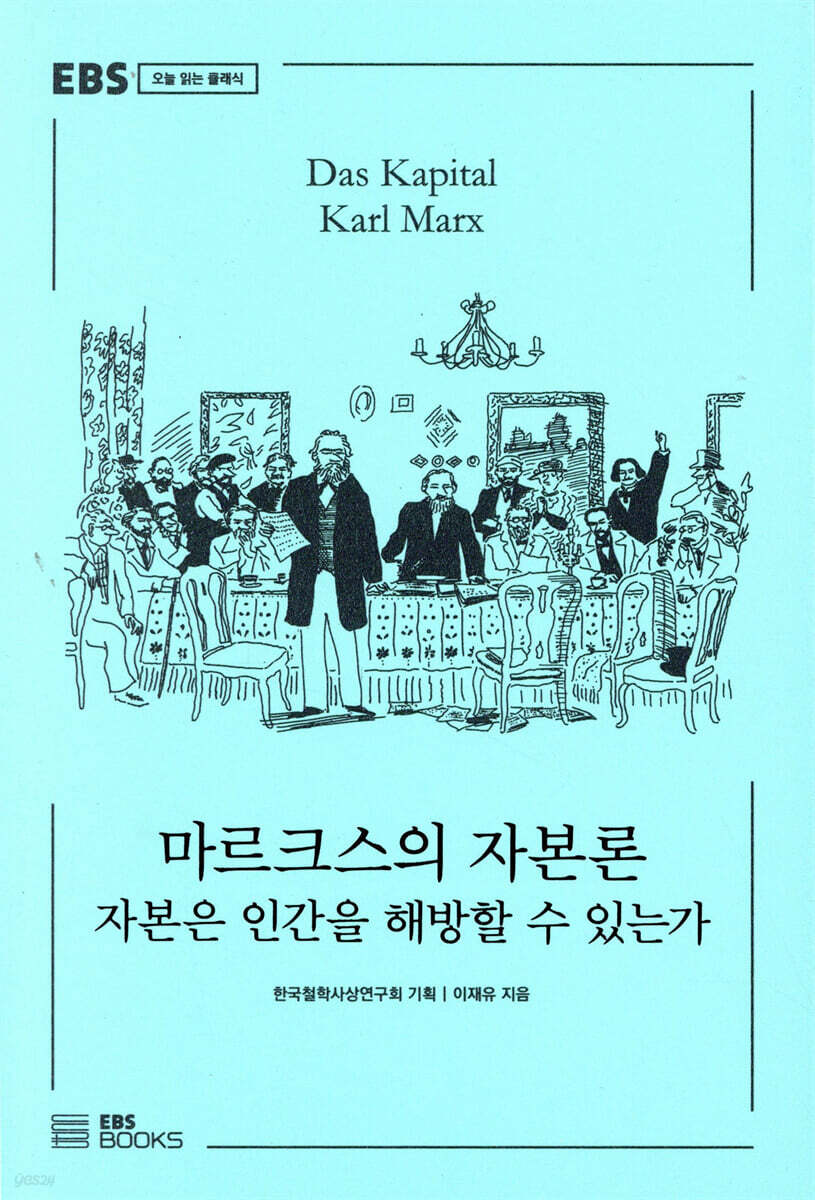
Marx's Das Kapital
 |
Description
Book Introduction
Great Books of Thought of the 20th Century
Journeying through the forest called "Das Kapital"
The capitalist system today has gone through great turmoil.
How have we lived through this turmoil? And how should we live going forward? Karl Marx's "Das Kapital" provides the answer.
This book is a friendly introduction to 『Capital』 and Marx's thought by philosopher Lee Jae-yu, who studies and teaches in fields such as Marx's thought, feminism, and education.
『Capital』 was published in three volumes in Germany, and is a five-volume work based on the domestic translation (translated by Kim Su-haeng, published by Bibong Publishing).
Although it took considerable effort to summarize only the essence of this vast intellectual heritage, the author has addressed the issue and provided in-depth commentary.
Also, before delving into the classics of 『Das Kapital』 in earnest, I added information about Marx's life and key concepts.
By doing so, the author seeks to provide readers with a philosophical milestone on why Marx's 『Das Kapital』 should be read in the 21st century. He explains that this is the power to produce a 'humane' life and a 'new' self from the 'old' self.
Marx's 『Capital』 is an unfinished work.
Capital ends with a section titled “Class,” but it does not provide a clear definition of class.
In this respect, the author raises the question of how Marx, according to his practical, revolutionary materialist worldview, would have defined the 'working class' beyond wage workers, and how he would have defined class consciousness.
It asks how one can have class consciousness as a subject of revolution and thus become a class.
So how can the new world Marx speaks of—a society in which "free individuals are in solidarity with one another"—be possible? The author guides us through "Capital" to find the starting point for this.
Journeying through the forest called "Das Kapital"
The capitalist system today has gone through great turmoil.
How have we lived through this turmoil? And how should we live going forward? Karl Marx's "Das Kapital" provides the answer.
This book is a friendly introduction to 『Capital』 and Marx's thought by philosopher Lee Jae-yu, who studies and teaches in fields such as Marx's thought, feminism, and education.
『Capital』 was published in three volumes in Germany, and is a five-volume work based on the domestic translation (translated by Kim Su-haeng, published by Bibong Publishing).
Although it took considerable effort to summarize only the essence of this vast intellectual heritage, the author has addressed the issue and provided in-depth commentary.
Also, before delving into the classics of 『Das Kapital』 in earnest, I added information about Marx's life and key concepts.
By doing so, the author seeks to provide readers with a philosophical milestone on why Marx's 『Das Kapital』 should be read in the 21st century. He explains that this is the power to produce a 'humane' life and a 'new' self from the 'old' self.
Marx's 『Capital』 is an unfinished work.
Capital ends with a section titled “Class,” but it does not provide a clear definition of class.
In this respect, the author raises the question of how Marx, according to his practical, revolutionary materialist worldview, would have defined the 'working class' beyond wage workers, and how he would have defined class consciousness.
It asks how one can have class consciousness as a subject of revolution and thus become a class.
So how can the new world Marx speaks of—a society in which "free individuals are in solidarity with one another"—be possible? The author guides us through "Capital" to find the starting point for this.
- You can preview some of the book's contents.
Preview
index
introduction
Chapter 1: Karl Marx, the Practical Materialist
What is my philosophical worldview?
Practical materialist, communist, revolutionary
Marx's Science: Science as Higher Materialism
The Core of Marx's Materialism and Dialectics: A Practice Aiming at the Otherness of the Other
The Source of Practical Action: Self-Awareness
Chapter 2: Reading Capital
What does the forest called "Das Kapital" look like as a whole?
How were commodities and money, the building blocks of the capitalist economic system, formed?
How Money Transforms into Capital
How does capital grow in size?
Understanding the capital circulation process: the key is totality.
Understanding the Total Process of Capitalist Production: A Dialectical and Scientific Understanding
Chapter 3: Milestones of Philosophy
Marx and Engels, The German Ideology
Adam Smith, The Wealth of Nations
Ludwig von Feuerbach, The Essence of Christianity
Georg Wilhelm Friedrich Hegel, Phenomenology of Spirit
Friedrich Engels, Dialectics of Nature
Vladimir Lenin, Philosophical Notes
Life chronology
References
Chapter 1: Karl Marx, the Practical Materialist
What is my philosophical worldview?
Practical materialist, communist, revolutionary
Marx's Science: Science as Higher Materialism
The Core of Marx's Materialism and Dialectics: A Practice Aiming at the Otherness of the Other
The Source of Practical Action: Self-Awareness
Chapter 2: Reading Capital
What does the forest called "Das Kapital" look like as a whole?
How were commodities and money, the building blocks of the capitalist economic system, formed?
How Money Transforms into Capital
How does capital grow in size?
Understanding the capital circulation process: the key is totality.
Understanding the Total Process of Capitalist Production: A Dialectical and Scientific Understanding
Chapter 3: Milestones of Philosophy
Marx and Engels, The German Ideology
Adam Smith, The Wealth of Nations
Ludwig von Feuerbach, The Essence of Christianity
Georg Wilhelm Friedrich Hegel, Phenomenology of Spirit
Friedrich Engels, Dialectics of Nature
Vladimir Lenin, Philosophical Notes
Life chronology
References
Into the book
The 'new self' that we must create and produce in the future is not the 'me' that is in a hellish relationship with others that we must constantly fight against.
It is the 'me' that can feel and be conscious of its own infinite 'power' to create a new self, not hell, by breaking free from this hellish relationship and 'freely connecting' with anyone.
The starting point for producing a ‘new self’ is doubt (scientific analysis) about one’s current self.
Marx's Das Kapital is a detailed travel guide to its origins.
---From the "Preface"
Self-consciousness (or self-consciousness) is the most important fundamental concept in modern Western philosophy.
From self-consciousness arise the concepts of subject, freedom, and free will.
Self-consciousness means becoming aware of oneself by looking into the contents related to one's own relationships, such as relationships with nature and relationships with other people (social relationships), through critical and fundamental insight into 'why' and 'how'.
Self-consciousness can be said to be the starting point of the practical activity (praxis) that seeks to create (produce) oneself anew, but this cannot be achieved within the relationship itself, but rather outside of the relationship itself.
This self-consciousness is closely connected to Marx's 'class consciousness' and 'the freely associating individual'.
---From "Chapter 1: Karl Marx, the Practical Materialist"
Marx's 『Capital』 is an unfinished work.
However, it is an unfinished work that contains the worldview of ‘practical’ and ‘revolutionary’ materialism.
Capital ends with a section titled “Class,” but it does not provide a clear definition of class.
However, in light of Marx's materialism, Marx would not have defined the 'wage workers' themselves, who are in opposition to the capitalists, as the class that is the subject of the revolution.
Because the wage worker is in a position opposite to the capitalist, who personifies the 'ideological' nature of capital as a 'god'.
That is because the 'materialistic' characteristics related to the 'material' aspect of capital are in a personified position (relative value form).
---From "Chapter 1: Karl Marx, the Practical Materialist"
Marx's 『Das Kapital』 became a symbol of 'scientific communism (socialism)'.
Marx's communism (socialism) was called 'scientific' communism (socialism) to distinguish it from other communisms (socialisms) (which Marx criticized as 'utopian' communism).
By what criteria did Marx distinguish between "utopian" and "scientific"? According to the dictionary definition, "utopian" means "vaguely imagining something that is completely unrealistic or has no hope of being realized."
However, for Marx, the word scientific is not simply the opposite of the word utopian, but rather has a 'transcendental' status that surpasses this word.
---From "Chapter 1: Karl Marx, the Practical Materialist"
Yet, based on an empirical worldview, “from the field of simple commodity circulation or commodity exchange, vulgar free traders derive their views, concepts, and criteria for judgment on a society based on capital and wage labor.”
“The field of distribution or commodity exchange, where labor power is bought and sold, is in fact a true paradise of innate rights of man.
What rules here is only liberty, equality, property, and Benthamism.
Freedom! Because buyers and sellers of a commodity, such as labor power, act solely of their own free will.
They enter into contracts as free persons, legally equal.
A contract is the final result of their common will finding a common legal expression.
Equality! Because they relate to each other only as commodity owners, exchanging equivalent for equivalent.
Ownership! Because each person has the right to dispose of only what is his own.
Bentham! Because each man looks only to his own advantage.”
---From "Chapter 2: Reading Capital"
Marx's 『Capital』 is not an economics book that 'observantly' interprets how the laws of capital operate like natural laws, but a 'scientific' book that embodies Marx's 'practical' materialism.
In other words, it can be said to be a representative work that 'scientifically' presents how capital obstructs human liberation and how the working class can overcome this obstacle.
And there is a method used to reveal the 'scientific nature' of materialism, which is dialectics as a 'method of rising from the abstract to the concrete.'
Thus, it can be said that 『Capital』 is a science in which materialism and dialectics are synthesized and unified.
---From "Chapter 2: Reading Capital"
One axis of Marx's critical succession to existing materialism is Adam Smith's The Wealth of Nations (1776).
The economic theory of 『The Wealth of Nations』 is imbued with the philosophical worldview and humanistic view that form the basis of that theory.
An Inquiry into the Nature and Causes of the Wealth of Nations, also known as The Wealth of Nations, is Adam Smith's major work, published on March 9, 1776, during the Age of Enlightenment.
This book explains what creates the wealth of a nation and is considered a foundational work in classical economics today.
This book reflects the economy at the dawn of the Industrial Revolution and covers a wide range of topics, including division of labor, productivity, and free markets.
It is the 'me' that can feel and be conscious of its own infinite 'power' to create a new self, not hell, by breaking free from this hellish relationship and 'freely connecting' with anyone.
The starting point for producing a ‘new self’ is doubt (scientific analysis) about one’s current self.
Marx's Das Kapital is a detailed travel guide to its origins.
---From the "Preface"
Self-consciousness (or self-consciousness) is the most important fundamental concept in modern Western philosophy.
From self-consciousness arise the concepts of subject, freedom, and free will.
Self-consciousness means becoming aware of oneself by looking into the contents related to one's own relationships, such as relationships with nature and relationships with other people (social relationships), through critical and fundamental insight into 'why' and 'how'.
Self-consciousness can be said to be the starting point of the practical activity (praxis) that seeks to create (produce) oneself anew, but this cannot be achieved within the relationship itself, but rather outside of the relationship itself.
This self-consciousness is closely connected to Marx's 'class consciousness' and 'the freely associating individual'.
---From "Chapter 1: Karl Marx, the Practical Materialist"
Marx's 『Capital』 is an unfinished work.
However, it is an unfinished work that contains the worldview of ‘practical’ and ‘revolutionary’ materialism.
Capital ends with a section titled “Class,” but it does not provide a clear definition of class.
However, in light of Marx's materialism, Marx would not have defined the 'wage workers' themselves, who are in opposition to the capitalists, as the class that is the subject of the revolution.
Because the wage worker is in a position opposite to the capitalist, who personifies the 'ideological' nature of capital as a 'god'.
That is because the 'materialistic' characteristics related to the 'material' aspect of capital are in a personified position (relative value form).
---From "Chapter 1: Karl Marx, the Practical Materialist"
Marx's 『Das Kapital』 became a symbol of 'scientific communism (socialism)'.
Marx's communism (socialism) was called 'scientific' communism (socialism) to distinguish it from other communisms (socialisms) (which Marx criticized as 'utopian' communism).
By what criteria did Marx distinguish between "utopian" and "scientific"? According to the dictionary definition, "utopian" means "vaguely imagining something that is completely unrealistic or has no hope of being realized."
However, for Marx, the word scientific is not simply the opposite of the word utopian, but rather has a 'transcendental' status that surpasses this word.
---From "Chapter 1: Karl Marx, the Practical Materialist"
Yet, based on an empirical worldview, “from the field of simple commodity circulation or commodity exchange, vulgar free traders derive their views, concepts, and criteria for judgment on a society based on capital and wage labor.”
“The field of distribution or commodity exchange, where labor power is bought and sold, is in fact a true paradise of innate rights of man.
What rules here is only liberty, equality, property, and Benthamism.
Freedom! Because buyers and sellers of a commodity, such as labor power, act solely of their own free will.
They enter into contracts as free persons, legally equal.
A contract is the final result of their common will finding a common legal expression.
Equality! Because they relate to each other only as commodity owners, exchanging equivalent for equivalent.
Ownership! Because each person has the right to dispose of only what is his own.
Bentham! Because each man looks only to his own advantage.”
---From "Chapter 2: Reading Capital"
Marx's 『Capital』 is not an economics book that 'observantly' interprets how the laws of capital operate like natural laws, but a 'scientific' book that embodies Marx's 'practical' materialism.
In other words, it can be said to be a representative work that 'scientifically' presents how capital obstructs human liberation and how the working class can overcome this obstacle.
And there is a method used to reveal the 'scientific nature' of materialism, which is dialectics as a 'method of rising from the abstract to the concrete.'
Thus, it can be said that 『Capital』 is a science in which materialism and dialectics are synthesized and unified.
---From "Chapter 2: Reading Capital"
One axis of Marx's critical succession to existing materialism is Adam Smith's The Wealth of Nations (1776).
The economic theory of 『The Wealth of Nations』 is imbued with the philosophical worldview and humanistic view that form the basis of that theory.
An Inquiry into the Nature and Causes of the Wealth of Nations, also known as The Wealth of Nations, is Adam Smith's major work, published on March 9, 1776, during the Age of Enlightenment.
This book explains what creates the wealth of a nation and is considered a foundational work in classical economics today.
This book reflects the economy at the dawn of the Industrial Revolution and covers a wide range of topics, including division of labor, productivity, and free markets.
---From "Chapter 3: Milestones of Philosophy"
Publisher's Review
A book that questions my philosophical worldview
An ideology that gave birth to the 20th-century socialist experiment and sounded the alarm for the capitalist economy.
Marx began writing his life's work in the early 1860s.
It was a three-volume set of 『Capital』 and 『Theory of Surplus Value』.
『Theory of Surplus Value』 is a discussion of the classical political economic theories of Adam Smith and others, and is sometimes considered the fourth volume of 『Capital』.
In 1867, the first volume of Capital was published.
Volume 2 of Capital (July 1893) and Volume 3 of Capital (October 1894) were not completed by Marx during his lifetime and remained only in manuscript form.
Both volumes were published by Engels after Marx's death.
The contents of Volume 1 (The Production Process of Capital) are an analysis of the production process of capitalism.
Here, Marx analyzes the process by which capital produces profit or surplus value, and the process by which capital maintains and reproduces the capital relation (the exploitative relationship of capital to labor).
The main content of Volume 1 can be said to be between Part 3 (Production of Absolute Surplus Value) and Part 7 (The Process of Accumulation of Capital).
Part 1 (Commodities and Money) and Part 2 (The Transformation of Money into Capital) analyze the theoretical basis of this central content, while Part 8 (The So-called Primitive Accumulation) reveals the historical and realistic formation process and cases of the central content.
Capitalists usually invest in the form of money to make a profit.
That is why, in Part 1, we have no choice but to analyze commodities to explain what money is and how it arises.
Then, in Part 2, the process of converting money into capital is explained.
Part 8 describes how, on the one hand, enormous wealth is concentrated in the hands of a few, and on the other hand, how all the rest are forced to sell their labor power without owning the means of production.
Volume 2 (The Circulation Process of Capital) analyzes the process through which capital must move (circulate) to produce and realize surplus value.
Here, the process by which money invested by capitalists multiplies is explained, that is, the process by which money is invested and converted into means of production and labor power, these two factors of production produce goods, and these goods are sold in the distribution process and return to money.
Volume 3 (The Total Process of Capitalist Production) analyzes the relationship between industrial capital (volumes 1 and 2 dealt with capital solely as industrial capital), commercial capital (commercial profits), financial capital (interest), and land property (rent).
And it reveals that the source of commercial profits, interest, and rent is the surplus labor of workers, and that these are specific phenomena of surplus labor.
Thus, he attempted to reveal that the industrial capitalist class, the commercial capitalist class, the financial capitalist class, and the landowning class, even though they may outwardly be in conflict and opposition with each other, are all ruling classes that exploit the working class.
Chapter 1 of this book, “Karl Marx: The Practical Materialist,” explores Marx’s life, thought, and historical background.
He synthesized the philosophies of the preceding era, namely idealism, materialism, and dialectical philosophy, to become a practical materialist, and through that will to practice, he lived as a communist and revolutionary thinker.
The author states that the core of Marx's materialism and dialectics is the practice of aiming for the otherness of the other, and that the source of practical activity is self-consciousness.
In Chapter 2, we begin reading 『Capital』 in earnest.
The original German version is 2,400 pages, and the Korean version is also a massive work, usually 5 volumes and 3,000 pages.
Also, Volume 3 is an unfinished work that Marx did not finish writing, and Professor Lee Jae-yu shows the overall picture of the forest called 『Capital』 and reveals the key points according to the system of 『Capital』.
How were commodities and money, the cells of the capitalist economic system, formed? How does money transform into capital? How does capital expand? At the core of understanding the process of capital circulation lies totality. Furthermore, it speaks of the need for a dialectical and scientific understanding of the entire process of capitalist production.
The final three chapters help readers understand the major books of thinkers such as Marx, Engels, Adam Smith, Ludwig von Feuerbach, Hegel, and Lenin as milestones leading to Marx's thought.
EBS Classics to Read Today
“Why is it a classic again today?”
This is because the thoughtful writings of thinkers from the East and the West, past and present, pose challenging questions to us living in the modern era and provide deep resonance and reflection.
The "EBS Today's Classics" series is a friendly guide and companion that helps you read Eastern and Western philosophical classics in an easy and three-dimensional way.
For readers who might get lost in the forest of ideas, the author provides a stepping stone to find direction and think for themselves.
If you re-examine Eastern and Western classics today and read them calmly, you will soon discover a new path.
Reading these classics becomes a valuable key to asking, thinking, and answering questions for yourself.
The humanistic wisdom of the classics provides us with a guidepost for life today.
- Korean Philosophical Thought Research Association
Philosophical thoughts that remained in textbooks
Here, you can encounter new and colorful things in your daily life!
From Confucius, Laozi, and Mencius to Plato, Thomas More, Locke, and Adam Smith! And even modern philosophers like Wittgenstein, Gilles Deleuze, and Slavoj Žižek.
EBS has compiled the epic journey of Eastern and Western and modern philosophy into its "Reading Classics Today" series.
Readers who are passionate about philosophy and frequent bookstores but aren't satisfied with "digest philosophy books." Those who long to read classics but are stymied by the formidable barrier of "original texts." Those who love philosophy but find it too heavy and burdensome to pull it off the shelf. This series of classic readings is for everyone, from high school students to adults seeking a deep philosophical understanding and contemporary relevance.
A philosophical classic you must read at least once in your life.
Start your philosophy binge today with "EBS Today's Classics"!
Understand the core ideas of classic philosophy, and explore the history of Eastern and Western philosophy and the genealogy of modern thought in this comprehensive collection of classic philosophy! Discover the lives of individual philosophers, as well as key philosophical ideas and their lineages, with other recommended reading! "Reading Classics Today," a joint project between EBS and the Korean Society for the Study of Philosophy, offers a comprehensive overview of modern and contemporary philosophy! Through this series, you can examine contemporary society, politics, and economics through classic philosophy, and revisit the philosophical reflections essential to individuals and communities in contemporary society.
An ideology that gave birth to the 20th-century socialist experiment and sounded the alarm for the capitalist economy.
Marx began writing his life's work in the early 1860s.
It was a three-volume set of 『Capital』 and 『Theory of Surplus Value』.
『Theory of Surplus Value』 is a discussion of the classical political economic theories of Adam Smith and others, and is sometimes considered the fourth volume of 『Capital』.
In 1867, the first volume of Capital was published.
Volume 2 of Capital (July 1893) and Volume 3 of Capital (October 1894) were not completed by Marx during his lifetime and remained only in manuscript form.
Both volumes were published by Engels after Marx's death.
The contents of Volume 1 (The Production Process of Capital) are an analysis of the production process of capitalism.
Here, Marx analyzes the process by which capital produces profit or surplus value, and the process by which capital maintains and reproduces the capital relation (the exploitative relationship of capital to labor).
The main content of Volume 1 can be said to be between Part 3 (Production of Absolute Surplus Value) and Part 7 (The Process of Accumulation of Capital).
Part 1 (Commodities and Money) and Part 2 (The Transformation of Money into Capital) analyze the theoretical basis of this central content, while Part 8 (The So-called Primitive Accumulation) reveals the historical and realistic formation process and cases of the central content.
Capitalists usually invest in the form of money to make a profit.
That is why, in Part 1, we have no choice but to analyze commodities to explain what money is and how it arises.
Then, in Part 2, the process of converting money into capital is explained.
Part 8 describes how, on the one hand, enormous wealth is concentrated in the hands of a few, and on the other hand, how all the rest are forced to sell their labor power without owning the means of production.
Volume 2 (The Circulation Process of Capital) analyzes the process through which capital must move (circulate) to produce and realize surplus value.
Here, the process by which money invested by capitalists multiplies is explained, that is, the process by which money is invested and converted into means of production and labor power, these two factors of production produce goods, and these goods are sold in the distribution process and return to money.
Volume 3 (The Total Process of Capitalist Production) analyzes the relationship between industrial capital (volumes 1 and 2 dealt with capital solely as industrial capital), commercial capital (commercial profits), financial capital (interest), and land property (rent).
And it reveals that the source of commercial profits, interest, and rent is the surplus labor of workers, and that these are specific phenomena of surplus labor.
Thus, he attempted to reveal that the industrial capitalist class, the commercial capitalist class, the financial capitalist class, and the landowning class, even though they may outwardly be in conflict and opposition with each other, are all ruling classes that exploit the working class.
Chapter 1 of this book, “Karl Marx: The Practical Materialist,” explores Marx’s life, thought, and historical background.
He synthesized the philosophies of the preceding era, namely idealism, materialism, and dialectical philosophy, to become a practical materialist, and through that will to practice, he lived as a communist and revolutionary thinker.
The author states that the core of Marx's materialism and dialectics is the practice of aiming for the otherness of the other, and that the source of practical activity is self-consciousness.
In Chapter 2, we begin reading 『Capital』 in earnest.
The original German version is 2,400 pages, and the Korean version is also a massive work, usually 5 volumes and 3,000 pages.
Also, Volume 3 is an unfinished work that Marx did not finish writing, and Professor Lee Jae-yu shows the overall picture of the forest called 『Capital』 and reveals the key points according to the system of 『Capital』.
How were commodities and money, the cells of the capitalist economic system, formed? How does money transform into capital? How does capital expand? At the core of understanding the process of capital circulation lies totality. Furthermore, it speaks of the need for a dialectical and scientific understanding of the entire process of capitalist production.
The final three chapters help readers understand the major books of thinkers such as Marx, Engels, Adam Smith, Ludwig von Feuerbach, Hegel, and Lenin as milestones leading to Marx's thought.
EBS Classics to Read Today
“Why is it a classic again today?”
This is because the thoughtful writings of thinkers from the East and the West, past and present, pose challenging questions to us living in the modern era and provide deep resonance and reflection.
The "EBS Today's Classics" series is a friendly guide and companion that helps you read Eastern and Western philosophical classics in an easy and three-dimensional way.
For readers who might get lost in the forest of ideas, the author provides a stepping stone to find direction and think for themselves.
If you re-examine Eastern and Western classics today and read them calmly, you will soon discover a new path.
Reading these classics becomes a valuable key to asking, thinking, and answering questions for yourself.
The humanistic wisdom of the classics provides us with a guidepost for life today.
- Korean Philosophical Thought Research Association
Philosophical thoughts that remained in textbooks
Here, you can encounter new and colorful things in your daily life!
From Confucius, Laozi, and Mencius to Plato, Thomas More, Locke, and Adam Smith! And even modern philosophers like Wittgenstein, Gilles Deleuze, and Slavoj Žižek.
EBS has compiled the epic journey of Eastern and Western and modern philosophy into its "Reading Classics Today" series.
Readers who are passionate about philosophy and frequent bookstores but aren't satisfied with "digest philosophy books." Those who long to read classics but are stymied by the formidable barrier of "original texts." Those who love philosophy but find it too heavy and burdensome to pull it off the shelf. This series of classic readings is for everyone, from high school students to adults seeking a deep philosophical understanding and contemporary relevance.
A philosophical classic you must read at least once in your life.
Start your philosophy binge today with "EBS Today's Classics"!
Understand the core ideas of classic philosophy, and explore the history of Eastern and Western philosophy and the genealogy of modern thought in this comprehensive collection of classic philosophy! Discover the lives of individual philosophers, as well as key philosophical ideas and their lineages, with other recommended reading! "Reading Classics Today," a joint project between EBS and the Korean Society for the Study of Philosophy, offers a comprehensive overview of modern and contemporary philosophy! Through this series, you can examine contemporary society, politics, and economics through classic philosophy, and revisit the philosophical reflections essential to individuals and communities in contemporary society.
GOODS SPECIFICS
- Date of issue: June 30, 2022
- Page count, weight, size: 204 pages | 278g | 128*188*12mm
- ISBN13: 9788954799805
- ISBN10: 8954799809
You may also like
카테고리
korean


korean

![GQ KOREA Mark (Monthly): December [2025]](http://librairie.coreenne.fr/cdn/shop/files/8ef265dbbfbf186523ed75ba7319009d.jpg?v=1765340328&width=3840)


