

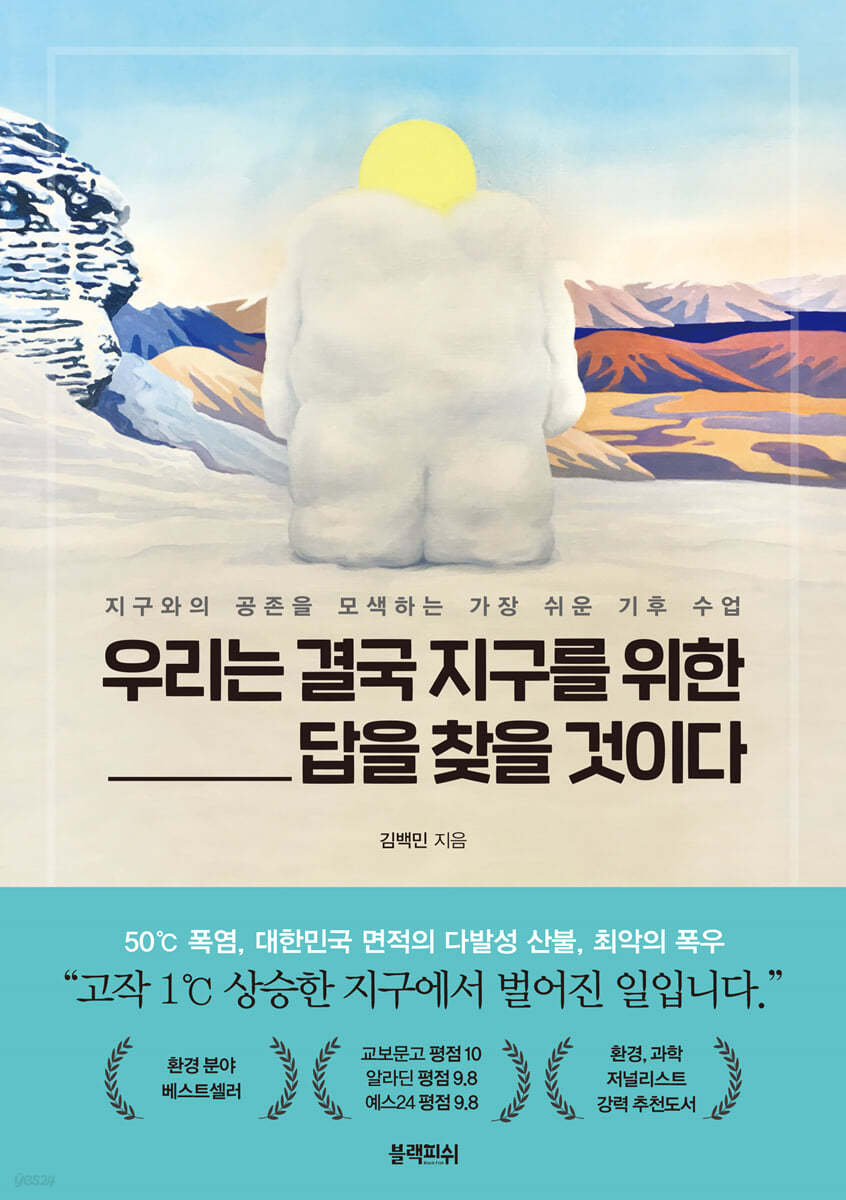
We will eventually find the answer for the Earth.
 |
Description
Book Introduction
From climate change to the Anthropocene, carbon neutrality, and the energy revolution
Starting a 'good study' for the Earth
Strongly recommended by heads of environmental organizations such as the Polar Research Institute and the Korean Meteorological Society.
In October 2020, our country also joined the "2050 Carbon Neutrality" declaration by world leaders.
This means reducing greenhouse gases on a large scale by reducing carbon emissions to zero, thereby turning around the warming Earth.
But is zero carbon emissions even possible? Or, if it weren't for humans, wouldn't the Earth be as hot as it is now?
"We Will Ultimately Find the Answer for the Earth" is a book written by polar expert and climate scientist Baekmin Kim, who meticulously explores all the questions surrounding the Earth's climate based on science and facts, and further explores the coexistence of the Earth and humanity.
You can encounter interesting climate stories that span 4.5 billion years of Earth's history, such as what kind of climate change the Earth experienced before the birth of mankind, whether the greenhouse gases emitted by humans are really so great that they raise the Earth's temperature, and whether humans, who are already well adapted to the cold of -10 degrees Celsius in winter and the heat of +40 degrees Celsius in summer, will face extinction like the dinosaurs just because the Earth's temperature increases by just 1 degree Celsius. You can encounter these interesting climate stories that span 4.5 billion years of Earth's history, along with various and rich visual materials.
Now, working for the environment is not a choice but a duty.
The author published this book in the hope that humans living on Earth will recognize the severity of the climate crisis and prepare for it based on accurate factual information.
If you're wondering whether you should 100% believe the dire future scientists predict, if you're someone who wants to put their heads together and find solutions for the future instead of feeling guilty about being the main culprit of the climate crisis, start "good study" to protect the Earth with this book now.
Starting a 'good study' for the Earth
Strongly recommended by heads of environmental organizations such as the Polar Research Institute and the Korean Meteorological Society.
In October 2020, our country also joined the "2050 Carbon Neutrality" declaration by world leaders.
This means reducing greenhouse gases on a large scale by reducing carbon emissions to zero, thereby turning around the warming Earth.
But is zero carbon emissions even possible? Or, if it weren't for humans, wouldn't the Earth be as hot as it is now?
"We Will Ultimately Find the Answer for the Earth" is a book written by polar expert and climate scientist Baekmin Kim, who meticulously explores all the questions surrounding the Earth's climate based on science and facts, and further explores the coexistence of the Earth and humanity.
You can encounter interesting climate stories that span 4.5 billion years of Earth's history, such as what kind of climate change the Earth experienced before the birth of mankind, whether the greenhouse gases emitted by humans are really so great that they raise the Earth's temperature, and whether humans, who are already well adapted to the cold of -10 degrees Celsius in winter and the heat of +40 degrees Celsius in summer, will face extinction like the dinosaurs just because the Earth's temperature increases by just 1 degree Celsius. You can encounter these interesting climate stories that span 4.5 billion years of Earth's history, along with various and rich visual materials.
Now, working for the environment is not a choice but a duty.
The author published this book in the hope that humans living on Earth will recognize the severity of the climate crisis and prepare for it based on accurate factual information.
If you're wondering whether you should 100% believe the dire future scientists predict, if you're someone who wants to put their heads together and find solutions for the future instead of feeling guilty about being the main culprit of the climate crisis, start "good study" to protect the Earth with this book now.
- You can preview some of the book's contents.
Preview
index
Recommendation
To begin with
Chapter 1.
There was a world 10 degrees hotter than now.
4.5 Billion Years Old Earth: A History of Constant Climate Change
The birth of the sun and the earth
The Story of Earth in the Snowball Era
Cyanobacteria: Remodeling Earth into a Life-Blooming Space
Why did Venus become a planet of death?
Messages from Earth's Past
Chapter 2.
The suspicious rhythm of the Ice Age
Traces left by giant glaciers
Entering a long ice age
Why Antarctica Turned into a Giant Iceberg
Humanity Recognizes the Existence of an Ice Age
The Rhythm of Climate Change Uncovered by Kroll and Milankovic
Plankton Transforms into Ocean Thermometers
Radiocarbon dating reveals the age of ice
The past told by air bubbles frozen in ice
Explaining Rapid Climate Change with the Ocean's Conveyor Belt
Humanity grows smarter as it battles the cold.
Chapter 3.
What are humans doing to the Earth?
What are we doing to the Earth?
A world that's neither too cold nor too hot, just right
Humanity awakens to fossil fuels
The beginning of the Anthropocene
Great acceleration
6th mass extinction
Chapter 4.
Are we really the culprits of global warming?
Crucial clues pointing to humanity as the culprit
Only 1℃?
Discovery of the greenhouse effect
Killing, the first to draw a carbon dioxide curve
a bathtub filled with carbon dioxide
In fact, information about the greenhouse effect was half-baked.
Calculating the greenhouse effect
A rough Earth? A gentle Earth?
The capricious oceans are causing the global temperature curve to fluctuate.
Chapter 5.
Hockey Sticks and Unbelievers
Scientist declares war on climate with hockey stick
The Medieval Warm Period Story
The emergence of hockey sticks
Was the hockey stick rigged?
Worst Climate Gate
Al Gore's Inconvenient Truth Story
BBC documentary "The Great Global Warming Hoax"
Even a brilliant atmospheric scientist can be a leading skeptic.
Floods, heat waves, typhoons, and droughts are caused by global warming?
Chapter 6.
Future prediction
You can't even predict tomorrow's weather, so how can you predict the climate 100 years from now?
The human mind is unpredictable: What climate change scenarios mean
Climate Models and Future Projections
Amazing Future Predictions by Geniuses of the 1970s and 1980s
The 2℃ Future and the Tipping Point
Chapter 7.
Surviving without fossil fuels
We will eventually find the answer
Even COVID-19 couldn't stop humanity's rising fossil fuel emissions.
The predicted end of the fossil fuel era
Increasing renewable energy isn't the only answer.
Can geoengineering save the Earth?
Beyond the Industrial Revolution to the Energy Revolution
Our role in changing the world
In conclusion
References
To begin with
Chapter 1.
There was a world 10 degrees hotter than now.
4.5 Billion Years Old Earth: A History of Constant Climate Change
The birth of the sun and the earth
The Story of Earth in the Snowball Era
Cyanobacteria: Remodeling Earth into a Life-Blooming Space
Why did Venus become a planet of death?
Messages from Earth's Past
Chapter 2.
The suspicious rhythm of the Ice Age
Traces left by giant glaciers
Entering a long ice age
Why Antarctica Turned into a Giant Iceberg
Humanity Recognizes the Existence of an Ice Age
The Rhythm of Climate Change Uncovered by Kroll and Milankovic
Plankton Transforms into Ocean Thermometers
Radiocarbon dating reveals the age of ice
The past told by air bubbles frozen in ice
Explaining Rapid Climate Change with the Ocean's Conveyor Belt
Humanity grows smarter as it battles the cold.
Chapter 3.
What are humans doing to the Earth?
What are we doing to the Earth?
A world that's neither too cold nor too hot, just right
Humanity awakens to fossil fuels
The beginning of the Anthropocene
Great acceleration
6th mass extinction
Chapter 4.
Are we really the culprits of global warming?
Crucial clues pointing to humanity as the culprit
Only 1℃?
Discovery of the greenhouse effect
Killing, the first to draw a carbon dioxide curve
a bathtub filled with carbon dioxide
In fact, information about the greenhouse effect was half-baked.
Calculating the greenhouse effect
A rough Earth? A gentle Earth?
The capricious oceans are causing the global temperature curve to fluctuate.
Chapter 5.
Hockey Sticks and Unbelievers
Scientist declares war on climate with hockey stick
The Medieval Warm Period Story
The emergence of hockey sticks
Was the hockey stick rigged?
Worst Climate Gate
Al Gore's Inconvenient Truth Story
BBC documentary "The Great Global Warming Hoax"
Even a brilliant atmospheric scientist can be a leading skeptic.
Floods, heat waves, typhoons, and droughts are caused by global warming?
Chapter 6.
Future prediction
You can't even predict tomorrow's weather, so how can you predict the climate 100 years from now?
The human mind is unpredictable: What climate change scenarios mean
Climate Models and Future Projections
Amazing Future Predictions by Geniuses of the 1970s and 1980s
The 2℃ Future and the Tipping Point
Chapter 7.
Surviving without fossil fuels
We will eventually find the answer
Even COVID-19 couldn't stop humanity's rising fossil fuel emissions.
The predicted end of the fossil fuel era
Increasing renewable energy isn't the only answer.
Can geoengineering save the Earth?
Beyond the Industrial Revolution to the Energy Revolution
Our role in changing the world
In conclusion
References
Detailed image

Into the book
Carbon dioxide in the atmosphere has increased from 0.028% before the Industrial Revolution to 0.04% today.
What's so significant about a mere 0.012% increase? It's said that global temperatures have risen by 1℃ since the Industrial Revolution.
Is that really that important? Aren't we already accustomed to living in temperatures as low as -10°C in winter and as high as 40°C in summer? Is a mere 1°C increase really that significant? What do you think? Even a single step forward raises a host of troubling questions in climate science.
Many books on climate change published to date have failed to answer this simple yet difficult question, leaving the public with only a superficial understanding of global warming.
In this book, I will delve into the mysterious truth about global warming with you, like a detective.
Armed with the hard truths about global warming, in the final chapter we'll explore what humanity needs most to find answers for our planet.
So, shall we begin our journey together to explore the dynamic climate change within our mysterious planet?
---From "Starting"
There is one lesson we can learn from looking at Venus.
A closer look at Venus's thermostat, which failed to handle the increasingly hot sun, reveals that what humans are doing now could be damaging Earth's thermostat in other ways.
This is done by digging up and burning fossil fuels, ancient organic matter trapped underground, thus raising the Earth's temperature.
At a rate faster than any known natural process in the last 4.5 billion years.
Humans have begun to regulate the concentration of greenhouse gases in the atmosphere, which nature has been slowly regulating for billions of years.
It's just embarrassing for Earth.
---「Chapter 1.
From "There was a world 10℃ hotter than now"
Highly developed human civilization has brought about a tremendous increase in population.
The human population is now more than twice the number of all large terrestrial vertebrates that have ever existed on Earth combined.
Compared to before the Industrial Revolution, the population has increased tenfold.
In just 200 years.
The problem is that most of the artifacts created by highly developed human civilization do not return to nature, but remain as residue or waste somewhere on Earth for a long time, leaving an ugly residue.
Like a mountain of scrap tires or a mountain of trash.
The massive landfills that inevitably exist wherever humans live will prove the existence of humanity even if we become extinct.
A pile of plastic that doesn't decompose even after thousands, if not tens of thousands, of years underground.
Humanity, obsessed with accumulating personal wealth, is too stingy to consider how much non-biodegradable waste is being generated by cities, boasting towering buildings and skyscrapers that are icons of civilization, and how this is harming the planet.
In this sense, the artificial byproducts that exist wherever humanity has set foot are perfectly suited to defining a new geological concept: the Anthropocene.
This is because a plastic layer was created that is different from the Holocene, which began with agricultural culture 10,000 years ago.
In fact, there are scholars who argue that the Anthropocene, the era of humanity, should be introduced from a geological perspective, and they cite radioactive substances, atmospheric carbon dioxide, plastics, and concrete as representative substances of the Anthropocene.
From chickens, of which 60 billion are consumed every year
Some consider the bones to be the greatest geological feature of the Anthropocene.
---Chapter 3.
From "What are humans doing to the Earth?"
2020 was a truly difficult year for humanity, which had been making progress.
An unprecedented situation occurred in which many shops and factories closed and most airplanes were grounded.
Because COVID-19 has swept the world.
Tens of thousands of people died each day, and people spent their time terrified at home.
As I write this in April 2021, we are preparing to escape the fear of COVID-19 through vaccines, but we still tremble in the face of a disaster that is not over yet.
We are learning a lot from COVID-19.
Among them, there is an important message related to climate change.
After a tumultuous year, scientists report that carbon dioxide equivalent greenhouse gas emissions in 2020 were only 2.3 billion tonnes lower than in 2019.
In other words, in 2020, when we thought everything had come to a halt, humanity emitted a little over 48 billion tons of greenhouse gases into the atmosphere, not much different from the 51 billion tons (2019 carbon dioxide emissions).
A British research team found that the reduction in greenhouse gas emissions due to COVID-19 only lowered the global average temperature by about 0.01℃.
I agree with Bill Gates's comment that "ending COVID-19 is a lot easier than stopping climate change," comparing the response to COVID-19 and climate change.
---「Chapter 4.
Are we really the culprits of global warming?
Today, countless climatologists like myself are making small, incremental progress through the vast forest of uncertainty, trying to improve upon the methods of predicting the future pioneered by scientists of the past.
A planet that will soon be 3 degrees hotter if we stop trying—this is the message that climate scientists, past and present, are sending to the world.
---「Chapter 6.
From "Future Prediction"
While joining the global Green New Deal movement is a call of the times, policies should not focus solely on carbon reduction.
Just as the Gyeongbu Expressway played a significant role in Korea's explosive economic growth, we must prioritize expanding energy infrastructure to efficiently store and smartly use electricity generated from renewable energy sources.
The argument is that expanding smart grid infrastructure to support electricity storage and intelligent distribution of electricity, as well as complementary energy sources that can sustain the transition to full renewable energy, may be more important than endlessly expanding solar and wind power infrastructure.
Otherwise, we will see the true face of renewable energy, which can collapse easily due to extreme weather events that can occur at any time, and it will take enormous time and effort to restart after a sudden collapse.
Therefore, we must move beyond policies focused on increasing renewable energy facilities and focus on expanding electricity infrastructure to transition to a coal-free society. We must also expand storage infrastructure, such as hydrogen fuel cells, which are useful for storing electricity.
It is also time to comprehensively review energy policies, including ways to utilize nuclear energy more safely as a stepping stone.
What's so significant about a mere 0.012% increase? It's said that global temperatures have risen by 1℃ since the Industrial Revolution.
Is that really that important? Aren't we already accustomed to living in temperatures as low as -10°C in winter and as high as 40°C in summer? Is a mere 1°C increase really that significant? What do you think? Even a single step forward raises a host of troubling questions in climate science.
Many books on climate change published to date have failed to answer this simple yet difficult question, leaving the public with only a superficial understanding of global warming.
In this book, I will delve into the mysterious truth about global warming with you, like a detective.
Armed with the hard truths about global warming, in the final chapter we'll explore what humanity needs most to find answers for our planet.
So, shall we begin our journey together to explore the dynamic climate change within our mysterious planet?
---From "Starting"
There is one lesson we can learn from looking at Venus.
A closer look at Venus's thermostat, which failed to handle the increasingly hot sun, reveals that what humans are doing now could be damaging Earth's thermostat in other ways.
This is done by digging up and burning fossil fuels, ancient organic matter trapped underground, thus raising the Earth's temperature.
At a rate faster than any known natural process in the last 4.5 billion years.
Humans have begun to regulate the concentration of greenhouse gases in the atmosphere, which nature has been slowly regulating for billions of years.
It's just embarrassing for Earth.
---「Chapter 1.
From "There was a world 10℃ hotter than now"
Highly developed human civilization has brought about a tremendous increase in population.
The human population is now more than twice the number of all large terrestrial vertebrates that have ever existed on Earth combined.
Compared to before the Industrial Revolution, the population has increased tenfold.
In just 200 years.
The problem is that most of the artifacts created by highly developed human civilization do not return to nature, but remain as residue or waste somewhere on Earth for a long time, leaving an ugly residue.
Like a mountain of scrap tires or a mountain of trash.
The massive landfills that inevitably exist wherever humans live will prove the existence of humanity even if we become extinct.
A pile of plastic that doesn't decompose even after thousands, if not tens of thousands, of years underground.
Humanity, obsessed with accumulating personal wealth, is too stingy to consider how much non-biodegradable waste is being generated by cities, boasting towering buildings and skyscrapers that are icons of civilization, and how this is harming the planet.
In this sense, the artificial byproducts that exist wherever humanity has set foot are perfectly suited to defining a new geological concept: the Anthropocene.
This is because a plastic layer was created that is different from the Holocene, which began with agricultural culture 10,000 years ago.
In fact, there are scholars who argue that the Anthropocene, the era of humanity, should be introduced from a geological perspective, and they cite radioactive substances, atmospheric carbon dioxide, plastics, and concrete as representative substances of the Anthropocene.
From chickens, of which 60 billion are consumed every year
Some consider the bones to be the greatest geological feature of the Anthropocene.
---Chapter 3.
From "What are humans doing to the Earth?"
2020 was a truly difficult year for humanity, which had been making progress.
An unprecedented situation occurred in which many shops and factories closed and most airplanes were grounded.
Because COVID-19 has swept the world.
Tens of thousands of people died each day, and people spent their time terrified at home.
As I write this in April 2021, we are preparing to escape the fear of COVID-19 through vaccines, but we still tremble in the face of a disaster that is not over yet.
We are learning a lot from COVID-19.
Among them, there is an important message related to climate change.
After a tumultuous year, scientists report that carbon dioxide equivalent greenhouse gas emissions in 2020 were only 2.3 billion tonnes lower than in 2019.
In other words, in 2020, when we thought everything had come to a halt, humanity emitted a little over 48 billion tons of greenhouse gases into the atmosphere, not much different from the 51 billion tons (2019 carbon dioxide emissions).
A British research team found that the reduction in greenhouse gas emissions due to COVID-19 only lowered the global average temperature by about 0.01℃.
I agree with Bill Gates's comment that "ending COVID-19 is a lot easier than stopping climate change," comparing the response to COVID-19 and climate change.
---「Chapter 4.
Are we really the culprits of global warming?
Today, countless climatologists like myself are making small, incremental progress through the vast forest of uncertainty, trying to improve upon the methods of predicting the future pioneered by scientists of the past.
A planet that will soon be 3 degrees hotter if we stop trying—this is the message that climate scientists, past and present, are sending to the world.
---「Chapter 6.
From "Future Prediction"
While joining the global Green New Deal movement is a call of the times, policies should not focus solely on carbon reduction.
Just as the Gyeongbu Expressway played a significant role in Korea's explosive economic growth, we must prioritize expanding energy infrastructure to efficiently store and smartly use electricity generated from renewable energy sources.
The argument is that expanding smart grid infrastructure to support electricity storage and intelligent distribution of electricity, as well as complementary energy sources that can sustain the transition to full renewable energy, may be more important than endlessly expanding solar and wind power infrastructure.
Otherwise, we will see the true face of renewable energy, which can collapse easily due to extreme weather events that can occur at any time, and it will take enormous time and effort to restart after a sudden collapse.
Therefore, we must move beyond policies focused on increasing renewable energy facilities and focus on expanding electricity infrastructure to transition to a coal-free society. We must also expand storage infrastructure, such as hydrogen fuel cells, which are useful for storing electricity.
It is also time to comprehensively review energy policies, including ways to utilize nuclear energy more safely as a stepping stone.
---Chapter 7.
From "Survival without Fossil Fuels"
From "Survival without Fossil Fuels"
Publisher's Review
“What on earth is happening on this peaceful planet?”
The Minimum Climate Lessons Every Earthling Must Know
The global environmental crisis was previously approached with a somewhat unfamiliar term, 'global warming.'
But the term global warming is not used much these days.
Somewhat extreme terms such as 'climate crisis', 'climate disaster', and even 'global heating' began to be used.
This means that the Earth's crisis has become even more severe.
So far, there have been five mass extinction events on Earth, and according to the book, scientists have now discovered that the world we live in is rapidly evolving towards the sixth mass extinction.
Humanity is now living in an era of rapid temperature change more than any other time in Earth's history.
Numerous climate crisis experts warn of a dire future awaiting us due to the rapidly changing natural environment, and say that we must change the way we live as humans.
But are humans really the culprit? If so, what about the other animals that emit massive amounts of methane gas when they fart? What about creatures like dinosaurs that went extinct before the rise of humans?
In this book, the author meticulously examines the Earth's climate since its birth 4.5 billion years ago, and through this, he reflects on the differences between natural and human-caused climate change, helping us face the truth of the climate crisis: "The culprit is none other than humanity."
In less than 200 years since the Industrial Revolution, which began the widespread use of fossil fuels, the average global temperature has changed by about 1 degree.
The author ponders from a scientific perspective what this figure, which might be thought of as "a mere 1 degree," means when considering the history of the entire planet, and what countermeasures humanity can take to prevent its own actions.
“Why do we all say different things about climate change?”
The Reality of the Climate Crisis: A Scientific and Objective Fact-Based Approach
Should we really 100% believe the dire future scientists predict? Could it be that there's a global climate hoax being propagated? Some say humans are causing glaciers to melt and polar bears to starve, but why do others dismiss the current climate crisis theory as a hoax?
The book presents several examples of people who, in an attempt to overemphasize the dangers of global warming, have made errors in their arguments or made logical leaps, ultimately fueling climate crisis skepticism or becoming prey to skeptics.
Examples include Michael Mann's manipulation of the "hockey stick climate graph" and Al Gore's documentary film "An Inconvenient Truth," in which he exaggerated data to make his point.
On the other hand, the BBC documentary "The Great Global Warming Hoax", which claimed that "global warming is a lie of scientists," fact-checks each and every one of its arguments and scientifically refutes all of its claims.
Although the author is a climatologist who falls into the 97% of the population and aims to reveal that humans are the main culprit of the climate crisis and find alternatives for coexistence, this book also covers the 3% of scientists who are skeptical of the climate crisis, providing balanced information and helping readers properly view the current climate situation for themselves.
Meanwhile, this book is also significant in that it confronts the severity of the climate crisis while acknowledging the limitations and uncertainty of current science and exploring possible response measures within that framework.
We can witness in real time the process of humanity's search for answers by looking into what climate models (Earth System Models) modern scientists are developing and what hypothetical scenarios they are constructing to more accurately predict the future.
Nothing is as uncertain as human intervention, yet we hold out hope that humanity can prevent the Earth from heating up.
“There is definitely something left for humans to do for the Earth!”
Realistic solutions to the climate crisis
The population, which has continued to grow since the Industrial Revolution, has steadily increased the use of fossil fuels.
The COVID-19 pandemic that has swept the globe in the past two years has reduced carbon dioxide emissions by 7 percent, but this too has not been able to halt the trend of increasing fossil fuel use.
Immediately after the Kyoto Protocol and the Paris Agreement, humanity actually increased its carbon dioxide consumption.
However, fossil fuels, which accounted for a large portion of human energy use, are beginning to run out, and this is heralding the end of the fossil fuel era.
The author says that we must now find a solution that kills both the climate crisis and the energy crisis at the same time.
For example, he warns that indiscriminate solar power development could lead to a severe food shortage like in the movie Interstellar, and that increasing renewable energy is not the only answer.
In addition, we introduce future technologies that will bring about a new world of renewable energy, such as methane backpack technology that can effectively reduce methane emissions from cows while converting it into bioenergy, carbon capture technology that turns carbon dioxide into stone, and geoengineering technology similar to the cooling material in the movie "Snowpiercer."
The author's goal with this book is to help people avoid being fooled by fake news and face the climate crisis squarely, that is, to gain the right insight into the Earth and its ecosystem.
To this end, chapters 1-6 clearly explain the current climate crisis in a way that is accessible to the public, and examine in detail the research scientists are conducting to ensure the coexistence of humanity and the Earth.
And in the final chapter of this book, Chapter 7, we present a hopeful alternative to protecting the Earth that we can accept and take action on.
We also add our opinions on small actions that individuals can take in the era of climate crisis, as well as the roles that companies should play, such as ESG management and RE100.
The Earth is getting hotter enough to warrant the term "global warming." Rather than feeling guilty that humans are the main culprit behind the climate crisis, it's time to put our heads together and find realistic alternatives for the future.
Let's start a healthier discussion with this book.
The Minimum Climate Lessons Every Earthling Must Know
The global environmental crisis was previously approached with a somewhat unfamiliar term, 'global warming.'
But the term global warming is not used much these days.
Somewhat extreme terms such as 'climate crisis', 'climate disaster', and even 'global heating' began to be used.
This means that the Earth's crisis has become even more severe.
So far, there have been five mass extinction events on Earth, and according to the book, scientists have now discovered that the world we live in is rapidly evolving towards the sixth mass extinction.
Humanity is now living in an era of rapid temperature change more than any other time in Earth's history.
Numerous climate crisis experts warn of a dire future awaiting us due to the rapidly changing natural environment, and say that we must change the way we live as humans.
But are humans really the culprit? If so, what about the other animals that emit massive amounts of methane gas when they fart? What about creatures like dinosaurs that went extinct before the rise of humans?
In this book, the author meticulously examines the Earth's climate since its birth 4.5 billion years ago, and through this, he reflects on the differences between natural and human-caused climate change, helping us face the truth of the climate crisis: "The culprit is none other than humanity."
In less than 200 years since the Industrial Revolution, which began the widespread use of fossil fuels, the average global temperature has changed by about 1 degree.
The author ponders from a scientific perspective what this figure, which might be thought of as "a mere 1 degree," means when considering the history of the entire planet, and what countermeasures humanity can take to prevent its own actions.
“Why do we all say different things about climate change?”
The Reality of the Climate Crisis: A Scientific and Objective Fact-Based Approach
Should we really 100% believe the dire future scientists predict? Could it be that there's a global climate hoax being propagated? Some say humans are causing glaciers to melt and polar bears to starve, but why do others dismiss the current climate crisis theory as a hoax?
The book presents several examples of people who, in an attempt to overemphasize the dangers of global warming, have made errors in their arguments or made logical leaps, ultimately fueling climate crisis skepticism or becoming prey to skeptics.
Examples include Michael Mann's manipulation of the "hockey stick climate graph" and Al Gore's documentary film "An Inconvenient Truth," in which he exaggerated data to make his point.
On the other hand, the BBC documentary "The Great Global Warming Hoax", which claimed that "global warming is a lie of scientists," fact-checks each and every one of its arguments and scientifically refutes all of its claims.
Although the author is a climatologist who falls into the 97% of the population and aims to reveal that humans are the main culprit of the climate crisis and find alternatives for coexistence, this book also covers the 3% of scientists who are skeptical of the climate crisis, providing balanced information and helping readers properly view the current climate situation for themselves.
Meanwhile, this book is also significant in that it confronts the severity of the climate crisis while acknowledging the limitations and uncertainty of current science and exploring possible response measures within that framework.
We can witness in real time the process of humanity's search for answers by looking into what climate models (Earth System Models) modern scientists are developing and what hypothetical scenarios they are constructing to more accurately predict the future.
Nothing is as uncertain as human intervention, yet we hold out hope that humanity can prevent the Earth from heating up.
“There is definitely something left for humans to do for the Earth!”
Realistic solutions to the climate crisis
The population, which has continued to grow since the Industrial Revolution, has steadily increased the use of fossil fuels.
The COVID-19 pandemic that has swept the globe in the past two years has reduced carbon dioxide emissions by 7 percent, but this too has not been able to halt the trend of increasing fossil fuel use.
Immediately after the Kyoto Protocol and the Paris Agreement, humanity actually increased its carbon dioxide consumption.
However, fossil fuels, which accounted for a large portion of human energy use, are beginning to run out, and this is heralding the end of the fossil fuel era.
The author says that we must now find a solution that kills both the climate crisis and the energy crisis at the same time.
For example, he warns that indiscriminate solar power development could lead to a severe food shortage like in the movie Interstellar, and that increasing renewable energy is not the only answer.
In addition, we introduce future technologies that will bring about a new world of renewable energy, such as methane backpack technology that can effectively reduce methane emissions from cows while converting it into bioenergy, carbon capture technology that turns carbon dioxide into stone, and geoengineering technology similar to the cooling material in the movie "Snowpiercer."
The author's goal with this book is to help people avoid being fooled by fake news and face the climate crisis squarely, that is, to gain the right insight into the Earth and its ecosystem.
To this end, chapters 1-6 clearly explain the current climate crisis in a way that is accessible to the public, and examine in detail the research scientists are conducting to ensure the coexistence of humanity and the Earth.
And in the final chapter of this book, Chapter 7, we present a hopeful alternative to protecting the Earth that we can accept and take action on.
We also add our opinions on small actions that individuals can take in the era of climate crisis, as well as the roles that companies should play, such as ESG management and RE100.
The Earth is getting hotter enough to warrant the term "global warming." Rather than feeling guilty that humans are the main culprit behind the climate crisis, it's time to put our heads together and find realistic alternatives for the future.
Let's start a healthier discussion with this book.
GOODS SPECIFICS
- Publication date: June 17, 2021
- Page count, weight, size: 344 pages | 544g | 148*210*30mm
- ISBN13: 9788968333217
- ISBN10: 8968333211
You may also like
카테고리
korean


korean

![GQ KOREA Mark (Monthly): December [2025]](http://librairie.coreenne.fr/cdn/shop/files/8ef265dbbfbf186523ed75ba7319009d.jpg?v=1765340328&width=3840)


