

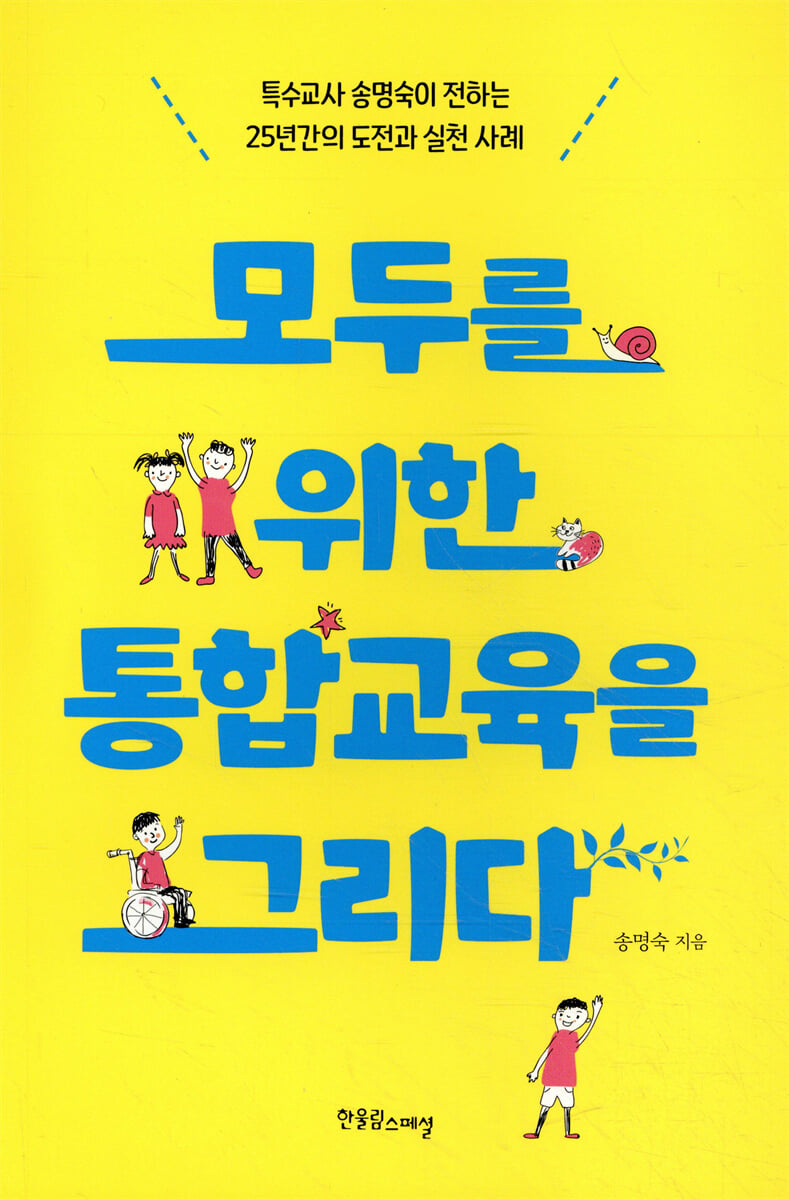
Drawing an Inclusive Education for All
 |
Description
Book Introduction
A special education teacher with 25 years of experience tells us A concrete and practical example of implementing 'Inclusive Education for All' This book was written by the author, who has been working towards the goal of realizing complete inclusive education as a special education teacher since the mid-1990s, for general and special education teachers, parents of students with and without disabilities, and school administrators who are the main players in inclusive education. Although inclusive education has become widespread, many schools still struggle with how to teach students with disabilities. This book explores the direction in which inclusive education should go, what practical inclusive education plans can be applied immediately, and what needs to be done at home, at school, and in society to achieve social integration beyond inclusive education. This book explores these questions, building on 25 years of challenges and practical examples. The school the author attended is known as a model school for its successful integrated education. After 25 years of effort, all classes now have mandatory one-hour weekly co-teaching sessions between general education and special education teachers, and special education teachers also attend instructional modification meetings to help students with disabilities participate effectively in general education classes. We hold a 'First Meeting' event every new school year to allow general teachers to meet students with disabilities in advance and build close relationships, and we also provide integrated education seminars for parents of new students to help parents of students without disabilities effectively guide their children's school life with students with disabilities. All of these are integrated education solutions that were discovered after countless trials and errors, taking various paths toward the goal of complete integrated education and trying new things. For schools and teachers struggling to implement inclusive education in unprepared situations, the challenges and practical examples contained in this book, while not necessarily the best, will serve as a valuable model. |
- You can preview some of the book's contents.
Preview
index
Entering
Prologue _ Our Perspective on Disability
Chapter 1_ Sprouting the Sprouts of Integrated Education: At Home
Parents of Students with Disabilities: The World They Live In
"My child has a disability" | Finding a therapy room | Becoming a parent of a child with a disability | Between teachers and parents | Parents who struggle to fully accept their children | Finding the treasure hidden within your child |
Parents who need to prepare for their children's future
Parents of Students Without Disabilities Learn the Value of "Togetherness"
Reflecting on the "Knee-jerk Appeal" of Parents of Students with Disabilities | Why We Need to Learn About Disabilities | An Inclusive Education Seminar: Learning the Value of "Togetherness" | Understanding Disabilities Through Books
Chapter 2 - Making Integrated Education Blossom: At School
An integrated classroom where everyone is happy
Children Who Will Change the World | The Allure of Inclusive Education | Steps to Helping Students with Disabilities | Empathetic Disability Awareness Education | We Are All Precious
Integrated education, like a 2-on-3 game
The Key to Integration: Collaboration Between General and Special Education Teachers | Look Closely and Long-Term | Relationship Building Begins | When Collaboration Between General and Special Education Teachers is Difficult | "I'm the Principal" | The Difficulty of Mediation | Collaborating with School Members
The alternative is collaborative teaching.
General and Special Education Teachers Join Forces | Classes for Everyone to Enjoy | A Difficult but Necessary Path | Finding Effective Co-Teaching Methods | Conducting Disability Awareness Education Through Co-Teaching
Chapter 3 _ Bearing Fruits of Integrated Education: In Society
My disciples who have grown up well
Special Education Teachers Have Students Too | Preparing for Life After Adulthood | Even with Disabilities, You're an Adult
Finding your way with a disability
Changing Your Mindset Reveals Solutions | Finding Your Way Inside School | Finding Your Way Outside School | For the Social Participation of People with Disabilities
Epilogue _ Integrated Education, One Step by Ten People
Questions about Disability: Answer them like this
Prologue _ Our Perspective on Disability
Chapter 1_ Sprouting the Sprouts of Integrated Education: At Home
Parents of Students with Disabilities: The World They Live In
"My child has a disability" | Finding a therapy room | Becoming a parent of a child with a disability | Between teachers and parents | Parents who struggle to fully accept their children | Finding the treasure hidden within your child |
Parents who need to prepare for their children's future
Parents of Students Without Disabilities Learn the Value of "Togetherness"
Reflecting on the "Knee-jerk Appeal" of Parents of Students with Disabilities | Why We Need to Learn About Disabilities | An Inclusive Education Seminar: Learning the Value of "Togetherness" | Understanding Disabilities Through Books
Chapter 2 - Making Integrated Education Blossom: At School
An integrated classroom where everyone is happy
Children Who Will Change the World | The Allure of Inclusive Education | Steps to Helping Students with Disabilities | Empathetic Disability Awareness Education | We Are All Precious
Integrated education, like a 2-on-3 game
The Key to Integration: Collaboration Between General and Special Education Teachers | Look Closely and Long-Term | Relationship Building Begins | When Collaboration Between General and Special Education Teachers is Difficult | "I'm the Principal" | The Difficulty of Mediation | Collaborating with School Members
The alternative is collaborative teaching.
General and Special Education Teachers Join Forces | Classes for Everyone to Enjoy | A Difficult but Necessary Path | Finding Effective Co-Teaching Methods | Conducting Disability Awareness Education Through Co-Teaching
Chapter 3 _ Bearing Fruits of Integrated Education: In Society
My disciples who have grown up well
Special Education Teachers Have Students Too | Preparing for Life After Adulthood | Even with Disabilities, You're an Adult
Finding your way with a disability
Changing Your Mindset Reveals Solutions | Finding Your Way Inside School | Finding Your Way Outside School | For the Social Participation of People with Disabilities
Epilogue _ Integrated Education, One Step by Ten People
Questions about Disability: Answer them like this
Into the book
Suddenly, I remembered when I first started inclusive education.
When I first started my teaching career as a special education teacher in 1996, the school gave me complete trust even though I had no field experience.
I had to do something to repay him, but there was nothing I could emulate.
The only thing given is the goal of integrated education.
It was no different from my previous situation, when I was left in a thick fog.
'How nice it would have been if there had been emergency lights like that back then.'
As I recalled the times when I struggled without even a small, dim light, I realized what I needed to do now.
'Yes, the one who turns on the emergency lights and goes ahead.
That's it.'
My role is to run ahead, turning on a small light in the darkness.
Even with just that small, faint flicker, other cars will be able to navigate on their own.
Then, if just one ray of sunlight shines, the fog will disappear completely.
--- p.7
Inclusive education can sometimes be difficult and challenging for students with disabilities.
However, that time can be a process of learning how to get along with non-disabled peers and finding greater happiness.
Just as I closed my eyes and acted like I was sleeping because I couldn't understand the movie, students with disabilities may also act like that in the classroom.
No one can live in this world with ease and comfort.
Just because a student is not disabled doesn't mean he or she doesn't have difficulties in school life.
You have to accept some level of stress for the future.
Likewise, students with disabilities need to tolerate appropriate stress and experience a variety of situations.
The idea that people with disabilities must live together with other people with disabilities and do things that are appropriate for their level is a very dangerous idea.
--- p.28-29
Students with disabilities have two homeroom teachers.
Inclusive class teacher and special class teacher.
Sometimes I see teachers in inclusive classes not thinking of students with disabilities as their own students and calling them "special class students." They should say "students in our class," not "special class students."
It is very important in an inclusive education setting for homeroom teachers to regard students with disabilities as their own students.
Also, in order for the homeroom teacher of an integrated class to be able to say without hesitation that a student with a disability is “a student in my class,” special education teachers must also let go of the idea that the student with a disability is their own student.
The position of homeroom teacher should be given to a regular teacher.
The more special education teachers hold a student with disabilities, the more difficult it is for them to become students in inclusive classes.
Special education teachers should simply play a supporting role in making inclusive classes and inclusive education better.
--- p.106
However, now that inclusive education has become widespread, more than 70 percent of students with disabilities attend regular schools.
At some point, you will inevitably encounter a disabled student.
But you don't have to worry.
I am confident that any teacher can teach students with disabilities.
In the future, every teacher will encounter students with disabilities in their classes, so it will no longer be possible to say that they don't know how to teach students with disabilities.
So, rather than feeling uncomfortable, you need to have the mindset that you only need to know and teach one student you are currently in charge of.
There is no need to say that you do not know about people with disabilities, and there is no need to worry about not knowing the characteristics of disabilities.
Because every disabled person is different, no one can claim to know everything about disabled people.
Perhaps the attitude that teachers need is not to try to 'know everything' about students with disabilities, but to get to know each student with a disability well.
And as we welcome the ‘new year’, we get to know the ‘new disabled students’ we met that year with a ‘new heart’.
It is more important to look closely and deeply at the disabled students I am currently in charge of and to educate them carefully.
--- p.110-111
Co-teaching is when two teachers (a general education teacher and a special education teacher) work together in a general classroom with students with disabilities to provide a qualitatively better education to all students in the class, including students without disabilities.
This refers to teaching activities in which two teachers take the initiative in lesson planning and preparation, class progress, learning assessment, class management, and student management from an equal position.
I still can't forget the first day I became a co-professor.
I, a special education teacher who teaches 5-6 students with disabilities in a special class, was teaching in front of about 30 students.
I don't get nervous at all when giving lectures in front of hundreds of people, so why was I so out of it that day?
As a special education teacher, I didn't notice students with disabilities.
I almost missed a disabled student who was trying to raise his hand to speak.
Even now, I spend more time and effort preparing to be a co-teacher than preparing for special education classes.
Although the workload is burdensome, the value of being a cooperating professor cannot be denied.
--- p.130-131
At this point, I believe that collaborative teaching is essential for students with disabilities to achieve social, emotional, and curricular integration beyond the physical integration into regular classrooms.
Looking back on my experience over the past 25 years, I've found that nothing has been more effective than co-teaching to help students with and without disabilities feel comfortable interacting, feel a sense of belonging in an inclusive classroom, and actively participate in learning.
I can confidently say that this is the best way to successfully implement inclusive education.
It's just a shame that I can't explain it to you without experiencing it.
Of course, when you first start out, the burden and difficulties are great.
So I would like to recommend that you start with the easy way.
If you start your co-teaching career with the subject you are most confident in teaching or the subject you enjoy the most, it won't be too burdensome.
Also, if the class content is more effective when two teachers teach together than when one teacher teaches, it can be more satisfying.
--- p.143-144
Co-teaching also helps teachers grow because general and special education teachers can learn from each other's educational expertise.
Most teachers teach alone, so progress can be slow.
However, through collaborative teaching, the two teachers' strengths are combined and they learn new things by sharing their abilities.
Especially these days, as many teachers have minors or double majors, the fields in which they can utilize their knowledge will expand significantly.
By maximizing each individual's expertise, both students and teachers will have the opportunity to enjoy, collaborate, build skills, and mature.
--- p.151
Backward planning is necessary when developing an individualized education plan for students with disabilities.
It's about setting goals by thinking about the long-term future and making plans one by one about what to do today to achieve them.
What is most important is ‘life after adulthood.’
Because integrated education takes place during childhood and adolescence, it is easy to focus only on the immediate situation.
The immediate challenge seems too big, and academics inevitably take priority.
But when I think about what I will do as an adult, it becomes clearer what I need to prepare and what I need to teach now.
Self-help skills, rule-following, and polite behavior may be more important to enable independent living.
What is certain is that students with disabilities also become adults.
No matter what your current appearance is, you should educate your children with the expectation that they will be like when they become adults.
--- p.166-167
What is the ultimate goal of inclusive education? It is to enable students with disabilities to live well and integrate into society.
School is the starting point for moving into society.
It is a place where you can learn about each aspect of life through various experiences.
Inclusive education is not a goal, it is a process.
Integration takes place first in school, and then naturally connects to society.
This is precisely why inclusive education is important.
--- p.178
If you know why you have to do something, you can figure out how to do it.
If you say, 'I can't do it because I don't know how or what to do,' that's just an excuse.
If the food was something you didn't like before, you might have made an excuse like, "I couldn't eat it because I didn't have a spoon."
But is it really because I didn't have a spoon that I couldn't eat? I blame the spoon, but the truth is, I just don't want to eat.
If the 'necessity' of living and studying together with people with disabilities is clear, a method will be found.
Of course, there will be a lot of twists and turns and trial and error, but it will happen anyway.
--- p.181 Chapter 3
Many schools still struggle with a lack of understanding of students with disabilities and how to teach them.
Even so, there are students, so the situation has become one where integrated education is necessary.
Inclusive education is an irreversible trend.
Since it is not someone else's business, I can no longer just watch from the other side of the river.
Not only schools, but our society will soon go through this process.
So now, it's not about others, it's about me! Not later, when I'm pushed to do it, but right now! Not somewhere else, but right here! I hope that we can each, in our own place, nurture, blossom, and create a life where inclusive education for all can flourish and bear fruit.
When I first started my teaching career as a special education teacher in 1996, the school gave me complete trust even though I had no field experience.
I had to do something to repay him, but there was nothing I could emulate.
The only thing given is the goal of integrated education.
It was no different from my previous situation, when I was left in a thick fog.
'How nice it would have been if there had been emergency lights like that back then.'
As I recalled the times when I struggled without even a small, dim light, I realized what I needed to do now.
'Yes, the one who turns on the emergency lights and goes ahead.
That's it.'
My role is to run ahead, turning on a small light in the darkness.
Even with just that small, faint flicker, other cars will be able to navigate on their own.
Then, if just one ray of sunlight shines, the fog will disappear completely.
--- p.7
Inclusive education can sometimes be difficult and challenging for students with disabilities.
However, that time can be a process of learning how to get along with non-disabled peers and finding greater happiness.
Just as I closed my eyes and acted like I was sleeping because I couldn't understand the movie, students with disabilities may also act like that in the classroom.
No one can live in this world with ease and comfort.
Just because a student is not disabled doesn't mean he or she doesn't have difficulties in school life.
You have to accept some level of stress for the future.
Likewise, students with disabilities need to tolerate appropriate stress and experience a variety of situations.
The idea that people with disabilities must live together with other people with disabilities and do things that are appropriate for their level is a very dangerous idea.
--- p.28-29
Students with disabilities have two homeroom teachers.
Inclusive class teacher and special class teacher.
Sometimes I see teachers in inclusive classes not thinking of students with disabilities as their own students and calling them "special class students." They should say "students in our class," not "special class students."
It is very important in an inclusive education setting for homeroom teachers to regard students with disabilities as their own students.
Also, in order for the homeroom teacher of an integrated class to be able to say without hesitation that a student with a disability is “a student in my class,” special education teachers must also let go of the idea that the student with a disability is their own student.
The position of homeroom teacher should be given to a regular teacher.
The more special education teachers hold a student with disabilities, the more difficult it is for them to become students in inclusive classes.
Special education teachers should simply play a supporting role in making inclusive classes and inclusive education better.
--- p.106
However, now that inclusive education has become widespread, more than 70 percent of students with disabilities attend regular schools.
At some point, you will inevitably encounter a disabled student.
But you don't have to worry.
I am confident that any teacher can teach students with disabilities.
In the future, every teacher will encounter students with disabilities in their classes, so it will no longer be possible to say that they don't know how to teach students with disabilities.
So, rather than feeling uncomfortable, you need to have the mindset that you only need to know and teach one student you are currently in charge of.
There is no need to say that you do not know about people with disabilities, and there is no need to worry about not knowing the characteristics of disabilities.
Because every disabled person is different, no one can claim to know everything about disabled people.
Perhaps the attitude that teachers need is not to try to 'know everything' about students with disabilities, but to get to know each student with a disability well.
And as we welcome the ‘new year’, we get to know the ‘new disabled students’ we met that year with a ‘new heart’.
It is more important to look closely and deeply at the disabled students I am currently in charge of and to educate them carefully.
--- p.110-111
Co-teaching is when two teachers (a general education teacher and a special education teacher) work together in a general classroom with students with disabilities to provide a qualitatively better education to all students in the class, including students without disabilities.
This refers to teaching activities in which two teachers take the initiative in lesson planning and preparation, class progress, learning assessment, class management, and student management from an equal position.
I still can't forget the first day I became a co-professor.
I, a special education teacher who teaches 5-6 students with disabilities in a special class, was teaching in front of about 30 students.
I don't get nervous at all when giving lectures in front of hundreds of people, so why was I so out of it that day?
As a special education teacher, I didn't notice students with disabilities.
I almost missed a disabled student who was trying to raise his hand to speak.
Even now, I spend more time and effort preparing to be a co-teacher than preparing for special education classes.
Although the workload is burdensome, the value of being a cooperating professor cannot be denied.
--- p.130-131
At this point, I believe that collaborative teaching is essential for students with disabilities to achieve social, emotional, and curricular integration beyond the physical integration into regular classrooms.
Looking back on my experience over the past 25 years, I've found that nothing has been more effective than co-teaching to help students with and without disabilities feel comfortable interacting, feel a sense of belonging in an inclusive classroom, and actively participate in learning.
I can confidently say that this is the best way to successfully implement inclusive education.
It's just a shame that I can't explain it to you without experiencing it.
Of course, when you first start out, the burden and difficulties are great.
So I would like to recommend that you start with the easy way.
If you start your co-teaching career with the subject you are most confident in teaching or the subject you enjoy the most, it won't be too burdensome.
Also, if the class content is more effective when two teachers teach together than when one teacher teaches, it can be more satisfying.
--- p.143-144
Co-teaching also helps teachers grow because general and special education teachers can learn from each other's educational expertise.
Most teachers teach alone, so progress can be slow.
However, through collaborative teaching, the two teachers' strengths are combined and they learn new things by sharing their abilities.
Especially these days, as many teachers have minors or double majors, the fields in which they can utilize their knowledge will expand significantly.
By maximizing each individual's expertise, both students and teachers will have the opportunity to enjoy, collaborate, build skills, and mature.
--- p.151
Backward planning is necessary when developing an individualized education plan for students with disabilities.
It's about setting goals by thinking about the long-term future and making plans one by one about what to do today to achieve them.
What is most important is ‘life after adulthood.’
Because integrated education takes place during childhood and adolescence, it is easy to focus only on the immediate situation.
The immediate challenge seems too big, and academics inevitably take priority.
But when I think about what I will do as an adult, it becomes clearer what I need to prepare and what I need to teach now.
Self-help skills, rule-following, and polite behavior may be more important to enable independent living.
What is certain is that students with disabilities also become adults.
No matter what your current appearance is, you should educate your children with the expectation that they will be like when they become adults.
--- p.166-167
What is the ultimate goal of inclusive education? It is to enable students with disabilities to live well and integrate into society.
School is the starting point for moving into society.
It is a place where you can learn about each aspect of life through various experiences.
Inclusive education is not a goal, it is a process.
Integration takes place first in school, and then naturally connects to society.
This is precisely why inclusive education is important.
--- p.178
If you know why you have to do something, you can figure out how to do it.
If you say, 'I can't do it because I don't know how or what to do,' that's just an excuse.
If the food was something you didn't like before, you might have made an excuse like, "I couldn't eat it because I didn't have a spoon."
But is it really because I didn't have a spoon that I couldn't eat? I blame the spoon, but the truth is, I just don't want to eat.
If the 'necessity' of living and studying together with people with disabilities is clear, a method will be found.
Of course, there will be a lot of twists and turns and trial and error, but it will happen anyway.
--- p.181 Chapter 3
Many schools still struggle with a lack of understanding of students with disabilities and how to teach them.
Even so, there are students, so the situation has become one where integrated education is necessary.
Inclusive education is an irreversible trend.
Since it is not someone else's business, I can no longer just watch from the other side of the river.
Not only schools, but our society will soon go through this process.
So now, it's not about others, it's about me! Not later, when I'm pushed to do it, but right now! Not somewhere else, but right here! I hope that we can each, in our own place, nurture, blossom, and create a life where inclusive education for all can flourish and bear fruit.
--- p.204
Publisher's Review
A special education teacher with 25 years of experience tells us
A concrete and practical example of implementing 'Inclusive Education for All'
This book was written by the author, who has been working towards the goal of realizing complete inclusive education as a special education teacher since the mid-1990s, for general and special education teachers, parents of students with and without disabilities, and school administrators who are the main players in inclusive education.
Although inclusive education has become widespread, many schools still struggle with how to teach students with disabilities. This book explores the direction in which inclusive education should go, what practical inclusive education plans can be applied immediately, and what needs to be done at home, at school, and in society to achieve social integration beyond inclusive education. This book explores these questions, building on 25 years of challenges and practical examples.
The school the author attended is known as a model school for its successful integrated education.
After 25 years of effort, all classes now have mandatory one-hour weekly co-teaching sessions between general education and special education teachers, and special education teachers also attend instructional modification meetings to help students with disabilities participate effectively in general education classes.
We hold a 'First Meeting' event every new school year to allow general teachers to meet students with disabilities in advance and build close relationships, and we also provide integrated education seminars for parents of new students to help parents of students without disabilities effectively guide their children's school life with students with disabilities.
All of these are integrated education solutions that were discovered after countless trials and errors, taking various paths toward the goal of complete integrated education and trying new things.
For schools and teachers struggling to implement inclusive education in unprepared situations, the challenges and practical examples contained in this book, while not necessarily the best, will serve as a valuable model.
The beginning of a society where we can all live together is having a correct perspective on disability.
Inclusive education creates an environment where students without disabilities and students with disabilities live together and become familiar with each other.
Non-disabled students who have experienced inclusive education can interact with people with disabilities without hesitation when they become adults and create a society where people with and without disabilities can live together.
This is precisely why inclusive education is important.
However, in our society, there are still many misunderstandings and prejudices about disabilities due to a lack of correct awareness of disabilities.
Although it has been nearly 30 years since inclusive education was fully implemented, there are still concerns that students with disabilities will disrupt classes and harm their children, or that non-disabled students may imitate the behavior of students with disabilities if they are placed in the same classroom.
The author says that these concerns arise because there is still a lack of understanding about disabilities.
He says that the reason we cannot create a society where we can live together may be because our perspective on disability is wrong.
This is why this book begins by looking back at our perspective on disability.
A disability is just a disability.
It's not a disease or an illness, it's just a disability.
It is not something to be treated or overcome, but something to be ‘lived with’.
Yet, it is cruel to expect individuals with disabilities to overcome it alone.
Rather, it is society's responsibility to develop and support resources and strategies to bridge the gap created by 'that part that cannot be overcome.'
It is difficult to achieve integration without a proper understanding that disabilities must be viewed and supported from a social perspective.
--- From P16 Prologue [Our Perspective on Disability]
Parents of students with and without disabilities are important stakeholders in inclusive education.
To properly implement integrated education, parents must also prepare.
How we view disability also influences the attitudes and perspectives of parents of students with and without disabilities.
In this book, the author introduces the cases of various parents of students with disabilities whom he has met over the past 25 years.
Based on real-life examples, this book provides advice on what parents of students with disabilities should consider in inclusive education, including how to understand their child's disability, how to prepare for elementary school, and how to prepare for their child's post-graduation life.
I recommended that Jimin be admitted to a special education program.
He said that from the beginning, we should receive support from special education teachers in the Integrated Education Support Center to prevent the learning gap from widening too much later.
(syncopation)
No parent wants to label their young child as a special education student.
Still, Jimin's mother said she would follow the school's decision as long as it meant her child would receive a better education.
Rather than trying to hide or conceal Jimin's weaknesses, he wanted to actively help Jimin bring out his potential to the fullest.
(syncopation)
Jimin proudly entered a university in Seoul through the special education admission process.
It was a desirable example of someone being able to acknowledge their own identity, enjoy the benefits that come with it, and advocate for themselves.
(syncopation)
If Jimin's mother had been going from one treatment room to another trying to somehow get rid of her child's disability, Jimin probably wouldn't be who he is today.
A mother's decision to accept her child as he is has made Jimin who he is today.
I am confident that this decision will allow us to see Jimin grow into an even more wonderful person in the future.
--- P59~61 Chapter 1 Sprouting the Sprouts of Inclusive Education [Parents of Students with Disabilities, the World They Live in]
The author also introduces the 'Integrated Education Seminar for Parents' being held at the school where he works.
Since children grow up observing their parents, it is said that when non-disabled children enter elementary school and receive inclusive education, parents of non-disabled students also need to learn about disabilities.
Nowadays, disability awareness education is mandatory in all schools.
However, the parental generation often has prejudice against disabilities because they did not receive education about them during their school years.
Parents of students without disabilities and parents of students with disabilities are important stakeholders in inclusive education.
Disability awareness education must eliminate preconceptions and biases so that the two parties can naturally meet.
Regardless of whether or not a child has a disability, our children will be able to grow up better when we understand each other as parents, share our experiences, and recognize the value of inclusive education.
In our school, we interview parents of non-disabled students before admission, and we often ask them questions like this.
“If your child is paired with a disabled student and gets teased sometimes, what will you say to them then?”
“That’s because the child doesn’t know.
I have to tell him to understand."
Most parents say they can understand it well enough.
(Omitted) But what if your child actually experiences difficulties in their relationship with a student with a disability? They may become upset, angry, and emotional.
You might even think, 'How can a child like this attend our school?'
There is a reason why I ask this question during interviews, even though I am fully aware that the attitudes of parents of non-disabled students can change abruptly.
If you answer rationally at this time, you will be able to think more calmly when something like that actually happens later.
(syncopation)
What we want is not to force our children to be unconditionally patient or understanding.
First, fully accept your child's frustration, and then work together to find a way to prevent this situation from happening again.
It is essential for parents of non-disabled children to think about living with a disabled person and learn how to live well together to guide their children in the right direction.
--- P73~74 Chapter 1 Sprouting the Sprouts of Inclusive Education [Parents of Non-Disabled Students, Learning the Value of ‘Togetherness’]
The key to integrated education is cooperation!
Practical solutions for collaboration, gleaned from 25 years of experience implementing integrated education.
The ultimate goal of inclusive education is to enable students with disabilities to live well integrated into society.
School is the starting point for moving into society, and students with disabilities practice moving into the wider society by spending time with their non-disabled peers in this small society.
Non-disabled students are important participants in inclusive education.
Teachers can only work with students with disabilities for a short period of time, often a few years.
It only supports and assists the current situation of a very small number of disabled students within the narrow space of school.
However, non-disabled students who have experienced inclusive education will go out into society and live alongside many disabled people.
We will be a strong companion to disabled students, sharing their present and future.
The author discusses the appeal of inclusive education through the case of a non-disabled student who experienced inclusive education and deeply felt the impact it would have on our society as an adult.
“Teacher, if you tell ○○ ‘no,’ he gets so angry.
You just have to say, ‘Let’s not do this.’”
It really was like that.
The autistic student in that class would get angry and yell if anyone said 'no'.
The non-disabled student knew more about his friend with autism than the homeroom teacher.
How was this possible? The reason is simple.
Because we've been through it! Because we've been together! (omitted)
These students have already acquired an attitude of seeing and acknowledging the different individualities of each person, even if they are not necessarily disabled.
I was ready to explain what I knew to others and lead change.
Although he is still a young student, he will be able to see people with disabilities as they are when he grows up and becomes an adult.
These are students who will truly change the world.
--- P88~90 Chapter 2: Blossoming Integrated Education [Integrated Classrooms Where Everyone is Happy]
The author says that cooperation is the most important thing to successfully implement this type of integrated education.
Inclusive education cannot be achieved without the cooperation of many parties, including general and special education teachers, parents, and school members.
However, in the process of cooperation, situations in which one side must accept the other side's opinion and step back are bound to arise.
It is easy for conflicts of opinion to arise due to differences in positions and viewpoints.
The author shares his own experiences of working collaboratively with various groups, including general teachers, school staff, and support staff, and shares his own know-how for effective collaboration.
In fact, it is difficult for two teachers to go together, like a two-person three-legged race.
If you go alone, you can get there quickly, but if you go together, you are likely to fall at first.
Because the process of adjusting to each other is inevitably involved, it is bound to be slow.
Still, we have to go together.
Even if you can't run as fast as running alone, if you run together, you can give each other strength when times get tough and tiring, find a better path, and go farther.
(syncopation)
So when I work with a general education teacher and feel like we have different opinions, I first try to accommodate my partner's opinion.
This may just be my one-sided opinion.
My partners may not think so, but I usually try to try what they want first anyway.
In my experience, this method has been much more effective unless there are critical errors or misdirection.
The secret to my good collaboration with general teachers is to offer what I want within the framework my partner teacher wants and to work together to find common ground.
--- P118 Chapter 2: Blossoming Integrated Education [Integrated Education, Like a 2-on-3 Game]
In addition, as a way to effectively implement integrated education, we propose 'co-teaching' (where general teachers and special education teachers plan and conduct classes together in a general classroom where students with disabilities are integrated, and also conduct evaluations together).
I've personally witnessed the effects and benefits of collaborative teaching over the past 15 years, and if it's difficult to apply immediately, I recommend starting with something practical.
The Ministry of Education announced the “Five-Year Plan for Special Education Development” and has been promoting the development of an integrated education cooperation model between special education teachers and general education teachers since 2018.
The education community is also focusing its attention on collaborative teaching.
The author's experiences in this book will serve as valuable reference material for schools and teachers struggling with the difficulties of collaboration between general and special education teachers.
“Teacher, this is a worksheet I made.
“If you give it to OO during class, he will do well.”
There are times when we provide support by creating worksheets to help students with disabilities follow integrated classes.
I didn't ask you to solve it with a disabled student, nor did I ask you to grade it.
I just asked you to pass it on.
all.
However, there were many times when even delivering the learning materials to students with disabilities was not accomplished.
(syncopation)
I was a little disappointed.
In a word, I couldn't understand.
As a former associate professor, I was able to understand general teachers.
No, I didn't just understand and say, 'That could have been it,' but I completely sympathized and said, 'That must have been the case.'
During the collaborative teaching session, I observed the demands and responses from many students at the same time. Only then did I realize that leading and teaching this many students could sometimes be a challenge, even providing them with a single workbook.
I realized that my previous assumptions that general education teachers were neglectful of students with disabilities and reluctant to collaborate with special education teachers were just hasty misunderstandings and delusions.
--- P132-133 Chapter 2: Bearing Fruit in Integrated Education [The Alternative is Collaborative Teaching]
For the day when social participation of people with disabilities becomes natural
Reaping the fruits of integrated education in each home, school, and society
The school the author attended did not practice integrated education well from the beginning.
In a society centered on the able-bodied, there is no place where inclusive education is easy.
However, when integrated education encounters difficulties, instead of just being frustrated or discouraged, there is someone who tries to solve the difficulty, and that one person's actions create a butterfly effect, and with that power, little by little, change and development occur.
Therefore, the author emphasizes that before considering how to properly implement integrated education, it is important to first understand the value and necessity of integrated education.
If the value of living and studying together with people with disabilities is clear, a method will be found.
There may be some trial and error, but it will happen anyway.
Inclusive education is not a goal, it is a process.
Integration must occur first at school and then naturally lead to social integration.
Therefore, the author emphasizes that we should no longer postpone it as someone else's responsibility, but rather, it is ours! We should not be pushed to do it later, but right now! We must each take the initiative to nurture, blossom, and bear fruit in our own positions.
There is one more idea we need to change.
I know I need to work with people with disabilities, but I don't think that's what I should be doing.
'Someone must be better than me!' But in life with a disability, there is no such thing as 'what I have to do' or 'what you have to do.'
Special education teachers and other related professionals may be responsible for more specialized areas, but fundamentally, living together is something that applies to all of us.
Rather than avoiding it because you don't know, the moment you try to participate, you will realize that the answer is already within you.
There is no one specific person who has the answers, but rather, when everyone works together, they find the answers one by one.
--- P184 Chapter 3: Bearing Fruit in Integrated Education [Finding the Way Together with People with Disabilities]
GOODS SPECIFICS
- Publication date: March 15, 2021
- Page count, weight, size: 208 pages | 286g | 140*210*12mm
- ISBN13: 9788993143959
- ISBN10: 8993143951
You may also like
카테고리
korean


korean

![GQ KOREA Mark (Monthly): December [2025]](http://librairie.coreenne.fr/cdn/shop/files/8ef265dbbfbf186523ed75ba7319009d.jpg?v=1765340328&width=3840)


