

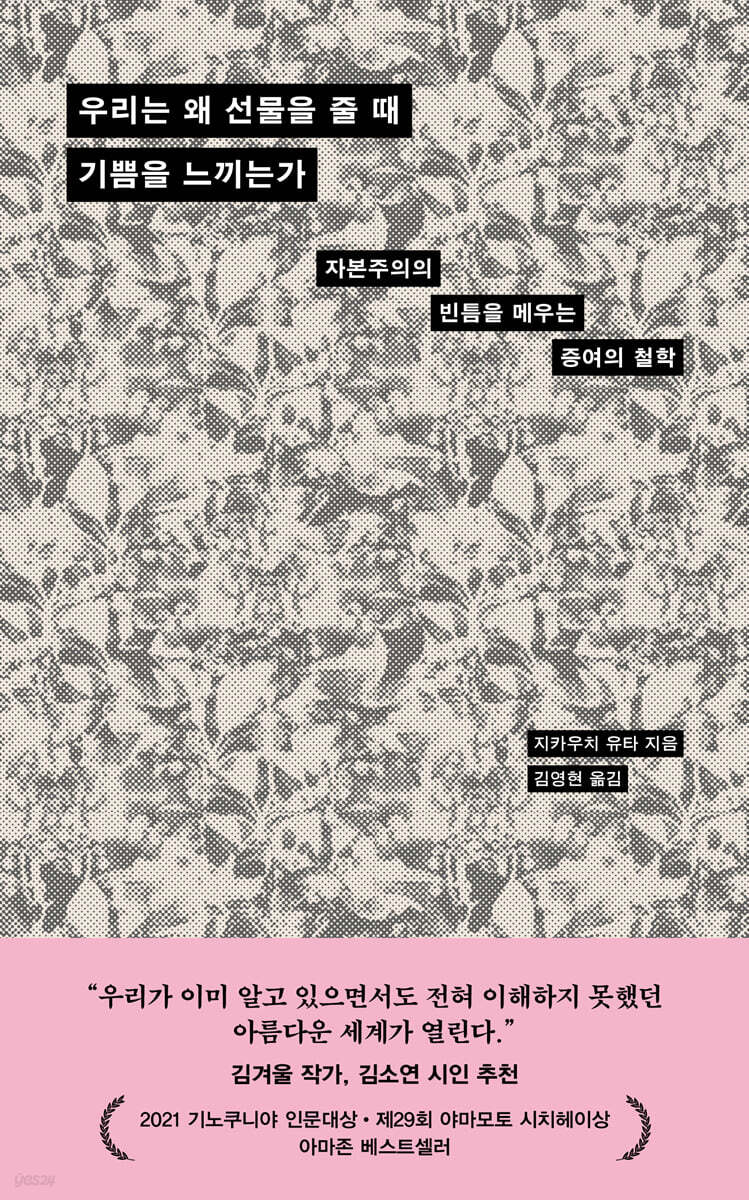
Why do we feel joy when giving gifts?
 |
Description
Book Introduction
Although we live in a capitalist society where everything becomes a commodity and all actions become a service, we know that there are things in this world that cannot be bought with money.
From secretly giving someone a gift to helping others while sacrificing your own interests.
"Why We Feel Joy When We Give Gifts" is a book written by an author who majored in Wittgenstein's philosophy. Through the process of uncovering the principle of "gift," which is something that cannot be bought with money, we understand the structure of this world and further awaken to the meaning of our lives and the lost possibilities.
The author approaches the essence of gifting based on a wide range of citations and interesting examples, including Wittgenstein's language games, Thomas Kuhn's anomalies, Mendeleev's periodic table, Camus's myth of Sisyphus, Sherlock Holmes's deductive techniques, and even the comic book Thermae Romae.
As the debut work of a young philosopher, it became a bestseller immediately after publication, sparking a local "donation craze" and receiving favorable reviews from both experts and readers, winning awards such as the Yamamoto Shichihei Award, the Kinokuniya Humanities Award, and the Readers' Choice Business Book Grand Prix in the liberal arts category.
From secretly giving someone a gift to helping others while sacrificing your own interests.
"Why We Feel Joy When We Give Gifts" is a book written by an author who majored in Wittgenstein's philosophy. Through the process of uncovering the principle of "gift," which is something that cannot be bought with money, we understand the structure of this world and further awaken to the meaning of our lives and the lost possibilities.
The author approaches the essence of gifting based on a wide range of citations and interesting examples, including Wittgenstein's language games, Thomas Kuhn's anomalies, Mendeleev's periodic table, Camus's myth of Sisyphus, Sherlock Holmes's deductive techniques, and even the comic book Thermae Romae.
As the debut work of a young philosopher, it became a bestseller immediately after publication, sparking a local "donation craze" and receiving favorable reviews from both experts and readers, winning awards such as the Yamamoto Shichihei Award, the Kinokuniya Humanities Award, and the Readers' Choice Business Book Grand Prix in the liberal arts category.
- You can preview some of the book's contents.
Preview
index
To begin with
Chapter 1: The Identity of "What Money Can't Buy"
Chapter 2: The Limits of Give and Take
Chapter 3: When a Gift Turns into a Curse
Chapter 4: The Identity of Santa Claus
Chapter 5: We Live in a Game of Language
Chapter 6: Questioning Common Sense
Chapter 7: Divergent Thinking: Reconnecting with the World
Chapter 8: Everyday Life Supported by a Nameless Hero
Chapter 9: The Bearer of Gifts
In conclusion
References
Chapter 1: The Identity of "What Money Can't Buy"
Chapter 2: The Limits of Give and Take
Chapter 3: When a Gift Turns into a Curse
Chapter 4: The Identity of Santa Claus
Chapter 5: We Live in a Game of Language
Chapter 6: Questioning Common Sense
Chapter 7: Divergent Thinking: Reconnecting with the World
Chapter 8: Everyday Life Supported by a Nameless Hero
Chapter 9: The Bearer of Gifts
In conclusion
References
Detailed image
Into the book
We don't know much about things that money can't buy (=gifts).
That's a good thing.
Because no one teaches us about giving, neither in school nor in society.
(...) The relationships we have with our loved ones, such as family, friends, and lovers, are also things that 'cannot be bought with money.'
There are probably very few people who have never worried about their relationships with family, friends, or lovers.
Why do we have to struggle in such relationships? Because the principle of "what money can't buy" (=gift) is at work in them.
--- p.10
Unconditional love always has a ‘prehistory.’
That warrior could be said to be love before love, a gift before a gift.
Parents also received care from their parents or caregivers regardless of any 'reasons for being loved', such as good looks, talent, or economic advantage.
'I have neither the grounds nor the value to be raised.
Nevertheless, the child carries the awareness, realization, or feeling that he or she was loved unfairly as a 'debt'.
--- p.31
The donor must not use his own name.
Because the moment you reveal your name, a reward occurs.
A gift can only be a proper gift if its identity is not discovered.
However, a donation that continues to go undetected cannot exist as a donation in the first place.
Because of that, there is a need to 'realize' that it is a gift someday, somewhere.
That was a donation. A donation that is understood as a past tense can be called a donation.
That's why we, as recipients of gifts, must use our imagination.
--- p.102
We always miss out on the goodwill of others.
To be precise, love is handed down without being discovered or noticed, as long as it is love.
Love comes to us like a gift from Santa Claus, hiding its identity.
So, isn't what we can do "rereading a letter that's already arrived"? Or perhaps it's transforming into a human capable of reading a letter that's already arrived.
--- p.131
Paradoxically, we who live in modern times are very aware of the 'absence' of something, but we do not realize the 'presence' of something.
No, more precisely, we simply forget that it is there.
So we can't describe in words what is 'just there'.
What we don't realize is that the things that are there are actually given to us, that their mere presence is something to be amazed by, and that if they were to disappear, we would be in real trouble.
--- p.206
The nameless hero may not care at all if no one realizes the gift he has sent.
I even go so far as to hope that no one realizes it.
Because the clearest proof of a peaceful society is that the recipient does not realize that he or she has received a gift.
That's a good thing.
Because no one teaches us about giving, neither in school nor in society.
(...) The relationships we have with our loved ones, such as family, friends, and lovers, are also things that 'cannot be bought with money.'
There are probably very few people who have never worried about their relationships with family, friends, or lovers.
Why do we have to struggle in such relationships? Because the principle of "what money can't buy" (=gift) is at work in them.
--- p.10
Unconditional love always has a ‘prehistory.’
That warrior could be said to be love before love, a gift before a gift.
Parents also received care from their parents or caregivers regardless of any 'reasons for being loved', such as good looks, talent, or economic advantage.
'I have neither the grounds nor the value to be raised.
Nevertheless, the child carries the awareness, realization, or feeling that he or she was loved unfairly as a 'debt'.
--- p.31
The donor must not use his own name.
Because the moment you reveal your name, a reward occurs.
A gift can only be a proper gift if its identity is not discovered.
However, a donation that continues to go undetected cannot exist as a donation in the first place.
Because of that, there is a need to 'realize' that it is a gift someday, somewhere.
That was a donation. A donation that is understood as a past tense can be called a donation.
That's why we, as recipients of gifts, must use our imagination.
--- p.102
We always miss out on the goodwill of others.
To be precise, love is handed down without being discovered or noticed, as long as it is love.
Love comes to us like a gift from Santa Claus, hiding its identity.
So, isn't what we can do "rereading a letter that's already arrived"? Or perhaps it's transforming into a human capable of reading a letter that's already arrived.
--- p.131
Paradoxically, we who live in modern times are very aware of the 'absence' of something, but we do not realize the 'presence' of something.
No, more precisely, we simply forget that it is there.
So we can't describe in words what is 'just there'.
What we don't realize is that the things that are there are actually given to us, that their mere presence is something to be amazed by, and that if they were to disappear, we would be in real trouble.
--- p.206
The nameless hero may not care at all if no one realizes the gift he has sent.
I even go so far as to hope that no one realizes it.
Because the clearest proof of a peaceful society is that the recipient does not realize that he or she has received a gift.
--- p.237
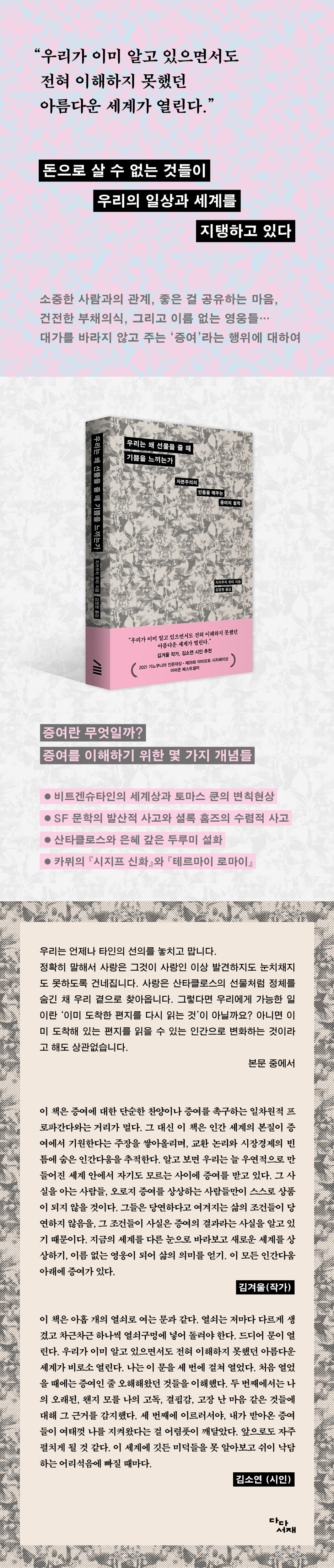
Publisher's Review
Things that money can't buy
Supporting our daily lives and the world
Relationships with loved ones, the heart to share good things,
A healthy sense of debt, and unsung heroes...
About the act of ‘donation’, which is giving without expecting anything in return
Strongly recommended by author Kim Gyul-wool and poet Kim So-yeon
2021 Kinokuniya Humanities Award · 29th Yamamoto Shichihei Award · Amazon Bestseller
Although we live in a capitalist society where everything becomes a commodity and all actions become a service, we know that there are things in this world that cannot be bought with money.
From secretly giving someone a gift to helping others while sacrificing your own interests.
"Why We Feel Joy When We Give Gifts" is a book written by an author who majored in Wittgenstein's philosophy. Through the process of uncovering the principle of "gift," which is something that cannot be bought with money, we understand the structure of this world and further awaken to the meaning of our lives and the lost possibilities.
The author approaches the essence of gifting based on a wide range of citations and interesting examples, including Wittgenstein's language games, Thomas Kuhn's anomalies, Mendeleev's periodic table, Camus's myth of Sisyphus, Sherlock Holmes's deductive techniques, and even the comic book Thermae Romae.
As the debut work of a young philosopher, it became a bestseller immediately after publication, sparking a local "donation craze" and receiving favorable reviews from both experts and readers, winning awards such as the Yamamoto Shichihei Award, the Kinokuniya Humanities Award, and the Readers' Choice Business Book Grand Prix in the liberal arts category.
A gift with a hidden sender and a message from the past
How does a donation begin and end?
What is a donation?
The book begins with philosopher Yuta Chikauchi discussing the principle of 'gift', a concept that is both familiar and unfamiliar.
Gifts are often referred to as legal terms such as ‘gift of property’ or ‘gift tax.’
The author first defines a gift as 'something that cannot be bought with money and its transfer.'
Moreover, donation is an act that is antithetical to the logic of exchange that drives the capitalist market economy and is not exchanged for a commodity.
But that alone cannot be considered complete justice.
To help readers understand the characteristics of gifting, such as "gifting must have a warrior," "it is impossible to be sure whether a gift will reach the recipient," and "gifting fails the moment you want immediate rewards and a sense of efficacy," the author takes a slow but interesting detour filled with scenery.
As readers read the author's extensive citations and diverse examples, they will soon come to understand what gifting is.
First, let's look at the following story.
A man's mother suffers from cognitive decline (dementia).
For some reason, my mother goes out every day at 4 p.m.
When the son tried to stop his mother from going out, the mother screamed and swung her fists.
The worried son sought advice from a veteran caregiver.
After hearing the story, the caregiver contacted the mother's older brother and asked if he knew about the time '4 p.m.'
After hearing the story, the mother's older brother answers.
“4 p.m. was the time my son got off the kindergarten bus when he was little.”
The above case clearly illustrates the meaning and principles of donation.
The mother was mistaken for 'wandering', a common symptom of cognitive decline, but in reality she lived in her own story of 'I can't leave my son alone'.
The gift of 'mother's love' reached the son across decades.
The mother's gift did not exist in this world until the son realized it.
A message is handed over by the sender without revealing his or her identity, and the recipient is unaware that he or she has received it, only to realize it later or after a long time has passed.
And after the recipient realizes that he has received it, he passes it on to someone else.
That's what a donation is.
The gifts from your parents that you only realize after you find out there's no Santa Claus, the moments when you realize how much love you received only after breaking up with someone.
A gift with a hidden sender and a letter that arrived late.
This is where understanding donation begins.
From Wittgenstein to Sherlock Holmes
A fascinating journey of knowledge that uncovers the true nature of gifts.
To prove the logic that 'a gift is only complete when the recipient discovers it', the author brings up Wittgenstein's 'language game'.
Language game is the concept that understanding a language is not about understanding its words, but about being able to use those words to communicate with others.
When someone says, “Close the window,” and another person closes the window, the child comes to understand the word “window” through that situation. This is learning based on language play.
The foundation of language play is ‘common sense’, what Wittgenstein calls ‘world view’.
For example, if a scale is not balanced when a 3-gram and a 5-gram weight are placed on one side and an 8-gram weight is placed on the other side (irrationality), we will realize that the scale is broken (discovery) without questioning whether '3+5=8' (our world view) is wrong.
Throughout the history of science, these irrational phenomena have led to numerous discoveries.
Mendeleev arranged the 63 elements and realized that the periodic table was incomplete (irrational), but he was confident in the periodic law (world view), so he published the periodic table leaving blank spaces for elements that had not yet been discovered.
Although he was ridiculed for this, later on, as Mendeleev had predicted, the elements in the blank space were discovered one after another.
The irrationality of the blank space in the periodic table led to the rationality of the discovery of various elements.
William Harvey also discovered a new worldview called the 'blood circulation theory' to rationally explain the fact that the heart pumps 6,000 kilograms of blood every day and the contradiction (irrationality) of the existing theory that blood is produced in the heart.
This irrationality, which Thomas Kuhn defined as an “anomaly,” serves to advance inquiry in the language game of science.
It's not just science.
Sherlock Holmes, a character created by author Arthur Conan Doyle, also detects anomalous phenomena and uncovers hidden truths based on the knowledge (world view) he has accumulated over many years.
When Holmes first meets his partner Watson, he deduces his occupation as a military doctor based on Watson's facial features (anomaly) of white wrists and a bronzed face and his knowledge (worldview) that the British Army fought in Afghanistan.
And let's go back to the anecdote of the '4 o'clock wandering' cited earlier.
The veteran caregiver who counseled the son determined that the mother's wandering was an anomalous phenomenon based on his professional knowledge.
A blank space on the periodic table, 6,000 kilograms of blood, a doctor with a sooty face, and a mother who goes out at a certain time.
The ability to perceive such anomalies is the ability to realize the gift.
The author continues his argument by mobilizing Thomas Kuhn's concepts of 'convergent thinking' and 'divergent thinking'.
The aforementioned Sherlock Holmes and the caregiver in 'The Four O'Clock Walk' are characters with convergent thinking abilities, which is a way of thinking that attempts to recognize and explain anomalous phenomena within the framework of common sense.
In contrast, divergent thinking is a way of thinking that 'questions common sense' and questions the worldview, and it becomes the basis of science fiction literature that destroys the worldview by describing events (anomalous phenomena) that could not possibly occur in reality.
Through convergent thinking, we can realize the anomalous phenomenon of gifting, and through divergent thinking, we can reconnect with this world we took for granted.
Gifts found in the chaos of everyday life, in the cracks of capitalism
How can we find meaning in our lives?
From power outages and shortages of essential goods to fires and crimes, we often find ourselves in situations where our stable daily lives are disrupted and thrown into disarray by sudden disruptions, large and small.
But isn't it true that our daily lives are in a precarious state of equilibrium, precariously balanced by invisible external forces?
The author speaks of the contributions of countless people who make our peaceful daily lives possible.
These are the 'unsung heroes', the hidden heroes who eliminate disasters and maintain society without anyone knowing.
The author says that only those who have realized the anomaly of our daily lives, which is an unstable equilibrium, by using various imaginations, such as the convergent/divergent thinking mentioned above, and only those who have recognized the existence of nameless heroes, can become another nameless hero and pass on the gift.
In a modern society where the logic of capitalist exchange is considered the truth of the world, and where even the extreme notion that "useless things have no reason to exist" is spreading, this book revives "gift," a social structure much older than capitalism.
The author emphasizes that the ethics of donation are never mired in idealism, but rather are values that coexist with capitalism and can only be born within the gaps of capitalism.
How can we realize the gifts we have received and become contributors of these gifts? How can we find meaning in life and fulfillment in our work? By the book's conclusion, we realize that the everyday lives we have lived and the conditions we have taken for granted are in fact the result of countless gifts received from the past.
The capitalist society, which we believed operated on the logic of exchange, was actually a world built on gifts, and that gifts were gifts given only to those who realized they were gifts.
Supporting our daily lives and the world
Relationships with loved ones, the heart to share good things,
A healthy sense of debt, and unsung heroes...
About the act of ‘donation’, which is giving without expecting anything in return
Strongly recommended by author Kim Gyul-wool and poet Kim So-yeon
2021 Kinokuniya Humanities Award · 29th Yamamoto Shichihei Award · Amazon Bestseller
Although we live in a capitalist society where everything becomes a commodity and all actions become a service, we know that there are things in this world that cannot be bought with money.
From secretly giving someone a gift to helping others while sacrificing your own interests.
"Why We Feel Joy When We Give Gifts" is a book written by an author who majored in Wittgenstein's philosophy. Through the process of uncovering the principle of "gift," which is something that cannot be bought with money, we understand the structure of this world and further awaken to the meaning of our lives and the lost possibilities.
The author approaches the essence of gifting based on a wide range of citations and interesting examples, including Wittgenstein's language games, Thomas Kuhn's anomalies, Mendeleev's periodic table, Camus's myth of Sisyphus, Sherlock Holmes's deductive techniques, and even the comic book Thermae Romae.
As the debut work of a young philosopher, it became a bestseller immediately after publication, sparking a local "donation craze" and receiving favorable reviews from both experts and readers, winning awards such as the Yamamoto Shichihei Award, the Kinokuniya Humanities Award, and the Readers' Choice Business Book Grand Prix in the liberal arts category.
A gift with a hidden sender and a message from the past
How does a donation begin and end?
What is a donation?
The book begins with philosopher Yuta Chikauchi discussing the principle of 'gift', a concept that is both familiar and unfamiliar.
Gifts are often referred to as legal terms such as ‘gift of property’ or ‘gift tax.’
The author first defines a gift as 'something that cannot be bought with money and its transfer.'
Moreover, donation is an act that is antithetical to the logic of exchange that drives the capitalist market economy and is not exchanged for a commodity.
But that alone cannot be considered complete justice.
To help readers understand the characteristics of gifting, such as "gifting must have a warrior," "it is impossible to be sure whether a gift will reach the recipient," and "gifting fails the moment you want immediate rewards and a sense of efficacy," the author takes a slow but interesting detour filled with scenery.
As readers read the author's extensive citations and diverse examples, they will soon come to understand what gifting is.
First, let's look at the following story.
A man's mother suffers from cognitive decline (dementia).
For some reason, my mother goes out every day at 4 p.m.
When the son tried to stop his mother from going out, the mother screamed and swung her fists.
The worried son sought advice from a veteran caregiver.
After hearing the story, the caregiver contacted the mother's older brother and asked if he knew about the time '4 p.m.'
After hearing the story, the mother's older brother answers.
“4 p.m. was the time my son got off the kindergarten bus when he was little.”
The above case clearly illustrates the meaning and principles of donation.
The mother was mistaken for 'wandering', a common symptom of cognitive decline, but in reality she lived in her own story of 'I can't leave my son alone'.
The gift of 'mother's love' reached the son across decades.
The mother's gift did not exist in this world until the son realized it.
A message is handed over by the sender without revealing his or her identity, and the recipient is unaware that he or she has received it, only to realize it later or after a long time has passed.
And after the recipient realizes that he has received it, he passes it on to someone else.
That's what a donation is.
The gifts from your parents that you only realize after you find out there's no Santa Claus, the moments when you realize how much love you received only after breaking up with someone.
A gift with a hidden sender and a letter that arrived late.
This is where understanding donation begins.
From Wittgenstein to Sherlock Holmes
A fascinating journey of knowledge that uncovers the true nature of gifts.
To prove the logic that 'a gift is only complete when the recipient discovers it', the author brings up Wittgenstein's 'language game'.
Language game is the concept that understanding a language is not about understanding its words, but about being able to use those words to communicate with others.
When someone says, “Close the window,” and another person closes the window, the child comes to understand the word “window” through that situation. This is learning based on language play.
The foundation of language play is ‘common sense’, what Wittgenstein calls ‘world view’.
For example, if a scale is not balanced when a 3-gram and a 5-gram weight are placed on one side and an 8-gram weight is placed on the other side (irrationality), we will realize that the scale is broken (discovery) without questioning whether '3+5=8' (our world view) is wrong.
Throughout the history of science, these irrational phenomena have led to numerous discoveries.
Mendeleev arranged the 63 elements and realized that the periodic table was incomplete (irrational), but he was confident in the periodic law (world view), so he published the periodic table leaving blank spaces for elements that had not yet been discovered.
Although he was ridiculed for this, later on, as Mendeleev had predicted, the elements in the blank space were discovered one after another.
The irrationality of the blank space in the periodic table led to the rationality of the discovery of various elements.
William Harvey also discovered a new worldview called the 'blood circulation theory' to rationally explain the fact that the heart pumps 6,000 kilograms of blood every day and the contradiction (irrationality) of the existing theory that blood is produced in the heart.
This irrationality, which Thomas Kuhn defined as an “anomaly,” serves to advance inquiry in the language game of science.
It's not just science.
Sherlock Holmes, a character created by author Arthur Conan Doyle, also detects anomalous phenomena and uncovers hidden truths based on the knowledge (world view) he has accumulated over many years.
When Holmes first meets his partner Watson, he deduces his occupation as a military doctor based on Watson's facial features (anomaly) of white wrists and a bronzed face and his knowledge (worldview) that the British Army fought in Afghanistan.
And let's go back to the anecdote of the '4 o'clock wandering' cited earlier.
The veteran caregiver who counseled the son determined that the mother's wandering was an anomalous phenomenon based on his professional knowledge.
A blank space on the periodic table, 6,000 kilograms of blood, a doctor with a sooty face, and a mother who goes out at a certain time.
The ability to perceive such anomalies is the ability to realize the gift.
The author continues his argument by mobilizing Thomas Kuhn's concepts of 'convergent thinking' and 'divergent thinking'.
The aforementioned Sherlock Holmes and the caregiver in 'The Four O'Clock Walk' are characters with convergent thinking abilities, which is a way of thinking that attempts to recognize and explain anomalous phenomena within the framework of common sense.
In contrast, divergent thinking is a way of thinking that 'questions common sense' and questions the worldview, and it becomes the basis of science fiction literature that destroys the worldview by describing events (anomalous phenomena) that could not possibly occur in reality.
Through convergent thinking, we can realize the anomalous phenomenon of gifting, and through divergent thinking, we can reconnect with this world we took for granted.
Gifts found in the chaos of everyday life, in the cracks of capitalism
How can we find meaning in our lives?
From power outages and shortages of essential goods to fires and crimes, we often find ourselves in situations where our stable daily lives are disrupted and thrown into disarray by sudden disruptions, large and small.
But isn't it true that our daily lives are in a precarious state of equilibrium, precariously balanced by invisible external forces?
The author speaks of the contributions of countless people who make our peaceful daily lives possible.
These are the 'unsung heroes', the hidden heroes who eliminate disasters and maintain society without anyone knowing.
The author says that only those who have realized the anomaly of our daily lives, which is an unstable equilibrium, by using various imaginations, such as the convergent/divergent thinking mentioned above, and only those who have recognized the existence of nameless heroes, can become another nameless hero and pass on the gift.
In a modern society where the logic of capitalist exchange is considered the truth of the world, and where even the extreme notion that "useless things have no reason to exist" is spreading, this book revives "gift," a social structure much older than capitalism.
The author emphasizes that the ethics of donation are never mired in idealism, but rather are values that coexist with capitalism and can only be born within the gaps of capitalism.
How can we realize the gifts we have received and become contributors of these gifts? How can we find meaning in life and fulfillment in our work? By the book's conclusion, we realize that the everyday lives we have lived and the conditions we have taken for granted are in fact the result of countless gifts received from the past.
The capitalist society, which we believed operated on the logic of exchange, was actually a world built on gifts, and that gifts were gifts given only to those who realized they were gifts.
GOODS SPECIFICS
- Date of issue: May 23, 2025
- Page count, weight, size: 280 pages | 330g | 128*205*20mm
- ISBN13: 9791191716405
- ISBN10: 1191716406
You may also like
카테고리
korean


korean

![GQ KOREA Mark (Monthly): December [2025]](http://librairie.coreenne.fr/cdn/shop/files/8ef265dbbfbf186523ed75ba7319009d.jpg?v=1765340328&width=3840)


