

Why do I treat myself so badly?
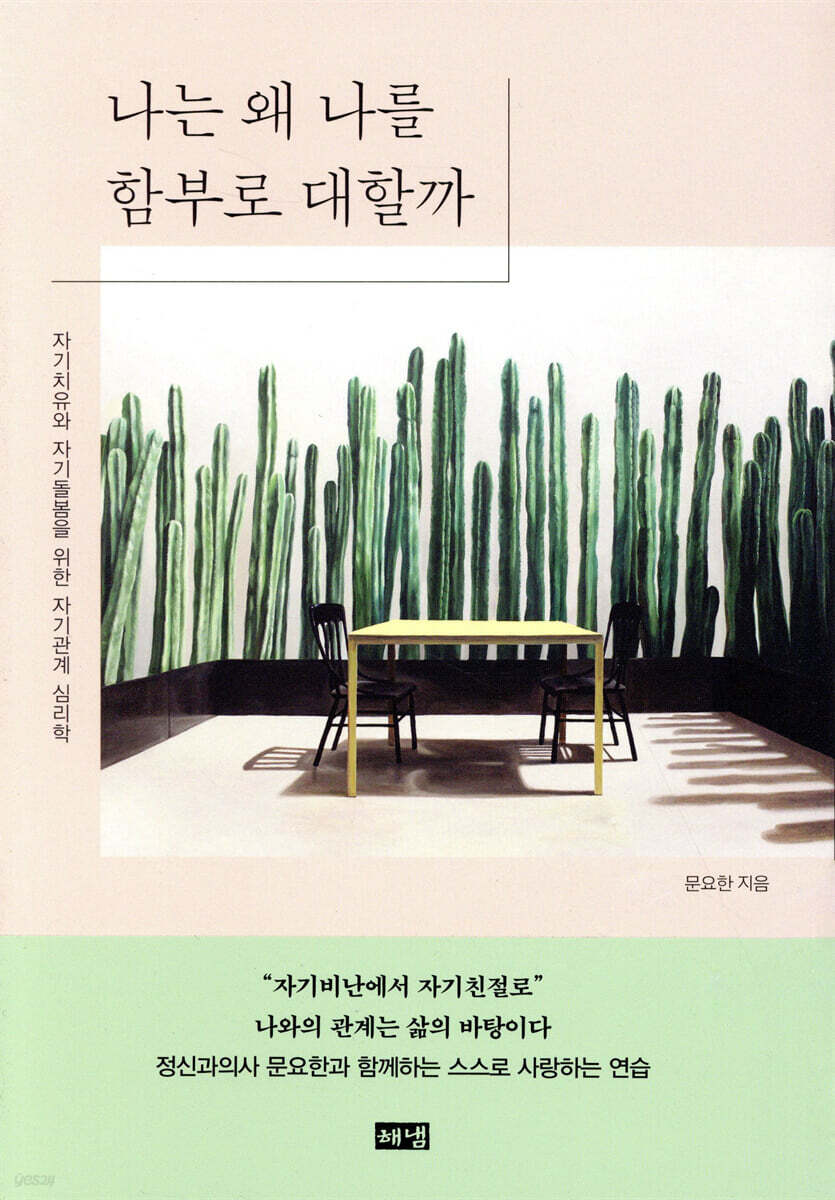 |
Description
Book Introduction
“A person who knows how to take care of himself is an adult.”
To you who are always stuck in a vicious cycle of self-criticism and self-reproach and regret
The wisdom of self-care from psychiatrist Moon Yo-han
There are people who hate and dislike themselves.
They criticize their own little mistakes or faults and constantly push themselves to appear better.
If you repeat these behaviors of being at odds with yourself and causing yourself pain, it can easily lead to mental problems such as burnout and obsessive-compulsive disorder.
Eventually, it becomes difficult to even live a normal life.
How can I restore my relationship with myself?
Psychiatrist Moon Yo-han has been studying psychological healing methods that integrate body and mind, focusing on human change and growth.
Through counseling for over 25 years, I have listened to the pain of many people and realized that various psychological problems and suffering stem from not being kind to oneself.
He too has been focusing on his own shortcomings for a long time, tormenting himself and trying to heal them.
As part of that effort, over the past decade, we have developed various programs, including psychological workshops and walking counseling, to help not only ourselves but also others.
By incorporating the author's intimate experiences, various psychological studies, and practical techniques into his new book, "Why Do I Treat Myself Rudely," he aims to fully present the "psychology of the self-regulatory system."
Author Moon Yo-han emphasizes that taking care of oneself is a prerequisite for living a healthy and happy life.
Self-care means 'taking care of one's own body and mind and becoming the main character who cultivates a beautiful life', and includes physical care as well as emotional, relationship, and spiritual care.
It refers to the overall process of feeling compassion for one's own pain through dialogue with oneself, respecting oneself within it, and showing kindness so that one can escape from it.
It is also a process of becoming a warm inner friend to yourself.
To you who are always stuck in a vicious cycle of self-criticism and self-reproach and regret
The wisdom of self-care from psychiatrist Moon Yo-han
There are people who hate and dislike themselves.
They criticize their own little mistakes or faults and constantly push themselves to appear better.
If you repeat these behaviors of being at odds with yourself and causing yourself pain, it can easily lead to mental problems such as burnout and obsessive-compulsive disorder.
Eventually, it becomes difficult to even live a normal life.
How can I restore my relationship with myself?
Psychiatrist Moon Yo-han has been studying psychological healing methods that integrate body and mind, focusing on human change and growth.
Through counseling for over 25 years, I have listened to the pain of many people and realized that various psychological problems and suffering stem from not being kind to oneself.
He too has been focusing on his own shortcomings for a long time, tormenting himself and trying to heal them.
As part of that effort, over the past decade, we have developed various programs, including psychological workshops and walking counseling, to help not only ourselves but also others.
By incorporating the author's intimate experiences, various psychological studies, and practical techniques into his new book, "Why Do I Treat Myself Rudely," he aims to fully present the "psychology of the self-regulatory system."
Author Moon Yo-han emphasizes that taking care of oneself is a prerequisite for living a healthy and happy life.
Self-care means 'taking care of one's own body and mind and becoming the main character who cultivates a beautiful life', and includes physical care as well as emotional, relationship, and spiritual care.
It refers to the overall process of feeling compassion for one's own pain through dialogue with oneself, respecting oneself within it, and showing kindness so that one can escape from it.
It is also a process of becoming a warm inner friend to yourself.
- You can preview some of the book's contents.
Preview
index
Prologue: To you who treats yourself harshly and regrets it
Chapter 1 Talking to Yourself Why do I treat myself this way?
1.
I can't stand seeing you do nothing
2.
Why She Can't Accept Compliments
3.
You idiot, you shouldn't have done that.
4.
I won't live the way you want me to
5.
People who are too self-absorbed
6.
I don't care what happens.
As long as you do well!
7.
Everyone hates me
8.
Am I a flawed being from the beginning?
Chapter 2 Understanding Your Relationship with Yourself Why Do You Torment Yourself?
1.
Shame attack, I just want to hide
2.
Attachment damage: I grew up being loved, but now I have a lack of affection!
3.
Negative childhood experiences: My childhood misfortunes are holding me back.
4.
Irrational Basic Belief: I am nothing
5.
Perfectionism: How long will I have to become a better me?
6.
Failure of self-regulation I hope it goes as I expected
7.
Deceiving me with a fake smile of emotional exhaustion
8.
I'm not that kind of person, I have a wounded heart.
Chapter 3: May you be kind to yourself even when it's hard to be friends with yourself.
1.
How did my parents treat me?
2.
Psychological base camp, safe base
3.
We need an intermediary to rely on.
4.
One person who will trust you unconditionally
5.
Should we live as we are or should we live by creating?
6.
Do you have a desire to do well?
7.
Respect what's inside me
8.
Become your own inner friend
Chapter 4: Self-Compassion: Take care of yourself as you would take care of someone you love.
1.
The closer the relationship, the greater the expectations.
2.
Compassion, the ultimate empathy
3.
It's not just me
4.
Expanding psychological perspective
5.
Don't fall into self-pity
6.
May I be free from pain and at ease
7.
Everyone has the right to be sick
8.
Hug me and pat me
Chapter 5: Self-Awareness: Let's take care of our body and mind first.
1.
Feel and express body sensations
2.
The mind is an object of observation and care.
3.
Moments of distraction are opportunities for mindfulness.
4.
When your heart wavers, support it with your body.
5.
Stay in the present experience
6.
Put parentheses in my heart
7.
Observing the pain of the mind
8.
Let's grow the brightness within me
Chapter 6: Self-Dialogue: Give yourself comfort and encouragement.
1.
How do I feel in the mirror?
2.
There is no such thing as a wrong being, there is just a wrong experience.
3.
Have an inner observer
4.
It's okay, it can be done!
5.
So that reflection does not become criticism
6.
When you can even embrace self-criticism
7.
'It shakes but doesn't sink'
8.
Creating a Mantra of Self-Kindness in Your Daily Life
Chapter 7: Give Yourself the Gift of Vitality: Love, Learn, and Share
1.
Attention from the outside in
2.
Slow comfort, not instant comfort
3.
Caring for something is caring for myself
4.
Separate work and rest
5.
Identify and align your desires
6.
Balancing Joy and Pleasure
7.
Learning gives elasticity to life
8.
From 'It's okay' to 'I can do it'
Epilogue: Now, extend a warm hand to me.
References
Chapter 1 Talking to Yourself Why do I treat myself this way?
1.
I can't stand seeing you do nothing
2.
Why She Can't Accept Compliments
3.
You idiot, you shouldn't have done that.
4.
I won't live the way you want me to
5.
People who are too self-absorbed
6.
I don't care what happens.
As long as you do well!
7.
Everyone hates me
8.
Am I a flawed being from the beginning?
Chapter 2 Understanding Your Relationship with Yourself Why Do You Torment Yourself?
1.
Shame attack, I just want to hide
2.
Attachment damage: I grew up being loved, but now I have a lack of affection!
3.
Negative childhood experiences: My childhood misfortunes are holding me back.
4.
Irrational Basic Belief: I am nothing
5.
Perfectionism: How long will I have to become a better me?
6.
Failure of self-regulation I hope it goes as I expected
7.
Deceiving me with a fake smile of emotional exhaustion
8.
I'm not that kind of person, I have a wounded heart.
Chapter 3: May you be kind to yourself even when it's hard to be friends with yourself.
1.
How did my parents treat me?
2.
Psychological base camp, safe base
3.
We need an intermediary to rely on.
4.
One person who will trust you unconditionally
5.
Should we live as we are or should we live by creating?
6.
Do you have a desire to do well?
7.
Respect what's inside me
8.
Become your own inner friend
Chapter 4: Self-Compassion: Take care of yourself as you would take care of someone you love.
1.
The closer the relationship, the greater the expectations.
2.
Compassion, the ultimate empathy
3.
It's not just me
4.
Expanding psychological perspective
5.
Don't fall into self-pity
6.
May I be free from pain and at ease
7.
Everyone has the right to be sick
8.
Hug me and pat me
Chapter 5: Self-Awareness: Let's take care of our body and mind first.
1.
Feel and express body sensations
2.
The mind is an object of observation and care.
3.
Moments of distraction are opportunities for mindfulness.
4.
When your heart wavers, support it with your body.
5.
Stay in the present experience
6.
Put parentheses in my heart
7.
Observing the pain of the mind
8.
Let's grow the brightness within me
Chapter 6: Self-Dialogue: Give yourself comfort and encouragement.
1.
How do I feel in the mirror?
2.
There is no such thing as a wrong being, there is just a wrong experience.
3.
Have an inner observer
4.
It's okay, it can be done!
5.
So that reflection does not become criticism
6.
When you can even embrace self-criticism
7.
'It shakes but doesn't sink'
8.
Creating a Mantra of Self-Kindness in Your Daily Life
Chapter 7: Give Yourself the Gift of Vitality: Love, Learn, and Share
1.
Attention from the outside in
2.
Slow comfort, not instant comfort
3.
Caring for something is caring for myself
4.
Separate work and rest
5.
Identify and align your desires
6.
Balancing Joy and Pleasure
7.
Learning gives elasticity to life
8.
From 'It's okay' to 'I can do it'
Epilogue: Now, extend a warm hand to me.
References
Detailed image

Into the book
To you who treats yourself harshly and regrets it
The solution to restoring your relationship with yourself is to understand your relationship with yourself and be kind to yourself as a life partner.
This is what 'self-care' is.
We often tend to think of care as something weak.
I think it's something only children need.
However, humans need care throughout their lives.
Pain is a part of life, and we are vulnerable beings.
However, as you become an adult, the responsibility for care must gradually shift to you.
Development is the transfer of responsibility from parents to oneself.
But many fail to make that transition.
Still trying to depend on someone or fight instead of taking care of yourself.
Some people do not see care holistically and limit it to the physical aspect.
It's like parents who think that feeding, putting to bed, and bathing their children is all there is to caring for them.
However, humans need emotional care as well as physical care.
Furthermore, it is necessary to take care of relationships so that we can build good relationships with each other, and it is also important to take care of our souls so that we can live a vibrant life.
Care is holistic and comprehensive.
Therefore, the self-care discussed in this book can be simply said to be ‘becoming the subject of cultivating a beautiful life.’
---From the "Prologue"
“It shakes but doesn’t sink.”
Time to accept myself as I am and meet myself again
Hyunju blushes at the slightest mistake or error and doesn't know where to look.
To other people, it may be 'that's how people can be', but to me, it is not 'that's how it can be'.
Even when I make a small mistake, I feel so embarrassed that I just want to hide somewhere.
It feels like my shame has been exposed in front of people.
The bigger problem is that when someone shouts, I startle like a child and freeze.
For example, my current boss tends to get angry a lot.
It's not that I'm only angry at Hyun-joo, but at the entire team.
Rather than being scared, my colleagues think, 'Here he goes again,' and don't think much of it.
Of course, he only thinks that way inside, but he makes a serious expression in front of his boss.
However, Hyunju's reaction is quite different from her colleagues.
She is like that not only on the outside but also on the inside.
I get really nervous and freeze.
When her boss yells, “Why did you do it this way!” she has to explain, but her voice gets muffled and she stutters.
And then I always turn around and blame myself.
'I should have said it like this...
'I can't say anything like an idiot.'
---From "1-3 You idiot, you shouldn't have done that"
Shame is a convulsive emotion.
And it is a toxic emotion that leads to self-denial.
Of course, there is also a weaker form of shame.
For example, farting loudly in class or being corrected for a mistake in front of others.
This can be called a 'universal shame' that makes anyone want to hide when they are in that situation.
It's closer to what is commonly called 'embarrassment'.
The shame we are talking about here refers to the 'primal shame' that strikes us suddenly even when there is no major mistake or wrongdoing.
So what is primal shame? It refers to the feeling of self-denial that stems from damaged attachment.
Primal shame is an emotion that follows you throughout your life.
Other emotions come and go like clouds, but this emotion never goes away.
This is why childhood shame hardens into a fundamental emotion.
---From "2-1 Shame Attack_ I Just Want to Hide"
A broken heart works differently than a healthy heart.
To put it simply, it has the characteristics of '3P+1F'.
3P stands for ‘personalization’, ‘pervasiveness’, and ‘perpetuation’.
Personalization refers to thinking of all problems or events as related to oneself, while generalization refers to expanding a part into the whole.
Personalization and generalization are common mental traits seen in children.
This is because cognitive and emotional development has not yet been properly achieved.
However, adults with wounded hearts show these psychological characteristics more than children.
Permanence refers to the belief that something or a characteristic will continue without change.
I think some problems have been there from the beginning and will continue to be there in the future.
1F stands for fusion.
Fusion refers to making real the thoughts or feelings that arise in your mind.
That is, when something happens due to 3P, not only do you think that it is all your fault (personalization), that everything is a problem (generalization), and that it will continue to be like that (perpetuation), but you also believe (fusion) that such thoughts and feelings are true due to 1F.
So, I can't get out of that state of mind.
---From "2-8 Wounded Heart_ I'm not originally that kind of person"
Even adults have certain objects that they particularly prefer and hold in special regard.
It refers to an object of comfort and empathy beyond what one likes.
For adults, the target audience is much more diverse than for children.
It could be a doll or a figure, a well-worn desk or a favorite piece of clothing, a musical instrument or a car.
Or it may not be a thing.
It could be a pet like a dog or cat, an art like music or art that you have enjoyed for a long time, a favorite writer or celebrity, or a space like a cafe or mountain that you often visit.
I think the representative objects are nature and faith.
I have been providing counseling through walking in nature for about five years.
Because through my sabbatical year trip in 2014, I realized how healing nature is.
When I was young, the mountains were a training ground that pushed me, but when I became middle-aged, the mountains I encountered became like a mother who embraced me.
Every time I do a walking consultation, I feel that although it is a one-on-one consultation, it is never one-on-one.
I always get the feeling that the great being called 'nature' is participating as a co-healer.
---From "3-3 We need an intermediary to rely on"
It's no different for everyone to have to live with the pain of a life that doesn't go as planned.
But when we feel pain, we tend to lose our sense of connection and universality.
It seems like I'm the only one having a hard time, while everyone else seems to be living well without any problems.
This often comes across as a greater pain than the original pain.
What drives people to despair is not the pain itself, but the feeling that they are alone in that pain.
Humans are social beings to the core, to the point where the feeling of being alone is the greatest pain.
That's why the feeling that we are not alone in our suffering but connected to someone else is what lifts us up and keeps us going.
Of course, recognizing universal humanity does not make the original suffering disappear.
However, the secondary pain such as shame, resentment, and isolation that comes from suffering alone is alleviated.
---From "4-3 It's not just me"
How do you achieve psychological defusion? A simple method is to use parentheses in your mind.
There is a term used by ancient Greek skeptics called 'epoché'.
It means 'stop' or 'suspend judgment'.
Skeptics deny absolute truth and even solid knowledge because each person has different thoughts, positions, and conditions.
Epoche is translated into German as 'parenthesizing or bracketing'.
That is, it means first enclosing the area of the mind that corresponds to the judgment in parentheses.
And we look at it free from subjectivity and preconceptions.
It is to look at thoughts as thoughts, memories as memories, and imagination as imagination, without immediately realizing them as facts, as just a mental phenomenon.
Mindfulness is similar.
By putting parentheses in the mind rather than directly realizing it, we secure a distance from which we can examine the mind.
Now, let's put parentheses around the thoughts or judgments that automatically come to mind.
[The judgment that that person is looking at me in a bad way] [The thought that I have to do this now] [The judgment that I am a useless person] [The thought that it didn't work last time, so it won't work this time either] This is how you create parentheses in your mind.
---From "5-6 Putting Parentheses in My Heart"
Looking back, my early to mid 20s were the most difficult for me.
The times were bleak, but the fact that my close friends were going to school in Seoul and I was left alone in the countryside was also difficult.
But the most difficult thing was that I had no idea how to live my life after entering college.
It wasn't easy to figure out how to get along with people, what to do, or how to live.
It was like that throughout my first year.
Then I came across a sentence in a book.
The saying was, 'It shakes but doesn't sink.'
The original Latin text reads 'Fluctuat nec margitur'.
At that time, I think I probably felt like I was on a shipwreck that was about to sink.
That whole sentence anchored itself deep in my heart.
And it was a great comfort to me throughout my youth.
Before that, I couldn't even tolerate being shaken and I blamed myself, but after encountering that sentence, I was able to allow myself to be shaken.
If I had always urged myself to go the right way, I could have accepted that I might get lost or wander from now on.
The solution to restoring your relationship with yourself is to understand your relationship with yourself and be kind to yourself as a life partner.
This is what 'self-care' is.
We often tend to think of care as something weak.
I think it's something only children need.
However, humans need care throughout their lives.
Pain is a part of life, and we are vulnerable beings.
However, as you become an adult, the responsibility for care must gradually shift to you.
Development is the transfer of responsibility from parents to oneself.
But many fail to make that transition.
Still trying to depend on someone or fight instead of taking care of yourself.
Some people do not see care holistically and limit it to the physical aspect.
It's like parents who think that feeding, putting to bed, and bathing their children is all there is to caring for them.
However, humans need emotional care as well as physical care.
Furthermore, it is necessary to take care of relationships so that we can build good relationships with each other, and it is also important to take care of our souls so that we can live a vibrant life.
Care is holistic and comprehensive.
Therefore, the self-care discussed in this book can be simply said to be ‘becoming the subject of cultivating a beautiful life.’
---From the "Prologue"
“It shakes but doesn’t sink.”
Time to accept myself as I am and meet myself again
Hyunju blushes at the slightest mistake or error and doesn't know where to look.
To other people, it may be 'that's how people can be', but to me, it is not 'that's how it can be'.
Even when I make a small mistake, I feel so embarrassed that I just want to hide somewhere.
It feels like my shame has been exposed in front of people.
The bigger problem is that when someone shouts, I startle like a child and freeze.
For example, my current boss tends to get angry a lot.
It's not that I'm only angry at Hyun-joo, but at the entire team.
Rather than being scared, my colleagues think, 'Here he goes again,' and don't think much of it.
Of course, he only thinks that way inside, but he makes a serious expression in front of his boss.
However, Hyunju's reaction is quite different from her colleagues.
She is like that not only on the outside but also on the inside.
I get really nervous and freeze.
When her boss yells, “Why did you do it this way!” she has to explain, but her voice gets muffled and she stutters.
And then I always turn around and blame myself.
'I should have said it like this...
'I can't say anything like an idiot.'
---From "1-3 You idiot, you shouldn't have done that"
Shame is a convulsive emotion.
And it is a toxic emotion that leads to self-denial.
Of course, there is also a weaker form of shame.
For example, farting loudly in class or being corrected for a mistake in front of others.
This can be called a 'universal shame' that makes anyone want to hide when they are in that situation.
It's closer to what is commonly called 'embarrassment'.
The shame we are talking about here refers to the 'primal shame' that strikes us suddenly even when there is no major mistake or wrongdoing.
So what is primal shame? It refers to the feeling of self-denial that stems from damaged attachment.
Primal shame is an emotion that follows you throughout your life.
Other emotions come and go like clouds, but this emotion never goes away.
This is why childhood shame hardens into a fundamental emotion.
---From "2-1 Shame Attack_ I Just Want to Hide"
A broken heart works differently than a healthy heart.
To put it simply, it has the characteristics of '3P+1F'.
3P stands for ‘personalization’, ‘pervasiveness’, and ‘perpetuation’.
Personalization refers to thinking of all problems or events as related to oneself, while generalization refers to expanding a part into the whole.
Personalization and generalization are common mental traits seen in children.
This is because cognitive and emotional development has not yet been properly achieved.
However, adults with wounded hearts show these psychological characteristics more than children.
Permanence refers to the belief that something or a characteristic will continue without change.
I think some problems have been there from the beginning and will continue to be there in the future.
1F stands for fusion.
Fusion refers to making real the thoughts or feelings that arise in your mind.
That is, when something happens due to 3P, not only do you think that it is all your fault (personalization), that everything is a problem (generalization), and that it will continue to be like that (perpetuation), but you also believe (fusion) that such thoughts and feelings are true due to 1F.
So, I can't get out of that state of mind.
---From "2-8 Wounded Heart_ I'm not originally that kind of person"
Even adults have certain objects that they particularly prefer and hold in special regard.
It refers to an object of comfort and empathy beyond what one likes.
For adults, the target audience is much more diverse than for children.
It could be a doll or a figure, a well-worn desk or a favorite piece of clothing, a musical instrument or a car.
Or it may not be a thing.
It could be a pet like a dog or cat, an art like music or art that you have enjoyed for a long time, a favorite writer or celebrity, or a space like a cafe or mountain that you often visit.
I think the representative objects are nature and faith.
I have been providing counseling through walking in nature for about five years.
Because through my sabbatical year trip in 2014, I realized how healing nature is.
When I was young, the mountains were a training ground that pushed me, but when I became middle-aged, the mountains I encountered became like a mother who embraced me.
Every time I do a walking consultation, I feel that although it is a one-on-one consultation, it is never one-on-one.
I always get the feeling that the great being called 'nature' is participating as a co-healer.
---From "3-3 We need an intermediary to rely on"
It's no different for everyone to have to live with the pain of a life that doesn't go as planned.
But when we feel pain, we tend to lose our sense of connection and universality.
It seems like I'm the only one having a hard time, while everyone else seems to be living well without any problems.
This often comes across as a greater pain than the original pain.
What drives people to despair is not the pain itself, but the feeling that they are alone in that pain.
Humans are social beings to the core, to the point where the feeling of being alone is the greatest pain.
That's why the feeling that we are not alone in our suffering but connected to someone else is what lifts us up and keeps us going.
Of course, recognizing universal humanity does not make the original suffering disappear.
However, the secondary pain such as shame, resentment, and isolation that comes from suffering alone is alleviated.
---From "4-3 It's not just me"
How do you achieve psychological defusion? A simple method is to use parentheses in your mind.
There is a term used by ancient Greek skeptics called 'epoché'.
It means 'stop' or 'suspend judgment'.
Skeptics deny absolute truth and even solid knowledge because each person has different thoughts, positions, and conditions.
Epoche is translated into German as 'parenthesizing or bracketing'.
That is, it means first enclosing the area of the mind that corresponds to the judgment in parentheses.
And we look at it free from subjectivity and preconceptions.
It is to look at thoughts as thoughts, memories as memories, and imagination as imagination, without immediately realizing them as facts, as just a mental phenomenon.
Mindfulness is similar.
By putting parentheses in the mind rather than directly realizing it, we secure a distance from which we can examine the mind.
Now, let's put parentheses around the thoughts or judgments that automatically come to mind.
[The judgment that that person is looking at me in a bad way] [The thought that I have to do this now] [The judgment that I am a useless person] [The thought that it didn't work last time, so it won't work this time either] This is how you create parentheses in your mind.
---From "5-6 Putting Parentheses in My Heart"
Looking back, my early to mid 20s were the most difficult for me.
The times were bleak, but the fact that my close friends were going to school in Seoul and I was left alone in the countryside was also difficult.
But the most difficult thing was that I had no idea how to live my life after entering college.
It wasn't easy to figure out how to get along with people, what to do, or how to live.
It was like that throughout my first year.
Then I came across a sentence in a book.
The saying was, 'It shakes but doesn't sink.'
The original Latin text reads 'Fluctuat nec margitur'.
At that time, I think I probably felt like I was on a shipwreck that was about to sink.
That whole sentence anchored itself deep in my heart.
And it was a great comfort to me throughout my youth.
Before that, I couldn't even tolerate being shaken and I blamed myself, but after encountering that sentence, I was able to allow myself to be shaken.
If I had always urged myself to go the right way, I could have accepted that I might get lost or wander from now on.
---From "6-7 'Shaking but not sinking'"
Publisher's Review
You are not a bad person.
There are just bad experiences
As we grow up, we all experience repeated threats to our survival due to our social and personal care environments.
When that experience becomes embedded in a wounded mind, it creates core emotions of 'shame, guilt, and helplessness', which have a lasting negative impact on a person's thoughts and actions.
Because you cannot distinguish between yourself and the problems you face, your relationship with yourself becomes worse, and this is directly transferred to your relationships with others, amplifying the conflict.
To get out of this situation, it is urgent to restore your relationship with yourself, and the representative method for doing so is self-care.
This book is divided into seven chapters and guides you through understanding the structure and workings of the mind, and how to observe and respect your own mind.
Chapter 1 examines the phenomena that arise from a lack of self-care, such as 'recognition obsession, resistance to expectations, self-absorption, and self-deprecation.'
Chapter 2 examines the background of wounded hearts, including 'shame attacks, attachment damage, and negative childhood experiences.'
Chapter 3 demonstrates that we can break the cycle of trauma and achieve our own stability through the theories of attachment and resilience.
Chapter 4 introduces self-compassion, the first step toward feeling, understanding, and overcoming one's own pain.
Chapter 5 introduces mindfulness and body awareness techniques that help you express your feelings in concrete terms and maintain an appropriate distance from your mind.
Chapter 6 teaches you how to be kind and considerate to yourself so that your reflection doesn't become judgmental.
Chapter 7 emphasizes that the best self-care is growing into a better person, and encourages finding activities that energize your life.
We need care throughout our lives
Care is needed not only for children but also for adults.
However, as you grow, you must become the subject of that care.
This book demonstrates the impact of self-care on mental health and overall life through psychological and sociological research, and examines the psychological factors behind behavioral symptoms such as self-blame, addiction, narcissism, and perfectionism from a psychiatric perspective.
Above all, the author emphasizes that giving yourself warm attention is the beginning of self-care.
To achieve this, we recommend simple, effective methods such as grounding, which involves observing the mind in a stable position; parenthesizing, which involves stopping habitual thoughts or judgments from occurring; and reciting self-kindness phrases whenever criticism arises.
In recent years, uncontrollable situations have increased and a fiercely competitive environment has raised red flags about individuals' stress and mental health.
This book is a popular psychology textbook on 'self-care' that guides you on the path to reconciliation with yourself and growth as your true self through vivid examples and theories.
It will give you time to look at your relationship with yourself in a new way, and above all, it will encourage you to tell yourself, "It's okay, that can happen" when times are tough.
There are just bad experiences
As we grow up, we all experience repeated threats to our survival due to our social and personal care environments.
When that experience becomes embedded in a wounded mind, it creates core emotions of 'shame, guilt, and helplessness', which have a lasting negative impact on a person's thoughts and actions.
Because you cannot distinguish between yourself and the problems you face, your relationship with yourself becomes worse, and this is directly transferred to your relationships with others, amplifying the conflict.
To get out of this situation, it is urgent to restore your relationship with yourself, and the representative method for doing so is self-care.
This book is divided into seven chapters and guides you through understanding the structure and workings of the mind, and how to observe and respect your own mind.
Chapter 1 examines the phenomena that arise from a lack of self-care, such as 'recognition obsession, resistance to expectations, self-absorption, and self-deprecation.'
Chapter 2 examines the background of wounded hearts, including 'shame attacks, attachment damage, and negative childhood experiences.'
Chapter 3 demonstrates that we can break the cycle of trauma and achieve our own stability through the theories of attachment and resilience.
Chapter 4 introduces self-compassion, the first step toward feeling, understanding, and overcoming one's own pain.
Chapter 5 introduces mindfulness and body awareness techniques that help you express your feelings in concrete terms and maintain an appropriate distance from your mind.
Chapter 6 teaches you how to be kind and considerate to yourself so that your reflection doesn't become judgmental.
Chapter 7 emphasizes that the best self-care is growing into a better person, and encourages finding activities that energize your life.
We need care throughout our lives
Care is needed not only for children but also for adults.
However, as you grow, you must become the subject of that care.
This book demonstrates the impact of self-care on mental health and overall life through psychological and sociological research, and examines the psychological factors behind behavioral symptoms such as self-blame, addiction, narcissism, and perfectionism from a psychiatric perspective.
Above all, the author emphasizes that giving yourself warm attention is the beginning of self-care.
To achieve this, we recommend simple, effective methods such as grounding, which involves observing the mind in a stable position; parenthesizing, which involves stopping habitual thoughts or judgments from occurring; and reciting self-kindness phrases whenever criticism arises.
In recent years, uncontrollable situations have increased and a fiercely competitive environment has raised red flags about individuals' stress and mental health.
This book is a popular psychology textbook on 'self-care' that guides you on the path to reconciliation with yourself and growth as your true self through vivid examples and theories.
It will give you time to look at your relationship with yourself in a new way, and above all, it will encourage you to tell yourself, "It's okay, that can happen" when times are tough.
GOODS SPECIFICS
- Date of issue: June 30, 2022
- Page count, weight, size: 288 pages | 386g | 145*210*15mm
- ISBN13: 9791167140401
- ISBN10: 1167140400
You may also like
카테고리
korean


korean

![GQ KOREA Mark (Monthly): December [2025]](http://librairie.coreenne.fr/cdn/shop/files/8ef265dbbfbf186523ed75ba7319009d.jpg?v=1765340328&width=3840)


