

The power of the first sentence
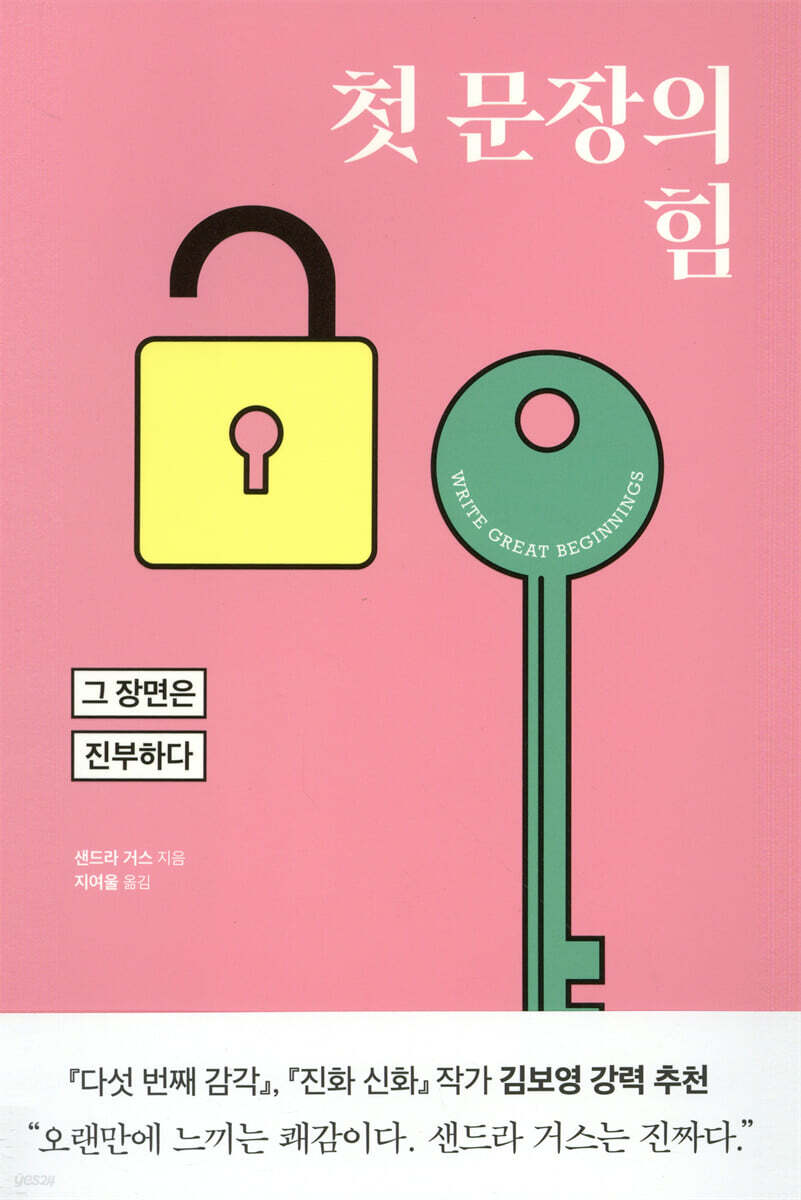 |
Description
Book Introduction
“It’s a pleasure I haven’t felt in a long time.
Sandra Guss is real”
_Highly recommended by novelist Kim Bo-young!
The secret to a story you'll want to keep reading
The final installment of the "How to Turn Your Writing into a Work of Art" series.
A steady-selling series in the writing field from the #1 Amazon bestselling author and editor.
"The Power of the First Sentence" is a writing guide for the "beginning" of a story, from the first word of the story to the protagonist's decision to pursue his goal.
The 'real' story begins the moment Holmes accepts the case in [Sherlock Holmes], the moment Katniss volunteers as a tribute in [The Hunger Games], and the moment Potter boards the train to the magic school in [Harry Potter].
But what if the reader closes the book before Sherlock and Watson meet? What if Potter closes the book before boarding the train? What if he leaves the movie theater before Marlin overcomes his fear and sets out to find his lost Nemo? Just think about it.
How do these works naturally and engagingly convey characters, background information, and atmosphere? Amazon's #1 bestselling author Sandra Guss reveals the secrets hidden in the beginnings of great stories, citing exemplary examples from dozens of her novels and other internationally beloved works.
And as a senior editor at a literary publishing house, I analyzed the fatal flaws in the manuscripts I reviewed, especially those that were rejected, and compiled a list of mistakes many writers make.
This book introduces four essential plot points that must be addressed at the beginning of the story.
Furthermore, it provides specific suggestions on how to polish the book into an engaging scene that will keep readers and editors glued to the book.
How do you effectively introduce your protagonist and world without overwhelming them with information? How do you engage your readers emotionally? What are the genre-specific considerations? How do you engage them emotionally? This book covers everything from how to write a draft tailored to your style, to how to analyze other works with a writer's perspective, to how to revise, to how to avoid genre-specific clichés, and yet still attract a loyal readership within your genre. This book contains tips for becoming a true master of the opening.
Remember.
The reader can close the book at any time.
Don't let your readers sleep in when they have to wake up early tomorrow morning to go to school or work! That's a writer's most important duty.
Sandra Guss is real”
_Highly recommended by novelist Kim Bo-young!
The secret to a story you'll want to keep reading
The final installment of the "How to Turn Your Writing into a Work of Art" series.
A steady-selling series in the writing field from the #1 Amazon bestselling author and editor.
"The Power of the First Sentence" is a writing guide for the "beginning" of a story, from the first word of the story to the protagonist's decision to pursue his goal.
The 'real' story begins the moment Holmes accepts the case in [Sherlock Holmes], the moment Katniss volunteers as a tribute in [The Hunger Games], and the moment Potter boards the train to the magic school in [Harry Potter].
But what if the reader closes the book before Sherlock and Watson meet? What if Potter closes the book before boarding the train? What if he leaves the movie theater before Marlin overcomes his fear and sets out to find his lost Nemo? Just think about it.
How do these works naturally and engagingly convey characters, background information, and atmosphere? Amazon's #1 bestselling author Sandra Guss reveals the secrets hidden in the beginnings of great stories, citing exemplary examples from dozens of her novels and other internationally beloved works.
And as a senior editor at a literary publishing house, I analyzed the fatal flaws in the manuscripts I reviewed, especially those that were rejected, and compiled a list of mistakes many writers make.
This book introduces four essential plot points that must be addressed at the beginning of the story.
Furthermore, it provides specific suggestions on how to polish the book into an engaging scene that will keep readers and editors glued to the book.
How do you effectively introduce your protagonist and world without overwhelming them with information? How do you engage your readers emotionally? What are the genre-specific considerations? How do you engage them emotionally? This book covers everything from how to write a draft tailored to your style, to how to analyze other works with a writer's perspective, to how to revise, to how to avoid genre-specific clichés, and yet still attract a loyal readership within your genre. This book contains tips for becoming a true master of the opening.
Remember.
The reader can close the book at any time.
Don't let your readers sleep in when they have to wake up early tomorrow morning to go to school or work! That's a writer's most important duty.
- You can preview some of the book's contents.
Preview
index
Introduction: Why Writing a Good Introduction is Essential for Your Novel
What is the introduction to Part 1?
Chapter 1 Definition: What is a Prologue?
Chapter 2: Drafts and Rewrites: Why You Don't Have to Write Perfectly the First Time
Part 2: Elements of a Great Introduction
Chapter 3, Act 3 Structure: How Understanding Narrative Structure Can Help You Write a Novel
Chapter 4 Plot Point 1 - The Everyday World: How to Introduce the Protagonist's Daily Life
Chapter 5 Plot Point 2 - Cataclysmic Events: How to Set the Plot in Motion
Chapter 6 Plot Point 3 - The Refusal of the Calling: How Does the Protagonist Respond to Cataclysmic Events?
Chapter 7 Plot Point 4 - The Point of No Return: How to Push a Character into Act 2
Part 3: What to Do to Write a Great Introduction
Chapter 8 Ten Tasks to Accomplish in Your Introduction: How to Write an Introduction That Captures Your Reader's Heart
Chapter 9, Task 1: How to Capture Your Reader's Heart
Chapter 10, Mission 2: Introducing the Main Character
Chapter 11, Mission 3: How to Start a Story in the Middle of an Incident
Chapter 12, Task 4: Setting the Tone, Setting Expectations
Chapter 13, Mission 5: How to Set Time and Space
Chapter 14, Task 6: Establishing a Point of View
Chapter 15, Mission 7: Introducing the Protagonist's Goals and Risks
Chapter 16, Mission 8: How to Create Conflict
Chapter 17, Task 9: Establishing the Protagonist's Character Trajectory
Chapter 18, Task 10: How to Hint at the Story's Ending
Part 4: Things to Avoid to Write a Great Introduction
Chapter 19: The Four Most Common Mistakes in Story Introductions: How to Avoid or Fix Common Pitfalls in Introductions
Chapter 20: The Overly Slow Introduction 1: How to Avoid Information Overload
Chapter 21: Overly Slow Prologue 2: How to Avoid Other Causes of Dragging Prologues
Chapter 22: Confusing Introductions: How to Avoid Confuse Your Reader
Chapter 23: Misleading Introductions: How to Keep Your Readers from Feeling Fooled
Chapter 24: Clichéd Introductions: How to Avoid Overused Introductions
Part 5: Three Types of Introductions to Avoid
Chapter 25: Prologue: Why You Should (Most Often) Avoid Prologues and How to Write One Effectively
Chapter 26: Flashbacks: Why You Shouldn't Put Flashbacks at the Beginning of Your Story
Chapter 27: Future Scenes: Why Starting a Book with a Future Scene Can Be Tricky
Conclusion: What to write now
What is the introduction to Part 1?
Chapter 1 Definition: What is a Prologue?
Chapter 2: Drafts and Rewrites: Why You Don't Have to Write Perfectly the First Time
Part 2: Elements of a Great Introduction
Chapter 3, Act 3 Structure: How Understanding Narrative Structure Can Help You Write a Novel
Chapter 4 Plot Point 1 - The Everyday World: How to Introduce the Protagonist's Daily Life
Chapter 5 Plot Point 2 - Cataclysmic Events: How to Set the Plot in Motion
Chapter 6 Plot Point 3 - The Refusal of the Calling: How Does the Protagonist Respond to Cataclysmic Events?
Chapter 7 Plot Point 4 - The Point of No Return: How to Push a Character into Act 2
Part 3: What to Do to Write a Great Introduction
Chapter 8 Ten Tasks to Accomplish in Your Introduction: How to Write an Introduction That Captures Your Reader's Heart
Chapter 9, Task 1: How to Capture Your Reader's Heart
Chapter 10, Mission 2: Introducing the Main Character
Chapter 11, Mission 3: How to Start a Story in the Middle of an Incident
Chapter 12, Task 4: Setting the Tone, Setting Expectations
Chapter 13, Mission 5: How to Set Time and Space
Chapter 14, Task 6: Establishing a Point of View
Chapter 15, Mission 7: Introducing the Protagonist's Goals and Risks
Chapter 16, Mission 8: How to Create Conflict
Chapter 17, Task 9: Establishing the Protagonist's Character Trajectory
Chapter 18, Task 10: How to Hint at the Story's Ending
Part 4: Things to Avoid to Write a Great Introduction
Chapter 19: The Four Most Common Mistakes in Story Introductions: How to Avoid or Fix Common Pitfalls in Introductions
Chapter 20: The Overly Slow Introduction 1: How to Avoid Information Overload
Chapter 21: Overly Slow Prologue 2: How to Avoid Other Causes of Dragging Prologues
Chapter 22: Confusing Introductions: How to Avoid Confuse Your Reader
Chapter 23: Misleading Introductions: How to Keep Your Readers from Feeling Fooled
Chapter 24: Clichéd Introductions: How to Avoid Overused Introductions
Part 5: Three Types of Introductions to Avoid
Chapter 25: Prologue: Why You Should (Most Often) Avoid Prologues and How to Write One Effectively
Chapter 26: Flashbacks: Why You Shouldn't Put Flashbacks at the Beginning of Your Story
Chapter 27: Future Scenes: Why Starting a Book with a Future Scene Can Be Tricky
Conclusion: What to write now
Detailed image

Into the book
I think you already know that it is important to write a good introduction.
---From the "first sentence"
Today's readers have short attention spans.
Readers today don't wait patiently for the first few chapters to see something interesting happen.
To convince a reader to buy your book or an editor to publish your manuscript, you have to win within the first page or two.
--- p.11
The introduction of the story begins with the first words of the novel and ends where the protagonist decides to pursue his goal.
For example, the moment a detective accepts a case in a murder mystery, the moment Katniss volunteers as a tribute in Suzanne Collins' The Hunger Games, or the moment Luke Skywalker decides to join the Rebel Alliance alongside Obi-Wan Kenobi in Star Wars: Episode IV - A New Hope.
--- p.20
The feeling of connection with the protagonist is what keeps the reader turning the pages, wanting to know what happens to the character.
--- p.40
It goes without saying that we cannot continue our daily lives indefinitely.
If no real change occurs, readers will quickly become bored.
There needs to be an event that disrupts the current status quo, pulls the protagonist out of safety, and moves the story forward.
--- p.47
But people are creatures of habit and do not like change.
That is why, in most cases, the protagonist does not respond to the call to action and tries not to break away from his everyday world.
For example, in Star Wars Episode IV: A New Hope, Luke Skywalker initially refuses to join the Rebel Alliance and follow Obi-Wan.
--- p.61
Once a question arises in our mind, we want to find out the answer to that question, and that is why we continue to read.
As a good example of this point, let's look at the first sentence of Andy Weir's The Martian:
I'm completely screwed
--- p.88
The antagonist must be introduced before the end of Act 1.
Even if the antagonist does not appear directly in Act 1, his or her existence must at least be hinted at in advance.
JK
Rowling did that with the Harry Potter series.
We don't meet Voldemort directly in Act 1 of Book 1, but we learn that he killed Harry's parents.
--- p.117
Science fiction, fantasy, and historical fiction are genres particularly prone to information overload.
Authors in this genre put a tremendous amount of effort into researching materials and creating a worldview, and when they write, they want to share the fruits of their labor with their readers.
--- p.174
Sometimes, to keep the reader entertained, the author goes to the other extreme and provides too little information, leaving the reader confused.
A confused reader is just as likely to put the book down and never pick it up again as a reader who finds the story boring.
--- p.212
Some introductions have been used so many times in countless books and movies that they have become clichés.
Among the clichéd introductions, there are some that contain the mistakes mentioned in the previous chapters.
For example, an introduction that begins a book with the protagonist dreaming, waking up, or going on a journey somewhere.
--- p.238
Once you've rewritten your manuscript to the best of your ability, it's time to get objective opinions.
Find two or three readers to read your manuscript and ask them to tell you what works and what doesn't.
---From the "first sentence"
Today's readers have short attention spans.
Readers today don't wait patiently for the first few chapters to see something interesting happen.
To convince a reader to buy your book or an editor to publish your manuscript, you have to win within the first page or two.
--- p.11
The introduction of the story begins with the first words of the novel and ends where the protagonist decides to pursue his goal.
For example, the moment a detective accepts a case in a murder mystery, the moment Katniss volunteers as a tribute in Suzanne Collins' The Hunger Games, or the moment Luke Skywalker decides to join the Rebel Alliance alongside Obi-Wan Kenobi in Star Wars: Episode IV - A New Hope.
--- p.20
The feeling of connection with the protagonist is what keeps the reader turning the pages, wanting to know what happens to the character.
--- p.40
It goes without saying that we cannot continue our daily lives indefinitely.
If no real change occurs, readers will quickly become bored.
There needs to be an event that disrupts the current status quo, pulls the protagonist out of safety, and moves the story forward.
--- p.47
But people are creatures of habit and do not like change.
That is why, in most cases, the protagonist does not respond to the call to action and tries not to break away from his everyday world.
For example, in Star Wars Episode IV: A New Hope, Luke Skywalker initially refuses to join the Rebel Alliance and follow Obi-Wan.
--- p.61
Once a question arises in our mind, we want to find out the answer to that question, and that is why we continue to read.
As a good example of this point, let's look at the first sentence of Andy Weir's The Martian:
I'm completely screwed
--- p.88
The antagonist must be introduced before the end of Act 1.
Even if the antagonist does not appear directly in Act 1, his or her existence must at least be hinted at in advance.
JK
Rowling did that with the Harry Potter series.
We don't meet Voldemort directly in Act 1 of Book 1, but we learn that he killed Harry's parents.
--- p.117
Science fiction, fantasy, and historical fiction are genres particularly prone to information overload.
Authors in this genre put a tremendous amount of effort into researching materials and creating a worldview, and when they write, they want to share the fruits of their labor with their readers.
--- p.174
Sometimes, to keep the reader entertained, the author goes to the other extreme and provides too little information, leaving the reader confused.
A confused reader is just as likely to put the book down and never pick it up again as a reader who finds the story boring.
--- p.212
Some introductions have been used so many times in countless books and movies that they have become clichés.
Among the clichéd introductions, there are some that contain the mistakes mentioned in the previous chapters.
For example, an introduction that begins a book with the protagonist dreaming, waking up, or going on a journey somewhere.
--- p.238
Once you've rewritten your manuscript to the best of your ability, it's time to get objective opinions.
Find two or three readers to read your manuscript and ask them to tell you what works and what doesn't.
--- p.276
Publisher's Review
Poetic descriptions, breathtaking chase scenes, heart-wrenching dialogue, and a twist-filled ending…
But nothing can exist before 'this'
The #1 Fatal Mistake Many Writers Make
Don't ruin your first encounter with your readers!
Whether you are a great writer, a new writer, or an aspiring writer, the moment you first meet your readers is the same.
This is the first sentence.
And it continues with the first paragraph, the first scene, the first chapter.
But many writers ruin this moment.
If you miss this first moment, you will never get a second chance.
Readers' shelves are full of interesting books they haven't read yet, and today's readers don't have the patience to wade through long descriptions and reams of information until the story is sufficiently engaging.
This is why Amazon's #1 bestselling novelist Sandra Guss published "The Power of the First Sentence" as the final installment in her "How to Become Your Own Writing" series.
This is because I have seen too many unfortunate writers who, despite having a lively writing style, unique characters, a twist-filled ending, and an insightful message, ultimately failed to win the hearts of readers.
He analyzed his own writing experience and classic and contemporary novels, films, and animations loved by readers around the world to devise ways to capture the reader's attention from the beginning of the story.
This isn't just a makeshift technique to fool the reader, but rather the true storyteller's technique of subtly pushing the reader between tightly woven sentences and meticulously calculated plots.
Let's open this book next to me and look at the file where my manuscript is stored, or the story I'm planning to write soon.
By the time you close the book, you'll have completed the "first" part of a wonderful work that will have readers turning the pages, forgetting they're going to school or work early the next morning.
The real magic of writing happens when you rewrite.
From how to read a work through the author's eyes to how to rewrite it
No matter how good the advice is, your writing skills only improve when you write it yourself, and your writing gets better with each revision.
"The Power of the First Sentence" is a book that will have a tremendous impact on anyone who has their own story in their folder or in their head.
It contains practical writing training methods that can be applied and revised on a case-by-case basis, as well as basic narrative operation methods.
First, let's start with the definition of 'introduction'.
And it introduces the four plots needed for a rush, the ten tasks the writer must accomplish, and the four traps to avoid.
To aid understanding, we cite world-renowned works and provide abundant practical examples.
We've added over 70 practice assignments to help you edit your own manuscripts.
It's as if a skilled literary editor is right there, pointing out mistakes as they happen, improving the quality of the work and stimulating the writer's creative motivation.
In fact, Sandra Guss works as a senior editor at a literary publishing house, and for this book, she revisited countless rejected manuscripts, meticulously cataloging the author's fatal mistakes.
Get this little editor by your side who knows how to nag you right now.
And prepare a new page and start writing for the manuscript I have written or will write in the future.
Let's start by revising the first sentence.
Establish four plot points and ground your readers in the characters and setting of your story.
Romance, thriller, fantasy… Readers have different expectations for each genre.
We must live up to their expectations while avoiding clichés.
Please refer to the prepared checklist.
Please reconsider whether you are being a useless writer.
The real magic of writing happens when you rewrite.
In an era where there are more writers than readers,
The best way to keep writing without getting lost
And how my writing becomes a work of art
In an age where people are more sensitive to images than text, the number of blog posts that were once thought to be lost is noticeably increasing.
Writing is the most accessible skill and can be used anywhere once learned, and it is also a basic means of self-expression.
There must be more than a few aspiring writers sitting at their desks after work today.
If you're still thinking about it, you can start with this book.
Start with the first sentence.
"The Power of the First Sentence" is a writing guide that can be applied to novels in a narrow sense and all narrative works in a broad sense.
When you look at writing guides that talk about 'structure' or 'plot', you might worry that your writing will be predictable.
But as the author emphasizes, this is not true.
Just as we are all the same human beings, yet we are all different, we can be different.
This book has been a proven bestseller in the writing field, helping many aspiring and new writers in the United States.
Kim Bo-young, one of director Bong Joon-ho's favorite writers and a writer who continues a unique lineage in Korean SF history, calls author Sandra Gerth "the real deal."
As he says, this book “gets you started writing right away.”
Start telling the story that is blooming in your head right now.
An idea is not a work of art.
If you've already started, this is your chance to perfect it.
Grab your reader's attention with a great introduction.
As the author says in every 'introduction' of his books, I hope you read happily and write happily!
But nothing can exist before 'this'
The #1 Fatal Mistake Many Writers Make
Don't ruin your first encounter with your readers!
Whether you are a great writer, a new writer, or an aspiring writer, the moment you first meet your readers is the same.
This is the first sentence.
And it continues with the first paragraph, the first scene, the first chapter.
But many writers ruin this moment.
If you miss this first moment, you will never get a second chance.
Readers' shelves are full of interesting books they haven't read yet, and today's readers don't have the patience to wade through long descriptions and reams of information until the story is sufficiently engaging.
This is why Amazon's #1 bestselling novelist Sandra Guss published "The Power of the First Sentence" as the final installment in her "How to Become Your Own Writing" series.
This is because I have seen too many unfortunate writers who, despite having a lively writing style, unique characters, a twist-filled ending, and an insightful message, ultimately failed to win the hearts of readers.
He analyzed his own writing experience and classic and contemporary novels, films, and animations loved by readers around the world to devise ways to capture the reader's attention from the beginning of the story.
This isn't just a makeshift technique to fool the reader, but rather the true storyteller's technique of subtly pushing the reader between tightly woven sentences and meticulously calculated plots.
Let's open this book next to me and look at the file where my manuscript is stored, or the story I'm planning to write soon.
By the time you close the book, you'll have completed the "first" part of a wonderful work that will have readers turning the pages, forgetting they're going to school or work early the next morning.
The real magic of writing happens when you rewrite.
From how to read a work through the author's eyes to how to rewrite it
No matter how good the advice is, your writing skills only improve when you write it yourself, and your writing gets better with each revision.
"The Power of the First Sentence" is a book that will have a tremendous impact on anyone who has their own story in their folder or in their head.
It contains practical writing training methods that can be applied and revised on a case-by-case basis, as well as basic narrative operation methods.
First, let's start with the definition of 'introduction'.
And it introduces the four plots needed for a rush, the ten tasks the writer must accomplish, and the four traps to avoid.
To aid understanding, we cite world-renowned works and provide abundant practical examples.
We've added over 70 practice assignments to help you edit your own manuscripts.
It's as if a skilled literary editor is right there, pointing out mistakes as they happen, improving the quality of the work and stimulating the writer's creative motivation.
In fact, Sandra Guss works as a senior editor at a literary publishing house, and for this book, she revisited countless rejected manuscripts, meticulously cataloging the author's fatal mistakes.
Get this little editor by your side who knows how to nag you right now.
And prepare a new page and start writing for the manuscript I have written or will write in the future.
Let's start by revising the first sentence.
Establish four plot points and ground your readers in the characters and setting of your story.
Romance, thriller, fantasy… Readers have different expectations for each genre.
We must live up to their expectations while avoiding clichés.
Please refer to the prepared checklist.
Please reconsider whether you are being a useless writer.
The real magic of writing happens when you rewrite.
In an era where there are more writers than readers,
The best way to keep writing without getting lost
And how my writing becomes a work of art
In an age where people are more sensitive to images than text, the number of blog posts that were once thought to be lost is noticeably increasing.
Writing is the most accessible skill and can be used anywhere once learned, and it is also a basic means of self-expression.
There must be more than a few aspiring writers sitting at their desks after work today.
If you're still thinking about it, you can start with this book.
Start with the first sentence.
"The Power of the First Sentence" is a writing guide that can be applied to novels in a narrow sense and all narrative works in a broad sense.
When you look at writing guides that talk about 'structure' or 'plot', you might worry that your writing will be predictable.
But as the author emphasizes, this is not true.
Just as we are all the same human beings, yet we are all different, we can be different.
This book has been a proven bestseller in the writing field, helping many aspiring and new writers in the United States.
Kim Bo-young, one of director Bong Joon-ho's favorite writers and a writer who continues a unique lineage in Korean SF history, calls author Sandra Gerth "the real deal."
As he says, this book “gets you started writing right away.”
Start telling the story that is blooming in your head right now.
An idea is not a work of art.
If you've already started, this is your chance to perfect it.
Grab your reader's attention with a great introduction.
As the author says in every 'introduction' of his books, I hope you read happily and write happily!
GOODS SPECIFICS
- Publication date: April 15, 2022
- Page count, weight, size: 280 pages | 364g | 135*205*16mm
- ISBN13: 9791155814604
You may also like
카테고리
korean


korean

![GQ KOREA Mark (Monthly): December [2025]](http://librairie.coreenne.fr/cdn/shop/files/8ef265dbbfbf186523ed75ba7319009d.jpg?v=1765340328&width=3840)


