

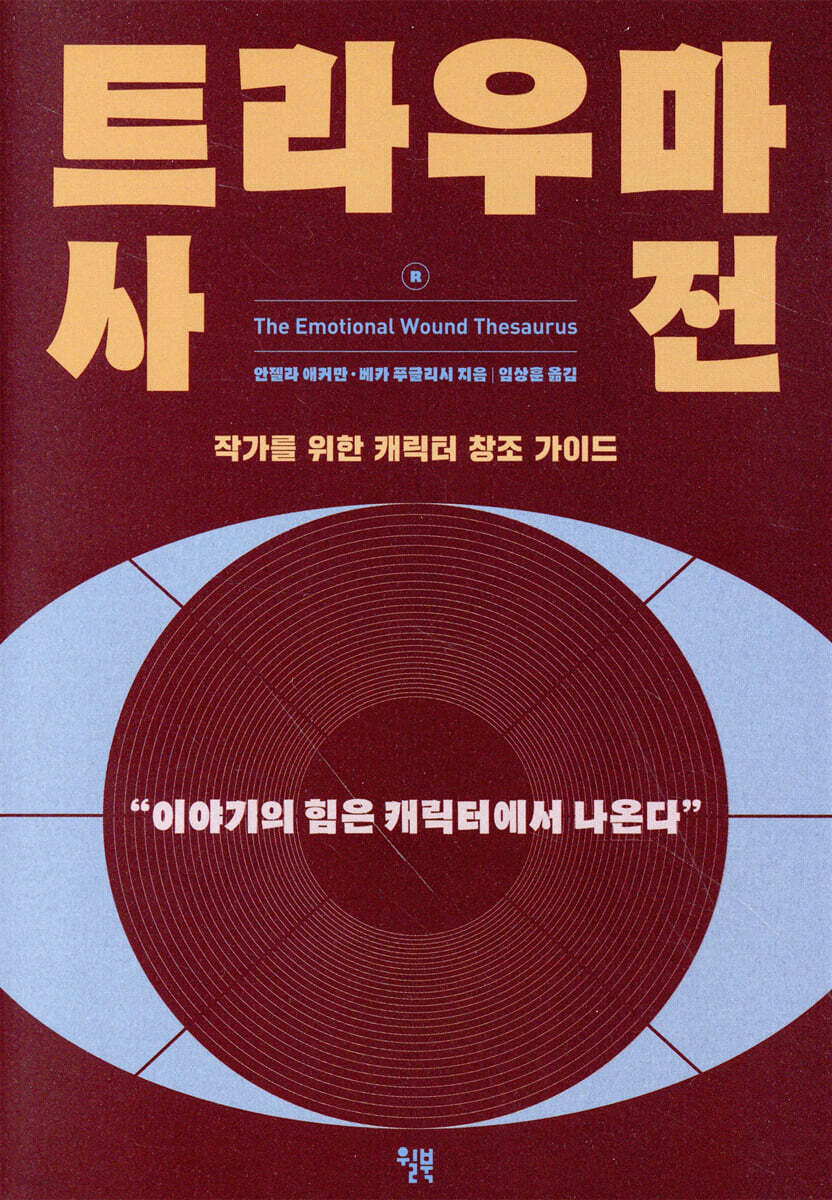
Trauma Dictionary
 |
Description
Book Introduction
A must-have book for any character creator.
Amazon's best-selling writing textbook, a college writing textbook for the US
Highly recommended by Duna (writer, film critic)
A book for anyone who creates stories.
This is a creative bible that helps not only established writers such as novelists, film and drama screenwriters, webtoon and web novel writers, but also anyone who wants to become a writer.
For writers struggling to make their stories shine and present vivid characters in an age of content overload, "The Trauma Dictionary" will serve as an excellent guide.
Angela Ackerman and Becca Puglisi, the authors behind the trusted website A Writer's Helping Writers, note that compelling characters always have trauma.
Wounds have the most powerful effect on a character's personality, behavior, and motivations.
Therefore, the author, as the creator, emphasizes that he must delve deeper into the wounds than anyone else and create characters with complex psychological layers, like real people.
Just as describing "bitten fingernails and bloodshot eyes" is more effective than saying, "I can't sleep because I'm anxious these days," the authors advise us to "show" rather than "tell" in our stories.
So how do we "show"? This dictionary, which compiles the details of various traumas, provides guidance.
This book is divided into two main parts and explains trauma research methods.
First, the first part is an overview of the character's trauma.
It delicately guides writers dealing with trauma on self-care methods for emotional health, and persuasively explains what character trauma is and why it is important to understand it.
The latter part introduces 118 types of trauma that a character can experience, and the resulting emotions and behaviors are grouped and conceptualized by topic, including events that can exacerbate the trauma and opportunities to overcome it.
It covers virtually every psychological experience humans experience, from betrayal by a friend to incurable illness, poverty, and terrorism, and is structured so that writers can keep it handy whenever they need it to build and flesh out their characters.
Do you want to create your own unique characters? Do you want to create relatable characters that readers can easily empathize with? "The Trauma Dictionary" will ignite your imagination.
Amazon's best-selling writing textbook, a college writing textbook for the US
Highly recommended by Duna (writer, film critic)
A book for anyone who creates stories.
This is a creative bible that helps not only established writers such as novelists, film and drama screenwriters, webtoon and web novel writers, but also anyone who wants to become a writer.
For writers struggling to make their stories shine and present vivid characters in an age of content overload, "The Trauma Dictionary" will serve as an excellent guide.
Angela Ackerman and Becca Puglisi, the authors behind the trusted website A Writer's Helping Writers, note that compelling characters always have trauma.
Wounds have the most powerful effect on a character's personality, behavior, and motivations.
Therefore, the author, as the creator, emphasizes that he must delve deeper into the wounds than anyone else and create characters with complex psychological layers, like real people.
Just as describing "bitten fingernails and bloodshot eyes" is more effective than saying, "I can't sleep because I'm anxious these days," the authors advise us to "show" rather than "tell" in our stories.
So how do we "show"? This dictionary, which compiles the details of various traumas, provides guidance.
This book is divided into two main parts and explains trauma research methods.
First, the first part is an overview of the character's trauma.
It delicately guides writers dealing with trauma on self-care methods for emotional health, and persuasively explains what character trauma is and why it is important to understand it.
The latter part introduces 118 types of trauma that a character can experience, and the resulting emotions and behaviors are grouped and conceptualized by topic, including events that can exacerbate the trauma and opportunities to overcome it.
It covers virtually every psychological experience humans experience, from betrayal by a friend to incurable illness, poverty, and terrorism, and is structured so that writers can keep it handy whenever they need it to build and flesh out their characters.
Do you want to create your own unique characters? Do you want to create relatable characters that readers can easily empathize with? "The Trauma Dictionary" will ignite your imagination.
- You can preview some of the book's contents.
Preview
index
Recommendation
introduction
Self-Care for Writers
What is emotional wound?
In-moon Ho
The Villain's Journey
Brainstorming about character wounds
Pain Runs Deep: Factors That Affect Hurt
Revealing your wounds through action
Problems to Avoid
Final words of advice
1.
betrayal
(Domestic violence/incest/being ostracized/being disappointed in a role model/being disappointed in an organization or social system you trusted/going bankrupt due to your spouse's irresponsibility/your spouse having an affair/discovering your spouse's secret sexual orientation/having two families/learning your parents are brutal criminals/getting heartbroken/having your ideas or achievements stolen/losing a loved one due to negligence at work/being abandoned due to an unexpected pregnancy/learning your child was abused/learning you were adopted/being sexually abused as a child by someone you know well/trusting the wrong person/being cut off from a relationship or being shunned/not accepting the truth/being betrayed by a sibling)
2.
crime victim
(Personal information theft/kidnapping/imprisonment/being treated as property/witnessing a murder/sexual assault/stalking/home invasion/carjacking/assault/unsolved damage cases)
3.
social injustice and personal suffering
(Poverty/Forced Deportation/Abuse of Power/Famine/Drought/Having an Unspeakable Secret/False Accusation/Inevitable Homelessness/Social Unrest/Malicious Rumors/Unjust Imprisonment/Group Bullying/Unrequited Love/Unfair Blaming for the Death of Another/Prejudice/Discrimination/Dismissal)
4.
failures and mistakes
(Public mistake/negligent homicide/extreme pressure/failing a grade/responsible for mass casualties/succumbing to peer pressure/serving time/failing to do the right thing/failing to save a life/erasing a child from one's life/poor judgment leading to a major accident/declared bankrupt)
5. Specific wounds from childhood
(Growing up in a family where emotional expression is suppressed/Born from rape/Growing up in the public eye/Being a wanderer/Growing up in an orphanage/Being abused by guardians/Being overprotective by parents/Being neglectful by parents/Being conditionally loving by parents/Being favored by one child/Being abandoned by parents/Growing up in the shadow of a successful sibling/Becoming the head of the household at a young age/Having parents die as a child/Witnessing violence as a child/Growing up in a high-crime area/Growing up with narcissistic parents/Growing up with siblings who are disabled or chronically ill/Growing up with addicted parents/Growing up with overly strict parents/Growing up separated from biological parents/Growing up in a cult/Always being left behind)
6.
unexpected mishap
(Be tortured/Be humiliated/Witness the death of another person/Have a child you were caring for die/Be in a life-threatening accident/Lose a loved one to indiscriminate violence/Your parents get divorced/Be diagnosed with a terminal illness/Be trapped in a collapsed building/Have a loved one commit suicide/Murder to survive/Be stranded in the same space as a corpse/Get divorced/Suffer a miscarriage/Stillbirth/Have an abortion/Have a child die/Give up a child for adoption/Experience a natural disaster/Man-made disaster/House fire/Get lost/Terrorism/School shooting)
7. Disability and aesthetic damage
(Chronic illness and pain/beauty that everyone looks back on/infertility/sexual dysfunction/speech impediment/loss of one of the five senses/disfigurement/traumatic brain injury/relationship problems/mental illness/loss of limbs/sub-average appearance/learning disabilities)
supplement
introduction
Self-Care for Writers
What is emotional wound?
In-moon Ho
The Villain's Journey
Brainstorming about character wounds
Pain Runs Deep: Factors That Affect Hurt
Revealing your wounds through action
Problems to Avoid
Final words of advice
1.
betrayal
(Domestic violence/incest/being ostracized/being disappointed in a role model/being disappointed in an organization or social system you trusted/going bankrupt due to your spouse's irresponsibility/your spouse having an affair/discovering your spouse's secret sexual orientation/having two families/learning your parents are brutal criminals/getting heartbroken/having your ideas or achievements stolen/losing a loved one due to negligence at work/being abandoned due to an unexpected pregnancy/learning your child was abused/learning you were adopted/being sexually abused as a child by someone you know well/trusting the wrong person/being cut off from a relationship or being shunned/not accepting the truth/being betrayed by a sibling)
2.
crime victim
(Personal information theft/kidnapping/imprisonment/being treated as property/witnessing a murder/sexual assault/stalking/home invasion/carjacking/assault/unsolved damage cases)
3.
social injustice and personal suffering
(Poverty/Forced Deportation/Abuse of Power/Famine/Drought/Having an Unspeakable Secret/False Accusation/Inevitable Homelessness/Social Unrest/Malicious Rumors/Unjust Imprisonment/Group Bullying/Unrequited Love/Unfair Blaming for the Death of Another/Prejudice/Discrimination/Dismissal)
4.
failures and mistakes
(Public mistake/negligent homicide/extreme pressure/failing a grade/responsible for mass casualties/succumbing to peer pressure/serving time/failing to do the right thing/failing to save a life/erasing a child from one's life/poor judgment leading to a major accident/declared bankrupt)
5. Specific wounds from childhood
(Growing up in a family where emotional expression is suppressed/Born from rape/Growing up in the public eye/Being a wanderer/Growing up in an orphanage/Being abused by guardians/Being overprotective by parents/Being neglectful by parents/Being conditionally loving by parents/Being favored by one child/Being abandoned by parents/Growing up in the shadow of a successful sibling/Becoming the head of the household at a young age/Having parents die as a child/Witnessing violence as a child/Growing up in a high-crime area/Growing up with narcissistic parents/Growing up with siblings who are disabled or chronically ill/Growing up with addicted parents/Growing up with overly strict parents/Growing up separated from biological parents/Growing up in a cult/Always being left behind)
6.
unexpected mishap
(Be tortured/Be humiliated/Witness the death of another person/Have a child you were caring for die/Be in a life-threatening accident/Lose a loved one to indiscriminate violence/Your parents get divorced/Be diagnosed with a terminal illness/Be trapped in a collapsed building/Have a loved one commit suicide/Murder to survive/Be stranded in the same space as a corpse/Get divorced/Suffer a miscarriage/Stillbirth/Have an abortion/Have a child die/Give up a child for adoption/Experience a natural disaster/Man-made disaster/House fire/Get lost/Terrorism/School shooting)
7. Disability and aesthetic damage
(Chronic illness and pain/beauty that everyone looks back on/infertility/sexual dysfunction/speech impediment/loss of one of the five senses/disfigurement/traumatic brain injury/relationship problems/mental illness/loss of limbs/sub-average appearance/learning disabilities)
supplement
Detailed image

Into the book
The stories writers create are mirrors of the real world, mirrors that allow readers to safely peer into their own abyss.
When characters face difficult choices, painful consequences, and hard-won achievements, readers reflect on their own lives.
--- p.21
The most powerful reflection of real life, the element that drives the story from beginning to end, is the emotional wounds of the characters.
--- p.22
People are ultimately a product of the past.
If you want to make your characters believable and believable, you need to understand their backstory.
(…) A character’s background of emotional wounds is particularly powerful and can have a significant impact on their personality and beliefs, as well as their fears.
Therefore, to create a fully formed, convincing character, it is essential to understand the suffering they have experienced.
--- p.24
Wounds destroy a character's self-esteem, change their worldview, make them untrustworthy, and even affect how they interact with others.
It may become difficult for the character to achieve his desired goal.
It is for this very reason that we need to delve into the character's background and uncover what traumas he has experienced.
--- p.25
A story needs more than just screeching tires and exploding buildings to be praised.
In a story, it is not just 'what' is happening that is important, but 'why' it is happening.
--- p.45
As the story begins, a character appears who is trying to achieve his own goal (external motivation).
The reason he pursues a goal is to avoid something or to satisfy a strong desire (intrinsic motivation).
This goal may be difficult or even impossible to achieve.
There may be obstacles along the way, or there may be people or forces that hinder the character (external conflict).
--- p.48
Even with little background, nightmare-worthy villains like Dolores Umbretta from the Harry Potter series can be created.
But every compelling and compelling villain has an equally compelling past.
--- p.56
'Character brainstorming', which we will discuss from now on, is one of the most important parts of writing.
Whatever story you want to write, your characters should be three-dimensional, believable individuals with clear motivations.
--- p.62
In a story with a twist, the wounds must always be painful.
Until the character sheds the fatal flaw caused by that suffering, he will never be able to obtain anything he desperately desires.
--- p.75
How do we convey this essential background to readers? "Showing" is far more effective than "telling."
(…) It is not about spoon-feeding the reader the information they need, but rather allowing them to experience the events that are happening together.
--- p.80
If you have a wound in mind but can't think of a clear scenario, I encourage you to read other articles in the same category.
Since the topics are all the same, you can use the existing items to come up with ideas that can be applied to specific situations for specific characters.
When characters face difficult choices, painful consequences, and hard-won achievements, readers reflect on their own lives.
--- p.21
The most powerful reflection of real life, the element that drives the story from beginning to end, is the emotional wounds of the characters.
--- p.22
People are ultimately a product of the past.
If you want to make your characters believable and believable, you need to understand their backstory.
(…) A character’s background of emotional wounds is particularly powerful and can have a significant impact on their personality and beliefs, as well as their fears.
Therefore, to create a fully formed, convincing character, it is essential to understand the suffering they have experienced.
--- p.24
Wounds destroy a character's self-esteem, change their worldview, make them untrustworthy, and even affect how they interact with others.
It may become difficult for the character to achieve his desired goal.
It is for this very reason that we need to delve into the character's background and uncover what traumas he has experienced.
--- p.25
A story needs more than just screeching tires and exploding buildings to be praised.
In a story, it is not just 'what' is happening that is important, but 'why' it is happening.
--- p.45
As the story begins, a character appears who is trying to achieve his own goal (external motivation).
The reason he pursues a goal is to avoid something or to satisfy a strong desire (intrinsic motivation).
This goal may be difficult or even impossible to achieve.
There may be obstacles along the way, or there may be people or forces that hinder the character (external conflict).
--- p.48
Even with little background, nightmare-worthy villains like Dolores Umbretta from the Harry Potter series can be created.
But every compelling and compelling villain has an equally compelling past.
--- p.56
'Character brainstorming', which we will discuss from now on, is one of the most important parts of writing.
Whatever story you want to write, your characters should be three-dimensional, believable individuals with clear motivations.
--- p.62
In a story with a twist, the wounds must always be painful.
Until the character sheds the fatal flaw caused by that suffering, he will never be able to obtain anything he desperately desires.
--- p.75
How do we convey this essential background to readers? "Showing" is far more effective than "telling."
(…) It is not about spoon-feeding the reader the information they need, but rather allowing them to experience the events that are happening together.
--- p.80
If you have a wound in mind but can't think of a clear scenario, I encourage you to read other articles in the same category.
Since the topics are all the same, you can use the existing items to come up with ideas that can be applied to specific situations for specific characters.
--- p.107
Publisher's Review
The character I'm attracted to has emotional scars.
From Gatsby in the novel The Great Gatsby to Thor, Iron Man, Hulk, and Captain America in the Avengers series.
We are immersed in a narrative driven by three-dimensional, living characters.
One thing to note is that most of these fascinating characters are wounded beings.
The element that breathes life into all kinds of stories, whether novels, movies, or dramas, is characters, and the most powerful motivation for those characters' actions is the pain they experienced in the past and the trauma they caused.
Wounded people think, act, and change.
It is no exaggeration to say that the success or failure of a story depends on how convincingly the process is depicted and how much the readers can empathize with it.
This book is a creative guide and psychological dictionary that will help you design with great precision what wounds your character received, when they occurred, what problems they caused, and how they will overcome them in the future.
Readers empathize with the character's inner journey from a state of devastation to a state of wholeness.
Each human being has darkness within them.
Although he can't show it, he wants to heal his wounds and become happier.
The stories writers create are mirrors that reflect the real world, allowing readers to safely peer into their own abyss.
Readers who discover themselves in the character's inner weaknesses will deeply empathize with the character and root for him or her as he or she overcomes hardships.
So, if you want your readers to be drawn into your story and not be able to get out, you need to build your characters perfectly.
The character's actions and inner self in dealing with conflict must be consistent and authentic.
The authors urge us not to forget that just as we are products of our past, characters are also beings with delicate and complex inner selves, formed from the accumulation of past experiences.
To do this, it shows us how to carefully analyze “why” a wounded character acts in a particular situation, rather than “how” he acts.
Giving a character a disease and medicine is done by 'showing' rather than 'telling'.
Sometimes we come across storytelling that just falls flat.
This is the story in which the author expresses everything in detail.
When a character is psychologically unstable, if you directly say, “I’m anxious right now,” the story loses interest.
It's a better story to describe a scene where water is spilled and pupils shake.
This book compiles the know-how of 'showing' and will help writers who are running out of ideas create suitable episodes.
You can see at a glance how trauma manifests itself in a character's behavior, whether it's having an idea stolen by a coworker, being bullied, being stalked, or experiencing violence.
A creative tool that will create 'realistic imagination'
Characters whose behavior is inconsistent or incomprehensible diminish the plausibility of the story and alienate readers.
Even though readers know the story is fiction, they still want reality.
The realism of the characters comes from the complexity of human psychology, and their behavior patterns are also very diverse.
This book has tried to include as much diversity as possible in a dictionary of over 500 pages.
There's no need to worry about whether the 118 thematic psychological details are clichés.
It covers everything from common situations experienced by characters who have experienced trauma to unfamiliar ones, allowing you to apply a variety of examples to adjust the intensity of your story and write novel stories.
How to Use This Book
When designing a character, I recommend using this book in the following order.
The 100-page introduction covers the general theory of character building.
Just by reading this part, you can learn the basics and core of storytelling.
The dictionary, which organizes trauma into categories over 400 pages, can be used as a practical guide.
Finally, you can create your own unique character using the character development tool and trauma contouring tool, referencing examples of emotional wounds from famous movies in the appendix.
From Gatsby in the novel The Great Gatsby to Thor, Iron Man, Hulk, and Captain America in the Avengers series.
We are immersed in a narrative driven by three-dimensional, living characters.
One thing to note is that most of these fascinating characters are wounded beings.
The element that breathes life into all kinds of stories, whether novels, movies, or dramas, is characters, and the most powerful motivation for those characters' actions is the pain they experienced in the past and the trauma they caused.
Wounded people think, act, and change.
It is no exaggeration to say that the success or failure of a story depends on how convincingly the process is depicted and how much the readers can empathize with it.
This book is a creative guide and psychological dictionary that will help you design with great precision what wounds your character received, when they occurred, what problems they caused, and how they will overcome them in the future.
Readers empathize with the character's inner journey from a state of devastation to a state of wholeness.
Each human being has darkness within them.
Although he can't show it, he wants to heal his wounds and become happier.
The stories writers create are mirrors that reflect the real world, allowing readers to safely peer into their own abyss.
Readers who discover themselves in the character's inner weaknesses will deeply empathize with the character and root for him or her as he or she overcomes hardships.
So, if you want your readers to be drawn into your story and not be able to get out, you need to build your characters perfectly.
The character's actions and inner self in dealing with conflict must be consistent and authentic.
The authors urge us not to forget that just as we are products of our past, characters are also beings with delicate and complex inner selves, formed from the accumulation of past experiences.
To do this, it shows us how to carefully analyze “why” a wounded character acts in a particular situation, rather than “how” he acts.
Giving a character a disease and medicine is done by 'showing' rather than 'telling'.
Sometimes we come across storytelling that just falls flat.
This is the story in which the author expresses everything in detail.
When a character is psychologically unstable, if you directly say, “I’m anxious right now,” the story loses interest.
It's a better story to describe a scene where water is spilled and pupils shake.
This book compiles the know-how of 'showing' and will help writers who are running out of ideas create suitable episodes.
You can see at a glance how trauma manifests itself in a character's behavior, whether it's having an idea stolen by a coworker, being bullied, being stalked, or experiencing violence.
A creative tool that will create 'realistic imagination'
Characters whose behavior is inconsistent or incomprehensible diminish the plausibility of the story and alienate readers.
Even though readers know the story is fiction, they still want reality.
The realism of the characters comes from the complexity of human psychology, and their behavior patterns are also very diverse.
This book has tried to include as much diversity as possible in a dictionary of over 500 pages.
There's no need to worry about whether the 118 thematic psychological details are clichés.
It covers everything from common situations experienced by characters who have experienced trauma to unfamiliar ones, allowing you to apply a variety of examples to adjust the intensity of your story and write novel stories.
How to Use This Book
When designing a character, I recommend using this book in the following order.
The 100-page introduction covers the general theory of character building.
Just by reading this part, you can learn the basics and core of storytelling.
The dictionary, which organizes trauma into categories over 400 pages, can be used as a practical guide.
Finally, you can create your own unique character using the character development tool and trauma contouring tool, referencing examples of emotional wounds from famous movies in the appendix.
GOODS SPECIFICS
- Publication date: April 20, 2020
- Page count, weight, size: 508 pages | 744g | 152*220*35mm
- ISBN13: 9791155812662
- ISBN10: 1155812662
You may also like
카테고리
korean


korean

![GQ KOREA Mark (Monthly): December [2025]](http://librairie.coreenne.fr/cdn/shop/files/8ef265dbbfbf186523ed75ba7319009d.jpg?v=1765340328&width=3840)


