

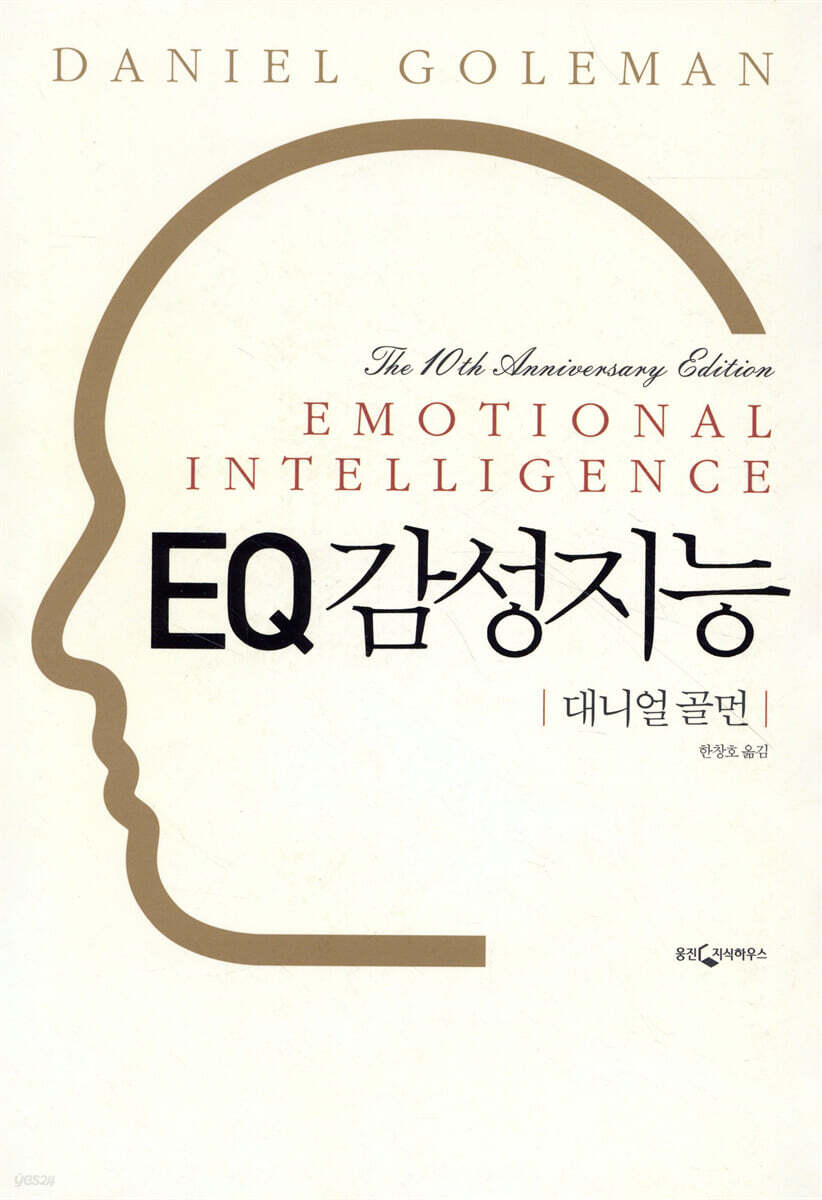
EQ emotional intelligence
 |
Description
Book Introduction
A book that redefines the meaning of 'intelligence' and sparks an 'emotional revolution' around the world!
This book, which deals with "emotional intelligence (EQ)," is a representative work of Daniel Goleman, who presented a new paradigm in almost all academic fields, including modern psychology, education, and management, by asserting that how well one can regulate one's own and others' emotions is a new standard of knowledge.
This book argues that "IQ," the traditional method of measuring intelligence, is not the only way to measure intelligence, and that emotional intelligence is not only about "how smart you are or how much expertise you have," but is also an intelligence that can be developed and is essential in modern society.
In "Part 1: The Emotional Brain," the author introduces what emotions are and what mechanisms they have, and in "Part 2: The Essence of Emotional Intelligence," he points out the limitations of "IQ" and the side effects of uncontrolled and undeveloped emotions, namely, the decline in interpersonal relationships and the quality of personal life.
In "Part 3: Practical Emotional Intelligence," we will explore how developed emotional intelligence can positively impact a person's life, business, and mental health.
In "Part 4: Window of Opportunity" and "Part 5: The World of Emotional Education," the topic of modern education, "emotional intelligence development education," is introduced, and the necessity and advantages of developing emotions from an early age are introduced.
This book, which deals with "emotional intelligence (EQ)," is a representative work of Daniel Goleman, who presented a new paradigm in almost all academic fields, including modern psychology, education, and management, by asserting that how well one can regulate one's own and others' emotions is a new standard of knowledge.
This book argues that "IQ," the traditional method of measuring intelligence, is not the only way to measure intelligence, and that emotional intelligence is not only about "how smart you are or how much expertise you have," but is also an intelligence that can be developed and is essential in modern society.
In "Part 1: The Emotional Brain," the author introduces what emotions are and what mechanisms they have, and in "Part 2: The Essence of Emotional Intelligence," he points out the limitations of "IQ" and the side effects of uncontrolled and undeveloped emotions, namely, the decline in interpersonal relationships and the quality of personal life.
In "Part 3: Practical Emotional Intelligence," we will explore how developed emotional intelligence can positively impact a person's life, business, and mental health.
In "Part 4: Window of Opportunity" and "Part 5: The World of Emotional Education," the topic of modern education, "emotional intelligence development education," is introduced, and the necessity and advantages of developing emotions from an early age are introduced.
- You can preview some of the book's contents.
Preview
index
Recommendation: Emotional Intelligence (EQ), a 10-Year History
Preface to the Korean Edition: Developing Potential with a Focus on EQ
10th Anniversary Special Edition Preface: Emotional Intelligence: The Key to Success and Happiness
Introduction: Aristotle's Challenge
Part 1: Emotional Brain
1.
Why did emotion arise? - When passion overwhelms reason.
2.
Anatomy of a Sudden Emotion - Emotions are a Momentary Plan
Part 2: The Essence of Emotional Intelligence
3.
Smart Fool - A high IQ doesn't guarantee success.
4.
Know Thyself - Tune in to your emotions before making decisions.
5.
Moments of intense emotion - coping with anger, anxiety, and depression
6.
The Master of All Talents: Emotional Intelligence - The Power to Motivate Yourself
7.
The Source of Empathy - The Mind of the Child Abuser, the Morality of the Mentally Ill
8.
The Art of Human Relationships - "We Hate You"
Part 3: Emotional Intelligence in Practice
9.
Emotional Intelligence for a Happy Marriage - Marriage of a Mars Man and Venus Woman
10.
Emotional Management for Top Companies - The Art of Persuading People to Pursue a Common Goal
11.
Psychiatry - Relationship-Focused Therapy
Part 4: Window of Opportunity
12.
Home Education and Emotional Intelligence - How Are Troublemakers Raised?
13.
Psychological Trauma and Emotional Retraining: Creating New Emotional Circuits
14.
Temperament Can Be Changed - Emotional Education Through Experience
Part 5: The World of Emotional Education
15.
The Price of Low Emotional Intelligence - Schools for Problem Children
16.
Emotional Education in Schools - A Timeline for Emotional Growth
Appendix A: What is Emotion? ∥ Appendix B: Characteristics of the Emotional Mind ∥ Appendix C: The Neural Circuit of Fear ∥ Appendix D: W.
T. Grant Institute: Components of a Prevention Program ∥ Appendix E: Self-Science Curriculum ∥ Appendix F: Social and Emotional Learning: Results Report
Preface to the Korean Edition: Developing Potential with a Focus on EQ
10th Anniversary Special Edition Preface: Emotional Intelligence: The Key to Success and Happiness
Introduction: Aristotle's Challenge
Part 1: Emotional Brain
1.
Why did emotion arise? - When passion overwhelms reason.
2.
Anatomy of a Sudden Emotion - Emotions are a Momentary Plan
Part 2: The Essence of Emotional Intelligence
3.
Smart Fool - A high IQ doesn't guarantee success.
4.
Know Thyself - Tune in to your emotions before making decisions.
5.
Moments of intense emotion - coping with anger, anxiety, and depression
6.
The Master of All Talents: Emotional Intelligence - The Power to Motivate Yourself
7.
The Source of Empathy - The Mind of the Child Abuser, the Morality of the Mentally Ill
8.
The Art of Human Relationships - "We Hate You"
Part 3: Emotional Intelligence in Practice
9.
Emotional Intelligence for a Happy Marriage - Marriage of a Mars Man and Venus Woman
10.
Emotional Management for Top Companies - The Art of Persuading People to Pursue a Common Goal
11.
Psychiatry - Relationship-Focused Therapy
Part 4: Window of Opportunity
12.
Home Education and Emotional Intelligence - How Are Troublemakers Raised?
13.
Psychological Trauma and Emotional Retraining: Creating New Emotional Circuits
14.
Temperament Can Be Changed - Emotional Education Through Experience
Part 5: The World of Emotional Education
15.
The Price of Low Emotional Intelligence - Schools for Problem Children
16.
Emotional Education in Schools - A Timeline for Emotional Growth
Appendix A: What is Emotion? ∥ Appendix B: Characteristics of the Emotional Mind ∥ Appendix C: The Neural Circuit of Fear ∥ Appendix D: W.
T. Grant Institute: Components of a Prevention Program ∥ Appendix E: Self-Science Curriculum ∥ Appendix F: Social and Emotional Learning: Results Report
Into the book
Humans are not born with fully mature brains.
The brain continues to shape itself after birth, growing most rapidly during childhood.
Children's brains have far more neurons than mature brains, and through a process known as "pruning," they eliminate connections between underused neurons and build stronger connections in heavily used synaptic circuits.
By removing irrelevant synapses, pruning removes sources of 'noise' and improves the signal-to-noise ratio in the brain.
This process is constant and rapid.
Synaptic connections can form in hours or days.
Experiences, especially childhood experiences, shape the brain.
--- p.369
Let's take a look at a study of star researchers at Bell Labs, a world-renowned think tank near Princeton.
The institute is staffed with engineers and scientists with the highest IQs.
But even in this treasure trove of talent, while some rise to stardom, others achieve only average results.
What separates stars from everyone else is not their IQ, but their emotional intelligence.
Stars are much better able to motivate themselves and better able to activate informal networks into special purpose organizations.
--- p.277
A study of second and third graders found that 26 percent of the most popular kids had already been rejected when trying to join a playgroup.
(…) Roger's strategy for joining the group was to first observe the group, then imitate what the other children were doing, and finally talk to the child and fully participate in the activity.
This is a strategy that guarantees victory.
Roger's skills are on display, for example, when he and Warren play a game of putting 'bombs' (actually pebbles) in socks.
Warren asks Roger if he would like to take a helicopter or a plane.
Before answering, Roger asks:
“Are you in a helicopter?”
Hatch says this about Roger:
“Roger ‘applies for membership’ to his playmates.
As a result, they and their play remain connected.
Meanwhile, many other children simply get into their helicopters or airplanes and fly away from each other.” --- pp.218-221
Many managers are very quick to criticize but stingy with praise.
So employees feel like they are only criticized when they make mistakes.
J. Larson, a psychologist at the University of Illinois,
R. Larson) points out.
“If a boss doesn’t express his or her feelings immediately, the employees’ frustration will gradually build up.
Then one day he gets furious.
If there had been proper criticism earlier, the employee could have solved the problem.
It's so often the case that we only criticize when things are boiling over, when we're so angry that we can't control ourselves.
So, it is precisely at such moments that we criticize in the worst possible way: in a sharp, cynical tone, in a disgruntled tone, or in a threatening tone.
Such accusations only serve to fuel a counterattack.
Criticism is perceived as an insult, and the person who is insulted becomes angry in return.
“This approach is the worst way to motivate people.”
The brain continues to shape itself after birth, growing most rapidly during childhood.
Children's brains have far more neurons than mature brains, and through a process known as "pruning," they eliminate connections between underused neurons and build stronger connections in heavily used synaptic circuits.
By removing irrelevant synapses, pruning removes sources of 'noise' and improves the signal-to-noise ratio in the brain.
This process is constant and rapid.
Synaptic connections can form in hours or days.
Experiences, especially childhood experiences, shape the brain.
--- p.369
Let's take a look at a study of star researchers at Bell Labs, a world-renowned think tank near Princeton.
The institute is staffed with engineers and scientists with the highest IQs.
But even in this treasure trove of talent, while some rise to stardom, others achieve only average results.
What separates stars from everyone else is not their IQ, but their emotional intelligence.
Stars are much better able to motivate themselves and better able to activate informal networks into special purpose organizations.
--- p.277
A study of second and third graders found that 26 percent of the most popular kids had already been rejected when trying to join a playgroup.
(…) Roger's strategy for joining the group was to first observe the group, then imitate what the other children were doing, and finally talk to the child and fully participate in the activity.
This is a strategy that guarantees victory.
Roger's skills are on display, for example, when he and Warren play a game of putting 'bombs' (actually pebbles) in socks.
Warren asks Roger if he would like to take a helicopter or a plane.
Before answering, Roger asks:
“Are you in a helicopter?”
Hatch says this about Roger:
“Roger ‘applies for membership’ to his playmates.
As a result, they and their play remain connected.
Meanwhile, many other children simply get into their helicopters or airplanes and fly away from each other.” --- pp.218-221
Many managers are very quick to criticize but stingy with praise.
So employees feel like they are only criticized when they make mistakes.
J. Larson, a psychologist at the University of Illinois,
R. Larson) points out.
“If a boss doesn’t express his or her feelings immediately, the employees’ frustration will gradually build up.
Then one day he gets furious.
If there had been proper criticism earlier, the employee could have solved the problem.
It's so often the case that we only criticize when things are boiling over, when we're so angry that we can't control ourselves.
So, it is precisely at such moments that we criticize in the worst possible way: in a sharp, cynical tone, in a disgruntled tone, or in a threatening tone.
Such accusations only serve to fuel a counterattack.
Criticism is perceived as an insult, and the person who is insulted becomes angry in return.
“This approach is the worst way to motivate people.”
--- pp.263-264
Publisher's Review
A book that redefines the meaning of 'intelligence'
- Daniel Goleman's 'Emotional Revolution' is ongoing.
The frustration of the study machines in Korea, the dropout rate of Korean students from prestigious American universities is 44%: It is said that the dropout rate of Korean students from prestigious American universities is as high as 44% (Kim Seung-gi, 'Research on Korean Students at Prestigious Universities', 2008).
This figure is significantly higher than the American average dropout rate of 34%, and is significantly higher than that of Jews (12.5%), Indians (21.5%), and Chinese (25%).
Why do half of South Korea's top talent fail to make it to prestigious American universities and mainstream society? Daniel Goleman's book "Emotional Intelligence," which challenged the performance-focused, achievement-oriented mindset and shifted the global educational paradigm, offers the answer.
When Daniel Goleman declared, “Emotional intelligence is more important than IQ, and EQ can be developed through learning,” and “Today, we are being judged not only by how smart we are or how much expertise we have, but also by how well we can manage our own and others’ emotions,” the impact of his words was enormous.
"Emotional Intelligence" has been translated into 30 languages and sold over 5 million copies, becoming a global bestseller and establishing Daniel Goleman as a world-renowned psychologist.
And the theory of emotional intelligence has become a core concept that has changed the paradigm of almost all academic fields, including modern psychology, education, and management.
The epicenter of the 'emotional revolution' is the education sector.
Every state in the United States has designated emotional intelligence courses as a required subject, UNESCO has sent a statement to ministers of education in over 140 countries urging the introduction of emotional intelligence education programs, and advanced educational countries around the world have actively embraced emotional intelligence education (SEL) programs.
In 2008, the Wall Street Journal selected Daniel Goleman as the 'most influential management thinker', and Daniel Goleman's 'emotional revolution' is still ongoing, with more than 80% of large American companies, including GE and IBM, adopting emotional intelligence theory.
In today's world, where terms like "emotional leadership," "emotional marketing," and "emotional engineering" are commonplace, emotional intelligence is considered "soft power" that determines the success of individuals and organizations. In an era where emotional ability is increasingly recognized as essential, surpassing IQ and specialized knowledge, "Emotional Intelligence" will serve as a perfect guide and commentary for awakening the emotional intelligence hidden within us.
There are many paths to success in life!
- The most essential life skill, emotional intelligence
The actual achievements people make depend not only on their intelligence (IQ), but also on their ability to endure defeat.
The ability to motivate yourself, push through setbacks, control impulses and delay gratification, regulate your moods to stay focused, empathize, and cultivate hope.
Emotional intelligence is a concept that has been scientifically proven based on extensive research data from psychology and neuroscience, reflecting this long-standing truth. Its effectiveness has been proven through various programs in education, business, and society over the past decade.
This is also a theory supported by the research of Howard Gabner (text 84-88), who brought about a revolution in the IQ-centered thinking system by putting forward the 'Theory of Multiple Intelligences', and Professor Mihaly Csikszentmihalyi, who established the 'FLOW' theory (text 167-175).
Whatever abilities we have, it is emotional intelligence that determines how well we utilize them.
Emotions enable us to utilize our inherent mental powers and further determine how we proceed in life.
Crucially, emotional intelligence can be developed through learning.
Evidence for this is abundant in this book.
In a world where performance is the direct measure of success, one might think that a soft approach like prioritizing emotional intelligence is too leisurely.
But scientific research clearly shows that what was once considered light is no longer light.
In today's society, where we value how well we can manage our own and others' emotions more than how talented we are or how much specialized knowledge we possess, this book is a revolutionary one that will change the future of us and our children.
Named one of the "Most Influential Management Thinkers" by the Wall Street Journal in 2008
- 'Soft power' that determines the success of individuals and organizations
Recently, it is companies that are showing the greatest interest in emotional intelligence.
Reflecting this trend, Daniel Goleman was selected as one of the '20 most influential management thinkers' by the Wall Street Journal in 2008.
The Harvard Business Review praised the emotional intelligence theory as “a revolutionary idea that shatters paradigms.”
There are two main reasons why companies entering a global competitive environment value emotional intelligence.
First, emotional intelligence is necessary to secure and retrain talent that will thrive in the global market.
Over the past decade, these very corporate demands have been at the heart of the "emotional revolution," including emotional leadership and emotional marketing.
The second can be found in emotional engineering, which is attracting new attention from leading companies such as Apple, LG, and Samsung.
From product design to corporate positioning, finding emotional connections with consumers is emerging as a key topic in a digitalized world.
According to emotional intelligence theory, the traditional “carrot and stick” approach makes no neurological sense.
Traditional incentive systems are inadequate for motivating employees to perform at their best.
How you deliver the message is more important than the message itself, and leaders who expect the best from their team members must first make them feel good.
For example, in 'Fun Management', which is based on the concept of emotional intelligence, the CEO sheds his authority and emphasizes communication with employees.
Robert Callaghan, former CEO of Southwest Airlines in the US, and Richard Branson, CEO of Virgin Group in the UK, who is known as an eccentric CEO, are representative examples of fun management.
In Korea, too, LG Electronics' former Vice Chairman Kim Ssang-soo randomly sent emails to employees, instructing them to make their colleagues laugh three times, and SK Telecom's President Kim Shin-bae sang songs in front of his employees, leading to a variety of fun management ideas.
Recently, each company has introduced employee activation programs such as 'Spicy Day', 'Happy Hour', and 'Town Meeting', all of which are part of fun management.
No matter how we define modern society—open society, pluralistic society, digital society, global society—the existing IQ-centric mindset is facing a major challenge.
Emotional intelligence, simply put, is the ability to use your emotions in ways that improve your quality of life.
In today's world, where the ability to manage each individual's skills and intellectual abilities in an integrated manner is valued, emotional intelligence will shine even brighter.
The wave of emotional education that has swept the world in just 10 years
Emotional intelligence education is now a required subject in every U.S. state.
The field that has most enthusiastically embraced the theory of emotional intelligence is undoubtedly the education sector.
Currently, all states in the United States have designated emotional intelligence education (SEL) as a required subject, just like math and language arts, and the state of Illinois is implementing special standards for emotional intelligence education across all grades from kindergarten to high school.
In 2002, UNESCO sent a recommendation containing 10 basic principles to 140 ministers of education to promote emotional intelligence education.
In Asia, Singapore, a powerhouse in education, has actively embraced emotional intelligence education (National University of Singapore ranked 30th and Seoul National University 50th in the 2008 World University Rankings).
In Korea, standardized tools for measuring emotional intelligence are already available and in use across all age groups, and emotional intelligence education programs are being utilized in schools and human resource development departments at companies.
For example, representative institutions that use this program include Seoul National University Education Administration Training Institute, Samsung Human Resources Development Institute, and Korea Community Education Council.
Today, the concept of emotional intelligence is accepted as a concept that coordinates and oversees various programs related to character education, violence prevention, and school discipline.
The reason why advanced countries in education are embracing emotional intelligence education is clear.
Fundamentally, they recognize that emotional intelligence is an essential skill for all children to manage anger and resolve conflict positively.
And it is because we have recognized from early on that raising emotionally well-tuned children is a desirable direction not only for individual students but also for society.
How well children express their emotions is an important social skill, and we have focused on the role that emotions play in the endless decisions they make throughout their lives.
"EQ Emotional Intelligence" demonstrates, through real-life educational examples, that children can actually improve their emotional abilities, which are essential for life, through learning.
Over the past decade, educational research has demonstrated that children who grow up receiving emotional intelligence education accept the process of making complex decisions and managing interpersonal relationships as part of their rhythm.
You will also be able to see that such children eventually become outstanding leaders who will lead outstanding individuals and organizations.
In traditional society, emotional intelligence education was a natural occurrence.
However, in a reality where extended family ties have broken down and children's free time has drastically decreased, the emotional intelligence that children traditionally learn through free play with parents or relatives in everyday life has weakened.
It is fortunate that the domestic education community is actively accepting and utilizing emotional intelligence education, which is considered the most perfect alternative for children who are neglected due to the problems of modern society.
- Daniel Goleman's 'Emotional Revolution' is ongoing.
The frustration of the study machines in Korea, the dropout rate of Korean students from prestigious American universities is 44%: It is said that the dropout rate of Korean students from prestigious American universities is as high as 44% (Kim Seung-gi, 'Research on Korean Students at Prestigious Universities', 2008).
This figure is significantly higher than the American average dropout rate of 34%, and is significantly higher than that of Jews (12.5%), Indians (21.5%), and Chinese (25%).
Why do half of South Korea's top talent fail to make it to prestigious American universities and mainstream society? Daniel Goleman's book "Emotional Intelligence," which challenged the performance-focused, achievement-oriented mindset and shifted the global educational paradigm, offers the answer.
When Daniel Goleman declared, “Emotional intelligence is more important than IQ, and EQ can be developed through learning,” and “Today, we are being judged not only by how smart we are or how much expertise we have, but also by how well we can manage our own and others’ emotions,” the impact of his words was enormous.
"Emotional Intelligence" has been translated into 30 languages and sold over 5 million copies, becoming a global bestseller and establishing Daniel Goleman as a world-renowned psychologist.
And the theory of emotional intelligence has become a core concept that has changed the paradigm of almost all academic fields, including modern psychology, education, and management.
The epicenter of the 'emotional revolution' is the education sector.
Every state in the United States has designated emotional intelligence courses as a required subject, UNESCO has sent a statement to ministers of education in over 140 countries urging the introduction of emotional intelligence education programs, and advanced educational countries around the world have actively embraced emotional intelligence education (SEL) programs.
In 2008, the Wall Street Journal selected Daniel Goleman as the 'most influential management thinker', and Daniel Goleman's 'emotional revolution' is still ongoing, with more than 80% of large American companies, including GE and IBM, adopting emotional intelligence theory.
In today's world, where terms like "emotional leadership," "emotional marketing," and "emotional engineering" are commonplace, emotional intelligence is considered "soft power" that determines the success of individuals and organizations. In an era where emotional ability is increasingly recognized as essential, surpassing IQ and specialized knowledge, "Emotional Intelligence" will serve as a perfect guide and commentary for awakening the emotional intelligence hidden within us.
There are many paths to success in life!
- The most essential life skill, emotional intelligence
The actual achievements people make depend not only on their intelligence (IQ), but also on their ability to endure defeat.
The ability to motivate yourself, push through setbacks, control impulses and delay gratification, regulate your moods to stay focused, empathize, and cultivate hope.
Emotional intelligence is a concept that has been scientifically proven based on extensive research data from psychology and neuroscience, reflecting this long-standing truth. Its effectiveness has been proven through various programs in education, business, and society over the past decade.
This is also a theory supported by the research of Howard Gabner (text 84-88), who brought about a revolution in the IQ-centered thinking system by putting forward the 'Theory of Multiple Intelligences', and Professor Mihaly Csikszentmihalyi, who established the 'FLOW' theory (text 167-175).
Whatever abilities we have, it is emotional intelligence that determines how well we utilize them.
Emotions enable us to utilize our inherent mental powers and further determine how we proceed in life.
Crucially, emotional intelligence can be developed through learning.
Evidence for this is abundant in this book.
In a world where performance is the direct measure of success, one might think that a soft approach like prioritizing emotional intelligence is too leisurely.
But scientific research clearly shows that what was once considered light is no longer light.
In today's society, where we value how well we can manage our own and others' emotions more than how talented we are or how much specialized knowledge we possess, this book is a revolutionary one that will change the future of us and our children.
Named one of the "Most Influential Management Thinkers" by the Wall Street Journal in 2008
- 'Soft power' that determines the success of individuals and organizations
Recently, it is companies that are showing the greatest interest in emotional intelligence.
Reflecting this trend, Daniel Goleman was selected as one of the '20 most influential management thinkers' by the Wall Street Journal in 2008.
The Harvard Business Review praised the emotional intelligence theory as “a revolutionary idea that shatters paradigms.”
There are two main reasons why companies entering a global competitive environment value emotional intelligence.
First, emotional intelligence is necessary to secure and retrain talent that will thrive in the global market.
Over the past decade, these very corporate demands have been at the heart of the "emotional revolution," including emotional leadership and emotional marketing.
The second can be found in emotional engineering, which is attracting new attention from leading companies such as Apple, LG, and Samsung.
From product design to corporate positioning, finding emotional connections with consumers is emerging as a key topic in a digitalized world.
According to emotional intelligence theory, the traditional “carrot and stick” approach makes no neurological sense.
Traditional incentive systems are inadequate for motivating employees to perform at their best.
How you deliver the message is more important than the message itself, and leaders who expect the best from their team members must first make them feel good.
For example, in 'Fun Management', which is based on the concept of emotional intelligence, the CEO sheds his authority and emphasizes communication with employees.
Robert Callaghan, former CEO of Southwest Airlines in the US, and Richard Branson, CEO of Virgin Group in the UK, who is known as an eccentric CEO, are representative examples of fun management.
In Korea, too, LG Electronics' former Vice Chairman Kim Ssang-soo randomly sent emails to employees, instructing them to make their colleagues laugh three times, and SK Telecom's President Kim Shin-bae sang songs in front of his employees, leading to a variety of fun management ideas.
Recently, each company has introduced employee activation programs such as 'Spicy Day', 'Happy Hour', and 'Town Meeting', all of which are part of fun management.
No matter how we define modern society—open society, pluralistic society, digital society, global society—the existing IQ-centric mindset is facing a major challenge.
Emotional intelligence, simply put, is the ability to use your emotions in ways that improve your quality of life.
In today's world, where the ability to manage each individual's skills and intellectual abilities in an integrated manner is valued, emotional intelligence will shine even brighter.
The wave of emotional education that has swept the world in just 10 years
Emotional intelligence education is now a required subject in every U.S. state.
The field that has most enthusiastically embraced the theory of emotional intelligence is undoubtedly the education sector.
Currently, all states in the United States have designated emotional intelligence education (SEL) as a required subject, just like math and language arts, and the state of Illinois is implementing special standards for emotional intelligence education across all grades from kindergarten to high school.
In 2002, UNESCO sent a recommendation containing 10 basic principles to 140 ministers of education to promote emotional intelligence education.
In Asia, Singapore, a powerhouse in education, has actively embraced emotional intelligence education (National University of Singapore ranked 30th and Seoul National University 50th in the 2008 World University Rankings).
In Korea, standardized tools for measuring emotional intelligence are already available and in use across all age groups, and emotional intelligence education programs are being utilized in schools and human resource development departments at companies.
For example, representative institutions that use this program include Seoul National University Education Administration Training Institute, Samsung Human Resources Development Institute, and Korea Community Education Council.
Today, the concept of emotional intelligence is accepted as a concept that coordinates and oversees various programs related to character education, violence prevention, and school discipline.
The reason why advanced countries in education are embracing emotional intelligence education is clear.
Fundamentally, they recognize that emotional intelligence is an essential skill for all children to manage anger and resolve conflict positively.
And it is because we have recognized from early on that raising emotionally well-tuned children is a desirable direction not only for individual students but also for society.
How well children express their emotions is an important social skill, and we have focused on the role that emotions play in the endless decisions they make throughout their lives.
"EQ Emotional Intelligence" demonstrates, through real-life educational examples, that children can actually improve their emotional abilities, which are essential for life, through learning.
Over the past decade, educational research has demonstrated that children who grow up receiving emotional intelligence education accept the process of making complex decisions and managing interpersonal relationships as part of their rhythm.
You will also be able to see that such children eventually become outstanding leaders who will lead outstanding individuals and organizations.
In traditional society, emotional intelligence education was a natural occurrence.
However, in a reality where extended family ties have broken down and children's free time has drastically decreased, the emotional intelligence that children traditionally learn through free play with parents or relatives in everyday life has weakened.
It is fortunate that the domestic education community is actively accepting and utilizing emotional intelligence education, which is considered the most perfect alternative for children who are neglected due to the problems of modern society.
GOODS SPECIFICS
- Date of issue: October 15, 2008
- Format: Hardcover book binding method guide
- Page count, weight, size: 543 pages | 991g | 166*245*35mm
- ISBN13: 9788901088839
- ISBN10: 8901088835
You may also like
카테고리
korean


korean

![GQ KOREA Mark (Monthly): December [2025]](http://librairie.coreenne.fr/cdn/shop/files/8ef265dbbfbf186523ed75ba7319009d.jpg?v=1765340328&width=3840)


