

Doctors Thinking
 |
Description
Book Introduction
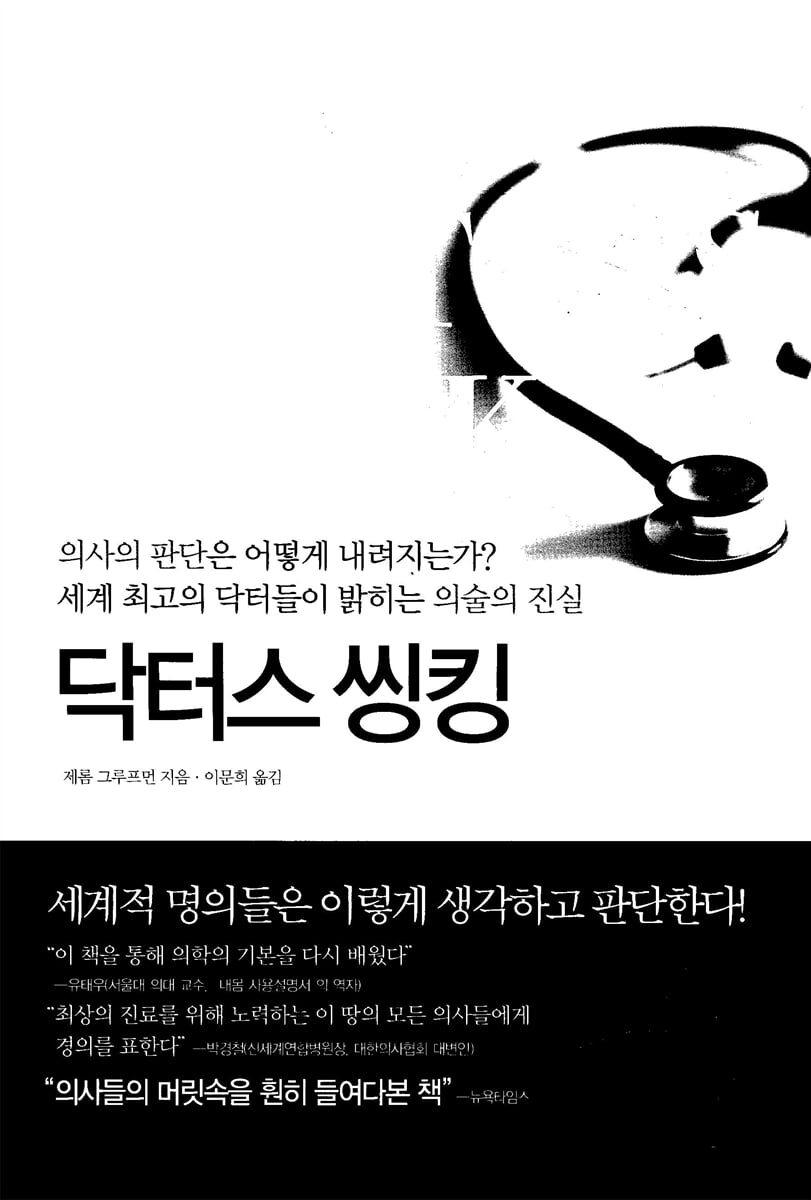
"Doctors Thinking" is a book by Dr. Jerome Groopman, a Harvard Medical School professor and oncologist, that presents the best way for doctors and patients to help each other prevent momentary misdiagnosis, discover the true diagnosis, and make the best decision.
Professor Redelmeyer of the University of Toronto, who mistook a patient who enjoyed drinking for an alcoholic and did not feel the need for a thorough examination, only to realize too late that it was a sign of a rare disease; Dr. Delgado, an endocrinologist who indifferently passed over a shabby young man because he felt aversion to him, only to find out soon afterwards that he was in a diabetic coma; Dr. Crosscarey, an emergency physician in Halifax, Nova Scotia, who missed the CT scan results of a patient complaining of chest pain only to realize that he had a myocardial infarction; and the author himself, who once put a patient in danger after taking steps to avoid painful tests because he shared a love of running and literature. These books present various types of misdiagnosis that occur due to science and technology, human perception, and emotional states as the basis for explaining the diagnostic process of doctors.
Drawing on interviews with leading physicians in each specialty, the author reveals that even amidst the deluge of cutting-edge science, true medicine begins with the exchange of information and emotions between doctor and patient—in other words, the best relationship.
Professor Redelmeyer of the University of Toronto, who mistook a patient who enjoyed drinking for an alcoholic and did not feel the need for a thorough examination, only to realize too late that it was a sign of a rare disease; Dr. Delgado, an endocrinologist who indifferently passed over a shabby young man because he felt aversion to him, only to find out soon afterwards that he was in a diabetic coma; Dr. Crosscarey, an emergency physician in Halifax, Nova Scotia, who missed the CT scan results of a patient complaining of chest pain only to realize that he had a myocardial infarction; and the author himself, who once put a patient in danger after taking steps to avoid painful tests because he shared a love of running and literature. These books present various types of misdiagnosis that occur due to science and technology, human perception, and emotional states as the basis for explaining the diagnostic process of doctors.
Drawing on interviews with leading physicians in each specialty, the author reveals that even amidst the deluge of cutting-edge science, true medicine begins with the exchange of information and emotions between doctor and patient—in other words, the best relationship.
- You can preview some of the book's contents.
Preview
index
Prologue: Everything a Doctor Needs to Know
How Doctors Think | The Foundation of Clinical Medicine: Language | The Miracle of Trust | Reflections on Errors
Chapter 1: Imperfect Human Judgment
The Boundary Between Books and Reality | A Shift in Thinking | See, Do, and Teach
Chapter 2: A Painful Lesson Learned from Mistakes
Between Reason and Instinct | The Temptation of Affinity | Concern and Responsibility for Patients
Chapter 3: Acrobats in the Emergency Room
The ABC Principle | Selective Perception | Deep Observation and Attention | Standing on the Patient's Side | Speed of Thought and Action
Chapter 4: The Master of Time
Friendly Gatekeeper | What Clinical Practice Really Needs | The Importance of Primary Care
Chapter 5: The Challenge of Belief
Nightmare Times | Lord, Where Are You | The Power of Motherhood | Acknowledging Exceptionality
Chapter 6: Fighting Uncertainty
Sherlock Holmes of the 21st Century | Back to Basics | Admitting Mistakes and Learning | The Meaning of Sufficient Experimentation
Chapter 7: One Disease, Five Doctors, Five Diagnoses
Trust in Doctors | The Trap of Preciseness | On the Line Between Treatment and Error | The Importance of Interpretation
Chapter 8: Difficulties in Reading Data
False Positives and False Negatives | Machine Errors | Advances in Medical Equipment and the Expert's Eye | Differences in Communication Methods
Chapter 9 Beyond Personal Desire
Background of Diagnosis and Prescription | Breaking Through the Wall of Illusion | A Doctor's Belief | Standards for Clinical and Pathological Research
Chapter 10: The Union of Science and the Soul
The Other Side of Familiarity | Strategic Diagnosis | Beyond Your Limitations | The Most Important Thing in Treatment
Epilogue: The Best Relationship Between Patient and Doctor
References
How Doctors Think | The Foundation of Clinical Medicine: Language | The Miracle of Trust | Reflections on Errors
Chapter 1: Imperfect Human Judgment
The Boundary Between Books and Reality | A Shift in Thinking | See, Do, and Teach
Chapter 2: A Painful Lesson Learned from Mistakes
Between Reason and Instinct | The Temptation of Affinity | Concern and Responsibility for Patients
Chapter 3: Acrobats in the Emergency Room
The ABC Principle | Selective Perception | Deep Observation and Attention | Standing on the Patient's Side | Speed of Thought and Action
Chapter 4: The Master of Time
Friendly Gatekeeper | What Clinical Practice Really Needs | The Importance of Primary Care
Chapter 5: The Challenge of Belief
Nightmare Times | Lord, Where Are You | The Power of Motherhood | Acknowledging Exceptionality
Chapter 6: Fighting Uncertainty
Sherlock Holmes of the 21st Century | Back to Basics | Admitting Mistakes and Learning | The Meaning of Sufficient Experimentation
Chapter 7: One Disease, Five Doctors, Five Diagnoses
Trust in Doctors | The Trap of Preciseness | On the Line Between Treatment and Error | The Importance of Interpretation
Chapter 8: Difficulties in Reading Data
False Positives and False Negatives | Machine Errors | Advances in Medical Equipment and the Expert's Eye | Differences in Communication Methods
Chapter 9 Beyond Personal Desire
Background of Diagnosis and Prescription | Breaking Through the Wall of Illusion | A Doctor's Belief | Standards for Clinical and Pathological Research
Chapter 10: The Union of Science and the Soul
The Other Side of Familiarity | Strategic Diagnosis | Beyond Your Limitations | The Most Important Thing in Treatment
Epilogue: The Best Relationship Between Patient and Doctor
References
Into the book
Misdiagnosis is a window into the doctor's mind.
This reveals why doctors fail to question their own assumptions, why they sometimes think in a closed and distorted way, and why they fail to see the gaps in their knowledge.
Experts who study misdiagnosis have recently concluded that most medical errors result from flaws in doctors' thinking, not from technical errors.
One study analyzing cases of misdiagnosis that caused serious harm to patients found that as many as 80 percent of misdiagnoses stemmed from a series of cognitive errors, like Anne's: patients were confined to narrow frames of mind and were ignoring information that contradicted their preconceived notions.
Another study analyzing 100 cases of inaccurate diagnoses found that a lack of medical knowledge was the cause of the error in only four of them.
In other words, doctors were not so much swayed by ignorance of clinical information as they were by cognitive traps that prevented them from making accurate diagnoses.
Unfortunately, these cognitive errors lead to high misdiagnosis rates.
According to a 1995 report in which doctors evaluated written reports of patients' symptoms and examined mock patients made up of actors portraying various illnesses, the misdiagnosis rate can be as high as 15 percent.
These results are consistent with classical studies based on autopsies, which have shown a misdiagnosis rate of 10 to 15 percent.
---From "Prologue: Everything a Doctor Should Know"
The internal state and tension of doctors not only intervene in their decision-making process and actions, but also have a strong influence.
Dr. Crosscarey mentioned the Yerkes-Dodson law, which was developed by psychologists who study psychomotor skills and relates to the efficiency of task performance.
This law is represented by a bell-shaped curve.
The vertical axis represents 'performance', while the horizontal axis represents the level of 'arousal', that is, the tension caused by adrenaline and other stress-related chemicals.
At the base of the curve before the rise, tension is very low.
We have long believed that the mistakes we make are primarily technical.
However, a growing body of research shows that these technical errors account for only a small proportion of inaccurate diagnoses and treatments.
Most errors are mistakes in thinking.
And some of the factors that cause such errors in perception are our inner feelings, feelings that are difficult to readily acknowledge and even to properly recognize.
---From "Chapter 1: Imperfect Human Judgment"
In fact, a recent study found that when adjusted for inflation, the incomes of doctors like pediatricians have decreased over the past decade.
Many doctors responded to this decline in income by reducing consultation times to 10 or 15 minutes and increasing the number of patients they see per day.
This response speeds up care and breeds the kinds of errors that Pat Crosscarey and Dr. Harrison Alter fear emergency room doctors, who perform "plate-spinner acrobatics," are prone to.
Being pressed for time not only increases cognitive errors, but can also hinder the delivery of the most basic information needed for treatment.
A survey of 45 doctors who treated 909 patients found that two-thirds of the doctors did not tell patients how long to take a new drug or what side effects it might cause when prescribing the drug.
Additionally, nearly half of the doctors did not explain the exact dosage and frequency of administration.
---From "Chapter 4: The Master of Time"
According to Dr. Rock, if a child has a pressure ratio of 2 to 1 between the right and left atria, meaning that the blood flow in the right atrium is twice as much as the blood flow in the left atrium, they are sent to the operating room to have the hole closed.
“Do you know how they came up with that 2 to 1 ratio?” Mr. Rock asked.
I thought it would come from close clinical observation of children who exhibited such defects.
“Of course you would think so.
But no.
At a conference in the 1960s, a pediatrician asked:
'When should we perform a closure?' This sparked a heated debate among cardiologists trying to determine the percentage at which surgical closure is required.
So, the conference organizers had no choice but to hold a vote.
Some suggested lower rates, others suggested higher rates.
In the end, the middle one, 2 to 1, was chosen.
The results were published in the American Journal of Cardiology, and now every textbook is stating as truth that occlusion should be performed when the ratio is 2 to 1.
However, there is a high possibility that you can live a healthy life and not feel the need for treatment while showing a 2 to 1 paragraph.
If you see a 2 to 1 paragraph, many children will get the procedure, but it may not be necessary.
But why continue? Because we can't conduct clinical research.
Imagine conducting a randomized controlled study of 500 children, comparing closed versus open access.
“It will take 40 years.” ---From “Chapter 6: Fighting Uncertainty”
“Perfection is the enemy of the best.
Nothing in surgery is perfect.
Everything is a compromise.
“If you recover 80 percent after surgery, you should be considered quite satisfied.”
To be honest, I was hoping for 100 percent and, like all patients, expected a perfect recovery.
But this is
In many cases, it is an unrealistic wish.
Because it's impossible to predict specifically what will happen to any given patient, we need to be honest and avoid overly rosy scenarios, Dr. Wright emphasized.
This requires extraordinary courage.
As a doctor, I have to put aside my pride to some extent, so I cannot help but be different.
Here we meet two different egos.
It is the healthy pride that Dr. Selzer spoke of that allows one to cut into another human body (the belief in oneself that one can make the right decisions and perform quick procedures in the operating room), and the pride that believes that the scalpel is a magic wand that can perfectly restore a sick body.
---From "Chapter 7: One Question, Five Doctors, Five Diagnoses"
The spine surgeons I spoke with were reluctant to reveal their names, expressing concern that being honest would harm their standing within the medical community and potentially lead to fewer patients.
So I'll just call one of those surgeons Dr. Wheeler.
Dr. Wheeler performs spinal fusions two or three times a week.
For years, he has advised his patients to avoid fusion unless absolutely necessary (unless the spine is dislocated or damaged by a condition that could cause spinal cord or nerve damage).
However, such absolute cases are extremely rare, accounting for less than 2 percent of chronic low back pain patients.
Mr. Wheeler explains:
“Patients suffering from chronic back pain are often diagnosed with ‘spinal instability.’
It's a term used to justify surgery.
Moreover, such a term cannot be directly refuted, so what a wonderful diagnosis it is."
This reveals why doctors fail to question their own assumptions, why they sometimes think in a closed and distorted way, and why they fail to see the gaps in their knowledge.
Experts who study misdiagnosis have recently concluded that most medical errors result from flaws in doctors' thinking, not from technical errors.
One study analyzing cases of misdiagnosis that caused serious harm to patients found that as many as 80 percent of misdiagnoses stemmed from a series of cognitive errors, like Anne's: patients were confined to narrow frames of mind and were ignoring information that contradicted their preconceived notions.
Another study analyzing 100 cases of inaccurate diagnoses found that a lack of medical knowledge was the cause of the error in only four of them.
In other words, doctors were not so much swayed by ignorance of clinical information as they were by cognitive traps that prevented them from making accurate diagnoses.
Unfortunately, these cognitive errors lead to high misdiagnosis rates.
According to a 1995 report in which doctors evaluated written reports of patients' symptoms and examined mock patients made up of actors portraying various illnesses, the misdiagnosis rate can be as high as 15 percent.
These results are consistent with classical studies based on autopsies, which have shown a misdiagnosis rate of 10 to 15 percent.
---From "Prologue: Everything a Doctor Should Know"
The internal state and tension of doctors not only intervene in their decision-making process and actions, but also have a strong influence.
Dr. Crosscarey mentioned the Yerkes-Dodson law, which was developed by psychologists who study psychomotor skills and relates to the efficiency of task performance.
This law is represented by a bell-shaped curve.
The vertical axis represents 'performance', while the horizontal axis represents the level of 'arousal', that is, the tension caused by adrenaline and other stress-related chemicals.
At the base of the curve before the rise, tension is very low.
We have long believed that the mistakes we make are primarily technical.
However, a growing body of research shows that these technical errors account for only a small proportion of inaccurate diagnoses and treatments.
Most errors are mistakes in thinking.
And some of the factors that cause such errors in perception are our inner feelings, feelings that are difficult to readily acknowledge and even to properly recognize.
---From "Chapter 1: Imperfect Human Judgment"
In fact, a recent study found that when adjusted for inflation, the incomes of doctors like pediatricians have decreased over the past decade.
Many doctors responded to this decline in income by reducing consultation times to 10 or 15 minutes and increasing the number of patients they see per day.
This response speeds up care and breeds the kinds of errors that Pat Crosscarey and Dr. Harrison Alter fear emergency room doctors, who perform "plate-spinner acrobatics," are prone to.
Being pressed for time not only increases cognitive errors, but can also hinder the delivery of the most basic information needed for treatment.
A survey of 45 doctors who treated 909 patients found that two-thirds of the doctors did not tell patients how long to take a new drug or what side effects it might cause when prescribing the drug.
Additionally, nearly half of the doctors did not explain the exact dosage and frequency of administration.
---From "Chapter 4: The Master of Time"
According to Dr. Rock, if a child has a pressure ratio of 2 to 1 between the right and left atria, meaning that the blood flow in the right atrium is twice as much as the blood flow in the left atrium, they are sent to the operating room to have the hole closed.
“Do you know how they came up with that 2 to 1 ratio?” Mr. Rock asked.
I thought it would come from close clinical observation of children who exhibited such defects.
“Of course you would think so.
But no.
At a conference in the 1960s, a pediatrician asked:
'When should we perform a closure?' This sparked a heated debate among cardiologists trying to determine the percentage at which surgical closure is required.
So, the conference organizers had no choice but to hold a vote.
Some suggested lower rates, others suggested higher rates.
In the end, the middle one, 2 to 1, was chosen.
The results were published in the American Journal of Cardiology, and now every textbook is stating as truth that occlusion should be performed when the ratio is 2 to 1.
However, there is a high possibility that you can live a healthy life and not feel the need for treatment while showing a 2 to 1 paragraph.
If you see a 2 to 1 paragraph, many children will get the procedure, but it may not be necessary.
But why continue? Because we can't conduct clinical research.
Imagine conducting a randomized controlled study of 500 children, comparing closed versus open access.
“It will take 40 years.” ---From “Chapter 6: Fighting Uncertainty”
“Perfection is the enemy of the best.
Nothing in surgery is perfect.
Everything is a compromise.
“If you recover 80 percent after surgery, you should be considered quite satisfied.”
To be honest, I was hoping for 100 percent and, like all patients, expected a perfect recovery.
But this is
In many cases, it is an unrealistic wish.
Because it's impossible to predict specifically what will happen to any given patient, we need to be honest and avoid overly rosy scenarios, Dr. Wright emphasized.
This requires extraordinary courage.
As a doctor, I have to put aside my pride to some extent, so I cannot help but be different.
Here we meet two different egos.
It is the healthy pride that Dr. Selzer spoke of that allows one to cut into another human body (the belief in oneself that one can make the right decisions and perform quick procedures in the operating room), and the pride that believes that the scalpel is a magic wand that can perfectly restore a sick body.
---From "Chapter 7: One Question, Five Doctors, Five Diagnoses"
The spine surgeons I spoke with were reluctant to reveal their names, expressing concern that being honest would harm their standing within the medical community and potentially lead to fewer patients.
So I'll just call one of those surgeons Dr. Wheeler.
Dr. Wheeler performs spinal fusions two or three times a week.
For years, he has advised his patients to avoid fusion unless absolutely necessary (unless the spine is dislocated or damaged by a condition that could cause spinal cord or nerve damage).
However, such absolute cases are extremely rare, accounting for less than 2 percent of chronic low back pain patients.
Mr. Wheeler explains:
“Patients suffering from chronic back pain are often diagnosed with ‘spinal instability.’
It's a term used to justify surgery.
Moreover, such a term cannot be directly refuted, so what a wonderful diagnosis it is."
---From "Chapter 9 Beyond Personal Desire"
Publisher's Review
“Without the patient’s help, you can never make the best decisions!”
A poignant reflection revealed only by doctors who must overcome their limitations as human beings!
Does the perfect doctor exist? What questions do doctors, who guide patients through life-threatening crossroads, grapple with in today's advanced scientific world? With an average of 18 seconds to make a diagnosis after meeting a patient, can they truly make decisions free from factors like their own emotional state, the patient's first impression, the hospital's workload, and government insurance coverage?
Dr. Jerome Gruppman, a professor at Harvard Medical School and an oncologist, has published "How Doctors Think," a book that is useful to both doctors and patients, based on interviews with leading doctors in each specialty and his own patient experiences.
This book, which was published in the United States in March of this year and had a first edition of 250,000 copies, not only received the splendid spotlight from national media outlets such as Time, The New York Times, and The Wall Street Journal immediately after its publication, but is still consistently popular with readers as it ranked 5th overall on Amazon.com and was a long-term bestseller on The New York Times.
Doctors these days are so busy entering medical information into their computers that they neglect to believe and think about the initial diagnosis before even placing their stethoscopes on the patient's chest.
Moreover, in an era where patients, who are not afraid to shop around for hospitals thanks to the various medical information available on the Internet, exaggerate the pain they think they "should" feel rather than the symptoms they are actually experiencing, how can doctors avoid the trap of misdiagnosis?
Doctors are also human, so even in the emergency room where life and death are at stake, they must remain calm and put their hands into a rapidly beating heart without hesitation. This is equally frightening. Excessive workload can cloud doctors' judgment, and they may be so caught up in the first symptom that they fail to notice symptoms that could be sending emergency signals from other places.
Also, traces of the courageous struggles that doctors face today are introduced, such as the burden placed on doctors by the hospital's treatment speed of one patient every 15 minutes (one patient every 1 minute and 24 seconds in Korea - MBC News report on November 21, 2006), the reality of the medical community that has no choice but to cooperate with pharmaceutical companies for new drug development, and the agony of radiologists who have to read hundreds of films a day despite the limitation that "people see what they want to see" (Professor Kundel of the University of Pennsylvania).
Through this, the author emphasizes that doctors need to maintain an optimal psychological state even under overwhelming workloads, and that patients, their families, and friends must form a partnership with their doctors to receive the best treatment in the shortest possible time. This book provides doctors with the knowledge to understand their own unique thought processes, and patients with the attitudes necessary for successful treatment. It offers us, as potential patients, the perfect opportunity to reflect on doctors, patients, and modern medicine.
A poignant reflection revealed only by doctors who must overcome their limitations as human beings!
Does the perfect doctor exist? What questions do doctors, who guide patients through life-threatening crossroads, grapple with in today's advanced scientific world? With an average of 18 seconds to make a diagnosis after meeting a patient, can they truly make decisions free from factors like their own emotional state, the patient's first impression, the hospital's workload, and government insurance coverage?
Dr. Jerome Gruppman, a professor at Harvard Medical School and an oncologist, has published "How Doctors Think," a book that is useful to both doctors and patients, based on interviews with leading doctors in each specialty and his own patient experiences.
This book, which was published in the United States in March of this year and had a first edition of 250,000 copies, not only received the splendid spotlight from national media outlets such as Time, The New York Times, and The Wall Street Journal immediately after its publication, but is still consistently popular with readers as it ranked 5th overall on Amazon.com and was a long-term bestseller on The New York Times.
Doctors these days are so busy entering medical information into their computers that they neglect to believe and think about the initial diagnosis before even placing their stethoscopes on the patient's chest.
Moreover, in an era where patients, who are not afraid to shop around for hospitals thanks to the various medical information available on the Internet, exaggerate the pain they think they "should" feel rather than the symptoms they are actually experiencing, how can doctors avoid the trap of misdiagnosis?
Doctors are also human, so even in the emergency room where life and death are at stake, they must remain calm and put their hands into a rapidly beating heart without hesitation. This is equally frightening. Excessive workload can cloud doctors' judgment, and they may be so caught up in the first symptom that they fail to notice symptoms that could be sending emergency signals from other places.
Also, traces of the courageous struggles that doctors face today are introduced, such as the burden placed on doctors by the hospital's treatment speed of one patient every 15 minutes (one patient every 1 minute and 24 seconds in Korea - MBC News report on November 21, 2006), the reality of the medical community that has no choice but to cooperate with pharmaceutical companies for new drug development, and the agony of radiologists who have to read hundreds of films a day despite the limitation that "people see what they want to see" (Professor Kundel of the University of Pennsylvania).
Through this, the author emphasizes that doctors need to maintain an optimal psychological state even under overwhelming workloads, and that patients, their families, and friends must form a partnership with their doctors to receive the best treatment in the shortest possible time. This book provides doctors with the knowledge to understand their own unique thought processes, and patients with the attitudes necessary for successful treatment. It offers us, as potential patients, the perfect opportunity to reflect on doctors, patients, and modern medicine.
GOODS SPECIFICS
- Date of issue: October 22, 2007
- Page count, weight, size: 395 pages | 582g | 153*224*30mm
- ISBN13: 9788973378791
- ISBN10: 8973378791
You may also like
카테고리
korean


korean

![GQ KOREA Mark (Monthly): December [2025]](http://librairie.coreenne.fr/cdn/shop/files/8ef265dbbfbf186523ed75ba7319009d.jpg?v=1765340328&width=3840)


