

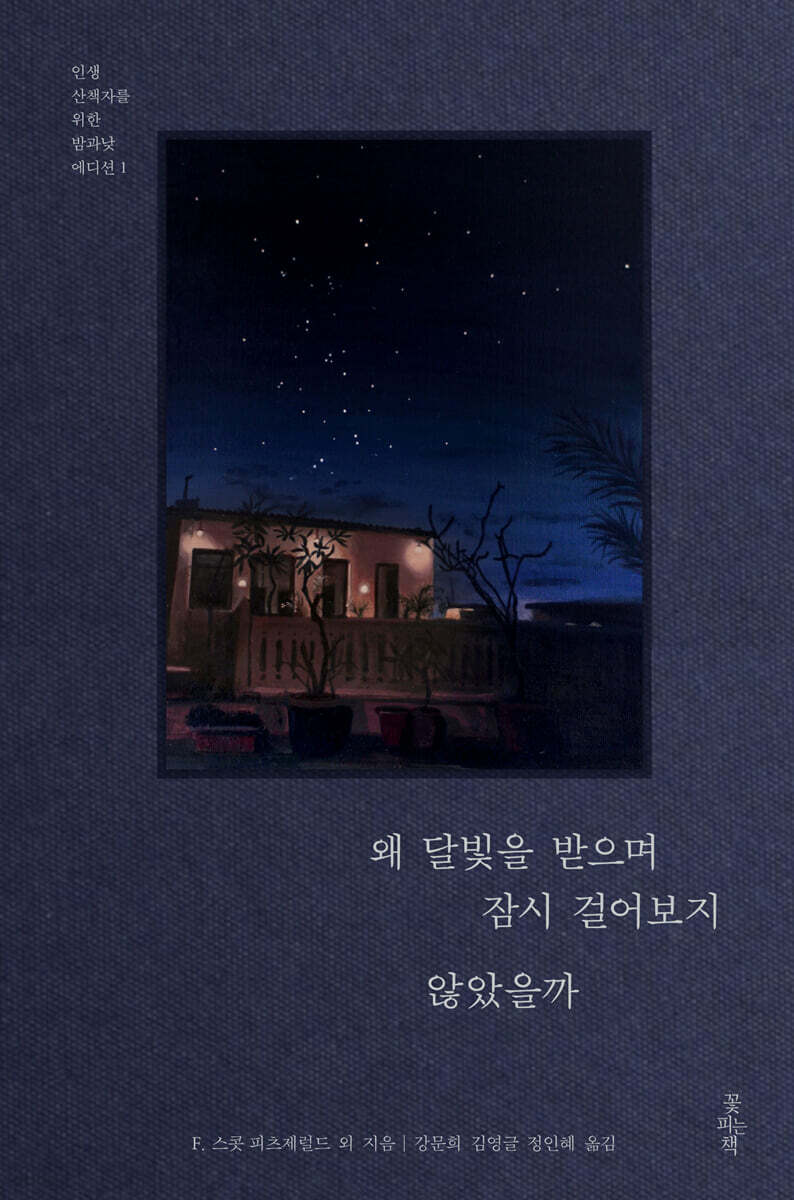
Why not take a walk in the moonlight?
 |
Description
Book Introduction
The pleasure of encountering the world's most classic prose today
Flowering Book Prose Collection "Night and Day Edition for Life's Walkers"
'Night and Day Edition for Life' is a two-volume collection of world-class prose that we must read.
Three young translators, who have spent much of their lives leaning on the broad embrace of literature, have come together to select works we have loved, love, and will love. They each took on works from the Anglo-American, European, and Japanese languages, meticulously and faithfully revisiting each word in Korean.
With Camus's words as a guidepost, "The duty we must fulfill while we live is to find every word and give it a name worthy of its light," I hope this will be a delightful gift for those who endure life through literature and color their lives like a walk.
Flowering Book Prose Collection "Night and Day Edition for Life's Walkers"
'Night and Day Edition for Life' is a two-volume collection of world-class prose that we must read.
Three young translators, who have spent much of their lives leaning on the broad embrace of literature, have come together to select works we have loved, love, and will love. They each took on works from the Anglo-American, European, and Japanese languages, meticulously and faithfully revisiting each word in Korean.
With Camus's words as a guidepost, "The duty we must fulfill while we live is to find every word and give it a name worthy of its light," I hope this will be a delightful gift for those who endure life through literature and color their lives like a walk.
- You can preview some of the book's contents.
Preview
index
Introduction
For sleepless nights
F.
Scott Fitzgerald | Sleep and Insomnia
Hermann Hesse | Sleepless Nights
Charles Dickens | A Night Walk
Stuart White | Lying awake at night
Death, goodbye a little slowly
Virginia Woolf | The Death of a Moth
Natsume Soseki | The Cat's Grave
Henry David Thoreau | The Death of a Pine Tree
Terada Dorahiko | Acorn
Take a walk, color time
Henry David Thoreau | Night and Moonlight
Virginia Woolf | Streets and Streets: Adventures in London
Ernest Hemingway | People on the Banks of the Seine
Jean-Jacques Rousseau | The Second Walk
George Gissing | Dawn Thoughts
Max Beerbohm | Going for a Walk
Writing, Midnight Dreamer
George Orwell | Why I Write
William Faulkner | Author's Preface
Albert Camus | The Almond Trees
George Gissing | Writing for Myself
Virginia Woolf | Women's Occupations
Solitude, from the abyss of existence
Fernando Pessoa | The Book of Disquiet 83
Franz Kafka | Tuxedo
Oscar Wilde | From the Abyss
Shimazaki Doson | Three Visitors
About the author
Original source
For sleepless nights
F.
Scott Fitzgerald | Sleep and Insomnia
Hermann Hesse | Sleepless Nights
Charles Dickens | A Night Walk
Stuart White | Lying awake at night
Death, goodbye a little slowly
Virginia Woolf | The Death of a Moth
Natsume Soseki | The Cat's Grave
Henry David Thoreau | The Death of a Pine Tree
Terada Dorahiko | Acorn
Take a walk, color time
Henry David Thoreau | Night and Moonlight
Virginia Woolf | Streets and Streets: Adventures in London
Ernest Hemingway | People on the Banks of the Seine
Jean-Jacques Rousseau | The Second Walk
George Gissing | Dawn Thoughts
Max Beerbohm | Going for a Walk
Writing, Midnight Dreamer
George Orwell | Why I Write
William Faulkner | Author's Preface
Albert Camus | The Almond Trees
George Gissing | Writing for Myself
Virginia Woolf | Women's Occupations
Solitude, from the abyss of existence
Fernando Pessoa | The Book of Disquiet 83
Franz Kafka | Tuxedo
Oscar Wilde | From the Abyss
Shimazaki Doson | Three Visitors
About the author
Original source
Detailed image

Into the book
Ruins and horror.
Things I could have been, things I could have done.
Things that are lost, thrown away, abandoned, wasted, and cannot be recovered.
I could have done that, I could have endured it, I could have been bold and not timid, I could have been cautious and not hasty.
I shouldn't have hurt her like that.
You shouldn't have told him that.
There is no need to break yourself while trying to break something that cannot be broken.
--- pp.20-21 「F.
Scott Fitzgerald | Sleep and Insomnia - From "Insomnia, For Sleepless Nights"
A bowl of rice filled with water was placed in front of the grave.
The flowers and water were changed daily.
On the third evening, I saw through the study window my four-year-old daughter standing alone in front of the grave, staring at the cedar tombstone for a moment, and then drinking water from a rice bowl with a play ladle she was holding.
It happened many times.
The clear water, covered with sari flowers, wet Aiko's neck under the tranquil evening glow.
--- p.69 From "Natsume Soseki | Cat Grave - Death, Say Goodbye a Little Slowly"
If I can conquer some realm of the night, if I can write in the newspapers about something interesting that happened to us during the night's prime, if I can show some of the beauty of the night that remains awake while people sleep, if I can add a line to the realm of poetry, then I will be a patron of the night.
Night is certainly more noble and less worldly than day.
But then I realized that I only knew the surface of the night.
Because I only occasionally saw the moon through the crack in the door.
Why not take a walk in the moonlight for a while?
--- pp.90-91 From "Henry David Thoreau | Night and Moonlight - A Walk, Coloring Time"
I turned around and grabbed the angel by the neck.
I tried my best to kill the angel.
If I were to stand trial for this, I would defend myself by saying it was self-defense.
If I hadn't killed her, that angel would have killed me.
Because she tried to extract her own thoughts from my writing.
As I realized the moment I picked up pen and put it to paper, I couldn't write a novel review without my own consciousness, without expressing what I thought was true about human relationships, morality, and gender.
'Angel in the House' said that women cannot freely and openly address these questions.
Because women have to seduce, cajole, and (let's be honest) lie to be successful.
--- pp.205-206 From "Virginia Woolf | Women's Occupations - Writing, Midnight Dreamers"
While I was in Wandsworth Prison, I longed for death.
It was the only thing I wanted.
When I found myself gradually recovering physically after spending two months in the infirmary and being transferred to a cell, I was filled with anger.
I decided to commit suicide the day I got out of prison.
After a while, the bad feeling disappeared and I decided to live, but instead I decided to wear melancholy like a king wearing purple.
I resolved never to laugh again, to make every house I entered a house of mourning, to make my friends walk slowly with me in sorrow, to teach them that melancholy is the true secret of life, to cripple them with sorrows that were not theirs, to ruin them with my own pain.
Things I could have been, things I could have done.
Things that are lost, thrown away, abandoned, wasted, and cannot be recovered.
I could have done that, I could have endured it, I could have been bold and not timid, I could have been cautious and not hasty.
I shouldn't have hurt her like that.
You shouldn't have told him that.
There is no need to break yourself while trying to break something that cannot be broken.
--- pp.20-21 「F.
Scott Fitzgerald | Sleep and Insomnia - From "Insomnia, For Sleepless Nights"
A bowl of rice filled with water was placed in front of the grave.
The flowers and water were changed daily.
On the third evening, I saw through the study window my four-year-old daughter standing alone in front of the grave, staring at the cedar tombstone for a moment, and then drinking water from a rice bowl with a play ladle she was holding.
It happened many times.
The clear water, covered with sari flowers, wet Aiko's neck under the tranquil evening glow.
--- p.69 From "Natsume Soseki | Cat Grave - Death, Say Goodbye a Little Slowly"
If I can conquer some realm of the night, if I can write in the newspapers about something interesting that happened to us during the night's prime, if I can show some of the beauty of the night that remains awake while people sleep, if I can add a line to the realm of poetry, then I will be a patron of the night.
Night is certainly more noble and less worldly than day.
But then I realized that I only knew the surface of the night.
Because I only occasionally saw the moon through the crack in the door.
Why not take a walk in the moonlight for a while?
--- pp.90-91 From "Henry David Thoreau | Night and Moonlight - A Walk, Coloring Time"
I turned around and grabbed the angel by the neck.
I tried my best to kill the angel.
If I were to stand trial for this, I would defend myself by saying it was self-defense.
If I hadn't killed her, that angel would have killed me.
Because she tried to extract her own thoughts from my writing.
As I realized the moment I picked up pen and put it to paper, I couldn't write a novel review without my own consciousness, without expressing what I thought was true about human relationships, morality, and gender.
'Angel in the House' said that women cannot freely and openly address these questions.
Because women have to seduce, cajole, and (let's be honest) lie to be successful.
--- pp.205-206 From "Virginia Woolf | Women's Occupations - Writing, Midnight Dreamers"
While I was in Wandsworth Prison, I longed for death.
It was the only thing I wanted.
When I found myself gradually recovering physically after spending two months in the infirmary and being transferred to a cell, I was filled with anger.
I decided to commit suicide the day I got out of prison.
After a while, the bad feeling disappeared and I decided to live, but instead I decided to wear melancholy like a king wearing purple.
I resolved never to laugh again, to make every house I entered a house of mourning, to make my friends walk slowly with me in sorrow, to teach them that melancholy is the true secret of life, to cripple them with sorrows that were not theirs, to ruin them with my own pain.
--- pp.228-229 From "Oscar Wilde? From the Abyss - Solitude, From the Abyss of Being"
Publisher's Review
A rich, fresh, and faithful selection of world classic prose, unlike anything ever before.
Blooming Books' "Night and Day Edition for Life's Walkers"
“Here are countless texts born with the help of the night.
Each in their own night.
In the solitude of each night.
In the lonely comfort of the night.
As you follow the night's guests who have arrived, you will begin to establish the special story that the darkness that has settled within you has built.
" - Writer Kim So-yeon
Wouldn't it be possible to encounter works by world-renowned authors from the UK, Europe, and the Japanese-speaking world all at once?
An unprecedentedly rich collection of world prose, featuring 51 works by 32 authors.
Kafka, Hesse, Wolf, Hemingway, Soseki, Osamu—couldn't we encounter the works of these authors, each one a world literary history in its own right, transcending their respective countries and cultural spheres? Prose that holds the key to unlocking the mysteries of their intimate lives and their literature? Kkotpinun Books' "Night and Day Edition for Life's Strollers" fulfills this desire with an unprecedentedly rich selection of world classic prose. Divided into two volumes, "Night Edition" and "Day Edition," it contains 51 essays by 32 world-renowned authors spanning the Anglo-American, European, and Japanese spheres.
I hope you can keep it close by and read it anytime, anywhere, whether while traveling or at your bedside, and fully enjoy the pleasure of walking alongside the masters who have walked the path of life firsthand.
The night edition, “Why Didn’t I Take a Walk in the Moonlight for a While”, features F.
Contains prose by Scott Fitzgerald, Natsume Soseki, Terada Torahiko, Max Beerbohm, Virginia Woolf, Stuart White, Shimazaki Dawson, Albert Camus, Ernest Hemingway, Oscar Wilde, William Faulkner, Jean-Jacques Rousseau, George Gissing, George Orwell, Charles Dickens, Ferdinand Pessoa, Franz Kafka, Hermann Hesse, and Henry David Thoreau.
By reading these 23 carefully selected works by 19 people, which will bring back the peaceful moonlit night, readers will experience a richer walk through life than ever before.
Can't we read and compare the serious thoughts and perspectives on life of world-renowned writers?
A world prose collection with an unprecedented structure, divided into ten themes, from death at night to love during the day.
The Flowering Book prose collection, "Night and Day Edition for Life's Walkers," is a new book composed of prose by world-renowned authors we have loved, love, and will love, divided into two time and space: night and day.
Looking at night and day from an abstract perspective, beyond the simple division of time, they can be said to be symbolic concepts that contain various themes that permeate our lives throughout our lives, according to their temperature and light and shade.
This is why it is both time and space, and space and time.
And in that space and time, on one hand, things like insomnia, death, walking, writing, and solitude can be contained, and on the other hand, things like space, seasons, travel, love, and companionship.
These are themes that permeate our lives, with different temperatures and shades of light and shade.
The night edition, "Why Didn't I Take a Walk in the Moonlight for a While?", is divided into five themes: insomnia, death, walking, writing, and solitude, and each of these themes contains works by world-renowned authors.
Readers will be able to experience the joy of encountering such different perspectives on life while reading Fitzgerald's irresistible insomnia full of regret and Hesse's voluntary insomnia where regret and reflection intersect, Woolf's delicate death filled with the will to live and Thoreau's magnificent death filled with a critical gaze, Rousseau's melancholic walks with philosophical tragedy and Beerbohm's humorous walks that pursue ironic rejection, Orwell's writing that unfolds with a serious expression of literary autobiography and literary theory and Camus's writing that demands a strong spirit while leaning against an almond tree, Kafka's solitude that seems so inevitable and Doson's solitude that seems far from solitude on the surface but contains the source of solitude within. They will be able to experience the ecstasy of feeling the serious thoughts of each writer contained within them at the same time.
Wouldn't it be possible to find a translation that conveys the author's writing style and rhythm, as well as the mysteries hidden within the work?
A world-class prose collection with unprecedented faithful translations that will satisfy this desire.
In planning the 'Night and Day Edition for Life Walkers', Kkotpin Books sought out young translators, especially those with experience in literary research or publishing.
It was because it would be possible to more faithfully translate the original text and faithfully solve the mysteries hidden in the original text.
First of all, for the sake of consistency in the length of the paragraphs or ease of conveying the content, the Blooming Book started by adjusting the author's writing style and the rhythm of the paragraphs in the original text by arbitrarily splitting long paragraphs, and then, putting aside the author's intention and trying to convey it more easily, by inserting words that were not in the original text or omitting words that were in the original text, rather than a translation that erases the differences in the original language to match the usage of the Korean language, we requested a translation that faithfully conveys the author's writing style and rhythm, accurate intention, and the differences in the original language more than any other translation by fully preserving even the commas.
In addition, the Blooming Book requested as many annotations as possible, to the extent deemed absolutely necessary.
When translating or publishing more emotionally charged texts, such as prose or poetry, most translators and publishers develop "footnote phobia."
But what if the original text contains Latin phrases? What if a character appears, perhaps unknown to Korean readers, that reveals the author's social standing or interpersonal relationships, yet is difficult to identify even through a search or nearly impossible to identify without basic knowledge or information?
Even authors can make mistakes. What if these mistakes were confirmed? Because Kkotpinun Books believed that the answers to these questions, these riddles, lie in the annotations, believing that these annotations would convey each work more fully and faithfully to the reader, we requested as many annotations as possible.
Fortunately, three young translators, researchers, and publishers readily agreed to this request.
This translation and annotation of 『Why Didn't I Walk a Little in the Moonlight』 from the Flowering Books essay collection 'Night and Day for Life Walkers Edition 1' is an unexpectedly wonderful gift from three translators who meticulously, yet joyfully, completed the translation work that was bound to take a very long time and was bound to be even more difficult.
Knock, knock, knock.
As raindrops fell from the windowsill or the curbstone, and water splashed from the pipes and gutters, the shadow of the homeless man would soon be cast on the stone path leading to Waterloo Bridge.
At that time, the homeless man would have thought it was worth half a penny to say 'good night' to the toll collector and glance at his lantern.
Moreover, the splendid lantern, the handsome coat, and the fine woolen scarf would have made the collector feel at ease, and his lively sleeplessness would have made him a good companion as he clanked his change on the iron desk, as if he had rejected all the sad thoughts of the night and cared nothing for the coming of dawn.
- Charles Dickens, from "A Night Walk"
The original text of this article contains a Latin sentence, and based on this, I have confirmed that the other author mentioned here is Ptolemy (Claudius Ptolemaeus, 100-170 AD).
He appears to be a Greek mathematician, astronomer, diviner, geographer, and musician.
This is because the phrase “The soul of the wise man assists the work of the stars” is conveyed through his expression.
However, I could not confirm the sentence that included the previous section (like a farmer improving the soil).
The original text of this article is missing 'The soul of'.
- Henry David Thoreau, Sixth Note in "Night and Moonlight"
Flowering Books' "Night and Day Edition for Life's Walkers" is a two-volume collection of prose by writers who have left a huge mark on world literature.
Day and night are scientific divisions that divide the time of day in half, but they are also emotional divisions that divide various topics that constitute, govern, guide, and permeate our lives according to their temperature and light and dark.
Insomnia, loneliness, loss, and death are seen as the realm of the night, while nature, love, family, and companionship are seen as the realm of the day.
And these two divided times and two themes, like light and shadow, like the front and back of a coin, are originally a pair, so they metaphorically represent life that cannot exist as a cross-section, and the space-time in which that life takes place.
As we walk the long and short path called life, light and darkness alternately illuminate and obscure the path.
It is a path worth walking, for there is no eternal day or eternal night.
And good literature is always a great companion along the way.
The sentences left behind by writers who passed away long ago contain traces of serious thought between every line, and their perspectives on life are alive and vibrant.
I hope that each reader will continue their own journey through life, resonating with the thoughts and gaze that are sometimes piercingly clear and sometimes as warm as the spring sunshine, and that their time will be filled with fulfillment.
- From the Translator's Note
Blooming Books' "Night and Day Edition for Life's Walkers"
“Here are countless texts born with the help of the night.
Each in their own night.
In the solitude of each night.
In the lonely comfort of the night.
As you follow the night's guests who have arrived, you will begin to establish the special story that the darkness that has settled within you has built.
" - Writer Kim So-yeon
Wouldn't it be possible to encounter works by world-renowned authors from the UK, Europe, and the Japanese-speaking world all at once?
An unprecedentedly rich collection of world prose, featuring 51 works by 32 authors.
Kafka, Hesse, Wolf, Hemingway, Soseki, Osamu—couldn't we encounter the works of these authors, each one a world literary history in its own right, transcending their respective countries and cultural spheres? Prose that holds the key to unlocking the mysteries of their intimate lives and their literature? Kkotpinun Books' "Night and Day Edition for Life's Strollers" fulfills this desire with an unprecedentedly rich selection of world classic prose. Divided into two volumes, "Night Edition" and "Day Edition," it contains 51 essays by 32 world-renowned authors spanning the Anglo-American, European, and Japanese spheres.
I hope you can keep it close by and read it anytime, anywhere, whether while traveling or at your bedside, and fully enjoy the pleasure of walking alongside the masters who have walked the path of life firsthand.
The night edition, “Why Didn’t I Take a Walk in the Moonlight for a While”, features F.
Contains prose by Scott Fitzgerald, Natsume Soseki, Terada Torahiko, Max Beerbohm, Virginia Woolf, Stuart White, Shimazaki Dawson, Albert Camus, Ernest Hemingway, Oscar Wilde, William Faulkner, Jean-Jacques Rousseau, George Gissing, George Orwell, Charles Dickens, Ferdinand Pessoa, Franz Kafka, Hermann Hesse, and Henry David Thoreau.
By reading these 23 carefully selected works by 19 people, which will bring back the peaceful moonlit night, readers will experience a richer walk through life than ever before.
Can't we read and compare the serious thoughts and perspectives on life of world-renowned writers?
A world prose collection with an unprecedented structure, divided into ten themes, from death at night to love during the day.
The Flowering Book prose collection, "Night and Day Edition for Life's Walkers," is a new book composed of prose by world-renowned authors we have loved, love, and will love, divided into two time and space: night and day.
Looking at night and day from an abstract perspective, beyond the simple division of time, they can be said to be symbolic concepts that contain various themes that permeate our lives throughout our lives, according to their temperature and light and shade.
This is why it is both time and space, and space and time.
And in that space and time, on one hand, things like insomnia, death, walking, writing, and solitude can be contained, and on the other hand, things like space, seasons, travel, love, and companionship.
These are themes that permeate our lives, with different temperatures and shades of light and shade.
The night edition, "Why Didn't I Take a Walk in the Moonlight for a While?", is divided into five themes: insomnia, death, walking, writing, and solitude, and each of these themes contains works by world-renowned authors.
Readers will be able to experience the joy of encountering such different perspectives on life while reading Fitzgerald's irresistible insomnia full of regret and Hesse's voluntary insomnia where regret and reflection intersect, Woolf's delicate death filled with the will to live and Thoreau's magnificent death filled with a critical gaze, Rousseau's melancholic walks with philosophical tragedy and Beerbohm's humorous walks that pursue ironic rejection, Orwell's writing that unfolds with a serious expression of literary autobiography and literary theory and Camus's writing that demands a strong spirit while leaning against an almond tree, Kafka's solitude that seems so inevitable and Doson's solitude that seems far from solitude on the surface but contains the source of solitude within. They will be able to experience the ecstasy of feeling the serious thoughts of each writer contained within them at the same time.
Wouldn't it be possible to find a translation that conveys the author's writing style and rhythm, as well as the mysteries hidden within the work?
A world-class prose collection with unprecedented faithful translations that will satisfy this desire.
In planning the 'Night and Day Edition for Life Walkers', Kkotpin Books sought out young translators, especially those with experience in literary research or publishing.
It was because it would be possible to more faithfully translate the original text and faithfully solve the mysteries hidden in the original text.
First of all, for the sake of consistency in the length of the paragraphs or ease of conveying the content, the Blooming Book started by adjusting the author's writing style and the rhythm of the paragraphs in the original text by arbitrarily splitting long paragraphs, and then, putting aside the author's intention and trying to convey it more easily, by inserting words that were not in the original text or omitting words that were in the original text, rather than a translation that erases the differences in the original language to match the usage of the Korean language, we requested a translation that faithfully conveys the author's writing style and rhythm, accurate intention, and the differences in the original language more than any other translation by fully preserving even the commas.
In addition, the Blooming Book requested as many annotations as possible, to the extent deemed absolutely necessary.
When translating or publishing more emotionally charged texts, such as prose or poetry, most translators and publishers develop "footnote phobia."
But what if the original text contains Latin phrases? What if a character appears, perhaps unknown to Korean readers, that reveals the author's social standing or interpersonal relationships, yet is difficult to identify even through a search or nearly impossible to identify without basic knowledge or information?
Even authors can make mistakes. What if these mistakes were confirmed? Because Kkotpinun Books believed that the answers to these questions, these riddles, lie in the annotations, believing that these annotations would convey each work more fully and faithfully to the reader, we requested as many annotations as possible.
Fortunately, three young translators, researchers, and publishers readily agreed to this request.
This translation and annotation of 『Why Didn't I Walk a Little in the Moonlight』 from the Flowering Books essay collection 'Night and Day for Life Walkers Edition 1' is an unexpectedly wonderful gift from three translators who meticulously, yet joyfully, completed the translation work that was bound to take a very long time and was bound to be even more difficult.
Knock, knock, knock.
As raindrops fell from the windowsill or the curbstone, and water splashed from the pipes and gutters, the shadow of the homeless man would soon be cast on the stone path leading to Waterloo Bridge.
At that time, the homeless man would have thought it was worth half a penny to say 'good night' to the toll collector and glance at his lantern.
Moreover, the splendid lantern, the handsome coat, and the fine woolen scarf would have made the collector feel at ease, and his lively sleeplessness would have made him a good companion as he clanked his change on the iron desk, as if he had rejected all the sad thoughts of the night and cared nothing for the coming of dawn.
- Charles Dickens, from "A Night Walk"
The original text of this article contains a Latin sentence, and based on this, I have confirmed that the other author mentioned here is Ptolemy (Claudius Ptolemaeus, 100-170 AD).
He appears to be a Greek mathematician, astronomer, diviner, geographer, and musician.
This is because the phrase “The soul of the wise man assists the work of the stars” is conveyed through his expression.
However, I could not confirm the sentence that included the previous section (like a farmer improving the soil).
The original text of this article is missing 'The soul of'.
- Henry David Thoreau, Sixth Note in "Night and Moonlight"
Flowering Books' "Night and Day Edition for Life's Walkers" is a two-volume collection of prose by writers who have left a huge mark on world literature.
Day and night are scientific divisions that divide the time of day in half, but they are also emotional divisions that divide various topics that constitute, govern, guide, and permeate our lives according to their temperature and light and dark.
Insomnia, loneliness, loss, and death are seen as the realm of the night, while nature, love, family, and companionship are seen as the realm of the day.
And these two divided times and two themes, like light and shadow, like the front and back of a coin, are originally a pair, so they metaphorically represent life that cannot exist as a cross-section, and the space-time in which that life takes place.
As we walk the long and short path called life, light and darkness alternately illuminate and obscure the path.
It is a path worth walking, for there is no eternal day or eternal night.
And good literature is always a great companion along the way.
The sentences left behind by writers who passed away long ago contain traces of serious thought between every line, and their perspectives on life are alive and vibrant.
I hope that each reader will continue their own journey through life, resonating with the thoughts and gaze that are sometimes piercingly clear and sometimes as warm as the spring sunshine, and that their time will be filled with fulfillment.
- From the Translator's Note
GOODS SPECIFICS
- Date of issue: June 30, 2025
- Format: Hardcover book binding method guide
- Page count, weight, size: 256 pages | 390g | 122*188*18mm
- ISBN13: 9791197894596
- ISBN10: 1197894594
You may also like
카테고리
korean


korean

![GQ KOREA Mark (Monthly): December [2025]](http://librairie.coreenne.fr/cdn/shop/files/8ef265dbbfbf186523ed75ba7319009d.jpg?v=1765340328&width=3840)


