

saving lives
 |
Description
Book Introduction
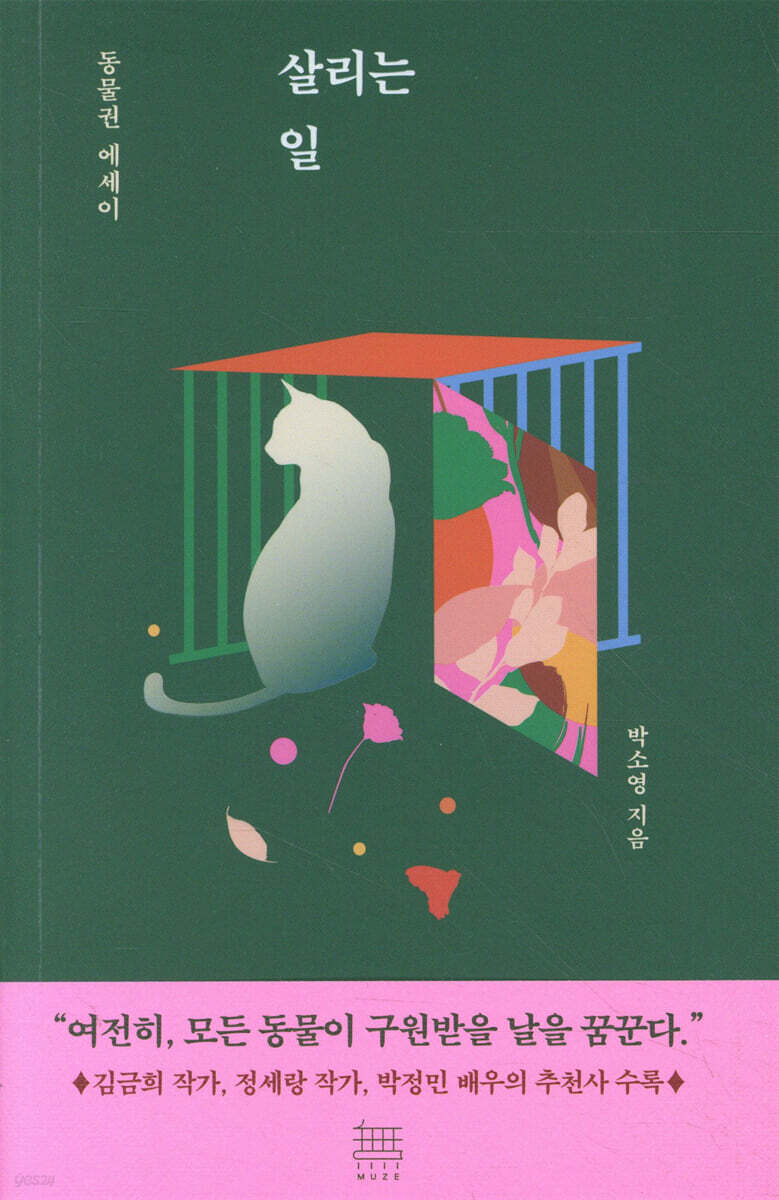
“To love someone is to save them.” From stray cats to captive bears, lab rabbits, and marginalized people. A story about expanding the object of embracing 'Homemade cat treats', 'dog kindergarten'. These are words that have become familiar in Korea, where the pet ownership population reaches 15 million. It's a welcome development that a culture has emerged that cares about the comfort and well-being of animals, but on the other hand, I have this thought. "The pet consumer market is growing rapidly, but how much progress has been made in animal protection laws?", "While some animals receive the utmost care, aren't there also animals that die on the asphalt for three days straight, with no one noticing their deaths?" A cat abuser who brutally murdered a cat in 2019 has been sentenced to six months in prison. It was the first prison sentence in 28 years since the Animal Protection Act was enacted. "Saving" is an animal rights essay that poses a clear question, based solely on the author's own personal experience, about a society where animals in the consumer market and animals under animal protection laws are not treated with the same weight of life. Writer Park So-young, a 'cat mom' who runs about 10 feeding stations for stray cats, extends a helping hand to the animals who hide in the darkness all night. He personally rescues cats and dogs from the streets and writes about the emotions that come with it, faithfully showing what it means to 'help others live'. Readers will get a glimpse into a day in the life of someone who has dedicated his entire life to loving animals. |
- You can preview some of the book's contents.
Preview
index
Here's a cat mom
'stonemason'
winter
Cat Mom 1
Cat Mom 2
Hoodie Story
tattoo
Show me your bag
Here's a cat mom
move
Goodbye Hong Kong
“I am an animal rights advocate.”
red one
What I Learned from Being a Vegetarian 1
“I’ll just eat it.”
What I Learned from Being a Vegetarian 2
Raccoon and Ant
Transformation
captive bears
Hair smell
seminar
The art of saving
Orwell and Neruda
Those who return to Omelas
Piazzolla and the Grasshopper
Semi-basement
For a disqualified society
I know that
Running Writer
Second Reformed
Dogs of Summer
Dogs at the Gas Station 1
Dogs at the Gas Station 2
Mr. B
Pla
Second vaccination
Again, animal rights
Animals and Language
On Animal Exploitation in the Media
Animal hospital
The Golden Age of Animals
Some animals are more equal
Do you like winter?
Conclusion
Recommendations - Kim Geum-hee, Jeong Se-rang, Park Jeong-min
'stonemason'
winter
Cat Mom 1
Cat Mom 2
Hoodie Story
tattoo
Show me your bag
Here's a cat mom
move
Goodbye Hong Kong
“I am an animal rights advocate.”
red one
What I Learned from Being a Vegetarian 1
“I’ll just eat it.”
What I Learned from Being a Vegetarian 2
Raccoon and Ant
Transformation
captive bears
Hair smell
seminar
The art of saving
Orwell and Neruda
Those who return to Omelas
Piazzolla and the Grasshopper
Semi-basement
For a disqualified society
I know that
Running Writer
Second Reformed
Dogs of Summer
Dogs at the Gas Station 1
Dogs at the Gas Station 2
Mr. B
Pla
Second vaccination
Again, animal rights
Animals and Language
On Animal Exploitation in the Media
Animal hospital
The Golden Age of Animals
Some animals are more equal
Do you like winter?
Conclusion
Recommendations - Kim Geum-hee, Jeong Se-rang, Park Jeong-min
Detailed image
.jpg)
Into the book
Even now, as I write this while drinking steaming coffee, I am thinking about it.
"Shouldn't I be out there saving at least one more while I'm typing?" "There might be another child waiting for food somewhere." I still haven't decided whether these trivial words are worth more than feeding and watering the children.
--- p.23
I was so embarrassed that I didn't even get angry when I saw feces in the cat feeding station.
Was it a drunken person who mistook the bathroom for their own business? Or was it a desperate situation that left them without the time to find a bathroom? My brother and I brainstormed various scenarios, but none of them made sense.
(Omitted) After that, I began to think that being a cat mom might mean facing a different riddle every day.
Today, I leave the house with a bag of feed in one hand and an empty bag in the other, ready to pick up anything.
--- p.26~28
There were several reasons why I decided to get a tattoo.
First, I wanted to engrave something on my body that would not change.
Having cats as pets changed my life, and it would remain so.
There may be many values I pursue in life, but one aspiration that will remain constant is to love animals and strive to protect their rights.
I thought it would be nice to commemorate that feeling with a tattoo.
--- p.44
Our neighborhood is filled with memories of countless cats that have passed us by, and there are still cats waiting for us at their feeding spots.
My brother and I always have this thought in our minds that cats that have become strays from their territory might return at any time.
So, we must and will be responsible for this neighborhood for the rest of our lives.
This is why I get angry when I see someone who moves without even finding a successor cat mom.
Stray cats depend a lot on those who feed them regularly.
Especially in the case of cats that have been neutered, they may lose their hunting ability and will.
That's why being a cat mom is a huge responsibility.
I believe that abandoning cats that have already become completely dependent on you is no different from abandoning a non-human animal that you have been keeping as a pet at home.
--- p.61~62
When I first heard the story about rabbits being used for mascara testing, I was shocked.
Mascara is made from the death of rabbits.
(I wrote the word 'sacrifice' and then erased it.
(Sacrifice smells somewhat voluntary.) Cosmetics company people decided that rabbits' habit of rarely shedding tears or blinking would be suitable for testing the durability of mascara.
For this reason, rabbits are kept in cages to prevent them from moving, and chemicals are injected into their eye mucosa.
During this process, many rabbits died with their necks broken while struggling in agony.
Human cruelty does not end here.
The rabbit is eventually euthanized and its eyes are removed for research.
I don't think the longer eyelashes from the rabbit's death are pretty.
I don't find the eyes, which have become large and distinct due to the death of the rabbit, attractive.
You can't call it beauty to take someone's life as collateral, but even if you could, you can't trade that beauty for the lives of tens of thousands of rabbits.
After writing this far, I feel like asking what beauty is.
--- p.118~119
After I became aware of animal rights, I often fell asleep with a heavy heart.
There were many times when I went to work crying after reading shocking articles.
This 'knowing' often shook me and made me uncomfortable.
But if someone were to ask me if I would like to go back to a time before I knew nonhuman animals and their lives, I would say no.
Knowing this discomfort, and embracing it, I have decided to live the rest of my life, and if I can contribute even a little to changing the world for the better, I too will choose to remain in the beginning.
--- p.138
My friends often ask me, as I spend a lot of time rescuing and caring for animals:
“Are you happy now?”
“Are you really happy in that process?”
Every time that happened, I was troubled.
I started to think that I didn't know exactly what 'happiness' was.
People each talk about happiness as a topic of life.
But to me, the 'theory of happiness' often felt rather harsh.
Rescuing animals made life a daily battle.
I had no time to relax while treating sick animals, and I had no time to relax while caring for abandoned animals.
There have always been problems in the world that needed to be solved, and there have always been marginalized beings who suffered because of those problems.
Is it possible to live happily in this reality and find one's own happiness?
Doesn't being happy ultimately mean turning a blind eye to other beings?
--- p.167~168
I often think about the way our society treats animals.
Animals feel both joy and pain, and are beings with individual intentions and wills.
Yet, humans manipulate and 'consume' animals as they please, because they are weak.
No, to be more precise, animals are often not even allowed into the enclosure of the 'socially disadvantaged'.
This is because being defined as an abbreviation is only possible when there is agreement among the members, in other words, when it is recognized as a member.
If art is a movement to make the world a better place, it has to be different.
Art should be an advocate and support for small and vulnerable lives.
I believe that we should become something like a splint that even the smallest being can step on and rely on.
If someone has to get hurt or be erased on the way to the destination, there is no room for the word art.
As far as I know, exclusion and exploitation are the words furthest from art.
"Shouldn't I be out there saving at least one more while I'm typing?" "There might be another child waiting for food somewhere." I still haven't decided whether these trivial words are worth more than feeding and watering the children.
--- p.23
I was so embarrassed that I didn't even get angry when I saw feces in the cat feeding station.
Was it a drunken person who mistook the bathroom for their own business? Or was it a desperate situation that left them without the time to find a bathroom? My brother and I brainstormed various scenarios, but none of them made sense.
(Omitted) After that, I began to think that being a cat mom might mean facing a different riddle every day.
Today, I leave the house with a bag of feed in one hand and an empty bag in the other, ready to pick up anything.
--- p.26~28
There were several reasons why I decided to get a tattoo.
First, I wanted to engrave something on my body that would not change.
Having cats as pets changed my life, and it would remain so.
There may be many values I pursue in life, but one aspiration that will remain constant is to love animals and strive to protect their rights.
I thought it would be nice to commemorate that feeling with a tattoo.
--- p.44
Our neighborhood is filled with memories of countless cats that have passed us by, and there are still cats waiting for us at their feeding spots.
My brother and I always have this thought in our minds that cats that have become strays from their territory might return at any time.
So, we must and will be responsible for this neighborhood for the rest of our lives.
This is why I get angry when I see someone who moves without even finding a successor cat mom.
Stray cats depend a lot on those who feed them regularly.
Especially in the case of cats that have been neutered, they may lose their hunting ability and will.
That's why being a cat mom is a huge responsibility.
I believe that abandoning cats that have already become completely dependent on you is no different from abandoning a non-human animal that you have been keeping as a pet at home.
--- p.61~62
When I first heard the story about rabbits being used for mascara testing, I was shocked.
Mascara is made from the death of rabbits.
(I wrote the word 'sacrifice' and then erased it.
(Sacrifice smells somewhat voluntary.) Cosmetics company people decided that rabbits' habit of rarely shedding tears or blinking would be suitable for testing the durability of mascara.
For this reason, rabbits are kept in cages to prevent them from moving, and chemicals are injected into their eye mucosa.
During this process, many rabbits died with their necks broken while struggling in agony.
Human cruelty does not end here.
The rabbit is eventually euthanized and its eyes are removed for research.
I don't think the longer eyelashes from the rabbit's death are pretty.
I don't find the eyes, which have become large and distinct due to the death of the rabbit, attractive.
You can't call it beauty to take someone's life as collateral, but even if you could, you can't trade that beauty for the lives of tens of thousands of rabbits.
After writing this far, I feel like asking what beauty is.
--- p.118~119
After I became aware of animal rights, I often fell asleep with a heavy heart.
There were many times when I went to work crying after reading shocking articles.
This 'knowing' often shook me and made me uncomfortable.
But if someone were to ask me if I would like to go back to a time before I knew nonhuman animals and their lives, I would say no.
Knowing this discomfort, and embracing it, I have decided to live the rest of my life, and if I can contribute even a little to changing the world for the better, I too will choose to remain in the beginning.
--- p.138
My friends often ask me, as I spend a lot of time rescuing and caring for animals:
“Are you happy now?”
“Are you really happy in that process?”
Every time that happened, I was troubled.
I started to think that I didn't know exactly what 'happiness' was.
People each talk about happiness as a topic of life.
But to me, the 'theory of happiness' often felt rather harsh.
Rescuing animals made life a daily battle.
I had no time to relax while treating sick animals, and I had no time to relax while caring for abandoned animals.
There have always been problems in the world that needed to be solved, and there have always been marginalized beings who suffered because of those problems.
Is it possible to live happily in this reality and find one's own happiness?
Doesn't being happy ultimately mean turning a blind eye to other beings?
--- p.167~168
I often think about the way our society treats animals.
Animals feel both joy and pain, and are beings with individual intentions and wills.
Yet, humans manipulate and 'consume' animals as they please, because they are weak.
No, to be more precise, animals are often not even allowed into the enclosure of the 'socially disadvantaged'.
This is because being defined as an abbreviation is only possible when there is agreement among the members, in other words, when it is recognized as a member.
If art is a movement to make the world a better place, it has to be different.
Art should be an advocate and support for small and vulnerable lives.
I believe that we should become something like a splint that even the smallest being can step on and rely on.
If someone has to get hurt or be erased on the way to the destination, there is no room for the word art.
As far as I know, exclusion and exploitation are the words furthest from art.
--- p.214~215
Publisher's Review
Asking how the weight of life differs
The author asks:
I wonder if the word dignity is a tipped scale for us, if we think that 'non-human animals' are too light and too undeserving of the word dignity.
There is no limit to the dignity that 『The Work of Salvation』 embraces.
It goes from a bear having its bile extracted from a stray cat to a rabbit being used as a cosmetic test subject to marginalized people.
The author, who has often suffered since becoming aware of animal rights, has developed a generous heart as a result of the pain he has endured.
This is why this book can show the meaning of ‘saving work’ from various angles.
This book is largely divided into five parts.
In "Here's a Cat Mom," she shares anecdotes from running a feeding station for stray cats, while in "I am an Animal Rights Advocate" and "The Art of Saving," she shows how caring for cats extends to rescuing other animals, and includes eating, clothing, reading, and listening.
In “Dogs of a Summer Day” and “Animal Rights Again,” the story begins with a story about caring for a dog abandoned at a gas station, and sharply exposes and points out “animal exploitation in the media” and “animal hierarchy.”
Ultimately, 『Salli-ni-il』 strongly pushes the concept of animal rights into the readers' lives.
It makes us feel the pulse of animals that were once alive in everyday still life.
Perhaps we have a duty to be willing to acknowledge that fact, even if it feels foreign and sometimes horrifying to us.
As equal 'animals' born as breathing beings, knowing what comfort and discomfort are, and knowing the pain of illness and the comfort of recovery.
“You must stop stepping on the lifeline of other lives and standing on it to breathe.
Where to start?
“The only people who can fix this are you and me.”
- From the text -
“Consistently saving the little ones”
She never stops loving in her own way
In the bitter wind of dawn, in front of a dog meat farm owner, in today's reality where hope is distant, writer Park So-young consistently saves small beings.
That pure love, combined with a cool gaze, makes readers feel a sense of pent-up crisis rather than a momentary pity.
Although it is still a small fight, the author calmly talks about the issue of 'life', which everyone must ultimately face, based on his own experience.
Sometimes, she is frustrated by those who need a helping hand and the reality that she cannot do it alone, but she never stops loving in her own way.
To always receive enough love from animals to offset the frustration and unhappiness.
“I think that loving someone is like ‘giving life.’
Feeding, protecting from pain, and healing the wounds in their hearts.
Something that gives you new strength and moves you forward.
“I am grateful that I can help someone, even if it is just a little, and I want to continue living a life of ‘saving.’”
- From the text -
"Park So-young the human, Park So-young the cat mom"
Why caring for life requires prejudice and risk
As the author says, “Being a cat mom might mean facing a different mystery every day,” this book features events that are difficult to understand.
Finding someone's 'feces' at a stray cat feeding station, witnessing 'men's panties' (intentionally displayed as if to target cat moms), the scary and uncomfortable things that happen when a young woman and a cat mom get together.
Caring for stray cats also means facing firsthand prejudice and discrimination against women and the socially vulnerable (homeless people, people with disabilities, etc.).
When the author was feeding a stray cat, a middle-aged man nagged him, saying, “If you have time to take care of cats, why don’t you go home and take care of your parents instead?” This brought up the uncomfortable question, “Is taking care of your parents important, but taking care of cats trivial? (Is taking care of a stray creature that isn’t your blood relative trivial?) Do all people who feed cats have distant relationships with their parents?”
Every time she goes to feed her cat, things keep happening that make her hold her heart, but the author is aware of the fact that she is a 'cat mom' and self-censors.
If you decide to return it, someone might harm the cats or take away their food bowls.
A world where we must live in fear that even the bare minimum of defense for the bare minimum of survival might end up threatening ourselves or the creatures we care for.
In front of such a world, the author says:
“As a feminist, my identity is always inevitably defeated by my identity as a cat mom.
I can only weakly admit that.
“And so today, too, human Park So-young knelt before cat mom Park So-young.”
“I will live the rest of my life knowing and embracing the discomfort.”
Because happiness paid for by someone else's misfortune is not a subject of pursuit.
Living as a minority (with the tastes and values of a minority) in a society where the spectrum of tolerance is not wide means accepting inconveniences.
Even authors who are vegetarian and try to buy animal-friendly products give up many conveniences.
The detailed episodes are sometimes told in a humorous and humorous way, and sometimes as intense as a flashing sword.
The author, who has an oily scalp, regains her love(?) after her boyfriend freaks out when he smells her hair, using a product from a certain company to get rid of the scalp odor.
But after learning that they are conducting notorious animal testing, they willingly choose to live with the 'smell' again.
The author also talks about how mascara (a cosmetic for women) is made from the death of rabbits, saying, “You can’t call something that is obtained at the cost of someone’s life beautiful, but even if it were, you can’t exchange that beauty for the lives of tens of thousands of rabbits.
After writing this far, I feel like asking, “What exactly is beauty?”
The act of ‘saving lives’ also leads to art.
“Art should be an advocate and support for small and vulnerable lives.
“If someone has to get hurt and be erased on the way to the destination, there is no room for the word ‘art,’” the author says, examining each work that does not ignore the miserable lives and emotions of non-human animals.
Reading Ursula Le Guin's work, "The Ones Who Walk Away from Omelas," I think of animals trapped in filthy cages their entire lives, unable to move. Listening to Piazzolla's music, which evokes the sorrow of small creatures, I carry the insect clinging to my chest to safety.
The heart that values the weight of life is reflected in people.
It is with the hope of the disabled to be regarded simply as a 'person next to you' rather than a 'symbol', and with a heart that considers the four seasons of those who do not have a home.
“The heart that cares for the weak connects with and expands the heart that cares for other weak people.”
- From the text -
In these unspoiled sentences filled with warmth, the message the author is trying to convey is clear.
"The value of love is supreme, regardless of the times, and saving someone is the realization of that value." A person who defends lives on the brink of death from the vulnerabilities and obstacles of society, a person who, even when their body is as weary as wet cotton, searches for the breath hidden within with a gaze more delicate than anyone else's.
Today, writer Park So-young leaves home again to reach out to another life.
The author asks:
I wonder if the word dignity is a tipped scale for us, if we think that 'non-human animals' are too light and too undeserving of the word dignity.
There is no limit to the dignity that 『The Work of Salvation』 embraces.
It goes from a bear having its bile extracted from a stray cat to a rabbit being used as a cosmetic test subject to marginalized people.
The author, who has often suffered since becoming aware of animal rights, has developed a generous heart as a result of the pain he has endured.
This is why this book can show the meaning of ‘saving work’ from various angles.
This book is largely divided into five parts.
In "Here's a Cat Mom," she shares anecdotes from running a feeding station for stray cats, while in "I am an Animal Rights Advocate" and "The Art of Saving," she shows how caring for cats extends to rescuing other animals, and includes eating, clothing, reading, and listening.
In “Dogs of a Summer Day” and “Animal Rights Again,” the story begins with a story about caring for a dog abandoned at a gas station, and sharply exposes and points out “animal exploitation in the media” and “animal hierarchy.”
Ultimately, 『Salli-ni-il』 strongly pushes the concept of animal rights into the readers' lives.
It makes us feel the pulse of animals that were once alive in everyday still life.
Perhaps we have a duty to be willing to acknowledge that fact, even if it feels foreign and sometimes horrifying to us.
As equal 'animals' born as breathing beings, knowing what comfort and discomfort are, and knowing the pain of illness and the comfort of recovery.
“You must stop stepping on the lifeline of other lives and standing on it to breathe.
Where to start?
“The only people who can fix this are you and me.”
- From the text -
“Consistently saving the little ones”
She never stops loving in her own way
In the bitter wind of dawn, in front of a dog meat farm owner, in today's reality where hope is distant, writer Park So-young consistently saves small beings.
That pure love, combined with a cool gaze, makes readers feel a sense of pent-up crisis rather than a momentary pity.
Although it is still a small fight, the author calmly talks about the issue of 'life', which everyone must ultimately face, based on his own experience.
Sometimes, she is frustrated by those who need a helping hand and the reality that she cannot do it alone, but she never stops loving in her own way.
To always receive enough love from animals to offset the frustration and unhappiness.
“I think that loving someone is like ‘giving life.’
Feeding, protecting from pain, and healing the wounds in their hearts.
Something that gives you new strength and moves you forward.
“I am grateful that I can help someone, even if it is just a little, and I want to continue living a life of ‘saving.’”
- From the text -
"Park So-young the human, Park So-young the cat mom"
Why caring for life requires prejudice and risk
As the author says, “Being a cat mom might mean facing a different mystery every day,” this book features events that are difficult to understand.
Finding someone's 'feces' at a stray cat feeding station, witnessing 'men's panties' (intentionally displayed as if to target cat moms), the scary and uncomfortable things that happen when a young woman and a cat mom get together.
Caring for stray cats also means facing firsthand prejudice and discrimination against women and the socially vulnerable (homeless people, people with disabilities, etc.).
When the author was feeding a stray cat, a middle-aged man nagged him, saying, “If you have time to take care of cats, why don’t you go home and take care of your parents instead?” This brought up the uncomfortable question, “Is taking care of your parents important, but taking care of cats trivial? (Is taking care of a stray creature that isn’t your blood relative trivial?) Do all people who feed cats have distant relationships with their parents?”
Every time she goes to feed her cat, things keep happening that make her hold her heart, but the author is aware of the fact that she is a 'cat mom' and self-censors.
If you decide to return it, someone might harm the cats or take away their food bowls.
A world where we must live in fear that even the bare minimum of defense for the bare minimum of survival might end up threatening ourselves or the creatures we care for.
In front of such a world, the author says:
“As a feminist, my identity is always inevitably defeated by my identity as a cat mom.
I can only weakly admit that.
“And so today, too, human Park So-young knelt before cat mom Park So-young.”
“I will live the rest of my life knowing and embracing the discomfort.”
Because happiness paid for by someone else's misfortune is not a subject of pursuit.
Living as a minority (with the tastes and values of a minority) in a society where the spectrum of tolerance is not wide means accepting inconveniences.
Even authors who are vegetarian and try to buy animal-friendly products give up many conveniences.
The detailed episodes are sometimes told in a humorous and humorous way, and sometimes as intense as a flashing sword.
The author, who has an oily scalp, regains her love(?) after her boyfriend freaks out when he smells her hair, using a product from a certain company to get rid of the scalp odor.
But after learning that they are conducting notorious animal testing, they willingly choose to live with the 'smell' again.
The author also talks about how mascara (a cosmetic for women) is made from the death of rabbits, saying, “You can’t call something that is obtained at the cost of someone’s life beautiful, but even if it were, you can’t exchange that beauty for the lives of tens of thousands of rabbits.
After writing this far, I feel like asking, “What exactly is beauty?”
The act of ‘saving lives’ also leads to art.
“Art should be an advocate and support for small and vulnerable lives.
“If someone has to get hurt and be erased on the way to the destination, there is no room for the word ‘art,’” the author says, examining each work that does not ignore the miserable lives and emotions of non-human animals.
Reading Ursula Le Guin's work, "The Ones Who Walk Away from Omelas," I think of animals trapped in filthy cages their entire lives, unable to move. Listening to Piazzolla's music, which evokes the sorrow of small creatures, I carry the insect clinging to my chest to safety.
The heart that values the weight of life is reflected in people.
It is with the hope of the disabled to be regarded simply as a 'person next to you' rather than a 'symbol', and with a heart that considers the four seasons of those who do not have a home.
“The heart that cares for the weak connects with and expands the heart that cares for other weak people.”
- From the text -
In these unspoiled sentences filled with warmth, the message the author is trying to convey is clear.
"The value of love is supreme, regardless of the times, and saving someone is the realization of that value." A person who defends lives on the brink of death from the vulnerabilities and obstacles of society, a person who, even when their body is as weary as wet cotton, searches for the breath hidden within with a gaze more delicate than anyone else's.
Today, writer Park So-young leaves home again to reach out to another life.
GOODS SPECIFICS
- Publication date: December 15, 2020
- Page count, weight, size: 252 pages | 326g | 123*190*15mm
- ISBN13: 9791197221972
- ISBN10: 1197221972
You may also like
카테고리
korean


korean

![GQ KOREA Mark (Monthly): December [2025]](http://librairie.coreenne.fr/cdn/shop/files/8ef265dbbfbf186523ed75ba7319009d.jpg?v=1765340328&width=3840)


