

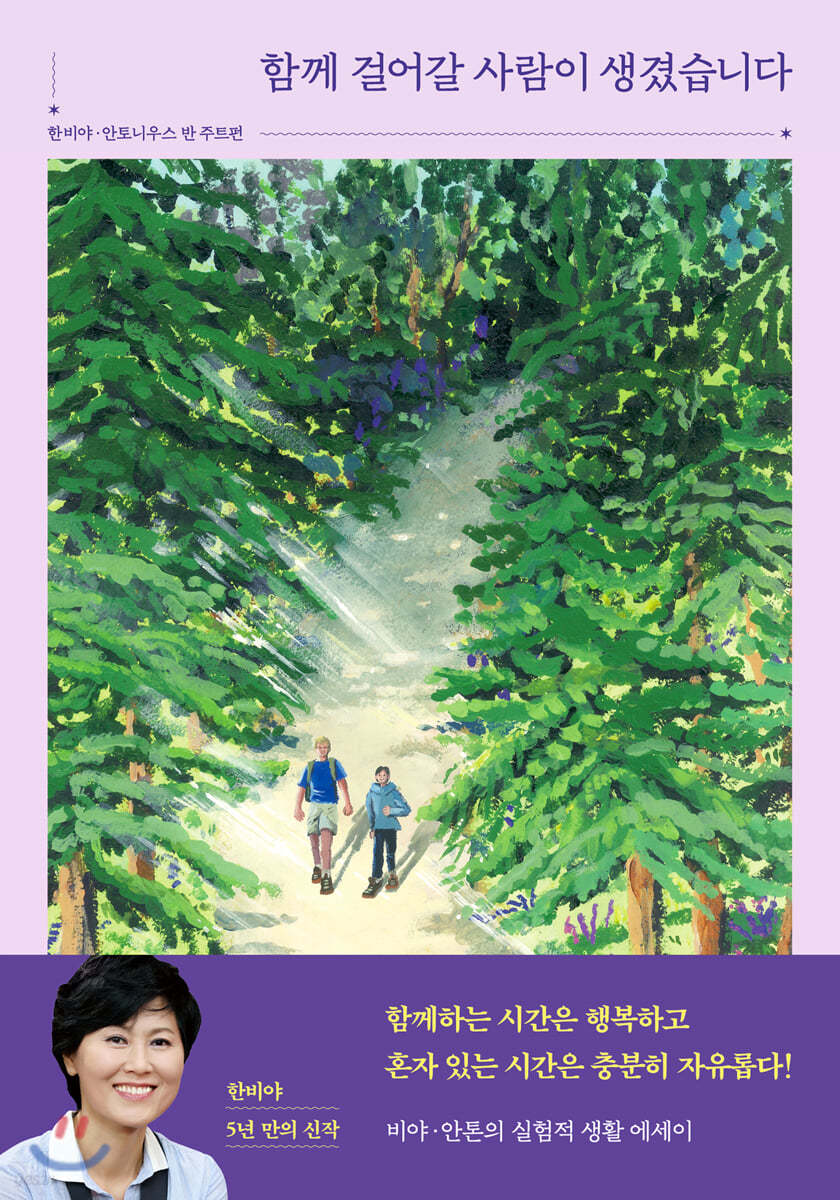
I have someone to walk with.
 |
Description
Book Introduction
Traveling between Korea and the Netherlands
Creating their own life formula
The 'separate yet together' life of a voluntary long-distance couple
Hanbiya and Antonius van Zutphen (hereinafter referred to as Anton), an international relief expert from the Netherlands, first met as a team leader and a team member at an emergency relief site in Herat, northern Afghanistan, in 2002, and after 15 years of being mentors, friends, and lovers, they became a couple.
In 2020, the couple, who are in their third year of marriage, are also a two-person project team that thinks, plans, and acts together on how to live their future lives.
But this couple has a different way of living.
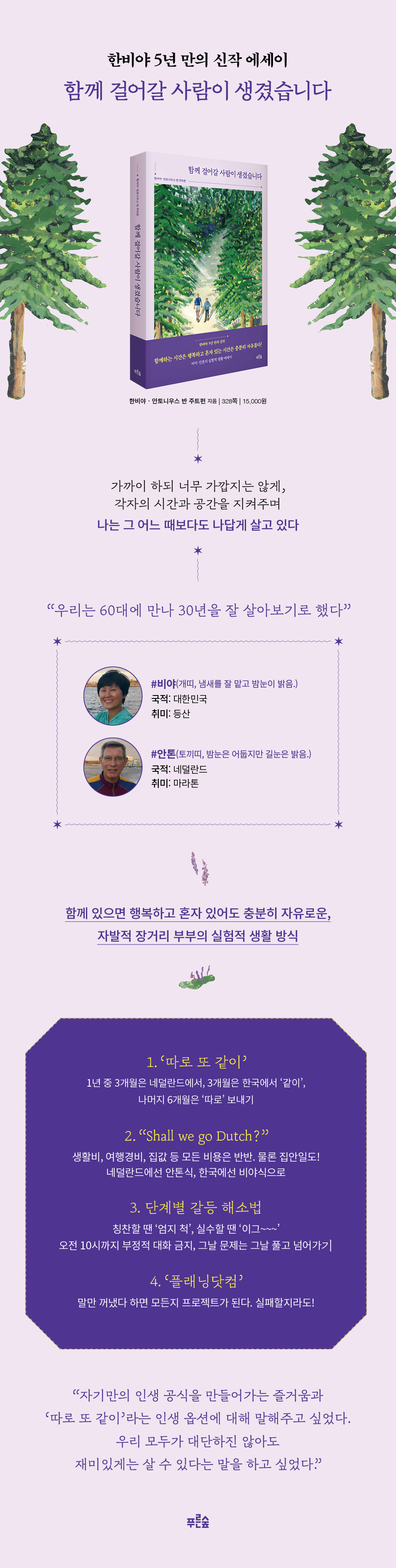
We spend 3 months a year together in Korea, 3 months in the Netherlands, and the remaining 6 months apart.
This is the so-called '336 time'.
"I've Got Someone to Walk With" is a story about an experimental married life of two people who are incredibly happy and unique when they spend time together, but are free enough to continue their original lives when they are alone.
This book tells us that there is no "right time" to do anything in life, and there is no "right way" to raise a family.
Through their experiences and trial and error, the two demonstrate that we can feel the happiest when we choose our lives according to our own values and circumstances, take responsibility for them, and enjoy freedom. They also demonstrate that life is not fixed but can unfold across a spectrum.
The success and failure of the 'project' of two people who like to plan and execute anything is also interesting.
Another interesting aspect of this book is that it allows readers to learn about the lifestyles and sentiments of each country through the stories of the Netherlands as seen by Hanbiya and Korea as seen by Anton, and to read the warm perspectives of emergency relief experts on the world.
For those approaching the latter half of their lives, this book will offer empathy and courage. For those still in the first or middle half of their lives, this book will help them reduce their fears and live freely, exploring various ways to live a life that may not be spectacular, but is still enjoyable.
Creating their own life formula
The 'separate yet together' life of a voluntary long-distance couple
Hanbiya and Antonius van Zutphen (hereinafter referred to as Anton), an international relief expert from the Netherlands, first met as a team leader and a team member at an emergency relief site in Herat, northern Afghanistan, in 2002, and after 15 years of being mentors, friends, and lovers, they became a couple.
In 2020, the couple, who are in their third year of marriage, are also a two-person project team that thinks, plans, and acts together on how to live their future lives.
But this couple has a different way of living.
We spend 3 months a year together in Korea, 3 months in the Netherlands, and the remaining 6 months apart.
This is the so-called '336 time'.
"I've Got Someone to Walk With" is a story about an experimental married life of two people who are incredibly happy and unique when they spend time together, but are free enough to continue their original lives when they are alone.
This book tells us that there is no "right time" to do anything in life, and there is no "right way" to raise a family.
Through their experiences and trial and error, the two demonstrate that we can feel the happiest when we choose our lives according to our own values and circumstances, take responsibility for them, and enjoy freedom. They also demonstrate that life is not fixed but can unfold across a spectrum.
The success and failure of the 'project' of two people who like to plan and execute anything is also interesting.
Another interesting aspect of this book is that it allows readers to learn about the lifestyles and sentiments of each country through the stories of the Netherlands as seen by Hanbiya and Korea as seen by Anton, and to read the warm perspectives of emergency relief experts on the world.
For those approaching the latter half of their lives, this book will offer empathy and courage. For those still in the first or middle half of their lives, this book will help them reduce their fears and live freely, exploring various ways to live a life that may not be spectacular, but is still enjoyable.
- You can preview some of the book's contents.
Preview
index
prolog
Chapter 1.
Our 'separate yet together' married life
Good morning, my sunshine!
Priorities and Minimum Standards for Relief Worker Couples
Dutch Rainder Orchid Road House
Men on the 2nd floor and women on the 3rd floor
We invest time in each other
In the Netherlands, it's called Anton's style, and in Korea, it's called Biya's style.
Moments when we want to protect each other
“Shall we go Dutch?”
If you really want to give a gift
Vivace and Andante
But I lived without any problems!
Different Time Management Methods
The art of pointing out mistakes without embarrassment
Sometimes I'm scared of myself
Love and chocolate are sweeter when shared.
Chapter 2.
Planning for today too
Planning.com
Is this your honeymoon? Or a language course?
Vamos, let's give it a try!
Study, compete, and love
Balcony shopping in Cuba
“You guys are crazy!”
Salsa has become a taboo word.
Let's solve the problem that day and leave it at that day.
My intense yet warm time in Cuba
Duty to help, right to receive help
He was the best boss
Rain, the one who asks serious questions
Specialist, a heart-pounding proposal
Meet the relief pitcher
Granada, the road from colleagues to friends
If I get married, it will be with this person
“But, what country are you from?”
I will live like sugar and salt.
Dr. Hanbiya's Creation Project
Trust saves lives
Anton, the cheerleader of my life
Blood, sweat, tears, and gratitude, gratitude
Chapter 3.
Dutch woman in Seoul, Korean man in the West
“No problem, it’s the Netherlands.”
A country with many world firsts
Welcome to Ranger
Mrs. Villa Van Zutphen-Han
Potato Boy of Bulkwang-dong
Should I plant a Rose of Sharon in the front yard?
The life of a voluntary retiree
The Dutch Herring Story
The power of the village beautification committee
A five-language fluent person struggles with Korean.
Lent and a Sip of Wine
Pilgrimage from home
Is that Napoleon?
A forgiving heart, a heart that asks for forgiveness
Chapter 4.
The power of being alone, the power of being together
Fruit cocktail-style marriage
The outer rope disappears at any time
If I hadn't been there
Preparation for 'that day'
Practice aging gracefully and gracefully
“Now we’ll catch you.”
If you divide the Baekdudaegan Mountain Range into sections
Beer makes friendships stronger
Where will I live in 10 years?
Calm and peaceful
A life that isn't great, but is enjoyable
Epilogue
Chapter 1.
Our 'separate yet together' married life
Good morning, my sunshine!
Priorities and Minimum Standards for Relief Worker Couples
Dutch Rainder Orchid Road House
Men on the 2nd floor and women on the 3rd floor
We invest time in each other
In the Netherlands, it's called Anton's style, and in Korea, it's called Biya's style.
Moments when we want to protect each other
“Shall we go Dutch?”
If you really want to give a gift
Vivace and Andante
But I lived without any problems!
Different Time Management Methods
The art of pointing out mistakes without embarrassment
Sometimes I'm scared of myself
Love and chocolate are sweeter when shared.
Chapter 2.
Planning for today too
Planning.com
Is this your honeymoon? Or a language course?
Vamos, let's give it a try!
Study, compete, and love
Balcony shopping in Cuba
“You guys are crazy!”
Salsa has become a taboo word.
Let's solve the problem that day and leave it at that day.
My intense yet warm time in Cuba
Duty to help, right to receive help
He was the best boss
Rain, the one who asks serious questions
Specialist, a heart-pounding proposal
Meet the relief pitcher
Granada, the road from colleagues to friends
If I get married, it will be with this person
“But, what country are you from?”
I will live like sugar and salt.
Dr. Hanbiya's Creation Project
Trust saves lives
Anton, the cheerleader of my life
Blood, sweat, tears, and gratitude, gratitude
Chapter 3.
Dutch woman in Seoul, Korean man in the West
“No problem, it’s the Netherlands.”
A country with many world firsts
Welcome to Ranger
Mrs. Villa Van Zutphen-Han
Potato Boy of Bulkwang-dong
Should I plant a Rose of Sharon in the front yard?
The life of a voluntary retiree
The Dutch Herring Story
The power of the village beautification committee
A five-language fluent person struggles with Korean.
Lent and a Sip of Wine
Pilgrimage from home
Is that Napoleon?
A forgiving heart, a heart that asks for forgiveness
Chapter 4.
The power of being alone, the power of being together
Fruit cocktail-style marriage
The outer rope disappears at any time
If I hadn't been there
Preparation for 'that day'
Practice aging gracefully and gracefully
“Now we’ll catch you.”
If you divide the Baekdudaegan Mountain Range into sections
Beer makes friendships stronger
Where will I live in 10 years?
Calm and peaceful
A life that isn't great, but is enjoyable
Epilogue
Detailed image
Into the book
Our married life is going back to '336 time'.
We spend three months of the year together in the Netherlands and three months in Korea, and the remaining six months apart. When we are apart, texting is the most important means of communication and connection.
--- p.18
But who are we?
Aren't we relief professionals who find the best solution even in the worst of situations to save as many lives as possible? Anton and I decided to apply the methods we use in the relief field to our relationship.
It is about setting ‘priorities’ and ‘minimum standards’.
--- p.20
While we both have the commonality of being neat and tidy, there are some distinct differences between Biya and me in our daily lives.
It's time management.
During her waking hours, Biya is like a bee, constantly working on something without resting for even a moment.
On the other hand, I enjoy the time I have to do nothing or just laze around without thinking about anything.
--- p.63
“Thumbs up!”
This is the first Korean expression Anton learned in Korea and it is very useful.
Could there be any other expression as useful as this? 'Good, great job, awesome, I really like it, that's a good idea, I'm very satisfied... ' --- p.77
With Biya coming into my life, this period of maturity has finally come to me.
In addition, the virtues of maturity such as understanding, empathy, trust, and peace began to take root in everyday life.
The same will apply to Biya.
We are gradually moving away from 'self-centered' thinking and behavior to 'we-centered' thinking and behavior.
--- p.88
As we ate breakfast with a light heart, we wholeheartedly agreed that it would be a shame to miss even a single day of our time together, as we only have so long to spend together.
And if something like this happens again, we set some basic rules that must be followed.
No matter how angry you are, solve the problem that day and go to sleep! --- p.127
In everyday life and at relief sites, we must never view or treat those receiving help as hopeless.
They too are decent human beings.
It's just that I need help right now.
We must not forget this fact.
--- p.136
“Where did you first meet?”
I answer this question, which I have been asked countless times, by adding information that was not even asked.
“Afghanistan.
“Back then Anton was the boss, but now I am the boss.”
This one word contains the history of our love.
Yes, that's right.
Our relationship has evolved and developed in many ways over the past 18 years.
--- p.137
If the local residents had received even a single bit of education or training on how to respond in a tsunami, if only each neighborhood had a siren to warn people to evacuate, how many lives could have been saved? However, the reality is that media attention and relief funds only begin to flow after a disaster has struck.
I always felt sorry about that.
This problem, which I had been thinking about for a long time, naturally became the topic of my thesis.
--- p.176
This small town is surprisingly a hub of Western Europe.
It's only 10 kilometers to Belgium.
It only takes 30 minutes by bike, and about two hours if you walk slowly along the rain forest path.
There are no proper landmarks other than large road signs, so it feels like you're going to a neighboring town rather than the border.
It's about a 30-minute drive to Germany, and Anton goes there once or twice a month to buy beer.
--- p.199
A while ago, I planted several Rose of Sharon trees in the front yard of my house and also planted a few next to Anton's parents' grave.
While I'm at it, how about planting all kinds of Rose of Sharon in front and backyards, turning them into a Rose of Sharon garden, and using those flowers to provide "true education" to the people of this neighborhood? --- p.220
Asking for forgiveness and giving forgiveness are both truly difficult tasks.
As I get older, I wonder how great it would be to become good at this. Could I become good at it with practice? As Anton said, it's beyond human effort, so perhaps I should seek God's help.
--- p.262
People often say that marriage is about finding your other half, but I think differently.
I don't think that two imperfect halves come together to become a whole, but rather that they must already be whole on their own before they can live completely together.
--- p.268
I developed this 'power of being alone' not while on a long-term trip to a remote area or working as an emergency relief specialist, but during the winter of my first year of high school.
--- p.269
No matter how thick and strong the external rope may seem, it is something truly unbelievable that disappears like the morning fog at the slightest change in circumstances.
In a world where standards and likes and dislikes change as easily as the palm of one's hand, the only thing you can trust is your own roots that keep you standing.
--- p.274
These days, we talk about this topic whenever we get a chance.
Because they both genuinely want to grow old like that.
To this end, countless principles and tactical strategies have been established, revised, and eliminated.
Doctors always say.
It is better to avoid doing one thing that is bad for your body than to do 100 things that are good for your body.
Applying this advice, we agreed on two things we should not do as a top priority and came up with countermeasures.
--- p.289
Someone said.
When you reach your 60s, you don't need to be smart anymore, but you do need to show that you've become wiser.
This means that I should try less to prove my own superiority and instead try more to share what I have learned with others.
We spend three months of the year together in the Netherlands and three months in Korea, and the remaining six months apart. When we are apart, texting is the most important means of communication and connection.
--- p.18
But who are we?
Aren't we relief professionals who find the best solution even in the worst of situations to save as many lives as possible? Anton and I decided to apply the methods we use in the relief field to our relationship.
It is about setting ‘priorities’ and ‘minimum standards’.
--- p.20
While we both have the commonality of being neat and tidy, there are some distinct differences between Biya and me in our daily lives.
It's time management.
During her waking hours, Biya is like a bee, constantly working on something without resting for even a moment.
On the other hand, I enjoy the time I have to do nothing or just laze around without thinking about anything.
--- p.63
“Thumbs up!”
This is the first Korean expression Anton learned in Korea and it is very useful.
Could there be any other expression as useful as this? 'Good, great job, awesome, I really like it, that's a good idea, I'm very satisfied... ' --- p.77
With Biya coming into my life, this period of maturity has finally come to me.
In addition, the virtues of maturity such as understanding, empathy, trust, and peace began to take root in everyday life.
The same will apply to Biya.
We are gradually moving away from 'self-centered' thinking and behavior to 'we-centered' thinking and behavior.
--- p.88
As we ate breakfast with a light heart, we wholeheartedly agreed that it would be a shame to miss even a single day of our time together, as we only have so long to spend together.
And if something like this happens again, we set some basic rules that must be followed.
No matter how angry you are, solve the problem that day and go to sleep! --- p.127
In everyday life and at relief sites, we must never view or treat those receiving help as hopeless.
They too are decent human beings.
It's just that I need help right now.
We must not forget this fact.
--- p.136
“Where did you first meet?”
I answer this question, which I have been asked countless times, by adding information that was not even asked.
“Afghanistan.
“Back then Anton was the boss, but now I am the boss.”
This one word contains the history of our love.
Yes, that's right.
Our relationship has evolved and developed in many ways over the past 18 years.
--- p.137
If the local residents had received even a single bit of education or training on how to respond in a tsunami, if only each neighborhood had a siren to warn people to evacuate, how many lives could have been saved? However, the reality is that media attention and relief funds only begin to flow after a disaster has struck.
I always felt sorry about that.
This problem, which I had been thinking about for a long time, naturally became the topic of my thesis.
--- p.176
This small town is surprisingly a hub of Western Europe.
It's only 10 kilometers to Belgium.
It only takes 30 minutes by bike, and about two hours if you walk slowly along the rain forest path.
There are no proper landmarks other than large road signs, so it feels like you're going to a neighboring town rather than the border.
It's about a 30-minute drive to Germany, and Anton goes there once or twice a month to buy beer.
--- p.199
A while ago, I planted several Rose of Sharon trees in the front yard of my house and also planted a few next to Anton's parents' grave.
While I'm at it, how about planting all kinds of Rose of Sharon in front and backyards, turning them into a Rose of Sharon garden, and using those flowers to provide "true education" to the people of this neighborhood? --- p.220
Asking for forgiveness and giving forgiveness are both truly difficult tasks.
As I get older, I wonder how great it would be to become good at this. Could I become good at it with practice? As Anton said, it's beyond human effort, so perhaps I should seek God's help.
--- p.262
People often say that marriage is about finding your other half, but I think differently.
I don't think that two imperfect halves come together to become a whole, but rather that they must already be whole on their own before they can live completely together.
--- p.268
I developed this 'power of being alone' not while on a long-term trip to a remote area or working as an emergency relief specialist, but during the winter of my first year of high school.
--- p.269
No matter how thick and strong the external rope may seem, it is something truly unbelievable that disappears like the morning fog at the slightest change in circumstances.
In a world where standards and likes and dislikes change as easily as the palm of one's hand, the only thing you can trust is your own roots that keep you standing.
--- p.274
These days, we talk about this topic whenever we get a chance.
Because they both genuinely want to grow old like that.
To this end, countless principles and tactical strategies have been established, revised, and eliminated.
Doctors always say.
It is better to avoid doing one thing that is bad for your body than to do 100 things that are good for your body.
Applying this advice, we agreed on two things we should not do as a top priority and came up with countermeasures.
--- p.289
Someone said.
When you reach your 60s, you don't need to be smart anymore, but you do need to show that you've become wiser.
This means that I should try less to prove my own superiority and instead try more to share what I have learned with others.
--- p.317
Publisher's Review
Hanbiya's first new work in five years
Time spent together is happy, and time spent alone is free enough!
3:3:6 times a year, going back and forth between Korea and the Netherlands
Creating their own life formula
An Experimental Life Essay on a Voluntary Long-Distance Couple
An icon of challenge and vitality, author Hanbiya, who has shared vivid real-life experiences and honest inner stories through nine books, including travelogues, emergency relief field reports, and study abroad stories, has returned with a new work after five years.
"I Found Someone to Walk With" is a book written by Hanbiya and her husband Anton, and is a story about the experimental life of a couple in their third year of marriage.
I share with readers the standards I've established and the valuable experiences I've gained while searching for the optimal lifestyle for a happier married life.
Hanbiya and Anton met as colleagues at an emergency relief site in Herat, northern Afghanistan, in 2002, and became mentors, friends, and lovers before getting married in 2017, 15 years after meeting.
The two set a standard called '336 Time' and spend three months a year together in Korea and three months in the Netherlands.
And for the remaining six months, they are a 'voluntary long-distance couple' who live separately.
One person settled in the Netherlands after retirement, and the other is still active in society in Korea.
Recently, new family forms centered on the values of independence and freedom, such as the LAT family (Living Apart Together, a couple who live separately in their own spaces and then live together in the same house for a certain period of time), are appearing, and the ways in which families live are also becoming increasingly diverse.
At such a time, the two people who met and enjoyed newlywed life when they had accumulated experience in their respective fields and were mature enough to reflect on themselves experimented with and realized the lifestyle of 'separate yet together', establishing principles between the couple and discovering the joy of being together while growing their strength to be alone.
Alone is enough, together is happy
A variation for everyone who wants to live more authentically than ever before.
Like emergency relief workers, the couple set 'priorities' and 'minimum standards' before getting married, and met once or twice a year to meet these standards. After getting married, they lived by the so-called '336 time'.
Also, I have been faithfully following the 'half-and-half' principle for expenses, plans, and housework.
Other useful principles for protecting each other's time and space, such as securing time alone in one space, methods for preventing nagging, different ways of living and managing time, prohibiting negative conversations before 10 a.m., methods for preventing nagging step by step, and techniques for pointing out mistakes without making them awkward, as well as smart coping methods designed to avoid fighting, are also very useful.
There are also countless episodes set in Korea, the Netherlands, and Cuba, including minor disagreements that any couple would experience, and the history of their relationship from colleagues to a couple.
In particular, the fast-paced writing led by Hanbiya, an 'energizer with a generator attached', and the leisurely writing led by Anton, a 'principled person who prepares for anything in advance', intersect to add to the pleasure of reading.
In particular, this book says that no matter what lifestyle you choose, you can only live your life true to yourself if you have the strength to be alone.
'Only when you have the awareness that you are enough on your own, the determination to stand on your own, and the strength to persevere and ultimately achieve something on your own can you have a good married life together.'
Whether single or married, if you have your own life formula, you can live a fun, if not spectacular, life, a newlywed couple in their 60s offer warm encouragement.
Anton and I decided to write this book with warmth and honesty, like a conversation you'd have with a close friend over dinner.
How we went from colleagues to friends, lovers, and then to a couple, what principles we set to get along well, how we live as ‘Mr. An’ and ‘Mrs. Seoul’ in each other’s countries, how we each maintain our own unique tastes and colors… … .
-From the preface
“Shall we go Dutch?”
“Okay, then let’s split the bill.
“I am Dutch.”
This book consists of four chapters.
Chapter 1, “Our ‘Separate Yet Together’ Married Life,” shows in detail the couple’s married life and the similarities and differences they discovered while living together as a couple.
The key is to maintain a balance between time spent together and time spent alone.
On the other hand, 'having similar life goals or values and living a harmonious and fulfilling daily life are two different things.'
Like any other couple, there is constant bickering in everyday life.
Eating habits, towel management methods, shopping principles, and standards of cleanliness are also different.
Their eating habits, sleeping habits, and time management methods are polar opposites.
Because our standards are so different, it's easy for petty arguments to arise.
So the two set some rules for when they were together to avoid arguments.
In Korea, it's called 'Biya style', in the Netherlands, it's called 'Anton style'.
Of course, the lifestyle agreed upon and maintained by the two authors of this book is not applicable to everyone.
The reason why one of the basic principles of married life, 'divide everything', is well-kept is because the two people's economic principle of 'I earn, I spend' and their consumption tendencies of pursuing minimalism are in sync.
So they hope their story will serve as an inspirational example, not a model.
There is no right answer for any lifestyle, and the point is that it is important to be diligent in maintaining the principles we have agreed upon.
In short, when I go to the Netherlands, I do it Anton's way, and when Anton comes to Korea, he does it mine.
Whether I liked it or not, whether I liked it or not, I decided to do it without showing any displeasure, even if it was annoying or uncomfortable, even if it didn't make sense.
If we don't do this, we'll end up fighting every day.
Conflicts do not arise from grand and significant events, but from the small and trivial things we encounter every day.
We really don't want to fight.
Since we met after turning 60, wouldn't it be enough time to just have fun and live happily together for the rest of our lives?
-Page 44
The reason we can live with this "half-and-half" bet is because our income and assets are similar, we're trained to transparently divide our shared and individual expenses, and we believe that this principle keeps our relationship healthy.
But I think the more fundamental reason is that our attitudes toward money are similar.
-Page 55
Chapter 2, “Planning Today Too,” contains the story of two people who call each other “Planning.com Korea” and “Planning.com Netherlands” growing closer as they carry out various projects, and the love story of two people who respected each other as colleagues until they became lovers and a married couple.
The ambitious honeymoon we embarked on two years after getting married became a honeymoon language study trip thanks to the 'Learn Spanish Project', and with the addition of the 'Learn Salsa Project', it became a honeymoon language study and salsa trip.
Although there are times when things fail, like the project to learn salsa, he says, "whether it's a half-failure or a complete failure, it's important to give it a try, and whether it succeeds or fails, if you enjoy the process of planning and preparing, it's not a total loss."
So the two of them always have plans, and they live making plans today as well.
It also tells the story of Hanbiya's struggles to obtain her doctorate and Anton's episode of actively assisting her with the field research and interviews required for her thesis writing, playing the role of a 'cheerleader', and the 'joint project' that the couple creates together.
After that, we worked together in Iran in 2003, Iraq in 2004, and the Indian Ocean tsunami in 2005, with Anton as the general manager and me as a dispatched agent, and we strengthened our camaraderie.
He overcame difficult situations head-on with remarkable determination and drive in any setting.
Because of this, there were frequent clashes with headquarters and he was criticized a lot, but I, who was there, respected and admired him for sticking to his principles in any situation.
-Pages 138-139
Amazingly, I realized many things that I would never have known if it weren't for this process.
It's a story of shared suffering, and more than anything, I've come to understand a little bit about the feelings of countless test takers, repeat test takers, and job seekers.
The pressure of exams keeps me from having a single day of peace.
I feel sorry for those who silently support me.
The feeling of guilt that comes over me on days when I overslept or studied lazily.
The feeling of inferiority that arises from wondering if doing this will work...
Oh, now I won't tell my friends who come to special lectures to work harder unconditionally.
Saying that is violence.
Because they are already working so hard that they are dying under this enormous burden.
- Pages 179-180
Watching my own mood, not that of others, and dancing to my own beat
For a fun life, even if it's not great
Chapter 3, “Dutch Seoul Lady, Korean Seobang,” deals with the wider world that the two people come to know through each other.
Leinde, a small village near Eindhoven where Anton settled after retirement, is a place where village autonomy and traditions are alive.
The story of the Netherlands told by Hanbiya, the 'Seoul Lady' of Leinde, is very interesting, including stories about Dutch history, culture, and people that we didn't know much about, such as how the Dutch people fought with water, how the Dutch constitution differs from ours, and how village communities operate.
Additionally, through Anton's voluntary retirement at the age of 66, his settlement in the Netherlands, and his adaptation to the village community, we can get a glimpse into the Dutch system, including the Dutch elderly welfare and pension system.
'How well do you understand Korea?' Anton always asks himself.
He is still confused about how to separate his trash, and he says Korean is more difficult than any other language in the world. His constant efforts to understand Korea more accurately and deeply are also deeply moving.
The people here try to preserve the village's old appearance as much as possible.
First of all, in our village, you can't fix your house as you please.
In particular, any renovation of the front of the house visible from the street, even a single window, must be approved by the town's appearance committee.
-Pages 233-234
In the Netherlands, retired people are not seen as out of the woods.
This is because retirees make a significant contribution to the local economy by generously using their various pensions and the assets they have accumulated.
In short, they are old people who spend money.
Most of them consider it more important to spend their money well while they are alive than to leave their wealth to their children and family.
-Page 225
Chapter 4, “The Power of Being Alone, the Power of Being Together,” corresponds to the “roots” of this book.
How to cultivate the strength to be alone, a story of two people in their 60s holding hands and taking steps together.
We all want to live our lives our way.
This book says that only by recognizing that "the only thing you can trust in the world is your own roots that allow you to stand on your own two feet," and constantly asking yourself, "What kind of person am I? What kind of temperament and nature do I have? What drives me?", can you finally find the courage to live your true self.
And what gives me the courage to live my life my way is the ‘power to be alone.’
The root of what makes married life rich is this very power of being alone.
The reason why two people can find and maintain a harmonious married life while maintaining their own individuality, and a lifestyle where each person's uniqueness and presence shines when together, is because each person has built up the 'strength to be alone' for a long time.
Hanbiya's will, revealed for the first time in this book, the couple's code of conduct for aging gracefully, and the courage to step out of the center and come down to the periphery serve as valuable references for anyone wishing to calmly accept aging and death.
I believe that a fruit cocktail-style marriage where two people can be happy together is possible only when there is the awareness that one is enough on their own, the determination to stand on their own, the strength to persevere and ultimately achieve something on their own.
So, whether you are single or married, the key is the 'power to be alone' and you must cultivate that power.
-Page 269
There are certain conditions that are absolutely necessary for a plant to take root firmly.
As the saying goes these days, you have to have the courage to live your own way.
What does it mean to live authentically? For me, it's dancing to my own beat.
No matter how cool someone else's rhythm may seem, if it doesn't match your own rhythm and rhythm, it's difficult to dance.
-Page 275
Instead, our plans are full of things we can accomplish with just a little focus and support from each other.
Things that are hard but fun, things that are difficult but become easier when you do them together, small but satisfying things, things that are enjoyable in themselves as you take steps toward your goal… … .
-Page 322
Time spent together is happy, and time spent alone is free enough!
3:3:6 times a year, going back and forth between Korea and the Netherlands
Creating their own life formula
An Experimental Life Essay on a Voluntary Long-Distance Couple
An icon of challenge and vitality, author Hanbiya, who has shared vivid real-life experiences and honest inner stories through nine books, including travelogues, emergency relief field reports, and study abroad stories, has returned with a new work after five years.
"I Found Someone to Walk With" is a book written by Hanbiya and her husband Anton, and is a story about the experimental life of a couple in their third year of marriage.
I share with readers the standards I've established and the valuable experiences I've gained while searching for the optimal lifestyle for a happier married life.
Hanbiya and Anton met as colleagues at an emergency relief site in Herat, northern Afghanistan, in 2002, and became mentors, friends, and lovers before getting married in 2017, 15 years after meeting.
The two set a standard called '336 Time' and spend three months a year together in Korea and three months in the Netherlands.
And for the remaining six months, they are a 'voluntary long-distance couple' who live separately.
One person settled in the Netherlands after retirement, and the other is still active in society in Korea.
Recently, new family forms centered on the values of independence and freedom, such as the LAT family (Living Apart Together, a couple who live separately in their own spaces and then live together in the same house for a certain period of time), are appearing, and the ways in which families live are also becoming increasingly diverse.
At such a time, the two people who met and enjoyed newlywed life when they had accumulated experience in their respective fields and were mature enough to reflect on themselves experimented with and realized the lifestyle of 'separate yet together', establishing principles between the couple and discovering the joy of being together while growing their strength to be alone.
Alone is enough, together is happy
A variation for everyone who wants to live more authentically than ever before.
Like emergency relief workers, the couple set 'priorities' and 'minimum standards' before getting married, and met once or twice a year to meet these standards. After getting married, they lived by the so-called '336 time'.
Also, I have been faithfully following the 'half-and-half' principle for expenses, plans, and housework.
Other useful principles for protecting each other's time and space, such as securing time alone in one space, methods for preventing nagging, different ways of living and managing time, prohibiting negative conversations before 10 a.m., methods for preventing nagging step by step, and techniques for pointing out mistakes without making them awkward, as well as smart coping methods designed to avoid fighting, are also very useful.
There are also countless episodes set in Korea, the Netherlands, and Cuba, including minor disagreements that any couple would experience, and the history of their relationship from colleagues to a couple.
In particular, the fast-paced writing led by Hanbiya, an 'energizer with a generator attached', and the leisurely writing led by Anton, a 'principled person who prepares for anything in advance', intersect to add to the pleasure of reading.
In particular, this book says that no matter what lifestyle you choose, you can only live your life true to yourself if you have the strength to be alone.
'Only when you have the awareness that you are enough on your own, the determination to stand on your own, and the strength to persevere and ultimately achieve something on your own can you have a good married life together.'
Whether single or married, if you have your own life formula, you can live a fun, if not spectacular, life, a newlywed couple in their 60s offer warm encouragement.
Anton and I decided to write this book with warmth and honesty, like a conversation you'd have with a close friend over dinner.
How we went from colleagues to friends, lovers, and then to a couple, what principles we set to get along well, how we live as ‘Mr. An’ and ‘Mrs. Seoul’ in each other’s countries, how we each maintain our own unique tastes and colors… … .
-From the preface
“Shall we go Dutch?”
“Okay, then let’s split the bill.
“I am Dutch.”
This book consists of four chapters.
Chapter 1, “Our ‘Separate Yet Together’ Married Life,” shows in detail the couple’s married life and the similarities and differences they discovered while living together as a couple.
The key is to maintain a balance between time spent together and time spent alone.
On the other hand, 'having similar life goals or values and living a harmonious and fulfilling daily life are two different things.'
Like any other couple, there is constant bickering in everyday life.
Eating habits, towel management methods, shopping principles, and standards of cleanliness are also different.
Their eating habits, sleeping habits, and time management methods are polar opposites.
Because our standards are so different, it's easy for petty arguments to arise.
So the two set some rules for when they were together to avoid arguments.
In Korea, it's called 'Biya style', in the Netherlands, it's called 'Anton style'.
Of course, the lifestyle agreed upon and maintained by the two authors of this book is not applicable to everyone.
The reason why one of the basic principles of married life, 'divide everything', is well-kept is because the two people's economic principle of 'I earn, I spend' and their consumption tendencies of pursuing minimalism are in sync.
So they hope their story will serve as an inspirational example, not a model.
There is no right answer for any lifestyle, and the point is that it is important to be diligent in maintaining the principles we have agreed upon.
In short, when I go to the Netherlands, I do it Anton's way, and when Anton comes to Korea, he does it mine.
Whether I liked it or not, whether I liked it or not, I decided to do it without showing any displeasure, even if it was annoying or uncomfortable, even if it didn't make sense.
If we don't do this, we'll end up fighting every day.
Conflicts do not arise from grand and significant events, but from the small and trivial things we encounter every day.
We really don't want to fight.
Since we met after turning 60, wouldn't it be enough time to just have fun and live happily together for the rest of our lives?
-Page 44
The reason we can live with this "half-and-half" bet is because our income and assets are similar, we're trained to transparently divide our shared and individual expenses, and we believe that this principle keeps our relationship healthy.
But I think the more fundamental reason is that our attitudes toward money are similar.
-Page 55
Chapter 2, “Planning Today Too,” contains the story of two people who call each other “Planning.com Korea” and “Planning.com Netherlands” growing closer as they carry out various projects, and the love story of two people who respected each other as colleagues until they became lovers and a married couple.
The ambitious honeymoon we embarked on two years after getting married became a honeymoon language study trip thanks to the 'Learn Spanish Project', and with the addition of the 'Learn Salsa Project', it became a honeymoon language study and salsa trip.
Although there are times when things fail, like the project to learn salsa, he says, "whether it's a half-failure or a complete failure, it's important to give it a try, and whether it succeeds or fails, if you enjoy the process of planning and preparing, it's not a total loss."
So the two of them always have plans, and they live making plans today as well.
It also tells the story of Hanbiya's struggles to obtain her doctorate and Anton's episode of actively assisting her with the field research and interviews required for her thesis writing, playing the role of a 'cheerleader', and the 'joint project' that the couple creates together.
After that, we worked together in Iran in 2003, Iraq in 2004, and the Indian Ocean tsunami in 2005, with Anton as the general manager and me as a dispatched agent, and we strengthened our camaraderie.
He overcame difficult situations head-on with remarkable determination and drive in any setting.
Because of this, there were frequent clashes with headquarters and he was criticized a lot, but I, who was there, respected and admired him for sticking to his principles in any situation.
-Pages 138-139
Amazingly, I realized many things that I would never have known if it weren't for this process.
It's a story of shared suffering, and more than anything, I've come to understand a little bit about the feelings of countless test takers, repeat test takers, and job seekers.
The pressure of exams keeps me from having a single day of peace.
I feel sorry for those who silently support me.
The feeling of guilt that comes over me on days when I overslept or studied lazily.
The feeling of inferiority that arises from wondering if doing this will work...
Oh, now I won't tell my friends who come to special lectures to work harder unconditionally.
Saying that is violence.
Because they are already working so hard that they are dying under this enormous burden.
- Pages 179-180
Watching my own mood, not that of others, and dancing to my own beat
For a fun life, even if it's not great
Chapter 3, “Dutch Seoul Lady, Korean Seobang,” deals with the wider world that the two people come to know through each other.
Leinde, a small village near Eindhoven where Anton settled after retirement, is a place where village autonomy and traditions are alive.
The story of the Netherlands told by Hanbiya, the 'Seoul Lady' of Leinde, is very interesting, including stories about Dutch history, culture, and people that we didn't know much about, such as how the Dutch people fought with water, how the Dutch constitution differs from ours, and how village communities operate.
Additionally, through Anton's voluntary retirement at the age of 66, his settlement in the Netherlands, and his adaptation to the village community, we can get a glimpse into the Dutch system, including the Dutch elderly welfare and pension system.
'How well do you understand Korea?' Anton always asks himself.
He is still confused about how to separate his trash, and he says Korean is more difficult than any other language in the world. His constant efforts to understand Korea more accurately and deeply are also deeply moving.
The people here try to preserve the village's old appearance as much as possible.
First of all, in our village, you can't fix your house as you please.
In particular, any renovation of the front of the house visible from the street, even a single window, must be approved by the town's appearance committee.
-Pages 233-234
In the Netherlands, retired people are not seen as out of the woods.
This is because retirees make a significant contribution to the local economy by generously using their various pensions and the assets they have accumulated.
In short, they are old people who spend money.
Most of them consider it more important to spend their money well while they are alive than to leave their wealth to their children and family.
-Page 225
Chapter 4, “The Power of Being Alone, the Power of Being Together,” corresponds to the “roots” of this book.
How to cultivate the strength to be alone, a story of two people in their 60s holding hands and taking steps together.
We all want to live our lives our way.
This book says that only by recognizing that "the only thing you can trust in the world is your own roots that allow you to stand on your own two feet," and constantly asking yourself, "What kind of person am I? What kind of temperament and nature do I have? What drives me?", can you finally find the courage to live your true self.
And what gives me the courage to live my life my way is the ‘power to be alone.’
The root of what makes married life rich is this very power of being alone.
The reason why two people can find and maintain a harmonious married life while maintaining their own individuality, and a lifestyle where each person's uniqueness and presence shines when together, is because each person has built up the 'strength to be alone' for a long time.
Hanbiya's will, revealed for the first time in this book, the couple's code of conduct for aging gracefully, and the courage to step out of the center and come down to the periphery serve as valuable references for anyone wishing to calmly accept aging and death.
I believe that a fruit cocktail-style marriage where two people can be happy together is possible only when there is the awareness that one is enough on their own, the determination to stand on their own, the strength to persevere and ultimately achieve something on their own.
So, whether you are single or married, the key is the 'power to be alone' and you must cultivate that power.
-Page 269
There are certain conditions that are absolutely necessary for a plant to take root firmly.
As the saying goes these days, you have to have the courage to live your own way.
What does it mean to live authentically? For me, it's dancing to my own beat.
No matter how cool someone else's rhythm may seem, if it doesn't match your own rhythm and rhythm, it's difficult to dance.
-Page 275
Instead, our plans are full of things we can accomplish with just a little focus and support from each other.
Things that are hard but fun, things that are difficult but become easier when you do them together, small but satisfying things, things that are enjoyable in themselves as you take steps toward your goal… … .
-Page 322
GOODS SPECIFICS
- Publication date: November 9, 2020
- Page count, weight, size: 328 pages | 420g | 140*200*20mm
- ISBN13: 9791156758464
- ISBN10: 1156758467
You may also like
카테고리
korean


korean

![GQ KOREA Mark (Monthly): December [2025]](http://librairie.coreenne.fr/cdn/shop/files/8ef265dbbfbf186523ed75ba7319009d.jpg?v=1765340328&width=3840)


