

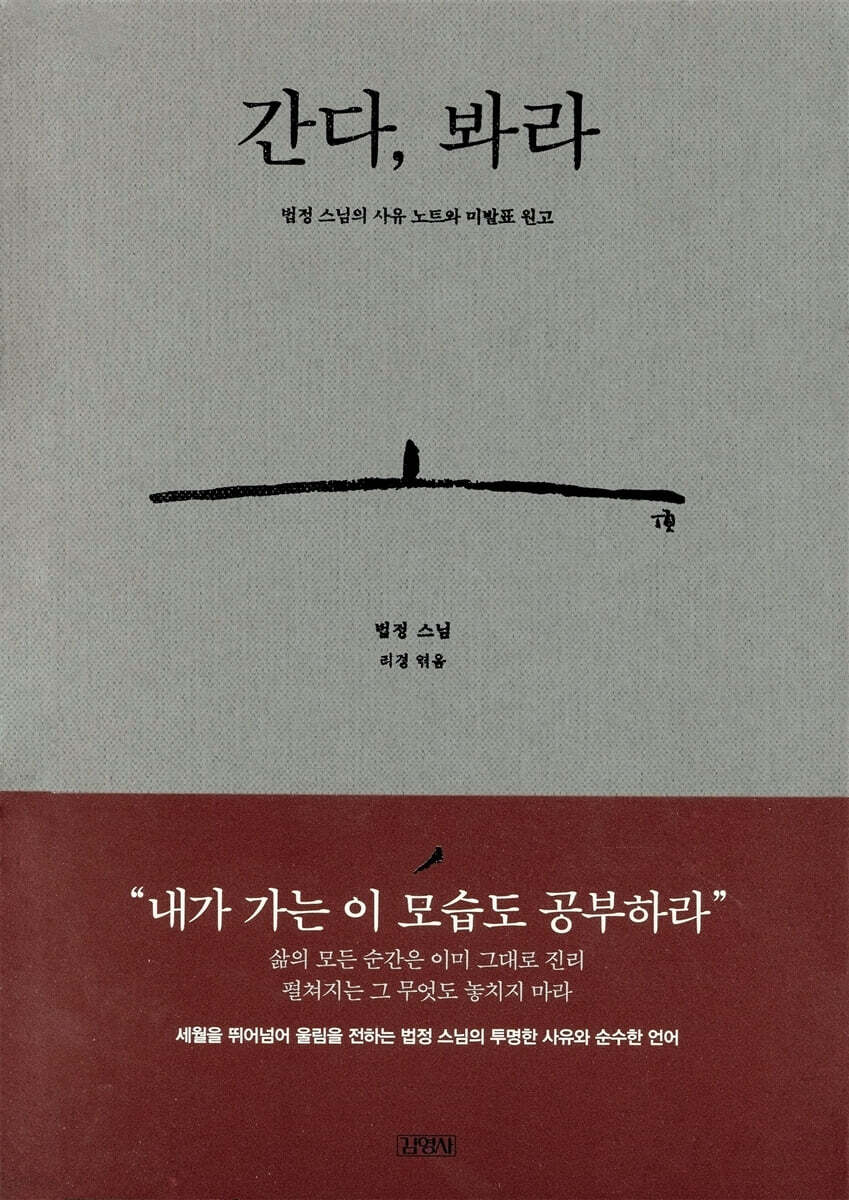
Go, look
 |
Description
Book Introduction
“Study this way I go too.”
The clear thoughts and pure language of the monk Beopjeong, which resonate deeply beyond time.
The first public disclosure of the monk Beopjeong's deathbed poem and mountain diary,
A collection of the monk's notes and unpublished manuscripts, along with vivid anecdotes and letters from acquaintances.
“Monk, please leave a last message.”
“Do not discriminate.
That's how I've lived.
“Here we go, look.”
From the monk's last words and private notes, which are being made public for the first time, to unpublished manuscripts that still contain the monk's breath, to anecdotes and letters from acquaintances.
“Welcome every moment of life! There is no one who does not face difficulties.
Don't try to avoid difficult things, just accept them.
Everything has its own meaning.
“The thought of accepting things as they are gives me peace of mind.” A clear and deep message from the monk Beopjeong for a free and fulfilling life.
The clear thoughts and pure language of the monk Beopjeong, which resonate deeply beyond time.
The first public disclosure of the monk Beopjeong's deathbed poem and mountain diary,
A collection of the monk's notes and unpublished manuscripts, along with vivid anecdotes and letters from acquaintances.
“Monk, please leave a last message.”
“Do not discriminate.
That's how I've lived.
“Here we go, look.”
From the monk's last words and private notes, which are being made public for the first time, to unpublished manuscripts that still contain the monk's breath, to anecdotes and letters from acquaintances.
“Welcome every moment of life! There is no one who does not face difficulties.
Don't try to avoid difficult things, just accept them.
Everything has its own meaning.
“The thought of accepting things as they are gives me peace of mind.” A clear and deep message from the monk Beopjeong for a free and fulfilling life.
- You can preview some of the book's contents.
Preview
index
Go, look
Opening Remarks: Im Jong-ge │ 5
1.
Birdsong, Wind Sound │ 11
Mountain Diary
2.
You Are a Seed │ 63
Nature, Earth, Life
3.
A Place Where No One Can Enter │ 83
Being alone, silence, speech
4.
Silent Music │ 101
meditation
5.
Have Less, Be More │ 133
No possessions
6.
A guest arrives on a cold night │ 149
car
7.
As flowers emit their fragrance │ 203
Love, self-abandonment, service
8.
The Finger Pointing the Way │ 221
"Koolook, kulook"
Greetings from 1974
"The Song of a Certain Ignorant Person"
Appendix 1: Yeosiamun 239
Appendix 2: Letters from Acquaintances 253
Recommendation 272
Compiling a Book 274
Opening Remarks: Im Jong-ge │ 5
1.
Birdsong, Wind Sound │ 11
Mountain Diary
2.
You Are a Seed │ 63
Nature, Earth, Life
3.
A Place Where No One Can Enter │ 83
Being alone, silence, speech
4.
Silent Music │ 101
meditation
5.
Have Less, Be More │ 133
No possessions
6.
A guest arrives on a cold night │ 149
car
7.
As flowers emit their fragrance │ 203
Love, self-abandonment, service
8.
The Finger Pointing the Way │ 221
"Koolook, kulook"
Greetings from 1974
"The Song of a Certain Ignorant Person"
Appendix 1: Yeosiamun 239
Appendix 2: Letters from Acquaintances 253
Recommendation 272
Compiling a Book 274
Detailed image

Into the book
Go, look
* The well at the bottom of the mountain that never dries up
I offer this to my friends in the mountains.
Bring one gourd each
Each of you, go and get the full moon.
--- p.13
* Regular Dharma Assembly Day.
A ceremonial event.
Is this Buddhism, or is this a religion? A Dharma assembly should be a proper gathering, but this kind of gathering cannot be a proper gathering.
The path to enlightenment is one that you must take yourself.
Why do I need other people's words to live my life?
Today, right after lunch, some crazy guy came up with a girl and started making noises.
He said he was looking for Buddha here and there.
I told him to go to a big temple because there are many great monks there, but he said there is no such monk anywhere in the world.
He sent him down shouting at him, asking where he was going, leaving his own Buddha behind.
Before going down, I asked him what the essence of Buddha was, and when I asked him what he was asking, he didn't understand and started talking nonsense.
The rainy season is coming, so these crazy guys are setting up shop.
--- p.37
* January 2nd (Wed)
Looking back on the past year, I have lived through the grace of many people, without even mentioning their names.
I have not given any grace to others, but the grace I have received is incalculable.
There is nothing empty in the world.
I must somehow repay that favor in the time I have left.
I think it was a good thing that I left the useless Hweju (Gilsangsa) because I wanted to break out of the mold.
Write down this year's action guidelines and post them on the table.
1.
Get out of the speed lane
-Take your time and enjoy it
2.
Share generously
-Originally nothing
What will we truly leave behind at the end of our lives?
3.
Be warmer and kinder
- Examine from time to time what a Buddha and a Bodhisattva are.
--- p.52~53
* October 20 (Mon) Clear Seohyeonsanbang
To ○○
I think you might still feel complicated because you've decided to build a house, cleared the ground, and made preparations, but then changed your mind and stopped.
Even though everything starts with a single thought, our lives are also ended or changed by that single thought.
You may feel complicated at first because you have finally stopped working hard and have finally decided to give up, but you should also consider it fortunate that you stopped the favor before it became too much.
Even if you are walking down the road and realize that it is not the right path for you, you should immediately turn back and avoid taking a wrong path.
(syncopation)
In the Avatamsaka Sutra, there is a dharma saying, “If you know illusion, you will be free from it. If you free yourself from illusion, you will be awakened.”
'If you know you've made a mistake, stop right there.' This is a lesson that if you stop, you'll soon return to your original position.
If you learn a great lesson from this incident for your future practice, then the work you have done will not have been in vain.
I hope your good intentions come true.
--- p.55
* I was happy to receive your letter and read it.
I am also happy to hear that it is said that Zen is the food of the past.
If you have left home in body but cannot feel the ancestors in your heart, you cannot become a monk.
A monk must repeatedly shake off all existing frameworks and rise up.
If we look back on why we turned our backs on worldly affections and became monks, we will not be able to spend our time in vain, living in a dream.
For a monk, there should be no tomorrow.
I often regret how many years I have wasted, putting things off for tomorrow.
You must always live 'like this, in this place, right now.'
And like a flower, it must bloom anew every day.
Poverty, tranquility, and peace should be the fragrance of the practitioner.
(syncopation)
I hope you will not be satisfied with the joy and blessings you experienced once, but will strive even harder.
To see further, we must climb higher again.
Talking as little as possible, sleeping less, and eating less will lead to a happier life in the monastery.
I feel like I'm getting some good news during this summer retreat, and it's giving me a boost of energy.
Let us enjoy the joy of release together.
--- p.57
* The sound of snow falling in a bamboo forest
It was heard while lying on my grandmother's lap
A Tale of the Past by Lamplight
The sound of snow falling in a bamboo grove
Come to me at sunset
The familiar sound of my friends' footsteps
The sound of snow falling in a bamboo grove
The day I left home and entered the mountains
Leave the house
The road I was looking back on (omitted)
--- p.59
* All life is one.
We are all participating in the feast of life that this universe is holding.
There is nothing, not even a single leaf, that does not affect us.
We all influence each other.
It's like a huge vibration that spreads out in all directions.
--- p.68
* The joy of being alone is not something that can only be found in remote places.
Such joy can be found even in the midst of a bustling city.
Joy is not something to be found in a lonely place or in a crowded city, but rather within the self.
--- p.85
* Those who have sought the truth have always been alone.
Those who have sought to discover the true meaning of life have always gone into a place no one can enter: themselves.
--- p.85
* Standing alone means becoming rich within.
--- p.85
* I should not be there.
There should be no ego, no self-centered behavior.
We must become one with the great silence.
Silence means the emptiness of everything.
And in that emptiness there is infinite space.
There is infinite energy there, not selfish energy, not limited energy.
--- p.92
* Silence is the mother of truth.
When the questions stop, the answers begin to emerge.
--- p.90
* If love is not accompanied by silence
It will eventually disappear into an empty shell.
Love matures in silence.
Whether near or far
Get used to that face that comes to mind in silence.
--- p.90
* Silence is the language of the universe.
It doesn't matter to you what other people say, do, or believe.
And leave that person completely alone.
--- p.93
* When you are hesitant about whether to speak or not, choose silence instead of speaking.
But silence that is kept out of fear is not silence.
--- p.93
* The gaze that has disappeared from the gazer, the infinite flowering of love, is meditation.
--- p.104
* Meditation is purity of the present.
Therefore, meditation is always ‘alone’.
I am completely alone.
A mind that is not influenced by thoughts does not accumulate.
Therefore, it is only in the present that one can empty one's mind.
--- p.104
* Life should become meditation.
Every moment must become a breath.
That's how change happens.
--- p.108
* I am not an abstract entity.
Therefore, I must explore myself in presence or reality.
In other words, I must explore the me that I am now, not the me that I wish to be.
Understand yourself first.
Then, from the knowledge of that self, right action will come.
--- p.111
* You originally had no name.
'Nameless' is your true self.
--- p.112
* Look at the facts as they are.
When you understand the truth, there is no pleasure or pain.
There are only facts.
--- p.114
* If we know how to see, then everything becomes clear.
And seeing requires neither philosophy nor teachers.
No one needs to teach you how to see.
You just have to look.
--- p.115
* What matters is not how great something is seen, but with what eyes of the mind it is seen.
--- p.117
* When I came, I came with white clouds
When I went, I followed the bright moon
The owner who comes and goes
Where are you finally?
--- p.126
* What really matters in life is not what you own, but who you are.
I believe that what kind of person a person is and what kind of actions a person takes are the elements that make up the essence of life.
Just living and owning things can be an obstacle and a burden.
It is not what we have, but what we do with it that determines the true value of life.
--- p.136
* If you are going on a long trip, you need to carry a little luggage.
If you want to go very high, you have to travel light.
--- p.137
* We must thoroughly reflect on what is necessary and what is not necessary for human survival on a daily basis.
--- p.137
* Simple things always impress.
“Love your neighbor as yourself.”
--- p.205
* I am convinced that there are only two correct attitudes when faced with the suffering of others.
Being silent and being there.
Let us be careful not to try to give advice to those who are suffering.
Let us be careful not to give them a fancy sermon.
Let us have the care, the prudence, to let them feel that we are there, by praying quietly, with affectionate and concerned gestures, by sharing in their suffering.
That's exactly what mercy is.
--- p.212
* Love has compassion, generosity, and skill, but these qualities are not love itself.
To understand love, to reach love, one must have a great sensitivity and insight into beauty.
Beauty is not in the mountains, the sky, the valleys, or the flowing rivers.
Beauty exists only when there is love.
And beauty, love is mercy.
There is no wind in mercy.
That beauty, love, and truth are the ultimate forms of intelligence.
--- p.213
* Compassion arises spontaneously when love matures.
Compassion is not love directed only to a specific person.
Compassion is not a give-and-take relationship, it is your own fundamental being.
Before you can realize, you must first learn compassion.
--- p.214
* If you give up something to get something, it is not true giving up.
--- p.215
* My creed:
“Follow love, even if it leads to self-sacrifice.”
--- p.215
* Love must be concrete.
If someone says, 'I love flowers, I love flowers more than anything else,' and doesn't water them but lets them dry out, what would you say to that person?
What good is it to say you have faith but have no actions? Can such faith save you? Faith without action is dead.
--- p.216
* The people I respect are those who have liberated themselves from self-centeredness, or rather, those who have been ‘liberated from self-centeredness through love.’
What I'm thinking of is Francis of Assisi and Buddha.
--- p.217
* Everyone's life is interconnected and in harmony.
Even if you are broke, you can always help others and enrich your life by doing so.
There are many ways to serve and minister to others.
All are holy.
--- p.219
* Welcome all guests as if they were Buddha and the Lord.
* The well at the bottom of the mountain that never dries up
I offer this to my friends in the mountains.
Bring one gourd each
Each of you, go and get the full moon.
--- p.13
* Regular Dharma Assembly Day.
A ceremonial event.
Is this Buddhism, or is this a religion? A Dharma assembly should be a proper gathering, but this kind of gathering cannot be a proper gathering.
The path to enlightenment is one that you must take yourself.
Why do I need other people's words to live my life?
Today, right after lunch, some crazy guy came up with a girl and started making noises.
He said he was looking for Buddha here and there.
I told him to go to a big temple because there are many great monks there, but he said there is no such monk anywhere in the world.
He sent him down shouting at him, asking where he was going, leaving his own Buddha behind.
Before going down, I asked him what the essence of Buddha was, and when I asked him what he was asking, he didn't understand and started talking nonsense.
The rainy season is coming, so these crazy guys are setting up shop.
--- p.37
* January 2nd (Wed)
Looking back on the past year, I have lived through the grace of many people, without even mentioning their names.
I have not given any grace to others, but the grace I have received is incalculable.
There is nothing empty in the world.
I must somehow repay that favor in the time I have left.
I think it was a good thing that I left the useless Hweju (Gilsangsa) because I wanted to break out of the mold.
Write down this year's action guidelines and post them on the table.
1.
Get out of the speed lane
-Take your time and enjoy it
2.
Share generously
-Originally nothing
What will we truly leave behind at the end of our lives?
3.
Be warmer and kinder
- Examine from time to time what a Buddha and a Bodhisattva are.
--- p.52~53
* October 20 (Mon) Clear Seohyeonsanbang
To ○○
I think you might still feel complicated because you've decided to build a house, cleared the ground, and made preparations, but then changed your mind and stopped.
Even though everything starts with a single thought, our lives are also ended or changed by that single thought.
You may feel complicated at first because you have finally stopped working hard and have finally decided to give up, but you should also consider it fortunate that you stopped the favor before it became too much.
Even if you are walking down the road and realize that it is not the right path for you, you should immediately turn back and avoid taking a wrong path.
(syncopation)
In the Avatamsaka Sutra, there is a dharma saying, “If you know illusion, you will be free from it. If you free yourself from illusion, you will be awakened.”
'If you know you've made a mistake, stop right there.' This is a lesson that if you stop, you'll soon return to your original position.
If you learn a great lesson from this incident for your future practice, then the work you have done will not have been in vain.
I hope your good intentions come true.
--- p.55
* I was happy to receive your letter and read it.
I am also happy to hear that it is said that Zen is the food of the past.
If you have left home in body but cannot feel the ancestors in your heart, you cannot become a monk.
A monk must repeatedly shake off all existing frameworks and rise up.
If we look back on why we turned our backs on worldly affections and became monks, we will not be able to spend our time in vain, living in a dream.
For a monk, there should be no tomorrow.
I often regret how many years I have wasted, putting things off for tomorrow.
You must always live 'like this, in this place, right now.'
And like a flower, it must bloom anew every day.
Poverty, tranquility, and peace should be the fragrance of the practitioner.
(syncopation)
I hope you will not be satisfied with the joy and blessings you experienced once, but will strive even harder.
To see further, we must climb higher again.
Talking as little as possible, sleeping less, and eating less will lead to a happier life in the monastery.
I feel like I'm getting some good news during this summer retreat, and it's giving me a boost of energy.
Let us enjoy the joy of release together.
--- p.57
* The sound of snow falling in a bamboo forest
It was heard while lying on my grandmother's lap
A Tale of the Past by Lamplight
The sound of snow falling in a bamboo grove
Come to me at sunset
The familiar sound of my friends' footsteps
The sound of snow falling in a bamboo grove
The day I left home and entered the mountains
Leave the house
The road I was looking back on (omitted)
--- p.59
* All life is one.
We are all participating in the feast of life that this universe is holding.
There is nothing, not even a single leaf, that does not affect us.
We all influence each other.
It's like a huge vibration that spreads out in all directions.
--- p.68
* The joy of being alone is not something that can only be found in remote places.
Such joy can be found even in the midst of a bustling city.
Joy is not something to be found in a lonely place or in a crowded city, but rather within the self.
--- p.85
* Those who have sought the truth have always been alone.
Those who have sought to discover the true meaning of life have always gone into a place no one can enter: themselves.
--- p.85
* Standing alone means becoming rich within.
--- p.85
* I should not be there.
There should be no ego, no self-centered behavior.
We must become one with the great silence.
Silence means the emptiness of everything.
And in that emptiness there is infinite space.
There is infinite energy there, not selfish energy, not limited energy.
--- p.92
* Silence is the mother of truth.
When the questions stop, the answers begin to emerge.
--- p.90
* If love is not accompanied by silence
It will eventually disappear into an empty shell.
Love matures in silence.
Whether near or far
Get used to that face that comes to mind in silence.
--- p.90
* Silence is the language of the universe.
It doesn't matter to you what other people say, do, or believe.
And leave that person completely alone.
--- p.93
* When you are hesitant about whether to speak or not, choose silence instead of speaking.
But silence that is kept out of fear is not silence.
--- p.93
* The gaze that has disappeared from the gazer, the infinite flowering of love, is meditation.
--- p.104
* Meditation is purity of the present.
Therefore, meditation is always ‘alone’.
I am completely alone.
A mind that is not influenced by thoughts does not accumulate.
Therefore, it is only in the present that one can empty one's mind.
--- p.104
* Life should become meditation.
Every moment must become a breath.
That's how change happens.
--- p.108
* I am not an abstract entity.
Therefore, I must explore myself in presence or reality.
In other words, I must explore the me that I am now, not the me that I wish to be.
Understand yourself first.
Then, from the knowledge of that self, right action will come.
--- p.111
* You originally had no name.
'Nameless' is your true self.
--- p.112
* Look at the facts as they are.
When you understand the truth, there is no pleasure or pain.
There are only facts.
--- p.114
* If we know how to see, then everything becomes clear.
And seeing requires neither philosophy nor teachers.
No one needs to teach you how to see.
You just have to look.
--- p.115
* What matters is not how great something is seen, but with what eyes of the mind it is seen.
--- p.117
* When I came, I came with white clouds
When I went, I followed the bright moon
The owner who comes and goes
Where are you finally?
--- p.126
* What really matters in life is not what you own, but who you are.
I believe that what kind of person a person is and what kind of actions a person takes are the elements that make up the essence of life.
Just living and owning things can be an obstacle and a burden.
It is not what we have, but what we do with it that determines the true value of life.
--- p.136
* If you are going on a long trip, you need to carry a little luggage.
If you want to go very high, you have to travel light.
--- p.137
* We must thoroughly reflect on what is necessary and what is not necessary for human survival on a daily basis.
--- p.137
* Simple things always impress.
“Love your neighbor as yourself.”
--- p.205
* I am convinced that there are only two correct attitudes when faced with the suffering of others.
Being silent and being there.
Let us be careful not to try to give advice to those who are suffering.
Let us be careful not to give them a fancy sermon.
Let us have the care, the prudence, to let them feel that we are there, by praying quietly, with affectionate and concerned gestures, by sharing in their suffering.
That's exactly what mercy is.
--- p.212
* Love has compassion, generosity, and skill, but these qualities are not love itself.
To understand love, to reach love, one must have a great sensitivity and insight into beauty.
Beauty is not in the mountains, the sky, the valleys, or the flowing rivers.
Beauty exists only when there is love.
And beauty, love is mercy.
There is no wind in mercy.
That beauty, love, and truth are the ultimate forms of intelligence.
--- p.213
* Compassion arises spontaneously when love matures.
Compassion is not love directed only to a specific person.
Compassion is not a give-and-take relationship, it is your own fundamental being.
Before you can realize, you must first learn compassion.
--- p.214
* If you give up something to get something, it is not true giving up.
--- p.215
* My creed:
“Follow love, even if it leads to self-sacrifice.”
--- p.215
* Love must be concrete.
If someone says, 'I love flowers, I love flowers more than anything else,' and doesn't water them but lets them dry out, what would you say to that person?
What good is it to say you have faith but have no actions? Can such faith save you? Faith without action is dead.
--- p.216
* The people I respect are those who have liberated themselves from self-centeredness, or rather, those who have been ‘liberated from self-centeredness through love.’
What I'm thinking of is Francis of Assisi and Buddha.
--- p.217
* Everyone's life is interconnected and in harmony.
Even if you are broke, you can always help others and enrich your life by doing so.
There are many ways to serve and minister to others.
All are holy.
--- p.219
* Welcome all guests as if they were Buddha and the Lord.
--- p.220
Publisher's Review
Go, look
“Study this way I go too.”
The first public disclosure of the monk Beopjeong's deathbed poem and mountain diary,
A collection of the monk's notes and unpublished manuscripts, along with vivid anecdotes and letters from acquaintances.
“Monk, please leave a last message.”
“Do not discriminate.
That's how I've lived.
“Here we go, look.”
A clear and profound message from the Venerable Beopjeong for a free and fulfilling life.
The notebooks, memos, letters, and drawings that the monk Beopjeong had kept until the time he spent his final years in the mountains of Gangwon Province have come to light again.
Even in his last residence, which he named 'Suryusanbang', he left writings and drawings for the world.
The handwritten notes and notebooks that formed the basis of the monk's works, which deeply moved and taught many people, are compiled into eight themes.
The writings and notes in the monk Beopjeong's notebook, which are collected again by topic, including the mountain diary that honestly captures the life of a mountain ascetic, nature and life, solitude, silence and words, meditation, non-possession, tea, love and service, have been revived today with new life as if they were a single manuscript from the beginning.
The monk's unpublished poems and essays, handwritten manuscripts that still retain the traces of his revising, and the most precious passages selected from various books were added to this, along with the monk's intense study and brilliant sensibility. This unique collection of proverbs left a lasting impression no matter which page was read.
If you sit on a rock under a tree and listen to the sound of the stream,
It is not the sound of water, but the voice of life and existence.
It is the voice of all things that exist forever.
Page 69
Why don't you ask the living source within you?
Page 103
Love is giving your heart, your mind, your whole being, without expecting anything in return.
Don't bring an empty vessel to receive love.
Page 205
In particular, the three resistance poems he wrote while suffering in prison during the democratization movement in the 1970s and the 'Imjongge' he left behind before his death are all the more significant as they are being made public for the first time.
Letters received from Cardinal Kim Su-hwan, Bishop Jang Ik, Mr. Ham Seok-heon, Monk Hyangbong, Monk Gusan, and other monks, as well as important anecdotes about the monks kept by acquaintances, were also compiled into an appendix.
It is enough to experience a new side of the monk Beopjeong, who was a cool-headed ascetic in the mountains, yet never missed a heated conversation with the world, and who was more thorough than anyone else, yet always maintained a warm sense of humor.
The monk's handwritten manuscripts, letters, and items he kept until the end are presented in color photographs to add vividness.
Would you like to delve deeper into your studies if I give you this bundle?
One day, I saw something being burned in the stove at the Suryusanbang and asked him about it.
“Monk! What are you burning in the stove again?”
“It’s just a means to an end.”
“Can a stove achieve the Way by using expedient means?”
The monk struck the stove door with a poker.
“Bodhisattva, if I give you this bundle, will you delve deeper into your studies?”
I gave an example with my hands clasped together.
From that day on, the monk's boxes of belongings came to me instead of the furnace.
In particular, this book is made up of a bundle of manuscripts that were thrown away in a box in the early spring of 2008.
On the first page of that manuscript bundle it is written:
"A Memo for a Collection of Proverbs - Written Like a Will, and Read Like a Will"
_From the editor's writings
“Study this way I go too.”
The first public disclosure of the monk Beopjeong's deathbed poem and mountain diary,
A collection of the monk's notes and unpublished manuscripts, along with vivid anecdotes and letters from acquaintances.
“Monk, please leave a last message.”
“Do not discriminate.
That's how I've lived.
“Here we go, look.”
A clear and profound message from the Venerable Beopjeong for a free and fulfilling life.
The notebooks, memos, letters, and drawings that the monk Beopjeong had kept until the time he spent his final years in the mountains of Gangwon Province have come to light again.
Even in his last residence, which he named 'Suryusanbang', he left writings and drawings for the world.
The handwritten notes and notebooks that formed the basis of the monk's works, which deeply moved and taught many people, are compiled into eight themes.
The writings and notes in the monk Beopjeong's notebook, which are collected again by topic, including the mountain diary that honestly captures the life of a mountain ascetic, nature and life, solitude, silence and words, meditation, non-possession, tea, love and service, have been revived today with new life as if they were a single manuscript from the beginning.
The monk's unpublished poems and essays, handwritten manuscripts that still retain the traces of his revising, and the most precious passages selected from various books were added to this, along with the monk's intense study and brilliant sensibility. This unique collection of proverbs left a lasting impression no matter which page was read.
If you sit on a rock under a tree and listen to the sound of the stream,
It is not the sound of water, but the voice of life and existence.
It is the voice of all things that exist forever.
Page 69
Why don't you ask the living source within you?
Page 103
Love is giving your heart, your mind, your whole being, without expecting anything in return.
Don't bring an empty vessel to receive love.
Page 205
In particular, the three resistance poems he wrote while suffering in prison during the democratization movement in the 1970s and the 'Imjongge' he left behind before his death are all the more significant as they are being made public for the first time.
Letters received from Cardinal Kim Su-hwan, Bishop Jang Ik, Mr. Ham Seok-heon, Monk Hyangbong, Monk Gusan, and other monks, as well as important anecdotes about the monks kept by acquaintances, were also compiled into an appendix.
It is enough to experience a new side of the monk Beopjeong, who was a cool-headed ascetic in the mountains, yet never missed a heated conversation with the world, and who was more thorough than anyone else, yet always maintained a warm sense of humor.
The monk's handwritten manuscripts, letters, and items he kept until the end are presented in color photographs to add vividness.
Would you like to delve deeper into your studies if I give you this bundle?
One day, I saw something being burned in the stove at the Suryusanbang and asked him about it.
“Monk! What are you burning in the stove again?”
“It’s just a means to an end.”
“Can a stove achieve the Way by using expedient means?”
The monk struck the stove door with a poker.
“Bodhisattva, if I give you this bundle, will you delve deeper into your studies?”
I gave an example with my hands clasped together.
From that day on, the monk's boxes of belongings came to me instead of the furnace.
In particular, this book is made up of a bundle of manuscripts that were thrown away in a box in the early spring of 2008.
On the first page of that manuscript bundle it is written:
"A Memo for a Collection of Proverbs - Written Like a Will, and Read Like a Will"
_From the editor's writings
GOODS SPECIFICS
- Date of issue: May 10, 2018
- Format: Hardcover book binding method guide
- Page count, weight, size: 280 pages | 528g | 148*210*20mm
- ISBN13: 9788934981596
- ISBN10: 8934981598
You may also like
카테고리
korean


korean

![GQ KOREA Mark (Monthly): December [2025]](http://librairie.coreenne.fr/cdn/shop/files/8ef265dbbfbf186523ed75ba7319009d.jpg?v=1765340328&width=3840)


