![Cinephilia Review: Fall [2025]](http://librairie.coreenne.fr/cdn/shop/files/b4a28ae590927a508779341e58e863ff.jpg?v=1765404612&width=3840)

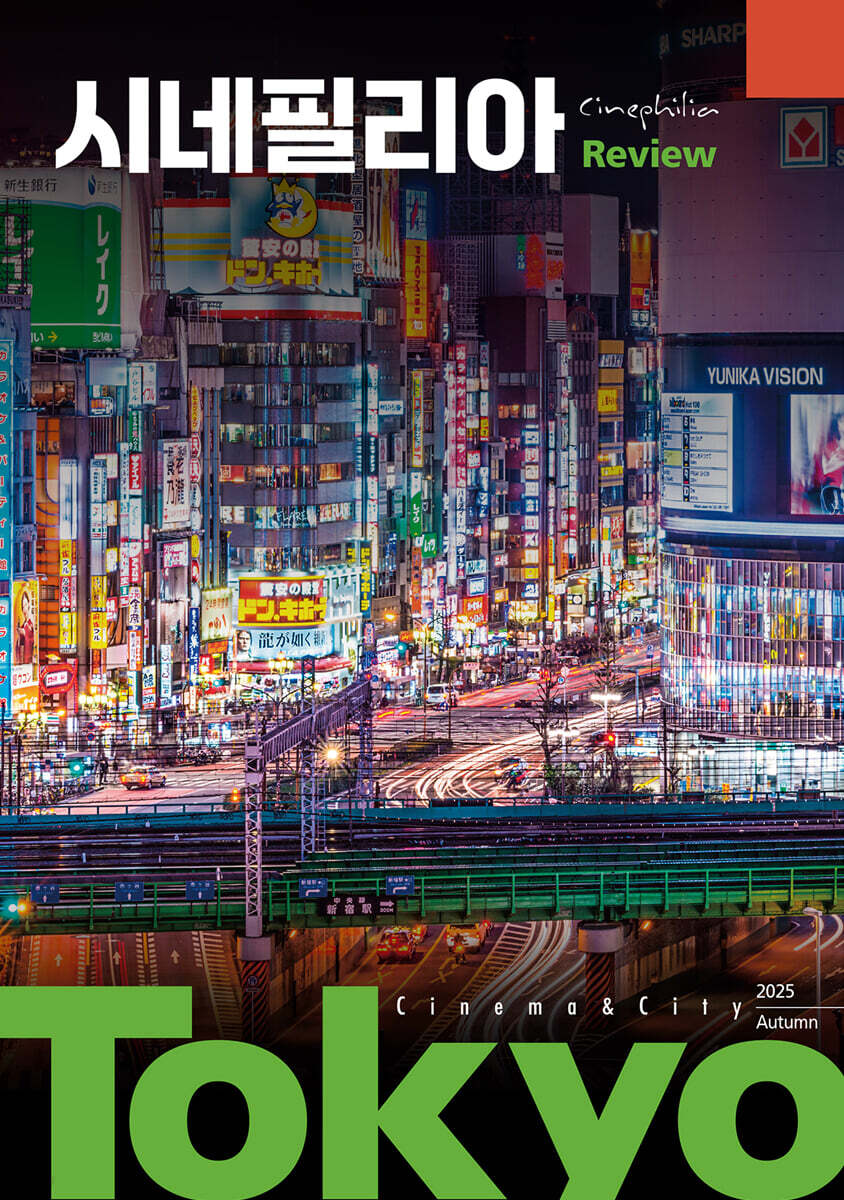
Cinephilia Review: Fall [2025]
 |
Description
Book Introduction
The Fall 2025 issue of Cinephilia Review explores the fascinating landscape of Japanese cinema, focusing on the city of Tokyo.
It examines the trajectory of Japanese cinema, from its origins in Kyoto's traditional theater to its expansion into Tokyo's modern sensibilities, and offers a broad overview, from the family narratives of Yasujiro Ozu and Hirokazu Kore-eda to the theatrical cinematic language of Akira Kurosawa and Ryusuke Hamaguchi, and the animation worlds of Hayao Miyazaki and Makoto Shinkai.
This special edition marks the finale of Season 1 of “Film and the City,” exploring the multi-layered world of fantasy, loneliness, and human connection in the metropolis of Tokyo.
In addition, 「Cine & City」 provides detailed analysis of films set in Tokyo, such as [Josee, the Tiger and the Fish], [All the Dawn], [Lost in Translation], and [Perfect Days], while 「Cine Review」 interprets Hirokazu Koreeda's [The Host] from various perspectives.
In addition, the "Cinephile Review" corner features critiques directly reflecting the readers' perspectives on various works such as [Shall We Dance], [Dongju], [Anarchist from Colony], and [Hana and Alice], satisfying both academic depth and popular sensibility.
The fall issue of 『Cinephilia Review』 goes beyond being a simple film magazine, inviting readers into a space of reflection that connects the screen, the city, memory, and emotion.
It examines the trajectory of Japanese cinema, from its origins in Kyoto's traditional theater to its expansion into Tokyo's modern sensibilities, and offers a broad overview, from the family narratives of Yasujiro Ozu and Hirokazu Kore-eda to the theatrical cinematic language of Akira Kurosawa and Ryusuke Hamaguchi, and the animation worlds of Hayao Miyazaki and Makoto Shinkai.
This special edition marks the finale of Season 1 of “Film and the City,” exploring the multi-layered world of fantasy, loneliness, and human connection in the metropolis of Tokyo.
In addition, 「Cine & City」 provides detailed analysis of films set in Tokyo, such as [Josee, the Tiger and the Fish], [All the Dawn], [Lost in Translation], and [Perfect Days], while 「Cine Review」 interprets Hirokazu Koreeda's [The Host] from various perspectives.
In addition, the "Cinephile Review" corner features critiques directly reflecting the readers' perspectives on various works such as [Shall We Dance], [Dongju], [Anarchist from Colony], and [Hana and Alice], satisfying both academic depth and popular sensibility.
The fall issue of 『Cinephilia Review』 goes beyond being a simple film magazine, inviting readers into a space of reflection that connects the screen, the city, memory, and emotion.
- You can preview some of the book's contents.
Preview
index
ine Special
Tokyo, a city where 12 genres intersect / Bang Kyung-mi
Cine & City
25 How did they come to Tokyo? Josee, the Tiger, and the Fish / Park So-eon
31 Dawn, each orbiting its own path, finally arrives at dawn. 〈All of Dawn〉 / Kim Ha-na
35 The Magician of Light Who Speaks of Darkness, Makoto Shinkai / Seungwon Lee
43 Lost Love, Lost Tokyo "Can Love Be Translated?" / Min Kyung-eun
51 Shadows in the Light, Light in the Shadows (Perfect Days) / Notes
Cine Review
Film and Viewpoint: The Host
60 #01 Who is the Monster / Woori Kim
64 #02 The Monster Named and Called / Ha Jung-min
68 #03 Variation of the Monster Repeated on the Staff / Woo Joo Ha
Cinephile Review
74 Let's do it together.
Shall We Dance? / Jo Yang-hee
80 The Tokyo of Dongju and Park Yeol, the Stage of Their Brilliant Lives / Jo Ah-chim
88 Chronic Loneliness and the Driving Force of Love "Oh Lucy!" / Isul-ah
94. Which Memory Are You Living In? "Hana and Alice" / Hong Ha-neul
100 From Tokyo to Longing: "How Will You Live?" / Park No-el
Tokyo, a city where 12 genres intersect / Bang Kyung-mi
Cine & City
25 How did they come to Tokyo? Josee, the Tiger, and the Fish / Park So-eon
31 Dawn, each orbiting its own path, finally arrives at dawn. 〈All of Dawn〉 / Kim Ha-na
35 The Magician of Light Who Speaks of Darkness, Makoto Shinkai / Seungwon Lee
43 Lost Love, Lost Tokyo "Can Love Be Translated?" / Min Kyung-eun
51 Shadows in the Light, Light in the Shadows (Perfect Days) / Notes
Cine Review
Film and Viewpoint: The Host
60 #01 Who is the Monster / Woori Kim
64 #02 The Monster Named and Called / Ha Jung-min
68 #03 Variation of the Monster Repeated on the Staff / Woo Joo Ha
Cinephile Review
74 Let's do it together.
Shall We Dance? / Jo Yang-hee
80 The Tokyo of Dongju and Park Yeol, the Stage of Their Brilliant Lives / Jo Ah-chim
88 Chronic Loneliness and the Driving Force of Love "Oh Lucy!" / Isul-ah
94. Which Memory Are You Living In? "Hana and Alice" / Hong Ha-neul
100 From Tokyo to Longing: "How Will You Live?" / Park No-el
Into the book
Movie and View #03 The Monster - Directed by Hirokazu Koreeda
'Hwit', inserted in 〈Monster〉, is played on the viol and starts with a subtle dissonance and gradually builds to a crescendo.
'Hwit' was used in the conflict scene between Minato and his mother after visiting the hospital in Chapter 1.
Mother tries to calm Minato's mind, but it eventually explodes, showing dissonance that represents the peak of the conflict.
Conversely, 'Hibari' was inserted in Chapter 3, when the children were climbing the jungle gym and talking about new things being born, along with Minato's words, "Shall we get ready?"
With these words, they go to the abandoned train and create their own world.
'Hibari' is an improvised piano piece with a brighter melody than 'Hwit', but is characterized by subtle dissonances.
This can be read as a positive sign that Minato and Cook are trying to communicate with each other despite their clumsy cooking skills.
In the movie, the horn sounds like a ship's horn.
As previously defined, the closing horn sound is a repeat sign, and the closing repeat sign can also be seen as a sound that signals the end of a repeated piece of music and the beginning of a new measure.
The sound of a horn, as if announcing the departure of a ship, makes the character move forward.
Minato heads to Yori through the typhoon, while Hori-sensei and Minato's mother run to the abandoned train.
Minato moves towards his own complete identity, while Hori-sensei and Minato's mother move towards understanding and reconciliation with such children.
To compare the sound of the horn to departure, we must look at the images of water, ships, and fish that appear in “The Host.”
The sign in Minato's room reads 'Do not enter'.
Given that the signpost is shaped like a fish, the fish in the film can be seen as a metaphor for Minato.
There are two characters in the movie who raise fish: Mr. Hori and Mr. Kombueng-eo, whom the kids call "Kombung Eel."
Mr. Hori raises carp in a fish tank, and among them, there is a carp that is turned upside down.
This carp is a metaphor for Yori and Minato, as Yori writes letters backwards and Minato thinks Mr. Hori is a good person, but turns him into a violent teacher.
Mr. Hori's fishbowl visualizes the way he educates his students within the framework of 'manly' education, just like raising carp.
Mr. Kombung Eel is an even more stereotypical figure in that he raises garden eels that live completely buried in the ground.
If we substitute Minato and Yori with fish, they were being consumed by the water in the fish tank.
The climax of the encroachment is the typhoon that appears in the latter half of the film.
The typhoon causes a landslide around an abandoned train with children inside, which means 'collapse'.
The two children break through the collapse and approach their world.
The person who gave the message to become a boat, not a fish, and to freely go his own way can be seen as a principal.
The principal was the one who folded the paper boat when meeting with her husband and also helped the child set sail by making the sound of the boat horn.
A ship is a means of travel without a ship.
At the sound of the boat horn, Minato, Yori, Mom, and Hori-sensei set off.
As Yori and Minato enter the abandoned train through the typhoon, the siren sounds and the children say, "It's the sound of departure."
With this scene, the most memorable song from “Monster”, “Aqua,” starts playing, and Minato and Yori pass through the abandoned train and head towards a deeper and wider place.
'Aqua' is a song from Sakamoto's "Back to the Basic" album.
The album consists entirely of piano, the instrument with which Sakamoto first began playing music as a child.
As the film ends and they leave the abandoned train, Yori asks, “Are we reborn?”
Minato replies, “I don’t think that’s the case.”
The meaning of this can be found in the scene where Yori lies to Minato, saying "I'm back to normal" due to his father's violence, and Minato says "You were normal before."
Minato and Yori must return to what they call normalcy in the world created by society.
But in the world outside of that society, the two are already normal and there is no need to be reborn.
In the final scene, the children run away screaming, showing that they have grown into characters who can make sounds on their own, without any toys, horns, or decorations.
Ryuichi Sakamoto's 'Aqua' warmly embraces such children.
'Hwit', inserted in 〈Monster〉, is played on the viol and starts with a subtle dissonance and gradually builds to a crescendo.
'Hwit' was used in the conflict scene between Minato and his mother after visiting the hospital in Chapter 1.
Mother tries to calm Minato's mind, but it eventually explodes, showing dissonance that represents the peak of the conflict.
Conversely, 'Hibari' was inserted in Chapter 3, when the children were climbing the jungle gym and talking about new things being born, along with Minato's words, "Shall we get ready?"
With these words, they go to the abandoned train and create their own world.
'Hibari' is an improvised piano piece with a brighter melody than 'Hwit', but is characterized by subtle dissonances.
This can be read as a positive sign that Minato and Cook are trying to communicate with each other despite their clumsy cooking skills.
In the movie, the horn sounds like a ship's horn.
As previously defined, the closing horn sound is a repeat sign, and the closing repeat sign can also be seen as a sound that signals the end of a repeated piece of music and the beginning of a new measure.
The sound of a horn, as if announcing the departure of a ship, makes the character move forward.
Minato heads to Yori through the typhoon, while Hori-sensei and Minato's mother run to the abandoned train.
Minato moves towards his own complete identity, while Hori-sensei and Minato's mother move towards understanding and reconciliation with such children.
To compare the sound of the horn to departure, we must look at the images of water, ships, and fish that appear in “The Host.”
The sign in Minato's room reads 'Do not enter'.
Given that the signpost is shaped like a fish, the fish in the film can be seen as a metaphor for Minato.
There are two characters in the movie who raise fish: Mr. Hori and Mr. Kombueng-eo, whom the kids call "Kombung Eel."
Mr. Hori raises carp in a fish tank, and among them, there is a carp that is turned upside down.
This carp is a metaphor for Yori and Minato, as Yori writes letters backwards and Minato thinks Mr. Hori is a good person, but turns him into a violent teacher.
Mr. Hori's fishbowl visualizes the way he educates his students within the framework of 'manly' education, just like raising carp.
Mr. Kombung Eel is an even more stereotypical figure in that he raises garden eels that live completely buried in the ground.
If we substitute Minato and Yori with fish, they were being consumed by the water in the fish tank.
The climax of the encroachment is the typhoon that appears in the latter half of the film.
The typhoon causes a landslide around an abandoned train with children inside, which means 'collapse'.
The two children break through the collapse and approach their world.
The person who gave the message to become a boat, not a fish, and to freely go his own way can be seen as a principal.
The principal was the one who folded the paper boat when meeting with her husband and also helped the child set sail by making the sound of the boat horn.
A ship is a means of travel without a ship.
At the sound of the boat horn, Minato, Yori, Mom, and Hori-sensei set off.
As Yori and Minato enter the abandoned train through the typhoon, the siren sounds and the children say, "It's the sound of departure."
With this scene, the most memorable song from “Monster”, “Aqua,” starts playing, and Minato and Yori pass through the abandoned train and head towards a deeper and wider place.
'Aqua' is a song from Sakamoto's "Back to the Basic" album.
The album consists entirely of piano, the instrument with which Sakamoto first began playing music as a child.
As the film ends and they leave the abandoned train, Yori asks, “Are we reborn?”
Minato replies, “I don’t think that’s the case.”
The meaning of this can be found in the scene where Yori lies to Minato, saying "I'm back to normal" due to his father's violence, and Minato says "You were normal before."
Minato and Yori must return to what they call normalcy in the world created by society.
But in the world outside of that society, the two are already normal and there is no need to be reborn.
In the final scene, the children run away screaming, showing that they have grown into characters who can make sounds on their own, without any toys, horns, or decorations.
Ryuichi Sakamoto's 'Aqua' warmly embraces such children.
--- From the text
Publisher's Review
Cinephilia Review Fall 2025 Issue
The completion of Season 1 of 'Film and the City' through Tokyo
This fall issue, which chose Tokyo as the final destination for Season 1 of 'City and Film (Film and City)', stands out for its clarity of planning and cohesive editing.
Rather than using Tokyo as a single backdrop, the publisher and editors contrast it with Kyoto as two axes of Japanese film history, bringing to the forefront the core concept of "a city where genres intersect."
As a result, the spectrum of genres, from period dramas to animation, is read in connection with the aesthetics of time and space, and readers naturally come to recognize that the city is not simply a stage, but a device for producing meaning.
The goal of "extending expert insight to the public," emphasized in the founding principles, is also most persuasively realized in this issue.
The three-stage breathing of planning and composition
Above all, the design of the main building is organically interlocked with three branches.
Bang Kyung-mi's article in 〈Cine Special〉 examines the Kyoto-Tokyo dual structure from the perspectives of history, system, and style, providing a map of the entire issue's perception.
〈Cine & City〉 follows the map and unravels specific scenes of Tokyo—the wanderings of youth, the recollections of old age, the emotions after a disaster, the impossibility of translation, and the labor of everyday life—through representative works, while 〈Cine Review〉 deepens the question of this issue by returning Koreeda Hirokazu's 〈The Host〉 to the question of 'gaze'.
Thanks to this structure, reading flows in a three-stage flow of 'concept → case → in-depth', and the persuasiveness of each review is multiplied within the context of each other.
Balance in selection of works and depth of examples
The balance in the selection of works is also impressive.
The self-reliance and care in Josee, the Tiger and the Fish, the mutual aid and conversation in All the Dawn, the lack of communication and consolation in Lost in Translation?, the private solitude and ethics in Perfect Days, and the post-disaster emotional landscape depicted in Makoto Shinkai's filmography reposition Tokyo as a "city that must respond."
In particular, the review of "Perfect Days" in the book connects life experiences such as books, music, coffee, and walks with narrative ethics, and delicately captures the microscopic rhythms of urban life.
This is a good example of the 'criticism with a touch of life' that this entire issue aims for.
Highlights of the "Monster" Special
The special feature on “Monster,” compiled under “Cine Review - Film and Perspective,” is the highlight of this issue.
Kim Woori's "violence of naming" clearly translates the work's core theme into sociological language, while Ha Jeong-min's writing closely traces how sound design produces/deconstructs the "monster being called."
Sakamoto Ryuichi's analysis of the universe reveals how music enables a 'narrative that can be heard again' through the layers of rhythm, harmony, and motif repetition, showing the density of music criticism that goes beyond the typical introduction of OSTs.
The three texts are arranged in a way that fills in the gaps between each other, achieving the planned aesthetic of ‘one work – three perspectives.’
The Power of Reader Engagement Sections
The reader participation section, “Cinephile Review,” solidifies the magazine’s identity.
The suggestion of de-powerment in “Shall We Dance?”, the solidarity of colonial intellectuals shown in “Dongju” and “Anarchist from Colony”, and the track “From Memory to Hope” shared by “Oh Lucy!”, “Hana and Alice”, and “How Will You Live?” flexibly cross the boundaries between professional criticism and appreciation of life.
In particular, Park No-el's sense of the title, 'From Tokyo to Longing,' concisely captures the duality of the city as a projection surface of desire and a healing place for loss.
What keeps this corner from becoming a mere collection of impressions is the editorial department's thematic curation and the writers' narrative composition skills.
Perfection of editing and composition
The editing design and flow also take great care to ensure a smooth reading experience.
The "Introduction," which reminds us of the continuity of the "Film and the City" series, clearly defines the position of the Tokyo edition and clearly presents the connection between the axis of perception of the preceding volume (Hong Kong-Berlin-New York) and the theme of this issue.
The sense of progression from 〈Special→City→Review〉 in the index and page flow maintains the solidity of the essay-style structure, and the title sentences of each section (“Shadow in the Light, Light in the Shadow,” “Lost Love, Speechless Tokyo”) provide the reader with a hint of preliminary understanding.
However, the tone and manner of each section can occasionally feel overly theoretical, so simplifying the definitions of concepts in some articles by one or two sentences would improve the balance between academicism and readability.
Critical Suggestions and Possibility of Extension
Critical suggestions are also added.
First, a slight incline is detected in terms of gender and generational diversity of directors and works.
The axis centered on the canon that runs from Ozu-Kurosawa-Kore-eda-Hamaguchi-Miyazaki-Shinkai is solid, but at the same time, I would like to see the narratives of the "invisible authors," such as Naomi Kawase, Nami Horikawa, and the creative subjectivity of the actors and staff who collaborate with Hamaguchi.
Second, if we broaden the spectrum of urban criticism to include sensory infrastructure such as architecture, soundscape, and transportation (railway culture), the way in which the city becomes mise-en-scène will become more three-dimensional.
Third, the animation section can connect the proposition of "thinking with moving images" more firmly with the reality of production by providing simple diagrams of the creative process (background, coloring, layout) and changes in digital workflow (digital shooting, compositing).
A new threshold, not an end
Still, the virtues of this fall issue are clear.
The keywords of history, city, genre, sound, music, and memory illuminate each other to form a 'multi-focus lens for understanding Tokyo,' and the sensibility of cinephiles and academic basis meet in a balanced way.
Above all, the writing style that allows readers to experience Tokyo as a city they have walked through without having been there is found throughout.
This is the achievement of the magazine's goal of 'appreciation beyond the screen', and it naturally expands expectations for Season 2.
Finally, as the conclusion of Season 1 of 'Film and the City', the Tokyo episode leaves the message that it is not an 'end' but a 'threshold'.
As in the question of “How Will You Live?”, the crossing between city and individual, memory and disaster, language and silence is never-ending.
Whatever city the next season calls upon—say, the alleys of Seoul, the waterfront of Bangkok, the tango of Buenos Aires, or the intersections of Nairobi—the methodology laid out in this issue—historical scanning, genre-specific examples, and sensory reading—will serve as a powerful starting point.
The Fall 2025 issue of 'Cinephilia Review' is an elegant signal flare that brings together a love of cities and reflections on film, prompting readers to revisit old questions.
The completion of Season 1 of 'Film and the City' through Tokyo
This fall issue, which chose Tokyo as the final destination for Season 1 of 'City and Film (Film and City)', stands out for its clarity of planning and cohesive editing.
Rather than using Tokyo as a single backdrop, the publisher and editors contrast it with Kyoto as two axes of Japanese film history, bringing to the forefront the core concept of "a city where genres intersect."
As a result, the spectrum of genres, from period dramas to animation, is read in connection with the aesthetics of time and space, and readers naturally come to recognize that the city is not simply a stage, but a device for producing meaning.
The goal of "extending expert insight to the public," emphasized in the founding principles, is also most persuasively realized in this issue.
The three-stage breathing of planning and composition
Above all, the design of the main building is organically interlocked with three branches.
Bang Kyung-mi's article in 〈Cine Special〉 examines the Kyoto-Tokyo dual structure from the perspectives of history, system, and style, providing a map of the entire issue's perception.
〈Cine & City〉 follows the map and unravels specific scenes of Tokyo—the wanderings of youth, the recollections of old age, the emotions after a disaster, the impossibility of translation, and the labor of everyday life—through representative works, while 〈Cine Review〉 deepens the question of this issue by returning Koreeda Hirokazu's 〈The Host〉 to the question of 'gaze'.
Thanks to this structure, reading flows in a three-stage flow of 'concept → case → in-depth', and the persuasiveness of each review is multiplied within the context of each other.
Balance in selection of works and depth of examples
The balance in the selection of works is also impressive.
The self-reliance and care in Josee, the Tiger and the Fish, the mutual aid and conversation in All the Dawn, the lack of communication and consolation in Lost in Translation?, the private solitude and ethics in Perfect Days, and the post-disaster emotional landscape depicted in Makoto Shinkai's filmography reposition Tokyo as a "city that must respond."
In particular, the review of "Perfect Days" in the book connects life experiences such as books, music, coffee, and walks with narrative ethics, and delicately captures the microscopic rhythms of urban life.
This is a good example of the 'criticism with a touch of life' that this entire issue aims for.
Highlights of the "Monster" Special
The special feature on “Monster,” compiled under “Cine Review - Film and Perspective,” is the highlight of this issue.
Kim Woori's "violence of naming" clearly translates the work's core theme into sociological language, while Ha Jeong-min's writing closely traces how sound design produces/deconstructs the "monster being called."
Sakamoto Ryuichi's analysis of the universe reveals how music enables a 'narrative that can be heard again' through the layers of rhythm, harmony, and motif repetition, showing the density of music criticism that goes beyond the typical introduction of OSTs.
The three texts are arranged in a way that fills in the gaps between each other, achieving the planned aesthetic of ‘one work – three perspectives.’
The Power of Reader Engagement Sections
The reader participation section, “Cinephile Review,” solidifies the magazine’s identity.
The suggestion of de-powerment in “Shall We Dance?”, the solidarity of colonial intellectuals shown in “Dongju” and “Anarchist from Colony”, and the track “From Memory to Hope” shared by “Oh Lucy!”, “Hana and Alice”, and “How Will You Live?” flexibly cross the boundaries between professional criticism and appreciation of life.
In particular, Park No-el's sense of the title, 'From Tokyo to Longing,' concisely captures the duality of the city as a projection surface of desire and a healing place for loss.
What keeps this corner from becoming a mere collection of impressions is the editorial department's thematic curation and the writers' narrative composition skills.
Perfection of editing and composition
The editing design and flow also take great care to ensure a smooth reading experience.
The "Introduction," which reminds us of the continuity of the "Film and the City" series, clearly defines the position of the Tokyo edition and clearly presents the connection between the axis of perception of the preceding volume (Hong Kong-Berlin-New York) and the theme of this issue.
The sense of progression from 〈Special→City→Review〉 in the index and page flow maintains the solidity of the essay-style structure, and the title sentences of each section (“Shadow in the Light, Light in the Shadow,” “Lost Love, Speechless Tokyo”) provide the reader with a hint of preliminary understanding.
However, the tone and manner of each section can occasionally feel overly theoretical, so simplifying the definitions of concepts in some articles by one or two sentences would improve the balance between academicism and readability.
Critical Suggestions and Possibility of Extension
Critical suggestions are also added.
First, a slight incline is detected in terms of gender and generational diversity of directors and works.
The axis centered on the canon that runs from Ozu-Kurosawa-Kore-eda-Hamaguchi-Miyazaki-Shinkai is solid, but at the same time, I would like to see the narratives of the "invisible authors," such as Naomi Kawase, Nami Horikawa, and the creative subjectivity of the actors and staff who collaborate with Hamaguchi.
Second, if we broaden the spectrum of urban criticism to include sensory infrastructure such as architecture, soundscape, and transportation (railway culture), the way in which the city becomes mise-en-scène will become more three-dimensional.
Third, the animation section can connect the proposition of "thinking with moving images" more firmly with the reality of production by providing simple diagrams of the creative process (background, coloring, layout) and changes in digital workflow (digital shooting, compositing).
A new threshold, not an end
Still, the virtues of this fall issue are clear.
The keywords of history, city, genre, sound, music, and memory illuminate each other to form a 'multi-focus lens for understanding Tokyo,' and the sensibility of cinephiles and academic basis meet in a balanced way.
Above all, the writing style that allows readers to experience Tokyo as a city they have walked through without having been there is found throughout.
This is the achievement of the magazine's goal of 'appreciation beyond the screen', and it naturally expands expectations for Season 2.
Finally, as the conclusion of Season 1 of 'Film and the City', the Tokyo episode leaves the message that it is not an 'end' but a 'threshold'.
As in the question of “How Will You Live?”, the crossing between city and individual, memory and disaster, language and silence is never-ending.
Whatever city the next season calls upon—say, the alleys of Seoul, the waterfront of Bangkok, the tango of Buenos Aires, or the intersections of Nairobi—the methodology laid out in this issue—historical scanning, genre-specific examples, and sensory reading—will serve as a powerful starting point.
The Fall 2025 issue of 'Cinephilia Review' is an elegant signal flare that brings together a love of cities and reflections on film, prompting readers to revisit old questions.
GOODS SPECIFICS
- Date of issue: September 25, 2025
- Page count, weight, size: 120 pages | 173*243*20mm
- ISBN13: 9772671413007
- ISBN10: 26714132
You may also like
카테고리
korean


korean

![GQ KOREA Mark (Monthly): December [2025]](http://librairie.coreenne.fr/cdn/shop/files/8ef265dbbfbf186523ed75ba7319009d.jpg?v=1765340328&width=3840)


