

SKEPTIC Korea (quarterly): Issue 40
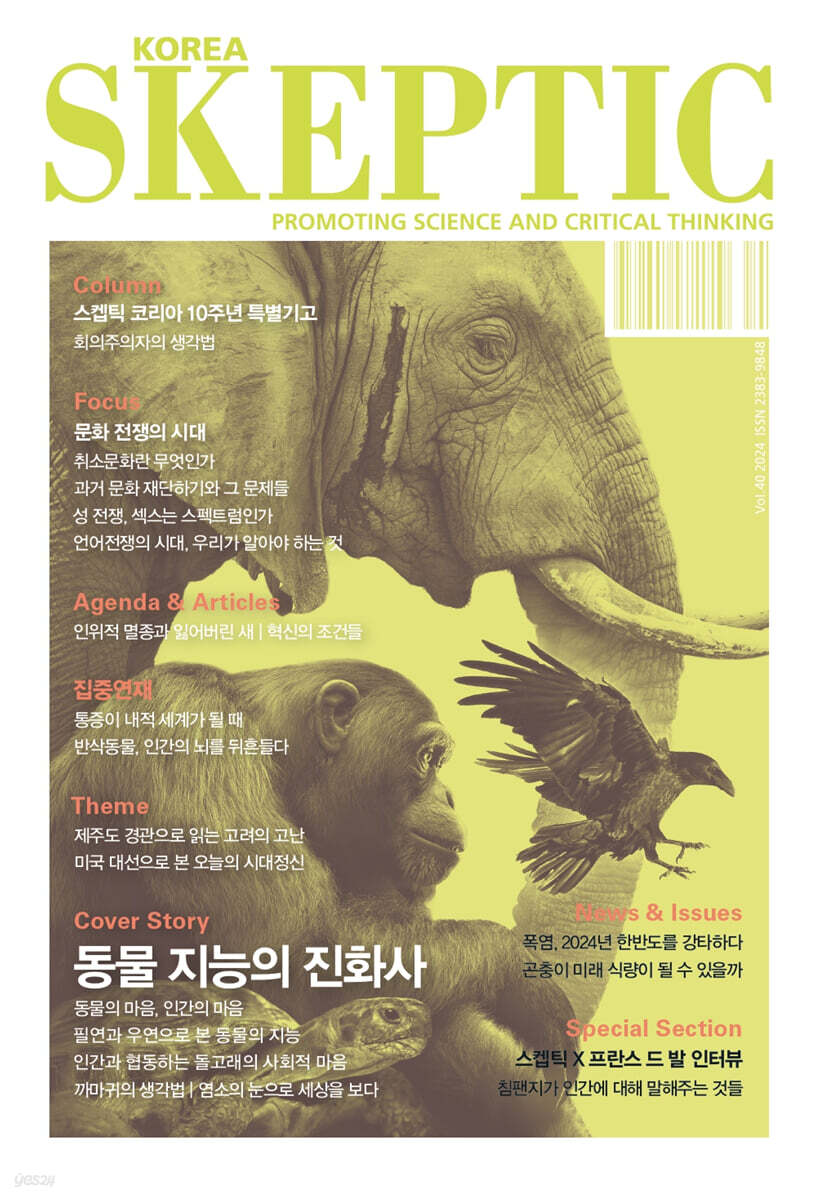 |
Description
Book Introduction
Korean Skeptic SKEPTIC No. 40
▶ Special contribution to commemorate the 10th anniversary of Skeptic: The Skeptic's way of thinking
▶ The Evolution of Animal Intelligence: A Look at Necessity and Chance
▶ Animal mind, human mind
▶ What is cancel culture?
▶ Past Cultural Foundations and Their Problems
▶ What We Need to Know in the Age of Language Wars
▶ Goryeo's Problems as Read Through Jeju Island's Landscape
Heatwave to hit the Korean Peninsula in 2024
▶ When pain becomes an inner world
Michael Shermer's special contribution to Skeptic Korea's 10th anniversary, "The Skeptic's Way of Thinking."
Had dinosaurs evolved instead of going extinct, would they have achieved human-like intelligence? Amazing animal intelligence surpasses human expectations: crows that plan for the future, dolphins that cooperate with humans, octopuses with nine brains.
The final interview with world-renowned primatologist Frans de Waal.
A critical examination of cancel culture and language erasure: Is gender binary or a spectrum?
Revisiting the era of the culture wars.
Issue 40 of Skeptic is filled with fascinating articles, including climate change as seen in the 2024 heatwave that hit the Korean Peninsula, Goryeo's suffering as seen in the Jeju Island landscape, and the semi-spined animals that are shaking up the history of brain evolution.
▶ Special contribution to commemorate the 10th anniversary of Skeptic: The Skeptic's way of thinking
▶ The Evolution of Animal Intelligence: A Look at Necessity and Chance
▶ Animal mind, human mind
▶ What is cancel culture?
▶ Past Cultural Foundations and Their Problems
▶ What We Need to Know in the Age of Language Wars
▶ Goryeo's Problems as Read Through Jeju Island's Landscape
Heatwave to hit the Korean Peninsula in 2024
▶ When pain becomes an inner world
Michael Shermer's special contribution to Skeptic Korea's 10th anniversary, "The Skeptic's Way of Thinking."
Had dinosaurs evolved instead of going extinct, would they have achieved human-like intelligence? Amazing animal intelligence surpasses human expectations: crows that plan for the future, dolphins that cooperate with humans, octopuses with nine brains.
The final interview with world-renowned primatologist Frans de Waal.
A critical examination of cancel culture and language erasure: Is gender binary or a spectrum?
Revisiting the era of the culture wars.
Issue 40 of Skeptic is filled with fascinating articles, including climate change as seen in the 2024 heatwave that hit the Korean Peninsula, Goryeo's suffering as seen in the Jeju Island landscape, and the semi-spined animals that are shaking up the history of brain evolution.
- You can preview some of the book's contents.
Preview
index
Column
The Skeptic's Way of Thinking - Michael Shermer
News & Issues
Heat Wave to Hit Korean Peninsula in 2024 - Yoon Shin-young
Could insects be the food of the future? - Arnold van Huys
Special Section: Skeptic X Frans de Waal Interview
What Chimpanzees Tell Us About Humans - Frans de Waal
Cover Story: The Evolution of Animal Intelligence
Animal Minds, Human Minds - Nicola S. Clayton, Victor Ajuwon
The Evolution of Animal Intelligence: A History of Necessity and Chance - Frank Miel
The Social Mind of Dolphins: How They Cooperate with Humans - Lee Dugakin
The Crow's Mind - Carole Caffrey
Seeing the World Through Goat Eyes - Michael Shermer
Intensive series
When Pain Becomes Your Inner World - Woo Chung-wan
Semi-sympathetic animals shake the human brain - Lee Dae-han
Focus: The Age of Culture Wars
What is Cancel Culture? - Carol Tavris
Foundations of Past Culture and Their Problems - John D. Van Dyke
The Sex War: Is Sex a Spectrum? - Jung Woo-hyun
What We Need to Know in the Age of Language Wars - Shin Dong-il
Theme
Reading Goryeo's Hardships Through Jeju Island's Landscape - Park Jeong-jae
The Zeitgeist of Today as Seen Through the US Presidential Election - Afternoon
Agenda & Articles
Artificial Extinction and the Lost Birds - Gisli Paulsson
Conditions for Innovation - J.
Michael Menke
The Skeptic's Way of Thinking - Michael Shermer
News & Issues
Heat Wave to Hit Korean Peninsula in 2024 - Yoon Shin-young
Could insects be the food of the future? - Arnold van Huys
Special Section: Skeptic X Frans de Waal Interview
What Chimpanzees Tell Us About Humans - Frans de Waal
Cover Story: The Evolution of Animal Intelligence
Animal Minds, Human Minds - Nicola S. Clayton, Victor Ajuwon
The Evolution of Animal Intelligence: A History of Necessity and Chance - Frank Miel
The Social Mind of Dolphins: How They Cooperate with Humans - Lee Dugakin
The Crow's Mind - Carole Caffrey
Seeing the World Through Goat Eyes - Michael Shermer
Intensive series
When Pain Becomes Your Inner World - Woo Chung-wan
Semi-sympathetic animals shake the human brain - Lee Dae-han
Focus: The Age of Culture Wars
What is Cancel Culture? - Carol Tavris
Foundations of Past Culture and Their Problems - John D. Van Dyke
The Sex War: Is Sex a Spectrum? - Jung Woo-hyun
What We Need to Know in the Age of Language Wars - Shin Dong-il
Theme
Reading Goryeo's Hardships Through Jeju Island's Landscape - Park Jeong-jae
The Zeitgeist of Today as Seen Through the US Presidential Election - Afternoon
Agenda & Articles
Artificial Extinction and the Lost Birds - Gisli Paulsson
Conditions for Innovation - J.
Michael Menke
Detailed image

Publisher's Review
▼ Skeptic Korea 10th Anniversary Special Contribution: The Skeptic's Way of Thinking
To mark the 10th anniversary of the Korean edition of Skeptic, Michael Shermer expressed his gratitude to Korean readers and shared with them 13 secrets to thinking like a scientist, distilling the skeptic's thinking tools he has used over the past decade.
While popularization of science has significantly reduced belief in the paranormal, the threat of deceptive misinformation in the information overload continues to grow.
The skeptic's thinking tools remain valid, in that the path we choose in life depends entirely on our ability to think clearly.
The Korean editorial staff of Skeptic would like to express their gratitude to the readers who have supported us over the past ten years and will continue to work to ensure that healthy skepticism takes root in Korea.
▼ Cover Story: The Evolution of Animal Intelligence
What would have been the fate of the dinosaurs if the asteroid hadn't collided with Earth and caused their extinction? Would they have achieved intelligence like ours? Paleontologist Stephen Jay Gould said that chance plays such a crucial role in evolution that even if the tape of life were replayed a million times, it's unlikely a species like humans would ever evolve again.
If Gould were alive, he would probably have answered that even if dinosaurs had not gone extinct, they would not have evolved into humans.
But paleontologist Dale Russell, curator of vertebrate fossils at the Canadian Museum of Natural History, disagreed with Gould.
He argued that if the asteroid had missed Earth, some lineage of dinosaurs with relatively larger brains might have eventually evolved into dinosaur-like creatures with forward-looking eyes, upright walking, grasping hands, and truly large brains, and cited 'convergent evolution' as the basis for this.
Convergent evolution refers to cases where two organisms that are not genetically closely related exhibit similar traits.
Considering that convergence has appeared as repeatedly as divergence in evolution, perhaps Gould was thinking in a human-centric way.
Moreover, the surprising intelligence of animals that is being newly discovered raises new possibilities.
Even crows with small brains can read the minds of others, octopuses with nine 'brains' can plan for the future, and dolphins show high social intelligence, forming factions in their social networks.
Animals with brains that humans would consider 'poor' are now demonstrating intellectual abilities that were once considered unique to humans.
In this cover story, we explore the remarkable intelligence of animals, newly discovered from their perspective, and consider whether we are still stuck in a human-centric way of thinking when it comes to understanding life.
▼ Skeptic X Frans de Waal Interview: What Chimpanzees Tell Us About Humans
This issue features an interview with the editorial staff of Skeptic conducted by Dr. Frans de Waal, a pioneer in primate research who has revealed much about humans through primates in works such as Chimpanzee Politics and The Mind of Difference, before he passed away at the age of 75 on March 14, 2024.
In the 1970s, when Frans de Waal was just beginning his research, the idea that animals had human-like emotions was ridiculed.
Due to the influence of the behaviorist school, which sought to elevate psychology to the status of a true science, animal research at the time considered only the functions of animal behavior, not the internal states of animals, as legitimate subjects of study.
For example, instead of saying “the animal was scared,” you should have said “the animal escaped from danger.”
Anecdotes like these, scattered throughout the interview, show how shocking de Waal's research and claims, now taken for granted, were at the time.
Additionally, this interview provides a detailed look into Dr. de Waal's thoughts on animal thoughts, emotions, and politics.
In remembrance of De Bal, I share that interview with my readers.
▼ Focus: The Age of Culture Wars
The whole world, including our country, is facing a crisis of division due to a culture war.
Progressives and conservatives are clashing over hot-button issues like abortion, the climate crisis, immigration, homosexuality, and transgenderism.
Culture wars don't just happen between political extremes.
Gender conflict, generational conflict, class conflict, and religious conflict are being expressed not only on the Internet but also on the streets.
The problem is that each side demonizes the other side, censoring and blocking freedom of speech.
It's not uncommon to drag down speakers you don't like by focusing on the words themselves rather than the context of their expression.
In this issue's Focus, we discuss cancel culture, erasing popular culture, the sex and gender debate, and erasing language, delving deeper into the implications of public discourse and freedom of expression in the age of culture wars.
▼ Heatwave to hit the Korean Peninsula in 2024
This summer, we experienced the problem of global warming firsthand.
There were many humid days, and hot days continued until Chuseok.
Editor Yoon Shin-young of Spotted Cow summarized the unique aspects of this year's summer on the Korean Peninsula using keywords and looked ahead to the future we face.
What was different about this year's unusually hot and humid summer compared to previous years?
The author, who checks daily temperature data from around the world and Korea, compared and analyzed not only the average daily temperature but also the average temperature and the number of heat wave days with data from 30 years ago and discovered a peculiarity called a "wet heat wave."
The climate of high humidity and heat waves simultaneously has a variety of impacts beyond health problems. It is truly threatening, with inequalities based on income and housing conditions worsening and the number of excess deaths due to heat-related injuries increasing, as well as worker injuries.
In fact, the number of heatwave deaths in 35 European countries in 2023 is estimated to be up to 58,000.
We explore how to address and prevent heat waves, which threaten our lives beyond our daily lives, at both a personal and public level.
▼ When Pain Becomes the World
Professor Woo Chung-wan, a neuroscientist at Sungkyunkwan University who studies the relationship between pain and the brain through brain imaging, begins a series titled 'Keywords for Understanding Pain, Existence, and Consciousness.'
According to him, pain is not just a basic emotion for survival, but a key keyword for understanding our existence and consciousness.
For example, chronic pain patients often begin to accept pain as a part of their self over time.
When observing the results of tracking the process of chronic back pain in patients with subacute back pain that lasted for about one or two months, the brain regions related to physical emotions were initially activated, but after a year, brain regions closely related to semantic emotions, such as the medial prefrontal cortex, showed a high correlation with back pain.
Here, semantic emotions refer to our autobiographical memories and beliefs, which form the unique emotional world of humans.
In this way, pain can be said to be a key element for understanding human existence and consciousness, beyond being a simple medical object.
▼ Goryeo's hardships as seen through Jeju Island's landscape
Jeju Island's unique landscape is made up of hundreds of mountain peaks, including the mighty Hallasan Mountain, and vast pastures ideal for horses.
People often misunderstand this kind of scenery as being original to Jeju Island.
However, considering that Jeju Island's climate is warm and humid, the grasslands spread out on the slopes of Mt. Halla are vegetation that does not fit with Jeju Island's climate at all.
Professor Park Jeong-jae, a geographer at Seoul National University who studies paleoclimatology, says that Jeju Island's unique landscape is a trace of human disturbance, particularly the hardships of the Goryeo Dynasty.
Professor Park Jeong-jae compares the coal deposits of Dongsuak Oreum and Mulyeongari Oreum to trace the changes that occurred between 938, when Tamna became a vassal state of Goryeo, and 1276-1374, when Mongolia operated Tamna Ranch.
Interestingly, the data on the amount of coal from Mulyeongari Oreum increases with the Goryeo plunder of Tamna starting around the 10th century and the Mongol invasion in the 13th century.
Also, Skeptic No. 40
- In 'Hemichordates, Shaking the Human Brain,' evolutionary biologist Professor Lee Dae-han examines how the recently proposed biological classification system for bilaterally symmetrical animals, focusing on hemichordates, suggests the possibility of revolutionary changes in brain evolution.
- In 'Conditions for Innovation,' Michael Menke, who studies research methodology, traces why innovation has been declining in various fields recently and examines the conditions for innovation.
- In 'Could Insects Be the Food of the Future?', Arnold van Huys examines why we should strive to utilize insects as a future food source and what obstacles lie ahead.
To mark the 10th anniversary of the Korean edition of Skeptic, Michael Shermer expressed his gratitude to Korean readers and shared with them 13 secrets to thinking like a scientist, distilling the skeptic's thinking tools he has used over the past decade.
While popularization of science has significantly reduced belief in the paranormal, the threat of deceptive misinformation in the information overload continues to grow.
The skeptic's thinking tools remain valid, in that the path we choose in life depends entirely on our ability to think clearly.
The Korean editorial staff of Skeptic would like to express their gratitude to the readers who have supported us over the past ten years and will continue to work to ensure that healthy skepticism takes root in Korea.
▼ Cover Story: The Evolution of Animal Intelligence
What would have been the fate of the dinosaurs if the asteroid hadn't collided with Earth and caused their extinction? Would they have achieved intelligence like ours? Paleontologist Stephen Jay Gould said that chance plays such a crucial role in evolution that even if the tape of life were replayed a million times, it's unlikely a species like humans would ever evolve again.
If Gould were alive, he would probably have answered that even if dinosaurs had not gone extinct, they would not have evolved into humans.
But paleontologist Dale Russell, curator of vertebrate fossils at the Canadian Museum of Natural History, disagreed with Gould.
He argued that if the asteroid had missed Earth, some lineage of dinosaurs with relatively larger brains might have eventually evolved into dinosaur-like creatures with forward-looking eyes, upright walking, grasping hands, and truly large brains, and cited 'convergent evolution' as the basis for this.
Convergent evolution refers to cases where two organisms that are not genetically closely related exhibit similar traits.
Considering that convergence has appeared as repeatedly as divergence in evolution, perhaps Gould was thinking in a human-centric way.
Moreover, the surprising intelligence of animals that is being newly discovered raises new possibilities.
Even crows with small brains can read the minds of others, octopuses with nine 'brains' can plan for the future, and dolphins show high social intelligence, forming factions in their social networks.
Animals with brains that humans would consider 'poor' are now demonstrating intellectual abilities that were once considered unique to humans.
In this cover story, we explore the remarkable intelligence of animals, newly discovered from their perspective, and consider whether we are still stuck in a human-centric way of thinking when it comes to understanding life.
▼ Skeptic X Frans de Waal Interview: What Chimpanzees Tell Us About Humans
This issue features an interview with the editorial staff of Skeptic conducted by Dr. Frans de Waal, a pioneer in primate research who has revealed much about humans through primates in works such as Chimpanzee Politics and The Mind of Difference, before he passed away at the age of 75 on March 14, 2024.
In the 1970s, when Frans de Waal was just beginning his research, the idea that animals had human-like emotions was ridiculed.
Due to the influence of the behaviorist school, which sought to elevate psychology to the status of a true science, animal research at the time considered only the functions of animal behavior, not the internal states of animals, as legitimate subjects of study.
For example, instead of saying “the animal was scared,” you should have said “the animal escaped from danger.”
Anecdotes like these, scattered throughout the interview, show how shocking de Waal's research and claims, now taken for granted, were at the time.
Additionally, this interview provides a detailed look into Dr. de Waal's thoughts on animal thoughts, emotions, and politics.
In remembrance of De Bal, I share that interview with my readers.
▼ Focus: The Age of Culture Wars
The whole world, including our country, is facing a crisis of division due to a culture war.
Progressives and conservatives are clashing over hot-button issues like abortion, the climate crisis, immigration, homosexuality, and transgenderism.
Culture wars don't just happen between political extremes.
Gender conflict, generational conflict, class conflict, and religious conflict are being expressed not only on the Internet but also on the streets.
The problem is that each side demonizes the other side, censoring and blocking freedom of speech.
It's not uncommon to drag down speakers you don't like by focusing on the words themselves rather than the context of their expression.
In this issue's Focus, we discuss cancel culture, erasing popular culture, the sex and gender debate, and erasing language, delving deeper into the implications of public discourse and freedom of expression in the age of culture wars.
▼ Heatwave to hit the Korean Peninsula in 2024
This summer, we experienced the problem of global warming firsthand.
There were many humid days, and hot days continued until Chuseok.
Editor Yoon Shin-young of Spotted Cow summarized the unique aspects of this year's summer on the Korean Peninsula using keywords and looked ahead to the future we face.
What was different about this year's unusually hot and humid summer compared to previous years?
The author, who checks daily temperature data from around the world and Korea, compared and analyzed not only the average daily temperature but also the average temperature and the number of heat wave days with data from 30 years ago and discovered a peculiarity called a "wet heat wave."
The climate of high humidity and heat waves simultaneously has a variety of impacts beyond health problems. It is truly threatening, with inequalities based on income and housing conditions worsening and the number of excess deaths due to heat-related injuries increasing, as well as worker injuries.
In fact, the number of heatwave deaths in 35 European countries in 2023 is estimated to be up to 58,000.
We explore how to address and prevent heat waves, which threaten our lives beyond our daily lives, at both a personal and public level.
▼ When Pain Becomes the World
Professor Woo Chung-wan, a neuroscientist at Sungkyunkwan University who studies the relationship between pain and the brain through brain imaging, begins a series titled 'Keywords for Understanding Pain, Existence, and Consciousness.'
According to him, pain is not just a basic emotion for survival, but a key keyword for understanding our existence and consciousness.
For example, chronic pain patients often begin to accept pain as a part of their self over time.
When observing the results of tracking the process of chronic back pain in patients with subacute back pain that lasted for about one or two months, the brain regions related to physical emotions were initially activated, but after a year, brain regions closely related to semantic emotions, such as the medial prefrontal cortex, showed a high correlation with back pain.
Here, semantic emotions refer to our autobiographical memories and beliefs, which form the unique emotional world of humans.
In this way, pain can be said to be a key element for understanding human existence and consciousness, beyond being a simple medical object.
▼ Goryeo's hardships as seen through Jeju Island's landscape
Jeju Island's unique landscape is made up of hundreds of mountain peaks, including the mighty Hallasan Mountain, and vast pastures ideal for horses.
People often misunderstand this kind of scenery as being original to Jeju Island.
However, considering that Jeju Island's climate is warm and humid, the grasslands spread out on the slopes of Mt. Halla are vegetation that does not fit with Jeju Island's climate at all.
Professor Park Jeong-jae, a geographer at Seoul National University who studies paleoclimatology, says that Jeju Island's unique landscape is a trace of human disturbance, particularly the hardships of the Goryeo Dynasty.
Professor Park Jeong-jae compares the coal deposits of Dongsuak Oreum and Mulyeongari Oreum to trace the changes that occurred between 938, when Tamna became a vassal state of Goryeo, and 1276-1374, when Mongolia operated Tamna Ranch.
Interestingly, the data on the amount of coal from Mulyeongari Oreum increases with the Goryeo plunder of Tamna starting around the 10th century and the Mongol invasion in the 13th century.
Also, Skeptic No. 40
- In 'Hemichordates, Shaking the Human Brain,' evolutionary biologist Professor Lee Dae-han examines how the recently proposed biological classification system for bilaterally symmetrical animals, focusing on hemichordates, suggests the possibility of revolutionary changes in brain evolution.
- In 'Conditions for Innovation,' Michael Menke, who studies research methodology, traces why innovation has been declining in various fields recently and examines the conditions for innovation.
- In 'Could Insects Be the Food of the Future?', Arnold van Huys examines why we should strive to utilize insects as a future food source and what obstacles lie ahead.
GOODS SPECIFICS
- Date of issue: December 6, 2024
- Page count, weight, size: 280 pages | 522g | 170*250*20mm
- ISBN13: 9772383984000
- ISBN10: 23839848
You may also like
카테고리
korean


korean

![GQ KOREA Mark (Monthly): December [2025]](http://librairie.coreenne.fr/cdn/shop/files/8ef265dbbfbf186523ed75ba7319009d.jpg?v=1765340328&width=3840)


